The Rigveda in one paragraph
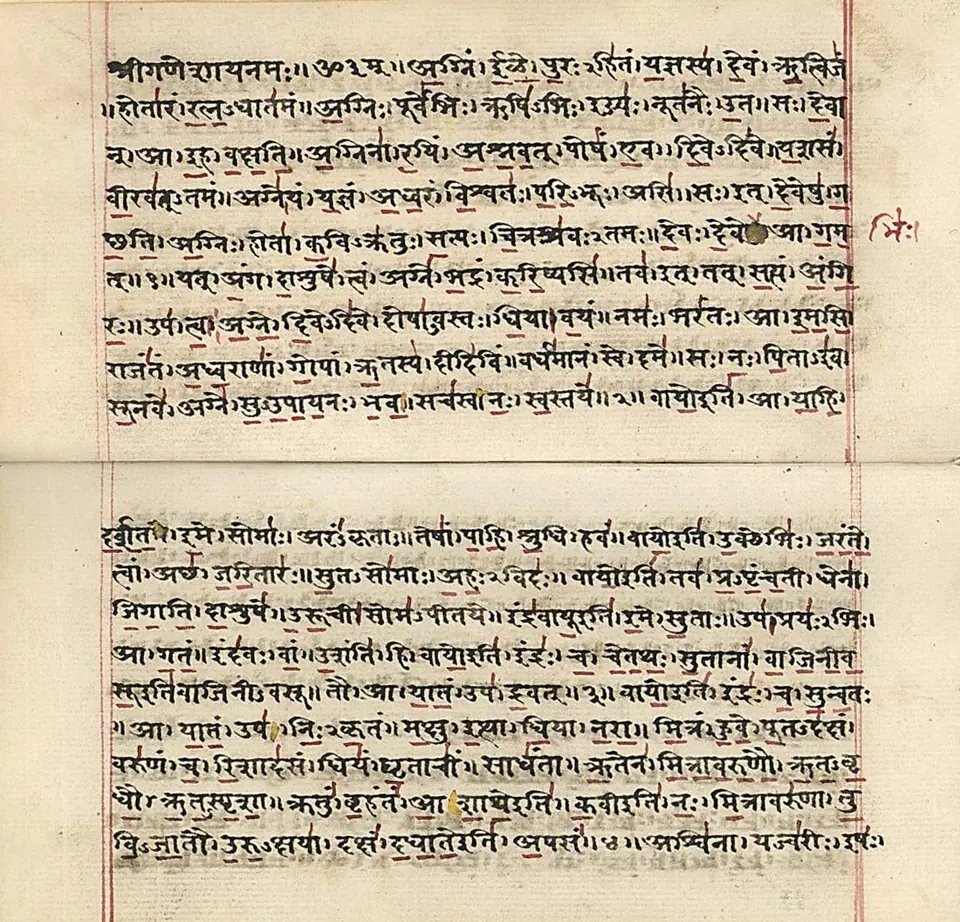
The Rigveda (Rig Veda), the oldest Hindu scripture, was composed orally in the Punjab, its oldest books most likely c. 1500–1200 BCE on the mainstream dating, and it was not written down for roughly a thousand years after. For those three centuries a cattle-herding, chariot-driving, Sanskrit-speaking society lived in the river country of the Punjab and left almost nothing in the ground — no cities, no monuments, no writing, barely any distinguishable pottery. What it left instead was a liturgy of 1,028 hymns, memorized syllable by syllable and transmitted with no writing at all for a thousand years and more.
Because that liturgy incidentally names its rivers, its crops, its metals, its animals, its political quarrels and its gods, it is one of the most detailed windows into any Bronze Age society anywhere. This chapter reconstructs that world from the text, showing the verse behind each claim.
The result is a religion that a modern Hindu would find largely unrecognizable: no temples, no images, no karma, no rebirth, no liberation, no cow-protection, no caste by birth — and a pantheon in which the two gods who now define Hinduism are a minor figure and a feared outsider.
How the Rigveda was preserved and structured
The Rigveda was preserved by a memorization system of engineered redundancy, and its ten maṇḍalas fall into layers, with Maṇḍalas 2–7 the oldest core and Maṇḍala 10 the latest.
How it survives
There was no writing in India when the Rigveda was composed, and none for roughly a millennium after. The text was preserved by a memorization system of deliberate, engineered redundancy. The same verse is learned in multiple recitation patterns:
| Pāṭha | Method | Purpose |
|---|---|---|
| saṃhitā | continuous, with all sandhi (sound-fusion) applied | the natural liturgical form |
| pada | word by word, sandhi undone | fixes the underlying words |
| krama | 1-2, 2-3, 3-4, 4-5 … | fixes adjacent order |
| jaṭā | 1-2, 2-1, 1-2, 2-3, 3-2, 2-3 … | order, forwards and backwards |
| ghana | 1-2, 2-1, 1-2-3, 3-2-1, 1-2-3 … | maximal redundancy |
Reciting jaṭā or ghana correctly is impossible unless every word, its order, and its pitch accent are exact. A corruption anywhere fails the pattern audibly. The effect is a biological error-correcting code.
The consequence matters for everything on this page: the Rigveda is textually better preserved than most ancient written literature. Manuscripts from opposite ends of India agree to a degree Greek or Biblical manuscript traditions never approach, and the text preserves a pitch accent that the spoken language had lost by roughly the last centuries BCE — nobody memorizes a feature they no longer understand unless they are transmitting mechanically and faithfully.[1][2] Consensus
Structure and internal chronology
Ten maṇḍalas, 1,028 sūktas, 10,552 verses.[1]
| Maṇḍala | Attributed lineage | Layer |
|---|---|---|
| 2 | Gṛtsamada | oldest core |
| 3 | Viśvāmitra | oldest core |
| 4 | Vāmadeva | oldest core |
| 5 | Atri | oldest core |
| 6 | Bharadvāja | oldest core |
| 7 | Vasiṣṭha | oldest core |
| 8 | Kaṇva, Āṅgirasa | middle |
| 9 | (all to Soma Pavamāna) | middle, arranged by metre |
| 1 | mixed | late |
| 10 | mixed | latest |
Maṇḍalas 2–7 are the “Family Books,” each the repertoire of one priestly lineage, and internally ordered by deity and by descending hymn-length — a mechanical arrangement that is itself evidence of deliberate archiving.[3][1] Consensus
Why this ordering carries so much weight here: several of the most famous and most theologically load-bearing hymns in the Rigveda — the four-varṇa hymn, the great creation hymn, the first mention of the Ganga — sit in Maṇḍala 10, the latest layer. When this page says something is “not early Vedic,” that is the argument.
The evidence ledger for early Vedic society
Early Vedic society was a semi-mobile, cattle-herding tribal chiefdom in the Indus–Punjab river country, with barley, bronze and the spoked-wheel horse chariot, but no cities, rice, iron or temples.
| Dimension | What we can say | Evidence | Confidence |
|---|---|---|---|
| Geography | Home territory is the Indus–Punjab river system; the Ganga plain is at the edge of awareness | RV 10.75 lists rivers east-to-west, from the Ganga out to the Afghan tributaries; Gaṅgā is named once in the whole collection, Yamunā three times, against Sindhu ~45× and Sarasvatī ~70×[4][5] | Consensus |
| Terrain | Mountains, snow, rivers, some desert; not a monsoon-forest world | Frequent párvata, hima; the aśva and chariot presuppose open ground | Consensus |
| Fauna | Horse (an import — RV 1.162.18 gives it thirty-four ribs, seventeen pairs, the steppe animal rather than the eighteen-pair Indian equid[6]), cattle, sheep, goat, dog. Lion known, tiger absent. Elephant marginal, described as “the beast with a hand” | siṃhá present; vyāghrá absent from RV, appears in AV; mṛgá hastín = “beast with a hand” — the word of someone newly meeting the animal | Consensus |
| Crops | Barley only. Rice unknown | yáva (barley) throughout; vrīhi (rice) absent from RV, present in AV and Yajurveda[5] | Consensus |
| Agriculture | Ploughing is known and blessed — but subsistence and prestige are pastoral | RV 4.57 (the whole hymn is to the field, furrow and plough); yet wealth-vocabulary is entirely cattle-based[7] | Majority |
| Metals | Copper and bronze. No iron | áyas in RV is copper/bronze; śyāma/kṛṣṇa áyas (“dark metal” = iron) first appears in AV[8] | Consensus |
| Technology | Spoked-wheel horse chariot is the prestige technology | rátha, ára (spoke), nábhya (nave), rathakāra (chariot-maker) — a full technical vocabulary, inventoried whole in RV 6.75[9] | Consensus |
| Economy | Cattle are wealth, currency, and the object of war | gáviṣṭi, literally “cattle-seeking,” is a standard word for battle; gópati “cattle-lord” = chief | Consensus |
| Settlement | Semi-mobile; grāma is a wagon-train/host, not a village; no cities | No RV vocabulary for brick fortification, street, or urban planning; púr means a rampart or stronghold, not a Harappan city[3] | Majority |
| Polity | Tribal chiefdom, not a state. The rājan leads in war and is checked by assemblies | jána, víś, rā́jan, sabhā́, samíti; no vocabulary of taxation, bureaucracy, standing army, or writing | Consensus |
| Society | Ranked, but ranks are occupational and not yet birth-fixed | Only RV 10.90.12 (latest layer) gives four varṇas; a poet in RV 9.112.3 says his father is a physician and his mother grinds grain[10][11] | Majority |
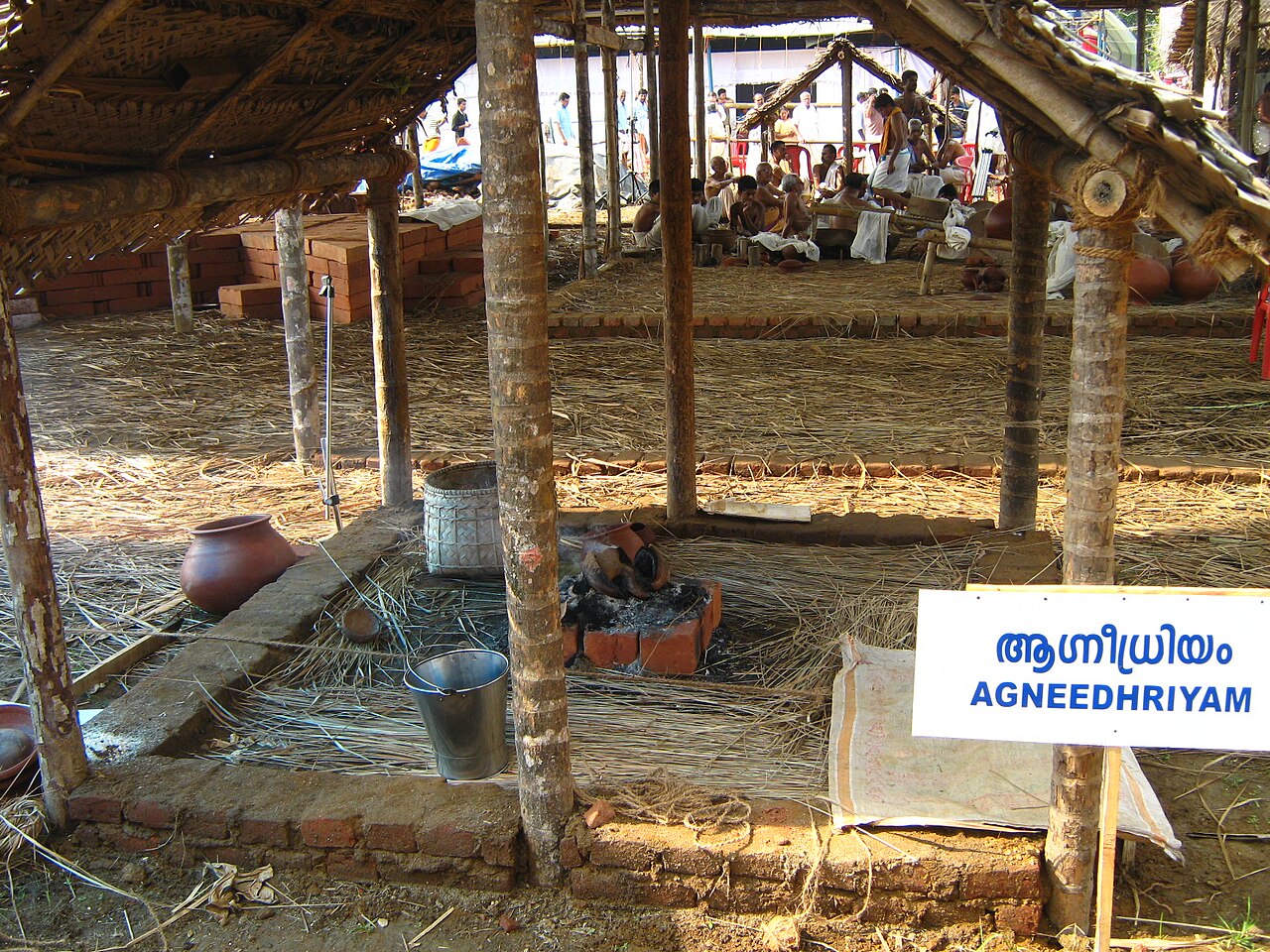
| Religion | Fire-offering outdoors; no building, no image, no priest-mediated temple | No RV word for temple, shrine, or cult-image; the ritual site is a laid-out grass altar with fires | Consensus |
| Contact | Indo-Aryan speech is attested outside India before it is attested inside | Mitanni treaty, c. 1350–1320 BCE, Anatolia[12] | Consensus |
Primary sources
1. Geography — the river hymn
RV 10.75.5 (Nadīstuti Sūkta)
इमं मे गङ्गे यमुने सरस्वति शुतुद्रि स्तोमं सचता परुष्ण्या । असिक्न्या मरुद्वृधे वितस्तयार्जीकीये शृणुह्या सुषोमया ॥
imáṃ me gaṅge yamune sarasvati śutudri stómaṃ sacatā paruṣṇyā | asiknyā marudvṛdhe vitastayā́rjīkīye śṛṇuhy ā́ suṣómayā ||
“Accept this praise of mine, O Gaṅgā, Yamunā, Sarasvatī, Śutudrī, together with the Paruṣṇī; with the Asiknī, O Marudvṛdhā, with the Vitastā — O Ārjīkīyā, hear, with the Suṣomā.”
The next verse (10.75.6) continues westward — Kubhā (the Kabul), Krumu (the Kurram), Gomatī (the Gomal), Rasā, Śvetyā. The hymn’s map runs from the eastern edge of awareness out into Afghanistan.[4]
What it proves. The enumeration is in strict geographical order, east to west, and the identifications are secure: Śutudrī = Sutlej, Paruṣṇī = Ravi, Asiknī = Chenab, Vitastā = Jhelum. This is a mental map centred on the Punjab, reaching west into the Afghan tributaries. The Gaṅgā and Yamunā appear only at its extreme eastern edge — and this hymn is in Maṇḍala 10, the latest layer. The Rigvedic world is the Indus system, and the Ganga plain is a late-arriving frontier.[5] Consensus
Two honest qualifications a hostile reader would otherwise find. The derivative gāṅgya occurs at RV 6.45.31,[13] and one of the three Yamunā references is RV 7.18.19[14] — both in Family Books. So the eastern rivers are not entirely unknown to the old core; they are merely peripheral to it.
2. The economy — the plough and the dice
RV 4.57.4 (Kṣetrapati Sūkta)
शुनं वाहाः शुनं नरः शुनं कृषतु लाङ्गलम् । शुनं वरत्रा बध्यन्तां शुनमष्ट्रामुदिङ्गय ॥
śúnaṃ vā́hāḥ śúnaṃ náraḥ śúnaṃ kṛṣatu lā́ṅgalam | śúnaṃ varatrā́ badhyantāṃ śúnam aṣṭrā́m úd iṅgaya ||
“Auspiciously the draught-oxen, auspiciously the men, auspiciously let the plough cut the furrow. Auspiciously let the traces be bound; auspiciously swing the goad.”[7]
RV 10.34.13 (the Gambler’s Hymn)
अक्षैर्मा दीव्यः कृषिमित्कृषस्व वित्ते रमस्व बहु मन्यमानः । तत्र गावः कितव तत्र जाया तन्मे वि चष्टे सवितायमर्यः ॥
akṣáir mā́ dīvyaḥ kṛṣím ít kṛṣasva vitté ramasva bahú mányamānaḥ | tátra gā́vaḥ kitava tátra jāyā́ tán me ví caṣṭe savitā́yám aryáḥ ||
“Do not gamble with dice — plough your furrow instead. Delight in your possessions, holding them of great worth. There are your cattle, gambler; there your wife. This is what noble Savitṛ reveals to me.”[15]
What they prove. Two things at once, and the tension between them is the real finding. Ploughing is known, practised, and ritually blessed — so the flat description “nomadic pastoralists” is wrong. But the entire wealth-vocabulary of the collection is cattle-derived, and the Gambler’s Hymn ranks what a ruined man loses in order: cattle first, wife second. Cattle are the unit of value. Agriculture is done; cattle are what counts. Majority
The Gambler’s Hymn is also, incidentally, the earliest surviving poem in an Indo-European language about gambling addiction, told from the addict’s point of view. It is worth reading whole.
3. The central myth — Indra kills Vṛtra
RV 1.32.1
इन्द्रस्य नु वीर्याणि प्र वोचं यानि चकार प्रथमानि वज्री । अहन्नहिमन्वपस्ततर्द प्र वक्षणा अभिनत्पर्वतानाम् ॥
índrasya nú vīryā̀ṇi prá vocaṃ yā́ni cakā́ra prathamā́ni vajrī́ | áhann áhim ánv apás tatarda prá vakṣáṇā abhinat párvatānām ||
“Now I proclaim the heroic deeds of Indra, the first that the wielder of the vajra performed. He slew the serpent, he bored through to the waters, he split open the bellies of the mountains.”[16]
What it proves. This is the defining act of the Rigvedic religion: Indra kills the serpent Vṛtra (“the obstructer”), who has penned the waters inside the mountains, and the rivers are released. The reading of the myth is contested — cosmogonic release of the waters, the monsoon breaking, the seasonal melt, or the mythologization of a raid on an enemy’s dammed reservoirs — and this series does not adjudicate. Contested
What is not contested is the theology it implies. The supreme god is a young, violent, hard-drinking warrior who wins by force and is praised for it. He is not a moral lawgiver, not a creator, not a source of liberation, and not an object of loving surrender. Nothing in the later devotional tradition is present here.[17] Consensus
4. Theological sophistication — one being, many names
RV 1.164.46
इन्द्रं मित्रं वरुणमग्निमाहुरथो दिव्यः स सुपर्णो गरुत्मान् । एकं सद्विप्रा बहुधा वदन्त्यग्निं यमं मातरिश्वानमाहुः ॥
índraṃ mitráṃ váruṇam agním āhur átho divyáḥ sá suparṇó garútmān | ékaṃ sád víprā bahudhā́ vadanty agníṃ yamáṃ mātaríśvānam āhuḥ ||
“They call it Indra, Mitra, Varuṇa, Agni — and it is the heavenly winged Garutmān. That which is, is One; the seers speak of it in many ways. They call it Agni, Yama, Mātariśvan.”[18]
What it proves. Ekaṃ sad viprā bahudhā vadanti is the single most quoted line in the Rigveda, and the ancestor of every later Hindu claim that the many gods are faces of one reality. It shows that the philosophical move was available already — but note the location: Maṇḍala 1, a late layer, in a famously riddling hymn. It is a flash of what is coming, not the operating theology of the Family Books, where the gods are emphatically distinct persons with distinct appetites. Majority
5. Creation, and the refusal to be certain
RV 10.129.7 (Nāsadīya Sūkta)
इयं विसृष्टिर्यत आबभूव यदि वा दधे यदि वा न । यो अस्याध्यक्षः परमे व्योमन्त्सो अङ्ग वेद यदि वा न वेद ॥
iyáṃ vísṛṣṭir yáta ābabhū́va yádi vā dadhé yádi vā ná | yó asyā́dhyakṣaḥ paramé vyòman só aṅga veda yádi vā ná véda ||
“Whence this creation arose — whether it was established, or whether not — he who surveys it from the highest heaven, he surely knows. Or perhaps he does not know.”[19]
What it proves. A canonical scripture ending its creation account by doubting whether even God knows the answer. It is the earliest sustained agnostic passage in world religious literature, and it is not a marginal or heterodox text — it is in the Veda. Also Maṇḍala 10: late, and pointing directly at the Upanishadic turn that follows in Chapter 5. Consensus
6. The one caste hymn
RV 10.90.12 (Puruṣa Sūkta)
ब्राह्मणोऽस्य मुखमासीद् बाहू राजन्यः कृतः । ऊरू तदस्य यद्वैश्यः पद्भ्यां शूद्रो अजायत ॥
brāhmaṇó ‘sya múkham āsīd bāhū́ rājanyáḥ kṛtáḥ | ūrū́ tád asya yád váiśyaḥ padbhyā́ṃ śūdró ajāyata ||
“His mouth was the Brāhmaṇa; the Rājanya was made his arms; his thighs the Vaiśya; from his feet the Śūdra was born.”[10]
What it proves — and the caution. This is the foundational text of varṇa, cited for three thousand years. Four facts about it, each independently established:
- It is the only passage in 1,028 hymns that describes a four-varṇa order.
- It is in Maṇḍala 10, the latest layer — by language, metre, and style it is markedly younger than the Family Books.
- It is the only occurrence of the words vaiśya and śūdra in the entire Rigveda.
- Its theology — a cosmic sacrifice of a primal being producing the world — has no parallel in the old core and belongs with the Brāhmaṇa-period ritual speculation of Chapter 4.
None of that makes it unimportant; it became the most consequential verse in Indian social history. It means the four-varṇa scheme is an end-point of the Rigvedic period, not its premise, and that whatever ranking existed in early Vedic society was not this.[3][1] Consensus on the dating; Contested on what early Vedic stratification actually looked like
Set against it, from Maṇḍala 9:
“I am a poet, my father is a physician, my mother a grinder of grain.” — RV 9.112.3[11]
One family, three occupations, stated without embarrassment. The caveat matters, though: RV 9.112 sits in the kṣudrasūkta appendix at the end of Maṇḍala 9 and is generally reckoned a late accretion. So this is not evidence that occupational fluidity is older than 10.90 — it is evidence that the two claims coexist inside the same collection. Majority
7. Women, in their own voices
The Rigveda is a priestly anthology composed overwhelmingly by men, and it says almost nothing about most women’s lives. What it does contain is a handful of passages in which women speak in the first person — and they are startling next to anything in Chapter 7.
RV 10.18.8, from the funeral hymns, addresses a widow lying beside her husband’s body:
उदीर्ष्व नार्यभि जीवलोकं गतासुमेतमुप शेष एहि ।
úd īrṣva nāry abhí jīvalokáṃ gatāsum etám úpa śeṣa éhi |
“Rise, come to the world of the living, O woman. Come — he beside whom you lie is without life.”
What it proves. The widow is raised from the pyre and returned to the living. This is the decisive Vedic passage against satī having any Vedic warrant. The Vedic scriptural case for sati rested instead on the verse just before it, RV 10.18.7, which bids the women of the household “mount the place first” (yónim ágre) — and it worked only by changing one word: later advocates quoted agre (“first, in front”) as agneḥ (“of fire”), so that the women seemed to be sent into the fire. The Rigvedic text itself reads agre; the altered reading belongs to the much later tradition that invoked it. Sati’s Vedic authority had to be manufactured.[20][21] Consensus on the Rigvedic reading; Contested on when and how the misreading arose
Three more, briefly. RV 10.159 has a woman declaring “I am the banner and the head,” claiming victory over her co-wives.[22] RV 8.91 has Apālā finding soma and pressing it with her teeth — a woman performing a pressing entirely outside the priestly apparatus.[23] And RV 1.179 has Lopāmudrā demanding sex from her ascetic husband Agastya, and winning the argument; Griffith exiled it to an appendix and left the frank lines in Latin.[24][25]
None of this describes an egalitarian society. It describes one in which women’s speech was recorded, preserved and canonized — which is precisely what stops being true by Chapter 7. Majority
8. History, or the closest thing to it — the Battle of the Ten Kings
RV 7.18 — the Dāśarājña.
Sudās, king of the Bharatas, backed by the priest Vasiṣṭha, is attacked by a confederation of kings and tribes. (Viśvāmitra is usually named as the organizer of the opposing alliance; note that the hymn does not say so — that is a reconstruction from the Vasiṣṭha–Viśvāmitra rivalry elsewhere.) The hymn names some fourteen groups, not a clean ten, including the Pakthas, Bhalānas, Alinas, Viṣāṇins, Śivas, Anus, Druhyus, Turvaśas, Pūrus, Bhṛgus, Ajas, Śigrus and Matsyas — several of which survive as later ethnonyms (Pakthas ↔ Pashtun is a long-standing, plausible but unproven identification). The battle is fought at the Paruṣṇī (Ravi); the hymn describes Sudās’s enemies being destroyed as the river is breached and they attempt to cross.[14]
What it proves. Three separate things:
- Political structure. Warfare is inter-tribal, over cattle and river crossings, conducted by named chiefs with named priests. There are no armies, no sieges, no territorial annexation. This is a chiefdom world.[26] Consensus
- The Bharatas matter. They win, and their name is why the subcontinent is called Bhārata. The Kuru dynasty of Chapter 4 descends from this victory; the Mahābhārata’s setting is the memory of this world, filtered through a thousand years.[3] Majority
- The text is partisan. Maṇḍala 7 is the Vasiṣṭha family book, and Vasiṣṭha is Sudās’s priest. We have the winners’ court poet. And the rivalry is real but more tangled than it looks: in RV 3.33, Viśvāmitra appears as Sudās’s own priest, negotiating with the Vipāś and Śutudrī so the Bharata host can ford them.[27] Maṇḍala 3 preserves his earlier tenure, before Vasiṣṭha displaced him. Two family books, two incompatible accounts of who served whom.
The Rigveda’s gods, by the numbers
Indra and Agni dominate the Rigveda by hymn count, while Viṣṇu, with about five hymns, and Rudra, with about three, are minor figures who later become Hinduism’s two supreme gods.
Hymn-counts are the crudest possible measure of religious importance and also the most honest one available. Approximate dedications across the collection:
| Deity | Hymns | Domain | Later fate |
|---|---|---|---|
| Indra | ~250 | war, storm, the vajra, soma-drinking | collapses to a minor king of a lesser heaven |
| Agni | ~200 | fire, the mouth of the gods, messenger | survives only as ritual apparatus |
| Soma | ~120 (all 114 hymns of Maṇḍala 9, plus a few elsewhere) | the pressed plant and the god | the plant is lost; the name transfers to the moon |
| Aśvins | ~50 | twin horsemen, healers, rescuers | fade almost entirely |
| Maruts | ~33 | storm troop, Indra’s warband | fade |
| Mitra–Varuṇa | ~35 combined | ṛta — cosmic and moral order, oath-keeping | Varuṇa demoted to a sea-god |
| Uṣas | ~21 | dawn, the most lyrical hymns in the text | disappears |
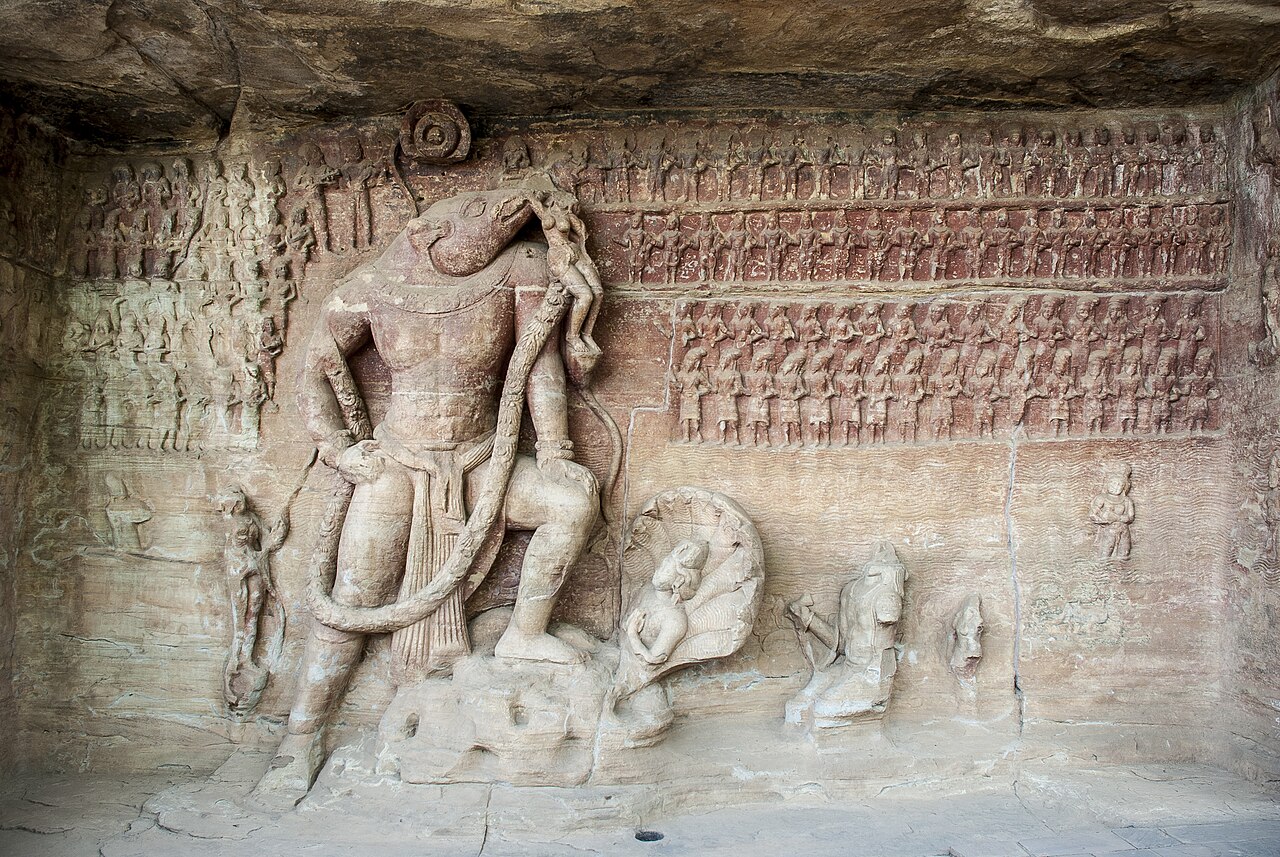
| Viṣṇu | ~5 | takes three strides across the cosmos | becomes one of the two supreme gods |
| Rudra | ~3 | wild, feared, disease-bringing outsider; propitiated so he stays away | becomes Śiva, the other supreme god |
This table is the single most important thing on this page. Read it top to bottom and then read the last column. The two deities who define Hinduism for the last two thousand years are, in its oldest scripture, a bit player with five hymns and a dangerous outsider with three. The gods who dominate it are gone.
Two further points:
- The word śiva occurs in the Rigveda only as an adjective meaning “auspicious, kindly” — frequently as a euphemism applied to Rudra, in the way one calls a feared power “the kindly one” to avoid provoking it. As a divine name, Śiva does not yet exist.[1] Consensus
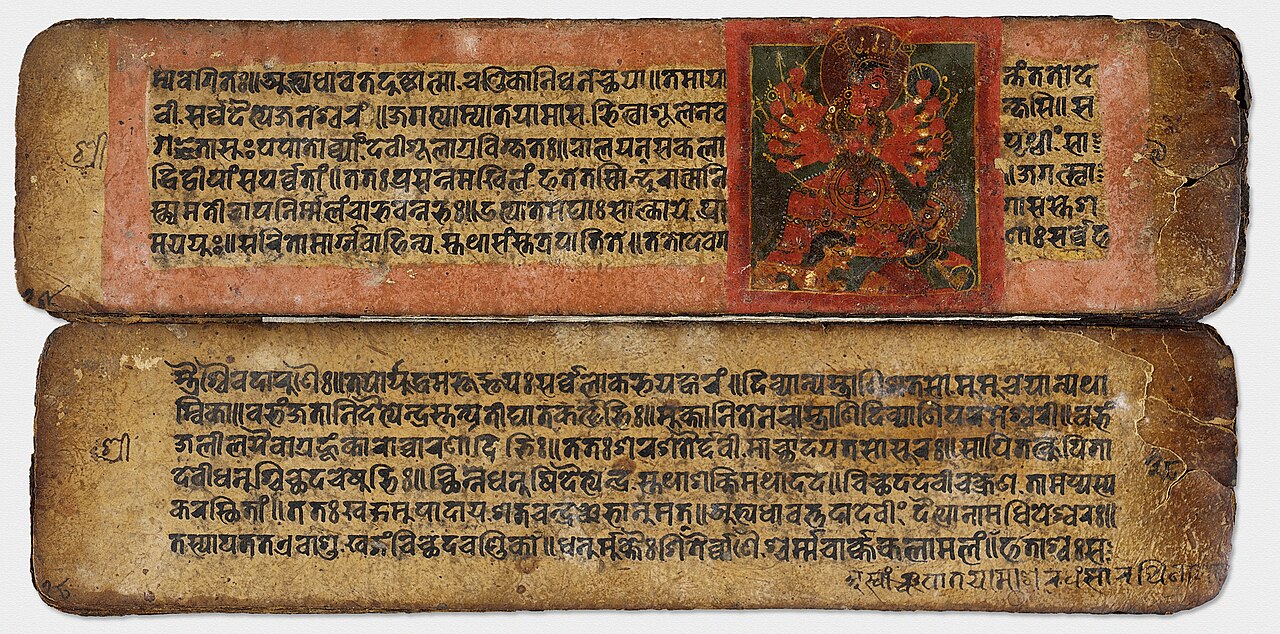
- Devī as supreme goddess does not exist. There are goddesses — Uṣas, Sarasvatī (a river), Aditi, Pṛthivī, Rātrī, Vāc[28] — but no Great Goddess, no Durgā, no Kālī, no Mahiṣāsura-slayer. That arrives in Chapter 8, roughly two thousand years later, and probably from outside the Vedic stream entirely. Majority
What is absent from the Rigveda
The Rigveda has no temples, images, karma, rebirth, mokṣa, ahiṃsā, vegetarianism, bhakti, caste by birth or writing, and no rice, iron, tigers, cities or coins.
The negative evidence is the most striking finding in this chapter, and it is what makes the Rigvedic world genuinely foreign rather than just early.
| Absent from the Rigveda | First appears |
|---|---|
| Temples, shrines, buildings for worship | c. 200 BCE onward (§7); stone temples §8 |
| Images / mūrti worship | c. 200 BCE – 300 CE (§7) |
| Karma as moral causation across lives | Bṛhadāraṇyaka Upaniṣad 3.2.13 (§5)[29] |
| Rebirth / saṃsāra | same — c. 700–500 BCE |
| Mokṣa / liberation | Upaniṣads (§5) |
| Ahiṃsā as a value | Śramaṇa era, c. 600–300 BCE (§6) |
| Vegetarianism; the cow as inviolable | post-Vedic (§6). Cattle were sacrificed, and the late Vedic Śatapatha Brāhmaṇa still records beef being eaten[30] |
| Bhakti — loving devotion to a personal god | Bhagavad Gītā, Ālvārs (§7, §9) |
| Caste by birth | RV 10.90 in embryo; hardens in the late Vedic Brāhmaṇas (§4), codified in Dharmaśāstra (§7) |
| Dharma in its later ethical sense | later Vedic; ṛta is the RV’s word for order |
| Yoga as meditative discipline | Upaniṣads onward; yoga in RV means yoking a chariot |
| Writing | c. 3rd century BCE |
| Rice, iron, tigers, cities, coins | Chapter 4 and after |
One honest complication. Yoga in the Rigveda means yoking a chariot, and there is no meditative system in it — but RV 10.136, the Keśin hymn, describes a long-haired ecstatic girdled with wind, who flies, and who drinks from a cup with Rudra. Whatever that is, it is not nothing, and it sits in the same collection. It does not vindicate Marshall’s reading of the Paśupati seal (§2), but it does mean the ascetic figure is not purely a later import.[31] Contested
The pattern is otherwise decisive because it holds across unrelated domains at once — theology, ethics, material culture, and technology all point the same way. A gap in one field could be an accident of a liturgical genre; a gap in all of them simultaneously is a period.[5] Consensus
The honest caveat: the Rigveda is a priestly sacrificial anthology, not a description of daily life. It underrepresents women, non-elites, household ritual, and popular practice by construction. Village religion in 1300 BCE almost certainly included things the hymns never mention. Absence from the Rigveda dates Vedic religion; it does not exhaust what people in the region believed.
Debates about the Rigveda
The main debates about the Rigveda concern its age, why it preserves no memory of arrival, who the Dasas and Dasyus were, and whether soma was a hallucinogen.
How old is the Rigveda?
The mainstream range for the Family Books is c. 1500–1200 BCE, anchored by the Mitanni evidence (Indo-Aryan gods in Syria by c. 1320 BCE) and by the absence of iron.[12][8] Older datings — 3000 BCE or earlier — are argued mainly from the Sarasvatī’s description as a great river, on the premise that the Ghaggar-Hakra dried before 2000 BCE. The counter-arguments: the Sarasvatī identification is not secure (it may originally be the Helmand/Avestan Haraxvaitī), the river’s grandeur is partly formulaic praise, and an early dating would put a fully iron-less, rice-less, city-less society in the middle of the mature Harappan urban period.[32] Contested / Political
Was the Rigvedic people’s arrival remembered?
No — and this is a real problem for the migration model, not a trivial one. The text contains no origin story of coming from elsewhere. Proposed explanations: the migration was slow and multi-generational rather than an event; the composers are already several centuries settled; and liturgy is not the genre in which such memories are kept. The counter-evidence remains strong: the language, the Mitanni attestations, the genetics.[33][32] Contested
Who were the Dasas and Dasyus?
The hymns’ enemies, dark-complexioned and anāsa (“noseless” — or “mouthless / speechless,” the reading is genuinely ambiguous),[34] akratu (without proper rites), aśraddha (faithless), dwellers in puras. Nineteenth-century scholarship read this as a racial record of conquest. Current readings emphasize that the terms are overwhelmingly ritual and linguistic, not racial — outsiders defined by not sacrificing correctly and not speaking properly[35][36] — and that dāsa also names respected patrons in some hymns.[37] The racial reading has been abandoned; what replaces it is still argued.[38] Contested
Was soma a hallucinogen?
Wasson proposed Amanita muscaria;[39] others argue for Ephedra (matching Zoroastrian haoma), Syrian rue, or a lost mountain plant. Maṇḍala 9 describes pressing between stones, filtering through wool, and mixing with milk, and describes effects of expansion and immortality.[40] No identification is secure and the plant was already lost to the tradition by the Brāhmaṇa period, which itself specifies substitutes.[41] Contested
Further reading
A warning for anyone checking the citations in this chapter. The freely available Griffith translation has two traps. His Maṇḍala 8 numbering runs 11 lower than standard above hymn 48, because he prints the Vālakhilya separately.[25] And he bowdlerizes: RV 1.179 (Lopāmudrā) is exiled to an appendix with lines left in Latin,[24] and at RV 2.12.4 he renders dāsaṃ varṇam as “the humbled brood of demons,” erasing the word varṇa altogether.[42] Use Jamison & Brereton.[1]
- Stephanie Jamison & Joel Brereton, The Rigveda: The Earliest Religious Poetry of India (Oxford, 2014). 3 vols. The standard complete English translation; supersedes Griffith entirely.
- Michael Witzel, “Tracing the Vedic Dialects” and “Early Sanskritization” — the core work on internal chronology, geography, and Kuru state formation.
- Wendy Doniger O’Flaherty, The Rig Veda: An Anthology (Penguin). 108 hymns, well annotated; the best entry point.
- Thomas Trautmann, Aryans and British India (1997) — on how the Aryan idea was constructed.
- Vagheesh Narasimhan et al., “The formation of human populations in South and Central Asia,” Science 365 (2019).
- Vasant Shinde et al., “An Ancient Harappan Genome Lacks Ancestry from Steppe Pastoralists or Iranian Farmers,” Cell 179 (2019).
References
- ^ a b c d e f Stephanie W. Jamison & Joel P. Brereton, trans. The Rigveda: The Earliest Religious Poetry of India. Oxford University Press, 3 vols., 2014. The standard complete English translation. Supersedes Griffith entirely.
- ^ Frits Staal Agni: The Vedic Ritual of the Fire Altar. Asian Humanities Press, 2 vols., 1983. open library Documentation of the 1975 Agnicayana in Kerala — plausibly the oldest continuously performed ritual on earth.
- ^ a b c d Michael Witzel "Early Sanskritization: Origins and Development of the Kuru State". Electronic Journal of Vedic Studies 1, 1995. doi The Kuru state thesis — canonization as a political project.
- ^ a b RV 10.75.5 — Rigveda. c. 1100 BCE. Vedic Sanskrit. The Nadīstuti river hymn. Fixes the Rigvedic world in the Punjab; the Ganga appears once, at the far edge. read the text
- ^ a b c d Michael Witzel "Tracing the Vedic Dialects". in Dialectes dans les littératures indo-aryennes, 1989. The foundational work on Rigvedic internal chronology and geography.
- ^ RV 1.162.18 — Rigveda. c. 1400 BCE. Vedic Sanskrit. The sacrificial horse has "four-and-thirty ribs" — 17 pairs, the steppe horse, not the 18 pairs of the indigenous Indian equid. The Rigvedic horse is anatomically an import. read the text
- ^ a b RV 4.57.4 — Rigveda. c. 1400 BCE. Vedic Sanskrit. Blessing on plough, oxen and furrow — proves ploughing was known, against a purely nomadic picture. read the text
- ^ a b Rakesh Tewari "The origins of iron-working in India". Antiquity 77, 2003. The early iron dates from Malhar and Raja Nala ka Tila.
- ^ RV 6.75 — Rigveda. c. 1400 BCE. Vedic Sanskrit. A complete inventory of war technology — armour, bow, quiver, charioteer, reins, chariot, whip, arm-guard — in one of the oldest Family Books. read the text
- ^ a b RV 10.90.12 — Rigveda. c. 1100 BCE. Vedic Sanskrit. Puruṣa Sūkta. The only four-varṇa passage in 1,028 hymns, and the only occurrence of vaiśya and śūdra — in the latest layer. read the text
- ^ a b RV 9.112.3 — Rigveda. c. 1200 BCE. Vedic Sanskrit. "I am a poet, my father a physician, my mother grinds grain" — one family, three occupations, no varṇa embarrassment. read the text
- ^ a b Mitanni–Hittite treaty — Boğazköy archive. c. 1350–1320 BCE. Akkadian, with Indo-Aryan divine names. Invokes Mitra, Varuṇa, Indra and the Nāsatyas as witnesses — Indo-Aryan gods attested in writing in Syria two centuries before anything written in India. about
- ^ RV 6.45.31 — Rigveda. c. 1400 BCE. Vedic Sanskrit. The derivative *gāṅgya* in a Family Book — the eastern rivers are not entirely unknown to the old core, merely peripheral to it. read the text
- ^ a b RV 7.18 — Rigveda. c. 1400 BCE. Vedic Sanskrit. The Battle of the Ten Kings. Sudās of the Bharatas defeats a confederation at the Paruṣṇī — the most historical-looking event in the Rigveda, told by the winners' priest. read the text
- ^ RV 10.34.13 — Rigveda. c. 1100 BCE. Vedic Sanskrit. The Gambler's Hymn. What the ruined man loses, in order: cattle first, wife second — cattle are the unit of value. read the text
- ^ RV 1.32.1 — Rigveda. c. 1400 BCE. Vedic Sanskrit. Indra slays the serpent Vṛtra and releases the waters — the defining act of Rigvedic religion. read the text
- ^ Gavin Flood An Introduction to Hinduism. Cambridge University Press, 1996. open library The standard university textbook, and the most balanced single overview.
- ^ RV 1.164.46 — Rigveda. c. 1100 BCE. Vedic Sanskrit. ekaṃ sad viprā bahudhā vadanti — "the One that is, the seers call by many names." Ancestor of every later Hindu claim that the gods are one. read the text
- ^ RV 10.129.7 — Rigveda. c. 1100 BCE. Vedic Sanskrit. Nāsadīya Sūkta. A creation hymn that ends by doubting whether even God knows — the earliest sustained agnosticism in scripture. read the text
- ^ RV 10.18.8 — Rigveda. c. 1200 BCE. Vedic Sanskrit. "Rise, come unto the world of life, O woman" — the widow is raised from the pyre and returned to the living. The definitive verse against satī having any Vedic warrant. read the text
- ^ Stephanie W. Jamison Sacrificed Wife / Sacrificer's Wife: Women, Ritual, and Hospitality in Ancient India. Oxford University Press, 1996. The standard study of women in śrauta ritual.
- ^ RV 10.159 — Rigveda. c. 1100 BCE. Vedic Sanskrit. "I am the banner and the head" — a woman's voice claiming dominance over husband and co-wives, inside scripture. read the text
- ^ RV 8.91 — Rigveda. c. 1200 BCE. Vedic Sanskrit. Apālā finds soma and presses it with her teeth — a woman performing a pressing outside the priestly apparatus. (Griffith numbers this 8.80.) read the text
- ^ a b RV 1.179 — Rigveda. c. 1300 BCE. Vedic Sanskrit. Lopāmudrā demands sex from her ascetic husband Agastya, and wins the argument. Griffith exiled it to an appendix with lines left in Latin. read the text
- ^ a b R. T. H. Griffith, trans. The Hymns of the Rig Veda. E. J. Lazarus, 1896. The free translation that dominates search results. Two traps: his Maṇḍala 8 numbering runs 11 lower than standard above hymn 48, and he bowdlerizes. Use Jamison & Brereton instead.
- ^ Romila Thapar Early India: From the Origins to AD 1300. Penguin, 2002. full text The best single-volume political and social history for this whole span.
- ^ RV 3.33 — Rigveda. c. 1400 BCE. Vedic Sanskrit. Viśvāmitra negotiates with the Vipāś and Śutudrī so the Bharata host can ford them — here he is **Sudās's own priest**, before Vasiṣṭha displaced him. Two family books, two incompatible accounts of who served whom. read the text
- ^ RV 10.125 — Rigveda (Devīsūkta). c. 1100 BCE. Vedic Sanskrit. Vāc declares herself supreme over Varuṇa, Mitra, Indra and Agni — a feminine principle asserting supremacy, in Maṇḍala 10. The concept of a Great Goddess exists here; the cult does not. read the text
- ^ BU 3.2.13 — Bṛhadāraṇyaka Upaniṣad. c. 700 BCE. Sanskrit. The single most important passage on this site: karma is taught in private, away from the assembly — which is how we know the idea was new. read the text
- ^ ŚB 3.1.2.21 — Śatapatha Brāhmaṇa. c. 900 BCE. Vedic Sanskrit. "Let him not eat the flesh of cow and ox. Nevertheless Yājñavalkya said: I, for one, eat it, provided it is tender." The prohibition and its casual violation in one sentence. read the text
- ^ RV 10.136 — Rigveda (Keśin hymn). c. 1100 BCE. Vedic Sanskrit. A long-haired ecstatic who flies and drinks from a cup with Rudra — the strongest Vedic-side evidence bearing on the Paśupati-seal debate, and a complication for "asceticism is absent from the Rigveda." read the text
- ^ a b Edwin Bryant The Quest for the Origins of Vedic Culture. Oxford University Press, 2001. open library The fairest book-length survey of the origins debate; takes the indigenist arguments seriously without endorsing them.
- ^ Vagheesh M. Narasimhan et al. "The formation of human populations in South and Central Asia". Science 365, 2019. doi Over 500 ancient genomes. The steppe-ancestry signal, and its limits.
- ^ RV 5.29.10 — Rigveda. c. 1400 BCE. Vedic Sanskrit. anāsa and mṛdhravāc in one verse — "noseless" or "mouthless," paired with "of hostile speech." The pairing is why the racial reading is disputed. read the text
- ^ RV 1.51.8 — Rigveda. c. 1300 BCE. Vedic Sanskrit. "Discern thou well Āryas and Dasyus" — and the criterion given in the same line is avrata, "without observances." read the text
- ^ RV 6.33.3 — Rigveda. c. 1400 BCE. Vedic Sanskrit. Indra strikes down "both the Ārya and the Dāsa" among opposing foes. The category is enmity, not ethnicity. read the text
- ^ RV 8.46.32 — Rigveda. c. 1200 BCE. Vedic Sanskrit. The poet receives gifts from Dāsa Balbūtha and Tarukṣa — two men labelled dāsa who are patrons paying a Vedic poet. Fatal to "dāsa = subjugated racial underclass." read the text
- ^ Hans Henrich Hock "Through a Glass Darkly: Modern 'Racial' Interpretations vs. Textual and General Prehistoric Evidence on Ārya and Dāsa/Dasyu in Vedic Society". in Aryan and Non-Aryan in South Asia, 1999. The standard reference on the Dāsa/Dasyu question.
- ^ R. Gordon Wasson Soma: Divine Mushroom of Immortality. Harcourt Brace Jovanovich, 1968. full text The Amanita muscaria proposal. Influential, widely doubted, and still the reason most people think soma was a hallucinogen.
- ^ RV 10.119 — Rigveda. c. 1100 BCE. Vedic Sanskrit. "Have I not drunk of Soma juice?" — a first-person account of intoxication from inside the experience. read the text
- ^ Wendy Doniger O'Flaherty, trans. The Rig Veda: An Anthology. Penguin, 1981. 108 hymns, well annotated. The best entry point.
- ^ RV 2.12.4 — Rigveda. c. 1400 BCE. Vedic Sanskrit. The earliest use of varṇa for a human group — and it is dāsa varṇa, not the fourfold scheme. Griffith's translation erases the word entirely. read the text