Pre-Vedic India in one paragraph
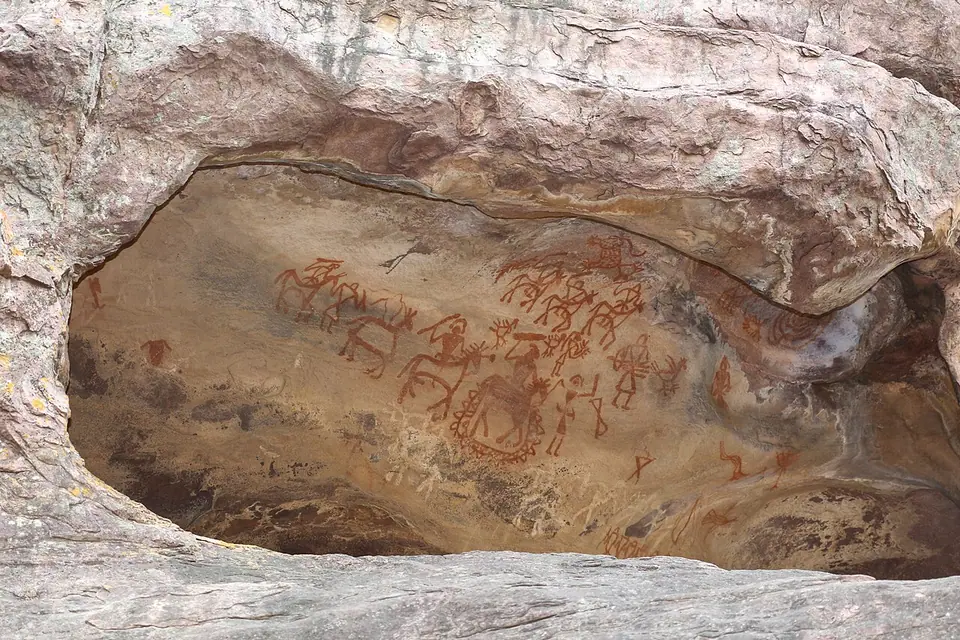
Pre-Vedic religion in South Asia runs from the Mesolithic rock art of Bhīmbetka (Bhimbetka), c. 10,000 years ago, through the farming village of Mehrgarh (from c. 7000 BCE or earlier on the conventional dating, c. 5250 BCE on a 2025 redating) to the eve of the Indus cities c. 3300 BCE. Long before any Indo-Aryan speaker reached the subcontinent, people here were farming barley, herding humped cattle, burying their dead with goods, painting rock shelters, and burning enormous mounds of cattle dung in what look like repeated communal rites.
They left no texts, so nothing about their beliefs can be read directly. But they left two things that matter enormously for this history: a population — the great majority of modern South Asian ancestry is descended from them, not from later arrivals — and a substrate of language and practice visible as loanwords in Sanskrit and as whole categories of Hindu religion that have no Vedic origin at all. Village goddesses, serpent worship, sacred trees, buffalo sacrifice, ritual bathing: none of this comes from the Rigveda.
This chapter is about where it plausibly does come from, and about being honest that “plausibly” is as far as the evidence goes. With no texts at all, it is the least secure material in the series, and its confidence tags run correspondingly low.
Timeline of pre-Vedic South Asia
Pre-Vedic South Asia runs from Bhīmbetka’s Mesolithic rock shelters, c. 10,000 BP, through the farming village of Mehrgarh to the start of the Early Harappan phase c. 3300 BCE.
Mehrgarh’s absolute dates are in flux. The rows below give the conventional chronology; a 2025 study that dated tooth enamel directly would move every Mehrgarh date roughly 1,750 years later (see below). Because the drilled molars come from Mehrgarh’s early farming-village burials, the redating moves them too: on either chronology the dentistry belongs to the farming village and does not precede it.
| Date | Event | Confidence |
|---|---|---|
| c. 10,000+ BP | Bhīmbetka rock shelters in continuous use; Mesolithic painting begins[1] | Consensus |
| c. 7000 BCE or earlier (conventional); c. 5250–4650 BCE (2025 redating) | Mehrgarh Period I — barley and wheat farming, Balochistan. The redating is a single study, from a direct method[2] | Contested |
| c. 7000–5500 BCE (conventional) | Drilled human molars at Mehrgarh — the earliest known dentistry. Moves later with Period I if the 2025 redating holds[3][4] | Majority |
| c. 6000 BCE | Independent local domestication of zebu cattle (Bos indicus)[5] | Majority |
| c. 5500 BCE | Pottery at Mehrgarh; copper working begins[6] | Consensus |
| c. 4500–3000 BCE | Mehrgarh periods IV–VII; terracotta figurines proliferate, female forms dominant[7] | Consensus |
| c. 3000–1200 BCE | Southern Neolithic ashmounds of the Deccan — cattle-pen burning[8][9] | Consensus |
| c. 3000–1500 BCE | Burzahom, Kashmir — pit-dwellings, dog-with-human burials[5] | Consensus |
| c. 3300 BCE | Early Harappan phase begins; Mehrgarh is abandoned as Nausharo rises[7] | Consensus |
Where pre-Vedic religion is found
Pre-Vedic religion is found in three separate worlds: the northwest around Mehrgarh, the cattle-centred Neolithic of the Deccan, and the foraging and farming cultures of central India and the Ganga plain.
Three separate worlds, not one:
- The northwest — Mehrgarh on the Kachi plain at the foot of the Bolan Pass, the corridor between Iran and the Indus. This is where farming enters and where the Harappan civilization’s direct ancestry lies.
- The Deccan — Karnataka and Andhra: Budihal, Sanganakallu, Kudatini, Utnur. A cattle-centred Neolithic largely independent of the north.
- Central India and the Ganga plain — Bhīmbetka’s rock shelters; Mesolithic cemeteries at Damdama and Mahadaha with elaborate burials. Foraging populations persisting alongside farming.
The evidence ledger for pre-Vedic South Asia
Pre-Vedic South Asians farmed barley and wheat, domesticated zebu locally, buried their dead with grave goods and burned cattle dung on a vast scale; they are the majority ancestry of modern South Asians.
There are no texts. Everything here is inferred from excavation, from comparative linguistics, and from working backwards from later practice — so the confidence tags run lower than anywhere else in this series.
| Dimension | What we can say | Evidence | Confidence |
|---|---|---|---|
| Subsistence | Barley-first agriculture, with wheat; herding of cattle, sheep, goat | Mehrgarh Period I carbonized grain and faunal assemblages[5] | Consensus |
| Cattle | Zebu was domesticated locally, not imported | Bos indicus mtDNA lineages distinct from Near Eastern taurine cattle; wild zebu bones at Mehrgarh preceding domesticates[5] | Majority |
| Technology | Ground stone, then pottery, then copper; cotton on a copper bead | Mehrgarh stratigraphy; Moulherat et al. 2002.[10] Absolute dates all shift later under the 2025 redating[2] | Contested (dates) |
| Death | Deliberate burial with grave goods; animals interred with humans | Mehrgarh burials with young goats; Burzahom dog-and-human burials[5] | Consensus |
| Ritual (Deccan) | Repeated, large-scale communal burning of cattle dung over centuries | Ashmounds up to 10 m high, vitrified dung, at ~20 sites[8][9] | Consensus that it happened; Contested what it meant |
| Imagery | Human figurines, overwhelmingly female, from c. 4500 BCE and abundant by c. 3000 BCE | Mehrgarh periods V–VII terracottas[7] | Consensus on the objects; Contested on function |
| Genetics | This population is the majority ancestry of modern South Asians | Narasimhan et al. 2019; “Ancient Ancestral South Indian” plus an Iranian-related component from a pre-farming lineage[11][12] | Consensus |
| Language | At least two, probably three, non-Indo-European families were here first | Dravidian and Munda distributions; unetymologizable substrate vocabulary in Sanskrit[13][14] | Majority |
Mehrgarh, the ashmounds and Bhimbetka up close
Mehrgarh shows the unbroken local sequence that the Indus civilization grew out of, the Deccan ashmounds give the clearest ritual signal, and Bhīmbetka shows image-making continuing across many thousands of years.
Mehrgarh — the deep root
Excavated from 1974 by Jean-François Jarrige, Mehrgarh runs almost unbroken down to c. 2600 BCE, which makes it the single most important site for understanding what the Indus civilization grew out of.[6]
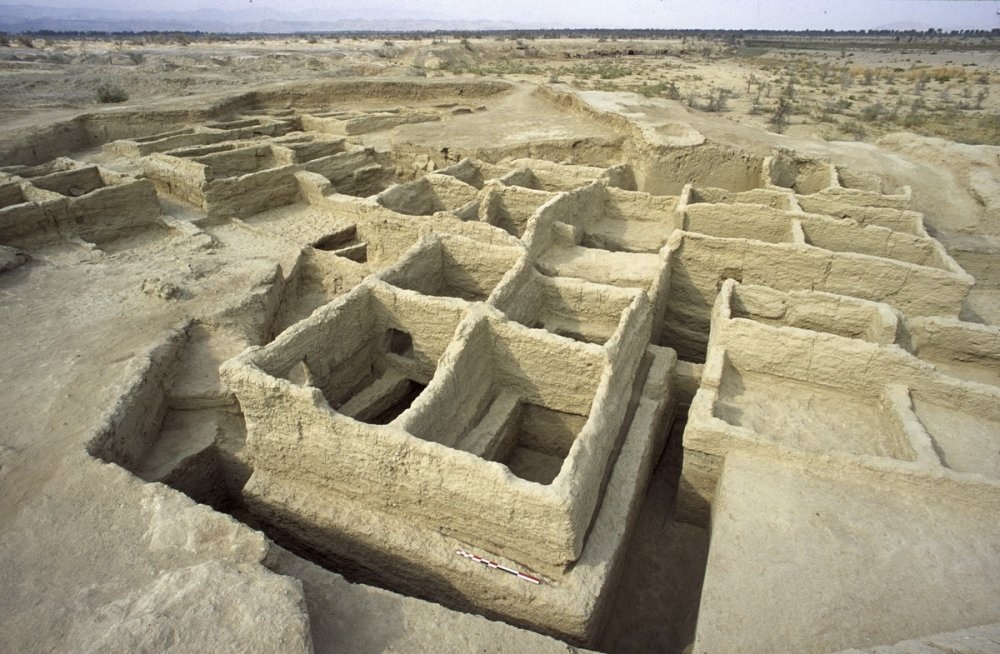
A large caveat, new since 2025. Mutin et al. (Scientific Reports 15: 11345) radiocarbon-dated human tooth enamel directly and put Mehrgarh Period I at 5250–4650 cal BCE — roughly 1,750 years later than the conventional pre-7000 BCE figure, and framed as “a late appearance of farming life in the Indus Valley.” If it holds, every absolute date on this page moves, and the Neolithic here is substantially shorter than the standard account. It is a single study and not yet absorbed by the field.[2] Contested — but from a direct dating method, and likely to stick
Whatever its absolute date, Period I is aceramic: mud-brick houses, storage compartments, barley and wheat, and burials laid on their sides with beads and sometimes with the bodies of young goats.
Two findings deserve attention because they reset expectations about how sophisticated this world was:
- Dentistry. Eleven drilled molar crowns from nine adults, with concentric striations showing a bow-drill. Coppa et al., Nature 440 (2006), give 7,500–9,000 years ago — i.e. c. 5500–7000 BCE.[4][3] These are living patients being treated for caries.
- Cotton. Mineralized cotton fibres on a copper bead — the earliest evidence for cotton in the Old World.[10] (Not “anywhere”: New World cotton at Huaca Prieta in Peru is of comparable antiquity.)
What it means for religion. Directly, very little — grave goods imply some belief about the dead, and nothing more specific can be honestly claimed. Indirectly, a great deal: the continuity Mehrgarh → Early Harappan → Mature Harappan is unbroken and local. The Indus civilization was not founded by newcomers, and whatever religious life it had was the descendant of this.[7][5] Consensus
The Deccan ashmounds — the clearest ritual signal
Across Karnataka and Andhra, some twenty Neolithic sites carry mounds of burnt cattle dung, some ten metres high, built up by repeated firing over centuries. At Budihal and Utnur, excavation shows cattle pens whose accumulated dung was burned again and again, sometimes to the point of vitrification.[8]
Why it looks ritual rather than practical. The scale far exceeds waste disposal; the burning is periodic rather than continuous; the mounds are sited prominently; and they persist across generations at fixed places. F. R. Allchin’s reading — seasonal cattle festivals, possibly involving driving cattle through smoke or fire — remains the standard interpretation.[9] Majority
The tempting inference, and the brake on it. It is very attractive to draw a line from ashmound cattle-festivals to the sanctity of the cow, to go-pūjā, to bonfire festivals like Pongal and Holi. The line is plausible and unproven. Three thousand years separate the ashmounds from any text describing such a practice, with no intervening evidence. This series marks that as Speculative and does not build on it.
Bhimbetka — continuity of image
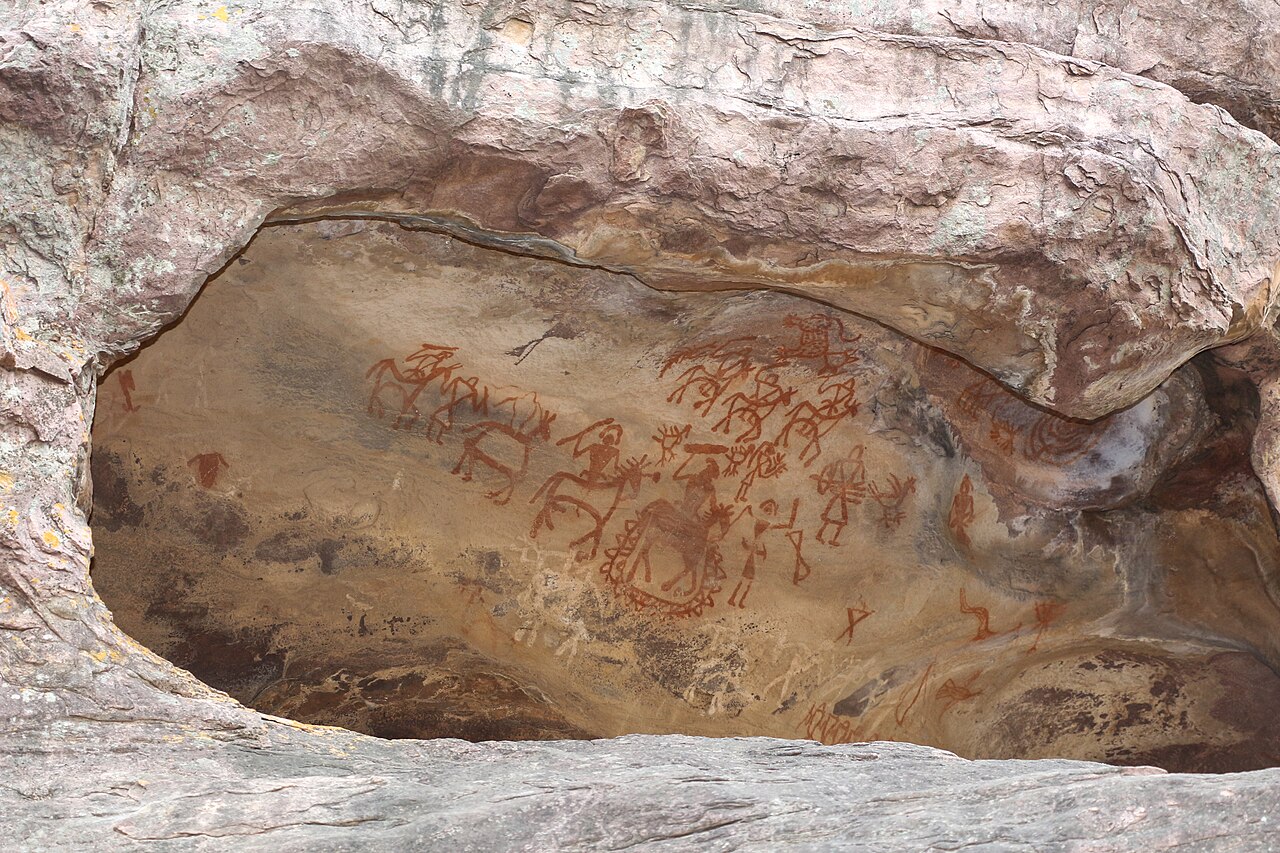
Over 700 rock shelters in the Vindhyas, roughly 400 painted, with images from the Mesolithic (c. 10,000 BP) through the historic period.[1] Later layers include horse riders and figures that some identify as recognizable deities. The shelters’ significance here is simply continuity: the same places were used for image-making across many thousands of years, spanning the arrival of farming, of the Harappans, and of Sanskrit.
The language substrate beneath Sanskrit
Retroflex consonants and unetymologizable vocabulary in Sanskrit are the strongest evidence for a pre-Vedic world, though Lubotsky argues many such words were borrowed in Central Asia before entry into South Asia.
This is the strongest evidence for a pre-Vedic religious world, because language preserves what archaeology cannot.
Retroflex consonants. Sanskrit has a series of retroflex sounds — ṭ, ṭh, ḍ, ḍh, ṇ, ṣ — made with the tongue curled back. No other Indo-European branch has an inherited, phonemically contrastive retroflex series reconstructible to its proto-stage. (Retroflexes do occur elsewhere in the family — Pashto and other eastern Iranian languages, Nuristani, and secondarily in Swedish and Polish — but they are secondary developments, and the Iranian cases sit inside the same contact zone.) Every Dravidian language has them. The standard explanation is substrate influence: Indo-Aryan speakers acquired the sound system of speakers who shifted to their language. Some argue for internal development instead.[13] Majority
Unexplained vocabulary. Colin Masica’s study of a corpus of Hindi plant and agricultural terms found roughly a third with no derivable etymology — not Indo-European, not Dravidian, not Munda.[14] Witzel documents similar unetymologizable words already inside the Rigveda itself, concentrated in exactly the semantic fields you would expect a migrant population to borrow: local plants, local animals, agriculture, and ritual objects. The implication is a lost language family — Witzel’s “Language X” or “Para-Munda” — spoken in the northwest and now entirely gone.[13] Majority
Named language families. Dravidian, now concentrated in the south but with Brahui surviving in Balochistan; and Munda (Austroasiatic), in eastern and central India. Neither is Indo-European, and both were here first.
The main alternative, which changes the conclusion. Alexander Lubotsky (“The Indo-Iranian Substratum,” 2001) observes that a large share of these unetymologizable words are shared by Indo-Aryan and Iranian — which would mean they were borrowed in Central Asia, from the BMAC population, before entry into South Asia, and are not evidence of a lost South Asian language at all. This is a well-regarded position and it reverses the inference.[15] Contested
What plausibly survives into Hinduism
Village goddesses, serpent worship and sacred trees plausibly descend from a pre-Vedic substrate rather than the Vedas; ritual bathing is contested, and the buffalo-demon motif and the cow’s special status are speculative.
State plainly: this is the least secure material in this series, because it argues backwards from later practice to an unrecorded origin. It is included because omitting it produces a worse distortion — a history in which Hinduism descends purely from the Vedas, which is clearly false.
| Later Hindu element | Why it looks non-Vedic | Confidence |
|---|---|---|
| Village goddesses (grāmadevatā) — Māriamman, Śītalā, Yellamma; disease-goddesses, buffalo sacrifice, non-brahmin priesthood | The Rigveda has no Great Goddess at all. These cults are structurally unlike Vedic religion: local, female, blood-offering, outside brahmin control[16] | Majority |
| Nāga (serpent) worship | Absent from early Vedic; serpents are the enemy there (Vṛtra, Ahi). Serpent veneration is pan-Indian, deeply localized, and heavily represented in later folk practice[17] | Majority |
| Sacred trees — the pipal above all | Pipal imagery is prominent on Harappan seals, including a horned figure standing inside a pipal[17] | Majority |
| Ritual bathing as purification | The Great Bath at Mohenjo-daro; the later tīrtha system’s density in non-Vedic regions[18][7] | Contested |
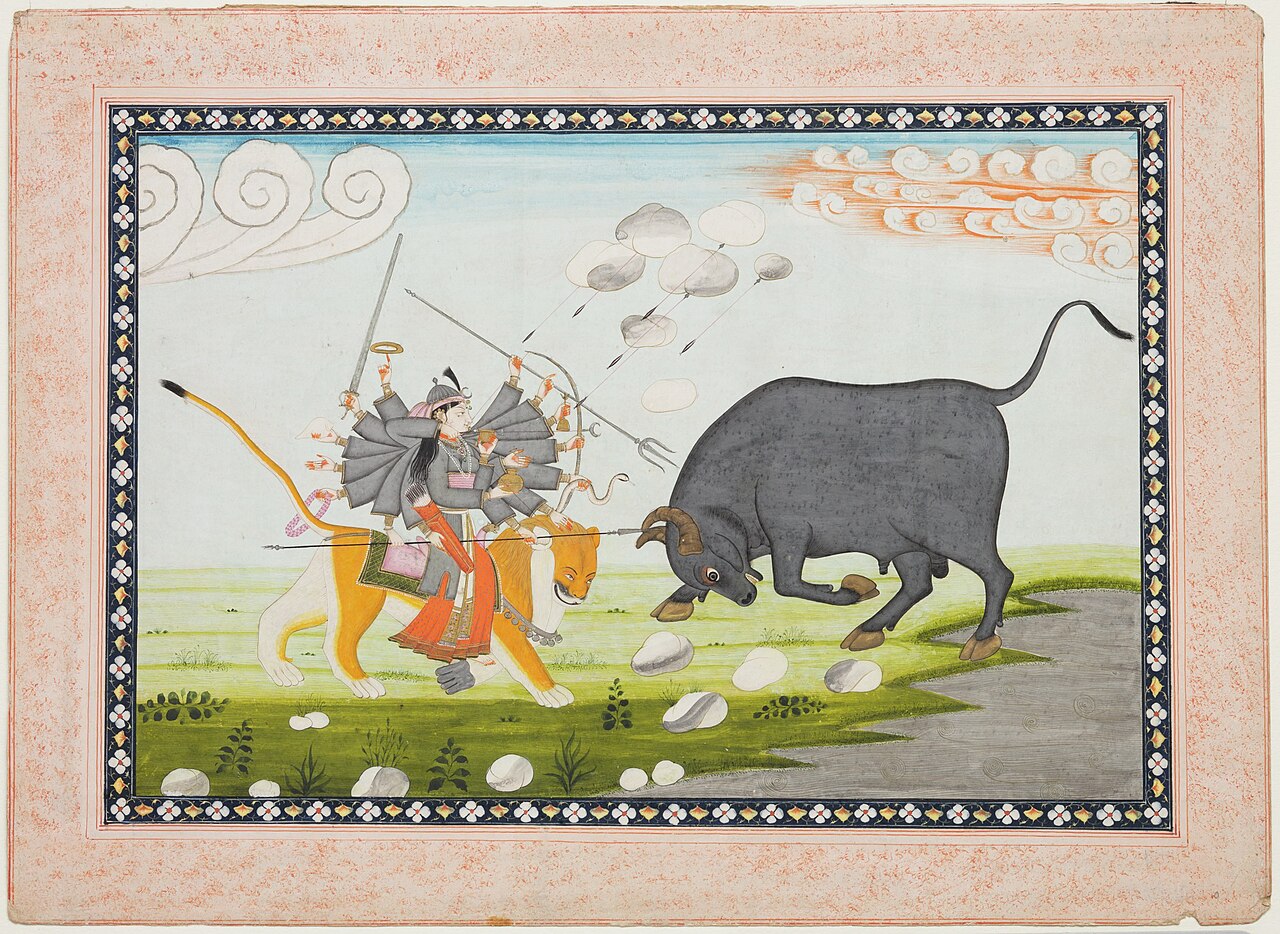
| Buffalo-demon motif (later Mahiṣāsura) | Buffalo sacrifice is the signature offering of village goddess cults; the Vedic sacrificial animal is the goat, horse, or cow[17] | Speculative |
| The cow’s special status | Not Vedic — the Rigvedic people ate beef at sacrifices. A deep Neolithic cattle-cult substrate is one candidate explanation for how it later became inviolable[9] | Speculative |
The honest summary: Hinduism is a braid, and this is one of its strands. The Vedic strand is documented in extraordinary detail because it was preserved by a literate priesthood obsessed with exactness. The substrate strand is nearly invisible for exactly the opposite reason — and its invisibility in the record is not evidence of its unimportance in people’s lives.
Debates about pre-Vedic religion
The open debates about pre-Vedic religion are whether it can be described at all, whether the female figurines are goddesses, whether Dravidian is related to Elamite, and whether it was the Indus language.
Did the Neolithic here have “religion” we can describe?
No — not in any detail. Burials with goods, figurines, and ritual-looking burning are the entire dossier, and each admits mundane readings. Anyone offering a confident reconstruction of Neolithic South Asian belief is extrapolating.[5] Consensus among archaeologists
Are the female figurines goddesses?
The “Mother Goddess” reading goes back to Marshall and early-20th-century assumptions about universal fertility cults. Alternatives: toys, votives, portraits, apotropaic objects, or objects used and discarded in domestic ritual. The figurines’ find contexts — often in refuse, not shrines — argue against a purely cultic reading.[7] Contested
Is Dravidian related to Elamite?
The Elamo-Dravidian hypothesis (McAlpin) would tie the Dravidian family to southwestern Iran and the spread of farming. It has real support and real critics; it is not established.[17] Contested
Was Dravidian the language of the Indus civilization?
Parpola’s case rests on his Dravidian readings of the seals, on Brahui’s survival in Balochistan, and on Dravidian loanwords in the Rigveda. Others argue for Para-Munda or an unrelated lost family. Undecidable while the script is unread.[17][13] Contested
Further reading
- Jean-François Jarrige et al., Mehrgarh: Field Reports 1974–1985.
- A. Coppa et al., “Early Neolithic tradition of dentistry,” Nature 440 (2006).
- F. R. Allchin, Neolithic Cattle-Keepers of South India (1963) — the ashmound study.
- Colin Masica, “Aryan and Non-Aryan Elements in North Indian Agriculture,” in Aryan and Non-Aryan in India (1979).
- Michael Witzel, “Substrate Languages in Old Indo-Aryan,” Electronic Journal of Vedic Studies 5 (1999).
- Asko Parpola, The Roots of Hinduism: The Early Aryans and the Indus Civilization (Oxford, 2015).
- Narasimhan et al., Science 365 (2019).
References
- ^ a b Bhīmbetka rock shelters — Madhya Pradesh. c. 10,000 BP onward. Over 700 shelters, some 400 painted, in use from the Mesolithic through the historic period. The significance is continuity: the same places used for image-making across many thousands of years. about
- ^ a b c Benjamin Mutin, Antoine Zazzo et al. "New radiocarbon dates of human tooth enamel reveal a late appearance of farming life in the Indus Valley". Scientific Reports 15: 11345, 2025. doi Redates Mehrgarh Period I to 5250–4650 cal BCE — roughly 1,750 years later than the conventional figure. Single study; not yet absorbed by the field.
- ^ a b Mehrgarh drilled molars — Mehrgarh. c. 7500–5500 BCE. Eleven bow-drilled teeth from nine adults — the earliest known dentistry, on living patients. about
- ^ a b A. Coppa et al. "Palaeontology: Early Neolithic tradition of dentistry". Nature 440, 2006. doi Drilled molars at Mehrgarh.
- ^ a b c d e f g Robin Coningham & Ruth Young The Archaeology of South Asia: From the Indus to Asoka. Cambridge University Press, 2015. The standard synthesis for §§1–6.
- ^ a b Jean-François Jarrige et al. Mehrgarh: Field Reports 1974–1985. Department of Culture and Tourism, Govt. of Sindh, 1995. The excavation reports underlying everything said about the site — now in tension with the 2025 redating.
- ^ a b c d e f Jonathan Mark Kenoyer Ancient Cities of the Indus Valley Civilization. Oxford University Press, 1998. full text The standard accessible account by an excavator.
- ^ a b c Deccan ashmounds — Budihal, Utnur, Kudatini. c. 3000–1200 BCE. Cattle-dung mounds up to 10 m, burned repeatedly over centuries — the clearest ritual signal in the South Asian Neolithic.
- ^ a b c d F. R. Allchin Neolithic Cattle-Keepers of South India. Cambridge University Press, 1963. full text The ashmound study.
- ^ a b Christophe Moulherat, Margareta Tengberg, Jérôme-F. Haquet & Benoît Mille "First Evidence of Cotton at Neolithic Mehrgarh, Pakistan". Journal of Archaeological Science 29, 2002. The mineralized fibres on a copper bead — earliest cotton in the Old World.
- ^ Vagheesh M. Narasimhan et al. "The formation of human populations in South and Central Asia". Science 365, 2019. doi Over 500 ancient genomes. The steppe-ancestry signal, and its limits.
- ^ Vasant Shinde et al. "An Ancient Harappan Genome Lacks Ancestry from Steppe Pastoralists or Iranian Farmers". Cell 179, 2019. doi The single sequenced Rakhigarhi individual.
- ^ a b c d Michael Witzel "Substrate Languages in Old Indo-Aryan". Electronic Journal of Vedic Studies 5, 1999. The case for a lost pre-Indo-Aryan language family in the northwest.
- ^ a b Colin P. Masica "Aryan and Non-Aryan Elements in North Indian Agriculture". in Aryan and Non-Aryan in India, 1979. The unetymologizable-vocabulary argument.
- ^ Alexander Lubotsky "The Indo-Iranian Substratum". Mémoires de la Société Finno-Ougrienne 242, 2001. The main alternative to Witzel's "Language X": the unexplained vocabulary is shared with Iranian, so borrowed in Central Asia before entry into South Asia.
- ^ Gavin Flood An Introduction to Hinduism. Cambridge University Press, 1996. open library The standard university textbook, and the most balanced single overview.
- ^ a b c d e Asko Parpola The Roots of Hinduism: The Early Aryans and the Indus Civilization. Oxford University Press, 2015. full text The fullest statement of the Dravidian-Indus case. Argued, not established.
- ^ The Great Bath — Mohenjo-daro. c. 2500 BCE. A monumental waterproofed tank. Ritual purity or civic amenity — nothing marks it as sacred. about