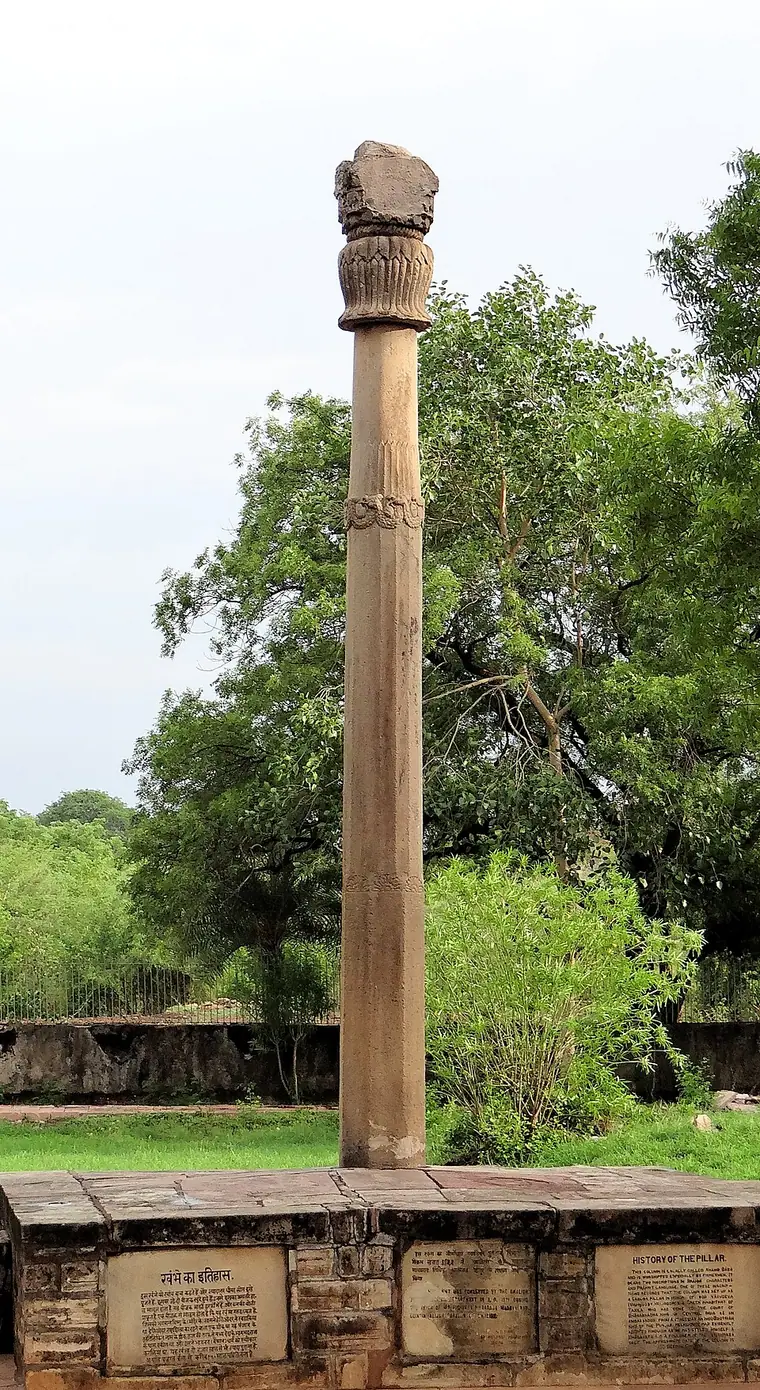
Hindu image worship and temple building begin between about 200 BCE and 300 CE. That is well over a thousand years after the oldest Vedic hymns. The first stone temples that still stand come later again, from around 400 CE, under the Guptas.[1][2] Before that, the religion recorded in the Vedas had no buildings for its gods and no images of them. The site of worship was a fire altar laid out in the open for a single rite and abandoned afterwards.[3][4]
The evidence
Before images: the Vedic altar
The Rigveda has no word for a temple, a shrine or a cult image. Its ritual site is a grass-strewn altar with fires (§3).[3] The later Vedic texts expand the rituals enormously without adding a temple.[5] The Upaniṣads (§5) and the age of the Buddha (§6) still show none. Ashoka, c. 250 BCE, builds stūpas and pillars, not temples.[6]
This silence has limits. The Rigveda is a priestly anthology and underrepresents household and popular religion (§3).[3] The Indus cities, c. 2500 BCE, left figurines and seals with horned figures of clear religious importance, including the so-called Paśupati seal. Whether any of these were worshipped as images, and whether they connect to later Hinduism, is contested.[7][8] The Vedic silence tells us about Vedic religion. It does not prove that nobody in South Asia venerated images.
The first shrines and images, c. 200 BCE – 300 CE
Evidence arrives from several directions at once, and most of it can be dated:
- Besnagar, c. 110 BCE. The Heliodorus pillar is a Garuḍa-standard erected to Vāsudeva, “God of Gods.”[9] A second Garuḍa pillar from the same site names “the excellent temple (prāsādottama) of the Bhagavat,” so there was a built temple at Vidiśā.[10]
- Nagarī (Ghoṣuṇḍī), c. 1st c. BCE. A stone enclosure is built for Saṃkarṣaṇa and Vāsudeva. This is early Vaiṣṇava cult architecture.[11][12]
- The Bhūteśvar relief, Mathurā, c. 100 BCE. A liṅga inside a railing is worshipped by winged figures. The relief is securely stratified, and it is probably the earliest evidence anywhere for an enshrined liṅga.[13]
- The Gudimallam liṅga, Andhra Pradesh. This is the earliest surviving liṅga, with a standing Śiva carved on its face. It is conventionally dated to the 2nd–1st century BCE, but I. K. Sarma’s excavation dates the brick temple around it to the 2nd–3rd century CE, and no inscription dates the liṅga itself.[14] Contested dating
- Mathurā. Mathurā sculptors produce images of Balarāma, Vāsudeva, Sūrya, Kubera, nāgas and yakṣas in local red sandstone.[15] The Mora well inscription, c. 10–25 CE, records images of the five Vṛṣṇi heroes installed in a stone shrine.[16] Goddess images killing the buffalo-demon appear in the Kuṣāṇa period, some four centuries before any text tells the story.[15]
- Kuṣāṇa coins, from c. 127 CE. Coins show a trident-bearing deity labelled Oēśo. Calling him Śiva is disputed, since he may be an Iranian god drawn with Śiva’s attributes.[17][18] Contested
- Nāgārjunakoṇḍa, c. 278 CE. This site has the earliest eight-armed Viṣṇu.[19]
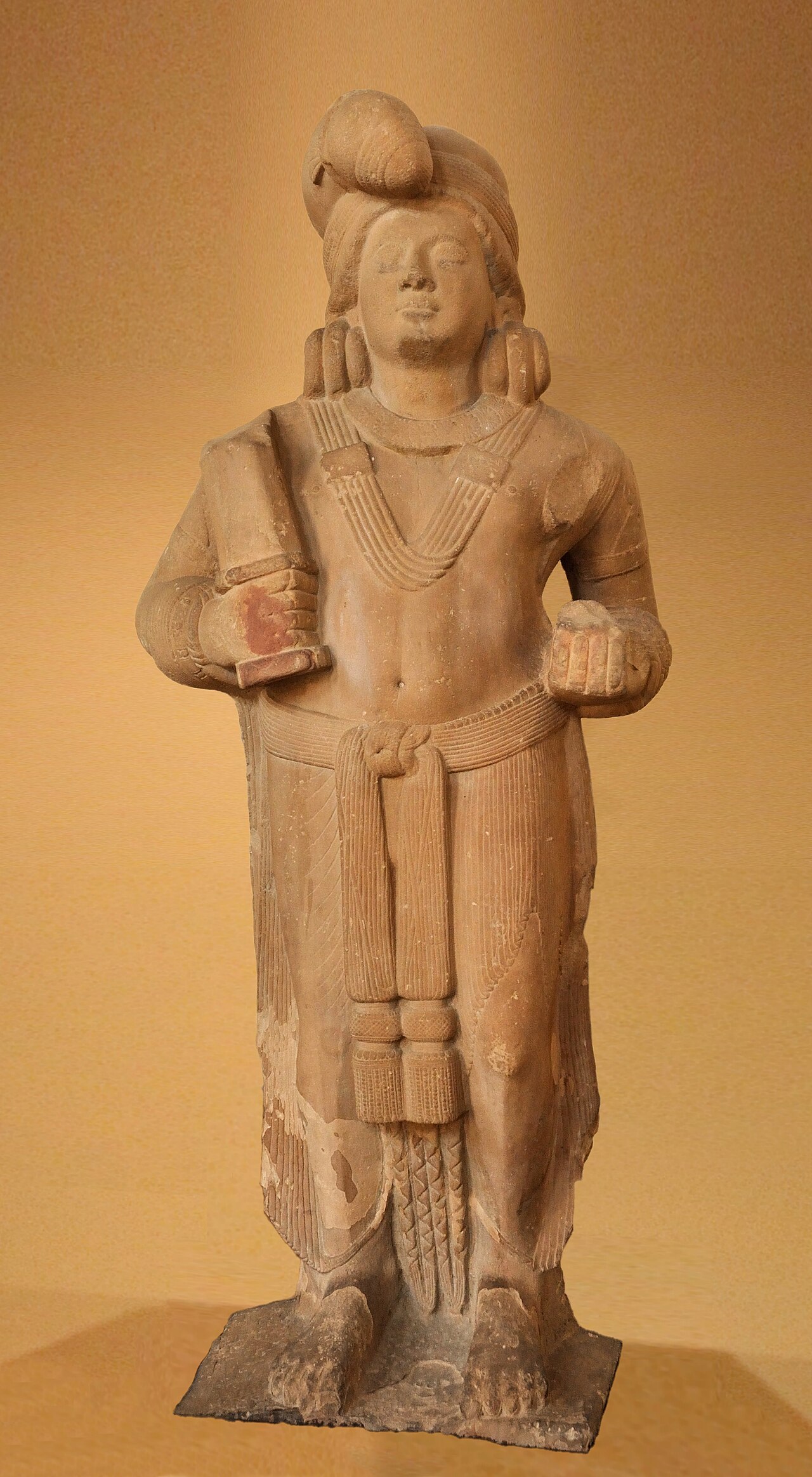
What it proves. In this period images were made to be worshipped and housed. The shrines were small, often apsidal (with a rounded end), and mostly built of perishable materials.[11] The visual language came substantially from the yakṣa and nāga cults, the local non-Vedic religion that the Vedic texts barely mention (§7).[15]
The first stone temples, c. 400 CE onward
From the Gupta period, temples survive. Sanchi Temple 17, c. 400 CE, has a flat-roofed square sanctum and a four-pillared porch. It is almost the simplest building that can count as a temple, and a lineage starts from it.[1] At Udayagiri, c. 401 CE, a monumental relief shows Viṣṇu as the boar Varāha lifting the earth, beside an inscription of Candragupta II’s minister.[2] The Deogarh Daśāvatāra temple, c. 500–525 CE, carries a panel of Viṣṇu asleep on the cosmic serpent in iconography any Hindu would recognise today.[20]
Inscriptions show temples being founded by different kinds of patrons:
- a Pāśupata Śaiva lineage with an endowed shrine at Mathurā in 380 CE;[21]
- a Sun temple built by a silk-weavers’ guild at Mandasor in 437 CE;[22]
- a Viṣṇu temple built by the state at Junāgaḍh in 457 CE, together with the repair of a reservoir.[23]
Over the following centuries northern and southern temple architecture split into the Nāgara and Drāviḍa styles.[24]
A short timeline
| Date | What happens | Confidence |
|---|---|---|
| c. 1500–1200 BCE | Rigveda: fire altars, no temples, no images[3] | Consensus |
| c. 250 BCE | Ashoka builds stūpas and pillars, not temples[6] | Consensus |
| c. 110 BCE | Heliodorus pillar; a second pillar names a temple at Vidiśā[9][10] | Consensus |
| c. 100 BCE | Bhūteśvar relief: enshrined liṅga worship at Mathurā[13] | Majority |
| c. 2nd c. BCE – 2nd c. CE | Gudimallam liṅga[14] | Contested |
| c. 10–25 CE | Mora well: Vṛṣṇi hero images in a stone shrine[16] | Majority |
| c. 127–200 CE | Kuṣāṇa coins with the trident-bearing Oēśo[17] | Contested |
| c. 400 CE | Sanchi Temple 17[1] | Majority |
| c. 401 CE | Udayagiri Varāha panel[2] | Consensus |
| c. 500–525 CE | Deogarh Daśāvatāra temple[20] | Majority |
What scholars disagree about
Did Greek contact create Hindu image worship? The first Buddha images and the first Hindu cult images appear in the regions and centuries of closest contact with Hellenistic art.[15] Mathurā’s imagery, however, grows out of a local yakṣa tradition with no Greek features. The likeliest account is convergence: an existing popular practice met new sculptural techniques and new patrons. Contested
Were there earlier images that simply did not survive? Almost certainly, in wood, clay and other perishable materials.[15] What is dated to 200 BCE–300 CE is image worship as a visible, inscribed, organised practice, not the first time anyone venerated an image. How far back the unrecorded practice goes cannot be measured.
Does it go back to the Indus Valley? Some writers, including those arguing for an indigenous origin of Vedic culture, see Harappan figurines and the Paśupati seal as the first Hindu images. The resemblances are real. Critics point out that the seal’s figure matches a form of Śiva attested only 1,500–2,000 years later, and that no text or inscription links the two (§2).[25][8] Contested
The traditional view. For many Hindus, the question “when did image worship start?” matters less than what an image is: a form in which the deity, once invoked, is truly present and can be seen (darśana).[4] Reformers made the opposite argument. In the nineteenth century Rammohan Roy and Dayānanda Sarasvatī rejected image worship as a post-Vedic corruption (§11).[26][27] Historians agree with the reformers’ dating but not their verdict: late does not mean false, and most of what Hindus practise today is post-Vedic.
Common misconceptions
- “Temples and idols are in the Vedas.” They are not. They are absent from the Rigveda and from the Upaniṣads.[3][28]
- “The first temples were grand stone buildings.” The first shrines were small and mostly perishable. Monumental stone architecture begins in the Gupta period.[1][24]
- “Temple ritual is Vedic.” The pūjā performed in most Hindu temples today is largely Tantric in structure, not Vedic (§8).[29]
Why it matters
A Vedic altar and a temple assume two different gods. The altar was built for one rite and taken down afterwards: the gods came, received the offering and left. The temple is a permanent home for a god who is present in one place, in an image, and available to be seen.[4] The change of building therefore records a change of theology, and it happened at the same time as bhakti, the avatāra doctrine and the Bhagavad Gītā (§7).[30][9] Temples then became landowning institutions. That endowment system is what later made the great Chola temples into landlords and banks.[31]
For the full story, see §7 on the first images and §8 on the Gupta temples.
References
- ^ a b c d Sanchi Temple 17 — Madhya Pradesh. c. 400 CE. Among the earliest surviving structural Hindu temples — small, plain, and the beginning of a lineage. about
- ^ a b c Udayagiri Cave 5 — Madhya Pradesh. c. 401 CE. The monumental Varāha panel — Viṣṇu lifting the earth, carved at the moment of Gupta imperial expansion. about
- ^ a b c d e Stephanie W. Jamison & Joel P. Brereton, trans. The Rigveda: The Earliest Religious Poetry of India. Oxford University Press, 3 vols., 2014. The standard complete English translation. Supersedes Griffith entirely.
- ^ a b c Diana L. Eck Darśan: Seeing the Divine Image in India. Columbia University Press, 3rd ed., 1998. open library Short and indispensable on what a temple image is for.
- ^ The Śrautasūtras — Āpastamba, Baudhāyana, Kātyāyana and others. c. 600–300 BCE. Sanskrit. The technical manuals that specify the sixteen-priest śrauta system in operational detail — the evidence that the Brāhmaṇas describe a real, if enormously expensive, practice.
- ^ a b Nayanjot Lahiri Ashoka in Ancient India. Harvard University Press, 2015. open library The current biography, strong on the archaeology.
- ^ Seal M-304 — Mohenjo-daro. c. 2500 BCE. undeciphered. The "Paśupati" seal. A horned figure among wild animals — proto-Śiva, a bovine deity, or a Near Eastern Master of Animals. Undecided. about
- ^ a b Doris Srinivasan "The So-Called Proto-Śiva Seal from Mohenjo-Daro: An Iconological Assessment". Archives of Asian Art 29, 1975. The critique that dismantled the confident Paśupati reading.
- ^ a b c Heliodorus pillar — Besnagar (Vidiśā). c. 110 BCE. Prakrit in Brāhmī. A Greek ambassador calls himself a Bhāgavata and Vāsudeva the God of Gods. The oldest hard evidence for bhakti, and datable by Antialkidas's coinage. about
- ^ a b Besnagar second Garuḍa pillar — Vidiśā. c. late 2nd c. BCE. Prakrit in Brāhmī. An Indian donor, also a Bhāgavata, erects a Garuḍa column for "the excellent temple of the Bhagavat" — proving a built temple at Vidiśā, and that Heliodorus followed a local convention rather than inventing one. read the text
- ^ a b Ghoṣuṇḍī / Nagari inscription — Rajasthan. c. 1st c. BCE. Sanskrit. A stone enclosure for Saṃkarṣaṇa and Vāsudeva — early Vaiṣṇava cult architecture. about
- ^ Ghoṣuṇḍī / Hāthībāḍā inscription — Nagari, Rajasthan. c. 1st c. BCE. Sanskrit. A stone enclosure — a Nārāyaṇa-vāṭikā — for Saṃkarṣaṇa and Vāsudeva, "unconquered and lords of all." The earliest epigraph placing the two under the collective name Nārāyaṇa. read the text
- ^ a b Bhūteśvar liṅga relief — Mathurā (Govt. Museum acc. 3625). c. 100 BCE. A liṅga inside a railing being worshipped — securely stratified, urban, and probably the earliest evidence anywhere for enshrined liṅga worship. read the text
- ^ a b Gudimallam liṅga — Andhra Pradesh. c. 2nd c. BCE – 2nd c. CE. The earliest surviving liṅga, with a standing Śiva carved on its face — abstract and anthropomorphic on one object. about
- ^ a b c d e Doris Srinivasan Many Heads, Arms and Eyes: Origin, Meaning and Form of Multiplicity in Indian Art. Brill, 1997. On how Hindu iconography emerged.
- ^ a b Mora well inscription — Mathurā. c. 10–25 CE. Sanskrit. Images of the "five heroes" of the Vṛṣṇis installed in a stone shrine — early Vaiṣṇava cult imagery, though Lüders rejected the reading that names Kṛṣṇa directly. read the text
- ^ a b Kuṣāṇa coinage (Oēśo) — Kaniṣka and successors. c. 127–200 CE. Greek script. Śiva with trident and bull on imperial state currency — standardized divine iconography.
- ^ Rabatak inscription — Kaniṣka I, Afghanistan. c. 127 CE. Bactrian in Greek script. The Kuṣāṇa dynastic pantheon — Nana, Umma, Aurmuzd, Mihr and others. Oēśo is absent, which is one of the arguments against reading him as Śiva. about
- ^ Nāgārjunakoṇḍa Aṣṭabhujasvāmin record — Andhra Pradesh. c. 278 CE. Sanskrit. Nārāyaṇa as deva-parama-deva and purāṇa-puruṣa — per Sircar the earliest epigraph clearly pointing to the Nārāyaṇa–Viṣṇu identification, and the earliest eight-armed Viṣṇu.
- ^ a b Deogarh Daśāvatāra temple — Uttar Pradesh. c. 500–525 CE. The Śeṣaśāyī panel of Viṣṇu asleep on the cosmic serpent — iconography by now fully standardized and recognizable to any Hindu today. about
- ^ Mathurā pillar of Candragupta II — Gupta year 61 (380/381 CE). 380 CE. Sanskrit. A Pāśupata guru-lineage counted ten generations deep, with an endowed "Shrine of the Teachers" housing liṅgas named after dead masters — the earliest dated evidence for an institutionalized Śaiva initiatory order. read the text
- ^ Mandasor inscription of Bandhuvarman — Mālava year 493 (437/438 CE). 437 CE. Sanskrit. A Sun temple built by the silk-weavers' guild, a migrant craft community — corporate, non-royal, non-Vaiṣṇava patronage, precisely dated.
- ^ Junāgaḍh rock inscription of Skandagupta — Gupta year 138. 457 CE. Sanskrit. A Viṣṇu temple built alongside the repair of a burst reservoir — state-level temple foundation paired with public works, and the key document for the Gupta era as a named reckoning. about
- ^ a b Michael W. Meister & M. A. Dhaky, eds. Encyclopaedia of Indian Temple Architecture. American Institute of Indian Studies, 1983. The reference work for temple dating and typology.
- ^ John Marshall Mohenjo-daro and the Indus Civilization. Arthur Probsthain, 3 vols., 1931. full text The excavation report that named the "Paśupati" seal, the "Priest-King" and the "Mother Goddess" — labels the field has been arguing with ever since.
- ^ Satyārth Prakāś — Dayānanda Sarasvatī. 1875 CE. Hindi. "Back to the Vedas" — reform by declaring image worship, the Purāṇas, avatāras and caste-by-birth all later corruption. about
- ^ Kenneth W. Jones Socio-Religious Reform Movements in British India. Cambridge University Press, 1989. doi The survey that maps Brahmo, Arya Samaj, Prarthana and the rest against each other.
- ^ Patrick Olivelle, trans. The Early Upaniṣads: Annotated Text and Translation. Oxford University Press, 1998. full text The scholarly standard. Its introduction is the best short account of the period.
- ^ Alexis Sanderson "The Śaiva Age: The Rise and Dominance of Śaivism during the Early Medieval Period". in Genesis and Development of Tantrism, 2009. full text The argument that Śaivism, not Vedānta, was the dominant religious force of the age.
- ^ BhG 4.7–8 — Bhagavad Gītā. c. 200 BCE – 200 CE. Sanskrit. The avatāra doctrine, stated for the first time. Nothing in the Vedas has a god descending into history. read the text
- ^ Michael Willis The Archaeology of Hindu Ritual: Temples and the Establishment of the Gods. Cambridge University Press, 2009. Includes the re-edition that undoes the "first Tantric temple" reading of Gaṅgdhār.