Many Hindus are vegetarian because non-violence, ahiṃsā, became one of the highest religious values in India between about 500 and 200 BCE. That value came to Brahmanical religion largely through competition with the Jains, Buddhists and other śramaṇa (“striver”) movements that rejected the Veda.[1][2] It is not the original Vedic position. Vedic religion was built on animal sacrifice, and the oldest ritual texts record beef being eaten.[3] Brahmins eventually made meatless eating a mark of purity and high status. Their example spread unevenly through a society that never adopted one rule for everyone.[4]
The evidence
The starting point: a sacrificial religion
In the later Vedic period, c. 1000–500 BCE, the great public rituals killed animals. The royal horse sacrifice killed a horse, and the ritual texts regulate the eating of cattle rather than ban it.[5][3] Ahiṃsā, vegetarianism and cow protection are all missing from that world (§4). A vegetarian ethic had to come from somewhere, and it did not come from the fire altar.
A minor virtue in the Upanishads
The word ahiṃsā does appear inside the Vedic stream. The Chāndogya Upaniṣad, c. 700 BCE, lists it among the virtues. It is one item in a list, not yet the organising ethic it later becomes.[6] The same early Upaniṣads introduce karma and rebirth, the doctrines that give later arguments about harming living beings their force (§5).[7]
The renouncers make it absolute
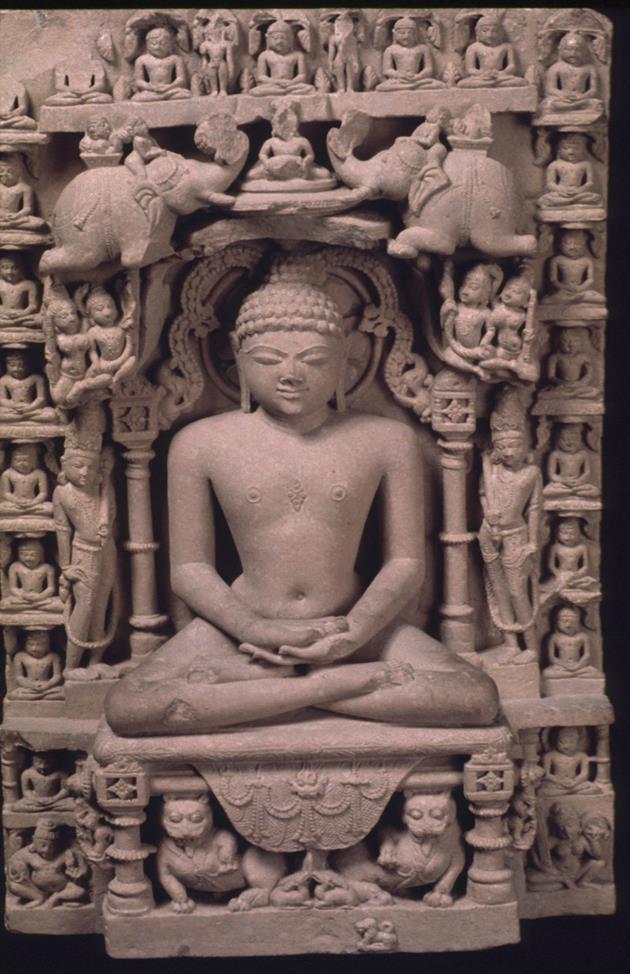
From around 500 BCE the eastern Ganga plain supported a crowded market of teachers who accepted karma and rebirth but rejected the Veda, sacrifice and the authority of brahmins.[8] The Jains pushed non-violence furthest. They filtered water and swept the path to avoid killing insects, and their oldest text states the principle as a claim about all life: “To all, life is dear.”[9][1] The Buddha took a different route. He kept the word “sacrifice” and redefined the great sacrifice as a bloodless one.[10]
An emperor turns against sacrifice
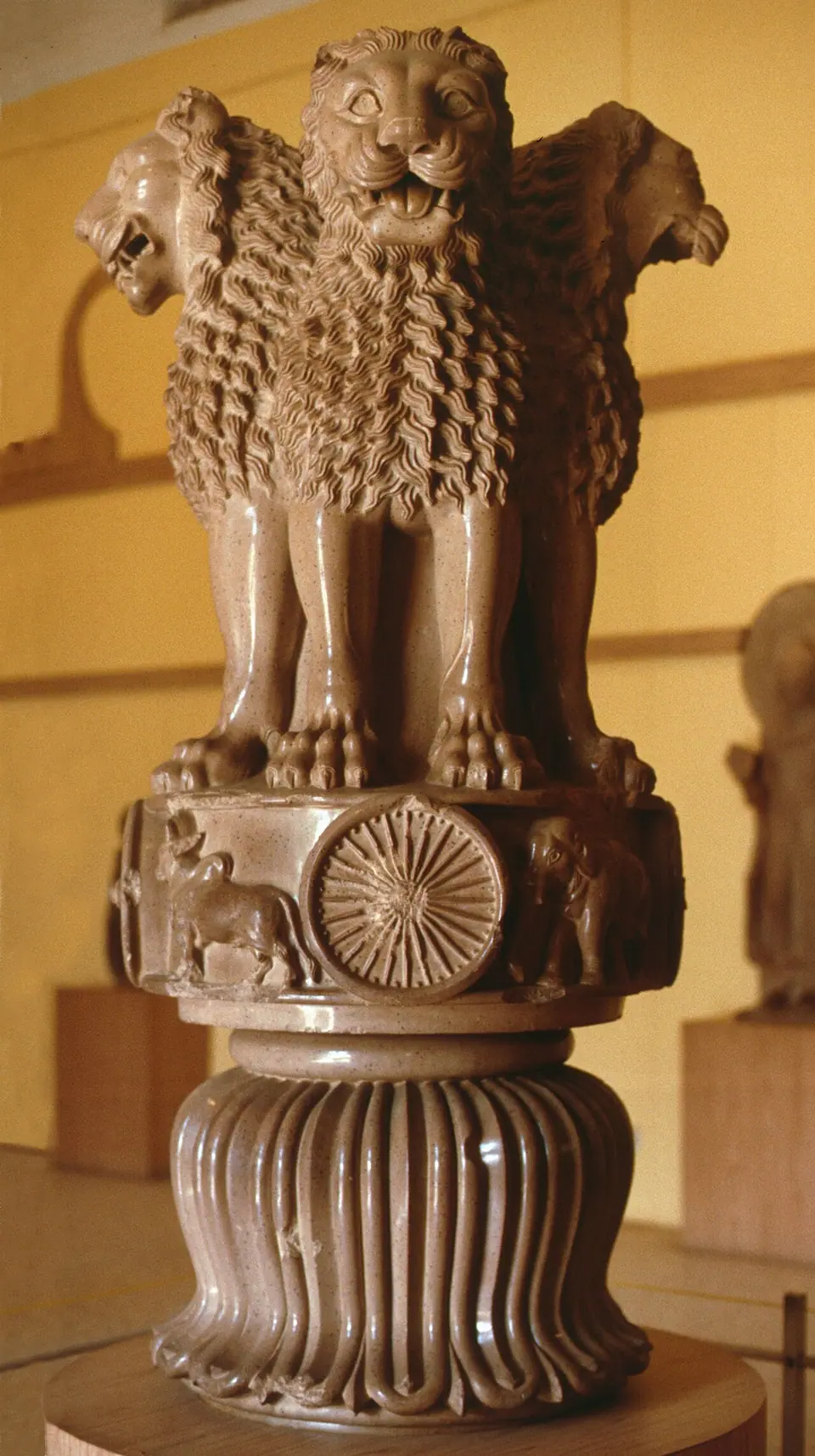
The decisive public moment is carved in stone. Ashoka’s first Rock Edict, Girnar recension, c. 257 BCE:
iyaṃ dhaṃma-lipī devānaṃpriyena priyadasinā rāñā lekhāpitā | idha na kiṃci jīvaṃ ārabhitpā prajūhitavyaṃ |
“This dhamma-inscription was caused to be written by King Priyadarśin, Beloved of the Gods. Here no living creature is to be slaughtered and offered in sacrifice.”[11][12]
The edict goes on to say that the royal kitchen, which had once killed hundreds of thousands of animals daily, is down to two peacocks and a deer, and that even those will stop. A later edict lists protected species in detail and forbids burning forests with living creatures in them.[13]
What it proves. Large-scale Vedic sacrifice depended on royal patronage. Here the most powerful king in India forbids sacrificial slaughter in his own capital. Whatever Ashoka’s personal motives, the prestige that had supported large-scale animal sacrifice never recovered.[14] Majority
Brahmanism adopts the winning argument
The brahmins did not answer by defending meat. They took over the higher standard, in the same way they took over renunciation. The āśrama theory, in its final form, allowed everyone to renounce but required everyone to do it last, after finishing their household duties (§6).[15] With diet, restraint became a sign of purity, and purity was the currency of brahmin status. §6 puts it this way: vegetarianism became a marker of high status in a religious world where the renouncers had made non-violence the measure of virtue, and Brahmanism adopted it because it was losing that argument.[2] Majority
The law books show the change was never complete. The Dharmasūtras (c. 300 BCE onward) and the Manusmṛti (c. 200 BCE–200 CE) regulate food minutely, and on meat they are ambivalent. They make room for it in ritual settings while praising abstention.[4][16] They were scholastic texts, and no premodern state enforced them (§7).[16] So vegetarianism spread as an ideal of prestige and piety, not as law.
A short timeline
| Date | What happens | Confidence |
|---|---|---|
| c. 1500–1200 BCE | Rigveda: animal sacrifice; beef eaten at sacrifices (§3)[17] | Majority |
| c. 900 BCE | Śatapatha Brāhmaṇa restricts beef for the consecrated sacrificer; Yājñavalkya eats it anyway[3] | Majority |
| c. 700 BCE | Ahiṃsā listed among virtues in the Chāndogya Upaniṣad[6] | Majority |
| c. 5th c. BCE | Mahāvīra reforms Jainism; the Buddha’s working-default dates c. 400 BCE[1][18] | Contested (dates) |
| c. 500–400 BCE | Ācārāṅga Sūtra: “To all, life is dear”[9] | Majority |
| c. 257 BCE | Ashoka’s Rock Edict 1 bans sacrificial slaughter in the capital[11] | Consensus |
| c. 243 BCE | Pillar Edict 5 protects named species[13] | Consensus |
| c. 300 BCE – 200 CE | Dharmasūtras and Manusmṛti: meat regulated, abstention praised[4][16] | Majority |
What scholars disagree about
Did Buddhism make Hindus vegetarian? Not by itself. Ahiṃsā appears in the Chāndogya before the renouncers made it central, and Jainism pushed it much harder than Buddhism did.[6][1] The defensible claim is about pressure from a whole competitive field, not about one rival. Majority
Inside or outside? Some scholars stress how the idea developed inside Vedic thought: ritual restraint, purity rules and the Chāndogya’s list of virtues. Johannes Bronkhorst’s “Greater Magadha” thesis puts it outside. He argues that the eastern Ganga plain had its own ascetic, rebirth-believing, non-Vedic culture, and that both Brahmanism and Buddhism drew on it.[19] Michael Witzel’s rebuttal is the main reply on chronology.[20] Bronkhorst’s thesis is a respectable minority position. Contested
The traditional view. Many Hindus understand vegetarianism as the natural expression of dharma and ahiṃsā, not as a borrowing from rivals. They can point to the Upaniṣads’ own list of virtues as evidence that the ideal is native to the Vedic tradition.[6] Historians do not deny the native root. Their point is that in the evidence, the root stays small until the renouncers’ challenge and Ashoka’s edicts, after which it grows rapidly.[11]
Common misconceptions
- “Hinduism has always been vegetarian.” The Vedic religion that is Hinduism’s oldest layer was sacrificial and ate meat, including beef (§3, §4).[3]
- “All Hindus are vegetarian.” Vegetarianism became an ideal, often associated with brahmin and merchant status, not a universal rule. Practice today varies widely by region, caste and community, and the old law books themselves never demanded it of everyone.[4][16]
- “Vegetarianism is a modern political requirement.” The ideal is more than two thousand years old. What is modern is its use in politics. Even Savarkar, who defined Hindutva, argued for cow protection on economic grounds and mocked cow worship (§11).[21]
Why it matters
Hindu vegetarianism is one of the clearest cases of the tradition absorbing its critics instead of defeating them. The concluding chapter of this series lists it among the defining features of Hinduism that arrived under pressure from movements that rejected the Veda outright (§12).[9][11] That makes it no less Hindu. Buddhist and Jain monasticism competed with Brahmanism for centuries, and the vegetarian kitchen of many Hindu households is one of the most lasting results.
For the full story of the renouncer movements and Ashoka, see §6.
References
- ^ a b c d Paul Dundas The Jains. Routledge, 2nd ed., 2002. open library The standard survey.
- ^ a b Richard Gombrich Theravāda Buddhism: A Social History. Routledge, 2nd ed., 2006. Excellent on the Brahmanical background the Buddha was arguing against.
- ^ a b c d ŚB 3.1.2.21 — Śatapatha Brāhmaṇa. c. 900 BCE. Vedic Sanskrit. "Let him not eat the flesh of cow and ox. Nevertheless Yājñavalkya said: I, for one, eat it, provided it is tender." The prohibition and its casual violation in one sentence. read the text
- ^ a b c d Patrick Olivelle, trans. Dharmasūtras: The Law Codes of Ancient India. Oxford University Press, 1999. Āpastamba, Gautama, Baudhāyana, Vasiṣṭha in one volume.
- ^ ŚB 13.1–5 — Śatapatha Brāhmaṇa. c. 900 BCE. Vedic Sanskrit. The Aśvamedha liturgy — territorial claim, fertility rite, and proof that a state now exists. read the text
- ^ a b c d CU 3.17.4 — Chāndogya Upaniṣad. c. 700 BCE. Sanskrit. Ahiṃsā listed among the virtues — present in the Vedic stream before the Śramaṇas made it central. read the text
- ^ BU 3.2.13 — Bṛhadāraṇyaka Upaniṣad. c. 700 BCE. Sanskrit. The single most important passage on this site: karma is taught in private, away from the assembly — which is how we know the idea was new. read the text
- ^ DN 2 — Sāmaññaphala Sutta (Dīgha Nikāya). c. 400–300 BCE. Pali. The six heterodox teachers — determinism, materialism, scepticism, atomism — the best map we have of the intellectual landscape, written by a rival. read the text
- ^ a b c Ācārāṅga 1.4.1 — Ācārāṅga Sūtra. c. 500–400 BCE. Ardhamāgadhī Prakrit. "To all, life is dear." The oldest Jain text states ahiṃsā as a universal claim about the interests of all living things. read the text
- ^ DN 5 — Kūṭadanta Sutta (Dīgha Nikāya). c. 300 BCE. Pali. The Buddha reframes "the great sacrifice" as bloodless — the Śramaṇa attack on animal sacrifice made by capturing the vocabulary of sacrifice rather than rejecting it. read the text
- ^ a b c d Rock Edict 1 (Girnar) — Ashokan edicts. c. 257 BCE. Prakrit in Brāhmī. "Here no living creature is to be slaughtered and sacrificed." A king turns state power against the Vedic sacrifice. read the text
- ^ E. Hultzsch Inscriptions of Asoka. Corpus Inscriptionum Indicarum I, Clarendon Press, 1925. full text The primary edition of the edicts. Public domain.
- ^ a b Pillar Edict 5 — Ashokan edicts. c. 243 BCE. Prakrit in Brāhmī. A detailed species-protection list, with fish inviolable on specified days and no burning of forests containing living creatures. Far more concrete than Rock Edict 1. read the text
- ^ Romila Thapar Aśoka and the Decline of the Mauryas. Oxford University Press, 3rd ed., 2012. open library
- ^ Patrick Olivelle The Āśrama System: The History and Hermeneutics of a Religious Institution. Oxford University Press, 1993. Establishes that the āśramas began as alternatives, not stages.
- ^ a b c d Patrick Olivelle, trans. Manu's Code of Law: A Critical Edition and Translation. Oxford University Press, 2005. full text The critical edition, plus the standard account of the text's real historical status.
- ^ Stephanie W. Jamison & Joel P. Brereton, trans. The Rigveda: The Earliest Religious Poetry of India. Oxford University Press, 3 vols., 2014. The standard complete English translation. Supersedes Griffith entirely.
- ^ Heinz Bechert, ed. The Dating of the Historical Buddha. Vandenhoeck & Ruprecht, 3 vols., 1991. The symposium that unsettled the traditional dates — and reached no consensus.
- ^ Johannes Bronkhorst Greater Magadha: Studies in the Culture of Early India. Brill, 2007. full text The strongest case for an eastern, non-Vedic origin for karma and rebirth. Influential and contested.
- ^ Michael Witzel "Moving Targets? Texts, Language, Archaeology and History in the Late Vedic and Early Buddhist Periods". Indo-Iranian Journal 52, 2009. doi The central chronological rebuttal to Bronkhorst.
- ^ Essentials of Hindutva — V. D. Savarkar. 1923 CE. English. Defines a Hindu territorially and ethnically — fatherland and holy land — not theologically. Savarkar was an atheist. about