Hinduism · Timeline · Free to reuse
A timeline of Hinduism, 7000 BCE to the present
Hinduism's history in 12 eras, from the Neolithic farmers of Mehrgarh to the Indian Constitution. Each era is one chapter of the series, shown with its date range, its key takeaways and the 31 dated firsts it argues, from the first karma passage to the first stone temples. Every date is the first datable attestation in the surviving record, and each era links to the chapter that cites the evidence.
Free to embed or reuse under CC BY 4.0. Get the embed code ↓
The whole span
Time axis compressed — each labelled interval gets equal width
Bars overlap where periods do — §2 Indus runs alongside §3 Rigveda, and §5 Upaniṣads alongside §6 Śramaṇa. That overlap is the actual history, not a rendering artefact.
Era by era
-
c. 7000 – 3300 BCE Chapter 1 Majority view
Before the Vedas
The Neolithic and the substrate that Hinduism was built on
Balochistan, Sindh, Kashmir, the Deccan, central India
- Farming, zebu herding and burial with grave goods in South Asia long predate any Indo-Aryan speakers.
- A 2025 study redates Mehrgarh's first farming to 5250–4650 BCE, about 1,750 years later than older accounts.
- Deccan ashmounds record centuries of communal cattle-dung burning; what the rites meant is contested.
- Village goddesses, serpent worship and sacred trees plausibly descend from this substrate, not from the Rigveda.
-
c. 3300 – 1300 BCE Chapter 2 Contested
The Indus Civilization
A great religion we cannot read
Indus and Ghaggar-Hakra basins — Sindh, Punjab, Haryana, Rajasthan, Gujarat, Balochistan
- The Indus script, found on about 4,000 objects, is undeciphered, so all claims about Harappan religion are inference.
- The Pashupati seal shows a horned figure among animals; calling it 'proto-Shiva' is contested.
- The cities emptied gradually after c. 1900 BCE amid aridification; there is no evidence of an invasion.
- No horse, chariot, spoked wheel, iron, monumental temple or royal tomb has been found in mature Harappan levels.
-
c. 1500 – 1200 BCE Chapter 3 Majority view
The Oral Rigveda
Early Vedic society, reconstructed from its own hymns
Sapta Sindhavaḥ — Punjab, Haryana, eastern Afghanistan
- c. 1400 BCE Ṛta — cosmic and moral order. The Vedic word for order. Not yet dharma, and not yet ethical in the later sense. Rigveda, Family Books (Maṇḍalas 2–7)
- c. 1100 BCE Cosmic doubt stated in scripture. The creation hymn ends by doubting whether even God knows the answer. RV 10.129 (Nāsadīya Sūkta)
- c. 1100 BCE The four varṇas. The only four-varṇa passage in 1,028 hymns, and it is in the latest layer. RV 10.90.12 (Puruṣa Sūkta)
- The Rigveda's 1,028 hymns were memorized and recited without writing for about a thousand years, with remarkable accuracy.
- Its world was the Punjab rivers: cattle, barley, bronze and horse chariots, with no cities, rice or iron.
- Indra and Agni dominate; Vishnu has about five hymns and Rudra, later Shiva, about three.
- Karma, rebirth, temples, image worship and caste by birth are all absent from the text.
- The only four-varna hymn, the Purusha Sukta, sits in the latest layer, Mandala 10.
-
c. 1200 – 900 BCE Chapter 4 Majority view
Late Vedic
Iron, rice, the Kuru state, and the age of ritual
Kuru-Pañcāla — the Ganga–Yamuna doāb, Haryana and western Uttar Pradesh
- c. 1200 BCE Iron. The Rigveda has only undifferentiated ayas — copper and bronze. Atharvaveda (śyāma / kṛṣṇa ayas); finds at Malhar
- c. 1100 BCE Rice. Absent from the Rigveda entirely. The surest marker separating early from late Vedic. Yajurveda saṃhitās (vrīhi)
- c. 1000 BCE "Namaḥ Śivāya". First appears as flattery of a dangerous god — śiva is still an adjective, "auspicious". Taittirīya Saṃhitā 4.5.8 (Śatarudrīya)
- c. 900 BCE Ritual compels the cosmos (bandhu). Power moves from the deity to the technician. The brahmin becomes indispensable. The Brāhmaṇas; Agnicayana
- Between about 1200 and 900 BCE the Vedic centre moved east from the Punjab into the Ganga-Yamuna doab.
- Iron and rice entered the language, and surplus farming supported the Kuru polity, the first state-like Vedic power.
- The Brahmanas taught that correctly performed ritual compels the cosmos, making priests indispensable.
- Rudra gained a whole liturgy, the Shatarudriya, where 'namah shivaya' first appears.
- Texts begin describing hereditary subordination by varna; temples, karma and rebirth are still absent.
-
c. 900 – 500 BCE Chapter 5 Majority view
The Upanishadic Turn
Karma, rebirth, and the discovery of the self
Kosala, Videha, Kāśī, Pañcāla — the eastern Ganga plain
- c. 700 BCE Karma as moral causation. Taught in private, away from the assembly — which is why we can tell it was new. Bṛhadāraṇyaka Upaniṣad 3.2.13
- c. 700 BCE Rebirth — saṃsāra. The Upaniṣads credit the doctrine to a kṣatriya king, not to brahmins. BU 3.2.13; Chāndogya 5.3–10 (Pañcāgni-vidyā)
- c. 700 BCE Mokṣa — liberation as the goal. Replaces long life, sons and cattle as what religion is ultimately for. The older Upaniṣads
- c. 700 BCE Ātman = Brahman. Relocates the sacred from the ritual arena into the person. Chāndogya 6.8.7 — tat tvam asi
- Karma, rebirth, liberation and the self-absolute identity first appear c. 700–500 BCE, not in the Vedas.
- The earliest karma passage, Brihadaranyaka 3.2.13, is taught in private, suggesting the idea was new.
- The texts credit kings such as Pravahana Jaivali, not brahmins, with the doctrine of rebirth.
- Cities, coins and a merchant class in the eastern Ganga plain are the likely setting.
- The Upanishads hold several philosophies; later Vedanta schools read them in opposite ways.
-
c. 600 – 200 BCE Chapter 6 Majority view
The Shramana Challenge
Buddha, Mahāvīra, and what Brahmanism had to become to survive them
Magadha and the eastern Ganga plain; then the Mauryan empire
- c. 500 BCE Ahiṃsā as a supreme value. Enters a tradition whose central rite had been animal sacrifice. Ācārāṅga Sūtra 1.4.1; Chāndogya 3.17.4 lists it earlier as one virtue
- c. 500 BCE Renunciation as an institution. Absorbed by requiring everyone to renounce — last. Śramaṇa orders; the āśrama scheme in the Dharmasūtras
- c. 250 BCE Writing. The Vedas had already been transmitted orally for roughly a thousand years. Ashokan edicts, Brāhmī and Kharoṣṭhī
- c. 250 BCE Vegetarianism as prestige. A king publicly prohibits sacrificial slaughter in his own capital. Ashoka, Rock Edict 1
- Buddhists, Jains and Ajivikas accepted karma and rebirth but rejected the Veda, sacrifice and brahmin authority.
- Ashoka's edicts, c. 250 BCE, are India's first securely dated writing and ban sacrificial slaughter.
- Ahimsa and vegetarianism entered Brahmanism under Shramana pressure; Vedic religion had sacrificed and eaten cattle.
- The four ashramas began as alternative vocations and only later became life stages ending in renunciation.
-
c. 200 BCE – 300 CE Chapter 7 Majority view
Epic and Classical Synthesis
The Gītā, the first images, and the birth of devotion
Śuṅga, Indo-Greek, Śaka, Kuṣāṇa and Sātavāhana north; Tamil south
- c. 110 BCE Bhakti — devotion, attested. A Greek ambassador calls himself a Bhāgavata and Vāsudeva the God of Gods. Heliodorus pillar, Besnagar
- c. 200 BCE – 200 CE Avatāra — God takes birth. Nothing in the Vedas or Upaniṣads has a god descending into history. Bhagavad Gītā 4.7–8
- c. 100 BCE – 200 CE Cult image — mūrti worship. The visual vocabulary comes largely from yakṣa and nāga cults, not the Veda. Gudimallam liṅga; Kuṣāṇa coins showing Śiva; Mathurā sculpture
- c. 200 BCE – 200 CE Caste as a comprehensive legal order. Graded punishment, impurity rules, and the disabilities of the caṇḍāla. Manusmṛti
- c. 200 BCE – 200 CE Women declared unfit for independence. Five centuries after Gārgī argued in open assembly. Manusmṛti 9.3
- Image worship, temples, bhakti and the avatar doctrine all first appear between about 200 BCE and 300 CE.
- The Heliodorus pillar, c. 110 BCE, shows a Greek ambassador worshipping Vasudeva as 'God of Gods.'
- The Bhagavad Gita reconciles action, knowledge and devotion, and opens liberation beyond the priestly elite.
- Rama is divine only in the Ramayana's later books; the core epic presents a heroic prince.
- The Manusmriti hardened caste and women's subordination, though no premodern state enforced it.
-
c. 300 – 650 CE Chapter 8 Majority view
Puranic Hinduism
The Goddess, the stone temple, and the religion's classical shape
Gupta empire and successors; the Deccan; Southeast Asia
- c. 400 CE The stone temple. A permanent residence for a god who can be seen. Darśana becomes central. Sanchi Temple 17; Udayagiri; Deogarh
- c. 450–550 CE Tantra, attested in text. Supplies the ritual grammar of ordinary temple pūjā to this day. Niśvāsatattvasaṃhitā
- c. 550–600 CE The supreme Goddess. The first text making a female deity the source of the male gods' power. Devī Māhātmya, in the Mārkaṇḍeya Purāṇa
- Between 300 and 650 CE the stone temple, image worship, pilgrimage and festival calendar took their lasting shape.
- The Devi Mahatmya, c. 550–600 CE, is the first text to make a goddess the supreme reality.
- Sanchi Temple 17, c. 400 CE, is among the earliest surviving structural Hindu temples.
- Vaishnava, Shaiva and Shakta communities crystallized, and the six philosophical darshanas were formalized.
- The puja in most Hindu temples today is largely Tantric, not Vedic, in structure.
-
c. 650 – 1200 CE Chapter 9 Majority view
Bhakti and the Regional Turn
Devotion in the mother tongue, and philosophy's classical age
Tamil country, Kashmir, Karnataka, Bengal — regional kingdoms across the subcontinent
- c. 700–750 CE Advaita as a system. One school among many at the time; its supremacy is a modern development. Śaṅkara, Brahmasūtrabhāṣya
- c. 6th–9th c. CE Vernacular scripture (Tamil). Devotional poetry in a spoken language achieves liturgical status. Ālvārs and Nāyanārs; the "Tamil Veda"
- Tamil poet-saints, the Alvars and Nayanars, made vernacular devotion a path to God open to women and outcastes.
- Shankara taught that only Brahman is real; Ramanuja answered that God is personal and souls stay real.
- Kashmir's Abhinavagupta and Karnataka's Basava produced the era's boldest philosophy and sharpest caste critique.
- Chola temples such as Thanjavur's Brihadisvara (1010 CE) were landlords, employers and financial institutions.
- Bhakti relativized caste for salvation but did not dismantle it in social life.
-
c. 1200 – 1750 CE Chapter 10 Majority view
Encounter with Islam
Vernacular scripture, the Sants, and a religion that learns to name itself
Delhi Sultanate, Vijayanagara, the Mughal empire — pan-India
- c. 1200–1500 CE Hindu as a religious self-description. Identity forms in contrast to Islam — but there is still no "-ism". Sant poetry contrasting hindū and turk
- 1574 CE Vernacular scripture (north). For hundreds of millions this, not Vālmīki, is the Rāmāyaṇa. Tulsīdās, Rāmcaritmānas (Awadhi)
- From 1200 to 1750 bhakti went vernacular: Kabir, Tulsidas, Mirabai, Tukaram and Chaitanya sang in regional languages.
- Tulsidas's Awadhi Ramcharitmanas, begun in 1574, became the Ramayana most Hindi speakers know.
- Eaton documents about 80 temple desecrations over five centuries, mostly royal temples of defeated kings.
- Guru Nanak's Sikhism emerged from the Sant milieu as a distinct religion, not a Hindu-Muslim blend.
- Dara Shukoh's Persian Upanishads reached Schopenhauer and shaped Western views of Hindu thought.
-
c. 1750 – 1947 CE Chapter 11 Majority view
The Invention of "Hinduism"
Orientalists, reformers, and the making of a world religion
Bengal, Bombay, Madras, Punjab — and London, Chicago, Oxford
- c. 1800 CE "Hinduism" as a world religion. One canon, one essence, one census box — the category, not the tradition. Orientalists, missionaries, census officials and reformers together
- 1893 CE All paths lead to the same truth. Would have puzzled Rāmānuja and Madhva, who argued the others were wrong. Vivekananda; Neo-Vedānta
- 1923 CE Hindutva. Defined territorially and ethnically, not theologically. Savarkar was an atheist. Savarkar, Essentials of Hindutva
- In 1750 there were many sects and no single religion called Hinduism; by 1947 there was one.
- Orientalists, missionaries, census officials and Indian reformers jointly gave it a canon, an essence and a census category.
- Vivekananda's 1893 Neo-Vedanta, that all paths lead to one truth, is a modern teaching, not a Vedic one.
- Colonial censuses hardened fluid caste identities into fixed all-India categories; they did not invent caste.
- Ambedkar rejected reform, arguing caste is authorized by the scriptures themselves.
-
c. 1947 – 2026 CE Chapter 12 Majority view
Modern and Contemporary
Constitution, diaspora, global yoga, and a religion in public argument with itself
India and a worldwide diaspora
- 1955–56 CE Codified Hindu law. A secular parliament imposes monogamy, divorce and daughters' inheritance. The Hindu Code Bills
- After 1947 the Indian state became Hinduism's legislator: Article 17 abolished untouchability and 1955–56 Acts rewrote family law.
- Ambedkar's 1956 conversion with hundreds of thousands of followers was modern Hinduism's largest secession.
- Modern postural yoga is largely a twentieth-century lineage from Krishnamacharya, loosely linked to ancient yoga.
- The 1987–90 TV epics turned India's many Ramayanas into one version for up to 100 million viewers.
- Hindutva moved to the centre of politics, and Ayodhya shows this history is far from academic.
How to read the dates
Era boundaries are the chapters' own ranges, and they are approximate; several overlap because the changes did. A date beside an idea is its first datable appearance, which is not the same as the date it began: oral practice leaves no trace. The confidence tag on each era says how settled its evidence is. The dating methods are set out in How we know.
Embed or reuse this timeline
Teachers, students, writers and site owners may copy, adapt and republish this timeline, including commercially, under the Creative Commons Attribution 4.0 licence. The only condition is credit: name How It Evolved (howitevolved.com) and link back to this page. Photographs elsewhere on the site keep their own licences.
Embed code
<iframe src="https://howitevolved.com/embed/hinduism-timeline/" title="Timeline of Hinduism, 7000 BCE to the present" width="100%" height="720" style="border:1px solid #e2dace;border-radius:8px;max-width:760px" loading="lazy"></iframe>
<p style="font-size:13px">Timeline: <a href="https://howitevolved.com/hinduism/timeline/">A timeline of Hinduism</a> by <a href="https://howitevolved.com/">How It Evolved</a>, licensed <a href="https://creativecommons.org/licenses/by/4.0/">CC BY 4.0</a>.</p>The embedded version is a plain page with no ads and no tracking, and it updates when the chapters do. Preview it.
Image version
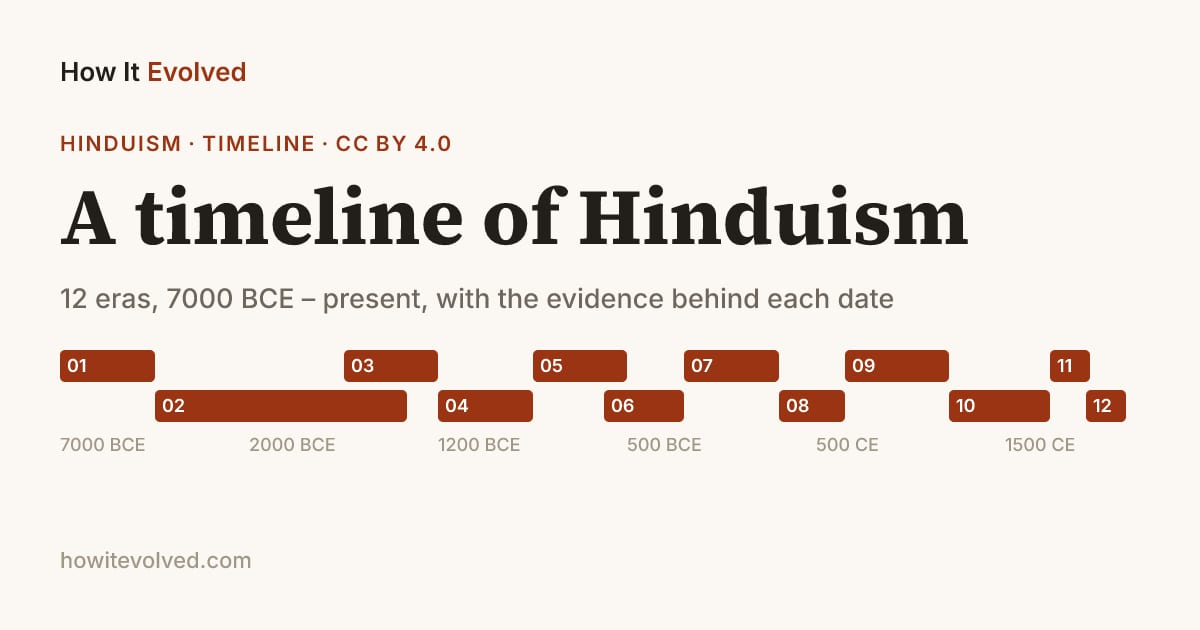
1200 × 630 JPEG. Credit: How It Evolved (howitevolved.com), CC BY 4.0.