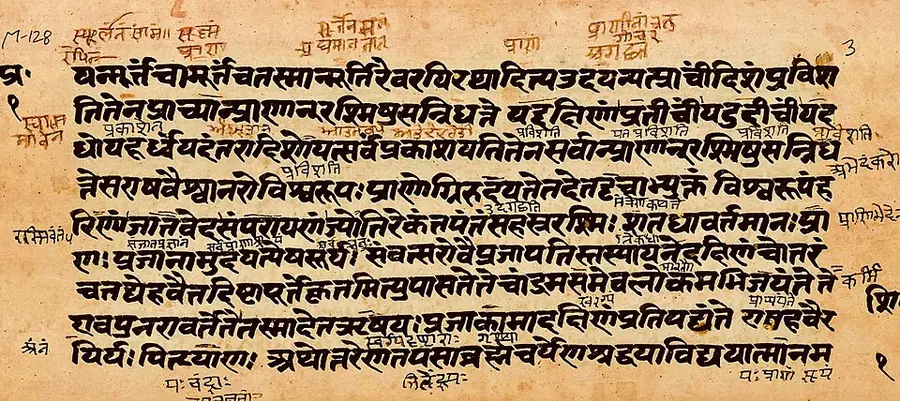
The Upanishads in one paragraph
Karma and rebirth first appear in the early Upanishads (Upaniṣads), above all the Bṛhadāraṇyaka (Brihadaranyaka) and Chāndogya (Chandogya), composed in the eastern Ganga plain c. 700–600 BCE. Across that region, between roughly 900 and 500 BCE, a set of ideas appears that had no precedent anywhere in the previous six hundred years of Vedic literature: that actions carry moral consequence across lifetimes (karma); that beings are reborn in an endless chain (saṃsāra); that the goal of religious life is release from that chain (mokṣa); and that release comes not from ritual but from knowing that the self within you is identical with the ground of all reality (ātman = brahman).
This is the largest single conceptual rupture in the history of Indian religion, and it happened alongside — and probably because of — a second urbanization: iron ploughs, rice surpluses, cities, coined money, long-distance trade, and a class of wealthy merchants with no standing in the sacrificial order. Within two centuries the same ferment produced the Buddha and Mahāvīra (§6).
Everything most people now think of as characteristically “Hindu” at the level of doctrine — karma, rebirth, liberation, the identity of self and absolute — starts here, not in the Vedas. The single most important passage in this series, the whispered first statement of karma at Bṛhadāraṇyaka 3.2.13, is quoted in full below.
Timeline of the Upanishadic period
The Upaniṣads were composed over roughly four centuries, from the prose Bṛhadāraṇyaka and Chāndogya (c. 700–600 BCE) to the verse Upaniṣads (c. 500–300 BCE), alongside the second urbanization.
| Date | Event | Confidence |
|---|---|---|
| c. 900–700 BCE | Āraṇyakas — “forest texts” — begin internalizing ritual as meditation[1] | Majority |
| c. 800–500 BCE | Agricultural surplus at scale in the eastern plain. Iron itself is far older (c. 1200–1000 BCE) and rice older still[2][3] | Majority |
| c. 700–600 BCE | Bṛhadāraṇyaka and Chāndogya Upaniṣads — the oldest, in prose[1][4] | Majority |
| c. 700–500 BCE | Northern Black Polished Ware; the second urbanization[2] | Consensus |
| c. 600–500 BCE | The sixteen mahājanapadas; first punch-marked coins[5] | Consensus |
| c. 600–500 BCE | Taittirīya, Aitareya, Kauṣītaki Upaniṣads | Majority |
| c. 480–400 BCE | The Buddha (working default; see §6 Debates); Mahāvīra → §6[6][7] | Contested (dates) |
| c. 500–300 BCE | Kaṭha, Kena, Īśā, Muṇḍaka, Śvetāśvatara — the verse Upaniṣads[1] | Majority |
Where the Upanishads were composed
The Upaniṣads were composed in Kosala, Videha and Kāśī (modern eastern UP and Bihar), a less brahmanized frontier where the Upanishadic and Śramaṇa revolutions happened at the same time.
The action has moved east again, and further than in Chapter 4. The Rigveda’s world was the Punjab; the Brāhmaṇas’ was the doāb; the Upaniṣads’ is Kosala, Videha and Kāśī — modern eastern UP and Bihar. King Janaka of Videha is the great patron; the debates happen at his court.[8]
This eastward drift is a through-line of the whole early history, and it is worth stating as a single sentence: the geographic centre of Indian religion moved roughly a thousand kilometres east between 1500 and 500 BCE, and the religion changed beyond recognition as it went.
The east matters for a second reason. It was the frontier — less brahmanized, more recently settled, with strong non-Vedic populations and traditions, and with kings who were not deferential to the priesthood. Both the Upanishadic and the Śramaṇa revolutions happen in the same region, at the same time, and to a considerable extent in the same social milieu. That is not coincidence.[9] Majority
The second urbanization behind the Upanishads
Cities, coinage, rice surplus and a wealthy merchant class without standing in the śrauta system are the best available explanation for why the Upanishadic ideas appear when and where they do.
The second urbanization is the setting, and it explains a great deal about why the ideas took.
| Dimension | Evidence | Confidence |
|---|---|---|
| Cities | Kauśāmbī, Rājagṛha, Śrāvastī, Vārāṇasī, Campā, Ujjayinī, Takṣaśilā — with ramparts, populations in the tens of thousands[2] | Consensus |
| Pottery | Northern Black Polished Ware, a luxury lustrous ware, c. 700–200 BCE[2] | Consensus |
| Coinage | Punch-marked silver kārṣāpaṇa — the first Indian money. Dates range from the 6th to the mid-4th c. BCE; Cribb argues for the later end on hoard and Achaemenid grounds[10] | Contested |
| Polity | Sixteen mahājanapadas, listed in the Buddhist Aṅguttara Nikāya; a mix of monarchies and gaṇa-saṅgha oligarchic republics[5] | Consensus |
| Economy | Iron ploughshares, rice surplus, guilds (śreṇi), long-distance trade routes, a wealthy merchant class | Consensus |
| Writing | Still not attested. Brāhmī appears securely only c. 3rd c. BCE[11] | Consensus |
Why this produces new religion. A merchant with a fortune and no varṇa standing cannot buy his way into the śrauta system, which is closed, hereditary, and requires a king’s resources. Cities detach people from lineage-based ritual obligations. Surplus makes full-time renunciation economically possible for the first time — a society has to be rich enough to feed people who produce nothing.
And urban life exposes people to the scale of anonymous suffering that makes a doctrine of cosmic justice attractive. Every one of these is a standard sociological argument and none is provable; together they are the best available explanation for why the ideas appear when and where they do.[12][5] Majority
Primary sources
The key Upaniṣadic passages show karma arriving as a whispered secret, rebirth credited to a king, the self identified with the absolute, and the Vedic gods subordinated to brahman.
1. Karma and rebirth — caught at the moment of arrival
This is the most important single passage in this series.
Bṛhadāraṇyaka Upaniṣad 3.2.13. In a public debating contest at Janaka’s court, Jāratkārava Ārtabhāga asks Yājñavalkya what remains of a person after death, when speech has gone into fire, breath into wind, and the eye into the sun. Yājñavalkya’s response:
आहर सौम्य हस्तमार्तभाग आवामेवैतस्य वेदिष्यावो न नावेतत्सजन इति । तौ होत्क्रम्य मन्त्रयांचक्राते । तौ ह यदूचतुः कर्म हैव तदूचतुः । पुण्यो वै पुण्येन कर्मणा भवति पापः पापेनेति ॥
āhara saumya hastam ārtabhāga | āvām evaitasya vediṣyāvo na nāv etat sajana iti | tau hotkramya mantrayāṃcakrāte | tau ha yad ūcatuḥ karma haiva tad ūcatuḥ | puṇyo vai puṇyena karmaṇā bhavati, pāpaḥ pāpeneti ||
“‘Take my hand, Ārtabhāga my friend. Only the two of us shall know this — this is not for us in public.’ So the two of them went out and deliberated. And what they spoke of was karman; what they praised was karman. One becomes good by good action, bad by bad action.”[13][1]
What it proves — and this is the crucial reading. The doctrine is not stated in the open debate. Yājñavalkya takes Ārtabhāga’s hand and says, in so many words, that this is not for the assembly — na nāv etat sajane. In a genre where every other teaching is proclaimed, karma is handled as an esoteric secret.
A tradition does not keep its own long-standing doctrine secret. It keeps a new one secret. Combined with the total absence of karma from the Rigveda, the other three Vedas, and the Brāhmaṇas — thousands of pages of religious literature that discuss death, the afterlife, and moral conduct at length — this passage marks the arrival of the idea, not a restatement of it.[14] Consensus that this is the earliest clear attestation; Majority on the "secret = new" reading
BU 4.4.5 then states it as settled doctrine, no longer whispered:
यथाकारी यथाचारी तथा भवति । साधुकारी साधुर्भवति । पापकारी पापो भवति ॥
yathākārī yathācārī tathā bhavati | sādhukārī sādhur bhavati | pāpakārī pāpo bhavati ||
“As one acts, as one conducts oneself, so one becomes. The doer of good becomes good; the doer of evil becomes evil.”[15]
Between 3.2.13 and 4.4.5, inside a single text, an idea goes from private to canonical.
2. Who taught it? — the kṣatriya problem
Chāndogya Upaniṣad 5.3 (and its parallel, BU 6.2), the Pañcāgni-vidyā or “doctrine of the five fires.”
Śvetaketu, a proud young brahmin freshly returned from twelve years of Vedic study, appears before Pravāhaṇa Jaivali, king of Pañcāla, who asks him five questions: Where do people go after death? How do they return? Why does the other world not fill up? At which offering do the waters become human? What are the two paths after death?
Śvetaketu cannot answer one of them. He goes to his father Uddālaka Āruṇi — a celebrated teacher — and his father cannot answer them either. Father and son go together to the king as students. And the king says (CU 5.3.7) that this knowledge has never before been in the possession of brahmins, which is why the rule of the world has belonged to the kṣatriya class.[16]
What it proves. The Upaniṣads themselves attribute the doctrine of rebirth and the two paths to a king, and record two eminent brahmins as ignorant of it. The pattern recurs: Janaka instructs brahmins; Ajātaśatru of Kāśī teaches Gārgya Bālāki (BU 2.1)[17]; Pravāhaṇa teaches here.
Two readings compete. (a) The new doctrines genuinely originated outside the priesthood — in kṣatriya circles, or in the non-Vedic populations of the east — and were absorbed by brahmins who honestly recorded where they came from. (b) It is a literary device: the humbling of the arrogant brahmin student is a stock frame, and it survives because it makes a pedagogical point, not a historical one.
The strongest evidence for (a) is simply that brahmin authors had no motive to invent stories in which brahmins are ignorant and kings are wise. Texts rarely fabricate their own humiliation.[9] Contested, leaning (a)
The doctrine itself is the first systematic theory of rebirth: the devayāna, path of the gods, from which there is no return; the pitṛyāna, path of the fathers, by which one goes to the moon, becomes rain, falls to earth, becomes food, becomes semen, and is born again; and a third, degraded course for those who do neither — “be born and die,” the small creatures.
3. Tat tvam asi — the identity of self and absolute
Chāndogya Upaniṣad 6.8.7. Uddālaka Āruṇi teaches his son Śvetaketu with a series of images: rivers merging into the sea and losing their names; salt dissolved in water, invisible but present in every part; the seed of a banyan, split open to reveal nothing, from which a great tree grows. Each ends with the same refrain:
स य एषोऽणिमैतदात्म्यमिदं सर्वं तत्सत्यं स आत्मा तत्त्वमसि श्वेतकेतो ।
sa ya eṣo ‘ṇimā, aitadātmyam idaṃ sarvam, tat satyam, sa ātmā, tat tvam asi śvetaketo |
“That which is the finest essence — this whole world has that as its self. That is the truth. That is the self. That you are, Śvetaketu.”[18]
A note this series’ own method requires. That famous rendering is Śaṅkara’s (Adi Shankara’s), followed by Deussen, Müller and almost all popular quotation. It is not the only construal: Joel Brereton (“Tat Tvam Asi in Context,” ZDMG 136, 1986) takes tat adverbially with sa ātmā as the predicate, giving “and that’s how you are, Śvetaketu” — which Olivelle adopts in the standard translation. The most quoted sentence in the corpus has a live philological dispute inside it, and a history built on evidence should say so.[19][1] Contested
[[img:max-muller|Friedrich Max Müller, whose editions and translations carried Śaṅkara’s construal of tat tvam asi into English and fixed it as the popular rendering. The grammar of the sentence is still argued over, as above.|side]]
What it proves. This is the doctrinal core of Vedānta and the most influential sentence in Indian philosophy. Note what it does structurally: it relocates the sacred from the ritual arena into the person. In Chapter 4, the cosmos is repaired by piling ten thousand bricks correctly. Here it is grasped by understanding what you already are. The entire apparatus of the śrauta system becomes, at a stroke, unnecessary for the highest goal. Consensus on the significance
Related formulations, all from the two oldest Upaniṣads:
| Passage | Sanskrit | Sense |
|---|---|---|
| BU 1.4.10[20] | अहं ब्रह्मास्मि — ahaṃ brahmāsmi | “I am brahman” |
| CU 3.14.1[21] | सर्वं खल्विदं ब्रह्म — sarvaṃ khalv idaṃ brahma | “All this is indeed brahman” |
| BU 2.3.6, 3.9.26[22] | नेति नेति — neti neti | “Not this, not this” — the absolute defined only by negation |
4. Yājñavalkya and Maitreyī — why anything is loved
Bṛhadāraṇyaka 2.4.5. Yājñavalkya, about to renounce the household life, offers to divide his property between his two wives. Maitreyī asks whether wealth would make her immortal. He says no. She replies: “What should I do with that which will not make me immortal? Tell me instead what you know.”
न वा अरे पत्युः कामाय पतिः प्रियो भवति आत्मनस्तु कामाय पतिः प्रियो भवति । … आत्मा वा अरे द्रष्टव्यः श्रोतव्यो मन्तव्यो निदिध्यासितव्यः ॥
na vā are patyuḥ kāmāya patiḥ priyo bhavati, ātmanas tu kāmāya patiḥ priyo bhavati | … ātmā vā are draṣṭavyaḥ śrotavyo mantavyo nididhyāsitavyaḥ ||
“Truly, it is not for the sake of the husband that the husband is dear, but for the sake of the self. … The self, indeed, is what should be seen, heard, reflected upon, and deeply contemplated.”[23][24]
What it proves. Two things. First, the argument itself — that every object of love is loved because of the self — which grounds the entire renunciant turn: if all desire is really desire for the self, then knowing the self ends desire. Second, the four verbs — draṣṭavya, śrotavya, mantavya, nididhyāsitavya — become the formal method of Vedānta for the next 2,500 years: hearing, reasoning, meditating.
5. Gārgī Vācaknavī — a woman argues in open assembly
BU 3.6 and 3.8. In the debating contest at Janaka’s court, Gārgī Vācaknavī questions Yājñavalkya directly. She asks what the world is woven on, and when he answers, asks what that is woven on, and so on, driving the regress upward until he stops her:
गार्गि मातिप्राक्षीर्मा ते मूर्धा व्यपप्तत् ।
gārgi mātiprākṣīr mā te mūrdhā vyapaptat | “Gārgī, do not question beyond limit, lest your head shatter.”
She sits down — and then in 3.8 stands up again, tells the assembled brahmins she will shoot two questions at him “like a warrior of Kāśī or Videha stringing his bow,” and asks what pervades what is above heaven and below earth. Yājñavalkya’s answer is the akṣara, the imperishable:
एतद्वै तदक्षरं गार्गि ब्राह्मणा अभिवदन्ति अस्थूलमनण्वह्रस्वमदीर्घम् ।
etad vai tad akṣaraṃ gārgi brāhmaṇā abhivadanti, asthūlam anaṇv ahrasvam adīrgham | “This, Gārgī, is that imperishable, which the knowers of brahman call: not coarse, not fine, not short, not long.”[25]
At the end she concedes, and tells the other brahmins that none of them will beat him.[26]
What it proves. A woman participates as a full contender in the highest philosophical debate of the age, is taken seriously, forces the greatest teacher of the period to his deepest answer, and is credited by name in scripture. This is a real datum about the period, and it should be neither inflated nor erased. It does not mean women in 700 BCE had general social equality — they did not, and Chapter 4 shows the trajectory of formal restriction already underway. It does mean the restriction was not yet total, and that the later exclusion of women from Vedic study was a development, not an eternal rule.[27][28] Consensus that the passage exists and says this; Contested on how representative it was
6. The gods get demoted
Kena Upaniṣad 3 (a later Upaniṣad, but the clearest statement). Brahman wins a victory, and the gods — Agni, Vāyu, Indra — take the credit. A mysterious spirit (yakṣa) appears before them. Agni, “the eater of all,” is challenged to burn a blade of grass and cannot. Vāyu, “who blows all things away,” is challenged to blow it away and cannot. Indra approaches, and the spirit vanishes. Only then is it revealed to him that this was brahman, and that the gods’ power was never their own.[29]
What it proves. The Vedic pantheon has been formally subordinated to an impersonal absolute. Agni had two hundred hymns in Chapter 3; here he cannot move a blade of grass. This is what the Upanishadic turn does to the older religion — it does not abolish the gods, it makes them provincial. Consensus
7. The prayer that outlived the system
BU 1.3.28
असतो मा सद्गमय । तमसो मा ज्योतिर्गमय । मृत्योर्मामृतं गमय ॥
asato mā sad gamaya | tamaso mā jyotir gamaya | mṛtyor mā amṛtaṃ gamaya ||
“From the unreal lead me to the real. From darkness lead me to light. From death lead me to immortality.”[30]
Recited today in schools and temples across India, and in its original context a formula spoken by the udgātṛ priest during a soma sacrifice — a fragment of the ritual world of Chapter 4 embedded inside the text that dissolved it.
What changed, in one table
The Upaniṣads moved the highest goal from ritual rewards to mokṣa, the means from correct ritual to knowledge of the self, and the locus of the sacred from the altar to the self.
| Brāhmaṇas (§4) | Upaniṣads (§5) | |
|---|---|---|
| Highest goal | long life, sons, cattle, the world of the fathers | mokṣa — release from rebirth |
| Means | correct ritual performance | jñāna — knowledge of the self |
| Authority | the priest who knows the correspondences | the teacher who has realized brahman |
| Locus of the sacred | the altar | the self |
| Problem to be solved | punarmṛtyu — dying again in heaven | saṃsāra — being born again at all |
| Fate after death | determined by ritual performed | determined by karma and by knowledge |
| Attitude to ritual | it is everything | not rejected, but demoted — “unsteady boats” (Muṇḍaka 1.2.7)[31] |
| The gods | dependent on sacrifice | dependent on brahman; peripheral |
| Social setting | king’s court, sacrificial ground | teacher–pupil, forest, debating assembly |
Note carefully what is not here. The Upaniṣads do not abolish ritual, and they are not a popular movement. They are esoteric texts — upa-ni-ṣad, “sitting down close to,” teachings transmitted privately — produced by an elite, for an elite, and they were attached to the Vedic corpus rather than set against it.[1] Later Vedānta will call them the Vedānta, the “end of the Veda,” in both senses of the word. Consensus
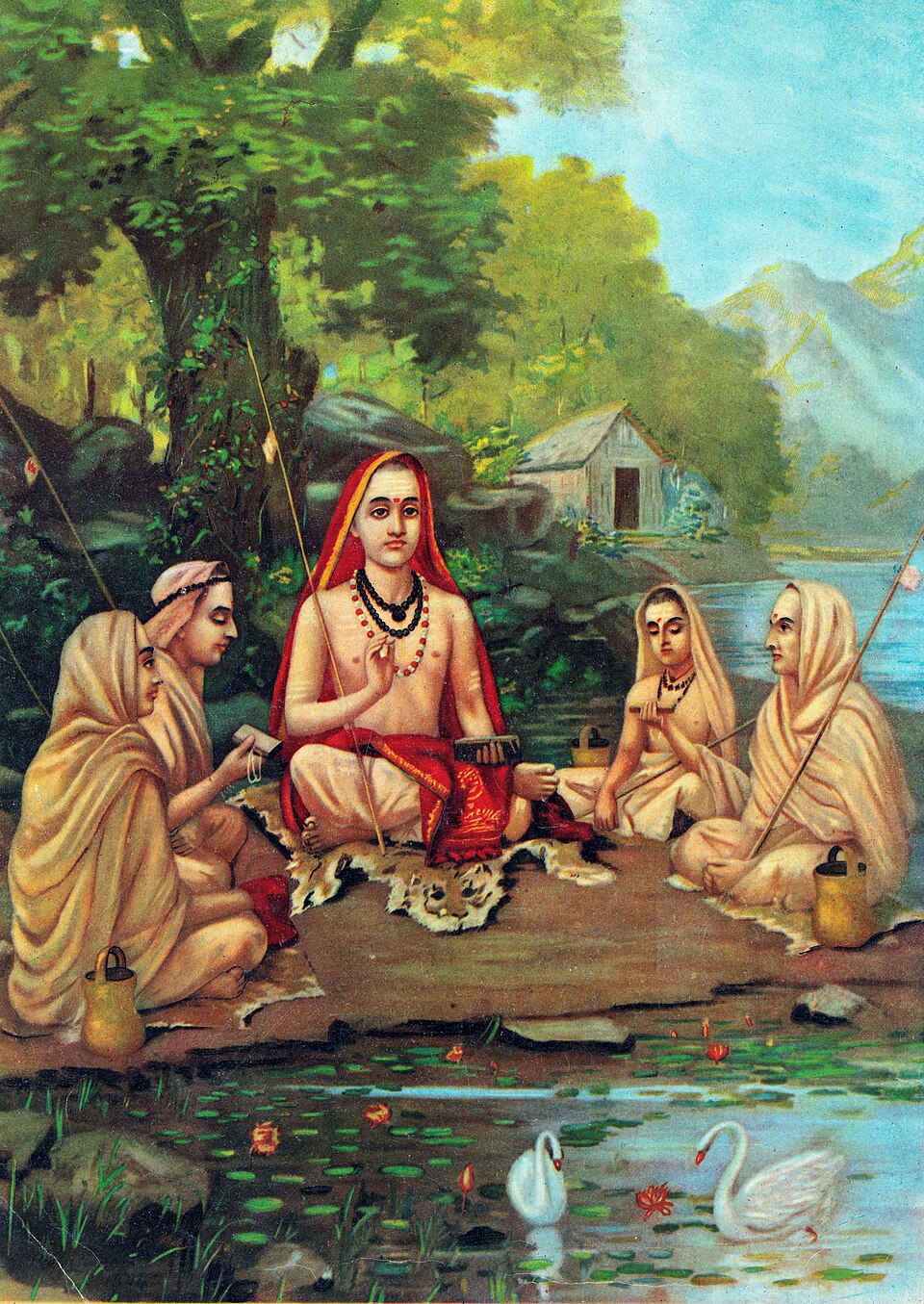
What is absent from the early Upanishads
The early Upaniṣads still have no temples or images, no bhakti as a path, no avatāra doctrine, no worked-out yoga and no writing.
- Temples and images — still nothing. Consensus
- Bhakti — devotion to a personal god is not the path here; the absolute is impersonal. The exception is the Śvetāśvatara Upaniṣad (c. 400–200 BCE), which is theistic, makes Rudra-Śiva the supreme being, and contains at 6.23 the earliest use of the word bhakti in the Vedic corpus. That text points directly at Chapter 7.[32] Majority
- Avatāra — no incarnation doctrine yet.
- A worked-out yoga — meditative practice is present (Kaṭha and Śvetāśvatara describe breath control and posture) but the eight-limbed system of Patañjali is centuries away.
- Ahiṃsā as a central value — present in Chāndogya 3.17.4 in a list of virtues[33], but not yet the organizing ethic it becomes under Śramaṇa influence (§6).
- Writing — still not attested.
Debates about the Upanishads
Four questions about the Upaniṣads remain debated: where karma and rebirth came from, whether the oldest texts precede the Buddha, whether they form a single philosophy, and whether Uddālaka’s monism was materialist.
Where did karma and rebirth come from?
Four live proposals, not mutually exclusive: (a) internal development — punarmṛtyu anxiety in the Brāhmaṇas evolving into full saṃsāra; (b) kṣatriya origin — as the texts themselves claim; (c) non-Vedic / substrate origin — from the eastern populations, with tribal cyclical cosmologies; (d) shared regional emergence — the same idea appearing across Vedic, Buddhist, Jain and Ājīvika circles at once because they are all responding to the same conditions.[9][14] Contested
Did the Upanishads precede the Buddha?
For BU and CU, yes, on almost all reckonings — they are pre-Buddhist in language and do not respond to Buddhist positions, while later Upaniṣads clearly do. The overall Upanishadic and Śramaṇa movements are best seen as contemporaneous strands of one ferment rather than as sequential.[1][34] Majority
Are the Upanishads a single philosophy?
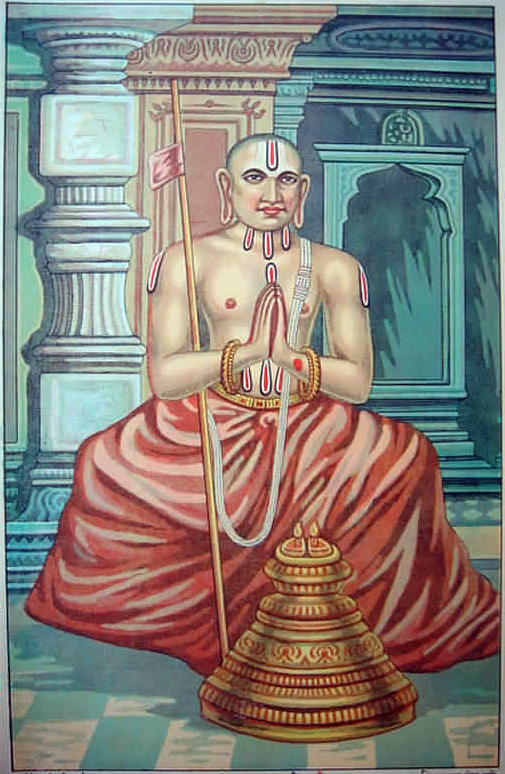
No. This is worth stressing because the tradition later treats them as one. They contain incompatible positions — a personal creator and an impersonal absolute; an ātman that is pure consciousness and one that is a subtle physical entity; monism and theism. The later Vedānta schools (§9) — Śaṅkara’s Advaita, Rāmānuja’s (Ramanuja’s) Viśiṣṭādvaita, Madhva’s Dvaita — each derive an entire, mutually contradictory system from the same texts, which is possible only because the texts are genuinely plural.[4] Consensus
Was Uddalaka’s monism materialist?
Sat, “being,” in Chāndogya 6 has been read as a proto-material substance rather than a spiritual absolute, with Uddālaka as a natural philosopher closer to the Presocratics than to later Vedānta. Śaṅkara’s reading — the standard one for a millennium — is not obviously what the text says.[35] Contested
Further reading
- Patrick Olivelle, The Early Upaniṣads: Annotated Text and Translation (Oxford, 1998). The standard scholarly edition; his introduction is the best short account of the period.
- Patrick Olivelle, The Āśrama System (1993) — on renunciation as a social institution.
- Signe Cohen, Text and Authority in the Older Upaniṣads (2008).
- Johannes Bronkhorst, Greater Magadha: Studies in the Culture of Early India (2007) — the strongest case for the eastern, non-Vedic origin of karma and rebirth.
- Wendy Doniger, The Hindus: An Alternative History (2009), chapters on the Upaniṣads.
- Romila Thapar, Early India: From the Origins to AD 1300 (2002) — for the second urbanization.
References
- ^ a b c d e f g Patrick Olivelle, trans. The Early Upaniṣads: Annotated Text and Translation. Oxford University Press, 1998. full text The scholarly standard. Its introduction is the best short account of the period.
- ^ a b c d Robin Coningham & Ruth Young The Archaeology of South Asia: From the Indus to Asoka. Cambridge University Press, 2015. The standard synthesis for §§1–6.
- ^ Rakesh Tewari "The origins of iron-working in India". Antiquity 77, 2003. The early iron dates from Malhar and Raja Nala ka Tila.
- ^ a b Signe Cohen Text and Authority in the Older Upaniṣads. Brill, 2008. open library
- ^ a b c Romila Thapar Early India: From the Origins to AD 1300. Penguin, 2002. full text The best single-volume political and social history for this whole span.
- ^ Heinz Bechert, ed. The Dating of the Historical Buddha. Vandenhoeck & Ruprecht, 3 vols., 1991. The symposium that unsettled the traditional dates — and reached no consensus.
- ^ L. S. Cousins "The Dating of the Historical Buddha: A Review Article". Journal of the Royal Asiatic Society 6, 1996. doi Where the c. 400 BCE working default comes from.
- ^ Steven E. Lindquist The Literary Life of Yājñavalkya. SUNY Press, 2023. doi Treats the Upaniṣads' central figure as literary characterization — a lever against reading BU 3–4 as doctrinal reportage.
- ^ a b c Johannes Bronkhorst Greater Magadha: Studies in the Culture of Early India. Brill, 2007. full text The strongest case for an eastern, non-Vedic origin for karma and rebirth. Influential and contested.
- ^ Upinder Singh A History of Ancient and Early Medieval India. Pearson, 2008. open library The best textbook on the archaeology-plus-text synthesis.
- ^ Richard Salomon Indian Epigraphy. Oxford University Press, 1998. open library The standard handbook for inscriptions and their dating.
- ^ Patrick Olivelle The Āśrama System: The History and Hermeneutics of a Religious Institution. Oxford University Press, 1993. Establishes that the āśramas began as alternatives, not stages.
- ^ BU 3.2.13 — Bṛhadāraṇyaka Upaniṣad. c. 700 BCE. Sanskrit. The single most important passage on this site: karma is taught in private, away from the assembly — which is how we know the idea was new. read the text
- ^ a b Johannes Bronkhorst "Whence Karma?". Contributions to Indian Sociology 56, 2022. doi His revised position: the thing to explain is ethicization, not rebirth. Rejects both Obeyesekere and Seaford.
- ^ BU 4.4.5 — Bṛhadāraṇyaka Upaniṣad. c. 700 BCE. Sanskrit. "As one acts, so one becomes." Karma now stated openly as settled doctrine — inside the same text that whispered it. read the text
- ^ CU 5.3–10 — Chāndogya Upaniṣad. c. 700 BCE. Sanskrit. Pañcāgni-vidyā. A kṣatriya king teaches rebirth to two brahmins who cannot answer his questions — the texts crediting the doctrine outside the priesthood. read the text
- ^ BU 2.1 — Bṛhadāraṇyaka Upaniṣad. c. 700 BCE. Sanskrit. Ajātaśatru, king of Kāśī, instructs the brahmin Gārgya Bālāki — another case of the texts crediting a kṣatriya. Not the Magadhan Ajātaśatru of §6. read the text
- ^ CU 6.8.7 — Chāndogya Upaniṣad. c. 700 BCE. Sanskrit. tat tvam asi — "that you are." The doctrinal core of Vedānta and the most influential sentence in Indian philosophy. read the text
- ^ Joel P. Brereton "Tat Tvam Asi in Context". Zeitschrift der Deutschen Morgenländischen Gesellschaft 136, 1986. The philological case against the familiar rendering of the most quoted sentence in the Upaniṣads.
- ^ BU 1.4.10 — Bṛhadāraṇyaka Upaniṣad. c. 700 BCE. Sanskrit. ahaṃ brahmāsmi — "I am brahman." read the text
- ^ CU 3.14.1 — Chāndogya Upaniṣad. c. 700 BCE. Sanskrit. sarvaṃ khalv idaṃ brahma — "all this is indeed brahman." read the text
- ^ BU 2.3.6 & 3.9.26 — Bṛhadāraṇyaka Upaniṣad. c. 700 BCE. Sanskrit. neti neti — "not this, not this." The absolute defined only by negation. read the text
- ^ BU 2.4.5 — Bṛhadāraṇyaka Upaniṣad. c. 700 BCE. Sanskrit. Yājñavalkya to Maitreyī: everything is loved for the sake of the self. Supplies Vedānta's method — hear, reason, meditate. read the text
- ^ BU 4.5.1 — Bṛhadāraṇyaka Upaniṣad. c. 700 BCE. Sanskrit. Maitreyī is a brahmavādinī; the other wife "had only a woman's knowledge." The redactor felt the need to categorize a woman as a theological disputant — and to contrast her. read the text
- ^ BU 3.6 & 3.8 — Bṛhadāraṇyaka Upaniṣad. c. 700 BCE. Sanskrit. Gārgī Vācaknavī argues Yājñavalkya to his deepest answer in open assembly, and is credited by name in scripture. read the text
- ^ BU 3.8.12 — Bṛhadāraṇyaka Upaniṣad. c. 700 BCE. Sanskrit. Gārgī concedes to the assembly and tells the other brahmins none of them will beat Yājñavalkya — it is she who adjudicates the contest. read the text
- ^ BU 6.4.17 — Bṛhadāraṇyaka Upaniṣad. c. 700 BCE. Sanskrit. A domestic rite for begetting a learned daughter (paṇḍitā). The adjacent rites for sons are more elaborate — the asymmetry is itself the finding. read the text
- ^ BU 6.5.1 — Bṛhadāraṇyaka Upaniṣad. c. 700 BCE. Sanskrit. A teacher lineage in which every master is named by his mother. Matronymic identification was normal in the transmission of the very corpus that restricts women. read the text
- ^ Kena 3 — Kena Upaniṣad. c. 500 BCE. Sanskrit. Agni cannot burn a blade of grass without brahman. The Vedic pantheon formally subordinated to an impersonal absolute. read the text
- ^ BU 1.3.28 — Bṛhadāraṇyaka Upaniṣad. c. 700 BCE. Sanskrit. asato mā sad gamaya — a soma-ritual formula that outlived the ritual and is recited in schools today. read the text
- ^ Muṇḍaka 1.2.7 — Muṇḍaka Upaniṣad. c. 400 BCE. Sanskrit. Sacrificial rites called "unsteady boats" — ritual demoted rather than rejected, in the tradition's own words. read the text
- ^ ŚvU 6.23 — Śvetāśvatara Upaniṣad. c. 400–200 BCE. Sanskrit. The earliest use of the word bhakti in the Vedic corpus, in the first theistic Upaniṣad. read the text
- ^ CU 3.17.4 — Chāndogya Upaniṣad. c. 700 BCE. Sanskrit. Ahiṃsā listed among the virtues — present in the Vedic stream before the Śramaṇas made it central. read the text
- ^ Michael Witzel "Moving Targets? Texts, Language, Archaeology and History in the Late Vedic and Early Buddhist Periods". Indo-Iranian Journal 52, 2009. doi The central chronological rebuttal to Bronkhorst.
- ^ CU 6.1–6.16 — Chāndogya Upaniṣad. c. 700 BCE. Sanskrit. Uddālaka Āruṇi's whole teaching on sat, "being" — read by Śaṅkara as a spiritual absolute, and by others as something closer to a material substance. read the text