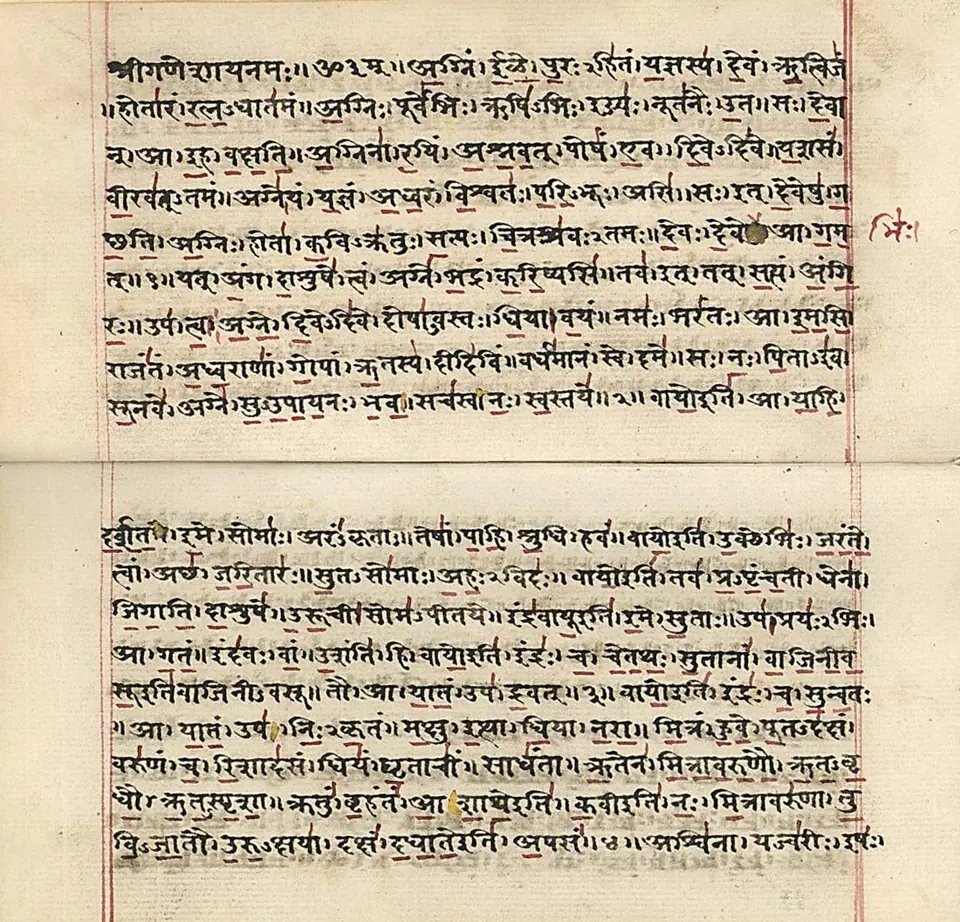
The honest answer is “one verse, and a late one.” The Rigveda contains the most famous statement of the four varṇas ever composed, and that statement is the only one of its kind in the entire collection. It sits in the youngest layer of the text. Everything that makes caste caste — birth, heredity, endogamy, untouchability — is either absent from the Rigveda or appears only later.[1][2]
The evidence
The verse. The Puruṣa Sūkta describes the gods sacrificing a primal cosmic being and making the world from his body:
ब्राह्मणोऽस्य मुखमासीद् बाहू राजन्यः कृतः । ऊरू तदस्य यद्वैश्यः पद्भ्यां शूद्रो अजायत ॥
brāhmaṇó ‘sya múkham āsīd bāhū́ rājanyáḥ kṛtáḥ | ūrū́ tád asya yád váiśyaḥ padbhyā́ṃ śūdró ajāyata ||
“His mouth was the Brāhmaṇa; the Rājanya was made his arms; his thighs the Vaiśya; from his feet the Śūdra was born.” — RV 10.90.12[1]
What it proves, and what it doesn’t. Four facts about it are independently established:
- It is the only passage in 1,028 hymns that describes a four-varṇa order.
- It is in Maṇḍala 10, which by language, metre and style is markedly younger than the Family Books (Maṇḍalas 2–7).
- It is the only occurrence of the words vaiśya and śūdra in the Rigveda.
- Its theology — a cosmic sacrifice producing the world — has no parallel in the old core and belongs with the ritual speculation of the Brāhmaṇa period.[3][2]
So the four-varṇa scheme is an end-point of the Rigvedic period, not its premise. Consensus on the dating; Contested on what earlier ranking looked like
What the older hymns show instead. The early Rigveda describes tribes (jána, víś), chiefs (rā́jan), assemblies and priests, and it is plainly ranked.[4] The word varṇa does occur in an old Family Book, but for something else: RV 2.12.4 speaks of the dāsa varṇa, a group of outsiders set against the Ārya — the earliest use of varṇa for a human group, and not the fourfold scheme.[5] The nineteenth-century racial reading of the Dāsas has been abandoned; the terms used of them are overwhelmingly ritual and linguistic (people who do not sacrifice or speak properly).[6] Contested And one late hymn has a poet say, without embarrassment:
“I am a poet, my father is a physician, my mother a grinder of grain.” — RV 9.112.3[7]
That hymn is itself a late accretion, so it proves coexistence, not an older fluidity: occupational mixing and the Puruṣa Sūkta sit inside the same collection. Majority
Where it hardens. A few centuries after the Rigveda, the Aitareya Brāhmaṇa (c. 800 BCE) describes the Vaiśya as “tributary to another, to be lived on by another, to be oppressed at will” and the Śūdra as “the servant of another, to be removed at will, to be slain at will.” Śūdras are barred from Vedic study, initiation and the great sacrifices.[8] This, rather than the Rigveda, is the hinge where ranking turns into religiously sanctioned hereditary subordination. Majority
Where it is codified. The Dharmasūtras (from c. 300 BCE) turn exclusion into penalty: Gautama prescribes molten tin for the ears of a śūdra who listens to the Veda.[9][10] The Manusmṛti (c. 200 BCE – 200 CE) fixes graded punishments by varṇa, elaborate impurity rules and the disabilities of the caṇḍāla — the point where untouchability becomes systematic doctrine.[11] Consensus that the texts say this
A short timeline
| Date | What happens | Confidence |
|---|---|---|
| c. 1500–1200 BCE | Family Books: ranked tribal society; dāsa varṇa for outsiders; no four-varṇa scheme[5][3] | Majority |
| c. 1200–1000 BCE | Puruṣa Sūkta, RV 10.90, in Maṇḍala 10[1] | Consensus |
| c. 800 BCE | Aitareya Brāhmaṇa 7.29: hereditary subordination stated[8] | Majority |
| c. 500–300 BCE | Buddhist and Jain critiques of birth-status: “not by birth does one become a brahmin”[12][13] | Consensus |
| c. 300 BCE onward | Dharmasūtras: ritual exclusion becomes legal penalty[9] | Majority |
| c. 200 BCE – 200 CE | Manusmṛti; Bhagavad Gītā 4.13 on varṇa by guṇa and karma[11][14] | Majority |
| c. 300–650 CE | Land grants entrench brahmin status; jāti proliferates[4] | Majority |
| 1871–1931 | Colonial censuses record, and in 1901 rank, castes[15][16] | Consensus |
Varṇa is not jāti
Much confusion comes from treating two different things as one. Varṇa is the four-part scheme of the Puruṣa Sūkta and the law books: a normative, priestly theory. Jāti is the thousands of endogamous birth-groups that actually structure Indian social life. The Rigveda has neither in its later form; the relation between the two is itself debated.[4] Colonial censuses from 1871 required everyone to have one caste, and H. H. Risley’s 1901 census ranked them, which helped turn a local, negotiable system into a rigid all-India category — though caste hierarchy, endogamy and untouchability are attested for centuries before.[15][16] Majority
What genetics adds. Narasimhan et al. (2019) found that steppe-derived ancestry in South Asia is distributed today on a gradient correlating with geography and with traditional priestly status.[17] That is consistent with long-standing endogamy among some groups, but it describes ancestry, not doctrine, and it says nothing about when or how varṇa ideology arose. Endogamy remains the mechanism by which caste reproduces itself, as Ambedkar argued in 1916; inter-caste marriage in India was still only 5.82% of marriages in 2011–12, essentially flat across four decades.[18][19] Consensus on the data; Contested on its history
What scholars disagree about
What early Vedic ranking looked like. Some read the priest–warrior–commoner division as already present in embryo, with the Puruṣa Sūkta merely formalizing it; others see a looser, occupational ranking that the late hymn reinterprets as cosmic.[3][2] Contested
Is the Puruṣa Sūkta about birth? The verb for the Śūdra is ajāyata, “was born,” while the other three are identified with body parts. Many traditional commentators and modern reformers read the hymn as a metaphor of social function — an organic body in which every part is needed — not a charter of hereditary rank. That reading has a long pedigree, and the Gītā’s “according to guṇa and karma” (4.13) has been used both ways for two thousand years.[14] What is not disputed is that later Brahmanical law treated varṇa as hereditary.[11] Contested
Did the British invent caste? No. The strong claim is not supportable; the defensible one is that colonial enumeration transformed and rigidified caste and made it a political category.[16] Majority
Common misconceptions
- “The Vedas are full of caste.” The four-varṇa scheme appears once in the Rigveda, late. Hereditary hierarchy is explicit in the later Brāhmaṇas and law books.[1][8]
- “Caste has no roots in scripture.” It does — the Puruṣa Sūkta became the most consequential verse in Indian social history — but those roots are in the Rigveda’s latest layer and in post-Rigvedic texts.[3]
- “Varṇa and caste mean the same thing.” Varṇa is four theoretical orders; jāti is thousands of real endogamous groups.[4]
Why it matters
Dating the Puruṣa Sūkta turns a claim about eternal order into a history with stages: occupational ranking in the early hymns, a four-varṇa theory at the end of the Rigvedic period, hereditary subordination in the Brāhmaṇas, legal codification in Dharmaśāstra, and colonial rigidification. That sequence is an argument about texts, not a verdict on anyone’s faith. The evidence for the first stages is laid out in §3 and §4.
References
- ^ a b c d RV 10.90.12 — Rigveda. c. 1100 BCE. Vedic Sanskrit. Puruṣa Sūkta. The only four-varṇa passage in 1,028 hymns, and the only occurrence of vaiśya and śūdra — in the latest layer. read the text
- ^ a b c Stephanie W. Jamison & Joel P. Brereton, trans. The Rigveda: The Earliest Religious Poetry of India. Oxford University Press, 3 vols., 2014. The standard complete English translation. Supersedes Griffith entirely.
- ^ a b c d Michael Witzel "Early Sanskritization: Origins and Development of the Kuru State". Electronic Journal of Vedic Studies 1, 1995. doi The Kuru state thesis — canonization as a political project.
- ^ a b c d Romila Thapar Early India: From the Origins to AD 1300. Penguin, 2002. full text The best single-volume political and social history for this whole span.
- ^ a b RV 2.12.4 — Rigveda. c. 1400 BCE. Vedic Sanskrit. The earliest use of varṇa for a human group — and it is dāsa varṇa, not the fourfold scheme. Griffith's translation erases the word entirely. read the text
- ^ Hans Henrich Hock "Through a Glass Darkly: Modern 'Racial' Interpretations vs. Textual and General Prehistoric Evidence on Ārya and Dāsa/Dasyu in Vedic Society". in Aryan and Non-Aryan in South Asia, 1999. The standard reference on the Dāsa/Dasyu question.
- ^ RV 9.112.3 — Rigveda. c. 1200 BCE. Vedic Sanskrit. "I am a poet, my father a physician, my mother grinds grain" — one family, three occupations, no varṇa embarrassment. read the text
- ^ a b c AB 7.29 — Aitareya Brāhmaṇa. c. 800 BCE. Vedic Sanskrit. Defines the vaiśya as "to be lived on by another" and the śūdra as "to be removed at will" — varṇa hardening into hereditary subordination. read the text
- ^ a b Gautama DhS 12.4–6 — Gautama Dharmasūtra. c. 300 BCE. Sanskrit. A śūdra who listens to Veda recitation shall have his ears filled with molten tin. Ritual exclusion becomes criminal penalty, exactly as the Śramaṇas make birth a public issue. read the text
- ^ Patrick Olivelle, trans. Dharmasūtras: The Law Codes of Ancient India. Oxford University Press, 1999. Āpastamba, Gautama, Baudhāyana, Vasiṣṭha in one volume.
- ^ a b c Patrick Olivelle, trans. Manu's Code of Law: A Critical Edition and Translation. Oxford University Press, 2005. full text The critical edition, plus the standard account of the text's real historical status.
- ^ Dhp 393 — Dhammapada. c. 300 BCE. Pali. "Not by matted hair, not by lineage, not by birth" — the Śramaṇa attack lands on hereditary claim, not on ritual technique. read the text
- ^ MN 93 — Assalāyana Sutta (Majjhima Nikāya). c. 300 BCE. Pali. The fullest argument against brahmin birth-claims: brahmin women give birth like everyone; among the Yonas masters become slaves; a fire kindled by an outcaste burns identically. read the text
- ^ a b BhG 4.13 — Bhagavad Gītā. c. 200 BCE – 200 CE. Sanskrit. Varṇa created "according to guṇa and karma" — whether that means birth or aptitude has been argued for two millennia. read the text
- ^ a b Report on the Census of India, 1901 — H. H. Risley. 1901 CE. English. Castes ranked "by social precedence" alongside nasal-index anthropometry — where Aryan race theory and the caste machinery physically meet. Ranking abandoned after the backlash. about
- ^ a b c Nicholas B. Dirks Castes of Mind: Colonialism and the Making of Modern India. Princeton University Press, 2001. full text The strong statement of the colonial-construction-of-caste case. Widely cited and widely criticized.
- ^ Vagheesh M. Narasimhan et al. "The formation of human populations in South and Central Asia". Science 365, 2019. doi Over 500 ancient genomes. The steppe-ancestry signal, and its limits.
- ^ Castes in India — B. R. Ambedkar. 1916 CE. English. A Columbia seminar paper identifying endogamy as the mechanism of caste — the thesis §12 relies on for why caste reproduces itself. about
- ^ India Human Development Survey II — NCAER and University of Maryland. 2011–12. English. 5.82% of ever-married women in an inter-caste marriage, with no upward trend across four decades of marriage cohorts. The flatness is the more striking finding than the level. about