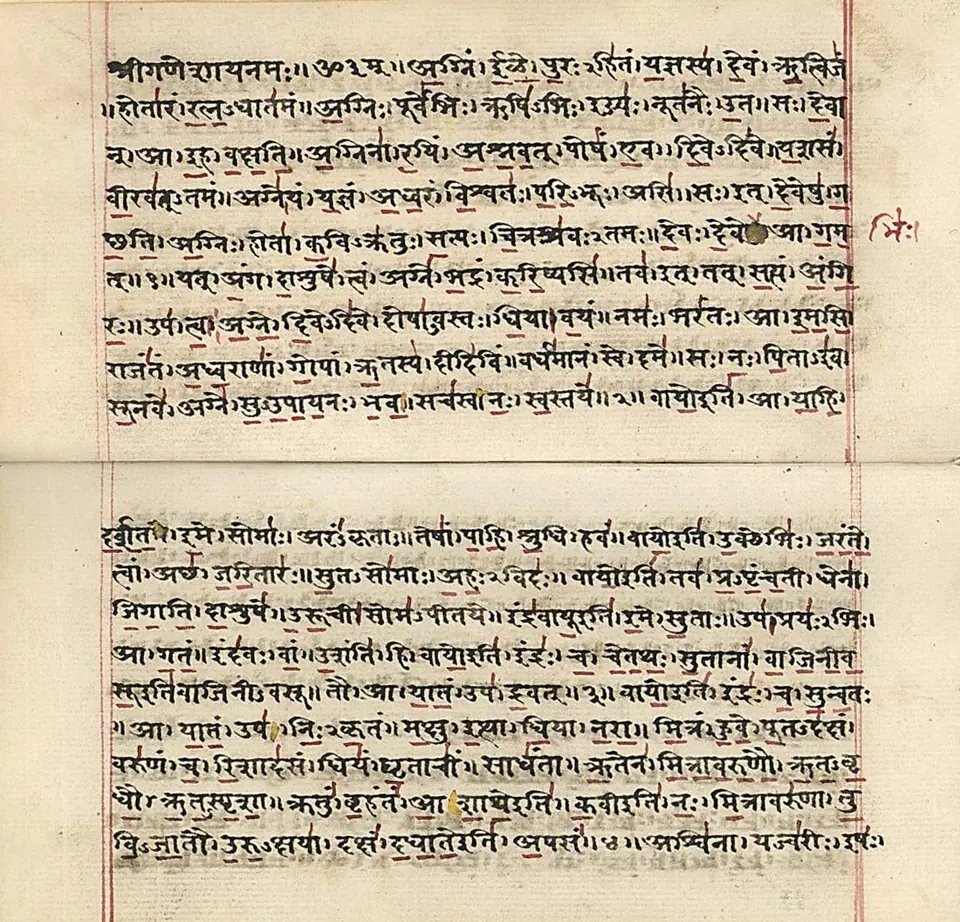
The question has two answers, and most confusion comes from mixing them up. The Rigveda was composed — orally, by named priestly families — over a few centuries in the second half of the second millennium BCE. It was written much later: there was no writing in India when it was made, and none for roughly a thousand years afterwards.[1][2] For most of its history the Rigveda was a text that existed only in trained memory.
Composed, not written: how the Rigveda survived
The Rigveda is 1,028 hymns and 10,552 verses in ten books (maṇḍalas).[1] It was preserved by a recitation system built for redundancy. Pupils learned every verse several ways: continuously (saṃhitā), word by word (pada), and in interlocking patterns such as krama (1-2, 2-3, 3-4), jaṭā and ghana, which run word pairs forwards and backwards. A single slip breaks the pattern audibly.[3]
The result is a text better preserved than most ancient written literature. Manuscripts from opposite ends of India agree closely, and the text keeps a pitch accent that the spoken language had lost by roughly the last centuries BCE — a feature nobody would preserve unless they were transmitting mechanically and faithfully.[1][3] Consensus
So “written” is the wrong verb for the composition, and the date of the first written copy tells you almost nothing about the age of the hymns. When the Rigveda was first committed to writing is not recorded; what can be said is that it cannot be earlier than writing itself, which in India is securely attested only from Ashoka’s edicts, c. 250 BCE.[2][4] Even after that, the tradition treated the recited text, not the manuscript, as the authority.
The evidence for 1500–1200 BCE
The Rigveda contains no dates. The mainstream range is reached by combining a relative sequence from inside the text with a few fixed points from outside it.
The internal sequence. Grammar, metre, vocabulary and the genealogies of seers and kings all agree that Maṇḍalas 2–7, the “Family Books,” are the oldest core; 8 and 9 follow; and Maṇḍalas 1 and 10 are the latest.[5][1] Consensus This is why the date is always given for a layer, not for “the Rigveda” as a whole. The only four-varṇa hymn, the Nāsadīya creation hymn and the Ganga’s first mention all sit in Maṇḍala 10.
The Mitanni treaty (c. 1350–1320 BCE). A treaty from the Hittite archive at Boğazköy in Anatolia invokes Mi-it-ra, Uru-wa-na, In-da-ra and the Na-ša-at-tiya — Mitra, Varuṇa, Indra and the Nāsatyas — as divine witnesses. A companion horse-training manual, the Kikkuli text, counts laps in Indo-Aryan numerals (aika-, tera-, panza-, satta-, na-vartana).[6][7] Indo-Aryan gods and speech were therefore in written form in Syria some two centuries before anything was written in India. It is the single most important external date in Vedic studies, and it puts a recognizably Vedic pantheon firmly in the second half of the second millennium. Consensus
The missing iron. In the Rigveda áyas means copper or bronze. The distinction “dark metal” (śyāma áyas, iron) against “red metal” first appears in the Atharvaveda.[8][9] Iron in quantity in north India is c. 1200 BCE, so a text that never needs a word for it most likely comes before it. Consensus on the sequence; Contested on the earliest iron dates
The world the hymns describe. Barley but no rice; horses and spoke-wheeled chariots but no cities, coins or writing; the lion but not the tiger.[10] The river hymn RV 10.75 lists the rivers in strict order from the Ganga westward into Afghanistan, and the Ganga is named only once in the whole collection:
इमं मे गङ्गे यमुने सरस्वति शुतुद्रि स्तोमं सचता परुष्ण्या ।
imáṃ me gaṅge yamune sarasvati śutudri stómaṃ sacatā paruṣṇyā |
“Accept this praise of mine, O Gaṅgā, Yamunā, Sarasvatī, Śutudrī, together with the Paruṣṇī.” — RV 10.75.5[11]
What it proves: the hymns’ mental map is centred on the Punjab, with the Ganga plain at the far eastern edge — the world before the eastward move that the later Vedic texts describe (§4).[10]
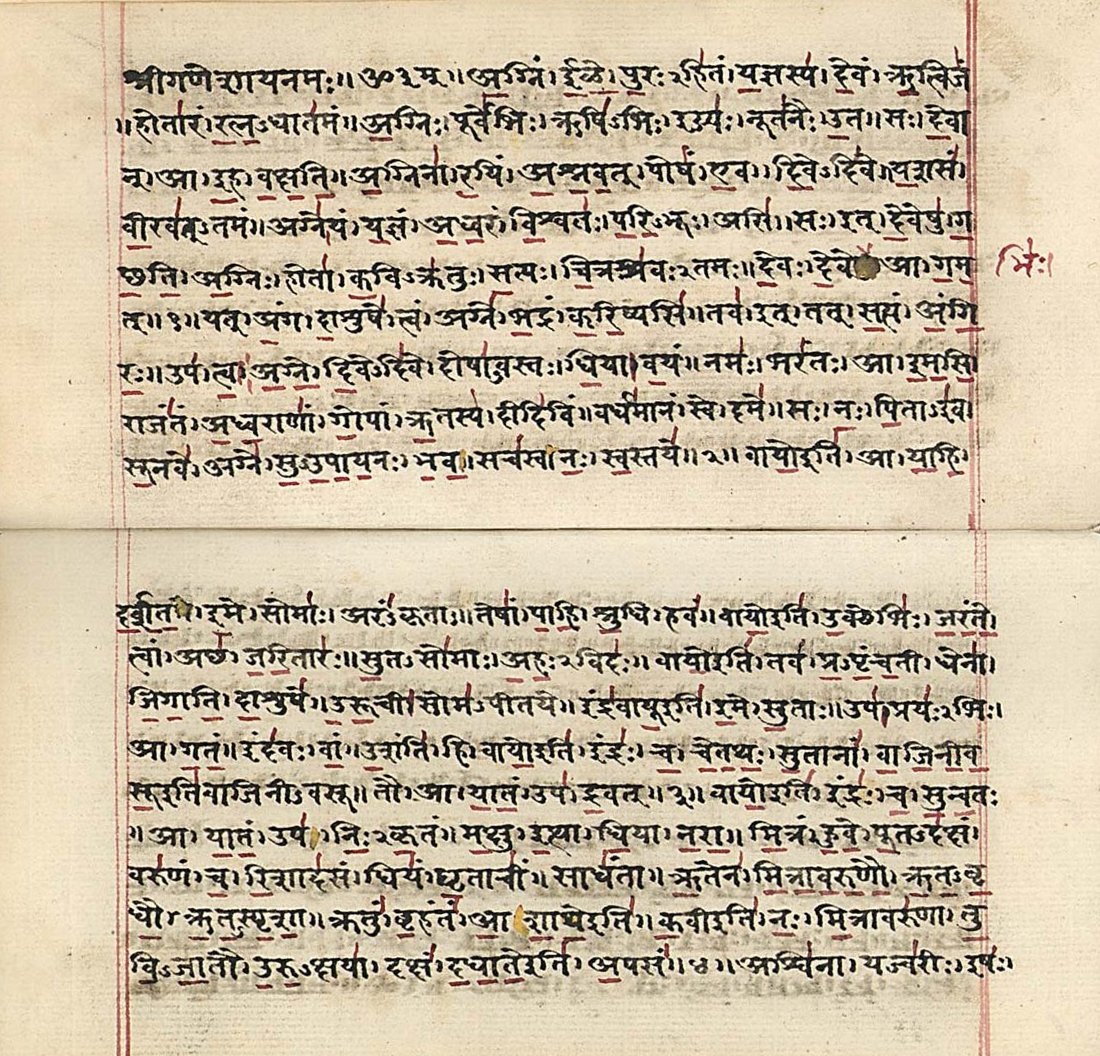
The end point. The later Vedic literature, which knows iron, rice and the Ganga–Yamuna doāb, treats the Rigveda as a closed, fixed collection. Witzel places that fixing, and the compilation of the other three Vedas, in the Kuru realm around 1100 BCE.[5] Majority
A short timeline
| Date | What happens | Confidence |
|---|---|---|
| c. 2600–1900 BCE | Mature Harappan cities, with no horse, chariot or spoked wheel (§2)[12] | Consensus |
| c. 2200 BCE | The domestic horse lineage begins spreading across Eurasia[13] | Majority |
| c. 1500–1200 BCE | Family Books (Maṇḍalas 2–7) composed in the Punjab[5][1] | Majority |
| c. 1350–1320 BCE | Mitanni treaty names Mitra, Varuṇa, Indra and the Nāsatyas[6] | Consensus |
| c. 1200–1000 BCE | Maṇḍala 10, the latest layer, including the Puruṣa Sūkta | Majority |
| c. 1100 BCE | The collection fixed under the Kurus; other Vedas compiled[5] | Majority |
| c. 250 BCE | First securely dated writing in India, Ashoka’s edicts[4][2] | Consensus |
| Later | The Rigveda is written down; oral recitation remains the authority | Consensus |
What scholars disagree about
How early the oldest hymns can go. Within the mainstream the argument is over decades and centuries, not millennia. The 1500 BCE figure is an estimate built back from the Mitanni horizon and the iron boundary, not a measured date. Majority
The Sarasvatī and the early dating. A different case puts the Rigveda at 3000 BCE or earlier. Its strongest form runs: the Rigveda praises the Sarasvatī, some seventy times, as a great river flowing to the sea; the Sarasvatī is the now-dry Ghaggar-Hakra, along which many Harappan sites lie; that river was already failing by c. 2000 BCE; so the hymns must be older, and the Harappans may have been Vedic.[14][15] The case is argued seriously, and Chatterjee et al. (2019) is a peer-reviewed paper for a Himalayan-fed river in the Harappan heartland. Contested / Political
The counter-case has three parts. Geomorphology (Giosan et al. 2012; Clift et al. 2012) indicates the Ghaggar-Hakra was monsoon-fed for most of the Harappan period, and that the Sutlej and Yamuna left it tens of millennia before the Harappans — so it was never the perennial Himalayan torrent the hymns describe.[16][17] The name Sarasvatī matches Avestan Haraxvaitī, the Helmand in Afghanistan, and may have travelled east with its speakers. And Rigvedic river praise is formulaic.[18] Above all, an early date would place an iron-less, rice-less, city-less, horse-and-chariot society in the middle of the mature Harappan urban period, whose cities the hymns never describe.[18][5]
The missing memory of arrival. The Rigveda contains no story of its people coming from elsewhere. That is a real puzzle for the migration model, not a trivial one; the usual replies are that the movement was slow and multi-generational, and that liturgy is not where such memories are kept.[18] Contested The genetic side of that argument is set out in the page on ancient DNA and the Aryan migration.
Common misconceptions
- “The Rigveda was written by one author.” It is an anthology. Each Family Book is the repertoire of a priestly lineage — Gṛtsamada, Viśvāmitra, Vāmadeva, Atri, Bharadvāja, Vasiṣṭha — and was mechanically ordered by deity and hymn-length, which is itself evidence of deliberate archiving.[5][1]
- “An oral text must be unreliable.” For the Rigveda the reverse is true; its oral transmission is more exact than most manuscript traditions.[3]
- “Rejecting a 5000 BCE date means accepting an ‘Aryan invasion.’” The invasion model has been abandoned for decades; the dating rests on the text’s own contents and the Mitanni documents, not on any theory of conquest (§0).[19]
Why it matters
The date decides what the Rigveda can be evidence for. Placed c. 1500–1200 BCE, it describes a pastoral, chariot-driving society in the Punjab after the Harappan cities had emptied — with no temples, images, karma or caste by birth — and everything later Hinduism added becomes a history of change. Push it back two thousand years and the same hymns would have to describe the Harappan world they never mention. The full reconstruction of that early world, hymn by hymn, is in §3.
References
- ^ a b c d e f Stephanie W. Jamison & Joel P. Brereton, trans. The Rigveda: The Earliest Religious Poetry of India. Oxford University Press, 3 vols., 2014. The standard complete English translation. Supersedes Griffith entirely.
- ^ a b c Richard Salomon Indian Epigraphy. Oxford University Press, 1998. open library The standard handbook for inscriptions and their dating.
- ^ a b c Frits Staal Agni: The Vedic Ritual of the Fire Altar. Asian Humanities Press, 2 vols., 1983. open library Documentation of the 1975 Agnicayana in Kerala — plausibly the oldest continuously performed ritual on earth.
- ^ a b Rock Edict 13 — Ashokan edicts. c. 256 BCE. Prakrit in Brāhmī. Names five Hellenistic kings whose reigns are independently dated — the peg the entire Indian chronology hangs from. read the text
- ^ a b c d e f Michael Witzel "Early Sanskritization: Origins and Development of the Kuru State". Electronic Journal of Vedic Studies 1, 1995. doi The Kuru state thesis — canonization as a political project.
- ^ a b Mitanni–Hittite treaty — Boğazköy archive. c. 1350–1320 BCE. Akkadian, with Indo-Aryan divine names. Invokes Mitra, Varuṇa, Indra and the Nāsatyas as witnesses — Indo-Aryan gods attested in writing in Syria two centuries before anything written in India. about
- ^ Kikkuli horse-training text — Hittite archive. c. 1400 BCE. Hittite with Indo-Aryan numerals. aika-, tera-, panza-, satta-, na-vartana — Indo-Aryan numerals in an Anatolian technical manual. about
- ^ Rakesh Tewari "The origins of iron-working in India". Antiquity 77, 2003. The early iron dates from Malhar and Raja Nala ka Tila.
- ^ AV 11.3.7 — Atharvaveda. c. 1000 BCE. Vedic Sanskrit. "Iron is its flesh." The metal vocabulary splits — dark metal separated from red — dating the text after the Rigveda. read the text
- ^ a b Michael Witzel "Tracing the Vedic Dialects". in Dialectes dans les littératures indo-aryennes, 1989. The foundational work on Rigvedic internal chronology and geography.
- ^ RV 10.75.5 — Rigveda. c. 1100 BCE. Vedic Sanskrit. The Nadīstuti river hymn. Fixes the Rigvedic world in the Punjab; the Ganga appears once, at the far edge. read the text
- ^ Jonathan Mark Kenoyer Ancient Cities of the Indus Valley Civilization. Oxford University Press, 1998. full text The standard accessible account by an excavator.
- ^ Pablo Librado et al. "Widespread horse-based mobility arose around 2200 BCE in Eurasia". Nature 631, 2024. doi Turns the Harappan "no horse" point from an argument from absence into a positive one: the domestic lineage had not yet spread anywhere.
- ^ Michel Danino The Lost River: On the Trail of the Sarasvatī. Penguin India, 2010. The best-argued case on the other side of the Sarasvatī question. Cite it if the debate is to be stated fairly.
- ^ Anirban Chatterjee et al. "On the existence of a perennial river in the Harappan heartland". Scientific Reports 9: 17221, 2019. doi The serious dissenting paper for a Himalayan-fed perennial river. Named here because omitting the one real counter-paper would be partisan.
- ^ Liviu Giosan et al. "Fluvial landscapes of the Harappan civilization". PNAS 109, 2012. doi The geomorphology behind the Ghaggar-Hakra argument.
- ^ Peter D. Clift et al. "U–Pb zircon dating evidence for a Pleistocene Sarasvati River and capture of the Yamuna River". Geology 40, 2012. doi Dates the river captures to the Pleistocene — tens of millennia before the Harappans.
- ^ a b c Edwin Bryant The Quest for the Origins of Vedic Culture. Oxford University Press, 2001. open library The fairest book-length survey of the origins debate; takes the indigenist arguments seriously without endorsing them.
- ^ Kenneth A. R. Kennedy "Have Aryans been identified in the prehistoric skeletal record from South Asia?". in The Indo-Aryans of Ancient South Asia, 1995. The reanalysis that ended the Mohenjo-daro "massacre".