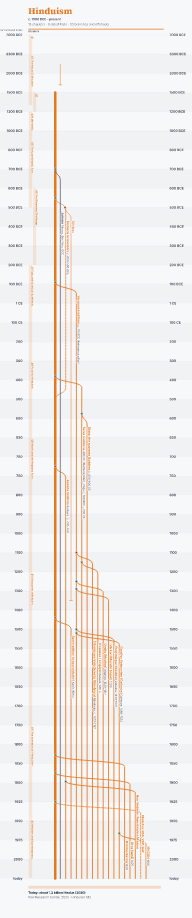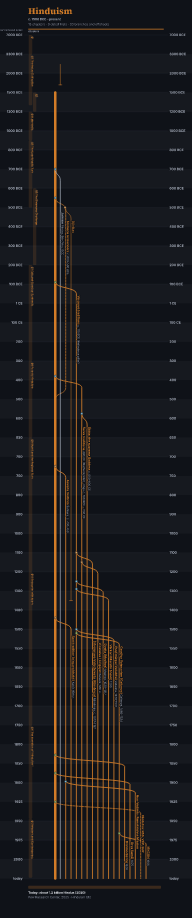
Nobody founded Hinduism. It has no founder, no founding date and no central authority, and its oldest scripture still in use, the Rigveda, was composed mainly c. 1500–1200 BCE.[1][2] That makes the tradition about 3,500 years old if you date it by its oldest text, and older or much younger depending on what else you count: roots in the Indus cities and the Neolithic before that, and most of its present shape added over the two thousand years after.
This page is about founding and age. Who counts as a Hindu, and when people began calling themselves that, is a different question, answered in Who was the first Hindu?
Who founded Hinduism?
No one did. Christianity, Islam, Buddhism and Sikhism each look back to a founder; Hinduism has no founder, no single canon and no central authority, and it is better described as a family of traditions that were later named as one.[1] Consensus
The nearest candidates for a “founder” all fail on inspection. The Rigveda’s oldest books are attributed to six priestly lineages (Gṛtsamada, Viśvāmitra, Vāmadeva, Atri, Bharadvāja and Vasiṣṭha), not to one person, and the gods those poets praised were mostly Indra, Agni and Soma, not the Viṣṇu and Śiva who dominate later Hinduism.[3][2] Śaṅkara, often called the founder of “true” Hinduism, systematized Advaita Vedānta in the eighth century, more than two thousand years after the oldest hymns.[4] The tradition’s own answer is that the question is misframed: on the Mīmāṃsā view the Veda is eternal and authorless, heard by the seers rather than made by them, and Hindus often call their religion sanātana dharma, the eternal order.[1][5] That is a theological position, which a historian can describe but not test.
So the historical answer is not a person but a process. Hinduism is, in the image this series uses, a braid: a Vedic strand, documented in extraordinary detail, and an older and nearly invisible strand of local and popular religion, with further strands added over the following two thousand years.[1][6]
Where did Hinduism originate?
In the northwest of the Indian subcontinent, in what is now Pakistan and northwest India. The Vedic strand began in the river country of the Punjab; the older strand runs through the Indus and Ghaggar-Hakra basins and back to the farming villages of Balochistan.[2][7][8] Majority
The Rigveda’s own geography is the Indus–Punjab river system, with the Ganga at the edge of its world: the Ganga is named once in the whole collection, the Indus some two hundred times.[9][10] The later layers of the tradition moved east. The Vedic world shifted into the Ganga–Yamuna region from c. 1200 BCE, and the early Upaniṣads were composed further east still, in the Ganga plain.[11] There is no single birthplace, only a direction of travel.
How old is Hinduism?
It depends what you count. Dated by its oldest scripture still in use, about 3,500 years. Dated by its oldest possible roots, perhaps 5,000 years or more. Dated as the recognizable religion of temple, image and devotion, about 2,000 years. Dated as a named single religion, about 240 years. Each of those is a defensible answer to a different question, and the layers are set out in order below.
The deepest layer: Mehrgarh and the Neolithic
At Mehrgarh, at the foot of the Bolan Pass, farmers grew barley and wheat, herded locally domesticated humped cattle and buried their dead with goods, sometimes with the bodies of young goats.[12][8] The conventional start of farming there is c. 7000 BCE or earlier; a 2025 study that radiocarbon-dated tooth enamel from the burials directly puts it at roughly 5200–4700 BCE instead. It is a single study, not yet absorbed by the field, but it dates the people themselves.[13] Contested
What this tells us about religion is very little: grave goods imply some belief about the dead, and nothing more specific can honestly be claimed. What it tells us about history is more. The sequence from Mehrgarh to the Indus cities is unbroken and local, and populations of this kind are the primary source of modern South Asian ancestry.[7][14] Consensus Read more in §1.
The Indus civilization: what can and cannot be traced
The Indus cities flourished c. 2600–1900 BCE, and they left a monumental bathing tank at Mohenjo-daro, pipal-tree imagery on seals, and a horned figure seated among animals.[7][6] Each plausibly feeds into later popular religion: ritual bathing, sacred trees, perhaps a stream of imagery later absorbed into Śiva.
What cannot be traced is anything said or believed. The Indus script, on about four thousand objects, is undeciphered, so we do not know the name of a single Harappan god.[15] And the Harappans were almost certainly not the Vedic people: they had cities, writing and no horses, while the Rigveda knows horses and chariots and no cities.[16][17] Continuity, if it exists, runs through village religion, not through the Vedas. Majority on some continuity; Contested on every specific item The evidence is weighed in §2 and in Did Hinduism come from the Indus Valley?
The Rigveda: the oldest text still in use
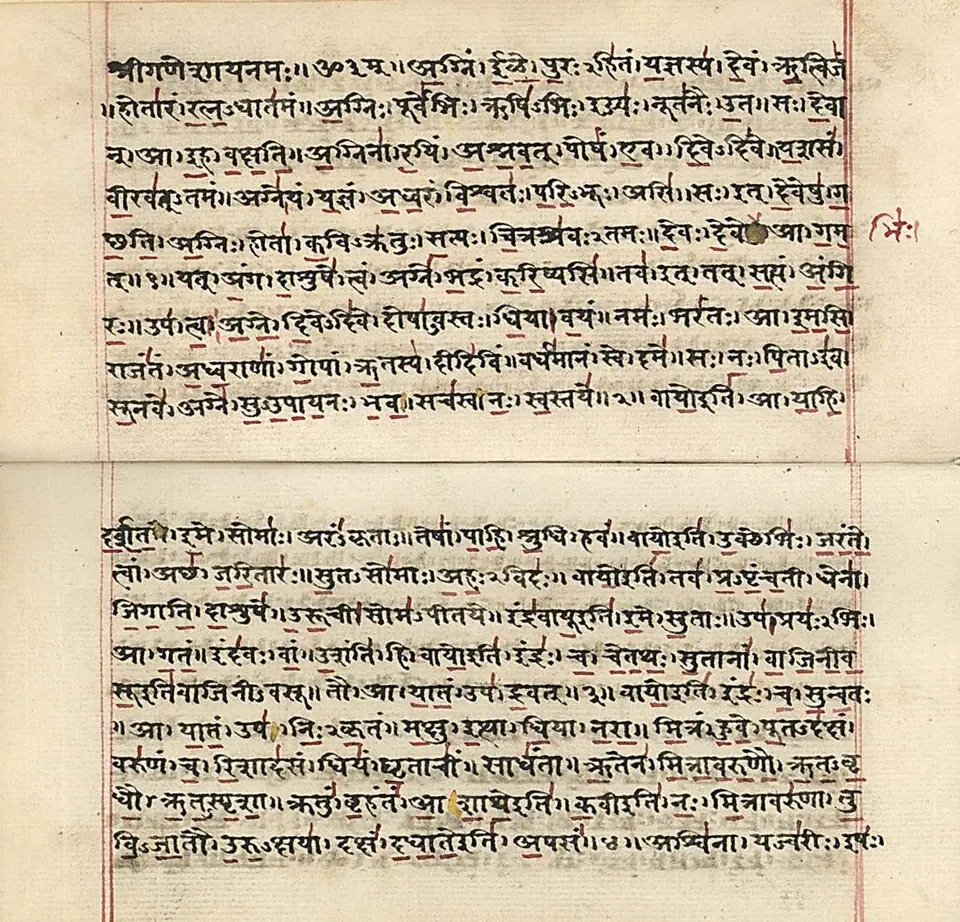
The Rigveda’s oldest core, the six “Family Books,” was composed orally in the Punjab most likely c. 1500–1200 BCE, and not written down for roughly a thousand years after.[3][2] That date is anchored from outside India: a treaty of c. 1350–1320 BCE, found at the Hittite capital in Anatolia, invokes Mitra, Varuṇa, Indra and the Nāsatyas as divine witnesses.[18] Majority
The Rigveda is also still recited, preserved by a system of memorization so redundant that recitation lineages from opposite ends of India agree to a degree few ancient written traditions approach.[2][19] Consensus This is the strongest single reason to date Hinduism to the second millennium BCE: a liturgy composed then is in use now. But it is a liturgy for a religion with no temples, no images, no karma, no rebirth and no caste by birth.[2] See §3 and When was the Rigveda written?
Upaniṣads, epics and temples: the religion people recognize
The ideas most people now associate with Hinduism came later. Karma and rebirth are first stated in the early Upaniṣads, composed c. 700–500 BCE.[11] Between roughly 200 BCE and 300 CE come images made for worship, small temples to house them, devotion (bhakti) to a personal god, and the Bhagavad Gītā, which declares that devotion a path to liberation in its own right.[20] The first named person on record declaring devotion to Vāsudeva, a name of Kṛṣṇa, is a Greek ambassador on a pillar at Besnagar, c. 110 BCE.[21] Consensus
Between c. 300 and 650 CE, in and after the Gupta empire, come stone temples, the Purāṇas, distinct Vaiṣṇava, Śaiva and Śākta communities, and a Goddess declared supreme in the Devī Māhātmya.[22][23] Majority This is roughly the shape Hinduism still holds. See §5, §7 and §8.
When was Hinduism founded as “Hinduism”?
As a named world religion, with one canon and one essence, between about 1750 and 1947. “Hinduism” is used in English from about 1787, and the census of 1871–72 required every Indian to be entered under exactly one religion.[24][25] Majority
In 1750 there were Vaiṣṇavas, Śaivas, Śāktas, Smārtas and hundreds of other communities, sharing much and agreeing on no creed and no founder; by 1947 there was a religion called Hinduism, with the Vedas and the Gītā as its canon and Vedānta presented as its essence.[25][26] That does not make the religion invented. The tradition is older than the category, and on two of the three main scholarly positions a philosophical unification and a Hindu self-identity are older than British rule.[4][27] The word itself is older still: “Hindu” began as a Persian place name for the Indus region.[28] That history is told in §11, Who invented the word “Hindu”? and Is Hinduism a colonial invention?
Is Hinduism 10,000 years old?
Not on any evidence that can be dated. The figure usually rests on one of three things: treating the Indus civilization as Vedic, dating the Rigveda to 3000 BCE or earlier, or counting the Neolithic and Mesolithic past of the subcontinent as Hindu. Contested / Political
The early dating of the Rigveda is argued mainly from its praise of the Sarasvatī as a great river, identified with the Ghaggar-Hakra, which was declining by c. 2000 BCE.[29][30] Critics answer that the identification is insecure, that the Ghaggar-Hakra was monsoon-fed rather than a Himalayan torrent in Harappan times, and that an early date would put an iron-less, city-less, horse-rich society in the middle of the Harappan urban period.[16][31] The Mehrgarh evidence, meanwhile, reaches c. 7000 BCE only on the older chronology, and even then shows farming and burial, not a religion anyone can name.[13][8]
The honest version is this: some strands of Hinduism plausibly run back five thousand years or more, but no strand can be shown to, and the religion as a whole cannot be. “Among the oldest living religious traditions” is accurate; “10,000 years old” is not a historical finding. Is Hinduism the oldest religion? sets it against the other contenders.
A short timeline
| Date | Event | Confidence |
|---|---|---|
| c. 7000 BCE (conventional); c. 5200 BCE (2025 redating) | Farming and burial with grave goods at Mehrgarh[12][13] | Contested (date) |
| c. 2600–1900 BCE | The Indus cities; seals and the Great Bath[7] | Consensus |
| c. 1500–1200 BCE | The Rigveda’s oldest books composed in the Punjab[3][2] | Majority |
| c. 1350–1320 BCE | Mitanni treaty names Vedic gods[18] | Consensus |
| c. 700–500 BCE | Karma and rebirth first stated, in the early Upaniṣads[11] | Majority |
| c. 200 BCE–200 CE | The Bhagavad Gītā composed[20] | Majority |
| c. 110 BCE | Heliodorus pillar: devotion to Vāsudeva in stone[21] | Consensus |
| c. 300–650 CE | Stone temples, Purāṇas, a supreme Goddess[22][23] | Majority |
| 8th century CE | Śaṅkara systematizes Advaita Vedānta[4] | Majority |
| c. 1787 | “Hinduism” in English[24] | Majority |
| 1871–72 | Census enters every Indian under one religion[25] | Consensus |
What scholars disagree about
How old the Rigveda is. The mainstream range for its oldest books is c. 1500–1200 BCE, anchored by the Mitanni treaty, the absence of iron and the closeness of Rigvedic Sanskrit to the Old Avestan of the Zoroastrian hymns.[18][32][33] A minority dates it to 3000 BCE or earlier from the Sarasvatī, and its strongest advocate, B. B. Lal, the excavator of Kalibangan, held that the Harappans and the Rigvedic people were one population.[29] Contested / Political
How much comes from before the Vedas. Asko Parpola argues for substantial continuity from the Indus civilization into later Hinduism; most scholars accept some continuity in popular religion, while every specific link, from the “proto-Śiva” seal to ritual bathing, is disputed.[6][15] Contested
When “Hinduism” became one thing. Robert Frykenberg treats the unified religion as essentially a colonial-era construction; Andrew Nicholson finds Indian philosophers unifying the orthodox schools between the fourteenth and seventeenth centuries; David Lorenzen finds a Hindu religious identity, formed against Islam, by 1200–1500.[26][4][27] These measure different things and can all be true at once. Contested
Common misconceptions
- “Hinduism was founded by a single sage or teacher.” It has no founder; even its oldest scripture is attributed to several priestly families, not one person.[1][3]
- “Śaṅkara founded Hinduism.” He systematized Advaita in the eighth century, when the tradition was already more than two thousand years old.[4]
- “Hinduism is 10,000 years old.” No dated evidence supports a Hindu religion that early; the oldest datable Hindu scripture is c. 1500–1200 BCE, and older roots are plausible, not proven.[2][15]
- “The Indus Valley people were Hindus practising Vedic religion.” Their material world and the Rigveda’s do not match, and their script is unread.[16][15]
- “The British invented Hinduism.” They helped package a world religion with one canon and one essence; the traditions it names, and a Hindu self-identity, are older.[4][27]
Why it matters
A religion with a founder can be dated from a life. Hinduism can only be dated in layers, and each popular answer to “how old is it?” is really an answer to a different question. Asked of its oldest text, the answer is about 3,500 years; of its deepest roots, older but unprovable; of its temples and devotion, about 2,000 years; of its name, about 240. Saying it has no founder is not a gap in the record. It is the most accurate description of how the religion came to exist: not founded, but accumulated. As §12 puts it, the continuity is real; it is a continuity of process, not of content.
For how the dates are established, see §0.
References
- ^ a b c d e Gavin Flood An Introduction to Hinduism. Cambridge University Press, 1996. open library The standard university textbook, and the most balanced single overview.
- ^ a b c d e f g h Stephanie W. Jamison & Joel P. Brereton, trans. The Rigveda: The Earliest Religious Poetry of India. Oxford University Press, 3 vols., 2014. The standard complete English translation. Supersedes Griffith entirely.
- ^ a b c d Michael Witzel "Early Sanskritization: Origins and Development of the Kuru State". Electronic Journal of Vedic Studies 1(4); repr. in B. Kölver, ed., Recht, Staat und Verwaltung im klassischen Indien (Oldenbourg, 1997): 27–52, 1995. doi The Kuru state thesis — canonization as a political project.
- ^ a b c d e f Andrew J. Nicholson Unifying Hinduism: Philosophy and Identity in Indian Intellectual History. Columbia University Press, 2010. full text Argues that the unification of Hinduism was the work of Indian philosophers from the fourteenth to the seventeenth centuries, well before the British — a key correction to the strong constructionist thesis.
- ^ Wilhelm Halbfass Tradition and Reflection: Explorations in Indian Thought. SUNY Press, 1991. full text On Śaṅkara and his Mīmāṃsā opponents.
- ^ a b c Asko Parpola The Roots of Hinduism: The Early Aryans and the Indus Civilization. Oxford University Press, 2015. full text The fullest statement of the Dravidian-Indus case. Argued, not established.
- ^ a b c d Jonathan Mark Kenoyer Ancient Cities of the Indus Valley Civilization. Oxford University Press, 1998. full text The standard accessible account by an excavator.
- ^ a b c Robin Coningham & Ruth Young The Archaeology of South Asia: From the Indus to Asoka. Cambridge University Press, 2015. The standard synthesis for §§1–6.
- ^ Michael Witzel "Tracing the Vedic Dialects". in Dialectes dans les littératures indo-aryennes, 1989. The foundational work on Rigvedic internal chronology and geography.
- ^ Theodor Aufrecht, ed. Die Hymnen des Rigveda (2nd ed.; digitized by B. A. van Nooten & G. B. Holland, GRETIL). Adolph Marcus, Bonn, 1877. open library The standard Śākala text, used here for the Sanskrit and for word and verse counts (10,552 verses).
- ^ a b c Patrick Olivelle, trans. The Early Upaniṣads: Annotated Text and Translation. Oxford University Press, 1998. full text The scholarly standard. Its introduction is the best short account of the period.
- ^ a b Jean-François Jarrige et al. Mehrgarh: Field Reports 1974–1985. Department of Culture and Tourism, Govt. of Sindh, 1995. The excavation reports underlying everything said about the site — now in tension with the 2025 redating.
- ^ a b c Benjamin Mutin, Antoine Zazzo, Luca Bondioli, Alfredo Coppa et al. "New radiocarbon dates of human tooth enamel reveal a late appearance of farming life in the Indus Valley". Scientific Reports 15: 11345, 2025. doi Tooth enamel from 23 Neolithic burials: the aceramic cemetery began c. 5200–4900 BCE and lasted two to five centuries, against a conventional start c. 7000–8000 BCE. Single study; not yet absorbed by the field.
- ^ Vagheesh M. Narasimhan et al. "The formation of human populations in South and Central Asia". Science 365, 2019. doi Over 500 ancient genomes. The steppe-ancestry signal, and its limits.
- ^ a b c d Steve Farmer, Richard Sproat & Michael Witzel "The Collapse of the Indus-Script Thesis". Electronic Journal of Vedic Studies 11, 2004. open access The minority argument that the sign system is not writing at all.
- ^ a b c Edwin Bryant The Quest for the Origins of Vedic Culture. Oxford University Press, 2001. open library The fairest book-length survey of the origins debate; takes the indigenist arguments seriously without endorsing them.
- ^ Vasant Shinde et al. "An Ancient Harappan Genome Lacks Ancestry from Steppe Pastoralists or Iranian Farmers". Cell 179, 2019. doi The single sequenced Rakhigarhi individual.
- ^ a b c Mitanni–Hittite treaty — Boğazköy archive. c. 1350–1320 BCE. Akkadian, with Indo-Aryan divine names. Invokes Mitra, Varuṇa, Indra and the Nāsatyas as witnesses — Indo-Aryan gods attested in writing in the Near East more than a thousand years before the earliest deciphered writing from India. about
- ^ Frits Staal The Fidelity of Oral Tradition and the Origins of Science. North-Holland (Mededelingen der KNAW, Afd. Letterkunde, N.R. 49.8), 1986. How the pāṭha recitation system preserved the Veda without writing, and why it is so exact.
- ^ a b Angelika Malinar The Bhagavadgītā: Doctrines and Contexts. Cambridge University Press, 2007. The standard study of the Gītā's doctrines and its place in the epic and in post-Mauryan debates.
- ^ a b Heliodorus pillar — Besnagar (Vidiśā). c. 110 BCE. Prakrit in Brāhmī. A Greek ambassador calls himself a Bhāgavata and Vāsudeva the God of Gods. The oldest hard evidence for bhakti, and datable by Antialkidas's coinage. about
- ^ a b Ludo Rocher The Purāṇas. Harrassowitz, 1986. open library The standard survey, and the clearest statement of why Purāṇas resist dating.
- ^ a b Thomas B. Coburn Devī-Māhātmya: The Crystallization of the Goddess Tradition. Motilal Banarsidass, 1984.
- ^ a b Will Sweetman "'Hinduism' and the History of 'Religion': Protestant Presuppositions in the Critique of the Concept of Hinduism". Method & Theory in the Study of Religion 15, 2003. doi The critique of Hinduism-as-a-religion smuggles in a Protestant model of what a religion must be. The best single citation for why the debate got distorted.
- ^ a b c Richard King Orientalism and Religion: Postcolonial Theory, India and "The Mystic East". Routledge, 1999. full text
- ^ a b Robert E. Frykenberg "The Emergence of Modern 'Hinduism' as a Concept and as an Institution". in Hinduism Reconsidered, Manohar, 1989. The classic statement of the strong colonial-construction position.
- ^ a b c David N. Lorenzen "Who Invented Hinduism?". Comparative Studies in Society and History 41, 1999. doi The case that Hindu self-identity predates colonialism by centuries.
- ^ Roland G. Kent Old Persian: Grammar, Texts, Lexicon. American Oriental Society (American Oriental Series 33), 2nd ed., 1953. full text The standard edition of the Achaemenid royal inscriptions; its lexicon gives Hidu- 'Sind' as the Old Persian form of Sanskrit sindhu.
- ^ a b B. B. Lal The Sarasvati Flows On: The Continuity of Indian Culture. Aryan Books International, 2002. The excavator of Kalibangan's case that the Harappans were the Rigvedic people; the principal indigenist statement by a senior archaeologist.
- ^ Michel Danino The Lost River: On the Trail of the Sarasvatī. Penguin India, 2010. The best-argued case on the other side of the Sarasvatī question. Cite it if the debate is to be stated fairly.
- ^ Liviu Giosan et al. "Fluvial landscapes of the Harappan civilization". PNAS 109, 2012. doi The geomorphology behind the Ghaggar-Hakra argument.
- ^ Rakesh Tewari "The origins of iron working in India: new evidence from the Central Ganga Plain and the Eastern Vindhyas". Antiquity 77: 536–544, 2003. doi Reports iron artefacts, furnaces and slag in Uttar Pradesh layers radiocarbon-dated between 1800 and 1000 BCE.
- ^ Michael Witzel "Early Indian History: Linguistic and Textual Parametres". in G. Erdosy, ed., The Indo-Aryans of Ancient South Asia, de Gruyter: 85–125, 1995. doi The linguistic and textual case for the mainstream dating of the Rigveda, including its relation to Old Avestan and Mitanni Indo-Aryan.