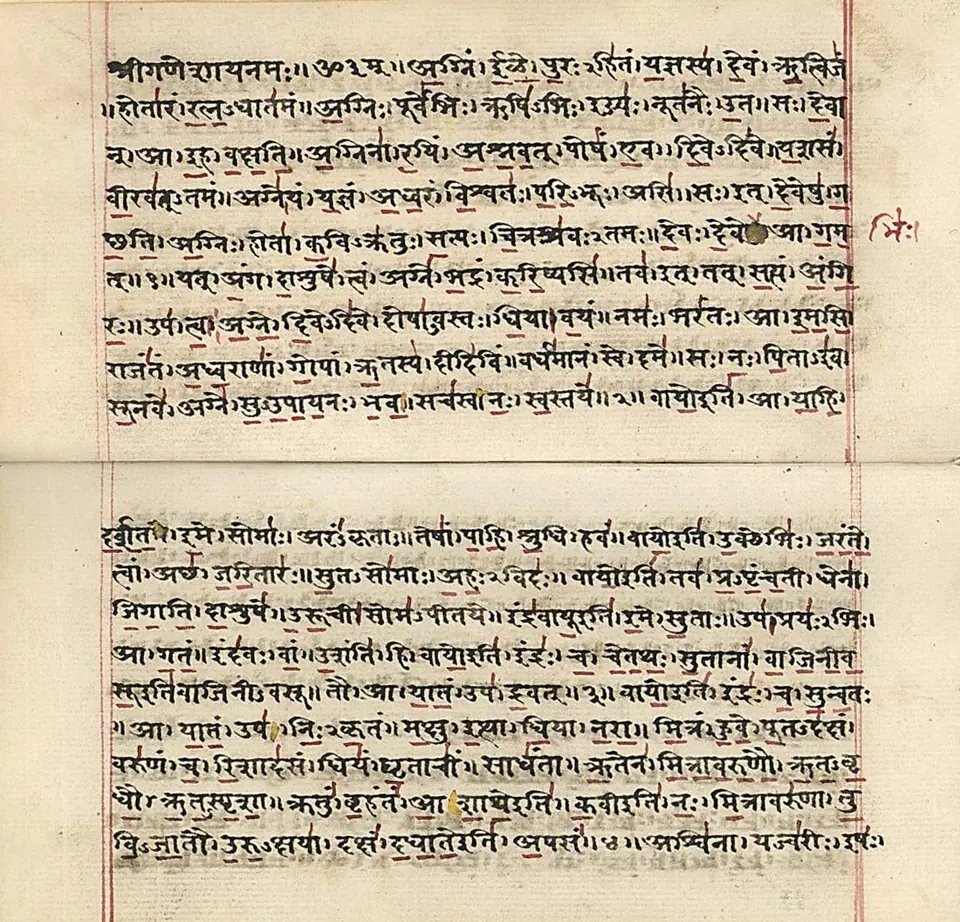
The honest answer depends on which “ancient Hindus” you mean. The people of the Vedic period, whose hymns and ritual manuals are the oldest Hindu scripture, kept cattle, sacrificed them and ate beef. Most historians regard this as well attested.[1] The idea that the cow must not be killed is post-Vedic. It grew over many centuries, alongside the rise of non-violence (ahiṃsā) and vegetarianism as religious ideals (§6). “Ancient Hindus” covers about two thousand years, and they did not share one diet.
This is a sensitive subject, and it is often argued as a verdict on present-day belief. It is not one. Hindu ethics about animals changed over time, the evidence for that change comes from the tradition’s own texts, and the changes were argued for from inside.
The evidence
The Rigveda: a cattle economy that sacrificed cattle
In the Rigveda’s world, c. 1500–1200 BCE on the mainstream dating, cattle were wealth. The common word for battle, gáviṣṭi, literally means “cattle-seeking,” and a chief is a gópati, a “cattle-lord.”[2] The Gambler’s Hymn lists what a ruined man has lost in order: “There are your cattle, gambler; there your wife.” Cattle come first.[3]
Religion was animal sacrifice made outdoors at fire altars, with no temples and no images.[2] Cow protection, vegetarianism and ahiṃsā are all missing from the Rigveda. The series’ survey of what the Rigveda lacks concludes that its people ate beef at sacrifices (§3). Valuing cattle and sacrificing them are not in tension. You offer the gods what is precious, and cattle were the most precious thing these people owned.
The Brahmanas: the rule and the exception in one sentence
By the later Vedic period, c. 1000–500 BCE, the ritual system had grown enormous. Animal sacrifice was at its core, and the royal horse sacrifice (Aśvamedha) killed a horse.[4] The most quoted passage on beef comes from the Śatapatha Brāhmaṇa, c. 900 BCE:
“Let him not eat the flesh of cow and ox. Nevertheless Yājñavalkya said: I, for one, eat it, provided it is tender.”[1]
What it proves. It proves two things. The rule belongs to the regulations for a sacrificer undergoing consecration, so abstaining from beef was already a mark of ritual purity in some settings. And the text records, without embarrassment, that one of its greatest authorities ignored the rule. A prohibition is only needed if people are doing the thing it prohibits. This one sentence is the hinge of the whole history: beef was eaten, and restraint had begun to carry prestige.
Non-violence arrives, first as one virtue among many
Ahiṃsā first appears in the Chāndogya Upaniṣad, c. 700 BCE, in a list of virtues. It is present in the Vedic stream but not yet central.[5] The renouncer movements made it central. The oldest Jain text states it as a claim about every living thing:
savve pāṇā piyāuyā suhasāyā dukkhapaḍikūlā appiyavahā piyajīviṇo jīviukāmā | savvesiṃ jīviyaṃ piyaṃ ||
“All beings are fond of life; they like pleasure and hate pain, shun destruction, like life, and long to live. To all, life is dear.”[6]
The Buddha, in a similar move, recast “the great sacrifice” as a bloodless one.[7] Then, around 257 BCE, the emperor Ashoka put the principle in stone: “Here no living creature is to be slaughtered and offered in sacrifice.” His edict adds that the royal kitchen, which had once killed many hundreds of thousands of animals a day, was down to two peacocks and a deer.[8] A later edict lists protected species in detail.[9]
The law books: regulation, not a clean ban
The Dharmasūtras (c. 300 BCE–100 CE, on Patrick Olivelle’s dating) and the Manusmṛti (c. 200 BCE–200 CE) do not simply forbid meat.[10][11] §6 calls them ambivalent. They make diet a matter of purity and status, allowing meat in ritual settings while praising those who abstain.[12] That ambivalence is itself evidence of the change: the older practice still had scriptural authority, and the newer ideal had moral prestige. Legal writers held both.
A short timeline
| Date | What happens | Confidence |
|---|---|---|
| c. 3000–1200 BCE | Deccan Neolithic ashmounds: cattle dung burned at communal sites for centuries[13] | Consensus that it happened |
| c. 1500–1200 BCE | Rigveda’s Family Books; cattle are wealth, and beef is eaten at sacrifices (§3)[3] | Majority |
| c. 900 BCE | Śatapatha Brāhmaṇa: no beef for the consecrated sacrificer; Yājñavalkya eats it anyway[1] | Majority |
| c. 700 BCE | Ahiṃsā listed among the virtues in the Chāndogya Upaniṣad[5] | Majority |
| c. 500–400 BCE | Jain Ācārāṅga: “To all, life is dear”[6] | Majority |
| c. 257 BCE | Ashoka bans sacrificial slaughter in his capital[8] | Consensus |
| c. 300 BCE – 200 CE | Dharmasūtras and Manusmṛti regulate diet; ambivalent about meat[10][11] | Majority |
| 1923 CE | Savarkar’s Hindutva; he backs cow protection on economic grounds and mocks cow worship[14] | Consensus |
What scholars disagree about
Did the texts mean real slaughter? Some traditionalist writers argue that the Vedic passages are symbolic, mistranslated, or describe outsiders rather than the Vedic community. They point out that the Rigveda calls the cow aghnyā, “not to be killed.” That is the strongest form of the case, and the word is real. Most Vedic scholars reply that the sacrificial manuals describe the handling of real animals in operational detail.[15] They also note that when these texts do make a sacrifice symbolic, they say so. In the Puruṣamedha, a voice warns that “man would eat man” if the human victims were killed, and the victims are released.[16] No such release is written for cattle. Most scholars read aghnyā as a term of esteem, or as protection for milk cows in particular, not as a ban on all killing of cattle. This is the majority reading. It is also, in §6’s own tag, a political one. Majority / Political
Whose diet? The Rigveda is a priestly anthology, not a record of everyday meals. It barely mentions ordinary people, household ritual or popular practice (§3).[2] The texts show beef at sacrifices and among ritual elites. How often an ordinary herding family ate beef is not recorded. Honest accounts say “beef was eaten, including at sacrifices,” not “everyone ate beef every day.”
Where did the cow’s sanctity come from? Three explanations are argued, and they can all be partly true. First, internal Vedic development: purity rules and ahiṃsā already appear in the Vedic stream.[5] Second, pressure from the renouncer movements. On the majority view, Brahmanism adopted vegetarianism as a mark of high status because it was losing the argument about violence (§6).[17][18] Third, a much older layer: some link the Neolithic cattle festivals of the Deccan to later cow veneration. That link is Speculative.[19]
Common misconceptions
- “Admitting Vedic beef-eating is a colonial or anti-Hindu invention.” The key texts are Sanskrit scriptures preserved by the brahmin tradition itself, which recorded Yājñavalkya’s remark and kept it.[1]
- “Eating cattle means cattle were not valued.” It was the reverse: cattle were the unit of wealth, which is why they were fit for the gods.[3]
- “Hindu reverence for the cow is a modern political invention.” Cow protection is post-Vedic, but the ideals behind it (non-violence, purity through diet) are more than two thousand years old.[8][6] Modern politics took up an old ideal. It did not create one.
Why it matters now
The question matters today because cow protection is a live political issue in India. A claim about the Vedas can be heard as a claim about who belongs. Even Hindu nationalism’s founding text shows that the issue was never simple. Savarkar, who defined Hindutva, argued for protecting cows on economic grounds while openly mocking cow worship (§11).[14][20] The historical finding supports neither side of today’s argument. It shows something else: the tradition changed its mind. It moved from sacrificing the animal it valued most to protecting it, and it did so through centuries of internal debate over violence, purity and what a good life requires. §12 lists this as one of the clearest cases of Hinduism’s “continuity of process, not of content.”
For the full context, see §3 on Rigvedic religion and §6 on the renouncer movements and the rise of ahiṃsā.
References
- ^ a b c d ŚB 3.1.2.21 — Śatapatha Brāhmaṇa. c. 900 BCE. Vedic Sanskrit. "Let him not eat the flesh of cow and ox. Nevertheless Yājñavalkya said: I, for one, eat it, provided it is tender." The prohibition and its casual violation in one sentence. read the text
- ^ a b c Stephanie W. Jamison & Joel P. Brereton, trans. The Rigveda: The Earliest Religious Poetry of India. Oxford University Press, 3 vols., 2014. The standard complete English translation. Supersedes Griffith entirely.
- ^ a b c RV 10.34.13 — Rigveda. c. 1100 BCE. Vedic Sanskrit. The Gambler's Hymn. What the ruined man loses, in order: cattle first, wife second — cattle are the unit of value. read the text
- ^ ŚB 13.1–5 — Śatapatha Brāhmaṇa. c. 900 BCE. Vedic Sanskrit. The Aśvamedha liturgy — territorial claim, fertility rite, and proof that a state now exists. read the text
- ^ a b c CU 3.17.4 — Chāndogya Upaniṣad. c. 700 BCE. Sanskrit. Ahiṃsā listed among the virtues — present in the Vedic stream before the Śramaṇas made it central. read the text
- ^ a b c Ācārāṅga 1.4.1 — Ācārāṅga Sūtra. c. 500–400 BCE. Ardhamāgadhī Prakrit. "To all, life is dear." The oldest Jain text states ahiṃsā as a universal claim about the interests of all living things. read the text
- ^ DN 5 — Kūṭadanta Sutta (Dīgha Nikāya). c. 300 BCE. Pali. The Buddha reframes "the great sacrifice" as bloodless — the Śramaṇa attack on animal sacrifice made by capturing the vocabulary of sacrifice rather than rejecting it. read the text
- ^ a b c Rock Edict 1 (Girnar) — Ashokan edicts. c. 257 BCE. Prakrit in Brāhmī. "Here no living creature is to be slaughtered and sacrificed." A king turns state power against the Vedic sacrifice. read the text
- ^ Pillar Edict 5 — Ashokan edicts. c. 243 BCE. Prakrit in Brāhmī. A detailed species-protection list, with fish inviolable on specified days and no burning of forests containing living creatures. Far more concrete than Rock Edict 1. read the text
- ^ a b Patrick Olivelle, trans. Dharmasūtras: The Law Codes of Ancient India. Oxford University Press, 1999. Āpastamba, Gautama, Baudhāyana, Vasiṣṭha in one volume.
- ^ a b Patrick Olivelle, trans. Manu's Code of Law: A Critical Edition and Translation. Oxford University Press, 2005. full text The critical edition, plus the standard account of the text's real historical status.
- ^ Patrick Olivelle & Donald R. Davis Jr., eds. The Oxford History of Hinduism: Hindu Law. Oxford University Press, 2018. The current reference work on Dharmaśāstra.
- ^ Deccan ashmounds — Budihal, Utnur, Kudatini. c. 3000–1200 BCE. Cattle-dung mounds up to 10 m, burned repeatedly over centuries — the clearest ritual signal in the South Asian Neolithic.
- ^ a b Essentials of Hindutva — V. D. Savarkar. 1923 CE. English. Defines a Hindu territorially and ethnically — fatherland and holy land — not theologically. Savarkar was an atheist. about
- ^ The Śrautasūtras — Āpastamba, Baudhāyana, Kātyāyana and others. c. 600–300 BCE. Sanskrit. The technical manuals that specify the sixteen-priest śrauta system in operational detail — the evidence that the Brāhmaṇas describe a real, if enormously expensive, practice.
- ^ ŚB 13.6.2.13 — Śatapatha Brāhmaṇa. c. 900 BCE. Vedic Sanskrit. In the Puruṣamedha a voice says "do not consummate these human victims: if thou wert to, man would eat man" — and they are released. The textual basis for reading human sacrifice here as symbolic. read the text
- ^ Paul Dundas The Jains. Routledge, 2nd ed., 2002. open library The standard survey.
- ^ Richard Gombrich Theravāda Buddhism: A Social History. Routledge, 2nd ed., 2006. Excellent on the Brahmanical background the Buddha was arguing against.
- ^ F. R. Allchin Neolithic Cattle-Keepers of South India. Cambridge University Press, 1963. full text The ashmound study.
- ^ Janaki Bakhle Savarkar and the Making of Hindutva. Princeton University Press, 2024. open library The Marathi-sourced counterpart on the other side.