The epic age in one paragraph
The Bhagavad Gītā (Bhagavad Gita) was most likely composed c. 200 BCE–200 CE, in the same centuries that produced the first Hindu images, temples and inscriptions of devotion (bhakti). This is where a modern Hindu would first start recognizing the religion. Between roughly 200 BCE and 300 CE, four things arrive that had never existed before: images of gods, made to be worshipped; temples, however modest, to house them; bhakti, loving devotion to a personal deity as a path to liberation in its own right; and avatāra, the doctrine that the supreme god descends into the world. The Vedic gods are now background furniture, and Viṣṇu and Śiva — a bit player and a feared outsider in Chapter 3 — have become supreme.
The document that does most of the work is the Bhagavad Gītā, which takes the ritual path, the knowledge path, and the new devotional path and declares all three valid, with devotion the most accessible. At the same moment, the Mahābhārata (Mahabharata) and Rāmāyaṇa (Ramayana) grow from war-lays into vast encyclopedias of the new synthesis, and the Manusmṛti (Manusmriti, the Laws of Manu) codifies a social order more rigid than anything the Vedas describe. Devotion opens up and caste closes down, in the same period, sometimes in the same texts.
Timeline of the epic and classical age
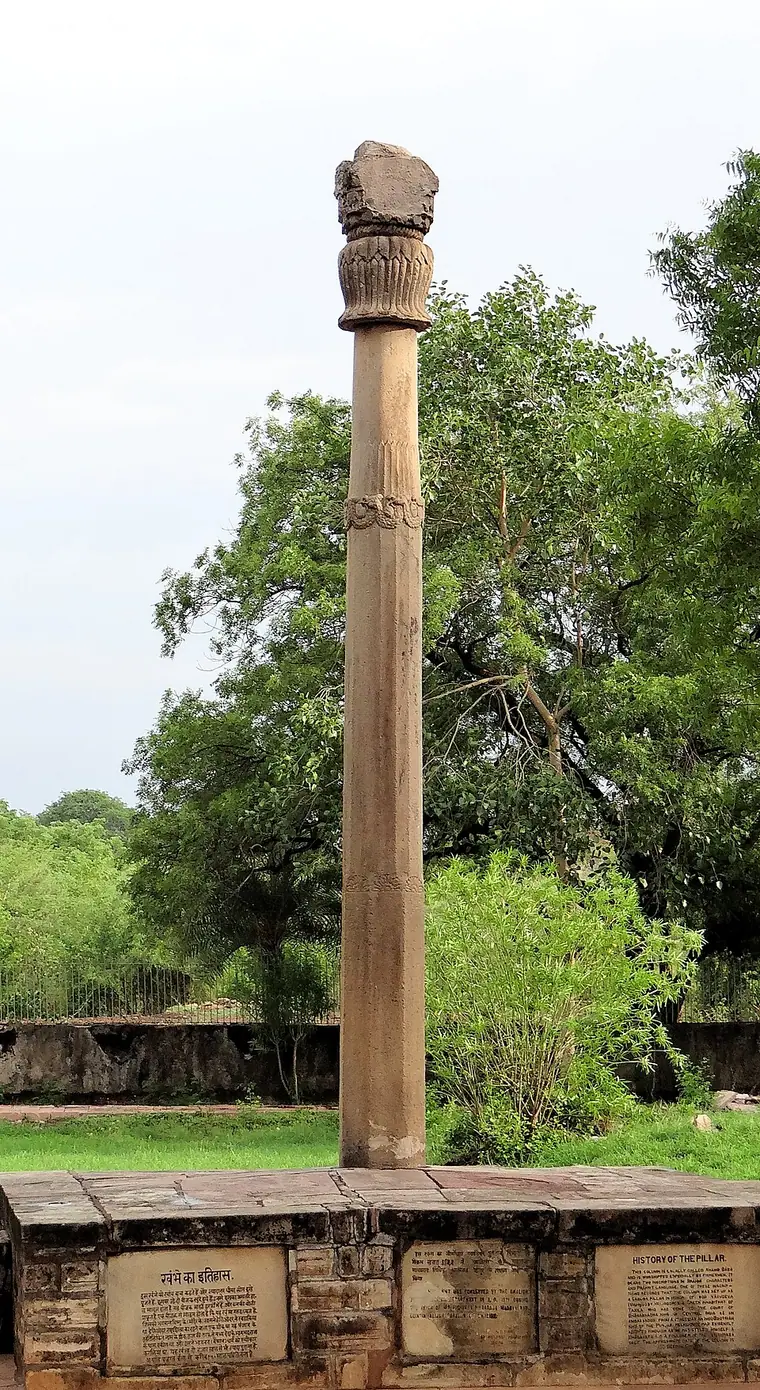
Between c. 400 BCE and 400 CE the epics reached their form, the Bhagavad Gītā and Manusmṛti were composed, and a Greek declared himself a Bhāgavata on the Heliodorus pillar, c. 110 BCE.
| Date | Event | Confidence |
|---|---|---|
| c. 400 BCE – 400 CE | Mahābhārata grows to ~100,000 verses; Rāmāyaṇa reaches its form[1][2] | Majority |
| c. 300 BCE – 300 CE | Sangam literature in Tamil — a documented non-Vedic southern religion[3][4] | Majority |
| c. 200 BCE – 200 CE | Bhagavad Gītā composed and inserted into the Mahābhārata[5] | Majority |
| c. 200 BCE – 200 CE | Manusmṛti compiled[6] | Majority |
| 185 BCE | Mauryan collapse; Śuṅgas; Puṣyamitra revives the Aśvamedha[7] | Majority |
| c. 180–100 BCE | Indo-Greek kingdoms; Menander (Milinda) | Consensus |
| c. 150 BCE – 200 CE | Sanchi and Bharhut stūpa railings; Mathurā and Gandhāra sculpture schools[8] | Consensus |
| c. 110 BCE | Heliodorus pillar, Besnagar — a Greek declares himself a Bhāgavata[9] | Consensus |
| c. 100 BCE – 200 CE | Gudimallam liṅga — the earliest surviving Śiva liṅga[10] | Contested (dating) |
| c. 1st–2nd c. CE | First anthropomorphic images of the Buddha; Kuṣāṇa coins showing a trident-and-bull deity labelled Oēśo — whether that figure is Śiva is contested[11] | Contested |
| c. 127 CE | Kaniṣka; the Kuṣāṇa empire at its height | Majority |
Where: the northwest, Mathura and the Tamil south
The Mauryan collapse breaks India into competing states, and — counter-intuitively — this is good for religion. Śuṅgas in the Gangetic core, Indo-Greeks and then Śakas and Kuṣāṇas in the northwest, Sātavāhanas in the Deccan, Cheras, Cholas and Pāṇḍyas in the Tamil south. Many courts means many patrons.
The northwest matters disproportionately. Under the Indo-Greeks and Kuṣāṇas, the Indian world is in continuous contact with Hellenistic and Iranian art, coinage and religion. The first images of the Buddha appear here and at Mathurā; so does the trident-and-bull deity on Kuṣāṇa coinage. Whether Greek naturalism caused Indian devotional imagery is argued (see the debates below), but the coincidence of time and place is not in dispute.[12] Consensus on the contact; Contested on the causation
The Tamil south enters the record for the first time, and independently. Sangam poetry describes a religion of its own: Murugaṉ, god of the hills, worshipped with ecstatic possession dance (veriyāṭal); Māyōṉ, “the dark one,” in the pastoral tracts; Koṟṟavai, a war goddess.[3] Vedic ritual is known and mentioned, but it is not the centre. This is direct evidence of a fully developed non-Vedic religious world that later merges into Hinduism — Murugaṉ becomes Skanda-Kārttikeya, Māyōṉ becomes Kṛṣṇa, Koṟṟavai becomes Durgā.[4] Majority
The evidence ledger for the epic age
The epic age produced inscribed bhakti, cult images, small shrines, pūjā and the avatāra doctrine, while the Manusmṛti hardened varṇa and stated women’s legal subordination as doctrine.
Every row is a first.
| Dimension | What we can say | Evidence | Confidence |
|---|---|---|---|
| Devotion | Bhakti exists as an organized, inscribed, socially real practice | Heliodorus pillar c. 110 BCE; Nāgārjunakoṇḍa and Mathurā inscriptions[9][13][14] | Consensus |
| Images | Anthropomorphic cult images of Hindu deities appear | The Bhūteśvar relief (Mathurā, c. 100 BCE): an enshrined liṅga inside a railing, worshipped; Mathurā sculpture; Gudimallam liṅga; Kuṣāṇa coinage[15][10][11] | Consensus on the images; Contested on the Kuṣāṇa identification |
| Temples | Small structural shrines, mostly apsidal, mostly perishable materials | Besnagar; the Nagari (Ghoṣuṇḍī) Vaiṣṇava enclosure inscription, c. 1st c. BCE[16][17] | Majority |
| Ritual | Pūjā — offering flowers, food, light to an image — begins displacing yajña | Iconography and shrine plans; the vocabulary appears in epic-period texts | Majority |
| Theology | Avatāra: the supreme god descends in bodily form | BhG 4.7–8; the emerging Vāsudeva-Kṛṣṇa-Viṣṇu identification[18] | Consensus |
| Access | Devotion is declared open across varṇa and to women | BhG 9.32 — but read the wording carefully (below)[19] | Consensus that it says this |
| Social order | Varṇa hardened into a comprehensive legal and ritual system | Manusmṛti[6] | Consensus |
| Women | Formal legal subordination stated as doctrine | Manusmṛti 9.3 and related passages[20] | Consensus that the text says it |
| Sacrifice | Śrauta ritual survives as royal spectacle, but is no longer the centre of religious life | Puṣyamitra’s and later Aśvamedhas are notable because they are rare[7] | Majority |
Primary sources
The epic age’s primary sources, from the Heliodorus pillar and the Bhagavad Gītā to the Manusmṛti, the layered epics and the first images, document bhakti, avatāra, a hardened social order and Rāma’s divinization.
1. The oldest hard evidence for bhakti — and a Greek left it
The Heliodorus pillar, Besnagar (Vidiśā, Madhya Pradesh), c. 110 BCE. Prakrit in Brāhmī:
devadevasa vā[sude]vasa garuḍadhvajo ayaṃ kārito i[a] heliodoreṇa bhāgavatena diyasa putreṇa takhkhasilākena yonadūtena…
“This Garuḍa-standard of Vāsudeva, the God of Gods, was made here by Heliodora (Heliodoros), the Bhāgavata, son of Diya (Dion), a man of Takṣaśilā, Greek ambassador, who came from the Great King Antialkidas to King Kāśīputra Bhāgabhadra…”[9][21]
A second face records three “immortal precepts” that lead to heaven: dama, cāga, apramāda — self-restraint, renunciation, vigilance.
And it was not the only one. A fragment of a second octagonal Garuḍa column from the same site (R. P. Chanda, Memoirs of the Archaeological Survey of India 5, 1920, p. 152) records that a Garuḍa pillar “of the excellent temple (prāsādottama) of the Bhagavat” was erected by a Gautamī-putra, also styling himself a Bhāgavata, in the twelfth year after the installation of Mahārāja Bhāgavata.[16] Two things follow. There was a built temple at Vidiśā, not just a free-standing pillar. And an Indian donor used the identical formula — so Heliodorus was following a local convention, not inventing one. The Greek is striking because of who he was, not because he was alone.
What it proves. This one column carries an extraordinary amount:
- Bhāgavata devotion is an established, named religious identity by 110 BCE — with a technical self-designation someone would use of himself in a formal public inscription.[9] Consensus
- Vāsudeva is already “God of Gods” — not one deity among many, but supreme. The Vāsudeva–Kṛṣṇa–Viṣṇu–Nārāyaṇa fusion is well advanced.[22] Majority
- It was open to a foreigner. A Greek ambassador, presumably a Greek speaker of Greek descent, is a Bhāgavata. Whatever this religion was in 110 BCE, it was not a closed hereditary system. Consensus
- It is datable, because Antialkidas is known from coinage — which is why it outranks any textual claim about early bhakti.
2. The Bhagavad Gita — the synthesis document
The Bhagavad Gītā sits inside the Mahābhārata’s sixth book: 700 verses, 18 chapters, a conversation between Arjuna and Kṛṣṇa in the moment before battle. Its achievement is not originality but reconciliation — it takes three competing paths and refuses to rank them out of existence.
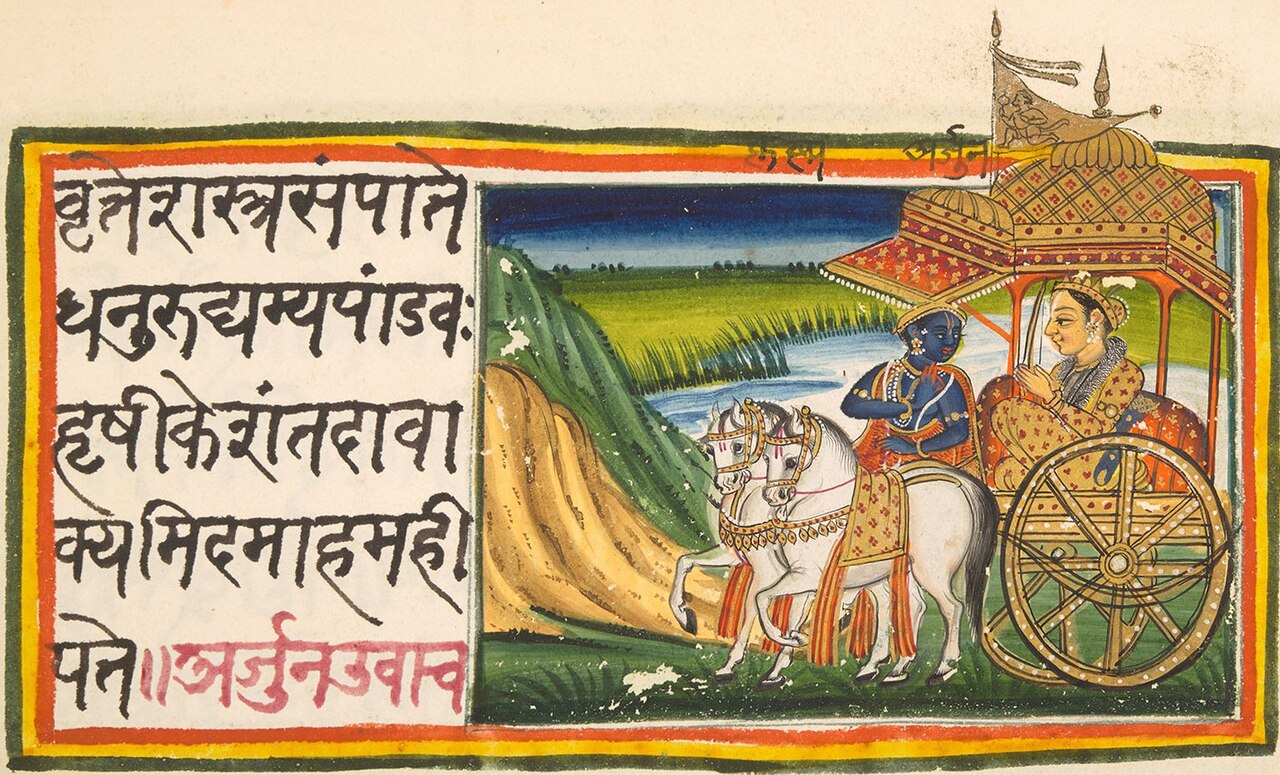
BhG 2.47 — action without attachment to results, the answer to renunciation:
कर्मण्येवाधिकारस्ते मा फलेषु कदाचन । मा कर्मफलहेतुर्भूर्मा ते सङ्गोऽस्त्वकर्मणि ॥
karmaṇy evādhikāras te mā phaleṣu kadācana | mā karmaphalahetur bhūr mā te saṅgo ‘stv akarmaṇi ||
“Your right is to action alone, never to its fruits. Let not the fruits of action be your motive, nor let your attachment be to inaction.”[23]
What it proves. This is a direct answer to the Śramaṇa challenge of Chapter 6. If karma binds you to rebirth, the logical response is to stop acting — which is what renunciation does, and which threatens society. The Gītā’s move is to say that attachment, not action, is what binds. You can be a renouncer while remaining a soldier, a farmer, a householder. It rescues ordinary life.[5] Consensus
BhG 4.7–8 — the avatāra doctrine, stated for the first time:
यदा यदा हि धर्मस्य ग्लानिर्भवति भारत । अभ्युत्थानमधर्मस्य तदात्मानं सृजाम्यहम् ॥
yadā yadā hi dharmasya glānir bhavati bhārata | abhyutthānam adharmasya tadātmānaṃ sṛjāmy aham ||
“Whenever there is a withering of dharma, Bhārata, and an upsurge of adharma, then I send myself forth.”[18]
What it proves. Nothing in the Vedas or the Upaniṣads has a god taking bodily birth to intervene in history. This single idea makes possible the whole later apparatus of Rāma and Kṛṣṇa as objects of worship, the ten avatāras, and a devotional relationship with a god who has a biography. Consensus
BhG 9.32 — the opening of access, quoted honestly:
मां हि पार्थ व्यपाश्रित्य येऽपि स्युः पापयोनयः । स्त्रियो वैश्यास्तथा शूद्रास्तेऽपि यान्ति परां गतिम् ॥
māṃ hi pārtha vyapāśritya ye ‘pi syuḥ pāpayonayaḥ | striyo vaiśyās tathā śūdrās te ‘pi yānti parāṃ gatim ||
“Taking refuge in me, Pārtha, even those who are of sinful birth — women, vaiśyas, and śūdras — they too reach the highest goal.”[19]
What it proves, and what it does not. This verse is genuinely revolutionary: liberation is declared available to people the śrauta system had excluded absolutely, and it requires no priest, no initiation, and no Sanskrit. It is the theological foundation of every later bhakti movement.
But it should be quoted with its own words intact. The same sentence classes women, vaiśyas and śūdras as pāpayonayaḥ — “of sinful birth” — and says “even they.” The Gītā opens the door without disputing that some people are standing on the wrong side of it. Both halves are the text.[19][5] Consensus on the reading; Contested on how to weigh it
The Gītā also, at 4.13, has Kṛṣṇa say he created the fourfold varṇa order according to guṇa and karma — quality and action. Whether that grounds varṇa in birth or in aptitude has been argued for two thousand years and was central to nineteenth- and twentieth-century reform.[24] Contested
3. Manusmriti — the social order codified
The Mānava Dharmaśāstra, c. 200 BCE – 200 CE, 2,685 verses. It is not a law code that any state enforced; it is a scholastic Brahmanical text, one of many, which later acquired enormous authority — partly because British colonial courts treated it as the definitive “Hindu law.”[25][6] Consensus
MS 9.3 — on the independence of women:
पिता रक्षति कौमारे भर्ता रक्षति यौवने । रक्षन्ति स्थविरे पुत्रा न स्त्री स्वातन्त्र्यमर्हति ॥
pitā rakṣati kaumāre bhartā rakṣati yauvane | rakṣanti sthavire putrā na strī svātantryam arhati ||
“The father protects her in childhood, the husband in youth, the sons in old age. A woman is never fit for independence.”[20]
What it proves. Set this next to Gārgī in Chapter 5, arguing Yājñavalkya to a standstill in open assembly roughly five centuries earlier. The trajectory sketched in Chapter 4 has now completed. The Manusmṛti also fixes the graded punishments by varṇa, the elaborate impurity rules, and the disabilities of the caṇḍāla, which is where untouchability becomes a systematic doctrine rather than a set of scattered avoidances. Consensus that the text says this
Two necessary qualifications. First, prescriptive is not descriptive: the text tells us what one group of Brahmanical scholars wanted, not how people lived, and inscriptions and literature show women owning property, endowing monasteries and ruling. Second, Manu was one voice among many Dharmaśāstras that disagree with each other; its supremacy is partly a colonial artefact. Neither qualification blunts the point that this became the canonical statement. Majority
4. The epics, and how we know they are layered
The Mahābhārata declares its own growth: it describes itself at 8,800 verses, then 24,000, then 100,000. The Pune Critical Edition (V. S. Sukthankar and successors, 1919–1966) collated some 1,250 manuscripts and reconstructed an archetype roughly a third shorter than the vulgate.[1]
Detectable layers include: a core war narrative; the didactic mountains of the Śānti and Anuśāsana books; the Gītā’s insertion; and the Harivaṃśa appendix supplying Kṛṣṇa’s childhood, which the epic proper does not narrate.
In the Rāmāyaṇa, books 2–6 form the older core. Book 1 (Bāla) and Book 7 (Uttara) are later additions — and they are the books in which Rāma is divine. In the core, Rāma is a heroic prince; the explicit identification with Viṣṇu belongs to the added frame.[2]
What it proves. The divinization of Rāma is a documented, datable process visible inside the text itself, not a premise of it. The same is true of Kṛṣṇa. Devotional Hinduism’s central figures became gods within the historical record. Majority
5. The first images
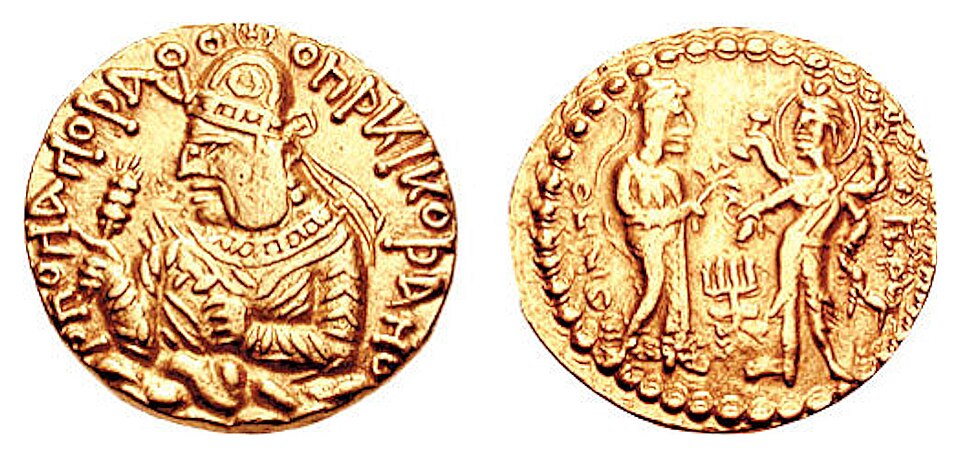
- Kuṣāṇa coinage shows a deity with trident, bull and multiple arms, labelled Oēśo in Greek script from Kaniṣka I onward. It is routinely called Śiva; the identification is contested. Vima Kadphises’ earlier trident-and-bull coins carry no divine name at all (only the king’s Śaiva-sounding epithets sarvaloga iśvarasa mahiśvarasa, readable as ordinary titulature); the Rabatak inscription’s list of dynastic gods does not include Oēśo[26]; and Humbach, Cribb and Tanabe derive the name from the Iranian wind-god Wēšparkar, depicted with Śiva’s attributes. What is not in doubt is that a trident-bearing, bull-associated deity was on imperial currency.[11] In plain terms: the coins show a god who looks like Śiva, but he may be an Iranian god drawn with Śiva’s attributes. Contested
-
The Gudimallam liṅga (Andhra Pradesh) is a five-foot stone liṅga with a standing figure of Śiva carved on its face, holding a ram and an axe. Dated variously from the 2nd c. BCE to the 2nd c. CE — and I. K. Sarma’s excavation dates the surrounding apsidal brick temple to the 2nd–3rd c. CE, which pulls against the early end. No inscription dates the liṅga itself. Best described as conventionally 2nd–1st c. BCE, with serious arguments for the early centuries CE. It is the earliest surviving liṅga and, crucially, anthropomorphic and aniconic at once — the abstract pillar and the figure on one object.[10] Contested dating
-
The Bhūteśvar relief from Mathurā (Government Museum Mathura, acc. 3625), Śuṅga period, c. 100 BCE, shows a liṅga inside a railing being worshipped by winged figures. Securely stratified, urban, and probably the earliest evidence for enshrined liṅga worship anywhere.[15]
-
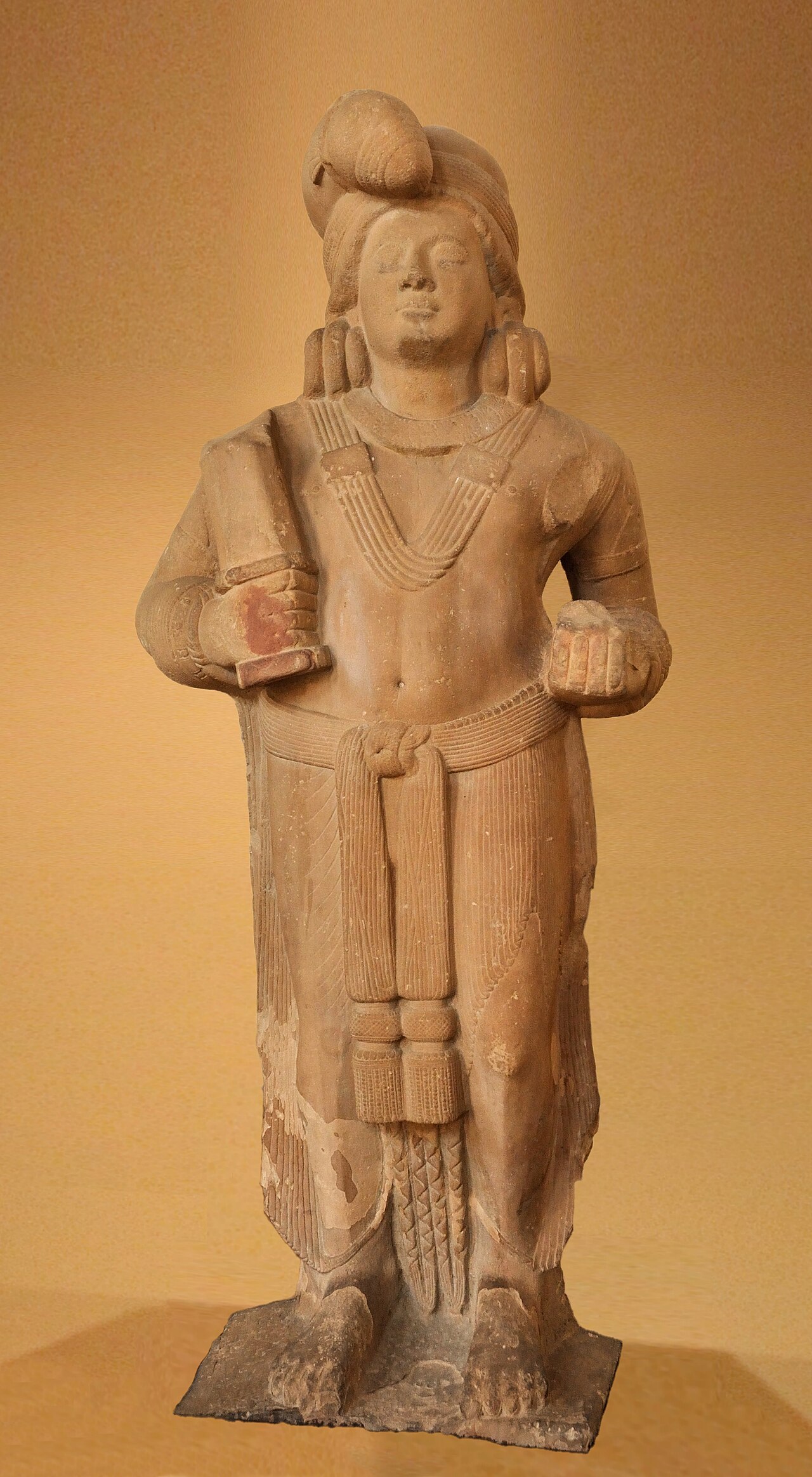
Mathurā produces images of Balarāma, Vāsudeva, Sūrya, Kubera, Nāgas and Yakṣas in quantity, in the local red sandstone, using a sculptural vocabulary developed for yakṣas.
What it proves. The technology and the visual language of Hindu image worship come substantially from the yakṣa and nāga cults — the popular, local, non-Vedic religion that Chapters 1 and 2 argued was always there and rarely written about. When it becomes archaeologically visible, it turns out to have supplied the forms that Vedic religion had no vocabulary for. Majority
The gods of the epic age
In the epic age Viṣṇu and Śiva became supreme while Indra, Agni and Varuṇa shrank to minor characters, an inversion the Mahābhārata marks by making Indra ineffectual and Kṛṣṇa God.
| Deity | Status now | Change since §3 |
|---|---|---|
| Viṣṇu / Vāsudeva / Kṛṣṇa / Nārāyaṇa | Supreme, with an inscribed cult by 110 BCE and an avatāra theology | ▲▲▲ from ~5 hymns |
| Śiva / Rudra | Supreme for his devotees; on imperial coinage; the liṅga established | ▲▲▲ from ~3 hymns |
| Skanda / Kārttikeya | Major, especially in the south (Murugaṉ) and on Kuṣāṇa coins | ▲▲ (absent from RV) |
| Goddesses | Yakṣīs, Śrī-Lakṣmī, local goddesses widespread; Mahiṣāsuramardinī images appear at Mathurā | ▲▲ — but no supreme Goddess text yet |
| Indra, Agni, Varuṇa | Present in the epics as minor characters; Indra is repeatedly humiliated | ▼▼▼ |
The Mahābhārata contains the clearest possible marker of the inversion: Indra, the supreme god of the Rigveda, appears as Arjuna’s father and as a somewhat ineffectual figure who is regularly outmatched — while Kṛṣṇa, who has no significant Rigvedic presence at all, is God.
What is absent in the epic age
The epic age still lacks the Purāṇas in surviving form, the Devī Māhātmya, stone temples of any size, Vedānta as a school, Tantra, and vernacular devotional poetry in the north.
- The Purāṇas in their surviving form — §8. Consensus
- The Devī Māhātmya and the Goddess as supreme reality — §8, c. 550 CE, despite the imagery existing earlier.
- Stone temples of any size. Shrines exist; monumental Hindu architecture does not. §8.
- Vedānta as a school — Bādarāyaṇa’s Brahmasūtra is being formed, but Śaṅkara is five centuries away (§9).
- Tantra — §8.
- Vernacular devotional poetry in the north — §10. In Tamil it is beginning (§9).
Debates about the Gita, Krishna and Manu
Debates about the epic age concern the Gītā’s date, whether Greek contact produced Hindu image worship, whether there was a historical Kṛṣṇa, and how much the Manusmṛti actually mattered.
When was the Bhagavad Gita composed?
Range c. 200 BCE – 200 CE. Its awareness of Buddhist ideas, its Sāṃkhya vocabulary, and its position within the Mahābhārata’s growth all place it well after the Upaniṣads. Attempts to date it to the second millennium BCE alongside a historical Mahābhārata war are not supported by its language.[5] Majority / Political
Did Greek contact produce Hindu image worship?
The chronological coincidence is real: the first Buddha images and the first Hindu cult images appear in the region and period of most intense Hellenistic contact. But Mathurā’s imagery grows out of a local yakṣa tradition with no Greek features, and image worship of some kind almost certainly existed earlier in perishable materials. The likeliest account is convergence — an existing popular practice of image veneration meeting new sculptural techniques and new patronage. Contested
Was there a historical Krishna?
Pāṇini’s rule implying Vāsudeva devotees, the Heliodorus pillar, and the Chāndogya Upaniṣad’s passing mention of a Kṛṣṇa Devakīputra as a student are the usual threads.[27][28][9] They establish that a Vāsudeva-Kṛṣṇa cult is old; they do not establish a biography. Contested
How much did the Manusmriti matter?
Its modern prominence owes a great deal to Sir William Jones’s 1794 translation and its adoption as the basis of Anglo-Hindu personal law — which gave one scholastic text a legal force it had never previously enjoyed, across a whole subcontinent. That does not make its content harmless; it does mean “Manu’s law ruled India for two thousand years” is false.[25][29] Majority
Further reading
- Alf Hiltebeitel, Rethinking the Mahābhārata (2001) and Dharma: Its Early History (2011).
- Angelika Malinar, The Bhagavadgītā: Doctrines and Contexts (2007).
- Patrick Olivelle, trans., Manu’s Code of Law (Oxford, 2005) — the critical edition and the standard account of the text’s real status.
- Robert Goldman et al., trans., The Rāmāyaṇa of Vālmīki (Princeton, 7 vols).
- Doris Srinivasan, Many Heads, Arms and Eyes (1997) — on the emergence of Hindu iconography.
- George Hart, The Poems of Ancient Tamil (1975) — on Sangam religion.
- Richard Salomon, Indian Epigraphy (1998) — for the Heliodorus and Ghoṣuṇḍī inscriptions.
References
- ^ a b V. S. Sukthankar et al., eds. The Mahābhārata: Critical Edition. Bhandarkar Oriental Research Institute, Pune, 1966. full text Collated from c. 1,250 manuscripts; the archetype runs about a third shorter than the vulgate.
- ^ a b Robert P. Goldman et al., trans. The Rāmāyaṇa of Vālmīki: An Epic of Ancient India. Princeton University Press, 7 vols., 1984. The complete scholarly translation of the critical edition.
- ^ a b Sangam corpus — Eṭṭuttokai and Pattuppāṭṭu. c. 300 BCE – 300 CE. Old Tamil. A fully developed non-Vedic southern religion documented independently: Murugaṉ worshipped with possession dance, Māyōṉ in the pastoral tracts, Koṟṟavai a war goddess. about
- ^ a b George L. Hart The Poems of Ancient Tamil: Their Milieu and Their Sanskrit Counterparts. University of California Press, 1975. open library On Sangam-era southern religion.
- ^ a b c d Angelika Malinar The Bhagavadgītā: Doctrines and Contexts. Cambridge University Press, 2007.
- ^ a b c Patrick Olivelle, trans. Manu's Code of Law: A Critical Edition and Translation. Oxford University Press, 2005. full text The critical edition, plus the standard account of the text's real historical status.
- ^ a b Ayodhyā inscription of Dhanadeva — Ayodhyā. c. 1st c. BCE. Sanskrit. Names Puṣyamitra Śuṅga as dvir-aśvamedha-yājin — independent epigraphic confirmation that the Aśvamedha was actually performed, twice.
- ^ Sanchi and Bharhut railings — Madhya Pradesh. c. 150–50 BCE. Stūpa railings carrying donative inscriptions in quantity — including gifts by named women, nuns and guilds, evidence of a broad lay donor economy. about
- ^ a b c d e Heliodorus pillar — Besnagar (Vidiśā). c. 110 BCE. Prakrit in Brāhmī. A Greek ambassador calls himself a Bhāgavata and Vāsudeva the God of Gods. The oldest hard evidence for bhakti, and datable by Antialkidas's coinage. about
- ^ a b c Gudimallam liṅga — Andhra Pradesh. c. 2nd c. BCE – 2nd c. CE. The earliest surviving liṅga, with a standing Śiva carved on its face — abstract and anthropomorphic on one object. about
- ^ a b c Kuṣāṇa coinage (Oēśo) — Kaniṣka and successors. c. 127–200 CE. Greek script. Śiva with trident and bull on imperial state currency — standardized divine iconography.
- ^ Doris Srinivasan Many Heads, Arms and Eyes: Origin, Meaning and Form of Multiplicity in Indian Art. Brill, 1997. On how Hindu iconography emerged.
- ^ Nāgārjunakoṇḍa Aṣṭabhujasvāmin record — Andhra Pradesh. c. 278 CE. Sanskrit. Nārāyaṇa as deva-parama-deva and purāṇa-puruṣa — per Sircar the earliest epigraph clearly pointing to the Nārāyaṇa–Viṣṇu identification, and the earliest eight-armed Viṣṇu.
- ^ Mora well inscription — Mathurā. c. 10–25 CE. Sanskrit. Images of the "five heroes" of the Vṛṣṇis installed in a stone shrine — early Vaiṣṇava cult imagery, though Lüders rejected the reading that names Kṛṣṇa directly. read the text
- ^ a b Bhūteśvar liṅga relief — Mathurā (Govt. Museum acc. 3625). c. 100 BCE. A liṅga inside a railing being worshipped — securely stratified, urban, and probably the earliest evidence anywhere for enshrined liṅga worship. read the text
- ^ a b Besnagar second Garuḍa pillar — Vidiśā. c. late 2nd c. BCE. Prakrit in Brāhmī. An Indian donor, also a Bhāgavata, erects a Garuḍa column for "the excellent temple of the Bhagavat" — proving a built temple at Vidiśā, and that Heliodorus followed a local convention rather than inventing one. read the text
- ^ Ghoṣuṇḍī / Nagari inscription — Rajasthan. c. 1st c. BCE. Sanskrit. A stone enclosure for Saṃkarṣaṇa and Vāsudeva — early Vaiṣṇava cult architecture. about
- ^ a b BhG 4.7–8 — Bhagavad Gītā. c. 200 BCE – 200 CE. Sanskrit. The avatāra doctrine, stated for the first time. Nothing in the Vedas has a god descending into history. read the text
- ^ a b c BhG 9.32 — Bhagavad Gītā. c. 200 BCE – 200 CE. Sanskrit. Liberation opened to women, vaiśyas and śūdras — in a sentence that also calls them "of sinful birth." Both halves are the text. read the text
- ^ a b Manusmṛti 9.3 — Mānava Dharmaśāstra. c. 200 BCE – 200 CE. Sanskrit. "A woman is never fit for independence." Five centuries after Gārgī. read the text
- ^ Richard Salomon Indian Epigraphy. Oxford University Press, 1998. open library The standard handbook for inscriptions and their dating.
- ^ Ghoṣuṇḍī / Hāthībāḍā inscription — Nagari, Rajasthan. c. 1st c. BCE. Sanskrit. A stone enclosure — a Nārāyaṇa-vāṭikā — for Saṃkarṣaṇa and Vāsudeva, "unconquered and lords of all." The earliest epigraph placing the two under the collective name Nārāyaṇa. read the text
- ^ BhG 2.47 — Bhagavad Gītā. c. 200 BCE – 200 CE. Sanskrit. Action without attachment to fruits — the answer to renunciation that rescues ordinary life. read the text
- ^ BhG 4.13 — Bhagavad Gītā. c. 200 BCE – 200 CE. Sanskrit. Varṇa created "according to guṇa and karma" — whether that means birth or aptitude has been argued for two millennia. read the text
- ^ a b Institutes of Hindu Law — Sir William Jones, trans.. 1794 CE. English. Jones's Manusmṛti. The translation that gave one scholastic Sanskrit text the force of enforceable personal law across a subcontinent. about
- ^ Rabatak inscription — Kaniṣka I, Afghanistan. c. 127 CE. Bactrian in Greek script. The Kuṣāṇa dynastic pantheon — Nana, Umma, Aurmuzd, Mihr and others. Oēśo is absent, which is one of the arguments against reading him as Śiva. about
- ^ Aṣṭādhyāyī 4.3.98 — Pāṇini. c. 500–400 BCE. Sanskrit. A grammatical rule forming the word for a devotee of Vāsudeva — implying an organized cult centuries before the Gītā. read the text
- ^ CU 3.17.4 — Chāndogya Upaniṣad. c. 700 BCE. Sanskrit. Ahiṃsā listed among the virtues — present in the Vedic stream before the Śramaṇas made it central. read the text
- ^ Bernard S. Cohn Colonialism and Its Forms of Knowledge. Princeton University Press, 1996. open library