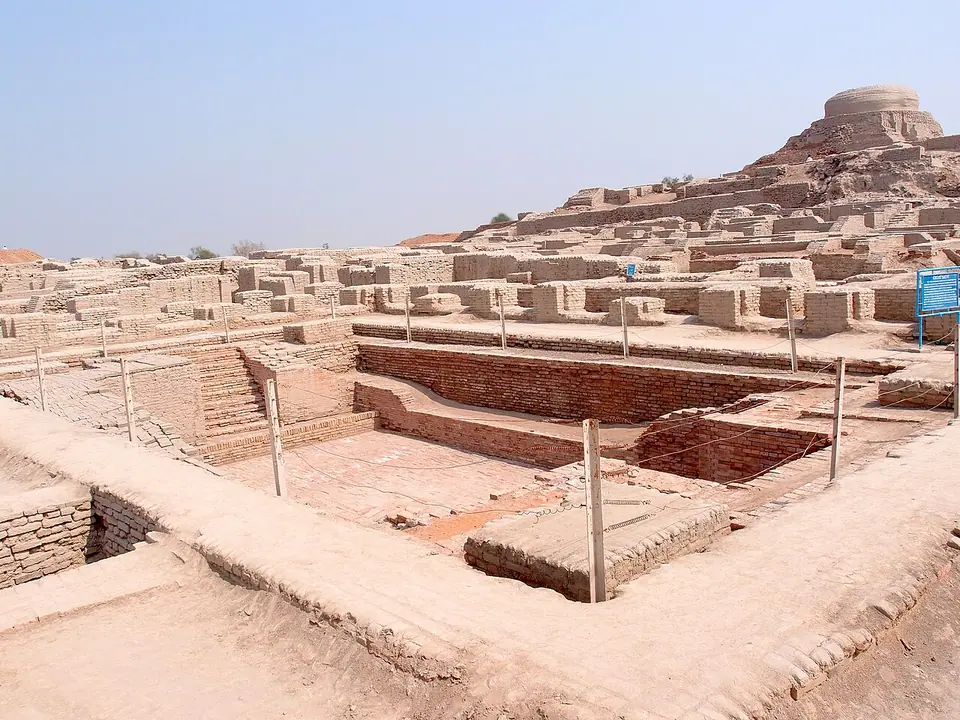
The honest answer is that nobody knows, and the “proto-Śiva” label is a hypothesis that has been repeated for so long that it is often mistaken for a finding. The seal shows a horned figure of evident religious importance surrounded by wild animals. It may belong to a stream of imagery that later fed into Śiva. What cannot be supported is the flat statement that it depicts Śiva, or even a direct ancestor of him.[1][2] Contested
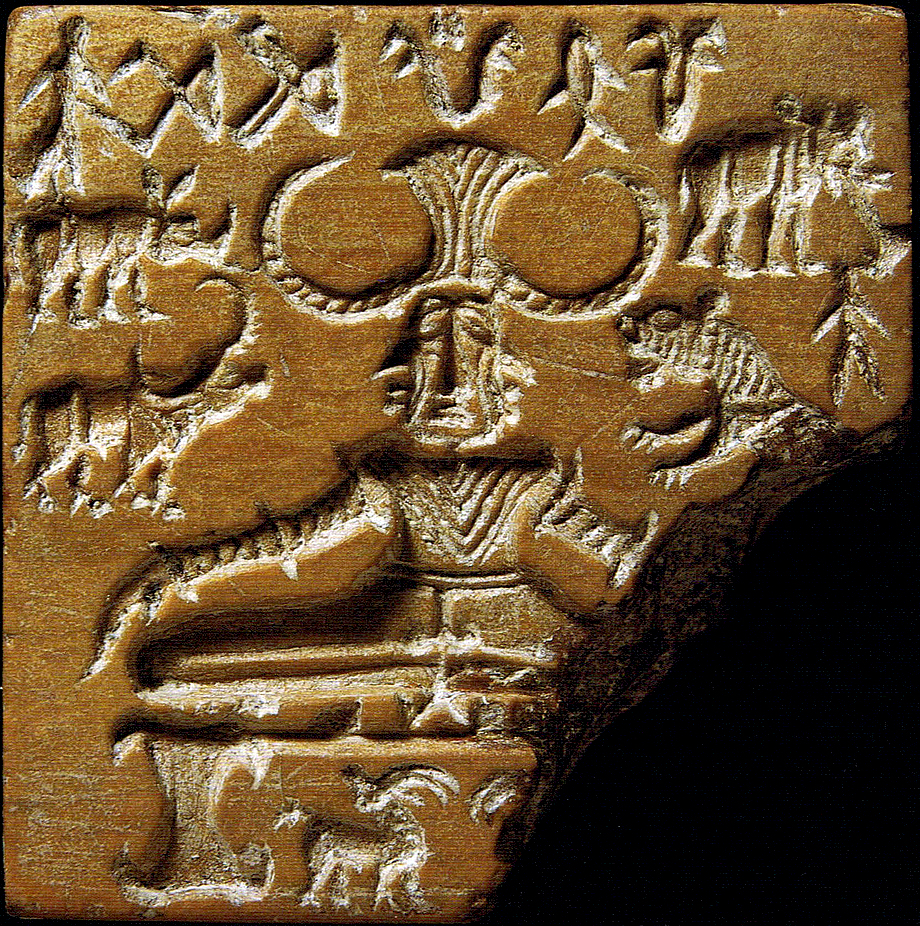
What the seal actually shows
The object is a small steatite seal from Mohenjo-daro, catalogued as M-304, from the mature Harappan period of c. 2600–1900 BCE. Its figure sits on a low platform with the heels drawn together and the knees splayed outward. It wears a tall headdress with a pair of great curving horns, its arms are covered in bangles, and it appears to be ithyphallic. Around it are an elephant and a tiger on one side, a rhinoceros and a water buffalo on the other, and two deer or ibexes beneath the seat.[3]
Above the figure runs a short line of Indus signs. That line is the whole problem. The Indus script survives on about four thousand objects, averages five signs an inscription, has no bilingual, and has never been deciphered; we do not know the name of a single Harappan god.[4][2] Everything said about who this figure is comes from its appearance alone.
The case for Shiva: Marshall’s four points
John Marshall, who directed the Mohenjo-daro excavations, proposed in 1931 that the figure is a prototype of Śiva as Paśupati, “Lord of Beasts.” He rested the identification on four correspondences:[5]
- The posture, which he read as yogic, and Śiva is the great yogi of later tradition.
- The animals, which make the figure a lord of creatures, like Paśupati.
- Three faces, which he saw in the head and linked to later multi-faced images of Śiva.
- The ithyphallic form, which he connected to the liṅga.
Put side by side, the match looks impressive, which is why the reading has appeared in most textbooks for ninety years. The strongest modern form of the case is more modest: that Harappan religion had a powerful horned male figure associated with wild animals and a seated posture, and that some of this imagery survived in popular religion and was later absorbed into the figure of Śiva.[2] Contested
The case against: four serious objections
The details do not hold up well. Doris Srinivasan’s iconographic study (1975, extended in 1997) found that the “three faces” are not clearly faces, and that the headdress is bovine: the horns belong to a bull or buffalo. On her reading the figure may be a bull-deity or buffalo-man, a type known across the Near East and India, not a proto-Śiva at all.[1][6]
The motif is regional, not uniquely Indian. A figure flanked by wild beasts, the “Master of Animals,” is common in Mesopotamian, Elamite and Central Asian art of the same era. M-304 may be a local version of a shared iconography.[2] The posture, too, is not securely yogic; comparable seated postures occur in Elamite art.
The early Śiva looks nothing like it. This is the weightiest objection. In the Rigveda, the god who later becomes Śiva is Rudra, with about three hymns: a wild, feared, disease-bringing outsider, propitiated so that he keeps away. He is not a lord of beasts, not a yogi, not ithyphallic and not associated with tigers, and śiva, “kindly,” is only an adjective used to placate him.[7] The Harappan figure has to be matched to a Śiva who is attested 1,500–2,000 years later.
Resemblance to a later god is a weak argument. Reading a Bronze Age image through a much later deity is exactly the kind of match that should raise suspicion. Similarity of form does not prove continuity of meaning, and without the script we cannot check what the Harappans themselves thought.[1]
How Shiva actually enters the record
It helps to set the seal beside the dated evidence for Śiva:
| Date | What happens | Confidence |
|---|---|---|
| c. 2500 BCE | Seal M-304, Mohenjo-daro: horned seated figure among animals | Consensus on the object |
| 1931 | Marshall’s proto-Śiva reading published | Consensus |
| c. 1500–1200 BCE | Rigveda: Rudra has ~3 hymns; śiva only an adjective | Consensus |
| Late Rigveda | RV 10.136, the Keśin hymn: a long-haired ecstatic who drinks “with Rudra” | Contested meaning |
| c. 1000 BCE | Śatarudrīya (TS 4.5): a whole litany to Rudra; namaḥ śivāya first appears | Consensus |
| c. 400–200 BCE | Śvetāśvatara Upaniṣad makes Rudra-Śiva the supreme being | Majority |
| c. 100 BCE | Bhūteśvar relief, Mathurā: an enshrined liṅga worshipped | Consensus |
| 380 CE | Mathurā pillar: a Pāśupata teaching lineage with an endowed shrine | Consensus |
The Yajurveda passage is the moment the later name first appears:
नमः शिवाय च शिवतराय च ।
namaḥ śivāya ca śivatarāya ca | “Homage to the auspicious one, and to the more auspicious.”[8]
What it proves: the mantra now most recited in Śaivism begins, some nine centuries after the Harappan cities emptied, as a flattering adjective for a dangerous Vedic god. The Śiva who is Paśupati, yogi and liṅga is built up over the following millennium, through the Śvetāśvatara Upaniṣad, the first liṅga images and the Pāśupata order.[9][10][11]
What scholars disagree about
Some continuity, via the substrate. Many scholars think Harappan imagery did survive into later Indian religion, not through the Vedas but through popular practice, and that the seal’s horned figure could be part of that. The Rigveda’s own Keśin hymn describes a long-haired ecstatic associated with Rudra, which suggests the ascetic figure is not purely a later import. That does not vindicate Marshall, but it keeps the question open.[12][2] Contested
No connection to Śiva at all. Srinivasan and others read the figure as a buffalo-horned deity of its own world, and treat the Śiva link as a projection of later Hinduism onto an unread civilization.[6] Contested
The traditional and indigenist reading. Many Hindus, and scholars who hold that the Harappans were themselves Vedic, see the seal as early evidence of Śiva worship and of the tradition’s deep antiquity. The problem this view has to answer is chronological: if Śiva was already a lord of beasts and a yogi in 2500 BCE, it has to explain why the Rigveda knows only a feared Rudra with three hymns.[7][13] Contested / Political
Common misconceptions
- “It is the oldest image of Śiva.” That is the hypothesis, not the finding. The earliest images securely identified as Śaiva are liṅgas from around the turn of the era, c. 100 BCE onward.[10][14]
- “It proves yoga is 5,000 years old.” The posture is not securely yogic, and meditative yoga is first described in the Upaniṣads.[1]
- “The name Paśupati is written on it.” The name was Marshall’s. The inscription is unread.[5]
Why it matters
The seal is the most famous test case for a larger question: whether Hinduism has roots in the Indus civilization. The best-supported answer is that it probably does, through popular religion, but that no single object proves it, and M-304 in particular cannot carry the weight put on it. The careful description (“an important horned figure among animals”) is more interesting than the confident one, because it leaves the actual Harappan god in view.
For the full context of Harappan religion, see §2; for Rudra’s rise to Śiva, §3 and §4.
References
- ^ a b c d Doris Srinivasan "The So-Called Proto-Śiva Seal from Mohenjo-Daro: An Iconological Assessment". Archives of Asian Art 29, 1975. The critique that dismantled the confident Paśupati reading.
- ^ a b c d e Asko Parpola The Roots of Hinduism: The Early Aryans and the Indus Civilization. Oxford University Press, 2015. full text The fullest statement of the Dravidian-Indus case. Argued, not established.
- ^ Seal M-304 — Mohenjo-daro. c. 2500 BCE. undeciphered. The "Paśupati" seal. A horned figure among wild animals — proto-Śiva, a bovine deity, or a Near Eastern Master of Animals. Undecided. about
- ^ Steve Farmer, Richard Sproat & Michael Witzel "The Collapse of the Indus-Script Thesis". Electronic Journal of Vedic Studies 11, 2004. open access The minority argument that the sign system is not writing at all.
- ^ a b John Marshall Mohenjo-daro and the Indus Civilization. Arthur Probsthain, 3 vols., 1931. full text The excavation report that named the "Paśupati" seal, the "Priest-King" and the "Mother Goddess" — labels the field has been arguing with ever since.
- ^ a b Doris Srinivasan Many Heads, Arms and Eyes: Origin, Meaning and Form of Multiplicity in Indian Art. Brill, 1997. On how Hindu iconography emerged.
- ^ a b Stephanie W. Jamison & Joel P. Brereton, trans. The Rigveda: The Earliest Religious Poetry of India. Oxford University Press, 3 vols., 2014. The standard complete English translation. Supersedes Griffith entirely.
- ^ TS 4.5.8.1 — Taittirīya Saṃhitā (Śatarudrīya). c. 1000 BCE. Vedic Sanskrit. namaḥ śivāya ca śivatarāya ca — the first appearance of the most-recited mantra in Śaivism, as flattery of a feared god. read the text
- ^ ŚvU 6.23 — Śvetāśvatara Upaniṣad. c. 400–200 BCE. Sanskrit. The earliest use of the word bhakti in the Vedic corpus, in the first theistic Upaniṣad. read the text
- ^ a b Bhūteśvar liṅga relief — Mathurā (Govt. Museum acc. 3625). c. 100 BCE. A liṅga inside a railing being worshipped — securely stratified, urban, and probably the earliest evidence anywhere for enshrined liṅga worship. read the text
- ^ Mathurā pillar of Candragupta II — Gupta year 61 (380/381 CE). 380 CE. Sanskrit. A Pāśupata guru-lineage counted ten generations deep, with an endowed "Shrine of the Teachers" housing liṅgas named after dead masters — the earliest dated evidence for an institutionalized Śaiva initiatory order. read the text
- ^ RV 10.136 — Rigveda (Keśin hymn). c. 1100 BCE. Vedic Sanskrit. A long-haired ecstatic who flies and drinks from a cup with Rudra — the strongest Vedic-side evidence bearing on the Paśupati-seal debate, and a complication for "asceticism is absent from the Rigveda." read the text
- ^ Michael Witzel "Early Sanskritization: Origins and Development of the Kuru State". Electronic Journal of Vedic Studies 1, 1995. doi The Kuru state thesis — canonization as a political project.
- ^ Gudimallam liṅga — Andhra Pradesh. c. 2nd c. BCE – 2nd c. CE. The earliest surviving liṅga, with a standing Śiva carved on its face — abstract and anthropomorphic on one object. about