A history of Sikhism · 1469 – present
The history of Sikhism: how it evolved, and how we know.
Sikhism began with one teacher in early sixteenth-century Punjab: Guru Nānak, a poet whose hymns survive in manuscripts written within a generation of his death. This series traces what came after, chapter by chapter: the Punjab of the Sants, Sufis and Nāth yogīs, Guru Nānak and the community at Kartārpur, the Gurus who built its institutions and its scripture, the sword beside the rosary, Guru Gobind Singh and the Khālsā, Banda and the misls of the eighteenth century, Ranjit Singh's kingdom, the Singh Sabhā under British rule, gurdwara reform and Partition, 1984, and the Sikhs of today.
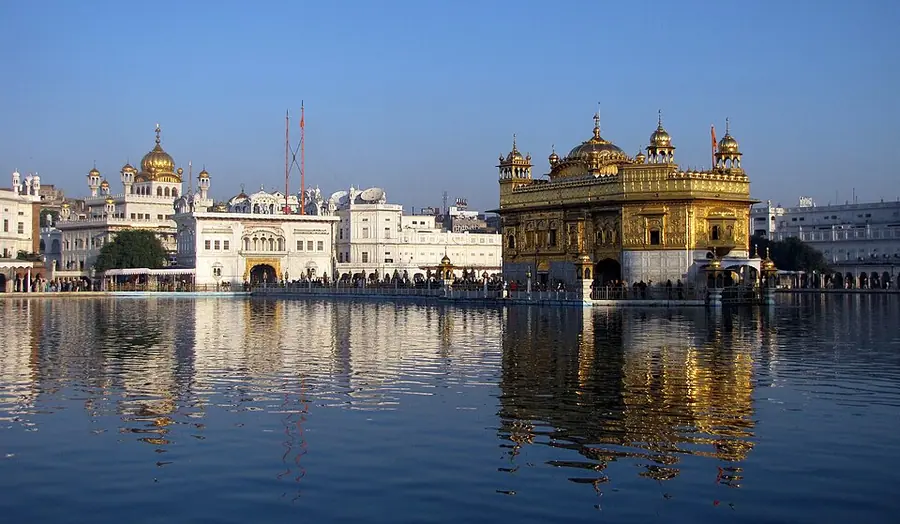
Much of what people now picture as Sikh came after Guru Nānak, and can be dated: the line of ten Gurus, the scripture as a book in 1604, the Harmandir Sāhib, the arming of the community, the Khālsā in 1699, the scripture as the living Guru after 1708, the Five Ks as a fixed list, the gold on the Golden Temple, a sharp boundary with Hinduism, and a written code of conduct agreed in 1945. Each has a date and evidence, and the series tracks them one by one.
Every chapter names the hymn, manuscript, chronicle, document or study behind its claims and tags each one by how settled it is: consensus, majority, contested, speculative or political. The tradition's own accounts are reported as what they say, with their dates, and set beside the earliest evidence; whether the Gurus' words are revealed is outside what history can test. Where scholars disagree, as they do over the lives of Guru Nānak, the founding of the Khālsā or the Dasam Granth, and where the history is still raw, as with 1984, the strongest version of each side is stated. Start with How We Know for the methods, or go straight to the period you want.
12 chapters, 1469 – present, about 6 hours of reading.
By Amrit Paudel Updated
Or begin with How we know, on the evidence and the dating methods.
New to the subject? Start with When was Sikhism founded?

The whole span
Time axis compressed: each labelled interval gets equal width
Bars overlap where periods do: §1 sets out the Punjab of the fifteenth century, into which Guru Nānak was born in 1469 (§2). After that the chapters follow one another, with the line of Gurus to 1708 and then the Panth's history to today.
The full timeline of Sikhism, era by era (free to embed)
All chapters
- Start here: the methods How We Know Manuscripts, janamsākhīs, Bhāī Gurdās, Persian witnesses, the eighteenth-century texts and a quarrel over method: the reader's toolkit for Sikh history Guru Nānak's own hymns are the best evidence for him: they survive in the Goindvāl pothīs of about 1570–1572, a generation after his death, and in the Ādi Granth that Guru Arjan compiled in 1604. The stories of Guru Nānak's life, the janamsākhīs, were written down from the seventeenth century onward. In 1968 W. H. McLeod sorted 124 of their episodes into five classes, from the established and the probable through the possible to the improbable and the impossible, and few of the best-known episodes reached the first two. 26 min read Majority view
- Chapter 1 c. 1400 – 1500 CE Punjab Before Guru Nānak The Lodī frontier, Sufi shrines, Nāth yogīs, Brahmins and the Sant poets: the world into which Guru Nānak was born Fifteenth-century Punjab was a frontier province of the Delhi sultanate, ravaged by Timur in 1398, held by his governor's line (the Sayyids) and then by the Afghan Lodīs, whose governor at Lahore, Daulat Khān, would invite Bābur in the 1520s. Its religious life was crowded: Chishtī and Suhrawardī Sufi shrines (above all Bābā Farīd's at Pākpattan), Nāth yogīs with split ears and patched coats, Brahmin priests, pilgrimage to the Ganges and the goddess shrines of the hills, and the songs of devotional poets from far beyond Punjab. Punjab between the Indus and the Yamunā: Lahore, Multan, Pākpattan, Sultānpur and the Salt Range 24 min read Majority view
- Chapter 2 c. 1469 – 1539 CE Guru Nānak Talvaṇḍī, Sultānpur and Kartārpur; the journeys and the stories told of them; the hymns on Bābur, the Japjī, and the first succession Guru Nānak was born in 1469 at Talvaṇḍī, now Nankāṇā Sāhib in Pakistan, into a Khatrī family; he worked for a time at Sultānpur Lodhī in the service of the Lodī governor Daulat Khān, travelled for many years, and spent his last years at Kartārpur on the Rāvī, where he died in 1539. Almost everything else people know about his life comes from Bhāī Gurdās's poems of some seventy years later and from the janamsākhīs, written down a century and more after him. The outline above is close to certain; the miracles, the meetings and the itineraries are the tradition's. Talvaṇḍī, Sultānpur Lodhī and Kartārpur in Punjab; journeys across India and, by tradition, to Mecca and Baghdad 33 min read Majority view
- Chapter 3 c. 1539 – 1606 CE The Gurus Build a Community Guru Aṅgad, Guru Amar Dās, Guru Rām Dās and Guru Arjan: Khaḍūr, Goindvāl and Amritsar, the laṅgar and the mañjīs, the Ādi Granth of 1604, and a death in Lahore Between 1539 and 1606 four Gurus turned Guru Nānak's following at Kartārpur into an organised community with its own centres (Khaḍūr, Goindvāl, Amritsar), its own script, a free communal kitchen, a network of deputies and a book of scripture. The laṅgar is attested inside the scripture itself: a ballad by the minstrels Sattā and Balvaṇḍ praises Mātā Khīvī, Guru Aṅgad's wife, for the rice pudding and ghee she served in it. The rule that visitors eat before they see the Guru is a later saying, attributed to Guru Amar Dās. The Mājhā and the Doāba of central Punjab: Khaḍūr, Goindvāl on the Beās, Amritsar, Tarn Tāran and Kartārpur; Lahore 29 min read Majority view
- Chapter 4 c. 1606 – 1675 CE Miri and Piri: The Sword Beside the Rosary Guru Hargobind's court and battles, the Akāl Takht, Gwalior, the boy Gurus and their rivals, and the execution of Guru Tegh Bahādur Guru Hargobind succeeded as the sixth Guru in 1606, aged eleven, after his father, Guru Arjan, died in Mughal custody at Lahore; Jahāṅgīr records ordering his execution. The new Guru kept horses, armed retainers and a court, and Sikh tradition says he wore two swords, one for spiritual authority (pīrī) and one for worldly authority (mīrī). The change is attested within his lifetime: Bhāī Gurdās (d. 1636) records Sikhs complaining that this Guru hunted, kept dogs, would not stay in one place and had been put in a fort by the emperor, and calls him a breaker of armies. The pairing of two named swords is told in later texts. Amritsar and the Mājhā; Kīratpur, Bakālā and Anandpur at the edge of the Śivālik hills; Gwalior and Delhi; journeys to Patna, Dhaka and Assam 27 min read Majority view
- Chapter 5 c. 1675 – 1708 CE Guru Gobind Singh and the Khālsā Anandpur, Vaisākhī 1699, the Five Ks, the wars with the hill rajas and the Mughals, and the scripture as Guru Guru Gobind Singh, born Gobind Rāi, became Guru at nine, in 1675, after his father Guru Tegh Bahādur was executed in Delhi; he spent most of his life at Anandpur in the Śivālik hills, as a ruler, poet and patron of poets, at war first with neighbouring hill rajas and then with Mughal armies. In 1699, at Vaisākhī, he founded the Khālsā: an order of initiated Sikhs owing allegiance directly to the Guru rather than to his agents, the masands, given a new initiation with the double-edged sword (khaṇḍe dī pāhul) and the name Singh. Anandpur and the Śivālik hills; Chamkaur, Sirhind and Talvaṇḍī Sābo in the plains; Nanded in the Deccan 25 min read Majority view
- Chapter 6 c. 1708 – 1799 CE Banda, Persecution and the Misls Banda Singh Bahādur, the Mughal and Afghan wars, the Ghallūghārās, the misls and the first Sikh rule at Lahore Banda Singh Bahādur, a Bairāgī ascetic who met Guru Gobind Singh at Nanded in 1708, led a rising in Punjab that killed the governor of Sirhind in 1710, held the country between the Sutlej and the Yamunā for a time, and struck coins and a seal in the name of the Gurus, not his own. He was captured in December 1715 and executed in Delhi in June 1716, after hundreds of his followers. Chroniclers hostile to him, and two English envoys at the court, all recorded the prisoners' refusal to recant. The Punjab: Sirhind and the Sutlej–Yamunā country, Lahore and Amritsar, the Mālvā; Delhi 32 min read Majority view
- Chapter 7 c. 1799 – 1849 CE Ranjit Singh's Kingdom Lahore, the Sutlej line, the Sarkār-i Khālsā, the gilding of the Harmandir, the argument over 'Sanātan' Sikhism, and the road to annexation Ranjit Singh, the young chief of the Sukerchakia misl, took Lahore in 1799 and was proclaimed Maharaja in 1801; over thirty years he turned a confederacy of Sikh chiefs into a single kingdom stretching from the Sutlej to the Khyber and from Multān to Kashmir. The state called itself the Sarkār-i Khālsā and struck its coins in the Gurus' names, not the king's; but most of its subjects were Muslims and Hindus, and its ministers, governors and generals included Muslims, Hindu Dogrās and Brahmins, and French and Italian officers. Lahore and Amritsar; the Punjab plains between the Sutlej and the Indus; Multān, Kashmir and Peshawar 24 min read Majority view
- Chapter 8 c. 1849 – 1920 CE Under the Raj: The Singh Sabhā and the Boundaries The army and the 'martial race', the Kūkās, the Singh Sabhā and the Arya Samāj, 'We are not Hindus', emigration, and Amritsar in 1919 After the annexation of 1849 the British recruited Sikhs heavily into their army, above all after Sikh troops fought on the British side in 1857. Recruits enlisted as Sikhs were expected to keep their hair, and regiments had those not yet initiated take the Khālsā pāhul, so the army became one of the forces that made the Khālsā form the standard one. The Nāmdhārīs (Kūkās), followers of Bābā Rām Singh, who held that the line of living Gurus had continued, were broken in January 1872, when some sixty-five of them were blown from guns at Malerkoṭlā without trial and their leader was exiled to Burma. British Punjab (Lahore, Amritsar, Ludhiana, Malerkoṭlā) and the North-West Frontier; Hong Kong, Malaya, British Columbia and California 27 min read Majority view
- Chapter 9 c. 1920 – 1966 CE Gurdwara Reform, Partition and Punjabi Suba The Akālī morchās, the SGPC and the Gurdwaras Act, the Rahit Maryādā, the division of Punjab in 1947, Article 25, and the Punjabi-speaking state of 1966 In 1920 most historic gurdwaras were run by hereditary custodians, the mahants, many of them Udāsīs. Between 1920 and 1925 the Akālī movement took the shrines from them, through mass non-violent campaigns and some bloodshed, and the Sikh Gurdwaras Act of 1925 handed them to an elected Sikh body, the Shiromaṇī Gurdwārā Prabandhak Committee (SGPC). The Act also gave the first legal definition of a Sikh: a person who declares belief in the Guru Granth Sāhib and the ten Gurus, and, from 1930, that he has no other religion. Who counts as a Sikh became a question for courts and electoral rolls. Amritsar, Nankāṇā Sāhib, Guru kā Bāgh and Jaito; Lahore and Rawalpindi; the Radcliffe line; East Punjab, Haryana and Chandigarh 26 min read Majority view
- Chapter 10 c. 1966 – 1995 CE 1984 The Anandpur Sāhib Resolution, Bhiṇḍrāṅwāle and the Akāl Takht, Operation Blue Star, the killings of November 1984, and the insurgency to 1995 Between 1973 and 1984 the quarrel between the Akālī Dal and the Congress over Punjab's powers, water and capital became entangled with a religious revival led by Jarnail Singh Bhiṇḍrāṅwāle, who preached initiation and abstinence and from December 1983 lived in the Akāl Takht. In Operation Blue Star (1–8 June 1984) the Indian army stormed the Golden Temple complex. The Akāl Takht was wrecked and the Sikh Reference Library burned. The government's White Paper counted 493 people in its single 'civilian/terrorist' category, and 83 soldiers, killed there; other estimates run far higher. Amritsar and the Punjab plains; Delhi, Kanpur and Bokaro; the diaspora in Canada and Britain 29 min read Politically contested
- Chapter 11 c. 1995 – 2026 CE Sikhs Today Census counts, turbans and kirpans in court, who counts as a Sikh, caste and the ḍerās, the calendar quarrel, women and the Harmandir, and the corridor to Kartārpur There are about 25 million Sikhs, and some estimates are higher. India's 2011 census counted 20.8 million (about 1.7 per cent of India), 57.7 per cent of the population of Punjab; Canada's 2021 census counted 771,790 and the census of England and Wales 524,140. The United States does not count religion, and estimates there run from about 200,000 to more than 500,000. Since the 1980s courts and governments have decided what Sikhs may wear: the House of Lords held in 1983 that Sikhs are an ethnic group under British race-relations law, the Supreme Court of Canada allowed a kirpan at school in 2006, and the US Army let brigade commanders approve turbans and beards in 2017. Indian Punjab, Haryana and Delhi; Kartārpur in Pakistani Punjab; the diaspora in Canada, Britain, the United States and beyond 30 min read Majority view
Questions, answered with the evidence
All 18 questions- Are Sikhs Hindus?
- Did Guru Nanak go to Mecca?
- Do Sikhs believe in heaven and hell?
- Do Sikhs have castes?
- Is Sikhism a mix of Hinduism and Islam?
- What are the Five Ks, and when were they fixed?
- What happened in 1699 in Sikh history?
- What happened in 1984 in Delhi?
- What happened in Operation Blue Star?
- What is Bandī Chhoṛ Divas, and is it Diwali?
- When was Sikhism founded?
- Who was Guru Nanak?
- Who wrote the Dasam Granth?
- Who wrote the Guru Granth Sahib?
- Why do Sikhs wear turbans?
- Why is the Golden Temple golden?
- Why is the Guru Granth Sāhib the Guru?
- Why was Guru Tegh Bahādur executed?
Reading the confidence tags
- Consensus Broad agreement across the field
- Majority view Mainstream, with a real minority view
- Contested Open, with competing schools
- Speculative Worth stating, but thin evidence
- Politically contested Driven by modern politics as much as data
Where the field disagrees, the strongest version of each position is stated rather than resolved. See How we know for the inscriptions, manuscripts and source criticism behind the dates, and how this series treats the relation between faith and history, and Sources for every primary citation in the series plus the annotated bibliography behind it.