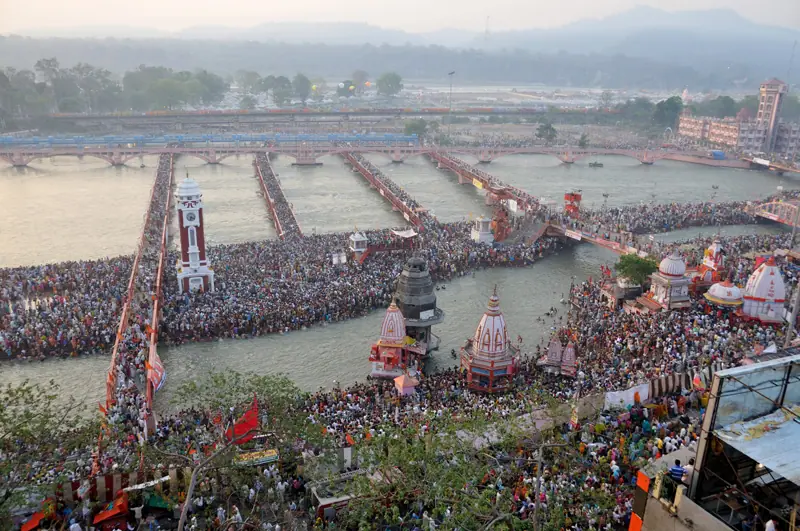
Hinduism has a strong claim to be among the oldest living religious traditions, and a weak claim to be simply “the oldest religion.” Which of those you get depends on three choices: whether you count religions that are no longer practised, whether you date a tradition by its oldest surviving text or by its oldest unwritten roots, and whether “the same religion” means the same beliefs or an unbroken line of people and practice. Hinduism does very well on some of those tests and poorly on others. This page takes them one at a time.
Test 1: the oldest datable evidence
Hinduism’s oldest scripture is the Rigveda. Its oldest layer, the six “Family Books,” was composed orally in the Punjab, most likely c. 1500–1200 BCE on the mainstream dating, and it was not written down for roughly a thousand years after.[1][2] Majority
That date is anchored from outside India. A treaty of c. 1350–1320 BCE from the Hittite capital in Anatolia invokes as divine witnesses Mi-it-ra, Uru-wa-na, In-da-ra and the Na-ša-at-tiya: Mitra, Varuṇa, Indra and the Nāsatyas, gods of the Rigveda.[3] Indo-Aryan gods are attested in writing in Syria roughly two centuries before anything written in India. Consensus
And the Rigveda is still in use. It was preserved by a system of memorization so redundant that manuscripts from opposite ends of India agree to a degree Greek or Biblical manuscript traditions never approach, and it is recited today.[2][4] Consensus A liturgy composed in the second millennium BCE and still chanted is a genuinely rare thing.
Some date the Rigveda much earlier, to 3000 BCE or before, mainly because it praises the Sarasvatī as a mighty river and the Ghaggar-Hakra, often identified with it, was declining by c. 2000 BCE. Critics answer that the identification is insecure and that an early date would put an iron-less, city-less, horse-rich society in the middle of the Harappan urban period.[5][6] Contested / Political
Test 2: older religions, including dead ones
If “oldest religion” means the oldest documented religious system of any kind, Hinduism is not first. The very document that dates the Vedic gods is a Hittite treaty written in cuneiform, in a Near Eastern world where gods had been named in writing for well over a thousand years.[3] The religions of ancient Egypt and Mesopotamia are older than the Rigveda; they simply have no living practitioners. The question therefore usually means oldest living religion, which is a narrower and fairer contest.
Among living traditions, comparisons have to stay modest, because every date involved is itself an argument. Zoroastrianism’s oldest hymns come from the same Indo-Iranian world as the Rigveda: the languages are so close that Vedic deva/asura and Avestan daēva/ahura invert each other exactly, the fossil of a religious split between communities that once shared a pantheon.[5] The dating of those hymns is even less secure than the Rigveda’s. Judaism’s scriptures are usually dated later than the oldest Rigvedic layer in their written form, though the tradition’s own roots are older than its texts. On any honest reckoning, Hinduism belongs in the first rank of the oldest living traditions; declaring a single winner requires choosing a definition that favours one contestant. Contested
Test 3: older than its oldest text?
Hinduism’s roots run beyond the Rigveda. The Indus civilization of c. 2600–1900 BCE left bathing installations, pipal imagery and a horned figure among animals that plausibly fed into later popular religion.[7] Earlier still, Mehrgarh’s farmers buried their dead with goods, and the Deccan ashmounds record centuries of ritual-looking cattle-dung burning from c. 3000 BCE.[8][9] Village goddesses, serpent worship and sacred trees have no Vedic origin and may descend from this substrate.[10]
This is where claims of 5,000 or 10,000 years come from. They are not baseless, but they are plausible, not demonstrable: the Indus script is unread, and every link is inferred from images across long gaps.[11] Majority on some continuity; Contested on every specific item
Test 4: the same religion?
This is the test Hinduism fails, and the failure is the most interesting part of its history. Its oldest scripture worships gods almost nobody worships now. Indra has about 250 Rigvedic hymns and survives as a minor king of a lesser heaven; Viṣṇu has about five and Rudra, later Śiva, about three.[2] The Rigveda has no temples, no images, no karma, no rebirth, no liberation, no bhakti and no caste by birth.[12]
इन्द्रं मित्रं वरुणमग्निमाहुरथो दिव्यः स सुपर्णो गरुत्मान् । एकं सद्विप्रा बहुधा वदन्त्यग्निं यमं मातरिश्वानमाहुः ॥
índraṃ mitráṃ váruṇam agním āhur átho divyáḥ sá suparṇó garútmān | ékaṃ sád víprā bahudhā́ vadanty agníṃ yamáṃ mātaríśvānam āhuḥ ||
“They call it Indra, Mitra, Varuṇa, Agni — and it is the heavenly winged Garutmān. That which is, is One; the seers speak of it in many ways. They call it Agni, Yama, Mātariśvan.”[13]
What it proves: a line in a late layer of the Rigveda already reaches for the idea that later Hindus would build on. The thread is real. But it is a thread, not the operating theology of the oldest hymns.
A short timeline
| Date | What happens | Confidence |
|---|---|---|
| c. 3000–1200 BCE | Deccan ashmounds: repeated communal cattle-dung burning | Consensus it happened |
| c. 2600–1900 BCE | Indus cities; seals and the Great Bath | Consensus |
| c. 1500–1200 BCE | Rigveda’s oldest books | Majority |
| c. 1350–1320 BCE | Mitanni treaty names Vedic gods | Consensus |
| c. 700–500 BCE | Karma and rebirth first stated (Upaniṣads) | Majority |
| c. 110 BCE | Heliodorus pillar: devotion to Vāsudeva in stone | Consensus |
| c. 300–650 CE | Stone temples, Purāṇas, a supreme Goddess | Majority |
| 1787 onward | “Hinduism” named as one religion in English | Majority |
What scholars disagree about
The traditional view. Hindu tradition calls itself sanātana dharma, the eternal order, and treats the Veda as eternal and authorless, a position argued formally by the Mīmāṃsā school.[10] On that view the question of age does not arise in the historian’s sense: the dharma was not founded. That is a theological claim, and a historian can describe it but not test it.
The long-roots view. Many Hindus and some scholars emphasize continuity from the Indus and earlier, which makes Hinduism the heir of a religious world going back to the Neolithic.[7]
The historicist view. Most historians date “Hinduism” as a recognizable configuration of temple, image, devotion and the great gods to the centuries around 200 BCE–600 CE, and “Hinduism” as a named single religion to the modern period, while agreeing that its components are far older.[10][14]
These are less opposed than they sound. They measure different things.
Why it matters
The best-supported conclusion is the one this series reaches at its end: Hinduism has no essence that has persisted unchanged, and a tradition that absorbed the Śramaṇa critique, the Tantric revolution, the Islamic encounter and the colonial encounter while remaining the practice of more than a billion people shows a strength that a fixed tradition could not. The continuity is real; it is a continuity of process, not of content. “Among the oldest living religious traditions” is accurate. “The oldest religion in the world” needs so many qualifications that it stops being a fact.
For how the dates are established, see §0; for the full argument about continuity, see §12.
References
- ^ Michael Witzel "Early Sanskritization: Origins and Development of the Kuru State". Electronic Journal of Vedic Studies 1, 1995. doi The Kuru state thesis — canonization as a political project.
- ^ a b c Stephanie W. Jamison & Joel P. Brereton, trans. The Rigveda: The Earliest Religious Poetry of India. Oxford University Press, 3 vols., 2014. The standard complete English translation. Supersedes Griffith entirely.
- ^ a b Mitanni–Hittite treaty — Boğazköy archive. c. 1350–1320 BCE. Akkadian, with Indo-Aryan divine names. Invokes Mitra, Varuṇa, Indra and the Nāsatyas as witnesses — Indo-Aryan gods attested in writing in Syria two centuries before anything written in India. about
- ^ Frits Staal Agni: The Vedic Ritual of the Fire Altar. Asian Humanities Press, 2 vols., 1983. open library Documentation of the 1975 Agnicayana in Kerala — plausibly the oldest continuously performed ritual on earth.
- ^ a b Edwin Bryant The Quest for the Origins of Vedic Culture. Oxford University Press, 2001. open library The fairest book-length survey of the origins debate; takes the indigenist arguments seriously without endorsing them.
- ^ Liviu Giosan et al. "Fluvial landscapes of the Harappan civilization". PNAS 109, 2012. doi The geomorphology behind the Ghaggar-Hakra argument.
- ^ a b Asko Parpola The Roots of Hinduism: The Early Aryans and the Indus Civilization. Oxford University Press, 2015. full text The fullest statement of the Dravidian-Indus case. Argued, not established.
- ^ Robin Coningham & Ruth Young The Archaeology of South Asia: From the Indus to Asoka. Cambridge University Press, 2015. The standard synthesis for §§1–6.
- ^ F. R. Allchin Neolithic Cattle-Keepers of South India. Cambridge University Press, 1963. full text The ashmound study.
- ^ a b c Gavin Flood An Introduction to Hinduism. Cambridge University Press, 1996. open library The standard university textbook, and the most balanced single overview.
- ^ Steve Farmer, Richard Sproat & Michael Witzel "The Collapse of the Indus-Script Thesis". Electronic Journal of Vedic Studies 11, 2004. open access The minority argument that the sign system is not writing at all.
- ^ Michael Witzel "Tracing the Vedic Dialects". in Dialectes dans les littératures indo-aryennes, 1989. The foundational work on Rigvedic internal chronology and geography.
- ^ RV 1.164.46 — Rigveda. c. 1100 BCE. Vedic Sanskrit. ekaṃ sad viprā bahudhā vadanti — "the One that is, the seers call by many names." Ancestor of every later Hindu claim that the gods are one. read the text
- ^ Will Sweetman "'Hinduism' and the History of 'Religion': Protestant Presuppositions in the Critique of the Concept of Hinduism". Method & Theory in the Study of Religion 15, 2003. doi The critique of Hinduism-as-a-religion smuggles in a Protestant model of what a religion must be. The best single citation for why the debate got distorted.