Modern Hinduism in one paragraph
Since independence in 1947, the Indian state has done something no premodern Hindu authority could have done: it has legislated Hinduism. Untouchability was abolished by constitutional article, temples were opened by statute, and the Hindu Code Bills of 1955–56 rewrote marriage, divorce, adoption and inheritance for a fifth of humanity — imposing monogamy, permitting divorce, and giving daughters inheritance rights, over fierce religious objection. A tradition with no central authority acquired one: the Indian state.
At the same time Hinduism became genuinely global, through a professional diaspora that built temples across four continents and through yoga, which detached from its religious setting and became a worldwide practice for millions of people who mostly do not consider themselves Hindu. Television did to the epics in 1987 what print had done to texts in the nineteenth century — standardized them, this time for a hundred million viewers at once. And Hindutva, the political ideology defined in Chapter 11, moved from the margins to the centre of Indian politics.
A tradition often described as among the oldest continuous religious traditions on earth is now also one of the most publicly argued-over, and this chapter ends where the argument currently stands rather than pretending it has been settled.
Timeline of Hinduism since 1947
Since 1947 Hinduism’s history runs through the Constitution’s abolition of untouchability, the Hindu Code Bills, Ambedkar’s conversion, the televised epics, the Babri Masjid demolition, the 2019 Ayodhya judgment and the Sabarimala reference.
| Date | Event | Confidence |
|---|---|---|
| 1947 | Independence and Partition | Consensus |
| 1950 | Constitution in force — Art. 17 abolishes untouchability; Art. 25(2)(b) empowers the State to open Hindu institutions to all classes of Hindus[1] | Consensus |
| 1951 | Ambedkar resigns as Law Minister — the stalled Hindu Code Bill is one of five stated grievances; Bharatiya Jana Sangh founded | Consensus |
| 1955–56 | Hindu Code Bills — Marriage, Succession, Minority & Guardianship, Adoptions & Maintenance Acts[2] | Consensus |
| 1956 | Ambedkar converts to Buddhism at Nagpur with several hundred thousand followers; dies weeks later | Consensus |
| 1959 | Tamil Nadu HR&CE Act — state administration of temples | Consensus |
| 1964 | Vishva Hindu Parishad founded | Consensus |
| 1965 | US Immigration and Nationality Act opens large-scale professional migration | Consensus |
| 1966 | ISKCON founded in New York by Bhaktivedanta Swami Prabhupāda | Consensus |
| 1980 | Bharatiya Janata Party founded | Consensus |
| 1987–90 | Ramanand Sagar’s Rāmāyaṇ and B. R. Chopra’s Mahābhārat on national television | Consensus |
| 1990 | Mandal Commission acceptance announced — stayed, upheld in Indra Sawhney (1992), implemented 1993; Advani’s rath yātrā[3] | Consensus |
| 1992 | Babri Masjid demolished, 6 December; nationwide riots follow | Consensus |
| 2005 | Hindu Succession Act amended — daughters get equal coparcenary rights | Consensus |
| 2015 | UN International Day of Yoga inaugurated | Consensus |
| 2018–19 | Sabarimala judgment admitting women of all ages; mass protests; questions referred to a nine-judge bench — the judgment itself was never stayed[4] | Consensus |
| 2019 | Supreme Court awards the Ayodhya site to Hindu parties, with land elsewhere for a mosque[5] | Consensus |
| 2024 | Rām Mandir consecrated at Ayodhya, 22 January; Davinder Singh permits sub-classification within the Scheduled Castes[6] | Consensus |
| 2024–25 | Supreme Court freezes new suits under the Places of Worship Act[7][8]; Uttarakhand’s UCC comes into force[9] | Consensus |
| 2025–27 | Caste enumeration approved for Census 2027 — the first in a national census since 1931 | Consensus |
| 2026 | The nine-judge Sabarimala bench hears the reference and reserves judgment (14 May)[10] | Consensus |
Where Hindus live today
The great majority of the world’s Hindus live in India, but Hinduism now also has an older indentured diaspora, a newer professional one in the West and the Gulf, and an online geography.
For the first time, “where” is not a region of India.
India holds the great majority of the world’s Hindus — on the order of a billion people, roughly four-fifths of its population. Nepal is majority Hindu. The older diaspora descends from indentured labour shipped between 1834 and 1917 to Mauritius, Fiji, Trinidad, Guyana, Suriname, South Africa and Malaya — communities now six or seven generations deep, with their own liturgies and forms of Hindi. The newer diaspora — Britain, the United States, Canada, Australia, the Gulf — is largely post-1947 and heavily professional, and it builds temples that are often more architecturally orthodox than anything in India, because they are built new, at once, with money.
A third geography barely existed thirty years ago: the online one. Temple livestreams, e-pūjā bookings, WhatsApp devotional networks, and searchable Sanskrit corpora (GRETIL, Muktabodha, SARIT) have made a tradition that spent three thousand years transmitting orally (§3) into one that is fully indexed and instantly quotable — by anyone, for any purpose.
The evidence ledger for modern Hinduism
Since 1947 the Indian state, not any religious body, defines Hindu personal law, while endogamy remains near-universal, yoga has spread worldwide and Hindu nationalism has become a dominant force in public life.
| Dimension | What we can say | Evidence | Confidence |
|---|---|---|---|
| Legal authority | The state, not any religious body, now defines Hindu personal law | Hindu Code Bills 1955–56; subsequent amendments and judgments[2][11] | Consensus |
| Caste in law | Untouchability is a criminal offence; affirmative action is constitutional | Art. 17; SC/ST (Prevention of Atrocities) Act 1989; reservations[1][12] | Consensus |
| Caste in practice | Endogamy remains near-universal; discrimination and violence persist | IHDS-II: 5.82% inter-caste marriage, flat across four decades of cohorts; NCRB 57,789 cases in 2023[13][14] | Consensus |
| Temple access | Legally open; contested in specific cases on grounds of custom | Art. 25(2)(b); the Sabarimala litigation | Consensus |
| Women | Legal rights transformed; ritual authority still largely male | 1956 and 2005 succession law; a small but real growth in women priests | Majority |
| Global reach | Yoga practised by millions worldwide, mostly detached from Hindu identity | Industry and survey estimates, which vary widely; UN observance since 2015 | Consensus |
| Standardization | Mass media collapses plural regional versions of the epics into single canonical ones | Viewership of the 1987–90 serials; subsequent retellings following their plot[15] | Majority |
| Politics | Hindu nationalism is a dominant force in Indian public life | Electoral results since 1998; institutional expansion[16] | Consensus |
Primary sources
The record of modern Hinduism centres on the Hindu Code Bills, Ambedkar’s conversion, global yoga, the televised epics, the Ayodhya litigation, and the state of caste and of women’s temple access.
1. The Hindu Code Bills — a state reforms a religion
Ambedkar, as Law Minister, drafted a comprehensive bill to codify and reform Hindu personal law. It met sustained opposition from Hindu traditionalist members and from President Rajendra Prasad, and was broken up and stalled. Ambedkar resigned in September 1951; his resignation statement lists the Code’s fate as one of five grievances, alongside his confinement to the Law portfolio, exclusion from the Planning Commission, the treatment of the Scheduled Castes, and Nehru’s Kashmir policy.[17] Nehru pushed the pieces through in 1955–56 as four separate Acts.
The reform also had a long colonial prehistory — the Hindu Marriages Validity Act 1949 had already validated inter-caste marriage, and Bombay and Madras had banned Hindu bigamy in 1946 and 1949.[11]
What changed for Hindus (and, by the Acts’ definition, Sikhs, Jains and Buddhists):
| Before | After |
|---|---|
| Polygamy permitted for men in most communities | Monogamy compulsory |
| Marriage a sacrament, effectively indissoluble | Divorce available, to both spouses |
| Daughters largely excluded from ancestral property | Inheritance rights 1956; coparcenary equality from 2005, made retroactive by Vineeta Sharma (2020)[18] |
| Adoption governed by varied customary and śāstric rules | Codified; unmarried, widowed and divorced women given the right to adopt — a married woman could not adopt in her own right until 2010 |
| Caste restrictions on valid marriage | Inter-caste marriage valid (already so under the 1949 Act; consolidated here) |
What it proves. This is the largest single change in the practice of Hinduism in this chapter, and it was made by a secular legislature against significant religious opposition, at the urging of a man who had publicly burned the Manusmṛti and would convert to Buddhism within months.
It also created an asymmetry that remains politically live: Hindu personal law was reformed and codified, while Muslim, Christian and Parsi personal laws largely were not. That asymmetry is the root of the continuing Uniform Civil Code argument, which Article 44 of the Constitution names as a directive principle and which Uttarakhand enacted at state level in 2024.[19][9] Consensus on the history; Political on the current debate
2. Ambedkar’s exit
On 14 October 1956 at Nagpur, Ambedkar formally converted to Buddhism together with a crowd usually estimated at three to four hundred thousand people. He administered twenty-two vows, several of which explicitly renounce belief in the Hindu gods and in the avatāra doctrine. He died seven weeks later.[20]
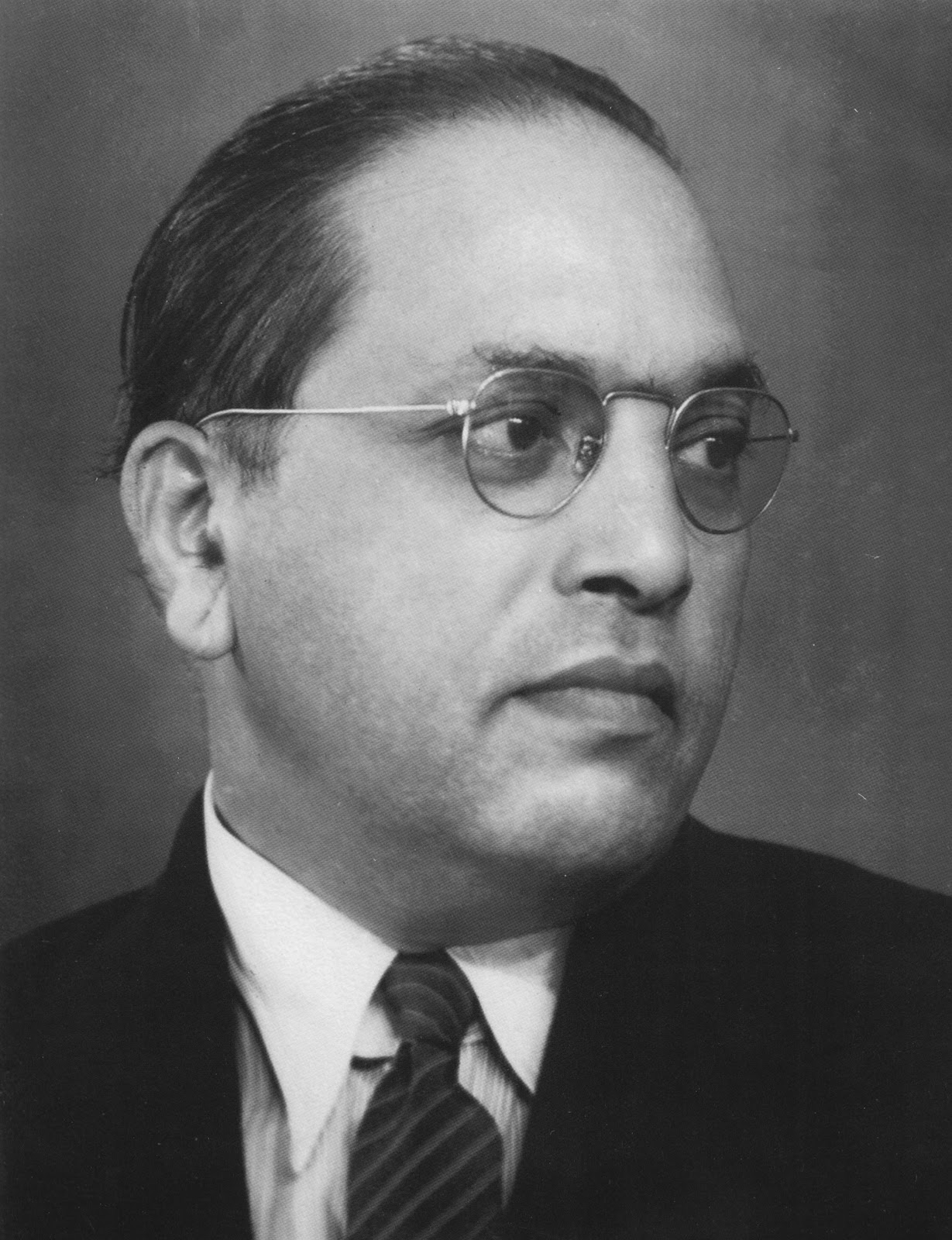
What it proves. The conversion is the logical endpoint of the argument in Chapter 11: if caste is authorized by the tradition’s own scriptures, then reform from inside is not available and exit is.[21] The Navayāna Buddhism he founded — this-worldly, rationalist, oriented to social liberation — now has millions of adherents concentrated in Maharashtra, and constitutes the largest religious secession from Hinduism in modern history. Consensus
3. Yoga leaves home
Modern postural yoga descends principally from T. Krishnamacharya (1888–1989), who taught in the Mysore palace and trained the teachers who globalized it: B. K. S. Iyengar, K. Pattabhi Jois, Indra Devi, and his son T. K. V. Desikachar.
Mark Singleton’s Yoga Body (2010) argued that the dynamic āsana sequences at the core of modern practice — sun salutations, flowing vinyāsa, the emphasis on physical postures — took shape in the early twentieth century through contact with European gymnastics, Scandinavian physical culture and Indian wrestling traditions.[22]
What happened next is more interesting than the dispute. James Mallinson’s 2011 response
accepted Singleton’s account of the modern lineage while objecting to the inference that premodern
āsana was thin. The two then co-authored Roots of Yoga (2017) from over a hundred premodern
sources, and worked with Jason Birch on the Haṭha Yoga Project at SOAS (2015–2020), which
substantially expanded the known premodern repertoire — the Haṭhābhyāsapaddhati (c. 18th c.)
describes some 112 postures including dynamic, jumping and rope-assisted sequences.[23][24] The honest
current statement: Singleton’s account of the modern lineage stands; the implied thinness of the
premodern record has been revised by his own later work. [Was contested; substantially settled by the disputants' joint work]
What is not disputed: the relationship to Chapter 5 and Chapter 7 is loose. Yoga in the Rigveda means yoking a chariot; in the Gītā it means disciplined action, knowledge or devotion; in Patañjali it means stilling the fluctuations of the mind, with posture given three sūtras out of 195 (YS 2.46–48).[23] A practice now done by millions of people, most of them not Hindu, mostly for health, is continuous with that history in name and lineage and quite distant from it in content. Whether that constitutes appropriation, evolution, or successful export is argued by Hindus themselves. Political
4. Television and the standardizing of story
Ramanand Sagar’s Rāmāyaṇ (1987–88) and B. R. Chopra’s Mahābhārat (1988–90) drew audiences routinely estimated at 80–100 million per episode.[25][26] Streets emptied. Sets were garlanded and worshipped.
What it proves. Chapter 10 established that India had many Rāmāyaṇas — Vālmīki’s, Tulsīdās’s, Kamban’s Tamil, Krittibas’s Bengali, Jain versions in which Rāvaṇa is a tragic hero, folk versions in which Sītā is the protagonist and versions where she is Rāvaṇa’s daughter. A. K. Ramanujan’s essay “Three Hundred Rāmāyaṇas” (1991) documented this plurality; it was removed from a Delhi University syllabus after protests in 2011.[27]
Broadcasting one version to a hundred million people simultaneously does something print never quite managed: it makes a single telling the telling. The serials drew mainly on Tulsīdās, and the version most Indians under fifty now carry in their heads is substantially Sagar’s. Media technology has shaped religious content at every stage of this history — oral memorization (§3), manuscript (§4 onward), print (§11), broadcast, and now the feed. Majority
5. Ayodhya
The dispute over the site at Ayodhya — a mosque built in 1528, claimed by Hindus as the birthplace of Rāma — was litigated from 1885. It became a mass movement in the 1980s: the VHP’s campaign from 1984, the śilānyās foundation ceremony in 1989, L. K. Advani’s rath yātrā in 1990.[28]
On 6 December 1992 a crowd demolished the Babri Masjid. Riots followed across India, killing roughly two thousand people, and the bombings in Bombay in March 1993 killed some two hundred and fifty more.[29]
On 9 November 2019, in M Siddiq v. Mahant Suresh Das (2020) 1 SCC 1, a unanimous and deliberately unsigned five-judge bench decreed the disputed land not to “the Hindus” generically but to the deity itself — Bhagwan Sri Ram Virajman — with possession to a trust to be constituted by the Central Government. The Nirmohi Akhara’s suit was dismissed as time-barred and the Sunni Waqf Board’s dismissed; five acres elsewhere were directed for a mosque under Article 142, expressly as a remedy for two wrongs the Court itself named as unlawful: the placing of idols inside the mosque in December 1949 and the demolition of December 1992.[5]
On the archaeology, the Court held the ASI report admissible but ruled that “a finding of title cannot be based in law on the archaeological findings.”[5] The ASI had found that the mosque was not built on vacant land and that the underlying structure was not Islamic — but not that it had been demolished to build the mosque. The temple was consecrated on 22 January 2024; the Trust announced completion of the wider complex in October 2025.
The legal sequel matters as much as the judgment. The 2019 bench expressly endorsed the Places of Worship (Special Provisions) Act, 1991, which freezes the character of every other religious site as it stood on 15 August 1947.[8] That Act is now itself under challenge, and on 12 December 2024 the Supreme Court barred the registration of new suits seeking surveys of religious places and barred effective orders in the roughly eighteen already pending — Gyanvapi, the Shahi Idgah at Mathura, Sambhal, Bhojshala and others.[7] Whether Ayodhya was an endpoint or a template is, as of 2026, still being litigated. Political
What it proves. Reporting this factually matters more than adjudicating it. What the sequence shows is that the historical questions running through this entire series — what happened to temples under Muslim rule (§10), who is indigenous to India (§0), what counts as Hindu (§11) — are not academic. They have produced mass mobilization, a demolished building, thousands of deaths, a Supreme Court judgment, and a consecrated temple. Consensus on the events; Political throughout
6. Caste now
- Legally: untouchability abolished (Art. 17), atrocities criminalized (1989 Act), reservations in education, employment and legislatures for Scheduled Castes, Scheduled Tribes and — after the Mandal Commission’s implementation in 1990 — Other Backward Classes.
- Socially: inter-caste marriage runs at roughly 5–6% of all marriages nationally (IHDS-II, 2011–12: 5.82%), and — the more striking finding — has been essentially flat across four decades of marriage cohorts. State variation is wide, from around 1% to above 11%.[13] Endogamy is the strongest surviving element of the system and the mechanism by which caste reproduces itself — a point first argued by Ambedkar in Castes in India (1916).[30] NCRB recorded 57,789 cases of crimes against Scheduled Castes in 2023, against 57,582 in 2022.[14]
- Politically: caste is a primary axis of electoral mobilization. In April–June 2025 the government approved caste enumeration in Census 2027 — the first in a national census since 1931, and the reason that 1931 figure still anchors every argument about caste numbers. In State of Punjab v. Davinder Singh (2024) a seven-judge bench held 6:1 that states may sub-classify within the Scheduled Castes, overruling E. V. Chinnaiah (2005); several judges urged extending the creamy-layer principle to SC/ST.[6] It is the most consequential caste-law ruling since Indra Sawhney.[3]
What it proves. The doctrinal history traced across this series — occupational ranking in §3 hardening into a birth order in §4, codified in §7, contested by devotional movements in §9 and §10, fixed administratively in §11 — did not end when the law changed.[31] Consensus
7. Women and access
Legal transformation, ritual continuity. In 2018 the Supreme Court held 4:1 that excluding women of menstruating age from the Sabarimala temple was unconstitutional (Indu Malhotra J. dissenting).[4] Mass protests followed, including by women devotees. In November 2019 the Court kept the review petitions pending and referred a set of broader questions to a nine-judge bench — but, contrary to widespread reporting, it did not stay the 2018 judgment, and two judges dissented specifically to say so.
The reference then sat dormant for six years. The nine-judge bench began hearing on 7 April 2026 and reserved judgment on 14 May 2026, taking Sabarimala together with Muslim women’s entry to mosques, Parsi women’s entry to fire temples after interfaith marriage, and Dawoodi Bohra excommunication.[10] The question it must answer is the one running under this whole section: whether a court may weigh “constitutional morality” against a religious denomination’s own account of what is essential to it.[32][33] As of this writing the judgment has not been delivered. Political Meanwhile training programmes have produced small but growing numbers of women performing priestly functions, mostly in Maharashtra and among urban householders.
The long arc from Chapter 5 is worth stating plainly: Gārgī argued in open assembly around 700 BCE[34]; Manu declared women unfit for independence around the turn of the era (§7)[35]; the bhakti saints made room for Āṇṭāḷ, Akka Mahādēvi and Mīrā (§9, §10) at the cost of exit from ordinary life; and formal legal equality arrived in the 1950s and 2005. Ritual authority has moved least. Majority
The gods of modern Hinduism
Rāma is the most politically charged deity in modern India, while Kṛṣṇa is globalized through ISKCON, Gaṇeśa is the most visible public deity, and living gurus command large followings.
| Deity | Note |
|---|---|
| Rāma | The most politically charged deity in modern India; Ayodhya and the televised epic |
| Kṛṣṇa | Globalized through ISKCON and the Gītā’s status as the portable Hindu scripture |
| Śiva | Broad, largely apolitical popular devotion; Kailāsa and Kāśī pilgrimage at record scale |
| Devī | Vaiṣṇo Devī and Śakti Pīṭha pilgrimage among the largest religious gatherings on earth |
| Gaṇeśa | The most visible public deity; Tilak’s public festival (§11) is now a civic institution |
| Bhārat Mātā | The nation as goddess, from §11, now with temples and a firm political role |
| Living gurus | A durable feature: Sathya Sai Baba, Ravi Shankar, Ramdev, Amma and others command followings, institutions and considerable wealth |
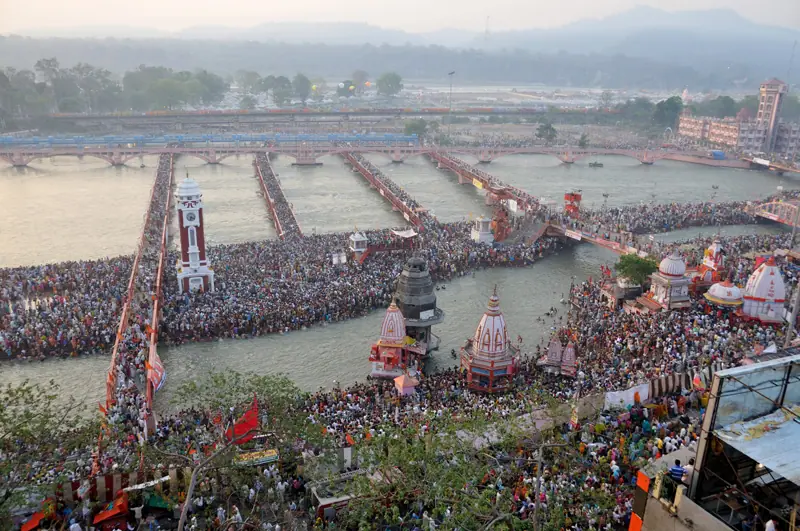
The Kumbh Mela, meanwhile, is routinely described as the largest gathering of human beings on the planet. For the Prayagraj Maha Kumbh of 2025 the Uttar Pradesh government reported roughly 660 million bathers over 45 days — a figure worth reporting as what it is, an official estimate with no independent count behind it, whose methodology has been publicly disputed. The occasion is bathing at a river confluence: a practice for which Chapter 2 offers a Harappan candidate ancestor in the Great Bath, and for which the Rigveda offers no warrant at all.
Debates about modern Hinduism
Debates about modern Hinduism centre on whether Hindutva is Hinduism, whether the state overreached in reforming Hindu law, whether global yoga is appropriation, and whether the period can be written about neutrally.
Is Hindutva Hinduism?
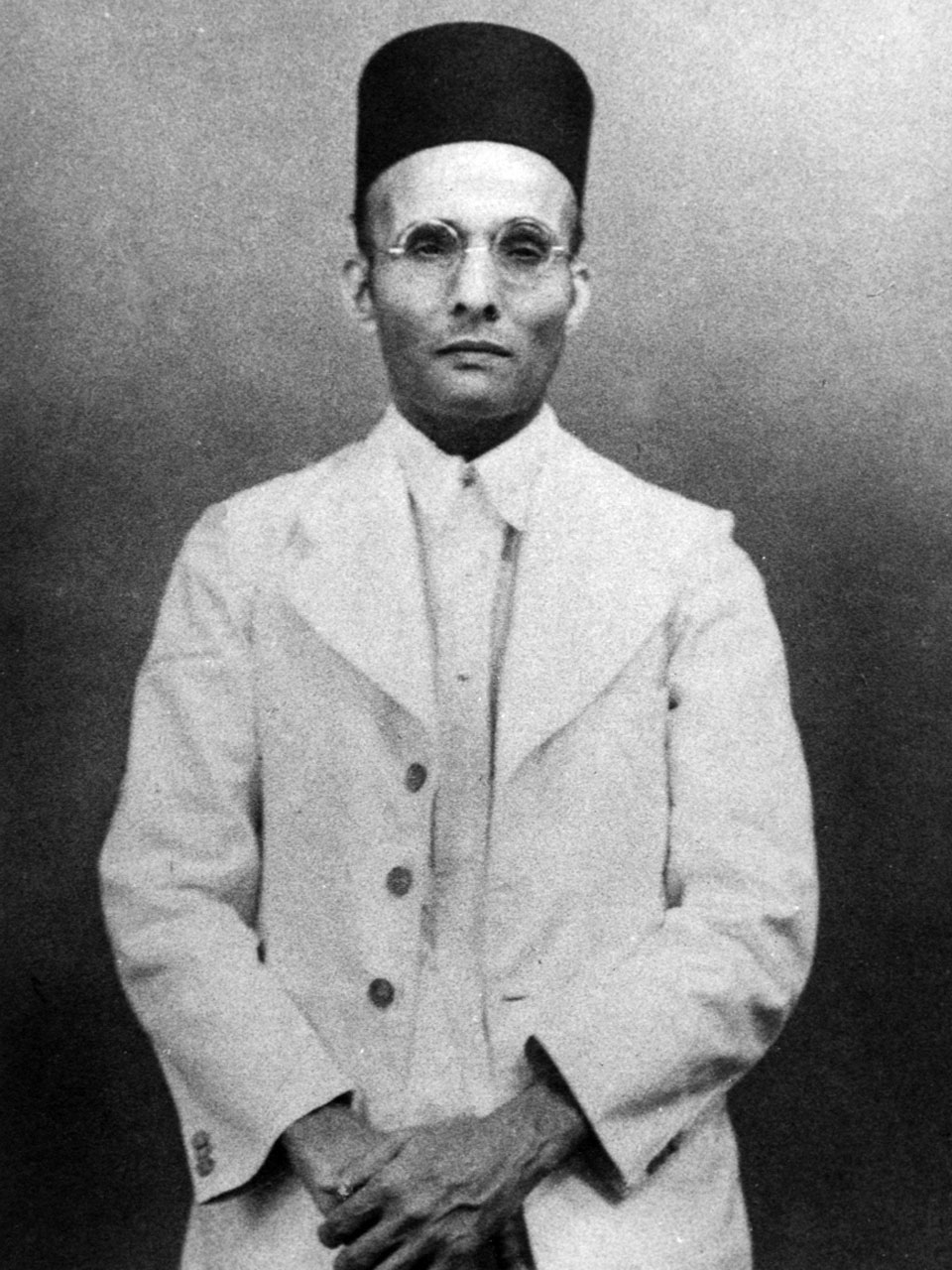
Its adherents generally say it is the political expression of Hindu civilization; its critics say it is an ethnonationalist ideology that instrumentalizes a religion. Two facts constrain the argument in both directions: Savarkar’s founding definition is territorial and ethnic rather than theological, and he was a professed rationalist who attacked cow worship and ritual religion — scholars describe him variously as an atheist or an agnostic (§11)[36][37]; and the movement nonetheless draws its symbols, festivals and mass appeal from religious practice. The Supreme Court’s 1995 Hindutva judgments, describing the term as denoting a way of life, remain contested.[38][33] This series treats them as distinct but entangled and reports specific events rather than adjudicating the category. Political
Did the state overreach in reforming Hindu law?
Supporters point to monogamy, divorce and women’s inheritance as unambiguous gains that no internal religious authority was going to deliver. Critics argue the state singled out one religion for reform and set a precedent for legislating belief. Both positions have been argued continuously since 1951. Political
Is global yoga appropriation?
The “Take Back Yoga” campaign argues the practice has been stripped of its Hindu context and commercialized. Others reply that Hindu teachers exported it deliberately and successfully, and that the modern practice is itself a hybrid creation of the twentieth century. Political
Can modern Hinduism be written about neutrally?
Not entirely, and it would be dishonest to claim otherwise. Events within living memory, tied to current politics and current litigation, cannot be narrated from nowhere. The commitment made here is narrower and checkable: state the documented facts, name the sources, attribute contested claims to whoever makes them, and mark where the evidence stops. Readers should treat this chapter, more than any other in the series, as an invitation to check the primary record. Political
Where this leaves the whole story
Read the twelve chapters end to end and the single most defensible conclusion is that Hinduism has no essence that has persisted unchanged — it has a history, and the history is one of continuous absorption and reinvention:
- Its oldest scripture worships gods almost nobody worships now (§3).
- Its central doctrines — karma, rebirth, liberation — are absent from that scripture and arrive around 700 BCE, credited by the texts themselves to non-brahmins (§5).[39]
- Its ethics of non-violence and vegetarianism were adopted under pressure from movements that rejected the Veda outright (§6).
- Its temples, images and devotion appear around two thousand years after its oldest hymns (§7, §8).
- Its supreme Goddess enters the written record around 550 CE, from a stream with no Vedic ancestry (§8).[40]
- Its most widely known scripture in the Hindi belt was written in 1574 in a spoken vernacular (§10).[41]
- Its modern self-description — one religion, Vedāntic in essence, holding all paths equally valid — dates from the nineteenth century (§11).
- Its personal law was written by a parliament in 1955 (§12).[2]
That is not a debunking. A tradition that could absorb the Śramaṇa critique, the Tantric revolution, the Islamic encounter and the colonial encounter, and remain the living practice of more than a billion people, is demonstrating exactly the kind of strength that a fixed and unchanging tradition could not. The continuity is real; it is a continuity of process, not of content.
Further reading
- Ramachandra Guha, India After Gandhi (2007; rev. 2017).
- Christophe Jaffrelot, Modi’s India: Hindu Nationalism and the Rise of Ethnic Democracy (2021).
- Mark Singleton, Yoga Body: The Origins of Modern Posture Practice (2010), with James Mallinson & Singleton, Roots of Yoga (2017) for the counterweight.
- Philip Lutgendorf, “Ramayan: The Video,” TDR 34 (1990) — on the televised epic.
- A. K. Ramanujan, “Three Hundred Rāmāyaṇas” (1991).
- Gauri Viswanathan, Outside the Fold: Conversion, Modernity, and Belief (1998).
- Anupama Rao, The Caste Question (2009).
- Vasudha Narayanan and Diana Eck on diaspora Hinduism; Eck, A New Religious America (2001).
References
- ^ a b Constitution of India, Arts. 17 & 25 — Republic of India. 1950 CE. English. Untouchability abolished; religious freedom guaranteed; temples opened to all classes of Hindus by constitutional mandate. about
- ^ a b c Hindu Code Bills — Parliament of India. 1955–56 CE. English. A secular legislature imposes monogamy, permits divorce, and grants daughters inheritance — the largest single change in Hindu practice in this history. about
- ^ a b Indra Sawhney v. Union of India — Supreme Court of India, 1992 Supp (3) SCC 217. 1992 CE. English. Mandal upheld; the 50% ceiling and the creamy-layer exclusion established. read the text
- ^ a b Indian Young Lawyers Assn. v. Kerala — Supreme Court of India, (2019) 11 SCC 1. 2018 CE. English. Sabarimala opened to women of all ages, 4:1. Referred onward in 2019 but never stayed; a nine-judge bench reserved judgment in May 2026. read the text
- ^ a b c M Siddiq v. Mahant Suresh Das — Supreme Court of India. 2019 CE. English. The Ayodhya judgment. Records both the 1949 placing of idols and the 1992 demolition as unlawful, and awards the site for a temple. about
- ^ a b State of Punjab v. Davinder Singh — Supreme Court of India, 2024 INSC 562. 2024 CE. English. States may sub-classify within the Scheduled Castes, 6:1 — the most consequential caste-law ruling since Indra Sawhney. about
- ^ a b Places of Worship order — Supreme Court of India, Ashwini Kumar Upadhyay v. Union of India. 12 December 2024. English. Bars registration of new suits seeking surveys of religious places, and effective orders in the roughly eighteen pending — Gyanvapi, Shahi Idgah, Sambhal, Bhojshala. The direct legal sequel to Ayodhya. read the text
- ^ a b Places of Worship (Special Provisions) Act — Parliament of India. 1991 CE. English. Freezes the character of every religious site as it stood on 15 August 1947. Endorsed by the 2019 Ayodhya bench; itself under challenge since 2024. about
- ^ a b Uniform Civil Code of Uttarakhand Act — State of Uttarakhand. 2024 CE (in force 2025). English. The first UCC in independent India. Exempts Scheduled Tribes and adds a compulsory registration regime for live-in relationships — the main ground of the constitutional challenges.
- ^ a b Kantaru Rajeevaru (nine-judge reference) — Supreme Court of India. heard April–May 2026. English. The Sabarimala reference: whether a court may weigh "constitutional morality" against a denomination's own account of what is essential to it. Heard from 7 April 2026, judgment reserved 14 May 2026, not yet delivered. read the text
- ^ a b Eleanor Newbigin The Hindu Family and the Emergence of Modern India: Law, Citizenship and Community. Cambridge University Press, 2013. full text The colonial prehistory of the Hindu Code Bills — essential to §12's opening claim.
- ^ Marc Galanter Competing Equalities: Law and the Backward Classes in India. University of California Press, 1984. full text The classic on reservation law.
- ^ a b India Human Development Survey II — NCAER and University of Maryland. 2011–12. English. 5.82% of ever-married women in an inter-caste marriage, with no upward trend across four decades of marriage cohorts. The flatness is the more striking finding than the level. about
- ^ a b Crime in India — National Crime Records Bureau. 2022–2023. English. 57,789 cases of crimes against Scheduled Castes recorded in 2023, against 57,582 in 2022 — the scale behind "discrimination and violence persist." about
- ^ Arvind Rajagopal Politics after Television: Hindu Nationalism and the Reshaping of the Public in India. Cambridge University Press, 2001. full text The televised Rāmāyaṇ and its political afterlife.
- ^ Christophe Jaffrelot Modi's India: Hindu Nationalism and the Rise of Ethnic Democracy. Princeton University Press, 2021.
- ^ Ashok Gopal A Part Apart: The Life and Thought of B. R. Ambedkar. Navayana, 2023. Fifteen years in the Marathi sources; corrects the English-only picture.
- ^ Vineeta Sharma v. Rakesh Sharma — Supreme Court of India, (2020) 9 SCC 1. 2020 CE. English. Daughters' coparcenary rights are retroactive by birth — without this, the 2005 amendment would have excluded a large share of them. about
- ^ Constitution of India, Art. 44 — Republic of India. 1950 CE. English. A Uniform Civil Code named as a directive principle — non-justiciable, and the constitutional hook for every UCC argument since. about
- ^ Scott R. Stroud The Evolution of Pragmatism in India: Ambedkar, Dewey, and the Rhetoric of Reconstruction. University of Chicago Press, 2023. Why Ambedkar rejected the reformist "authentic ancient core" move: Dewey's meliorism made him hostile to arguments from origin.
- ^ Annihilation of Caste — B. R. Ambedkar. 1936 CE. English. Caste is authorized by the scriptures, not a corruption of them — so reform from inside is unavailable, and exit is the conclusion. about
- ^ Mark Singleton Yoga Body: The Origins of Modern Posture Practice. Oxford University Press, 2010. full text The hybrid-origins thesis for modern postural yoga.
- ^ a b James Mallinson & Mark Singleton Roots of Yoga. Penguin, 2017. The premodern textual record, and the necessary counterweight to Yoga Body.
- ^ Jason Birch "The Proliferation of Āsana-s in Late Medieval Yoga Texts". in Yoga in Transformation, Vienna University Press, 2018. doi Open access. The evidence for premodern athletic āsana that revises Yoga Body's implied thinness.
- ^ Rāmāyaṇ (television serial) — Ramanand Sagar, Doordarshan. 1987–88. Hindi. 78 episodes drawn largely from Tulsīdās, watched by an estimated 80–100 million per episode. Broadcasting one telling to a hundred million people did what print never quite managed. about
- ^ Philip Lutgendorf "Ramayan: The Video". TDR: The Drama Review 34, 1990. doi Written while the serial was still airing. The best account of what mass broadcast did to a plural narrative tradition.
- ^ Paula Richman, ed. Many Rāmāyaṇas: The Diversity of a Narrative Tradition in South Asia. University of California Press, 1991. full text Contains Ramanujan's "Three Hundred Rāmāyaṇas."
- ^ Christophe Jaffrelot The Hindu Nationalist Movement in India. Columbia University Press, 1996. open library
- ^ Ramachandra Guha India After Gandhi. Picador, rev. ed., 2017. open library
- ^ Castes in India — B. R. Ambedkar. 1916 CE. English. A Columbia seminar paper identifying endogamy as the mechanism of caste — the thesis §12 relies on for why caste reproduces itself. about
- ^ Anupama Rao The Caste Question: Dalits and the Politics of Modern India. University of California Press, 2009. full text
- ^ Shirur Mutt — Supreme Court of India, AIR 1954 SC 282. 1954 CE. English. Origin of the "essential religious practices" doctrine — the courts take on deciding what is essential to a religion. read the text
- ^ a b Ronojoy Sen Articles of Faith: Religion, Secularism, and the Indian Supreme Court. Oxford University Press, 2010. How the courts came to decide what is essential to a religion.
- ^ BU 3.6 & 3.8 — Bṛhadāraṇyaka Upaniṣad. c. 700 BCE. Sanskrit. Gārgī Vācaknavī argues Yājñavalkya to his deepest answer in open assembly, and is credited by name in scripture. read the text
- ^ Manusmṛti 9.3 — Mānava Dharmaśāstra. c. 200 BCE – 200 CE. Sanskrit. "A woman is never fit for independence." Five centuries after Gārgī. read the text
- ^ Essentials of Hindutva — V. D. Savarkar. 1923 CE. English. Defines a Hindu territorially and ethnically — fatherland and holy land — not theologically. Savarkar was an atheist. about
- ^ Janaki Bakhle Savarkar and the Making of Hindutva. Princeton University Press, 2024. open library The Marathi-sourced counterpart on the other side.
- ^ Ramesh Yeshwant Prabhoo v. Prabhakar Kunte — Supreme Court of India, (1996) 1 SCC 130. 1995 CE. English. The "Hindutva is a way of life" holding. Left expressly unreconsidered by a seven-judge bench in *Abhiram Singh* (2017), which is why it still stands. about
- ^ CU 5.3–10 — Chāndogya Upaniṣad. c. 700 BCE. Sanskrit. Pañcāgni-vidyā. A kṣatriya king teaches rebirth to two brahmins who cannot answer his questions — the texts crediting the doctrine outside the priesthood. read the text
- ^ Devī Māhātmya 5 — Mārkaṇḍeya Purāṇa. c. 550–600 CE. Sanskrit. yā devī sarvabhūteṣu — the first text making a goddess the supreme reality and the source of the male gods' power. about
- ^ Rāmcaritmānas, Bālkāṇḍ — Tulsīdās. 1574 CE. Awadhi. For hundreds of millions this, not Vālmīki, is the Rāmāyaṇa. Scripture in a spoken tongue, over pandits' objections. read the text