The later Vedic period in one paragraph
The later (or late) Vedic period, roughly 1200–900 BCE, is when the Vedic world moved east out of the Punjab into the Ganga–Yamuna doāb, and in doing so changed almost everything about itself. Iron arrived; rice arrived; ploughing wet land produced a surplus the Punjab could not; the tribal chiefdoms of the Rigveda consolidated into the first thing resembling a state, ruled by the Kurus. That state did something unprecedented: it collected, fixed, and canonized the hymns into an unalterable scripture, compiled three more Vedas beside it, and built out of them a ritual system of staggering complexity and expense.
And the theology inverted. In the Rigveda the priest asks the gods for help. In the Brāhmaṇas the correctly performed ritual compels the cosmos, and the gods themselves became what they are only by sacrificing. Power moved from the deity to the technician. This is the period that made brahmins indispensable — and it is also the period in which the varṇa order hardens from occupation toward birth, and in which Rudra begins to be addressed as śiva.
Timeline of the later Vedic period
The later Vedic period runs from the Painted Grey Ware horizon and the formation of the Kuru polity c. 1200 BCE to the shift of the Vedic centre east to Kosala and Videha c. 900 BCE.
| Date | Event | Confidence |
|---|---|---|
| c. 1800–1000 BCE | Iron-bearing levels at Malhar and Raja Nala ka Tila (Tewari 2003). The early end is disputed on stratigraphic grounds; iron in quantity is c. 1200 BCE[1] | Contested |
| c. 1200 BCE | Painted Grey Ware horizon begins in the doāb[2] | Consensus |
| c. 1200–1000 BCE | Bhagwanpura: PGW appears in levels overlapping Late Harappan | Consensus |
| c. 1200–1000 BCE | Kuru polity forms from a Bharata–Pūru merger; Parikṣit and Janamejaya[3] | Majority |
| c. 1100 BCE | Rigveda Saṃhitā fixed; Sāma-, Yajur-, Atharvaveda compiled[3] | Majority |
| c. 1000–800 BCE | The Brāhmaṇas composed; śrauta ritual systematized | Majority |
| c. 900 BCE | Śatapatha Brāhmaṇa records the eastward crossing of the Sadānīrā[4] | Majority |
| c. 900 BCE | Centre of gravity shifts east to Kosala and Videha → §5[5] | Majority |
Where: the move east into the Ganga plain
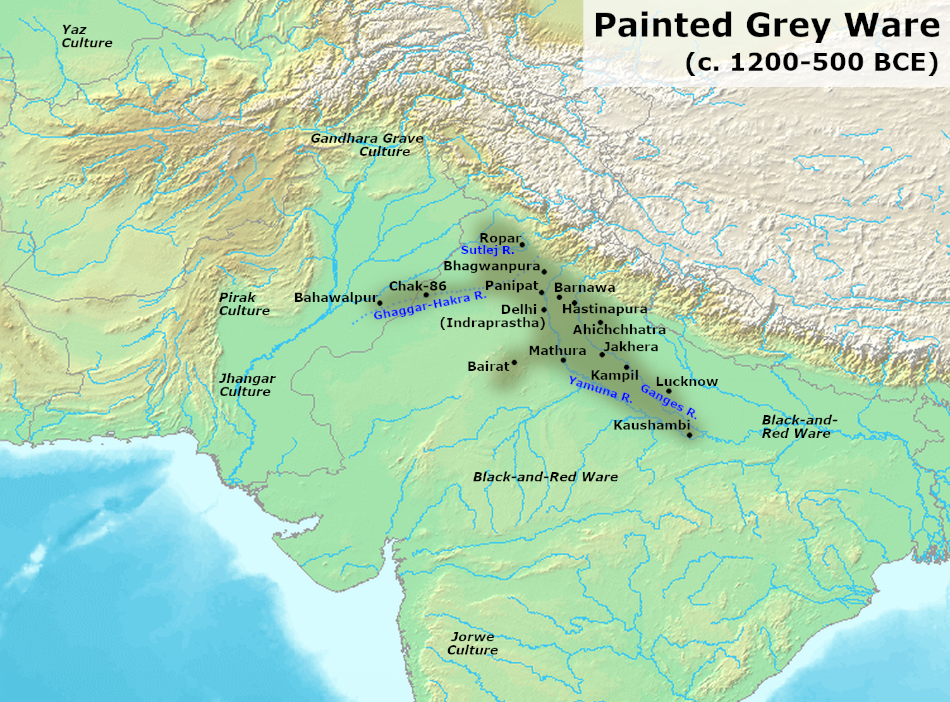
The later Vedic world moved east from the Punjab into the Ganga–Yamuna doāb, a shift the Śatapatha Brāhmaṇa tells as the Videgha Māthava myth and Painted Grey Ware traces archaeologically.
The move east, narrated by the tradition itself.
The most remarkable geographical evidence in Vedic literature is the Videgha Māthava story (Śatapatha Brāhmaṇa 1.4.1.10–17).[4] Videgha Māthava carries Agni Vaiśvānara in his mouth; his priest Gotama Rāhūgaṇa addresses him and Agni bursts out, burning eastward across the land, drying the marshes as he goes. Māthava follows the fire. It halts at the river Sadānīrā (probably the Gaṇḍakī in modern Bihar; Eggeling also canvasses the Karatoyā), which Agni will not cross. The text then says, in effect:
“That land was formerly very uncultivated, very marshy, because it had not been tasted by Agni Vaiśvānara. Nowadays, however, it is well cultivated, for brahmins have caused Agni to taste it through sacrifices. … In former times brahmins did not cross that river, thinking, ‘It has not been burnt over by Agni Vaiśvānara.’ Nowadays there are many brahmins to the east of it.” — ŚB 1.4.1.14–17 (paraphrasing Eggeling’s translation)[4][6]
What it proves. This is a migration memory encoded as myth, and it is unusually explicit: a frontier moving east into wet, forested, marshy country; fire-clearance as the mechanism; brahmins following the frontier; and a named river as the limit of respectable settlement at the time of writing. It matches the archaeological spread of Painted Grey Ware into the doāb almost exactly. Consensus that it records eastward expansion; Majority on the PGW correlation
Compare Chapter 3: the Rigveda barely knows the Ganga. Here, the Ganga plain is the world.
The archaeological signature. PGW sites — Hastināpura, Ahicchatrā, Atranjikhera, Kauśāmbī — are villages and small towns, not cities: wattle-and-daub and mud-brick, iron tools, rice, cattle, horse, and a fine wheel-turned grey pottery with painted geometric designs. Bhagwanpura in Haryana is the crucial site, because there PGW appears in levels overlapping Late Harappan material. Not replacement, not conquest — coexistence.[2] Consensus
The evidence ledger: early vs later Vedic
Compared with the early Vedic period, the later Vedic world had iron, rice, permanent villages, territorial kingdoms and a vast śrauta ritual system, with Prajāpati replacing Indra as chief deity.
Every row here is a change from Chapter 3. That is the point of the chapter.
| Dimension | Early Vedic (§3) | Late Vedic | Evidence | Confidence |
|---|---|---|---|---|
| Geography | Punjab, Sapta Sindhavaḥ | Ganga–Yamuna doāb; the east as frontier | ŚB 1.4.1; PGW distribution; eastern rivers named in AV | Consensus |
| Metal | copper/bronze (áyas) | iron (śyāma áyas, kṛṣṇa áyas) | AV 11.3.7 names dark metal against red; iron at Malhar and Raja Nala ka Tila[7][1] | Consensus on the sequence; Contested on the earliest dates |
| Grain | barley only | rice (vrīhi), wheat (godhūma), sesame (tila), beans (māṣa), millet | Yajurveda saṃhitās list them in offering formulas; AV | Consensus |
| Settlement | semi-mobile, no towns | permanent villages, incipient towns | PGW site sizes and continuity[2] | Consensus |
| Polity | tribal chiefdom, rājan checked by assembly | territorial kingdom; elaborate consecration rituals | Rājasūya and Aśvamedha liturgies; ŚB 5, 13[8][9] | Majority |
| Ritual | fire offerings, soma pressing | vast multi-year śrauta system with 16+ priests | Brāhmaṇas; Śrautasūtras[10] | Consensus |
| Theology | gods petitioned | ritual compels; gods secondary | Brāhmaṇa doctrine of bandhu[11] | Consensus |
| Chief deity | Indra | Prajāpati | Prajāpati dominant in ŚB; Indra recedes | Consensus |
| Society | ranks occupational | varṇa hardening toward birth; Śūdra excluded | Aitareya Brāhmaṇa 7.29; ritual exclusions[12] | Majority |
| Women | composers, participants, relatively visible | patnī required at sacrifice but authority narrowing | Śrauta ritual requires the wife; but AB/ŚB commentary on women declines[13][14] | Majority |
| Absent still | — | no temples, no images, no karma, no rebirth, no writing | argument from absence across all four Vedas and the Brāhmaṇas | Consensus |
Primary sources
1. Iron enters the language
AV 11.3.7 — in a hymn describing the rice-porridge oblation (odana) as a cosmic body:
श्यामम् अयो ऽस्य मांसानि लोहितम् अस्य लोहितम् ।
śyāmam ayo ‘sya māṃsāni lohitam asya lohitam | “Dark metal its flesh, red its blood.” (Whitney)[7]
The distinction is inside the verse itself: śyāma ayas, “dark metal” — iron — set against lohita, the red metal, copper. The Rigveda has only undifferentiated ayas.
What it proves. A language coins a qualifier only when it needs to distinguish. The emergence of “dark metal” as a term marks the moment iron becomes common enough to require separating from copper. Combined with the iron-bearing levels at Malhar and Raja Nala ka Tila, this puts the Atharvaveda after the Rigveda by a technological generation. (How early those levels are is disputed — Tewari read them as 1800–1000 BCE, and critics question whether the dated samples are securely associated with the iron.) Consensus on the sequence; Contested on the dates
The consequence is not merely metallurgical. Iron axes clear the wet doāb forest; iron ploughshares break its heavy soil; rice grown on cleared wetland yields far more per hectare than Punjab barley. Surplus → population → towns → the state.
2. Rice, and a new agricultural world
The Yajurveda’s offering lists name grains the Rigveda never mentions: vrīhi (rice), godhūma (wheat), tila (sesame), māṣa (bean), aṇu and priyaṅgu (millets), śyāmāka. The Taittirīya Saṃhitā prescribes which grain suits which deity and which season.
What it proves. The economy is now agricultural rather than pastoral-with-farming. Cattle remain wealth, but they are no longer the whole of it. Rice in particular is a wet-land, labour-intensive, high-yield crop, and its arrival in the ritual vocabulary is the surest single marker separating early from late Vedic texts.[15] Consensus
3. The theology of the sacrifice
The Brāhmaṇas are prose manuals explaining why each ritual act works, and their explanatory principle is bandhu — hidden correspondence. Every ritual element is homologous to something in the body and something in the cosmos: the sacrificial fire is speech is the sun; the year is Prajāpati is the altar; 360 bricks are 360 days.
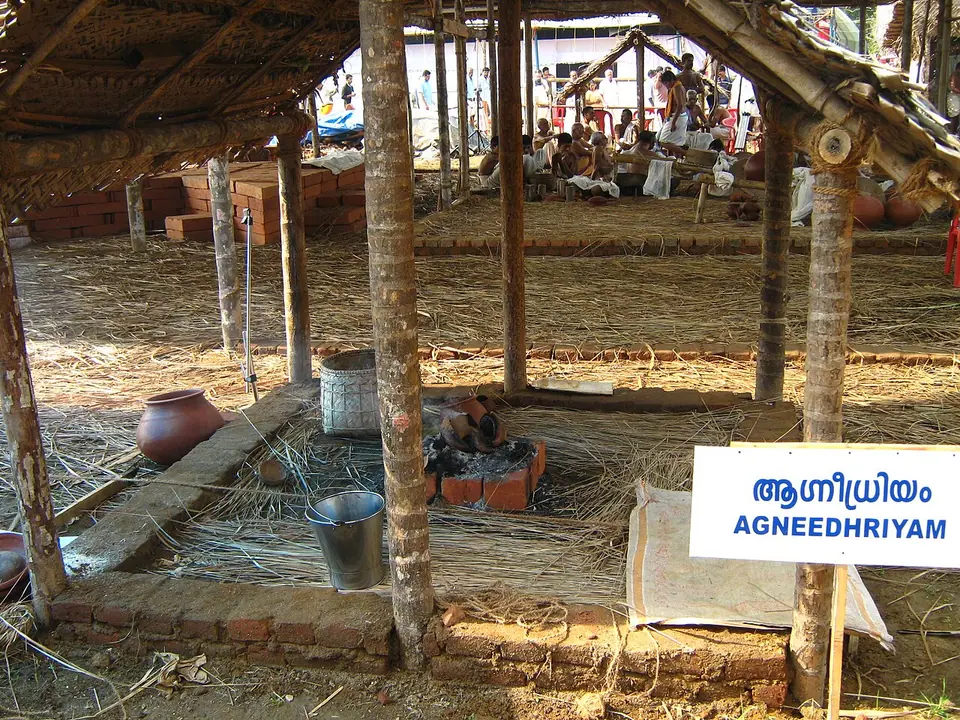
The Agnicayana — the piling of the fire altar — is the system’s masterpiece: a falcon-shaped altar in five layers, laid over a year. The Śatapatha Brāhmaṇa (10.4.3.8) prescribes 360 enclosing-stones, 360 yajuṣmatī bricks plus 36, and 10,800 lokampṛṇā (“space-filler”) bricks. Only the yajuṣmatī bricks get individual formulas; the 10,800 are laid with a repeated one.
And the number is not engineering — the text says why: “there are ten thousand and eight hundred of them, for so many muhūrtas there are in the year” (ŚB 10.4.3.20)[16]. That is the bandhu doctrine doing its work in plain sight. Its stated purpose is to reassemble Prajāpati, who exhausted and dismembered himself in creating the world.
(The altar as actually built in surviving Nambūdiri practice uses 1,005 bricks in five layers.[17] Textual ideal and performed rite are not the same thing — a distinction worth keeping throughout this chapter.) The sacrificer rebuilds the creator, and in doing so constructs an immortal self for himself.
What it proves. This is a wholly different religion from Chapter 3’s. There, Indra is asked for cattle and victory. Here, the ritual is a machine for repairing the universe, the gods are its beneficiaries rather than its controllers, and the man who knows the correspondences — ya evaṃ veda, “he who knows thus,” the Brāhmaṇas’ constant refrain — holds the power. The authority of the brahmin as a professional caste is manufactured in this period, by this doctrine.[11] Consensus
The Agnicayana is also, remarkably, still performed. Frits Staal filmed and documented a full twelve-day performance by Nambūdiri brahmins in Kerala in 1975 — plausibly among the oldest continuously transmitted rituals anywhere.[17]
4. The royal rituals
| Ritual | What happens | What it tells us |
|---|---|---|
| Rājasūya | Year-long royal consecration: ritual anointing, a symbolic cattle raid, and a dice game the king must be allowed to win | Kingship is now made rather than assumed; and it is legitimated by brahmins, who alone can perform it[18][9] |
| Vājapeya | A chariot race the king must win; the king ascends a post to touch the sun | Prestige competition formalized into liturgy |
| Aśvamedha | A stallion is released to wander for a year, followed by an army; every land it enters is claimed. It is then sacrificed, and the chief queen (mahiṣī) lies beside the dead horse while priests exchange ritual obscenities | Territorial claim, fertility rite, and the most expensive display of power available. Only a king who controls the territory dares release the horse[8] |
| Puruṣamedha | Human sacrifice, described in detail (ŚB 13.6) — victims bound to stakes, then released | Almost certainly symbolic and probably never enacted as described; the texts themselves have the victims released.[19] Contested |
What they prove. These liturgies require surplus, manpower, territorial control, and a professional priesthood — none of which the Rigvedic world could have supplied. The rituals are the best evidence we have that a state now exists.[3] Majority
5. Rudra becomes auspicious — the first “Namah Shivaya”
The Śatarudrīya (recited today as the Sri Rudram), the “Hymn to the Hundred Rudras” (Taittirīya Saṃhitā 4.5), is a long litany of homage to Rudra in every conceivable form — Rudra of the mountains, of the crossroads, of thieves, of cattle, of arrows.
TS 4.5.8.1
नमः शिवाय च शिवतराय च ।
namaḥ śivāya ca śivatarāya ca | — “Homage to the auspicious one, and to the more auspicious.”[20]
What it proves. Read this next to Chapter 3. In the Rigveda, Rudra has three hymns and is propitiated so that he will stay away; śiva is only an adjective. Here, an entire major liturgy is devoted to him, and the epithet śiva is applied to him repeatedly and formulaically. The sentence that is now the most-recited mantra in Śaivism first appears here, in the Yajurveda, as an adjective for a dangerous god being flattered. The whole later history of Śiva runs through this line. Consensus
[[img:nataraja-bronze|Śiva as Naṭarāja, a South Indian bronze of the Chola period. The mantra behind this image, namaḥ śivāya, is first attested in the Yajurveda passage above — where śiva is still only a placating adjective and Śiva is not yet a god’s name.|half]]
The Śatarudrīya also foreshadows Śiva’s characteristic paradox: the god is addressed simultaneously as destroyer and as healer, as lord of robbers and as protector.
6. The hardening of varṇa
Aitareya Brāhmaṇa 7.29 describes the varṇas by their relations of power. Its account of the two lower orders is unambiguous:
- the Vaiśya is “tributary to another, to be lived on by another, to be oppressed at will”;
- the Śūdra is “the servant of another, to be removed at will, to be slain at will.”[12]
Alongside this, ritual exclusion becomes systematic: the Śūdra is barred from Vedic study, from the upanayana initiation, and from śrauta sacrifice.
What it proves. Compare RV 9.112.3 in Chapter 3, where a poet cheerfully reports that his father is a physician and his mother grinds grain.[21] Within a few centuries, the same tradition is producing a formal theory of hereditary subordination. This is the hinge on which caste turns from a loose occupational ranking into a religiously enforced hierarchy — and it happens here, in the late Vedic period, not in the Rigveda. Majority
Two qualifications, both real. First, these are normative priestly texts; how far actual society obeyed them is unknown and probably “not very.” Second, the fourfold varṇa scheme is never the same thing as jāti, the thousands of endogamous birth-groups that structure real Indian society; the relation between the two remains debated (§6, §11).
7. Women: a mixed record
The śrauta system requires the wife. A sacrifice performed without the patnī present is invalid; she has assigned roles, speaks assigned formulas, and in the Aśvamedha the chief queen has the central part.[13] Marriage becomes ritually necessary for full religious status — for the man.
But the texts also state the restriction outright. Taittirīya Saṃhitā 6.5.8.2, on why soma is not drawn for women, concludes: “therefore women are powerless, have no inheritance, and speak more humbly than even a bad man.” (Keith.)[14] That is a hard, datable, Yajurvedic sentence, and it does more work than the often-repeated claim that girls lost access to upanayana — for which there is no Brāhmaṇa-period evidence at all, only much later digests. Compared to the Rigveda — which names women among its composers, and whose Gambler’s Hymn assumes a wife with a household to lose — the trajectory is downward, and it continues into Chapters 6 and 7. Majority
The counter-current appears immediately afterwards: Gārgī and Maitreyī in the Upaniṣads (§5) argue philosophy in public assemblies. The window is not yet closed.
The gods of the later Vedic period
In the later Vedic period Prajāpati rises to supremacy, Rudra gains an entire major liturgy and Viṣṇu is identified with the sacrifice, while Indra, Varuṇa and the lesser Rigvedic gods recede.
| Deity | Rigveda | Late Vedic | Direction |
|---|---|---|---|
| Prajāpati | barely present (an epithet, a late hymn) | the creator, the year, the sacrifice, the supreme | ▲▲▲ |
| Rudra | 3 hymns, feared outsider | an entire major liturgy (Śatarudrīya); addressed as śiva | ▲▲ |
| Viṣṇu | ~5 hymns, three strides | identified with the sacrifice itself: yajño vai viṣṇuḥ[22] | ▲ |
| Brahman | bráhman = the ritual formula’s power | becoming an abstract cosmic principle → §5[23] | ▲ |
| Indra | ~250 hymns, supreme | still present but no longer the centre; increasingly a figure who needs the ritual | ▼ |
| Varuṇa | guardian of ṛta | narrowing toward waters | ▼ |
| Uṣas, Aśvins, Maruts | major | vestigial | ▼▼ |
The single most consequential line in this table is Rudra’s — from three hymns and a name used as a euphemism, to an entire major liturgy. The identification yajño vai viṣṇuḥ, “the sacrifice is Viṣṇu” (ŚB 1.1.2.13)[22], matters nearly as much: it embeds Viṣṇu in the ritual core at the moment the ritual is being declared supreme, and gives him a foothold the Rigveda never did.
What is still absent in the later Vedic period
The later Vedic period still has no temples or images, no karma, rebirth or mokṣa, no ahiṃsā or vegetarianism, no writing and no bhakti.
Still absent, after three hundred years and an entire new literature:
- Temples and images. Ritual remains outdoor, on constructed altars, with fire. Consensus
- Karma and rebirth. Not in the Saṃhitās, not in the Brāhmaṇas. The Brāhmaṇas do worry about punarmṛtyu, “re-death” — the fear of dying again in the next world — which is the conceptual seed, but it is not yet rebirth on earth and it is solved by ritual, not by knowledge or ethics.[24][25] Consensus
- Mokṣa. The goal is a full lifespan, sons, cattle, and a secure place in the world of the fathers — not escape from existence.
- Ahiṃsā, vegetarianism, cow protection. Animal sacrifice is at the system’s core; the Aśvamedha kills a horse, and when the Śatapatha Brāhmaṇa forbids eating cow and ox, Yājñavalkya replies that he eats it anyway, “provided it is tender.”[26]
- Writing. Still none.
- Bhakti. Devotion in the later sense does not exist; the relation to the deity is contractual and technical.
Debates about the later Vedic period
The main debates about the later Vedic period concern whether the Kurus formed a state, whether the Aśvamedha was performed as described, and how far the priestly texts reflect real practice.
Was there a “Kuru state”?
Witzel’s thesis — that the Kurus, formed by the merger of Bharatas and Pūrus after the Ten Kings war, deliberately created Vedic orthodoxy by canonizing the Rigveda, compiling the other Vedas, and systematizing ritual as an instrument of political integration — is the dominant reading. It explains the timing of canonization elegantly. Critics note it leans heavily on inference from text and PGW correlation, with little direct evidence of state institutions.[3] Majority
Was the Ashvamedha horse sacrifice performed as described?
The liturgy’s explicit fertility rite involving the chief queen is described in the Śatapatha Brāhmaṇa in detail.[8] Whether it was enacted, symbolically mimed, or a textual ideal is argued. Later historical Aśvamedhas — Puṣyamitra Śuṅga, Samudragupta — are attested by inscription and coin, so the ritual was certainly performed in some form for centuries. Contested on the details
How much of this was real practice?
All of it is priestly literature written by and for specialists. It describes an ideal system of enormous cost. Most people in the doāb in 1000 BCE almost certainly practised something simpler and more local — household fire ritual, ancestor offerings, and the village cults invisible in these texts. The Atharvaveda, with its healing spells, love charms, and curses, is the closest we get to popular religion[27][28], and it is notable that it was the last Veda to be accepted as canonical at all. Majority
Further reading
- Michael Witzel, “Early Sanskritization: Origins and Development of the Kuru State,” EJVS 1 (1995).
- Julius Eggeling, trans., The Śatapatha Brāhmaṇa, Sacred Books of the East, 5 vols.
- Frits Staal, Agni: The Vedic Ritual of the Fire Altar (1983).
- Jan Heesterman, The Inner Conflict of Tradition (1985) and The Broken World of Sacrifice (1993).
- Brian K. Smith, Reflections on Resemblance, Ritual, and Religion (1989) — on bandhu.
- Stephanie Jamison, Sacrificed Wife / Sacrificer’s Wife (1996) — the best study of women in śrauta ritual.
- Rakesh Tewari, “The origins of iron-working in India,” Antiquity 77 (2003).
References
- ^ a b Rakesh Tewari "The origins of iron-working in India". Antiquity 77, 2003. The early iron dates from Malhar and Raja Nala ka Tila.
- ^ a b c Robin Coningham & Ruth Young The Archaeology of South Asia: From the Indus to Asoka. Cambridge University Press, 2015. The standard synthesis for §§1–6.
- ^ a b c d Michael Witzel "Early Sanskritization: Origins and Development of the Kuru State". Electronic Journal of Vedic Studies 1, 1995. doi The Kuru state thesis — canonization as a political project.
- ^ a b c ŚB 1.4.1.10–17 — Śatapatha Brāhmaṇa. c. 900 BCE. Vedic Sanskrit. Videgha Māthava carries Agni east across the Sadānīrā — the tradition's own memory of the frontier moving into the Ganga plain. read the text
- ^ Michael Witzel "Tracing the Vedic Dialects". in Dialectes dans les littératures indo-aryennes, 1989. The foundational work on Rigvedic internal chronology and geography.
- ^ Julius Eggeling, trans. The Śatapatha Brāhmaṇa. Sacred Books of the East, 5 vols., 1882. full text Old, and still the only complete English version. Use with care.
- ^ a b AV 11.3.7 — Atharvaveda. c. 1000 BCE. Vedic Sanskrit. "Iron is its flesh." The metal vocabulary splits — dark metal separated from red — dating the text after the Rigveda. read the text
- ^ a b c ŚB 13.1–5 — Śatapatha Brāhmaṇa. c. 900 BCE. Vedic Sanskrit. The Aśvamedha liturgy — territorial claim, fertility rite, and proof that a state now exists. read the text
- ^ a b Jan C. Heesterman The Inner Conflict of Tradition. University of Chicago Press, 1985. full text On the tension between ritual and renunciation.
- ^ The Śrautasūtras — Āpastamba, Baudhāyana, Kātyāyana and others. c. 600–300 BCE. Sanskrit. The technical manuals that specify the sixteen-priest śrauta system in operational detail — the evidence that the Brāhmaṇas describe a real, if enormously expensive, practice.
- ^ a b Brian K. Smith Reflections on Resemblance, Ritual, and Religion. Oxford University Press, 1989. open library The best account of bandhu — the doctrine of hidden correspondences.
- ^ a b AB 7.29 — Aitareya Brāhmaṇa. c. 800 BCE. Vedic Sanskrit. Defines the vaiśya as "to be lived on by another" and the śūdra as "to be removed at will" — varṇa hardening into hereditary subordination. read the text
- ^ a b Stephanie W. Jamison Sacrificed Wife / Sacrificer's Wife: Women, Ritual, and Hospitality in Ancient India. Oxford University Press, 1996. The standard study of women in śrauta ritual.
- ^ a b TS 6.5.8.2 — Taittirīya Saṃhitā. c. 900 BCE. Vedic Sanskrit. Soma could not bear being drawn for women — "therefore women are powerless, have no inheritance, and speak more humbly than even a bad man." A hard, datable Yajurvedic statement. read the text
- ^ Colin P. Masica "Aryan and Non-Aryan Elements in North Indian Agriculture". in Aryan and Non-Aryan in India, 1979. The unetymologizable-vocabulary argument.
- ^ ŚB 10.4.3.8 & 10.4.3.20 — Śatapatha Brāhmaṇa. c. 900 BCE. Vedic Sanskrit. 10,800 lokampṛṇā bricks in the fire altar — "for so many muhūrtas there are in the year." The bandhu doctrine stated outright: the number is cosmology, not engineering. read the text
- ^ a b Frits Staal Agni: The Vedic Ritual of the Fire Altar. Asian Humanities Press, 2 vols., 1983. open library Documentation of the 1975 Agnicayana in Kerala — plausibly the oldest continuously performed ritual on earth.
- ^ AB 7.13–18 — Aitareya Brāhmaṇa. c. 800 BCE. Vedic Sanskrit. The Śunaḥśepa legend — a boy bought for sacrifice and then released. Human sacrifice narrated and averted, and the Rājasūya's ideological charter. read the text
- ^ ŚB 13.6.2.13 — Śatapatha Brāhmaṇa. c. 900 BCE. Vedic Sanskrit. In the Puruṣamedha a voice says "do not consummate these human victims: if thou wert to, man would eat man" — and they are released. The textual basis for reading human sacrifice here as symbolic. read the text
- ^ TS 4.5.8.1 — Taittirīya Saṃhitā (Śatarudrīya). c. 1000 BCE. Vedic Sanskrit. namaḥ śivāya ca śivatarāya ca — the first appearance of the most-recited mantra in Śaivism, as flattery of a feared god. read the text
- ^ RV 9.112.3 — Rigveda. c. 1200 BCE. Vedic Sanskrit. "I am a poet, my father a physician, my mother grinds grain" — one family, three occupations, no varṇa embarrassment. read the text
- ^ a b ŚB 1.1.2.13 — Śatapatha Brāhmaṇa. c. 900 BCE. Vedic Sanskrit. yajño vai viṣṇuḥ — "the sacrifice is Viṣṇu." How Viṣṇu's three Rigvedic strides get him embedded in the ritual core just as ritual is declared supreme. read the text
- ^ AV 10.7 — Atharvaveda. c. 1000 BCE. Vedic Sanskrit. The Skambha hymn — the cosmic pillar speculation out of which the abstract concept of brahman grows. read the text
- ^ ŚB 2.3.3.9 — Śatapatha Brāhmaṇa. c. 900 BCE. Vedic Sanskrit. Whoever goes to the next world without escaping Death "dies again and again there" — punarmṛtyu, the fear of re-death, which is the conceptual seed of saṃsāra but is solved by ritual, not knowledge. read the text
- ^ ŚB 10.1.4.14 — Śatapatha Brāhmaṇa. c. 900 BCE. Vedic Sanskrit. "Whereby the Sacrificer conquers recurring death" — punarmṛtyu, the anxiety that ritual is meant to solve and that saṃsāra later replaces. read the text
- ^ ŚB 3.1.2.21 — Śatapatha Brāhmaṇa. c. 900 BCE. Vedic Sanskrit. "Let him not eat the flesh of cow and ox. Nevertheless Yājñavalkya said: I, for one, eat it, provided it is tender." The prohibition and its casual violation in one sentence. read the text
- ^ AV 5.22.14 — Atharvaveda. c. 1000 BCE. Vedic Sanskrit. Fever is dispatched to the Gandhāris, Mūjavants, Aṅgas and Magadhas — the Atharvaveda knows the far east the Rigveda has never heard of, and treats it as where you send disease. read the text
- ^ AV Kāṇḍa 15 — Atharvaveda (Vrātya book). c. 1000 BCE. Vedic Sanskrit. An entire Vedic book devoted to a wandering non-brahmanical fellowship, absorbed into the canon — the earliest evidence for the ascetic stream §6 will need. read the text