Some of it probably did. But the part that came from the Indus Valley is not the part people usually mean. The Vedic religion of the Rigveda, with its fire sacrifice, its horse-drawn gods and its Sanskrit hymns, does not descend from the Harappan cities: the two cultures are too different materially to be the same people at the same time.[1][2] What may descend from the Harappans is a layer of popular religion: ritual bathing, sacred trees, animal symbolism, perhaps a horned god among beasts. That layer later merged with the Vedic stream, and the merger is what we call Hinduism.[3] Majority on some continuity; Contested on every specific item
The single most important caveat governs everything below. The Indus script is undeciphered. We do not know the Harappans’ language, and we do not know the name of a single one of their gods. Every claim about their religion is inference from images and buildings.[4][3] Consensus
Hinduism as a braid
The most useful way to think about the question is that Hinduism has more than one ancestor. The Vedic strand is documented in extraordinary detail, because a literate priesthood preserved it with obsessive precision. The substrate strand is nearly invisible, because it was never written down. Its invisibility in the record is not evidence of its unimportance in people’s lives.[5]
That substrate goes back further than the Indus cities. Farming villages at Mehrgarh in Balochistan grew into the Early Harappan towns and then into the mature cities, in an unbroken local sequence.[2][6] The great majority of modern South Asian ancestry descends from these pre-Vedic populations, not from later arrivals.[7][8] So “did Hinduism come from the Indus Valley?” is partly a question about whether the religion of the majority population left traces. It would be surprising if it left none.
The discontinuities: why the Harappans were not Vedic
The evidence that the Harappan and Rigvedic worlds are distinct is convergent rather than single-stranded:[1][8]
| Harappan cities (c. 2600–1900 BCE) | Rigveda (c. 1500–1200 BCE) |
|---|---|
| Planned cities, fired brick, covered drains | No cities; no word for the Harappan built world |
| A script on ~4,000 objects | No writing at all; oral transmission |
| No securely identified horse, no spoked wheel, no chariot | Horses and chariots everywhere; aśva among its commonest nouns |
| Seals, standardized weights, sea trade | None of these described |
| No monumental temple, no cult statue | No temples or images either, but worship at fire altars |
| Rakhigarhi genome: no steppe ancestry | Steppe ancestry arrives in the second millennium BCE |
The horse is the most decisive line. Genetic work now shows that the domestic horse lineage only began spreading across Eurasia around 2200 BCE, so its absence from mature Harappan levels is not an accident of excavation.[9][2] And the cities were not destroyed by anyone: they emptied gradually from c. 1900 BCE as the monsoon weakened and trade contracted.[10][11] The current migration model places Indo-Aryan speakers arriving into an already de-urbanizing landscape, centuries later.[7] Majority
The continuities: what might have survived
Here is the candidate list, with the confidence each deserves:
| Later Hindu element | Harappan or earlier evidence | Confidence |
|---|---|---|
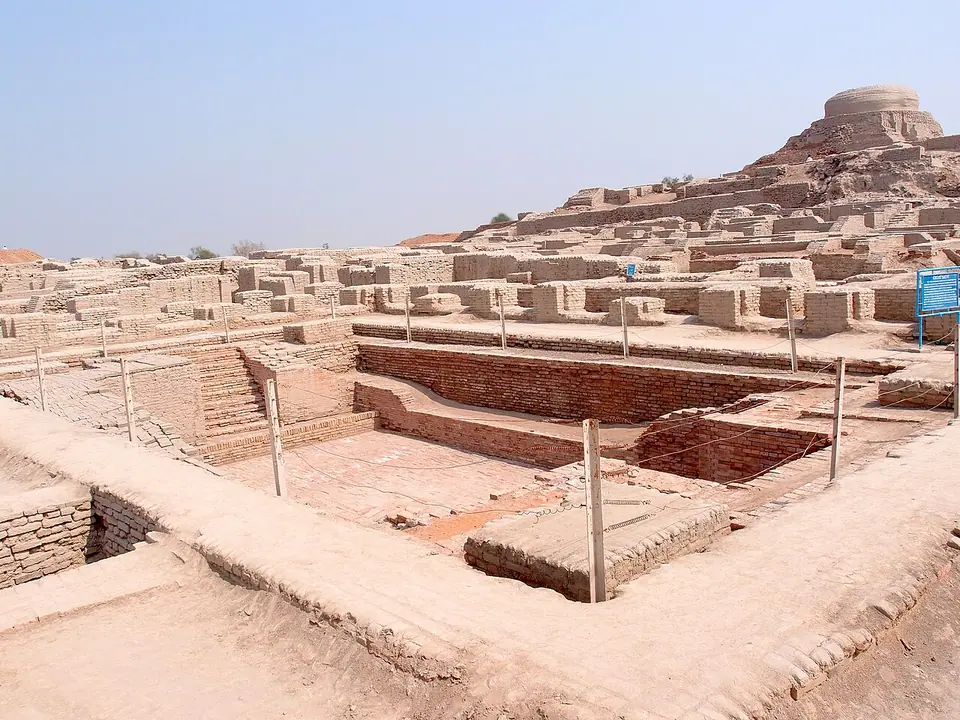
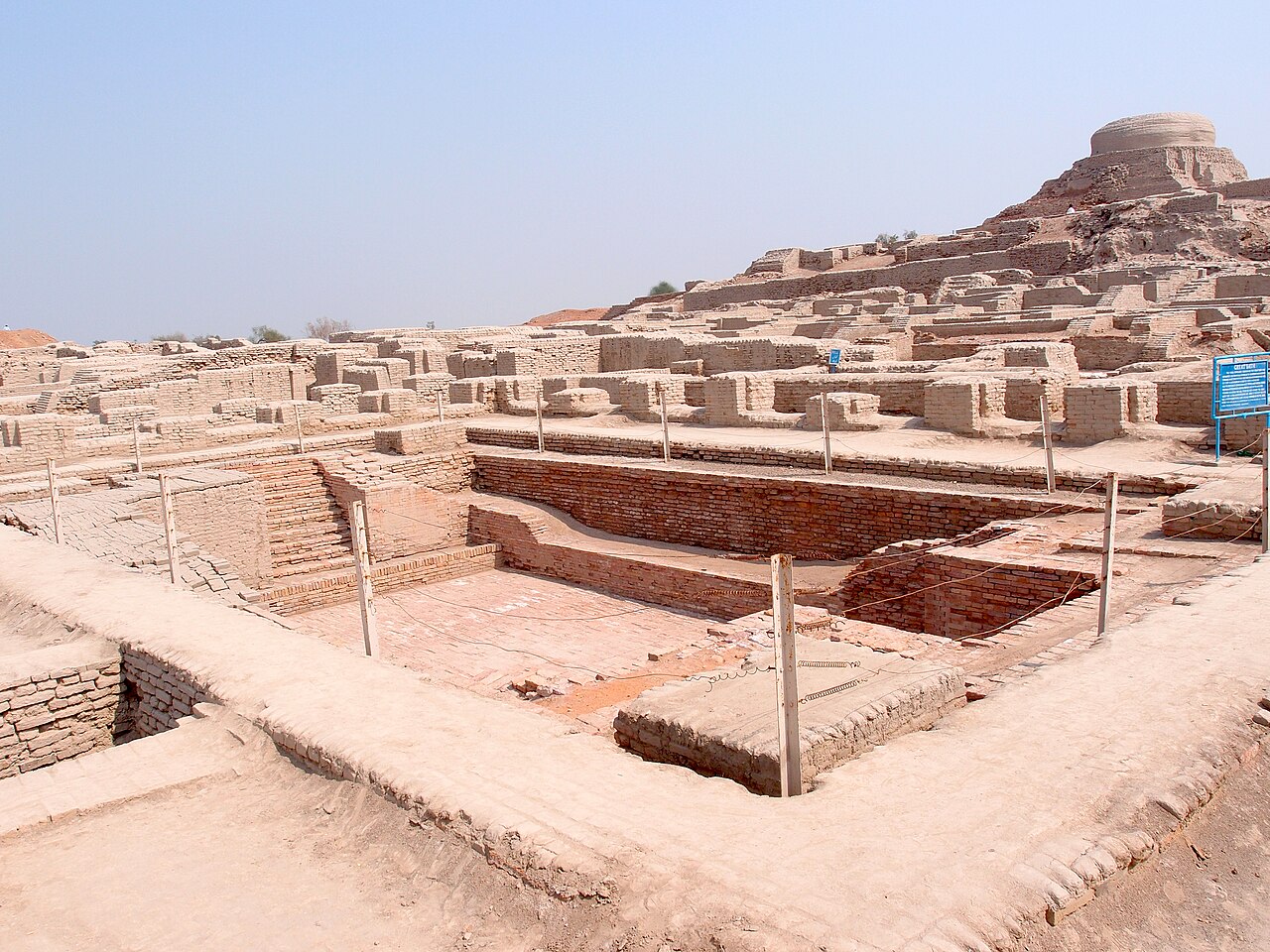
| Ritual bathing as purification | The Great Bath at Mohenjo-daro; bathrooms in ordinary houses[12][2] | Contested |
| Sacred trees, above all the pipal | Pipal leaves on seals, including a horned figure standing inside a pipal[3] | Majority |
| A horned god among animals | Seal M-304, the “Paśupati” seal[13][14] | Contested |
| Serpent worship | Absent from early Vedic religion, where serpents are enemies; pan-Indian later[3] | Majority non-Vedic; origin unproven |
| Village goddesses | Female figurines abundant from Mehrgarh on; the Rigveda has no Great Goddess[2][5] | Majority non-Vedic; figurines Contested |
| Cattle sanctity | Deccan ashmounds: centuries of ritual-looking cattle-dung burning[15] | Speculative |
The Great Bath shows how careful one has to be. It is a sunken brick tank about 12 by 7 metres, waterproofed with bitumen, set in the largest building on the citadel mound. Its cost and prominence argue for ritual use; the absence of any altar, image or offering argues that it could equally have been a civic bath.[12] The safer claim is the broader one: Harappan cities invested in water and personal cleanliness to a degree no contemporary civilization matched, and the later Hindu emphasis on purification by bathing has an obvious candidate ancestor there. Speculative on the connection
Language points the same way. Sanskrit acquired retroflex consonants that no other Indo-European branch inherited, and the Rigveda already contains words with no Indo-European etymology, concentrated in local plants, animals, farming and ritual objects. The standard explanation is contact with, and absorption of, speakers of the region’s older languages.[16] That is exactly what a braid would look like. (A well-regarded alternative argues many of those words were borrowed in Central Asia before entry, which weakens this inference.[17])
A short timeline
| Date | What happens | Confidence |
|---|---|---|
| c. 7000 or c. 5250 BCE | Mehrgarh farming village; the date depends on a 2025 redating | Contested |
| c. 3300–2600 BCE | Early Harappan towns | Consensus |
| c. 2600–1900 BCE | Mature Harappan cities; seals, the Great Bath | Consensus |
| c. 1900 BCE | De-urbanization begins; no invasion | Consensus |
| c. 1900–1300 BCE | Late Harappan village cultures | Consensus |
| c. 1500–1200 BCE | Rigveda’s oldest books, in the Punjab | Majority |
| c. 200 BCE onward | Images, shrines, goddesses and liṅgas enter the record; substrate and Vedic streams visibly merge | Majority |
What scholars disagree about
The mainstream view holds that the Harappans were not Vedic, and that continuity into Hinduism runs through the substrate, surfacing in popular religion that the Sanskrit tradition absorbs from around 200 BCE onward (§7).[3][1] Majority
Asko Parpola’s stronger version reconstructs a great deal of Harappan religion from later Hindu practice and from proposed Dravidian readings of the signs. It is the most developed continuity argument, and it stands or falls with readings of a script nobody can yet confirm.[3] Contested
The indigenist view holds that the Harappans were Vedic, so Hinduism came from the Indus Valley directly. Its strongest arguments are the Sarasvatī, praised in the Rigveda as a mighty river and identified by many with the Ghaggar-Hakra, along which many Harappan sites lie; and the Kalibangan “fire altars,” read by B. B. Lal and others as Vedic sacrifice.[18][19] The counter-arguments: the Ghaggar-Hakra was monsoon-fed, not a Himalayan torrent, through the Harappan period; the Kalibangan pits lack the apparatus and geometry of Vedic altars; and a Vedic Harappa would have to explain the missing horse, chariot and spoked wheel.[10][20][9] Contested / Political
The skeptical view notes that nearly every proposed continuity argues backwards from later practice to an unrecorded origin, and that bathing, sacred trees and animal imagery are widespread enough to arise independently. The case is cumulative, not demonstrative.[6]
Common misconceptions
- “Aryans destroyed the Indus cities.” No destruction layer exists, and the “massacre” skeletons come from different periods with no battle trauma.[21]
- “The Indus religion was Hinduism.” Too strong. There were no temples or cult statues, and we cannot name a Harappan god.[2]
- “Hinduism is purely Vedic.” Also wrong. Village goddesses, serpent cults and the Great Goddess have no Vedic ancestry.[5]
Why it matters
The question is often posed as a contest between “Hinduism is Aryan” and “Hinduism is Harappan.” The evidence supports neither. Hinduism looks like a confluence of a documented Vedic stream and an older, mostly unwritten one, and the Indus civilization is the most visible early form of that older stream.
For the full evidence, see §2 on the Indus civilization, §1 on the pre-Vedic substrate and §3 on the Rigveda.
References
- ^ a b c Michael Witzel "Early Sanskritization: Origins and Development of the Kuru State". Electronic Journal of Vedic Studies 1, 1995. doi The Kuru state thesis — canonization as a political project.
- ^ a b c d e f Jonathan Mark Kenoyer Ancient Cities of the Indus Valley Civilization. Oxford University Press, 1998. full text The standard accessible account by an excavator.
- ^ a b c d e f Asko Parpola The Roots of Hinduism: The Early Aryans and the Indus Civilization. Oxford University Press, 2015. full text The fullest statement of the Dravidian-Indus case. Argued, not established.
- ^ Steve Farmer, Richard Sproat & Michael Witzel "The Collapse of the Indus-Script Thesis". Electronic Journal of Vedic Studies 11, 2004. open access The minority argument that the sign system is not writing at all.
- ^ a b c Gavin Flood An Introduction to Hinduism. Cambridge University Press, 1996. open library The standard university textbook, and the most balanced single overview.
- ^ a b Robin Coningham & Ruth Young The Archaeology of South Asia: From the Indus to Asoka. Cambridge University Press, 2015. The standard synthesis for §§1–6.
- ^ a b Vagheesh M. Narasimhan et al. "The formation of human populations in South and Central Asia". Science 365, 2019. doi Over 500 ancient genomes. The steppe-ancestry signal, and its limits.
- ^ a b Vasant Shinde et al. "An Ancient Harappan Genome Lacks Ancestry from Steppe Pastoralists or Iranian Farmers". Cell 179, 2019. doi The single sequenced Rakhigarhi individual.
- ^ a b Pablo Librado et al. "Widespread horse-based mobility arose around 2200 BCE in Eurasia". Nature 631, 2024. doi Turns the Harappan "no horse" point from an argument from absence into a positive one: the domestic lineage had not yet spread anywhere.
- ^ a b Liviu Giosan et al. "Fluvial landscapes of the Harappan civilization". PNAS 109, 2012. doi The geomorphology behind the Ghaggar-Hakra argument.
- ^ Rita P. Wright The Ancient Indus: Urbanism, Economy, and Society. Cambridge University Press, 2010. full text Strong on economy and on what the absence of palaces does and does not imply.
- ^ a b The Great Bath — Mohenjo-daro. c. 2500 BCE. A monumental waterproofed tank. Ritual purity or civic amenity — nothing marks it as sacred. about
- ^ Seal M-304 — Mohenjo-daro. c. 2500 BCE. undeciphered. The "Paśupati" seal. A horned figure among wild animals — proto-Śiva, a bovine deity, or a Near Eastern Master of Animals. Undecided. about
- ^ Doris Srinivasan "The So-Called Proto-Śiva Seal from Mohenjo-Daro: An Iconological Assessment". Archives of Asian Art 29, 1975. The critique that dismantled the confident Paśupati reading.
- ^ F. R. Allchin Neolithic Cattle-Keepers of South India. Cambridge University Press, 1963. full text The ashmound study.
- ^ Michael Witzel "Substrate Languages in Old Indo-Aryan". Electronic Journal of Vedic Studies 5, 1999. The case for a lost pre-Indo-Aryan language family in the northwest.
- ^ Alexander Lubotsky "The Indo-Iranian Substratum". Mémoires de la Société Finno-Ougrienne 242, 2001. The main alternative to Witzel's "Language X": the unexplained vocabulary is shared with Iranian, so borrowed in Central Asia before entry into South Asia.
- ^ Michel Danino The Lost River: On the Trail of the Sarasvatī. Penguin India, 2010. The best-argued case on the other side of the Sarasvatī question. Cite it if the debate is to be stated fairly.
- ^ Kalibangan fire pits — Kalibangan. c. 2500 BCE. Seven pits with ash and stelae, argued as Vedic-style yajña. No soma apparatus, no geometric altar construction. about
- ^ Frits Staal Agni: The Vedic Ritual of the Fire Altar. Asian Humanities Press, 2 vols., 1983. open library Documentation of the 1975 Agnicayana in Kerala — plausibly the oldest continuously performed ritual on earth.
- ^ Kenneth A. R. Kennedy "Have Aryans been identified in the prehistoric skeletal record from South Asia?". in The Indo-Aryans of Ancient South Asia, 1995. The reanalysis that ended the Mohenjo-daro "massacre".