The short version: the Bhagavad Gītā was composed most likely between about 200 BCE and 200 CE, and it was composed as, or worked into, part of the Mahābhārata’s sixth book.[1] Nothing in the text states a date, and no manuscript survives from anywhere near that time. The window rests on three independent kinds of evidence: what the Gītā’s language and ideas presuppose, where it sits in the epic’s long growth, and inscriptions showing when the religion it expresses existed in public.
The evidence for dating the Gita
What the text already knows
A text cannot argue against ideas that do not yet exist. The Gītā uses the technical vocabulary of Sāṃkhya philosophy, and it answers the challenge posed by the Buddhist and other śramaṇa renouncer movements.[1] Those movements date from roughly 500 BCE onward, and they held the intellectual initiative for about four centuries (see §6).[2][3] The Gītā’s most famous verse is its reply to them:
कर्मण्येवाधिकारस्ते मा फलेषु कदाचन । मा कर्मफलहेतुर्भूर्मा ते सङ्गोऽस्त्वकर्मणि ॥
karmaṇy evādhikāras te mā phaleṣu kadācana | mā karmaphalahetur bhūr mā te saṅgo ‘stv akarmaṇi ||
“Your right is to action alone, never to its fruits. Let not the fruits of action be your motive, nor let your attachment be to inaction.”[4]
What it proves. The verse only makes sense after renunciation has become a serious option. If karma binds you to rebirth, the obvious response is to stop acting, which is what monks do. The Gītā says it is attachment, not action, that binds, so a soldier or householder can live as a renouncer inwardly.[1] That argument belongs to the world §6 describes, not to the Rigveda.
The Upaniṣads give a second floor. The prose Bṛhadāraṇyaka and Chāndogya date to about 700–600 BCE; the verse Upaniṣads, including the Kaṭha and Śvetāśvatara, to about 500–300 BCE.[5] The Śvetāśvatara contains the earliest use of the word bhakti in the Vedic corpus.[6] The Gītā treats devotion as a complete path to liberation, a step further than that first occurrence of the word.
Where it sits in the Mahabharata
The Mahābhārata describes its own growth: it calls itself 8,800 verses, then 24,000, then 100,000. The Pune Critical Edition, completed in 1966, collated some 1,250 manuscripts and reconstructed an archetype about a third shorter than the popular text.[7] Scholars can see layers in it: a core war story, huge teaching books added later, the Gītā set into Book 6, and the Harivaṃśa appendix supplying Kṛṣṇa’s childhood. The epic as a whole grew over roughly 400 BCE–400 CE, and the Gītā belongs within that span, not before it.[7][8]
What inscriptions show about Krishna devotion
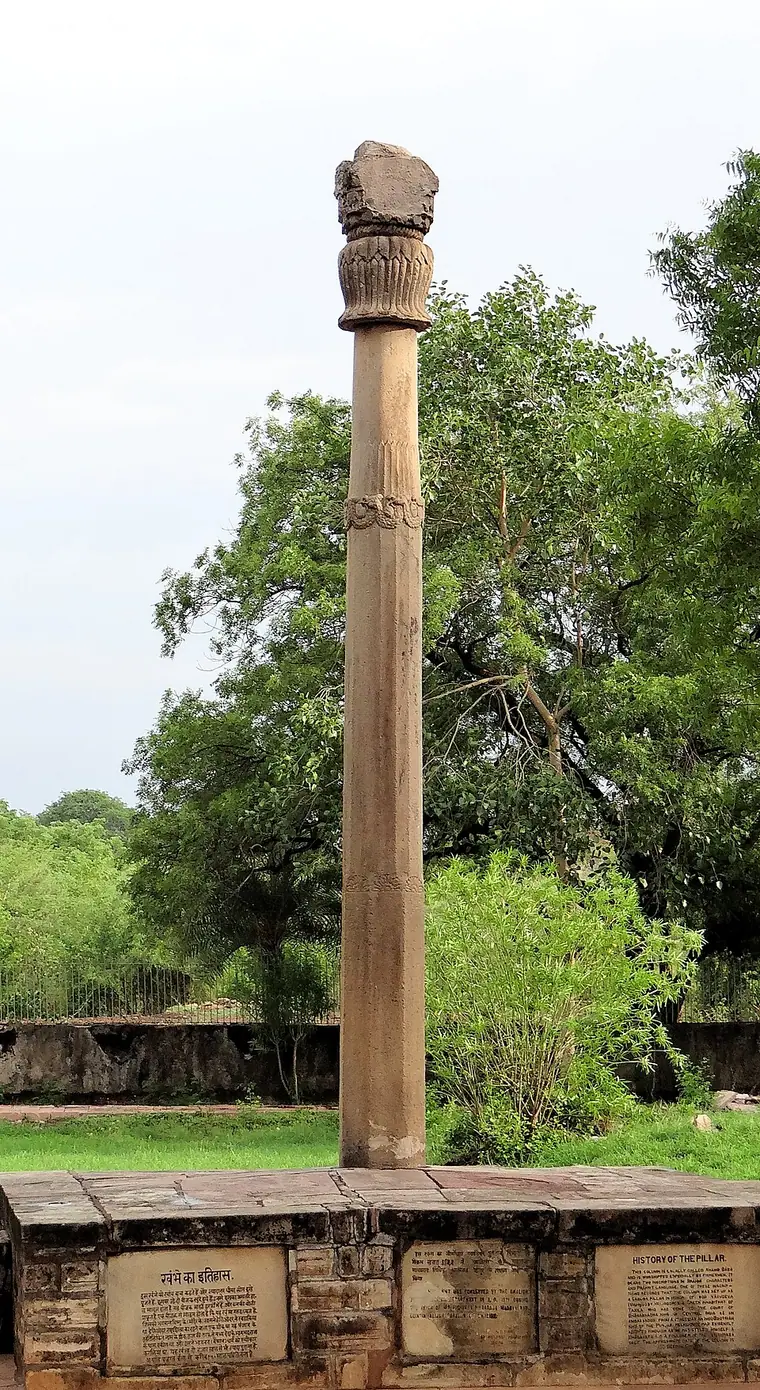
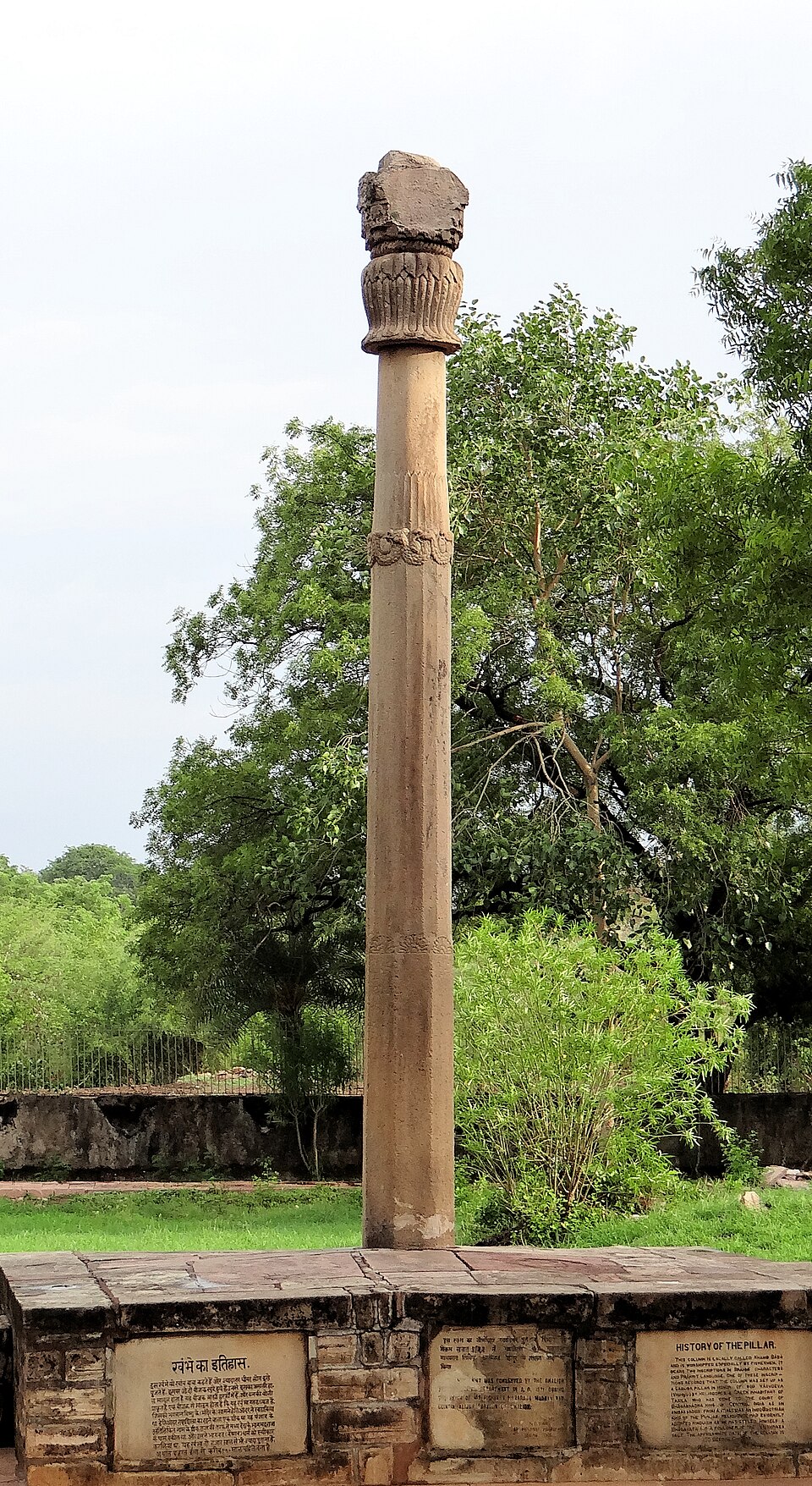
Inscriptions date the religion, not the text, and they are the only hard dates available. The most important is the Heliodorus pillar at Besnagar, near Vidiśā, of about 110 BCE:[9]
devadevasa vā[sude]vasa garuḍadhvajo ayaṃ kārito i[a] heliodoreṇa bhāgavatena diyasa putreṇa takhkhasilākena yonadūtena…
“This Garuḍa-standard of Vāsudeva, the God of Gods, was made here by Heliodora (Heliodoros), the Bhāgavata, son of Diya (Dion), a man of Takṣaśilā, Greek ambassador…”[9][10]
What it proves. By about 110 BCE, devotion to Vāsudeva was a named public identity. A Greek ambassador called himself a Bhāgavata, and he called Vāsudeva “God of Gods.” The date is secure because his king, Antialkidas, is known from coins. A second pillar at the same site shows an Indian donor using the same title and mentions a built temple, so Heliodorus was following local custom rather than inventing it.[11] This is exactly the religious world the Gītā speaks to. It shows the Gītā’s audience existed. It does not show that the Gītā itself existed yet.
Older traces show the cult is older still. Pāṇini’s grammar, c. 5th–4th century BCE, has a rule for the word meaning “devotee of Vāsudeva.”[12] Megasthenes, around 300 BCE, reports Indians worshipping a “Herakles,” usually read as Kṛṣṇa-Vāsudeva.[13] The Chāndogya Upaniṣad mentions a Kṛṣṇa Devakīputra in passing, as a student.[14] Within a century or two of the Gītā’s likely date, inscriptions show Vāsudeva, Nārāyaṇa and Viṣṇu merging into one god. The Gītā’s claim that the supreme god takes birth “whenever dharma withers” (4.7–8) depends on that merger.[15][16][17]
Who wrote the Bhagavad Gita?
Tradition credits the whole Mahābhārata to the sage Vyāsa, and within the story the Gītā is Kṛṣṇa’s own teaching to Arjuna before the battle at Kurukṣetra. Historically, no author can be named. The Mahābhārata was not the work of one person in one generation. It grew over centuries in a learned Brahmanical milieu, and its manuscripts show additions piling up long after its core took shape.[7] The Gītā’s 700 verses and 18 chapters are well organised and argue consistently enough that many readers sense a single mind behind them. Its argument, though, draws on Upaniṣadic, Sāṃkhya, yogic and devotional ideas that took centuries to develop, and it brings them together more than it originates them.[1]
A short timeline
| Date | What happens | Confidence |
|---|---|---|
| c. 700–600 BCE | Oldest prose Upaniṣads (Bṛhadāraṇyaka, Chāndogya)[5] | Majority |
| c. 500–300 BCE | Verse Upaniṣads, including Kaṭha and Śvetāśvatara; first bhakti (ŚvU 6.23)[5][6] | Majority |
| c. 5th–4th c. BCE | Pāṇini’s rule for a “devotee of Vāsudeva”[12] | Majority |
| c. 400 BCE (±20 years) | Working default for the Buddha’s death[2][18] | Contested |
| c. 400 BCE – 400 CE | The Mahābhārata grows toward 100,000 verses[7] | Majority |
| c. 300 BCE | Megasthenes reports a “Herakles” cult, usually read as Kṛṣṇa[13] | Contested |
| c. 200 BCE – 200 CE | Bhagavad Gītā composed and set into Book 6[1] | Majority |
| c. 110 BCE | Heliodorus pillar: Vāsudeva as “God of Gods”[9] | Consensus |
| 1290 CE | Jñāneśvarī, a Marathi commentary on the Gītā (§10) | Majority |
| 1785 CE | Wilkins’s Bhagvat-Geeta, the first direct Sanskrit-to-English translation[19] | Consensus |
What scholars disagree about
The exact date inside the window. Nobody can pin the Gītā to a single century. The earliest possible date depends on how late one puts the Buddha and the verse Upaniṣads. The Buddha’s own dates are still contested, with a working default near 400 BCE.[2][18] The latest possible date depends on how fast one thinks the epic reached its classical form. “About 200 BCE to 200 CE” is the majority range, not a measurement.[1]
Was the Gita inserted, or part of the design? The majority view, and the one §7 follows, reads the Gītā as a doctrinal insertion into a growing epic.[7] Alf Hiltebeitel and others read the Mahābhārata as a more deliberately composed work, planned by its authors rather than accumulated by accident. On that view the Gītā is part of the plan, not a patch on it.[20] Both positions leave the Gītā in roughly the same centuries; they differ on how it got there.
The traditional view. For many Hindus, the Gītā records what Kṛṣṇa actually said on the field of Kurukṣetra. Its date is then the date of the war, which traditional reckonings put in the second millennium BCE or earlier. That view deserves to be stated fairly: it treats the text as the record of an event, and it is held with deep conviction. The historian’s objection is linguistic and doctrinal. The Gītā is in epic Sanskrit, not Vedic, and its arguments presuppose the Upaniṣads, Sāṃkhya and the renouncer movements. A second-millennium date is not supported by its language.[1] The question is also political, because an older Gītā is sometimes used as a claim about an older nation. Majority / Political
Was there a historical Krishna? Pāṇini, the Heliodorus pillar and the Chāndogya’s Kṛṣṇa Devakīputra show that a Vāsudeva-Kṛṣṇa cult is old. They do not establish a biography, and they cannot date the Gītā’s words to a historical speaker.[12][14][9] Contested
Common misconceptions
- “The Gita is the oldest Hindu scripture.” The Rigveda’s oldest books are about a thousand years older, c. 1500–1200 BCE on the mainstream dating (§3).[21][22]
- “The Gita is a separate book.” It is 700 verses inside the Mahābhārata’s sixth book. It circulated on its own as a manuscript and later as a printed book, which is why it can feel separate.[7]
- “The Gita has always been the Hindu Bible.” It was one important text among many for most of its history. It rose to become the Hindu scripture in the colonial period, through Wilkins’s 1785 translation and then commentaries by Tilak, Gandhi and Aurobindo (§11).[19]
Why the date matters
Putting the Gītā at 200 BCE–200 CE puts it in the same centuries as the first Hindu images, the first temples, the inscriptions of the Bhāgavatas and the Manusmṛti.[9][23][24] That is why it reads as a settlement. It accepts ritual action, Upaniṣadic knowledge and the new path of devotion, ranks none of them out of existence, and opens liberation to women, vaiśyas and śūdras (9.32), while still calling them “of sinful birth.”[25] Read against the Rigveda it looks very new. Read against the Buddhist and Jain challenge of its own time, it looks like the most successful reply that challenge received.
For the full story of the Gītā, the epics and the first images, see §7.
References
- ^ a b c d e f g Angelika Malinar The Bhagavadgītā: Doctrines and Contexts. Cambridge University Press, 2007.
- ^ a b c Heinz Bechert, ed. The Dating of the Historical Buddha. Vandenhoeck & Ruprecht, 3 vols., 1991. The symposium that unsettled the traditional dates — and reached no consensus.
- ^ Paul Dundas The Jains. Routledge, 2nd ed., 2002. open library The standard survey.
- ^ BhG 2.47 — Bhagavad Gītā. c. 200 BCE – 200 CE. Sanskrit. Action without attachment to fruits — the answer to renunciation that rescues ordinary life. read the text
- ^ a b c Patrick Olivelle, trans. The Early Upaniṣads: Annotated Text and Translation. Oxford University Press, 1998. full text The scholarly standard. Its introduction is the best short account of the period.
- ^ a b ŚvU 6.23 — Śvetāśvatara Upaniṣad. c. 400–200 BCE. Sanskrit. The earliest use of the word bhakti in the Vedic corpus, in the first theistic Upaniṣad. read the text
- ^ a b c d e f V. S. Sukthankar et al., eds. The Mahābhārata: Critical Edition. Bhandarkar Oriental Research Institute, Pune, 1966. full text Collated from c. 1,250 manuscripts; the archetype runs about a third shorter than the vulgate.
- ^ Robert P. Goldman et al., trans. The Rāmāyaṇa of Vālmīki: An Epic of Ancient India. Princeton University Press, 7 vols., 1984. The complete scholarly translation of the critical edition.
- ^ a b c d e Heliodorus pillar — Besnagar (Vidiśā). c. 110 BCE. Prakrit in Brāhmī. A Greek ambassador calls himself a Bhāgavata and Vāsudeva the God of Gods. The oldest hard evidence for bhakti, and datable by Antialkidas's coinage. about
- ^ Richard Salomon Indian Epigraphy. Oxford University Press, 1998. open library The standard handbook for inscriptions and their dating.
- ^ Besnagar second Garuḍa pillar — Vidiśā. c. late 2nd c. BCE. Prakrit in Brāhmī. An Indian donor, also a Bhāgavata, erects a Garuḍa column for "the excellent temple of the Bhagavat" — proving a built temple at Vidiśā, and that Heliodorus followed a local convention rather than inventing one. read the text
- ^ a b c Aṣṭādhyāyī 4.3.98 — Pāṇini. c. 500–400 BCE. Sanskrit. A grammatical rule forming the word for a devotee of Vāsudeva — implying an organized cult centuries before the Gītā. read the text
- ^ a b Indica — Megasthenes. c. 300 BCE. Greek. A Seleucid ambassador's report on Mauryan India, surviving only in quotation by Arrian, Diodorus and Strabo. Describes worship of a "Herakles" and a "Dionysus," usually read as Kṛṣṇa and Śiva. about
- ^ a b CU 3.17.4 — Chāndogya Upaniṣad. c. 700 BCE. Sanskrit. Ahiṃsā listed among the virtues — present in the Vedic stream before the Śramaṇas made it central. read the text
- ^ Ghoṣuṇḍī / Hāthībāḍā inscription — Nagari, Rajasthan. c. 1st c. BCE. Sanskrit. A stone enclosure — a Nārāyaṇa-vāṭikā — for Saṃkarṣaṇa and Vāsudeva, "unconquered and lords of all." The earliest epigraph placing the two under the collective name Nārāyaṇa. read the text
- ^ Nāgārjunakoṇḍa Aṣṭabhujasvāmin record — Andhra Pradesh. c. 278 CE. Sanskrit. Nārāyaṇa as deva-parama-deva and purāṇa-puruṣa — per Sircar the earliest epigraph clearly pointing to the Nārāyaṇa–Viṣṇu identification, and the earliest eight-armed Viṣṇu.
- ^ BhG 4.7–8 — Bhagavad Gītā. c. 200 BCE – 200 CE. Sanskrit. The avatāra doctrine, stated for the first time. Nothing in the Vedas has a god descending into history. read the text
- ^ a b L. S. Cousins "The Dating of the Historical Buddha: A Review Article". Journal of the Royal Asiatic Society 6, 1996. doi Where the c. 400 BCE working default comes from.
- ^ a b Bhagvat-Geeta — Charles Wilkins, trans.. 1785 CE. English. The first direct Sanskrit-to-English translation of any Indian text, and the beginning of the Gītā's career as *the* Hindu scripture in Western eyes. about
- ^ Alf Hiltebeitel Rethinking the Mahābhārata. University of Chicago Press, 2001. open library
- ^ Stephanie W. Jamison & Joel P. Brereton, trans. The Rigveda: The Earliest Religious Poetry of India. Oxford University Press, 3 vols., 2014. The standard complete English translation. Supersedes Griffith entirely.
- ^ Mitanni–Hittite treaty — Boğazköy archive. c. 1350–1320 BCE. Akkadian, with Indo-Aryan divine names. Invokes Mitra, Varuṇa, Indra and the Nāsatyas as witnesses — Indo-Aryan gods attested in writing in Syria two centuries before anything written in India. about
- ^ Bhūteśvar liṅga relief — Mathurā (Govt. Museum acc. 3625). c. 100 BCE. A liṅga inside a railing being worshipped — securely stratified, urban, and probably the earliest evidence anywhere for enshrined liṅga worship. read the text
- ^ Patrick Olivelle, trans. Manu's Code of Law: A Critical Edition and Translation. Oxford University Press, 2005. full text The critical edition, plus the standard account of the text's real historical status.
- ^ BhG 9.32 — Bhagavad Gītā. c. 200 BCE – 200 CE. Sanskrit. Liberation opened to women, vaiśyas and śūdras — in a sentence that also calls them "of sinful birth." Both halves are the text. read the text