It is a trick question, and a good one. Christianity, Islam, Buddhism and Sikhism each look back to a founder; Hinduism does not. It has no founder, no single canon and no central authority, and the word “Hindu” was a foreigners’ place name for most of its history.[1] So there cannot be a first Hindu in the way there was a first Christian. But the question has several real answers, depending on what you mean by it, and each one tells you something true about how the religion came to exist.
Answer 1: the first people to call themselves Hindu
“Hindu” began as the Iranian form of Sanskrit sindhu, the Indus: a geographical label for people living beyond that river, whatever their religion.[1][2] For that label to become a religious identity, people inside India had to start using it about themselves, as the name of a faith.
That happens gradually, and no single person does it first. On David Lorenzen’s reading, it is clearly visible between about 1200 and 1500 CE, in poetry that sets hindū against turk or musalmān.[3] The weaver-poet Kabīr of Banaras is the most vivid witness. He turns on both communities at once: if worshipping stone could achieve anything, he says, he would worship a mountain; and when the mullah climbs up to give the call to prayer, has God gone deaf?[4][5] Kabīr belongs fully to neither side, and both claimed him after his death. But his poems only make sense to an audience that already knew there were two sides. Majority
So if the question is “who first called himself a Hindu?”, the honest answer is a generation of unnamed people in the late medieval centuries, visible to us through poets and royal titles rather than through any single declaration.[3][6]
Answer 2: the first named person to declare his devotion in stone
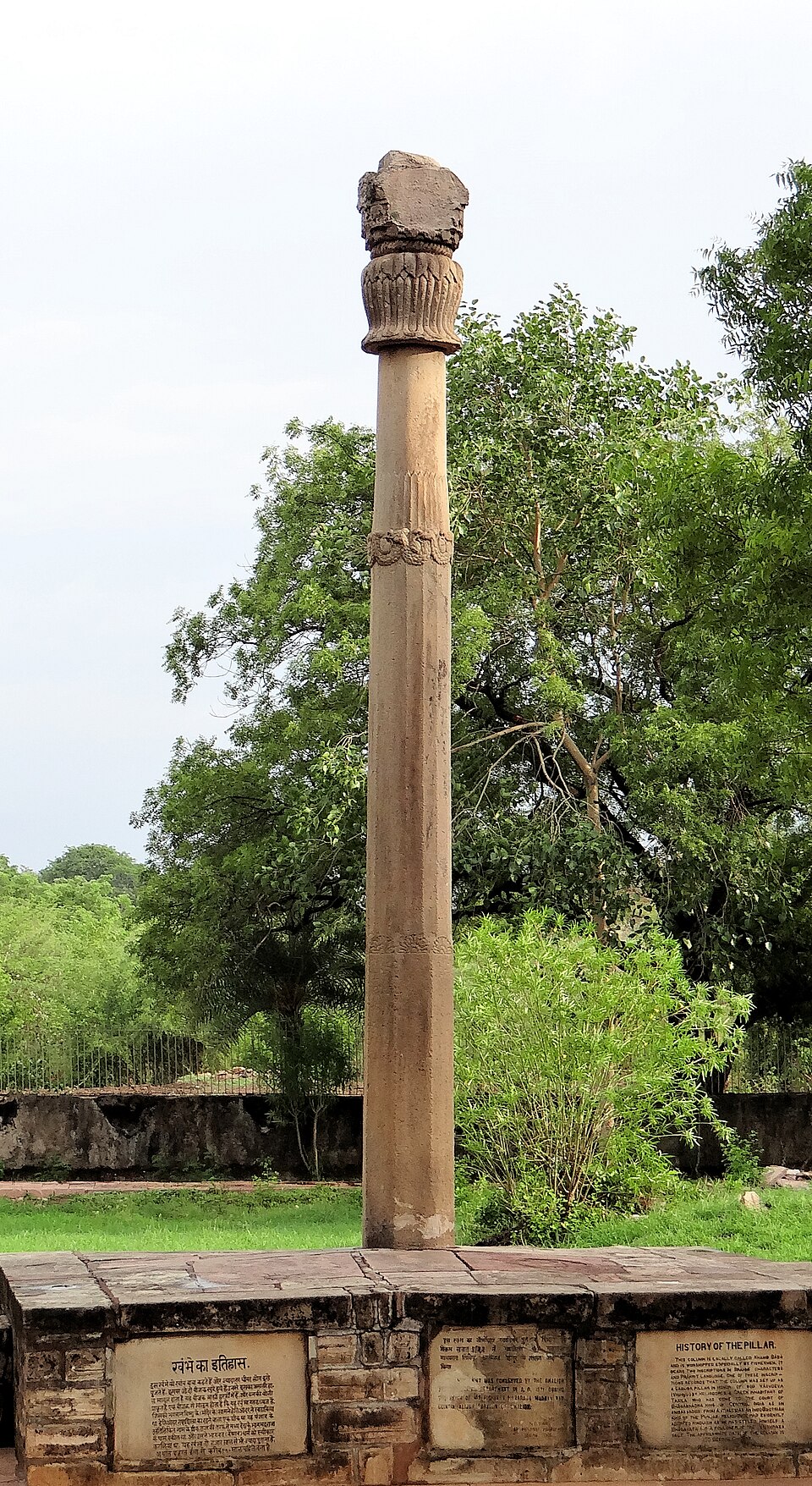
Go back more than a thousand years and the evidence turns up a surprise. The oldest hard evidence for Vaiṣṇava devotional religion was left by a Greek. At Besnagar in central India, c. 110 BCE, a pillar reads:
devadevasa vā[sude]vasa garuḍadhvajo ayaṃ kārito i[a] heliodoreṇa bhāgavatena diyasa putreṇa takhkhasilākena yonadūtena…
“This Garuḍa-standard of Vāsudeva, the God of Gods, was made here by Heliodora (Heliodoros), the Bhāgavata, son of Diya (Dion), a man of Takṣaśilā, Greek ambassador, who came from the Great King Antialkidas to King Kāśīputra Bhāgabhadra…”[7][8]
What it proves: by 110 BCE, “Bhāgavata,” devotee of the Lord, was a religious identity someone would claim publicly and permanently. Vāsudeva is a name of Kṛṣṇa, and the Vāsudeva-Kṛṣṇa-Viṣṇu fusion was well advanced. It also proves the identity was open to a foreigner.
Heliodoros was not the first Bhāgavata, only the most famous. A second pillar from the same site records an Indian donor using the same formula, and a built temple of the Lord.[9] So the Greek was following a local convention, not inventing one; he stands out because of who he was, not because he was alone. Consensus
Answer 3: the first named composers of Hindu scripture
If a “Hindu” is someone whose words are still chanted as Hindu scripture, the earliest names belong to the Rigveda’s seer families. Its oldest core, the six “Family Books,” is attributed to the lineages of Gṛtsamada, Viśvāmitra, Vāmadeva, Atri, Bharadvāja and Vasiṣṭha, composed orally in the Punjab most likely c. 1500–1200 BCE.[10][11] Majority
There is a catch. These poets worshipped Indra, Agni and Soma. They had no temples, no images, no karma, no rebirth, and no Śiva as a god’s name: śiva was an adjective, and Rudra a feared outsider with about three hymns.[11] They are ancestors of Hinduism, but they would not have recognized most of what a Hindu does today, and they never heard the word “Hindu.”
And the oldest written invocation of their gods was not made by them at all. A treaty of c. 1350–1320 BCE between a Hittite king and a king of Mitanni, in Syria, calls on Mitra, Varuṇa, Indra and the Nāsatyas as witnesses, two centuries before anything was written in India.[12] The first people on record swearing by Vedic gods were Near Eastern kings. Consensus
Answer 4: nobody, because nobody founded it
The tradition’s own answer is that the question is misframed. Hindus often call their religion sanātana dharma, the eternal order, and the Mīmāṃsā school held the Veda to be eternal and authorless: heard by the seers, not made by them.[1] On that view there is no first Hindu for the same reason nobody is credited with inventing the truths of arithmetic. It is a theological position, not a historical claim, and a historian can describe it but not test it.
Answer 5: the people we cannot name
Some of Hinduism is older than any name. Village goddesses, serpent worship and sacred trees have no Vedic origin and plausibly descend from the religion of the pre-Vedic majority population, including the Indus civilization of c. 2600–1900 BCE.[13][1] If they count, the first “Hindus” were farmers and city-dwellers whose language we cannot read. Contested
A short timeline
| Date | What happens | Confidence |
|---|---|---|
| c. 2600–1900 BCE | Indus cities; possible substrate of later popular religion | Contested |
| c. 1500–1200 BCE | Rigvedic seer families compose the Family Books | Majority |
| c. 1350–1320 BCE | Mitanni treaty invokes Vedic gods in writing | Consensus |
| Late 6th c. BCE | “Hindu” as a Persian place name for the Indus region | Consensus |
| c. 110 BCE | Heliodoros, “the Bhāgavata,” at Besnagar | Consensus |
| c. 1200–1500 CE | Hindū used as a religious self-name, against turk | Majority |
| c. 1787 | “Hinduism” in English | Majority |
| 1871–72 | Census requires every Indian to have one religion | Consensus |
What scholars disagree about
When “Hindu” became a religious identity. Robert Frykenberg and others treat unified Hinduism as essentially a nineteenth-century construction; Lorenzen finds a self-conscious Hindu identity by 1200–1500; Andrew Nicholson finds Indian philosophers unifying the orthodox schools in the 14th–17th centuries.[14][3][6] Whether Islam was the main catalyst, or competition between Hindu sects did as much, is still argued.[15][16] Contested
Who counts. Savarkar’s Essentials of Hindutva (1923) defined a Hindu not by belief but by nation and territory, descent and civilization. On that definition Buddhists, Jains and Sikhs are Hindus and Muslims and Christians are not, regardless of what anyone believes.[17] That is a modern political definition, and it gives a very different answer to “who is a Hindu” from the religious ones above. Political
Common misconceptions
- “Śaṅkara founded Hinduism.” He systematized Advaita in the eighth century; the tradition was already more than two thousand years old, and in his own time he was one voice among many.[6][18]
- “The Vedic seers were the first Hindus in the modern sense.” Their religion lacked most of what defines Hinduism now.[11]
- “Hindus have always called themselves Hindus.” For most of history they named themselves by sect and lineage: Bhāgavata, Śaiva, Vaiṣṇava.[1]
Why it matters
A religion with a founder can be dated from a life. Hinduism can only be dated in layers: a Vedic liturgy, an Upanishadic philosophy, devotion carved in stone, a name borrowed from outsiders and then claimed. The absence of a first Hindu is not a gap in the record. It is the most accurate thing the record says about the religion.
For how the name and the identity formed, see §10 and §11; for the Heliodorus pillar, §7.
References
- ^ a b c d e Gavin Flood An Introduction to Hinduism. Cambridge University Press, 1996. open library The standard university textbook, and the most balanced single overview.
- ^ Edwin Bryant The Quest for the Origins of Vedic Culture. Oxford University Press, 2001. open library The fairest book-length survey of the origins debate; takes the indigenist arguments seriously without endorsing them.
- ^ a b c David N. Lorenzen "Who Invented Hinduism?". Comparative Studies in Society and History 41, 1999. doi The case that Hindu self-identity predates colonialism by centuries.
- ^ Bījak — Kabīr. c. 17th c. (compiled). Old Hindi. The Kabīrpanthī recension — one of three collections that disagree with each other, which is the whole point about Kabīr's transmission. about
- ^ Linda Hess & Shukdev Singh, trans. The Bījak of Kabir. North Point Press, 1983. full text With an essay on Kabir's unstable textual traditions.
- ^ a b c Andrew J. Nicholson Unifying Hinduism: Philosophy and Identity in Indian Intellectual History. Columbia University Press, 2010. full text Argues the unification of Hinduism began in the 12th–16th centuries, well before the British — a key correction to the strong constructionist thesis.
- ^ Heliodorus pillar — Besnagar (Vidiśā). c. 110 BCE. Prakrit in Brāhmī. A Greek ambassador calls himself a Bhāgavata and Vāsudeva the God of Gods. The oldest hard evidence for bhakti, and datable by Antialkidas's coinage. about
- ^ Richard Salomon Indian Epigraphy. Oxford University Press, 1998. open library The standard handbook for inscriptions and their dating.
- ^ Besnagar second Garuḍa pillar — Vidiśā. c. late 2nd c. BCE. Prakrit in Brāhmī. An Indian donor, also a Bhāgavata, erects a Garuḍa column for "the excellent temple of the Bhagavat" — proving a built temple at Vidiśā, and that Heliodorus followed a local convention rather than inventing one. read the text
- ^ Michael Witzel "Early Sanskritization: Origins and Development of the Kuru State". Electronic Journal of Vedic Studies 1, 1995. doi The Kuru state thesis — canonization as a political project.
- ^ a b c Stephanie W. Jamison & Joel P. Brereton, trans. The Rigveda: The Earliest Religious Poetry of India. Oxford University Press, 3 vols., 2014. The standard complete English translation. Supersedes Griffith entirely.
- ^ Mitanni–Hittite treaty — Boğazköy archive. c. 1350–1320 BCE. Akkadian, with Indo-Aryan divine names. Invokes Mitra, Varuṇa, Indra and the Nāsatyas as witnesses — Indo-Aryan gods attested in writing in Syria two centuries before anything written in India. about
- ^ Asko Parpola The Roots of Hinduism: The Early Aryans and the Indus Civilization. Oxford University Press, 2015. full text The fullest statement of the Dravidian-Indus case. Argued, not established.
- ^ Robert E. Frykenberg "The Emergence of Modern 'Hinduism' as a Concept and as an Institution". in Hinduism Reconsidered, Manohar, 1989. The classic statement of the strong colonial-construction position.
- ^ Elaine M. Fisher Hindu Pluralism: Religion and the Public Sphere in Early Modern South India. University of California Press (open access), 2017. doi Sectarian publics performing distinct identities — the case that intra-Hindu competition, not only Islam, did the boundary-drawing.
- ^ Divya Cherian Merchants of Virtue: Hindus, Muslims, and Untouchables in Eighteenth-Century South Asia. University of California Press, 2022. doi "Hindu" hardening as a legal and social category in eighteenth-century Marwar — precolonial, but late.
- ^ Essentials of Hindutva — V. D. Savarkar. 1923 CE. English. Defines a Hindu territorially and ethnically — fatherland and holy land — not theologically. Savarkar was an atheist. about
- ^ Wilhelm Halbfass Tradition and Reflection: Explorations in Indian Thought. SUNY Press, 1991. full text On Śaṅkara and his Mīmāṃsā opponents.