The Indus Civilization in one paragraph
The Indus Valley (Harappan) Civilization flourished as an urban culture c. 2600–1900 BCE across roughly 1.25 million km² of what is now Pakistan and northwest India, and its religion cannot be read, because its script is undeciphered. For seven hundred years it was, on most estimates, the most extensive civilization of its day:[1] planned cities with covered street drains and household bathrooms on a scale unusual anywhere in the Bronze Age,[2] standardized weights accurate across a thousand kilometres, long-distance trade with Mesopotamia, and a writing system on four thousand objects that nobody can read.
That last fact governs this entire chapter. We know the Harappans had a symbolic and probably religious life — they left seals showing horned deities, figures seated in postures, animals in ritual arrangement, and a monumental bathing tank. We cannot say what any of it meant. Everything claimed about Harappan religion is inference from images, and this page’s main job is to show what the images are, what has been claimed about them, and exactly where the claims outrun the evidence.
It also settles two things that can be settled: the cities were not destroyed by invaders, and there were no horses.
Timeline of the Indus Valley Civilization
The Indus Valley Civilization runs from the Early Harappan phase c. 3300 BCE through its mature urban peak c. 2600–1900 BCE to a Late Harappan village phase lasting until c. 1300 BCE.
| Date | Event | Confidence |
|---|---|---|
| c. 3300–2600 BCE | Early Harappan (Ravi / Hakra / Kot Diji phases) — regional towns, early sign use | Consensus |
| c. 2600 BCE | Urban transition — planned cities appear rapidly, script standardizes | Consensus |
| c. 2600–1900 BCE | Mature Harappan. ~1.25 million km²; 1000+ settlements[1] | Consensus |
| c. 2500–2000 BCE | Trade with Mesopotamia; Akkadian texts name Meluhha | Consensus |
| c. 2200–2000 BCE | 4.2-kiloyear aridification event; monsoon weakening[3] | Majority |
| c. 1900 BCE | De-urbanization begins — cities emptied over generations, not destroyed | Consensus |
| c. 1900–1300 BCE | Late Harappan: Cemetery H, Jhukar, Rangpur. Village life, no script[4] | Consensus |
| c. 1500–1200 BCE | Rigvedic composition begins to the north and west (§3) | Majority |
| c. 1400–1000 BCE | Bhagwanpura: Late Harappan and Painted Grey Ware overlap in the same levels[5] | Consensus |
Where the Harappan cities were
The Harappan cities, among them Mohenjo-daro, Harappa, Rakhigarhi and Dholavira, lie along two river systems: the Indus and its tributaries, and the now-dry Ghaggar-Hakra.
| Site | Modern location | Note |
|---|---|---|
| Mohenjo-daro | Sindh, Pakistan | The Great Bath, the “Priest-King,” the Pashupati seal |
| Harappa | Punjab, Pakistan | First excavated (1920s); Cemetery H culture named here |
| Rakhigarhi | Haryana, India | Largest known site; source of the sequenced Harappan genome[6] |
| Dholavira | Kutch, Gujarat | Water reservoirs; the ten-sign “signboard”[7] |
| Kalibangan | Rajasthan | The disputed “fire altars”; a ploughed field |
| Lothal | Gujarat | Dockyard/basin; bead workshop |
| Ganweriwala | Cholistan, Pakistan | Large, largely unexcavated |
The distribution follows two river systems: the Indus and its tributaries, and the now-dry Ghaggar-Hakra in Haryana and Rajasthan, where a large share of known sites lie. What that dry river was, and when it dried, is one of the most politically loaded questions in Indian archaeology (see the debates below).
The evidence ledger for Harappan religion
The Harappans built grid-planned cities with standardized weights and traded with Mesopotamia, but left no palaces or monumental temples, no horse, spoked wheel or iron, and a sign system nobody can read.
| Dimension | What we can say | Evidence | Confidence |
|---|---|---|---|
| Urbanism | Grid-planned cities, fired brick in a standard 1:2:4 ratio, covered street drains, private wells and bathrooms | Mohenjo-daro, Harappa, Dholavira plans[2] | Consensus |
| Standardization | Weights in a binary series, consistent across the whole area | Chert cube weights, near-identical at sites 1,000 km apart[1] | Consensus |
| Political form | No palaces, no royal tombs, no monumental temples, no ruler iconography, no clear military | The absence is uniform across all excavated sites[8] | Consensus on the absence; Contested on the inference |
| Crops | Wheat and barley in the north; millets and rice in the east; sesame, peas, cotton. Multi-cropping across seasons | Bates, Petrie & Singh 2017 — Indus populations cultivated rice on a partly independent domestication trajectory[9] | Majority |
| Animals | Zebu cattle, water buffalo, sheep, goat, dog, elephant, camel. No horse | Faunal assemblages across all mature-phase sites | Consensus |
| Transport | Solid-wheel ox carts. No spoked wheel, no chariot | Terracotta cart models; no spoked-wheel depiction anywhere. The Sinauli vehicles (c. 1865–1507 BCE), often called chariots, have solid disc wheels and were found with no horse remains[10] | Consensus |
| Metals | Copper, bronze, gold, silver, lead. No iron | Metallurgical finds | Consensus |
| Trade | Maritime and overland contact with Oman, Bahrain, and Mesopotamia | Indus seals and carnelian beads at Ur; “Meluhha” in Akkadian records[2] | Consensus |
| Writing | A sign system on ~4,000 objects; ~400–600 signs; average inscription ~5 signs, longest ~26 | The corpus itself[11] | Consensus on the data; Contested whether it encodes language |
| Religion | Bathing installations, horned-deity imagery, animal symbolism, a widespread pipal-tree motif, figurines | Seals, tablets, terracottas, the Great Bath[12][13] | Contested throughout |
Harappan religion: the evidence up close
With the Indus script undeciphered, the Paśupati seal, the Great Bath and the Kalibangan pits remain contested evidence for Harappan religion, while the absence of the horse and of any invasion is secure.
The script, and why it is the wall
Roughly four thousand inscribed objects survive — mostly seals, sealings, and small tablets. The sign inventory is somewhere between 400 and 600, which is too many for an alphabet and too few for a purely logographic system like Chinese, suggesting a logo-syllabic script. But the inscriptions are catastrophically short: five signs on average, twenty-six at the longest. There is no bilingual, no Rosetta Stone, and no known descendant language securely attached to it.
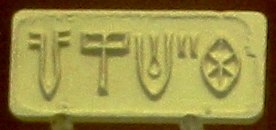
The consequences are absolute. We do not know what language the Harappans spoke. We do not know the name of a single Harappan person, city, king, or god. Claims to have deciphered the script appear regularly — hundreds now — and none has convinced the field.[12] Consensus
A measure of how open the problem remains: in January 2025, at a conference marking the centenary of the civilization’s discovery, the Chief Minister of Tamil Nadu announced a one million dollar prize for a successful decipherment, noting that a century of effort had not produced one.[14] The offer is itself evidence — nobody posts a bounty on a solved problem. Consensus
A minority position (Farmer, Sproat & Witzel, 2004) argues the system is not writing at all but a nonlinguistic sign system, like heraldry or tallies. Their evidence: the extreme brevity, the absence of long texts anywhere, the lack of any writing surface for extended documents, and sign frequency distributions unlike known scripts.[11] The counter: sealings are inherently brief everywhere, and perishable writing surfaces would not survive. Contested
Seal M-304 — the “Pashupati” seal
The single most discussed object in South Asian archaeology. A steatite seal from Mohenjo-daro shows a figure seated on a low platform with heels together and knees splayed outward, wearing a tall horned headdress, arms covered in bangles, apparently ithyphallic. Around it: an elephant and a tiger on one side, a rhinoceros and a water buffalo on the other, with two deer or ibexes beneath the seat.[15]
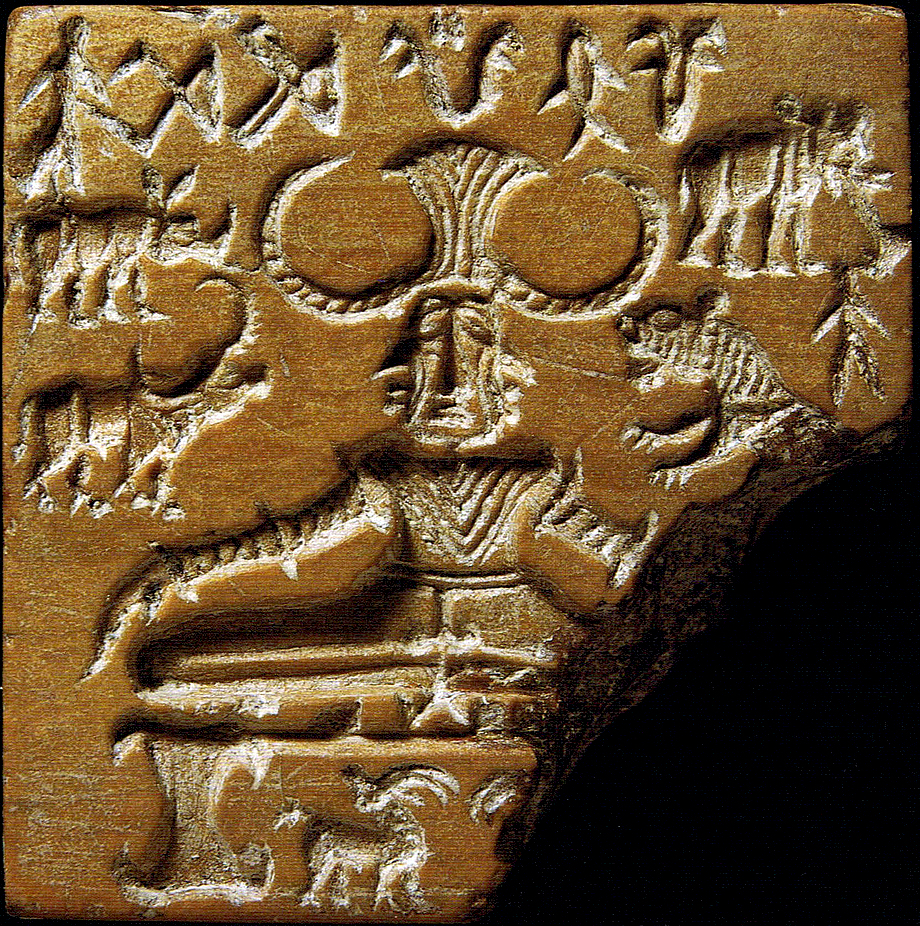
John Marshall’s 1931 reading — a prototype of Śiva as Paśupati, “Lord of Beasts” — is based on four correspondences: the yogic posture, the animal lordship, the possible three faces, and the ithyphallic form. It has been repeated for ninety years and appears in most textbooks.[16]
The objections, which are serious:
- Doris Srinivasan’s critique (1975 onward): the “three faces” are not clearly faces; the headdress is bovine, and the figure may be a bull-deity or a buffalo-man, a widespread Near Eastern and Indian type, not a proto-Śiva.[17][18]
- The Master of Animals motif — a figure flanked by wild beasts — is common across Mesopotamia, Elam and Central Asia in this period. The seal may simply be a local version of a shared regional iconography.[12]
- The posture is not securely yogic; comparable seated postures occur in Elamite art.
- Above all: Rudra in the Rigveda is not a lord of beasts, not a yogi, not ithyphallic, and not associated with tigers. The Paśupati identification requires matching the seal to a form of Śiva that is attested only 1,500–2,000 years later. It is a resemblance to a later deity, which is exactly the kind of match that should raise suspicion.[17] Contested
Where this series lands: the seal shows a horned figure of evident religious importance surrounded by wild animals. It may well belong to a stream of imagery that later fed into Śiva. Calling it “proto-Śiva” as established fact is not supportable.
The Great Bath
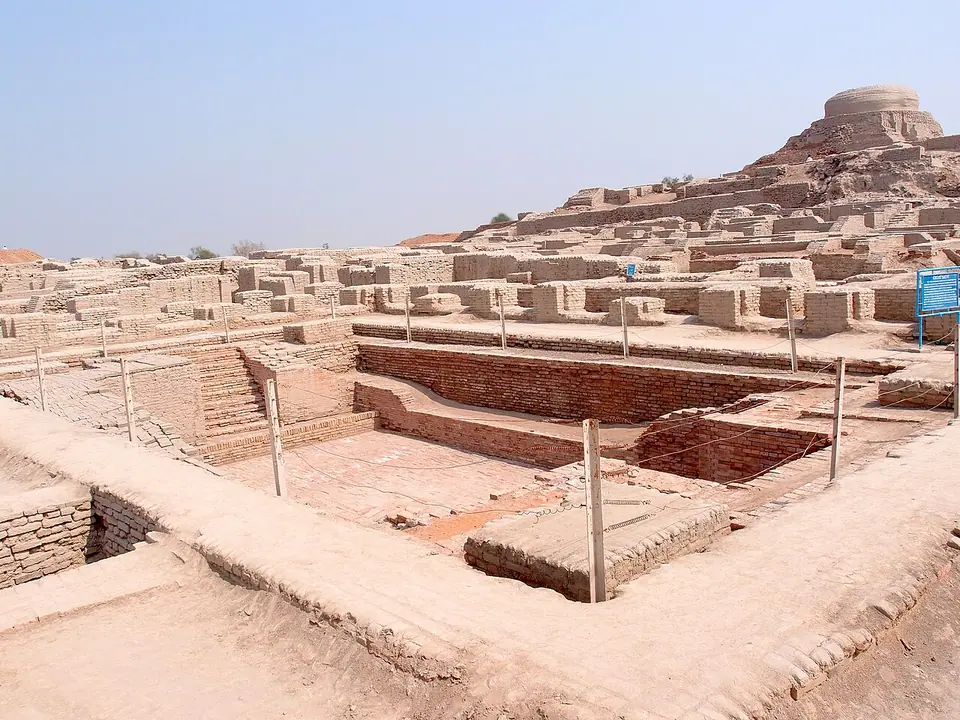
At Mohenjo-daro, a sunken brick tank roughly 12 × 7 metres and 2.4 metres deep, with steps at both ends, a bitumen waterproof layer, and a drain — set within the largest structure on the citadel mound, surrounded by small rooms.[13][2]
The argument for ritual use: its prominence and cost; the surrounding cells resembling changing or preparation rooms; the elaborate waterproofing; and the extraordinary attention to water and personal bathing throughout Harappan domestic architecture, which is unusual among Bronze Age civilizations.
The argument against reading too much in: nothing marks it as sacred — no altar, no imagery, no deposits, no iconography. A civic bath, an elite amenity, or a water-storage facility all remain possible. Contested
The wider point is safer than the specific one: Harappan cities were built around water management and personal cleanliness to a degree no contemporary civilization matched, and the later Indian religious emphasis on ritual purity through bathing has an obvious ancestral candidate here. Speculative on the connection
The Kalibangan “fire altars”
At Kalibangan, a row of seven rectangular pits on a raised platform, each with a terracotta stele at the centre, containing ash, charcoal and animal bone. Similar features at Lothal and Banawali.[19]
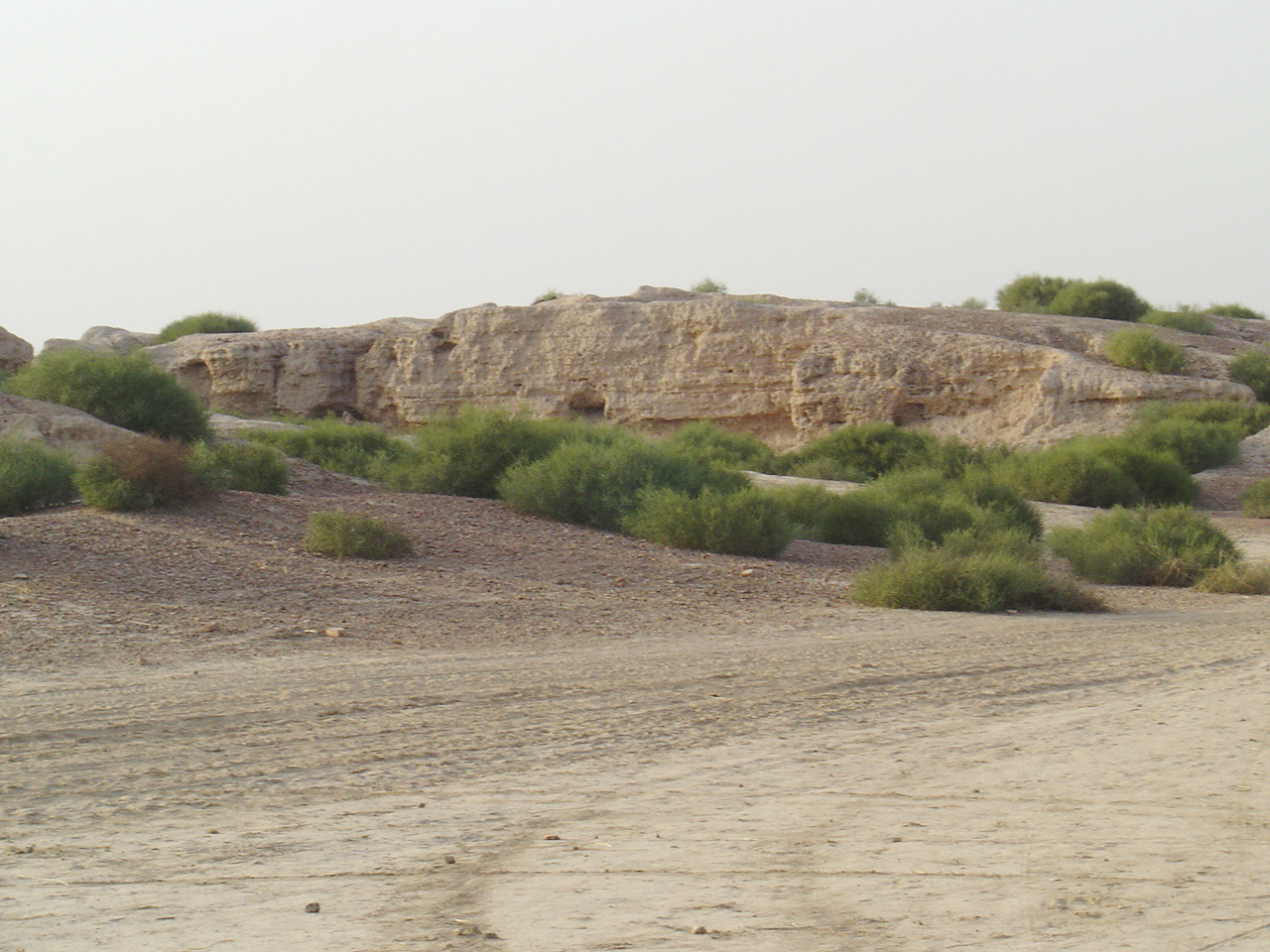
B. B. Lal and others read these as fire altars implying Vedic-style yajña, and therefore Vedic religion inside the Harappan world — which, if right, would collapse the chronology this series uses. The counter-arguments: the pits contain no soma-related apparatus, no offering ladles, and none of the geometrically precise altar-construction that defines Vedic ritual; they may be communal hearths or feasting installations; and Vedic śrauta altars have a specific, well-documented form these do not match.[20][4] Contested / Political
The absent horse
There is no securely identified horse bone from any mature Harappan level, no depiction of a horse among thousands of animal images on seals, and no spoked wheel or chariot.[2] Meanwhile the Rigveda is saturated with horses and chariots — aśva is among its commonest nouns.
This is one of the strongest arguments that the Rigvedic culture and the mature Harappan culture are not the same thing — and since 2021 it has stopped being an argument from absence. Librado et al. (Nature 2021, 2024) show that the modern domestic horse lineage began its rapid Eurasian expansion only around 2200 BCE.[21] The horse could not have been present in the mature Harappan phase because it had not yet spread anywhere. The counter-claim rests chiefly on a 1997 identification by Sándor Bökönyi of horse remains at Surkotada,[22] disputed in detail by Richard Meadow and Ajita Patel, who identified the specimens as onager or half-ass.[23] Consensus on the absence; Contested on Surkotada
How it ended — and how it did not
Mortimer Wheeler, excavating in the 1940s, found scattered skeletons at Mohenjo-daro, connected them to the Rigveda’s Indra as purandara, “fort-destroyer,” and proposed that Aryan invaders sacked the cities.[24] This became the standard popular story, and it is wrong.
- The skeletons are not a massacre. Kenneth Kennedy’s reanalysis showed no battle trauma; the bodies come from different stratigraphic levels spanning centuries; several are ordinary interments.[25]
- There is no destruction layer, no burning horizon, no weapons cache, no defensive reorganization at any Harappan city.[2]
- The pattern is gradual de-urbanization over generations — public buildings falling out of maintenance, drainage failing, populations dispersing east and south into village cultures.
The current explanation is environmental and economic. The 4.2-kiloyear aridification event weakened the monsoon, and the Ghaggar-Hakra — which Giosan et al. (PNAS 2012) show was monsoon-fed, not glacier-fed, throughout the Holocene[3] — declined with it. (The Sutlej and Yamuna were diverted away from that valley, but Clift et al. date those captures to the Pleistocene, tens of millennia before the Harappans;[26] and Singh et al. 2017 argue the abandoned, flood-free palaeochannel is precisely why settlements clustered there.[27]) Agriculture shifted toward drought-tolerant millets and smaller settlements; and the long-distance trade with Mesopotamia that supported urban elites contracted. Cities need surplus and exchange. Both failed.[1] Consensus
This matters for the whole series. The “Aryan invasion” that popular argument attacks and defends was abandoned by scholarship decades ago. The current migration model (§0) proposes gradual movement into an already de-urbanizing landscape, several centuries after the cities declined. Nobody sacked anything.
What is absent from the Harappan record
The Harappan record has no monumental temple, no large cult image, no royal iconography, no unambiguous weapons of war, and no horse, chariot, spoked wheel or iron.
The Harappan absences are as informative as the Rigvedic ones, and they point in a completely different direction:
- No monumental temple. In seven centuries of city-building, nothing identifiable as a large religious structure.
- No large-scale cult image, no divine statuary, nothing corresponding to a Mesopotamian ziggurat’s god-house.
- No royal iconography — no king-lists, no victory reliefs, no named rulers, no royal burials with wealth.
- No unambiguous weapons of war, no fortification designed against siege, no depictions of battle.
- No horse, no chariot, no spoked wheel, no iron.
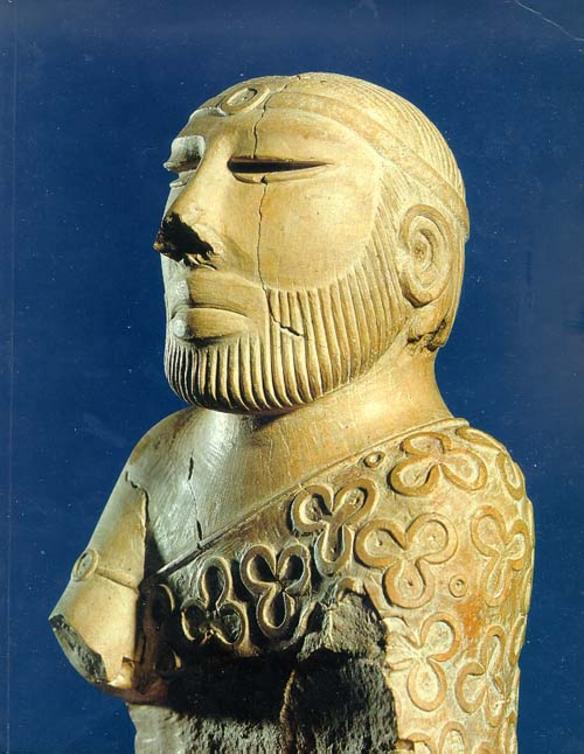
Set the first four against contemporary Egypt and Mesopotamia and the contrast is stark. Whatever organized Harappan society, it did not advertise itself through god-kings and temples. Whether that reflects a genuinely different politics or simply a different medium of display is open. Contested
Debates about the Indus Civilization
The main debates about the Indus Civilization concern the identity of the Sarasvatī, whether the Harappans were the Vedic people, whether their religion continues into Hinduism, and whether their society was egalitarian.
What was the Sarasvati river?
The Rigveda praises a Sarasvatī as a great river flowing from mountain to sea. Many identify it with the Ghaggar-Hakra, along which a large proportion of Harappan sites lie. If the Rigvedic Sarasvatī is a mighty Ghaggar-Hakra, and that river was already declining by c. 2000 BCE, the Rigveda would have to be older than the standard chronology allows — and the Harappans would be Vedic.[28][29]
The counter-case: recent geomorphology (Giosan et al. 2012; Clift et al. 2012) indicates the Ghaggar-Hakra was monsoon-fed rather than glacier-fed for most of the Harappan period, and so never the perennial Himalayan torrent the hymns describe;[3][26] the name Sarasvatī corresponds etymologically to Avestan Haraxvaitī, the Helmand in Afghanistan, and may have been transferred eastward with the people; and Rigvedic river praise is formulaic, applied hyperbolically to several rivers.[30] The Rigveda also already knows the Sarasvatī can be modest — a later Brāhmaṇa notes it disappearing into the sands. Contested / Political
Were the Harappans and the Vedic people the same?
Almost certainly not, and the evidence is convergent rather than single-stranded: the Harappans had cities, brick, drainage, seals, writing, and no horses; the Rigvedic people had horses, chariots, no cities, no writing, and no vocabulary for any of the Harappan material world. The Rigveda never describes anything like a Harappan city — no fired brick, no drains, no seals, no standardized weights — which it could hardly have missed.[31] (It does have Indra shattering puras, but those are ramparts and strongholds, not this.) And Rakhigarhi’s genome lacks the steppe component that later populations carry.[6][32] Majority
Is there continuity from the Harappans into Hinduism?
Yes, in all likelihood — but through the substrate, not through the Vedas. Pipal veneration, ritual bathing, possible proto-Śiva imagery, the swastika, and animal symbolism all plausibly descend from this world into later popular religion, which then merges with the Vedic stream from Chapter 7 onward. Plausibly, not demonstrably.[12] Majority on some continuity; Contested on every specific item
Was Harappan society egalitarian?
The absence of palaces and royal tombs has produced readings of the Harappans as unusually non-hierarchical, even as a merchant oligarchy or a theocratic collective. Caution: differences in house size, access to wealth goods, and burial provision do exist. Absence of advertised hierarchy is not absence of hierarchy.[8][1] Contested
Further reading
- Jonathan Mark Kenoyer, Ancient Cities of the Indus Valley Civilization (1998).
- Rita Wright, The Ancient Indus: Urbanism, Economy, and Society (2010).
- Asko Parpola, Deciphering the Indus Script (1994) and The Roots of Hinduism (2015).
- Steve Farmer, Richard Sproat & Michael Witzel, “The Collapse of the Indus-Script Thesis,” EJVS 11 (2004).
- Doris Srinivasan, “The So-Called Proto-Śiva Seal from Mohenjo-Daro,” Archives of Asian Art 29 (1975).
- Liviu Giosan et al., “Fluvial landscapes of the Harappan civilization,” PNAS 109 (2012).
- Kenneth Kennedy, “Have Aryans been identified in the prehistoric skeletal record from South Asia?” in The Indo-Aryans of Ancient South Asia (1995).
- Shinde et al., Cell 179 (2019) — the Rakhigarhi genome.
References
- ^ a b c d e Rita P. Wright The Ancient Indus: Urbanism, Economy, and Society. Cambridge University Press, 2010. full text Strong on economy and on what the absence of palaces does and does not imply.
- ^ a b c d e f Jonathan Mark Kenoyer Ancient Cities of the Indus Valley Civilization. Oxford University Press, 1998. full text The standard accessible account by an excavator.
- ^ a b c Liviu Giosan et al. "Fluvial landscapes of the Harappan civilization". PNAS 109, 2012. doi The geomorphology behind the Ghaggar-Hakra argument.
- ^ a b Robin Coningham & Ruth Young The Archaeology of South Asia: From the Indus to Asoka. Cambridge University Press, 2015. The standard synthesis for §§1–6.
- ^ Upinder Singh A History of Ancient and Early Medieval India. Pearson, 2008. open library The best textbook on the archaeology-plus-text synthesis.
- ^ a b Vasant Shinde et al. "An Ancient Harappan Genome Lacks Ancestry from Steppe Pastoralists or Iranian Farmers". Cell 179, 2019. doi The single sequenced Rakhigarhi individual.
- ^ Dholavira signboard — Kutch, Gujarat. c. 2500 BCE. undeciphered. Ten large signs, apparently mounted above a gateway — the longest single-line Indus inscription, and still unreadable. about
- ^ a b Adam S. Green "Killing the Priest-King: Addressing Egalitarianism in the Indus Civilization". Journal of Archaeological Research 29, 2021. doi The canonical modern statement of the Harappan egalitarianism debate.
- ^ Jennifer Bates, Cameron Petrie & Ravindra Singh "Approaching rice domestication in South Asia: New evidence from Indus settlements in northern India". Journal of Archaeological Science 78, 2017. doi Indus rice cultivation on a partly independent trajectory — which means §4's "rice arrives" story is about ritual vocabulary, not about rice.
- ^ Sinauli vehicles — Baghpat, Uttar Pradesh. c. 1865–1507 BCE. Three full-sized wooden vehicles with **solid disc wheels**, copper-sheathed, found with no horse or draught-animal remains. Routinely called chariots; the physical evidence does not support it. about
- ^ a b Steve Farmer, Richard Sproat & Michael Witzel "The Collapse of the Indus-Script Thesis". Electronic Journal of Vedic Studies 11, 2004. open access The minority argument that the sign system is not writing at all.
- ^ a b c d Asko Parpola The Roots of Hinduism: The Early Aryans and the Indus Civilization. Oxford University Press, 2015. full text The fullest statement of the Dravidian-Indus case. Argued, not established.
- ^ a b The Great Bath — Mohenjo-daro. c. 2500 BCE. A monumental waterproofed tank. Ritual purity or civic amenity — nothing marks it as sacred. about
- ^ Tamil Nadu decipherment prize — Government of Tamil Nadu. January 2025. A one-million-dollar prize announced at the civilization's centenary conference for deciphering the Indus script. Nobody posts a bounty on a solved problem. about
- ^ Seal M-304 — Mohenjo-daro. c. 2500 BCE. undeciphered. The "Paśupati" seal. A horned figure among wild animals — proto-Śiva, a bovine deity, or a Near Eastern Master of Animals. Undecided. about
- ^ John Marshall Mohenjo-daro and the Indus Civilization. Arthur Probsthain, 3 vols., 1931. full text The excavation report that named the "Paśupati" seal, the "Priest-King" and the "Mother Goddess" — labels the field has been arguing with ever since.
- ^ a b Doris Srinivasan "The So-Called Proto-Śiva Seal from Mohenjo-Daro: An Iconological Assessment". Archives of Asian Art 29, 1975. The critique that dismantled the confident Paśupati reading.
- ^ Doris Srinivasan Many Heads, Arms and Eyes: Origin, Meaning and Form of Multiplicity in Indian Art. Brill, 1997. On how Hindu iconography emerged.
- ^ Kalibangan fire pits — Kalibangan. c. 2500 BCE. Seven pits with ash and stelae, argued as Vedic-style yajña. No soma apparatus, no geometric altar construction. about
- ^ Frits Staal Agni: The Vedic Ritual of the Fire Altar. Asian Humanities Press, 2 vols., 1983. open library Documentation of the 1975 Agnicayana in Kerala — plausibly the oldest continuously performed ritual on earth.
- ^ Pablo Librado et al. "Widespread horse-based mobility arose around 2200 BCE in Eurasia". Nature 631, 2024. doi Turns the Harappan "no horse" point from an argument from absence into a positive one: the domestic lineage had not yet spread anywhere.
- ^ Sándor Bökönyi "Horse remains from the prehistoric site of Surkotada, Kutch". South Asian Studies 13, 1997. The one identification of Harappan horse remains. Disputed in detail by Meadow and Patel, who read the specimens as onager.
- ^ Richard H. Meadow & Ajita Patel "A comment on 'Horse remains from Surkotada' by Sándor Bökönyi". South Asian Studies 13, 1997. doi The rebuttal. This exchange is the whole of the Harappan horse debate's primary literature.
- ^ Mortimer Wheeler The Indus Civilization. Cambridge University Press, 1953. full text The source of the invasion hypothesis, built on Mohenjo-daro skeletons that later reanalysis showed were not a massacre. Read as historiography, not as archaeology.
- ^ Kenneth A. R. Kennedy "Have Aryans been identified in the prehistoric skeletal record from South Asia?". in The Indo-Aryans of Ancient South Asia, 1995. The reanalysis that ended the Mohenjo-daro "massacre".
- ^ a b Peter D. Clift et al. "U–Pb zircon dating evidence for a Pleistocene Sarasvati River and capture of the Yamuna River". Geology 40, 2012. doi Dates the river captures to the Pleistocene — tens of millennia before the Harappans.
- ^ Ajit Singh et al. "Counter-intuitive influence of Himalayan river morphodynamics on Indus Civilisation urban settlements". Nature Communications 8: 1617, 2017. doi The Sutlej left the Ghaggar valley ~8,000 years ago; Harappan settlement clustered there *because* it was an abandoned, flood-free channel.
- ^ Michel Danino The Lost River: On the Trail of the Sarasvatī. Penguin India, 2010. The best-argued case on the other side of the Sarasvatī question. Cite it if the debate is to be stated fairly.
- ^ Anirban Chatterjee et al. "On the existence of a perennial river in the Harappan heartland". Scientific Reports 9: 17221, 2019. doi The serious dissenting paper for a Himalayan-fed perennial river. Named here because omitting the one real counter-paper would be partisan.
- ^ Edwin Bryant The Quest for the Origins of Vedic Culture. Oxford University Press, 2001. open library The fairest book-length survey of the origins debate; takes the indigenist arguments seriously without endorsing them.
- ^ Michael Witzel "Early Sanskritization: Origins and Development of the Kuru State". Electronic Journal of Vedic Studies 1, 1995. doi The Kuru state thesis — canonization as a political project.
- ^ Vagheesh M. Narasimhan et al. "The formation of human populations in South and Central Asia". Science 365, 2019. doi Over 500 ancient genomes. The steppe-ancestry signal, and its limits.