The short version: nobody wrote the Vedas, and many people composed them. The Rigveda’s hymns are the work of many poet-priest families, the ṛṣis, composing orally over several centuries.[1] Priestly schools then collected them, with newer material, into four Vedas and attached long prose texts to each.[2][3] The tradition gives a different answer, and it is not naive: the Veda, it says, has no author at all. Both answers are set out below.
When the hymns were composed, and why they were memorized rather than written down, is a separate question, covered in when was the Rigveda written. In brief, the oldest layer most likely dates to c. 1500–1200 BCE.
Who composed the Rigveda
The Rigveda is 1,028 hymns in ten books, or maṇḍalas.[1] Its oldest core, Books 2 to 7, is the “Family Books”: each one is the hymn collection of a single priestly lineage.[2][1]
| Book | Lineage it is attributed to |
|---|---|
| 2 | Gṛtsamada |
| 3 | Viśvāmitra |
| 4 | Vāmadeva |
| 5 | Atri |
| 6 | Bharadvāja |
| 7 | Vasiṣṭha |
| 8 | mostly Kaṇva, with Āṅgirasa poets |
| 9 | gathered from many families; every hymn is to Soma |
| 1 and 10 | many poets; the latest layer |
These were not hermits receiving private visions. They were professional poets attached to chiefs, paid in cattle and horses, and openly competitive.[1] They describe their hymns as things crafted, the way a carpenter shapes a chariot, and they boast of offering a new hymn.[1] Their rivalries left marks on the text. In RV 3.33 Viśvāmitra is the priest of King Sudās, leading the Bharata host across two rivers; in Book 7 the same king’s priest is Vasiṣṭha, whose family book celebrates Sudās’s great victory.[4][5] Two family books, two accounts of who served the king. Consensus
Each family’s book was later ordered mechanically, by deity and then by falling hymn-length, which shows that someone deliberately archived the repertoires as collections.[2]
The hymns name their makers in their own words. The most famous line in the Rigveda reads:
एकं सद्विप्रा बहुधा वदन्ति
ékaṃ sád víprā bahudhā́ vadanti
“That which is, is One; the seers speak of it in many ways.” (RV 1.164.46; our translation.)[6]
What it proves. The word for “seers” here is víprā, the inspired poets, and the verb is vadanti, “they speak.” The Rigveda presents itself as the speech of human poets reaching toward the gods, not as a text without speakers. The idea that the Veda has no author is not stated in the hymns. It is a later theological reading of them.[1][7]
The seers, including women
The tradition remembers a seer, a deity and a metre for every hymn, recorded in later indexes called Anukramaṇīs.[1] For the Family Books these attributions largely match the internal evidence. For the late books they are less reliable: a hymn is sometimes credited to a speaker who appears in it, as with RV 10.125, in which the goddess Vāc (Speech) praises herself and is listed as its seer.[8][1] Majority
Several hymns are attributed to women. In RV 1.179 Lopāmudrā argues with her ascetic husband Agastya and wins.[9] In RV 8.91 Apālā finds soma and presses it with her teeth, outside the priestly ritual.[10] In RV 10.159 a woman declares herself “the banner and the head” over her co-wives.[11] Two hymns of Book 10 are also credited to Ghoṣā.[1] Because attribution sometimes follows the speaker, it cannot be shown that a woman composed each of these. What is certain is that women’s voices were recorded and canonized in the oldest scripture, before the later Vedic texts narrowed women’s ritual roles (see Chapter 4: Late Vedic).[12] Majority
From one Rigveda to four Vedas
The Rigveda was not composed as a “Veda” among others. Its hymns were fixed as a closed collection around 1100 BCE in the Kuru realm, the first state-like Vedic power, in the Ganga–Yamuna region. In the same setting the priests compiled three more collections, each serving a different ritual role.[2] Majority
- The Sāmaveda is a songbook. Most of its verses are taken from the Rigveda and set to melodies for the priest who chants at the soma rite.[7]
- The Yajurveda holds the formulas, much of it in prose, spoken by the priest who builds the altar and handles the offerings. The Taittirīya Saṃhitā is one school’s version.[13]
- The Atharvaveda collects spells for healing, love, protection and harm, together with some speculative hymns. It knows iron, which the Rigveda does not.[14] Older texts often speak of a “threefold” Vedic knowledge, and the Atharvaveda’s equal standing came more slowly.
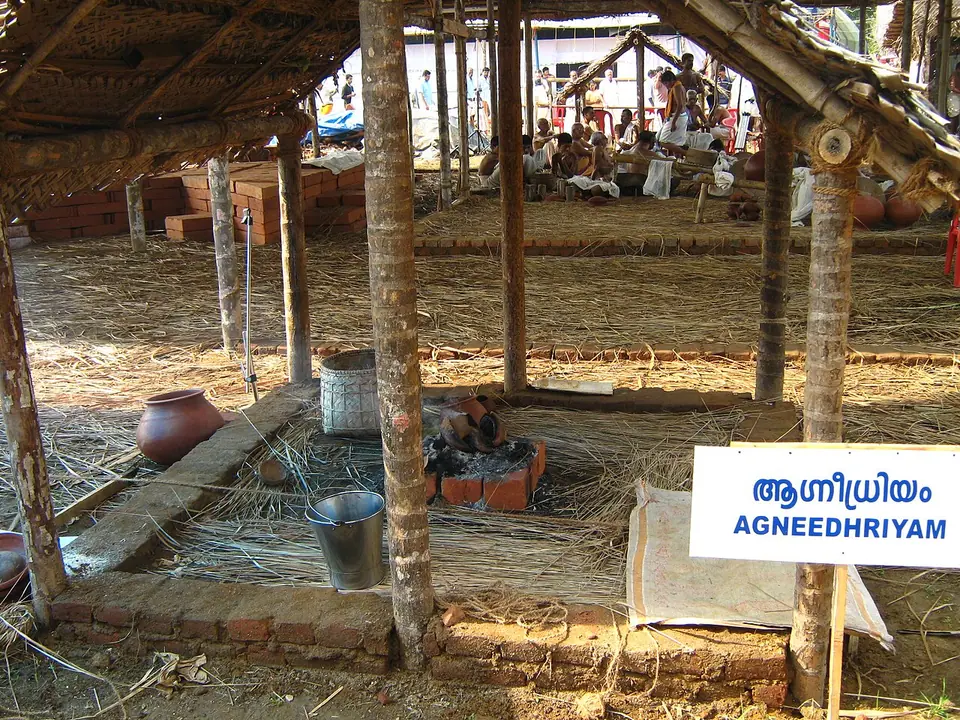
The great śrauta rituals divide the work among several priests, each trained in his own Veda. The Kerala Agnicayana that Frits Staal recorded in 1975 assigned the Ṛg, Sāma and Yajur recitations to separate specialists.[15] Consensus
Schools, recensions and the later layers of “Veda”
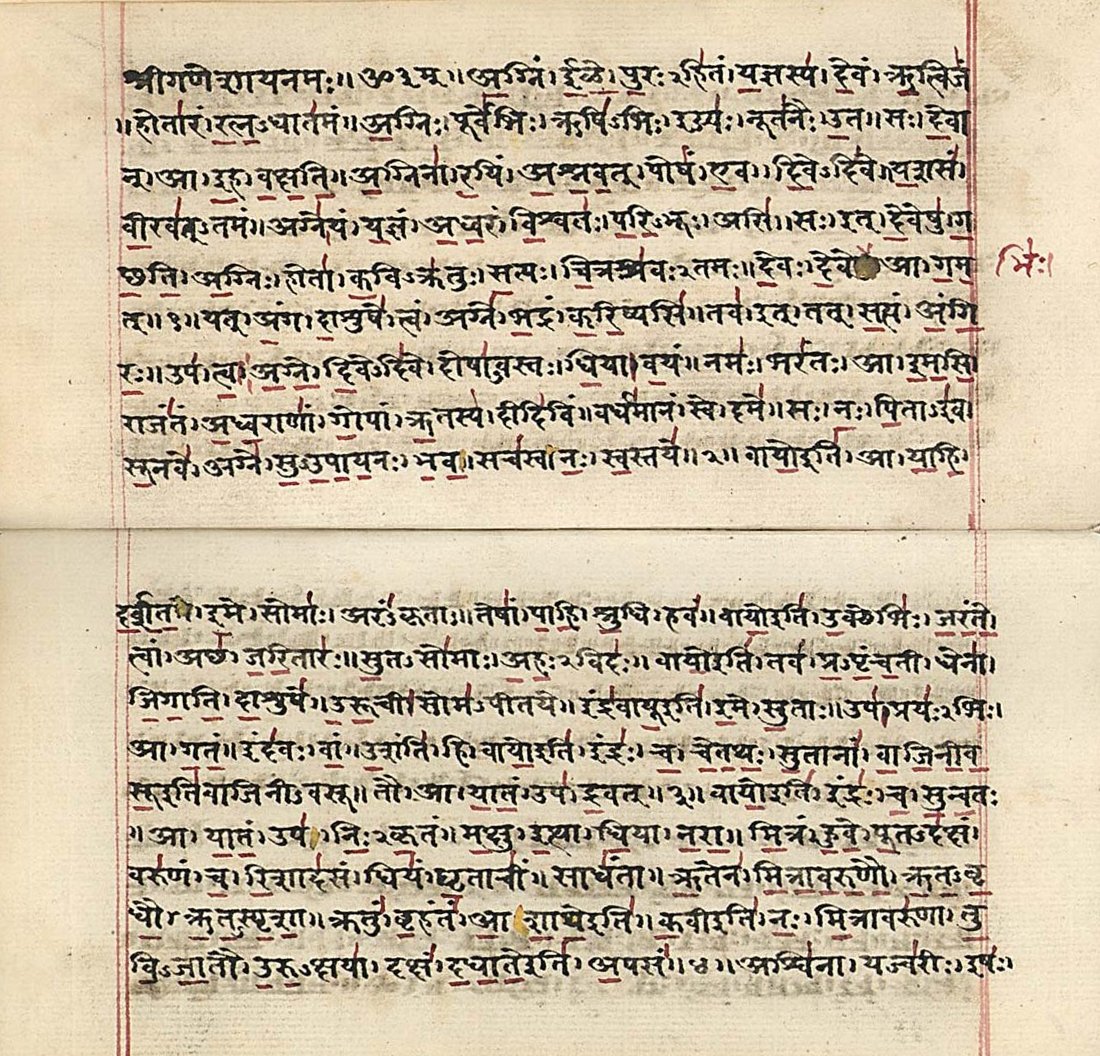
The compiling was done by priestly schools, the śākhās (“branches”). Each school kept its own recension of a Veda’s hymns or formulas and its own prose works, and the schools spread across north India as patrons moved east.[3] Most were lost. The Rigveda survives essentially in one recension, that of the Śākala school.[3] Majority
To each collection, the schools added prose layers over several centuries:
- Brāhmaṇas (c. 1000–800 BCE): manuals explaining why each ritual act works, such as the Aitareya Brāhmaṇa of the Rigveda schools.[16]
- Āraṇyakas, “forest books”: ritual material considered too dangerous to teach in the village.[17]
- Upaniṣads (from c. 700 BCE): dialogues on the self and brahman, attached to the schools as their final part, which is why they are called Vedānta, “the end of the Veda.”[17]
All of this is “Veda” in the traditional sense. A tradition that calls the Upaniṣads Veda is therefore crediting the same unauthored source with texts composed some eight centuries after the oldest hymns. Like the hymns, these prose texts are the work of schools over generations, and their teachers appear inside them as speakers in dialogues.[17]
A short timeline
| Date | What happens | Confidence |
|---|---|---|
| c. 1500–1200 BCE | Family Books composed by six priestly lineages[2][1] | Majority |
| c. 1200–1000 BCE | Books 1 and 10 added by many poets, including hymns ascribed to women[1] | Majority |
| c. 1100 BCE | Rigveda fixed in the Kuru realm; Sāma-, Yajur- and Atharvaveda compiled[2] | Majority |
| c. 1000–800 BCE | Brāhmaṇas composed in the Vedic schools[3] | Majority |
| c. 700–300 BCE | Upaniṣads composed and attached to the schools[17] | Majority |
| c. 400 BCE – 400 CE | The Mahābhārata, which names Vyāsa, grows to its classical length[18] | Majority |
| c. 200 BCE – 500 CE | Jaimini’s sūtras and Śabara’s commentary: the Veda is eternal and authorless[19] | Majority |
What scholars disagree about
The traditional view. In Hindu tradition the Veda is śruti, “what was heard,” and apauruṣeya, “not of human making.” The ṛṣis did not invent the hymns; they saw or heard eternal sound and passed it on.[7] The Pūrva Mīmāṃsā school, founded on Jaimini’s sūtras and Śabara’s commentary, gave the doctrine its sharpest form. No author of the Veda is remembered, it argued, so it has none. A text with no author has no human error. Its injunctions can therefore be known to be true in a way no human report can be.[19] This deserves to be stated fairly. It is not a claim that nobody ever recited the hymns first. It is a claim about where their authority comes from, and it is held with great seriousness. Other schools disagreed from inside the tradition. The Nyāya logicians, for instance, held that the Veda was authoritative because God composed it.[19] A historian can describe the doctrine but cannot test it. Consensus on what the doctrine says
Vyāsa. The name means “arranger.” In the Mahābhārata and the Purāṇas, the sage Vyāsa divides the one original Veda into four and teaches them to four pupils, and he is also credited with the Mahābhārata itself.[18][20] This is tradition, not history. The four collections took shape among Kuru-era priests and in many separate schools over generations, not by one editor’s decision.[2][3] Majority
How historical the seer genealogies are. The family attributions of Books 2–7 are generally trusted, because grammar, style and the kings named in them agree.[2] Individual seer names in the late books, and the lineages linking them, are less secure.[1] Contested
Common misconceptions
- “Vyāsa wrote the Vedas.” Even the tradition says he arranged them. Historically the hymns come from many families over centuries, and the compiling was done by schools.[3]
- “There is one Veda.” There are four Vedic collections, each with prose layers and once with many school versions. “The Vedas” can mean only the four hymn collections or the whole library down to the Upaniṣads.[7]
- “The Vedas were written down by the seers.” They were composed and transmitted orally, and memorized with techniques designed to prevent any change.[15] The details are on the Rigveda dating page.
- “Authorless means the scholars and the tradition flatly contradict each other.” They answer different questions. One asks who first spoke the words. The other asks what makes them binding.
Why it matters
The answer decides what kind of text the Veda is. Read historically, it is a library: the surviving repertoires of rival poet families, reshaped by a royal court around 1100 BCE and by generations of schools after it. That is why the Rigveda can contradict itself about who served King Sudās, why women’s voices appear in its oldest layers, and why the “Veda” grew for eight centuries. Read theologically, it is a single eternal revelation with no author. Each later Hindu movement has had to decide how much weight to give the Veda’s authority. For the poets, the families and the hymns themselves, see Chapter 3: The Oral Rigveda.
References
- ^ a b c d e f g h i j k l Stephanie W. Jamison & Joel P. Brereton, trans. The Rigveda: The Earliest Religious Poetry of India. Oxford University Press, 3 vols., 2014. The standard complete English translation. Supersedes Griffith entirely.
- ^ a b c d e f g h Michael Witzel "Early Sanskritization: Origins and Development of the Kuru State". Electronic Journal of Vedic Studies 1(4); repr. in B. Kölver, ed., Recht, Staat und Verwaltung im klassischen Indien (Oldenbourg, 1997): 27–52, 1995. doi The Kuru state thesis — canonization as a political project.
- ^ a b c d e f Michael Witzel "The Development of the Vedic Canon and its Schools: The Social and Political Milieu". in Witzel, ed., Inside the Texts, Beyond the Texts (Harvard Oriental Series, Opera Minora 2), 1997. How the four Vedas and their recensions (śākhās) were collected, and by whom.
- ^ RV 3.33 — Rigveda. c. 1400 BCE. Vedic Sanskrit. Viśvāmitra negotiates with the Vipāś and Śutudrī so the Bharata host can ford them — here he is **Sudās's own priest**, before Vasiṣṭha displaced him. Two family books, two incompatible accounts of who served whom. read the text
- ^ RV 7.18 — Rigveda. c. 1400 BCE. Vedic Sanskrit. The Battle of the Ten Kings. Sudās of the Bharatas defeats a confederation at the Paruṣṇī — the most historical-looking event in the Rigveda, told by the winners' priest. read the text
- ^ RV 1.164.46 — Rigveda. c. 1100 BCE. Vedic Sanskrit. ekaṃ sad viprā bahudhā vadanti — "the One that is, the seers call by many names." Ancestor of every later Hindu claim that the gods are one. read the text
- ^ a b c d Gavin Flood An Introduction to Hinduism. Cambridge University Press, 1996. open library The standard university textbook, and the most balanced single overview.
- ^ RV 10.125 — Rigveda (Devīsūkta). c. 1100 BCE. Vedic Sanskrit. Vāc declares herself supreme over Varuṇa, Mitra, Indra and Agni — a feminine principle asserting supremacy, in Maṇḍala 10. The concept of a Great Goddess exists here; the cult does not. read the text
- ^ RV 1.179 — Rigveda. c. 1300 BCE. Vedic Sanskrit. Lopāmudrā demands sex from her ascetic husband Agastya, and wins the argument. Griffith exiled it to an appendix with lines left in Latin. read the text
- ^ RV 8.91 — Rigveda. c. 1200 BCE. Vedic Sanskrit. Apālā finds soma and presses it with her teeth — a woman performing a pressing outside the priestly apparatus. (Griffith numbers this 8.80.) read the text
- ^ RV 10.159 — Rigveda. c. 1100 BCE. Vedic Sanskrit. "I am the banner and the head" — a woman's voice claiming dominance over husband and co-wives, inside scripture. read the text
- ^ Stephanie W. Jamison Sacrificed Wife / Sacrificer's Wife: Women, Ritual, and Hospitality in Ancient India. Oxford University Press, 1996. The standard study of women in śrauta ritual.
- ^ Arthur Berriedale Keith, trans. The Veda of the Black Yajus School, entitled Taittirīya Sanhitā. Harvard Oriental Series 18–19, 1914. full text Source for the Śatarudrīya and TS 6.5.8.2.
- ^ AV 11.3.7 — Atharvaveda. c. 1000 BCE. Vedic Sanskrit. śyāmam ayo 'sya māṃsāni lohitam asya lohitam — "dark metal its flesh, red its blood": the metal vocabulary splits, dark metal (iron) set against red, dating the text after the Rigveda. read the text
- ^ a b Frits Staal Agni: The Vedic Ritual of the Fire Altar. Asian Humanities Press, 2 vols., 1983. open library Documentation of the 1975 Agnicayana in Kerala — plausibly the oldest continuously performed ritual on earth.
- ^ Arthur Berriedale Keith, trans. Rigveda Brahmanas: The Aitareya and Kauṣītaki Brāhmaṇas. Harvard Oriental Series 25, 1920. full text Where the Aitareya passages on varṇa are read from.
- ^ a b c d Patrick Olivelle, trans. The Early Upaniṣads: Annotated Text and Translation. Oxford University Press, 1998. full text The scholarly standard. Its introduction is the best short account of the period.
- ^ a b V. S. Sukthankar et al., eds. The Mahābhārata: Critical Edition. Bhandarkar Oriental Research Institute, Pune, 1966. full text Pune critical edition (1919–1966): 1,259 manuscripts examined, 734 actually used; passages found only in some manuscripts relegated to footnotes and appendices.
- ^ a b c Wilhelm Halbfass Tradition and Reflection: Explorations in Indian Thought. SUNY Press, 1991. full text On Śaṅkara and his Mīmāṃsā opponents.
- ^ Ludo Rocher The Purāṇas. Harrassowitz, 1986. open library The standard survey, and the clearest statement of why Purāṇas resist dating.