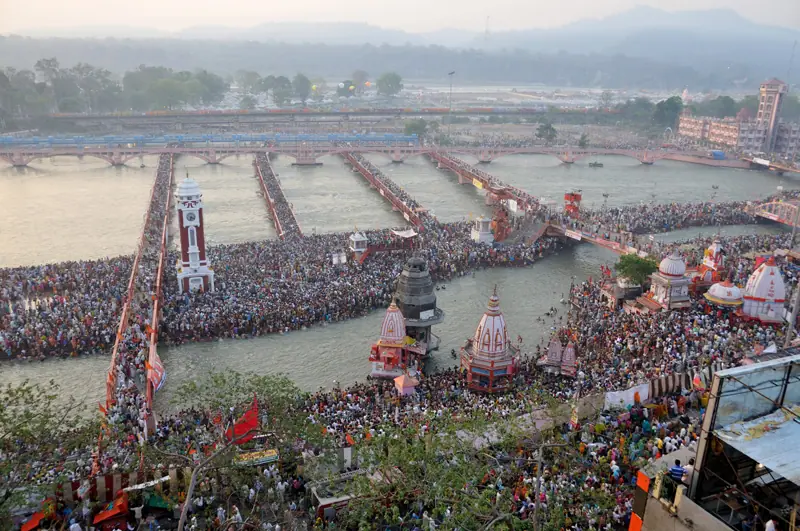
Yoga is old, but not in the way it is usually advertised. What the word has meant has changed several times, and each meaning has its own date. As a meditative discipline, yoga is first described around 500–300 BCE, in the verse Upaniṣads.[1] As a philosophical system, it gets its classic text in Patañjali’s Yogasūtra, c. 100 BCE–400 CE.[2] As a practice built around many bodily postures, it is medieval.[3] The flowing, posture-centred yoga taught in studios worldwide took shape in the early twentieth century (§12).[4] The familiar claim of a 5,000-year-old yogi rests on a single Indus seal whose reading is disputed.[5][6]
The evidence, layer by layer
The Indus seal, c. 2500 BCE
Seal M-304 from Mohenjo-daro shows a figure with a tall horned headdress, seated on a low platform with heels together and knees splayed outward, surrounded by an elephant, a tiger, a rhinoceros and a buffalo.[5] John Marshall, in 1931, called it a prototype of Śiva as Lord of Beasts and read the pose as yogic.[7]
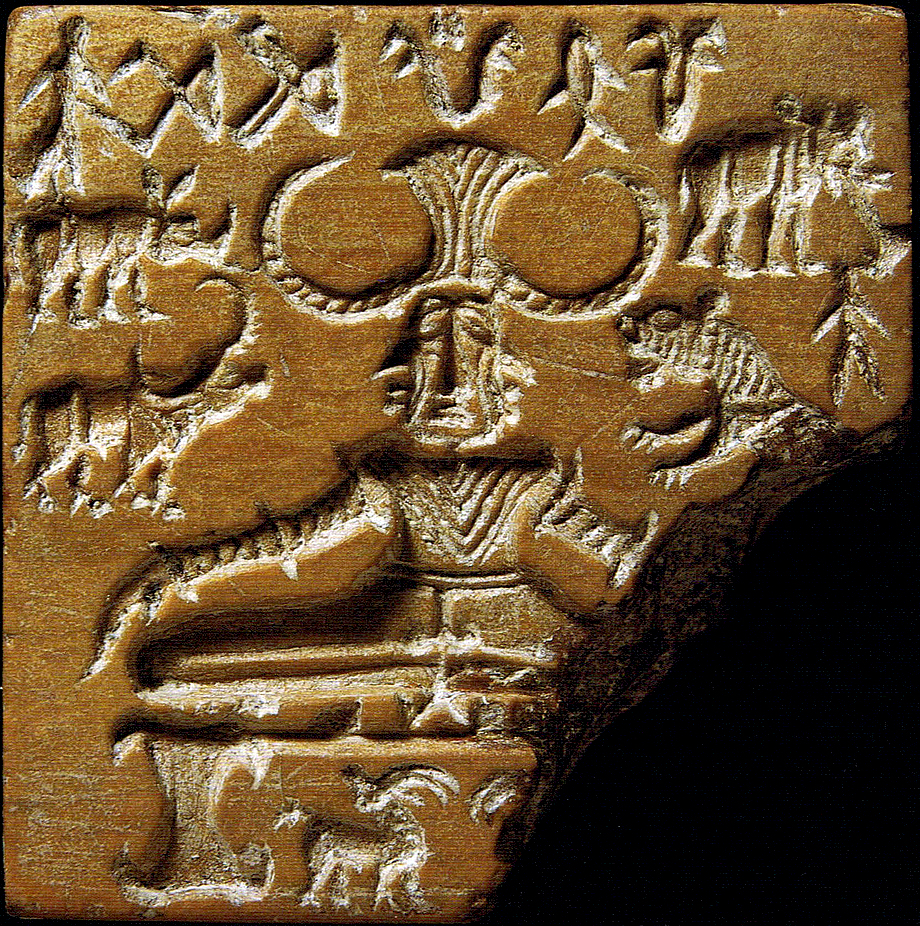
What it proves, and what it does not. It proves that a seated, horned figure was religiously important in a Harappan city. It does not prove yoga. The posture is not securely yogic, and comparable seated postures occur in Elamite art. Doris Srinivasan has argued that the headdress is bovine and that the “three faces” are not clearly faces.[6][8] The Indus script is undeciphered, so nothing on the seal tells us what the pose meant (§2).[9] Contested
The Rigveda: “yoga” means yoking
In the Rigveda, yoga is the harnessing of a chariot, and there is no meditative system in the text (§3).[10] There is, however, one striking figure. RV 10.136, the Keśin hymn, describes a long-haired ecstatic “girdled with wind,” who flies and drinks from a cup with Rudra. It does not prove Marshall right, but it shows that the ascetic figure is not purely a later import.[11] Contested
The forest texts and the Upanishads
From about 900–700 BCE the Āraṇyakas, the “forest texts,” began to turn external ritual into inner meditation.[1] The verse Upaniṣads (c. 500–300 BCE) take the next step. The Kaṭha and Śvetāśvatara describe breath control and posture as a discipline for reaching the self. This is the first recognisable description of yoga as a practice, though Patañjali’s eight-limbed system is still centuries away (§5).[1] Majority
The same centuries saw the rise of the renouncer movements, which made disciplined practice of the body and mind central to liberation (§6).[12][13]
The Gita: yoga as a way of acting
In the Bhagavad Gītā (c. 200 BCE–200 CE), yoga broadens to mean disciplined action, disciplined knowledge, and disciplined devotion. Its most quoted instruction is to act without attachment to the fruits of action.[14][15] This is yoga as an ethic for ordinary life, not a routine of exercises.
Patanjali’s Yoga Sutra
The Yogasūtra of Patañjali, variously dated c. 100 BCE–400 CE, has 195 short aphorisms on stilling the fluctuations of the mind. It lays out the eight-limbed path that most people think of as “classical yoga.”[2] Posture (āsana) gets three sūtras (2.46–48), and what they require is a seat that is steady and comfortable for meditation.[2][16] By the Gupta period, Yoga was one of the six recognised schools of Brahmanical philosophy (§8).[2]
Hatha yoga: the body takes centre stage
Tantra, documented from the 5th–6th century CE, made the body itself the site of religious practice (§8).[17][18] Haṭha yoga grows from that world. Late medieval yoga texts multiply the postures: Jason Birch has traced the proliferation of āsanas in these sources.[3] One manual, the Haṭhābhyāsapaddhati (c. 18th century), describes some 112 postures, including dynamic, jumping and rope-assisted sequences.[3][16]
Modern postural yoga
The yoga most people now practise descends mainly from T. Krishnamacharya (1888–1989), who taught at the Mysore palace. His students, B. K. S. Iyengar, K. Pattabhi Jois, Indra Devi and his son T. K. V. Desikachar, carried it around the world.[4] Vivekananda’s teaching from the 1890s had already presented yoga to Western audiences as a universal spiritual science (§11).[19] The UN’s International Day of Yoga began in 2015. Today yoga is practised by millions of people, most of whom do not consider themselves Hindu.[20]
A short timeline
| Date | What happens | Confidence |
|---|---|---|
| c. 2500 BCE | Indus seal M-304: a seated horned figure; the “yogi” reading is disputed[5] | Contested |
| c. 1500–1200 BCE | Rigveda: yoga means yoking; the Keśin hymn is late (Maṇḍala 10)[11] | Majority |
| c. 900–700 BCE | Āraṇyakas internalise ritual as meditation[1] | Majority |
| c. 500–300 BCE | Kaṭha and Śvetāśvatara Upaniṣads: breath control and posture[1] | Majority |
| c. 200 BCE – 200 CE | Bhagavad Gītā: yoga of action, knowledge, devotion[15] | Majority |
| c. 100 BCE – 400 CE | Patañjali’s Yogasūtra; three sūtras on posture[2] | Majority |
| c. 450–550 CE | Earliest surviving Śaiva Tantra; the body as a site of practice[17] | Majority |
| late medieval | Haṭha texts; postures multiply[3] | Majority |
| c. 18th c. | Haṭhābhyāsapaddhati: some 112 postures[3] | Majority |
| early 20th c. | Krishnamacharya at Mysore; the modern postural lineage[4] | Consensus |
| 2015 | First UN International Day of Yoga | Consensus |
What scholars disagree about
Is the Indus seal a yogi? Supporters of the reading, including many who argue for continuity between the Indus civilisation and later Hinduism, see a meditating figure that anticipates Śiva as the great yogi. The resemblance is real. Critics point out that it is a resemblance to a form of Śiva attested only 1,500–2,000 years later, and that Rudra in the Rigveda is not a yogi at all (§2).[6][7] Contested
Vedic or renouncer origins? One account traces meditation to the Vedic tradition itself, through the Āraṇyakas’ internalised ritual.[1] Another, associated with Johannes Bronkhorst and more cautiously Geoffrey Samuel, places the roots of yoga in an eastern ascetic culture outside the Vedic mainstream, shared by the Buddhists and Jains.[21][22] Witzel disputes Bronkhorst’s chronology.[23] Contested
Is modern yoga ancient? Mark Singleton’s Yoga Body (2010) argued that the dynamic sequences of
modern practice took shape in the early twentieth century, drawing on European gymnastics and Indian
wrestling traditions.[4] James Mallinson objected that premodern posture practice
was richer than that implied. The two then wrote Roots of Yoga (2017) together from more than a
hundred premodern sources.[16] The current position is that Singleton’s account of
the modern lineage stands, and the premodern record is fuller than first thought. [Was contested; substantially settled by the disputants' joint work]
The traditional view. Many practitioners and teachers regard yoga as older than any text. On this view the Upaniṣads and Patañjali recorded a practice rather than inventing it, and the Indus seal fits that belief. It is a coherent position, and practice certainly existed before it was written down. Historians can date only the evidence, and the evidence for yoga as a named discipline begins with the Upaniṣads.[1]
Common misconceptions
- “Yoga is 5,000 years old.” That number depends entirely on the contested Indus seal. The earliest secure textual description is about 2,300–2,500 years old.[5][1]
- “The Yoga Sutra is a manual of postures.” It is about stilling the mind. Posture is three sūtras out of 195.[2]
- “Modern yoga is a Western invention.” Its founding teachers were Indian, and the premodern Indian posture tradition was substantial. What is new is the dynamic, fitness-oriented synthesis.[4][3]
Why it matters
The global practice is connected to its history in name and lineage, and quite distant from it in content (§12).[16] That gap drives the current argument over whether global yoga is appropriation, evolution or a successful export. The “Take Back Yoga” campaign argues that yoga has been stripped of its Hindu context. Others reply that Hindu teachers exported it deliberately, and that the modern form is itself a twentieth-century hybrid.[20] Political Knowing which yoga is which does not settle that argument, but it helps.
For the full story of modern yoga, see §12. For its Upaniṣadic roots, see §5.
References
- ^ a b c d e f g h Patrick Olivelle, trans. The Early Upaniṣads: Annotated Text and Translation. Oxford University Press, 1998. full text The scholarly standard. Its introduction is the best short account of the period.
- ^ a b c d e f Yogasūtra — Patañjali. c. 100 BCE – 400 CE. Sanskrit. 195 sūtras on stilling the fluctuations of the mind. Posture gets three of them (2.46–48). about
- ^ a b c d e f Jason Birch "The Proliferation of Āsana-s in Late Medieval Yoga Texts". in Yoga in Transformation, Vienna University Press, 2018. doi Open access. The evidence for premodern athletic āsana that revises Yoga Body's implied thinness.
- ^ a b c d e Mark Singleton Yoga Body: The Origins of Modern Posture Practice. Oxford University Press, 2010. full text The hybrid-origins thesis for modern postural yoga.
- ^ a b c d Seal M-304 — Mohenjo-daro. c. 2500 BCE. undeciphered. The "Paśupati" seal. A horned figure among wild animals — proto-Śiva, a bovine deity, or a Near Eastern Master of Animals. Undecided. about
- ^ a b c Doris Srinivasan "The So-Called Proto-Śiva Seal from Mohenjo-Daro: An Iconological Assessment". Archives of Asian Art 29, 1975. The critique that dismantled the confident Paśupati reading.
- ^ a b John Marshall Mohenjo-daro and the Indus Civilization. Arthur Probsthain, 3 vols., 1931. full text The excavation report that named the "Paśupati" seal, the "Priest-King" and the "Mother Goddess" — labels the field has been arguing with ever since.
- ^ Doris Srinivasan Many Heads, Arms and Eyes: Origin, Meaning and Form of Multiplicity in Indian Art. Brill, 1997. On how Hindu iconography emerged.
- ^ Asko Parpola The Roots of Hinduism: The Early Aryans and the Indus Civilization. Oxford University Press, 2015. full text The fullest statement of the Dravidian-Indus case. Argued, not established.
- ^ Stephanie W. Jamison & Joel P. Brereton, trans. The Rigveda: The Earliest Religious Poetry of India. Oxford University Press, 3 vols., 2014. The standard complete English translation. Supersedes Griffith entirely.
- ^ a b RV 10.136 — Rigveda (Keśin hymn). c. 1100 BCE. Vedic Sanskrit. A long-haired ecstatic who flies and drinks from a cup with Rudra — the strongest Vedic-side evidence bearing on the Paśupati-seal debate, and a complication for "asceticism is absent from the Rigveda." read the text
- ^ Paul Dundas The Jains. Routledge, 2nd ed., 2002. open library The standard survey.
- ^ Richard Gombrich What the Buddha Thought. Equinox, 2009.
- ^ BhG 2.47 — Bhagavad Gītā. c. 200 BCE – 200 CE. Sanskrit. Action without attachment to fruits — the answer to renunciation that rescues ordinary life. read the text
- ^ a b Angelika Malinar The Bhagavadgītā: Doctrines and Contexts. Cambridge University Press, 2007.
- ^ a b c d James Mallinson & Mark Singleton Roots of Yoga. Penguin, 2017. The premodern textual record, and the necessary counterweight to Yoga Body.
- ^ a b Niśvāsatattvasaṃhitā — Śaiva Tantra. c. 450–550 CE. Sanskrit. The oldest surviving Tantra. Before it Tantra is inferred; from here it is documented.
- ^ Alexis Sanderson "The Śaiva Age: The Rise and Dominance of Śaivism during the Early Medieval Period". in Genesis and Development of Tantrism, 2009. full text The argument that Śaivism, not Vedānta, was the dominant religious force of the age.
- ^ Elizabeth De Michelis A History of Modern Yoga: Patañjali and Western Esotericism. Continuum, 2004. full text The Vivekananda-to-modern-yoga line.
- ^ a b Andrea R. Jain Selling Yoga: From Counterculture to Pop Culture. Oxford University Press, 2015.
- ^ Johannes Bronkhorst Greater Magadha: Studies in the Culture of Early India. Brill, 2007. full text The strongest case for an eastern, non-Vedic origin for karma and rebirth. Influential and contested.
- ^ Geoffrey Samuel The Origins of Yoga and Tantra: Indic Religions to the Thirteenth Century. Cambridge University Press, 2008. A partial ally of the Greater Magadha thesis, explicitly softer than Bronkhorst's binary.
- ^ Michael Witzel "Moving Targets? Texts, Language, Archaeology and History in the Late Vedic and Early Buddhist Periods". Indo-Iranian Journal 52, 2009. doi The central chronological rebuttal to Bronkhorst.