The short version: Hindus cremate because the funeral is understood as a sacrifice, the last one a person takes part in, with their own body as the offering. Fire, Agni, is the god who carries every offering to its destination, and in the funeral he carries the dead to the ancestors.[1][2] Burning also releases the self from a body it no longer needs.[1] But cremation was not always the South Asian norm. The region’s earliest farmers buried their dead, so did the Indus cities, and the Rigveda itself knows both burial and cremation.[3][4][5] Cremation became the standard through the later Vedic ritual tradition, and even today some Hindus are buried rather than burned.
What cremation means in Hindu tradition
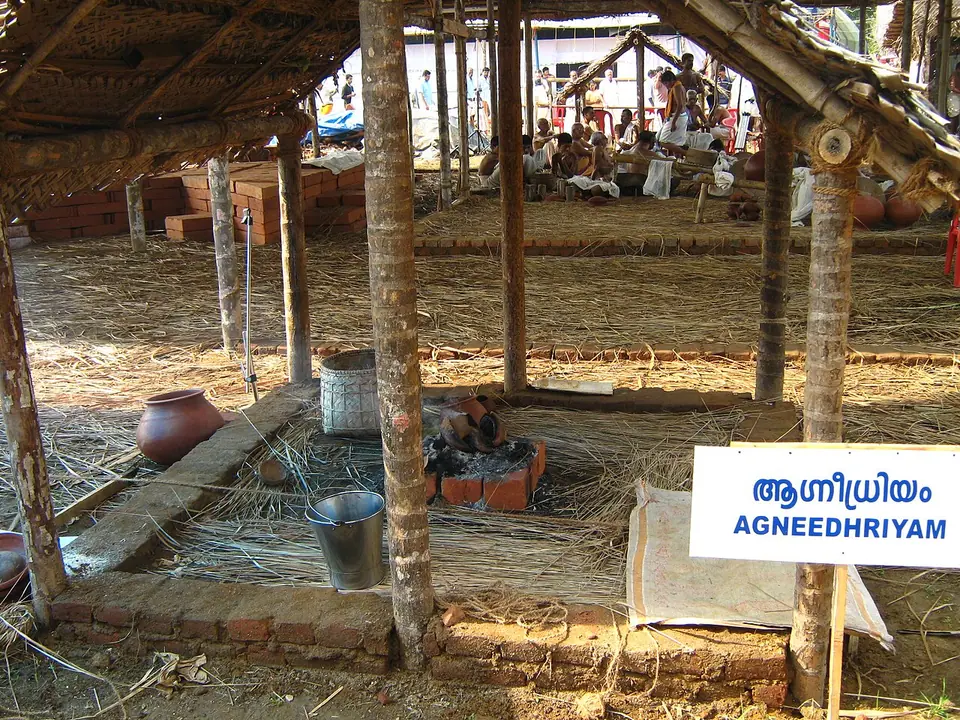
The Sanskrit name for the funeral, antyeṣṭi, means “last sacrifice” or “final offering.” It is the last of the life-cycle rites (saṃskāras) that mark a Hindu life from before birth onward.[6] The logic is the logic of the Vedic fire ritual. In a sacrifice, something is placed in the fire, and Agni transforms it and conveys it to the gods. In the funeral, the dead person is the offering, and the destination is the world of the Fathers (pitṛs), the ancestors.[1]
Jonathan Parry’s study of Banaras, the city where many Hindus most hope to be cremated, shows that this is not only a textbook idea. The people who perform cremations there describe the rite as a sacrifice, and the chief mourner, usually the eldest son, acts as its sacrificer.[1] After cremation the ashes and remaining bones are given to the river, ideally the Gaṅgā, and a sequence of further rites over the following days is meant to give the dead person a new body among the ancestors.[1]
Burial came first: South Asia before the Vedas
The oldest evidence for how people in South Asia treated their dead is burial. At Mehrgarh, below the Bolan Pass, the early farming village buried its dead laid on their sides, with beads and sometimes with the bodies of young goats.[3] The absolute dates of that village are now disputed, but the burials themselves are not (§1).[7] At Burzahom in Kashmir, c. 3000–1500 BCE, dogs were buried with humans.[3]
The cities of the Indus civilization, c. 2600–1900 BCE, also buried their dead. Their cemeteries hold bodies laid out full length, with pottery and personal ornaments.[4] A later cemetery at Harappa, Cemetery H, gives its name to one of the Late Harappan cultures of c. 1900–1300 BCE, when the cities were breaking up into village life (§2).[3]
What it proves. Grave goods imply some belief about the dead, and nothing more specific can be honestly claimed. What the evidence does show is that burial, not cremation, was the long-standing South Asian practice before the Vedic texts.[3][4] Consensus
The Rigveda knows both
The Rigveda, Hinduism’s oldest text, contains a small group of funeral hymns in its latest book, Maṇḍala 10. Taken together, they show a society that both burned and buried its dead.
The hymn to the Fathers says so outright. It invokes the ancestors “burned by fire and not burned by fire,” treating both as legitimate members of the world of the dead.[5]
The next hymn, RV 10.16, is the cremation hymn. It speaks to the fire on the pyre and asks Agni, in paraphrase, not to burn the dead man up or destroy him, but to “cook” him, to make him ready, and then send him on to the Fathers.[2][8] The image is sacrificial: the body is prepared in the fire the way an offering is, and the fire delivers it. The same hymn sends the dead man’s eye to the sun and his breath to the wind, returning each part of the person to its place in the cosmos.[2]
Two hymns later come verses that commit the dead to the ground. They tell the dead man, in a literal rendering, to “creep to this mother earth,” and ask the earth to receive and cover him gently.[9] Whether these verses accompanied the burial of a whole body or the burial of bones gathered after cremation is not certain, and the hymn can be read either way.[8] The same funeral hymn is the one later misquoted in support of satī; the Rigvedic text itself raises the widow from beside her husband and returns her to the living (see Chapter 3: The Oral Rigveda).[10]
What it proves. The earliest Hindu scripture does not prescribe one way to treat the dead. It knows cremation and gives it its theology, but it also knows burial and accepts it. Consensus on what the texts say; Contested on how the burial verses were used
How cremation became the norm
Between the Rigveda and the classical period, cremation became the Brahmanical standard. This was the age of the great Vedic ritual system, in which almost every important act was organised around the fire altar and the sacrifice (§4).[11] A funeral understood as the last sacrifice fitted that system exactly, and Hindu tradition has understood it that way ever since.[6][1]
The early Upaniṣads, c. 700 BCE, take the pyre as the starting point of their teaching on what happens after death. In the Chāndogya, a king teaches two brahmins about two paths. Those who know the secret teaching pass from the cremation fire into its flame and go by the path of the gods, from which there is no return. Those who have only performed rites and good works pass into its smoke and go by the path of the Fathers, to the moon, and come back to be born again (§5).[12][13] A related passage in the Bṛhadāraṇyaka asks what is left of a person once speech has gone into fire, breath into wind and the eye into the sun, echoing the cremation hymn, and answers with karma.[14]
What it shows. By this time cremation was not just a funeral custom. It was built into the first Indian theory of rebirth, which is one reason it became so firmly attached to Hindu identity. Majority
Who is still buried, and why
Cremation is the norm for Hindus today, but not for everyone. The exceptions follow from the same logic that makes cremation meaningful.
- Small children. The Manusmṛti, c. 200 BCE – 300 CE, directs that a child who dies very young be buried rather than cremated.[15] In Banaras, Parry found small children buried or given to the river instead of being burned.[1] A young child has not yet undergone the rites that would make him or her a full participant in the sacrificial order.
- Renouncers. Ascetics and saṃnyāsins are usually buried, often seated, or given to the river.[1] The usual explanation is that a renouncer has already given up the sacrificial fires, and in a sense performed his own funeral, when he renounced. He has no need of the last sacrifice, and his body is not offered into it.[1] This is why the tombs (samādhis) of many Hindu saints are places of pilgrimage.
- Communities with their own traditions. Some Hindu castes and communities in different regions have long buried their dead. Practice in India has never been as uniform as the Brahmanical texts suggest.
A short timeline
| Date | What happens | Confidence |
|---|---|---|
| Mehrgarh Period I (date disputed) | Farming-village burials with beads and goats[3][7] | Consensus |
| c. 3000–1500 BCE | Burzahom, Kashmir: dog-and-human burials[3] | Consensus |
| c. 2600–1900 BCE | Indus cities bury their dead in cemeteries[4] | Consensus |
| c. 1900–1300 BCE | Late Harappan, including the Cemetery H culture[3] | Consensus |
| c. 1100 BCE | Rigveda’s funeral hymns: both the burned and the unburned dead[5][2] | Majority |
| c. 1000–500 BCE | Vedic ritual system; cremation becomes the Brahmanical norm[11] | Majority |
| c. 700 BCE | Chāndogya’s two paths after the pyre[12] | Majority |
| c. 200 BCE – 300 CE | Manusmṛti: infants buried, not cremated[15] | Majority |
| 20th century | Banaras: cremation as sacrifice, with exceptions[1] | Consensus |
What scholars disagree about
When cremation arrived. The texts show cremation in the Rigveda’s latest book, and the archaeology shows burial much earlier. Exactly when and where cremation took hold on the ground is less clear, because cremation leaves far less to dig up than burial. The absence of cremated remains at a site is weaker evidence than the presence of graves. Contested
What the Rigveda’s burial verses mean. Some read RV 10.18 as describing the burial of a body, others as the burial of bones after cremation. Both readings are possible.[9][8] Contested
The traditional view. For many Hindus, cremation is simply what the Vedas command, and has been since the beginning. That view deserves a fair hearing. It is true that the theology of cremation goes back to the Rigveda, that the funeral has been understood as a sacrifice for about three thousand years, and that it is one of the most continuous rites in the tradition.[2][1] The historian’s qualification is that the Rigveda also accepts burial, and that people in South Asia buried their dead for thousands of years before that.[5][3] Majority
Common misconceptions
- “Hindus have always cremated.” South Asia’s earliest farmers and the Indus cities buried their dead, and the Rigveda names both practices.[3][4][5]
- “Hindus never bury their dead.” Small children and renouncers are still often buried, and some communities bury as a matter of course.[1][15]
- “Cremation is about hygiene.” Whatever its practical benefits, the reason given in the texts and by those who perform it is sacrificial: Agni carries the dead to the ancestors.[2][1]
- “The Vedas command widows to burn with their husbands.” The Rigveda’s funeral hymn tells the widow to rise and return to the living; the Vedic case for satī rested on a misquotation (§3).[10][16]
Why it matters
How a society treats its dead is among the most conservative things it does, and in South Asia it changed. The shift from burial to cremation tracks the rise of the Vedic fire ritual, and the cremation fire then became the starting point for the Upaniṣads’ new ideas about rebirth. The practice also became a marker of identity. When Hindus and Muslims both claimed the poet Kabīr after his death, the famous legend frames the dispute as cremation against burial.[17] The exceptions, the buried child and the buried saint, are a reminder that the rite was always about the sacrifice, and that those outside it were treated differently for that reason.
For the Rigveda’s funeral hymns and what they say about widows, see Chapter 3: The Oral Rigveda.
References
- ^ a b c d e f g h i j k l m Jonathan P. Parry Death in Banaras. Cambridge University Press, 1994. open library The ethnography of cremation at Banaras: the rite as sacrifice, and the dead who are buried or given to the river instead.
- ^ a b c d e f RV 10.16 — Rigveda. c. 1100 BCE. Vedic Sanskrit. The cremation hymn: Agni is asked not to consume the dead man but to cook him and carry him to the Fathers. about
- ^ a b c d e f g h i j Robin Coningham & Ruth Young The Archaeology of South Asia: From the Indus to Asoka. Cambridge University Press, 2015. The standard synthesis for §§1–6.
- ^ a b c d e Jonathan Mark Kenoyer Ancient Cities of the Indus Valley Civilization. Oxford University Press, 1998. full text The standard accessible account by an excavator.
- ^ a b c d e RV 10.15.14 — Rigveda. c. 1100 BCE. Vedic Sanskrit. "Those burned by fire and those not burned by fire": the Fathers include both the cremated and the buried, so the Rigveda knows two ways of disposing of the dead. about
- ^ a b Gavin Flood An Introduction to Hinduism. Cambridge University Press, 1996. open library The standard university textbook, and the most balanced single overview.
- ^ a b Benjamin Mutin, Antoine Zazzo, Luca Bondioli, Alfredo Coppa et al. "New radiocarbon dates of human tooth enamel reveal a late appearance of farming life in the Indus Valley". Scientific Reports 15: 11345, 2025. doi Tooth enamel from 23 Neolithic burials: the aceramic cemetery began c. 5200–4900 BCE and lasted two to five centuries, against a conventional start c. 7000–8000 BCE. Single study; not yet absorbed by the field.
- ^ a b c Stephanie W. Jamison & Joel P. Brereton, trans. The Rigveda: The Earliest Religious Poetry of India. Oxford University Press, 3 vols., 2014. The standard complete English translation. Supersedes Griffith entirely.
- ^ a b RV 10.18.10–13 — Rigveda. c. 1100 BCE. Vedic Sanskrit. "Creep to this mother earth": verses that commit the dead, or their bones, to the ground. about
- ^ a b RV 10.18.8 — Rigveda. c. 1200 BCE. Vedic Sanskrit. "Rise, come unto the world of life, O woman" — the widow is raised from the pyre and returned to the living. The definitive verse against satī having any Vedic warrant. read the text
- ^ a b The Śrautasūtras — Āpastamba, Baudhāyana, Kātyāyana and others. c. 600–300 BCE. Sanskrit. The technical manuals that specify the sixteen-priest śrauta system in operational detail — the evidence that the Brāhmaṇas describe a real, if enormously expensive, practice.
- ^ a b CU 5.3–10 — Chāndogya Upaniṣad. c. 700 BCE. Sanskrit. Pañcāgni-vidyā. A kṣatriya king teaches rebirth to two brahmins who cannot answer his questions — the texts crediting the doctrine outside the priesthood. read the text
- ^ Patrick Olivelle, trans. The Early Upaniṣads: Annotated Text and Translation. Oxford University Press, 1998. full text The scholarly standard. Its introduction is the best short account of the period.
- ^ BU 3.2.13 — Bṛhadāraṇyaka Upaniṣad. c. 700 BCE. Sanskrit. The single most important passage on this site: karma is taught in private, away from the assembly — which is how we know the idea was new. read the text
- ^ a b c Patrick Olivelle, trans. Manu's Code of Law: A Critical Edition and Translation. Oxford University Press, 2005. full text The critical edition, plus the standard account of the text's real historical status.
- ^ Stephanie W. Jamison Sacrificed Wife / Sacrificer's Wife: Women, Ritual, and Hospitality in Ancient India. Oxford University Press, 1996. The standard study of women in śrauta ritual.
- ^ David N. Lorenzen "Who Invented Hinduism?". Comparative Studies in Society and History 41, 1999. doi The case that Hindu self-identity predates colonialism by centuries.