Puranic Hinduism in one paragraph
Between c. 300 and 650 CE, in and after the Gupta empire, Hinduism assumes the shape it still largely holds: Purāṇa (Purana) scriptures, stone temples, sectarian communities and a supreme Goddess. The Purāṇas turn theology into narrative — cosmology, genealogy, avatāra stories, pilgrimage geography, and vows any household could perform — creating for the first time a mass religion that needed neither Sanskrit learning nor priestly initiation to participate in.
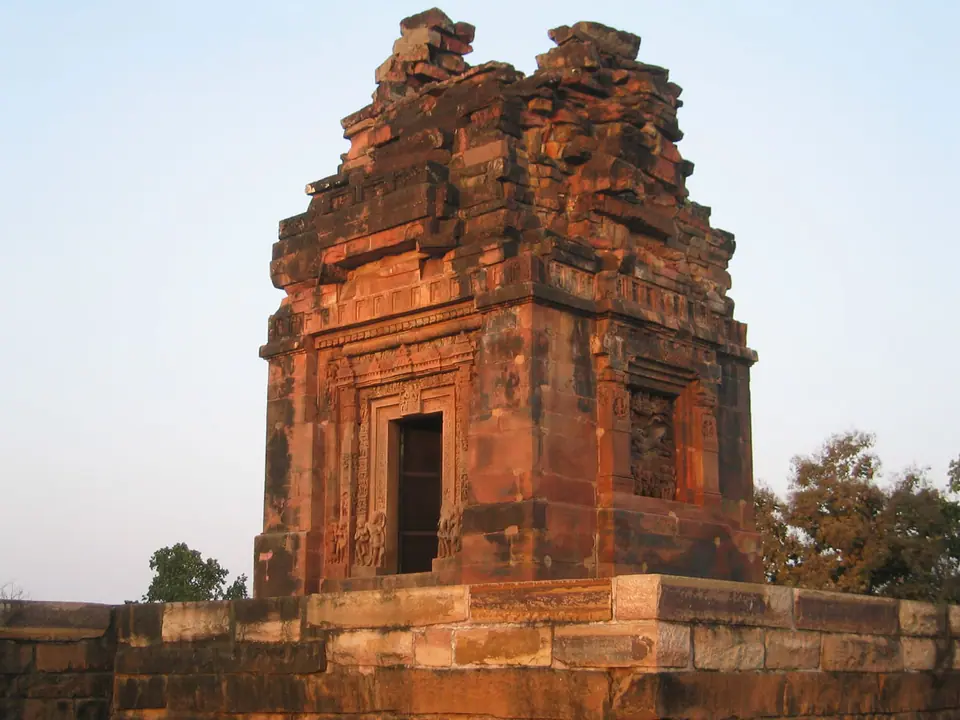
The stone temple appears and never disappears again. Sectarian communities crystallize: you are now a Vaiṣṇava, a Śaiva, or a Śākta. The six darśanas are formalized as philosophical systems. And around 550 CE a text appears that does something with no Vedic precedent whatsoever: the Devī Māhātmya (Devi Mahatmya) declares a goddess to be the supreme reality, the source of the male gods’ power, and the slayer of the demon they could not kill.
Almost everything a visitor to a Hindu temple sees today — the image in the shrine, the circumambulation, the pūjā, the iconography, the festival calendar, the pilgrimage — is in place by the end of this period.
Timeline of the Gupta and Puranic age
The Puranic age runs from the start of the Gupta era, c. 320 CE, through the first stone temples, the earliest Śaiva Tantra and the Devī Māhātmya to Harṣa’s reign, 606–647 CE.
| Date | Event | Confidence |
|---|---|---|
| c. 320 CE | Gupta era begins; Candragupta I | Consensus |
| c. 335–375 CE | Samudragupta; the Allahabad pillar praśasti by Hariṣeṇa[1] | Consensus |
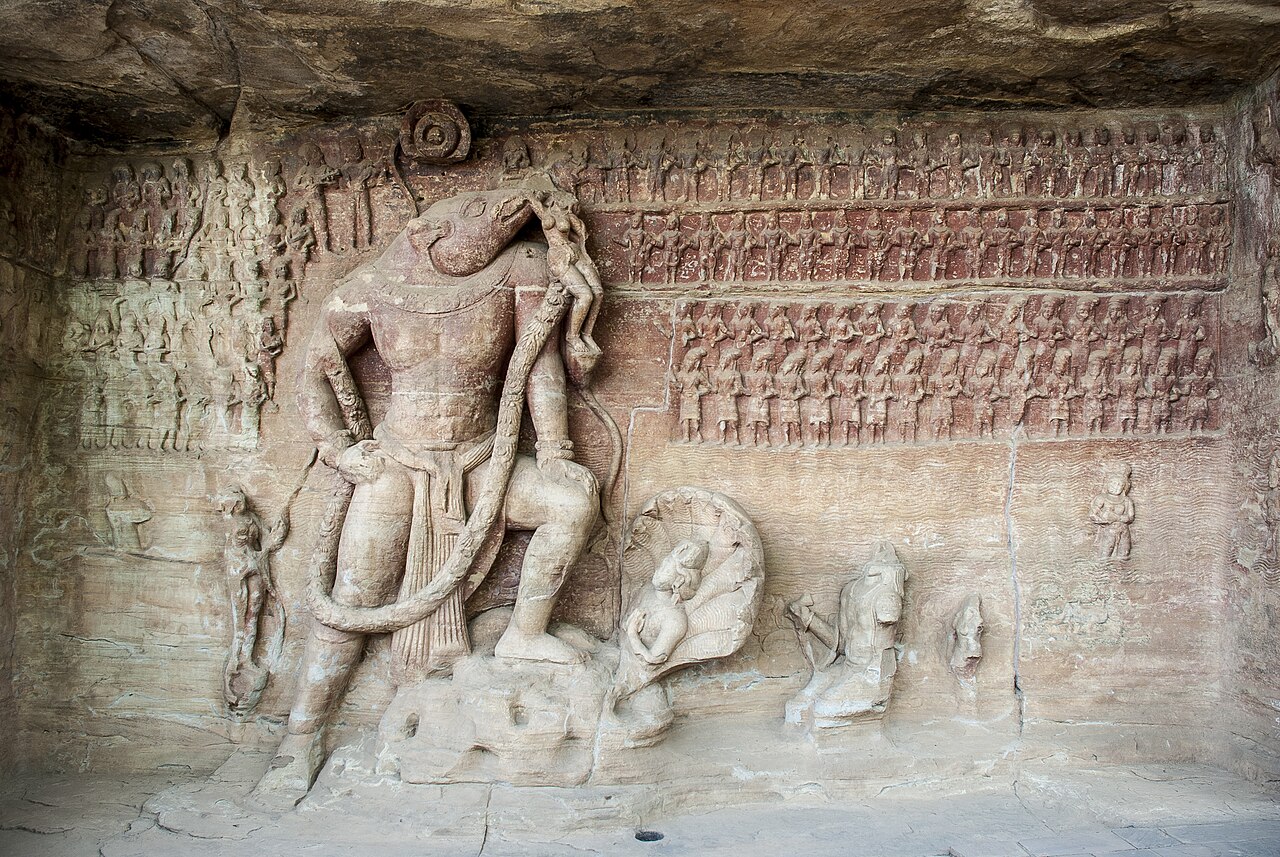
| c. 375–415 CE | Candragupta II Vikramāditya; Udayagiri caves, c. 401 CE[2] | Consensus |
| c. 400 CE | Earliest Sanskrit inscriptions in Southeast Asia — Mūlavarman’s yūpas, Kutai, Borneo[3] | Consensus |
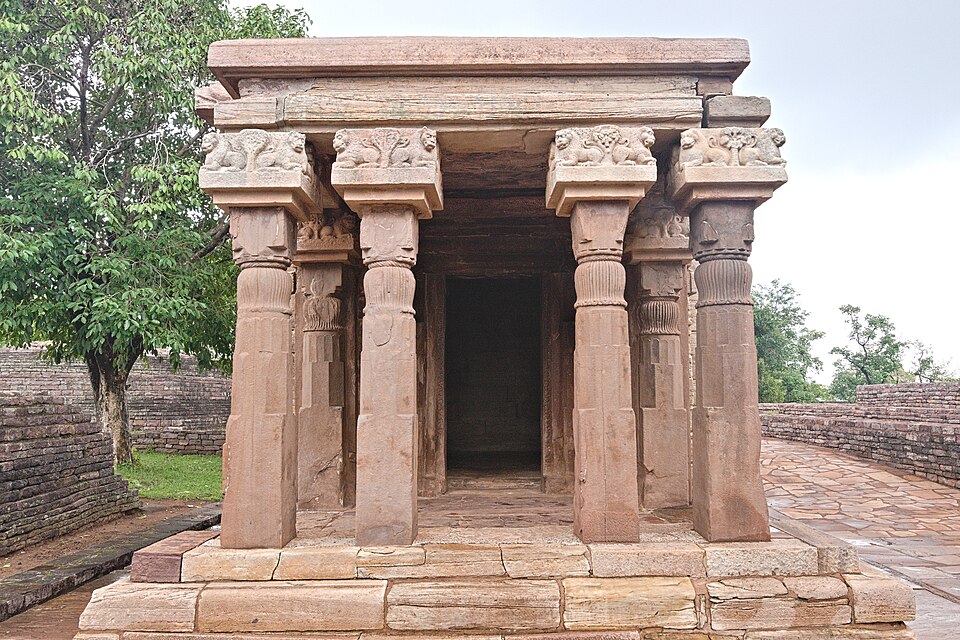
| c. 400 CE | Sanchi Temple 17 — among the earliest surviving structural Hindu temples[4] | Majority |
| c. 400–500 CE | Viṣṇu Purāṇa; the Purāṇic genre consolidates[5] | Majority |
| c. 400–450 CE | Kālidāsa | Majority |
| c. 450–550 CE | Niśvāsatattvasaṃhitā — the earliest surviving Śaiva Tantra[6] | Majority |
| 499 CE | Āryabhaṭa’s Āryabhaṭīya[7] | Consensus |
| c. 500–525 CE | Deogarh Daśāvatāra temple — the Śeṣaśāyī Viṣṇu panel[8][9] | Majority |
| c. 550 CE | Gupta empire disintegrates after the Hūṇa wars | Consensus |
| c. 550–600 CE | Devī Māhātmya, inside the Mārkaṇḍeya Purāṇa[10][11] | Majority |
| 606–647 CE | Harṣa — the last northern imperial unifier for centuries | Consensus |
Where the first Hindu temples were built
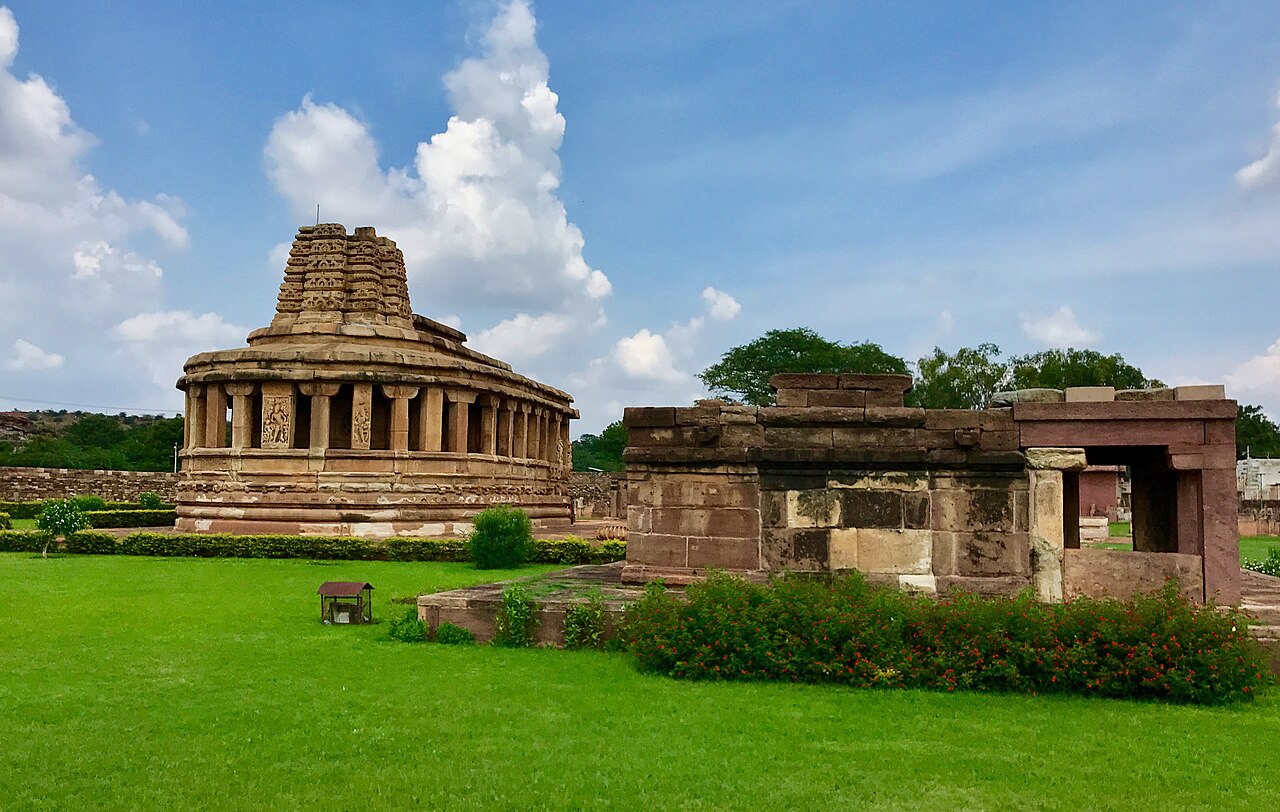
The first Hindu temples were built simultaneously in central India, the Deccan and the far south, where the Nāgara and Drāviḍa architectural grammars began to diverge, while Southeast Asia adopted Sanskrit kingship.
The Gupta heartland is the Ganga plain, but the important development is dispersal. Temple building begins simultaneously in central India (Udayagiri, Sanchi, Deogarh, Bhitargaon), the Deccan (early Chalukyan Aihole and Badami), and the far south (Pallava beginnings at Mahābalipuram, just after this period).
Two architectural grammars start diverging and never reconverge: Nāgara in the north, with a curvilinear śikhara; Drāviḍa in the south, with a stepped pyramidal vimāna. By the end of the period they are recognizably distinct traditions with their own technical literature.[9] Consensus
Southeast Asia enters the story. The Mūlavarman yūpa inscriptions from Kutai in Borneo (c. 400 CE) are in Sanskrit, record a brahmin-officiated donation, and are older than most surviving Indian temple inscriptions. Funan, Champa, and later Angkor and Java build Hindu states on the Purāṇic model. This is not conquest — it is trade, ritual prestige, and Sanskrit as a language of kingship.[3][12] Consensus
The evidence ledger for Puranic Hinduism
In the Puranic age free-standing stone temples appear, pūjā to an enshrined image becomes the normative act, sectarian communities crystallize, and tax-free land grants make brahmin status economically self-sustaining.
| Dimension | What we can say | Evidence | Confidence |
|---|---|---|---|
| Architecture | Free-standing stone temples, then rapid stylistic elaboration | Sanchi 17, Tigawa, Bhitargaon (brick), Deogarh, Udayagiri[4][2][9] | Consensus |
| Worship | Pūjā to an enshrined image is the normative act; yajña is a specialist survival | Temple plans with garbhagṛha; Purāṇic ritual prescription[13] | Consensus |
| Sectarianism | Distinct Vaiṣṇava, Śaiva and Śākta communities with their own scriptures and initiations | Purāṇas partitioned by allegiance; the Mathurā pillar of 380 CE records a Pāśupata guru-lineage ten generations deep with an endowed shrine; early Tantric orders[14][15] | Consensus |
| The Goddess | Devī elevated to supreme reality, absorbing local goddesses under one theology | Devī Māhātmya; Mahiṣāsuramardinī imagery proliferating[10][11] | Majority |
| Royal religion | Kings advertise sectarian allegiance while funding rivals | Gupta parama-bhāgavata titles + Garuḍa coinage + Buddhist endowments | Consensus |
| Economy | Tax-free land grants (agrahāra, brahmadeya) to brahmins and temples | Gupta and Vākāṭaka copper-plate grants in quantity[16] | Consensus |
| Philosophy | Six darśanas formalized as competing systems with base texts and commentaries | Nyāya, Vaiśeṣika, Sāṃkhya, Yoga, Mīmāṃsā, Vedānta sūtras and bhāṣyas | Consensus |
| Science | Decimal place-value, zero, trigonometry, planetary models, a rotating earth | Āryabhaṭīya, 499 CE[7] | Consensus |
| Caste | Land grants make brahmin status economically self-sustaining; jāti proliferates | Copper plates; Purāṇic and Dharmaśāstric elaboration[17] | Majority |
Primary sources
The primary sources of Puranic Hinduism document a goddess made supreme in the Devī Māhātmya, the Purāṇas as machinery of mass religion, the first stone temples, six formal philosophical systems, and the beginnings of Tantra.
1. The Goddess becomes supreme
The Devī Māhātmya (“Glorification of the Goddess”), c. 550–600 CE, 700 verses embedded in the Mārkaṇḍeya Purāṇa.[11] Also called the Durgā Saptaśatī or Caṇḍī, and still recited annually during Navarātri.
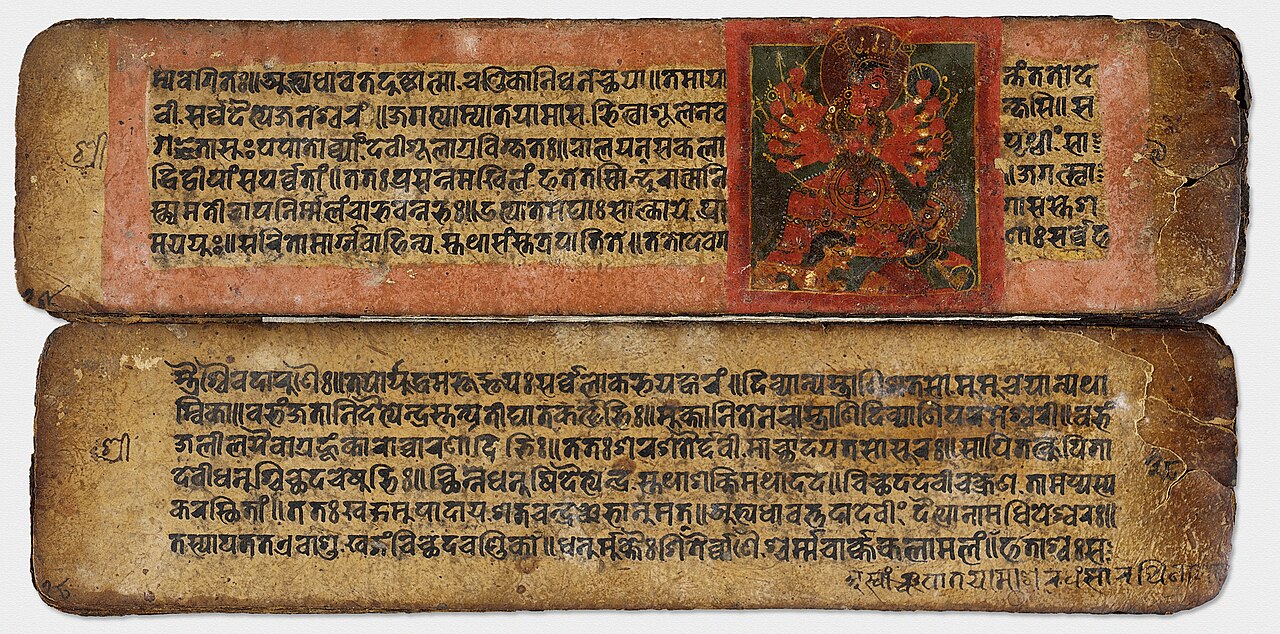
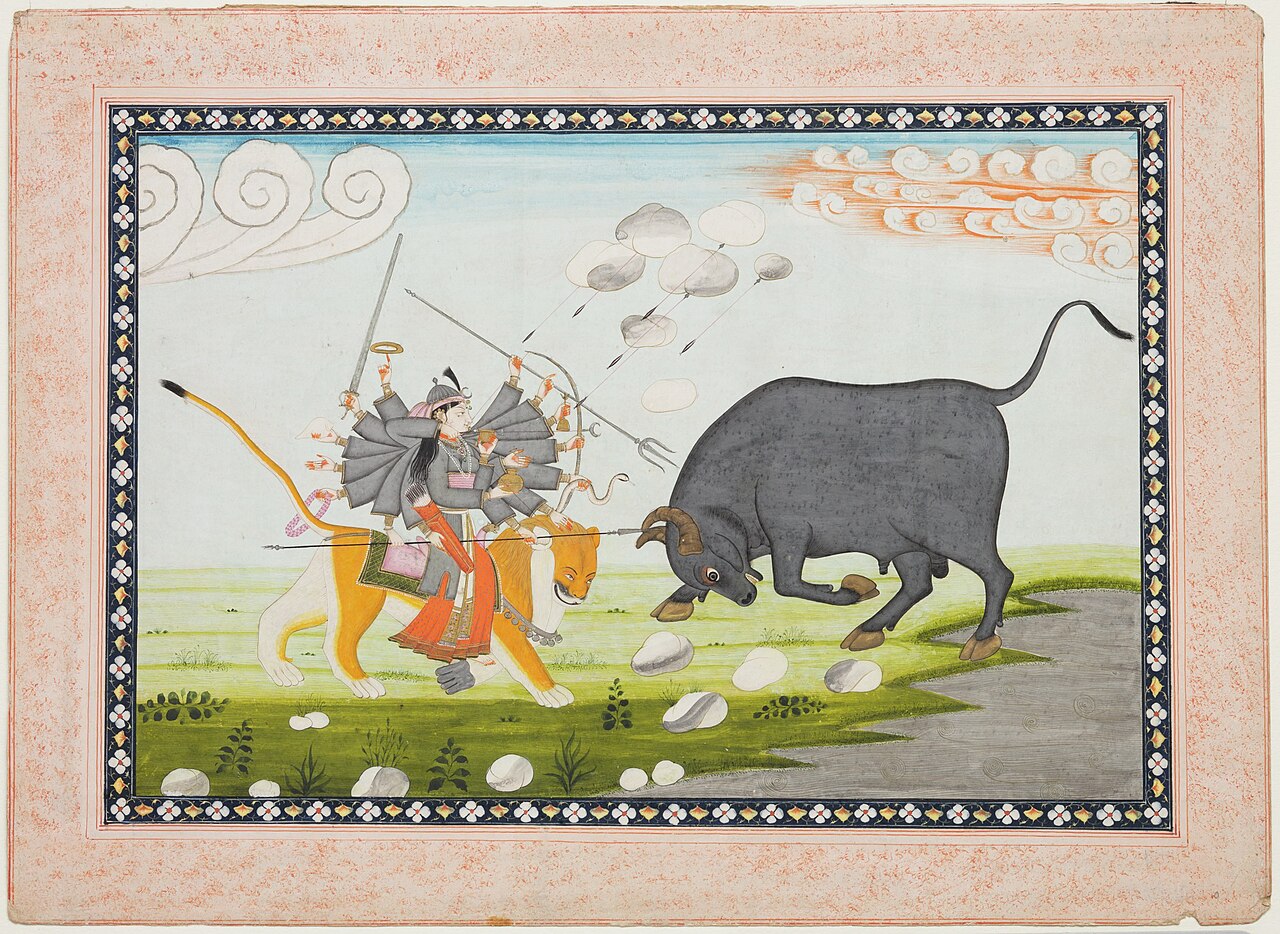
Its structure is three demon-slaying episodes. In the central one, the gods — defeated by the buffalo-demon Mahiṣāsura — pour out their collective energies, which fuse into a woman who then does what none of them could.
The refrain of chapter 5, repeated with dozens of substitutions:
या देवी सर्वभूतेषु शक्तिरूपेण संस्थिता । नमस्तस्यै नमस्तस्यै नमस्तस्यै नमो नमः ॥
yā devī sarvabhūteṣu śakti-rūpeṇa saṃsthitā | namas tasyai namas tasyai namas tasyai namo namaḥ ||
“The Goddess who abides in all beings in the form of power — to her salutation, to her salutation, to her salutation, salutation again and again.”[10]
What it proves. Four things, and together they amount to a revolution:
- A female deity is the supreme reality, not a consort, not a helper. She is prior to and the source of the male gods’ power.[10][18] Consensus that the text claims this
- The gods are dependent on her. The Mahiṣāsura myth is explicitly a story of male divine failure, and the resolution is not male.
- Many goddesses, one Goddess. The text names and absorbs a long list of local and independent goddesses as her forms. This is the theological machinery by which the village goddesses of Section 1 — the strand with no Vedic ancestry at all — are brought inside a unified Sanskrit framework without being abolished.[11] Majority
- The imagery predates the theology. Mahiṣāsuramardinī sculptures exist at Mathurā from the Kuṣāṇa period, four centuries before this text. The Devī Māhātmya is not inventing the Goddess. It is a literate tradition finally writing down, and claiming, something that had been going on for a very long time.[19] Majority
Compare Chapter 3: the Rigveda has goddesses, but no Great Goddess, no Durgā, and no buffalo-demon.[20] The distance between the two is roughly two thousand years and two different religious streams.
2. What a Purāṇa is for
The Purāṇas define themselves by five topics (pañcalakṣaṇa): creation, re-creation after dissolution, divine and royal genealogies, the ages of the Manus, and dynastic history.[5] In practice the surviving texts are far more: pilgrimage guides, vow calendars, temple ritual manuals, gift theory, iconographic prescription, cosmology, and vast quantities of story.
What they prove. The Purāṇas are the machinery of mass religion. Consider what they made available to someone with no Sanskrit and no ritual standing:
| Innovation | Effect |
|---|---|
| Tīrtha — a sacralized map of the subcontinent | Pilgrimage as a religious act available to anyone who can walk |
| Vrata — vows and fasts tied to a calendar | Domestic religion, largely conducted by women, needing no priest |
| Avatāra cycles and myth | Theology transmitted as story, recitable in any language |
| Dāna — merit through giving | A route to religious standing purchasable by merchants |
| Sectarian allegiance | A chosen deity (iṣṭadevatā) rather than an inherited ritual role |
The trade-off is that Purāṇas are almost impossible to date. They were revised for a thousand years, regionally, with material added freely. Any statement of the form “the Purāṇas say X” needs a specific text, a specific recension, and a date. The Bhāgavata Purāṇa, the single most influential of them for later Kṛṣṇa devotion, is c. 900–1000 CE — later than the Tamil Ālvārs whose emotional devotion it reflects, and some four hundred years later than this section.[5][21] Majority
3. The temple appears
Sanchi Temple 17 (c. 400 CE): a flat-roofed square sanctum with a four-pillared porch. Small, plain, and structurally almost the simplest thing that could count as a temple — which is exactly why it matters. It is the beginning of a lineage.[4]
Udayagiri Cave 5 (c. 401 CE): a monumental relief of Varāha, Viṣṇu as the boar, lifting the earth-goddess from the cosmic ocean, with an inscription of Candragupta II’s minister nearby. The sculpture is large, confident, and politically legible — a king’s god rescuing the earth is not a subtle image at the moment of imperial expansion.[2][22] Majority on the political reading
Deogarh Daśāvatāra temple (c. 500–525 CE): the Śeṣaśāyī panel of Viṣṇu asleep on the cosmic serpent between world-ages, with Brahmā emerging on a lotus. By now the iconography is fully standardized — attributes, postures, vehicles, companions — and would be recognizable to any Hindu today.[8]
What it proves. The temple is a machine for a specific theology: a god who is present, in one place, in an image, and available to be seen. Darśana — literally “seeing,” the mutual gaze between devotee and image — becomes the central religious act. Nothing in Chapters 3–5 has any use for such a building. The Vedic altar was built for a rite and dismantled after; the temple is a permanent residence.[13] Consensus
The temple is also an institution. Copper-plate grants show tax-free land assigned in perpetuity to temples and brahmin settlements. That endowment structure is what will make the Chola temples of Chapter 9 into landlords, employers and banks.[22]
4. The six schools of Hindu philosophy (darshanas)
By the end of this period, philosophical debate is organized into six recognized Brahmanical systems, each with a root text and a commentarial tradition, all arguing with each other and with Buddhists and Jains:
| System | Root text | Core concern |
|---|---|---|
| Nyāya | Nyāya Sūtra (c. 200 CE) | Logic, epistemology, valid means of knowledge |
| Vaiśeṣika | Vaiśeṣika Sūtra | Atomism, categories of being |
| Sāṃkhya | Sāṃkhyakārikā (c. 350–450 CE)[23] | Dualism of puruṣa and prakṛti; the three guṇas |
| Yoga | Yogasūtra of Patañjali[24] | Eight-limbed discipline; stilling the mind |
| Pūrva Mīmāṃsā | Jaimini’s Sūtra; Śabara’s commentary | Ritual exegesis; the Veda as eternal and authorless |
| Vedānta | Brahmasūtra of Bādarāyaṇa[25] | Reconciling the Upaniṣads |
What it proves. Two things worth noticing. First, Mīmāṃsā — pure ritual theory — is a live, prestigious system for centuries after ritual has stopped being most people’s religion. The scholastic tradition and popular practice run on different clocks. Second, Vedānta is at this stage just one system among six, and not the dominant one. Its later position as the Hindu philosophy is a result of Śaṅkara (§9) and, much more, of nineteenth-century Neo-Vedānta (§11).[26] Majority
5. Tantra begins
The Niśvāsatattvasaṃhitā (c. 450–550 CE), surviving in an early Nepalese palm-leaf manuscript, is the oldest Śaiva Tantra we have. Before this, Tantra is inferred; from here it is documented.[6]
Tantra introduces a distinct religious logic: initiation (dīkṣā) by a guru rather than birth; mantra, maṇḍala and visualization as technique; the body as the site of practice; and — in its transgressive currents — the deliberate use of what orthodoxy considers impure. It also brings a sharply different attitude to caste, since initiation could in principle override birth.
Two technical cautions follow for specialists. The short version: the famous “first Tantric temple” inscription probably says nothing about Tantra, and the supposed 2nd-century founder of the Pāśupata order is not securely attested until the 10th century.
A caution about the epigraphy. The Gaṅgdhār inscription of 423/424 CE is often cited as “the first Tantric temple,” on Fleet’s reading of tāntr-odbhūta as “arisen from magic rites.” Sullivan, Padoux and Michael Willis all reject it: the word is tāntra, not tantra, and its ordinary sense is stringed instrument — the Mothers’ lyre, not their Tantra. What survives undisputed is ḍākinī-saṃprakīrṇṇam, “filled with ḍākinīs,” applied to a shrine of the Mothers subsidiary to a Viṣṇu temple: the earliest datable epigraphic occurrence of ḍākinī, which is quite enough without the overreach.[27][28][22] Contested
And a caution about Pāśupata origins. Lakulīśa is conventionally dated to the 2nd century CE and called the founder. There is no securely dated early evidence for him: the identification of the figure on the Mathurā pillar of 380 CE is disputed (Diwakar Acharya reads it as Caṇḍa), and the earliest inscription that unambiguously names Lakulīśa is from 971/72 CE, six centuries later.[29] What the 380 CE pillar does prove is better anyway — an institutionalized Śaiva initiatory lineage, counted in named generations, with a permanent endowed shrine housing liṅgas named after dead teachers. Note too that the Pāśupata system was known only through hostile doxographies until the Pāśupatasūtra with Kauṇḍinya’s commentary was first edited in 1940.[30][14][15][31] Contested
What it proves. Tantra is not a marginal curiosity. Over the following centuries it supplies the ritual grammar of mainstream temple worship across sects — the pūjā performed in an ordinary Hindu temple today is largely Tantric in structure, not Vedic. Alexis Sanderson’s work has established Śaivism as arguably the dominant religious force in India from roughly the 6th to the 13th century.[32] Majority
The gods of Puranic Hinduism
In Puranic Hinduism Viṣṇu, Śiva and Devī are each supreme for their own devotees, while Indra, Agni and Varuṇa are reduced to guardians of the compass directions.
| Deity | Status | Note |
|---|---|---|
| Viṣṇu | Supreme for Vaiṣṇavas; the Gupta dynastic god | Avatāra list consolidating toward the standard ten |
| Śiva | Supreme for Śaivas; the Pāśupata order; Tantric scriptures | Liṅga worship now normative |
| Devī | Supreme for Śāktas from c. 550 CE | The largest single addition to the pantheon since §3 |
| Brahmā | Named as creator in the Trimūrti — and almost never worshipped | A theological placeholder more than a cult |
| Gaṇeśa | Emerging; becomes ubiquitous slightly later | Absent from the Vedas entirely |
| Sūrya | A major independent cult in this period, with Iranian-influenced iconography | Later declines |
| Indra, Agni, Varuṇa | Reduced to lokapālas — guardians of the compass directions | The final demotion: from gods to furniture |
What is absent from Puranic Hinduism
Puranic Hinduism still lacks Śaṅkara and the Vedānta schools, the Tamil bhakti saints, the Bhāgavata Purāṇa, Islam, northern vernacular scripture, and any category called “Hinduism”.
- Śaṅkara (Adi Shankara) and the Vedānta schools — §9. Advaita as a systematic tradition does not yet exist.
- The Tamil bhakti saints — the Ālvārs and Nāyanārs begin at the very end of this window (§9).
- The Bhāgavata Purāṇa and the emotional Kṛṣṇa devotion of later centuries — c. 900–1000 CE.
- Islam — §10.
- Vernacular scripture in the north — §10.
- Any category called “Hinduism” — this is a landscape of named sects, not one religion. Majority
Debates about the Gupta and Puranic age
Debates about the Gupta and Puranic age concern whether it was a golden age, where the Goddess comes from, why Buddhism declined in India, and how old Tantra really is.
Was the Gupta period a golden age?
The label comes from early-20th-century nationalist historiography and does real work in popular memory. The achievements are genuine — Kālidāsa, Āryabhaṭa, the temple form, decimal notation. But the same period shows land grants entrenching hereditary privilege, the Manusmṛti’s social order becoming normative, and evidence of worsening conditions for women and lower castes. “Classical” is defensible; “golden” is a value judgement about whose experience counts.[33] Contested
Where does the Goddess come from?
Three strands, probably all real: local and village goddesses of the substrate (§1), given a Sanskrit theology; the Sāṃkhya concept of prakṛti as active material nature, supplying the philosophical vocabulary of śakti; and tribal and forest deities absorbed as the Brahmanical order expanded into new territory. What is not available is Vedic descent.[11] Majority
Did Buddhism decline because Hinduism absorbed it?
Partly, but the fuller account is institutional. Buddhism’s Indian base was monastic and depended on urban mercantile and royal patronage; as patronage shifted to temples and brahmin land grants, and as Purāṇic religion offered laypeople a richer devotional life, the monasteries lost their economic footing. The Buddha’s absorption as a Viṣṇu avatāra is a symptom of the process, not its cause. Later invasions destroyed institutions that were already weakened.[17] Majority
How old is Tantra really?
The surviving texts start in the 5th–6th centuries, but they present themselves as ancient and refer to established practice. Earlier oral or lost textual traditions are likely; claims of Indus-era Tantra are not supportable. Contested
Further reading
- Ludo Rocher, The Purāṇas (1986) — the standard survey, especially on dating problems.
- Thomas Coburn, Devī-Māhātmya: The Crystallization of the Goddess Tradition (1984), and Encountering the Goddess (1991).
- Michael Meister & M. A. Dhaky, eds., Encyclopaedia of Indian Temple Architecture.
- Alexis Sanderson, “The Śaiva Age,” in Genesis and Development of Tantrism (2009).
- Diana Eck, Darśan: Seeing the Divine Image in India (3rd ed., 1998).
- Wendy Doniger, The Hindus: An Alternative History (2009), Purāṇic chapters.
- Upinder Singh, A History of Ancient and Early Medieval India (2008).
References
- ^ Allahabad pillar praśasti — Hariṣeṇa, for Samudragupta. c. 350 CE. Sanskrit. The Gupta imperial panegyric, inscribed on a pillar that already carried Ashokan edicts — one monument, two empires, seven centuries apart. about
- ^ a b c Udayagiri Cave 5 — Madhya Pradesh. c. 401 CE. The monumental Varāha panel — Viṣṇu lifting the earth, carved at the moment of Gupta imperial expansion. about
- ^ a b Mūlavarman yūpa inscriptions — Kutai, Borneo. c. 400 CE. Sanskrit. Sanskrit ritual inscriptions in Borneo older than most surviving Indian temple inscriptions — Hinduism abroad by trade, not conquest. about
- ^ a b c Sanchi Temple 17 — Madhya Pradesh. c. 400 CE. Among the earliest surviving structural Hindu temples — small, plain, and the beginning of a lineage. about
- ^ a b c Ludo Rocher The Purāṇas. Harrassowitz, 1986. open library The standard survey, and the clearest statement of why Purāṇas resist dating.
- ^ a b Niśvāsatattvasaṃhitā — Śaiva Tantra. c. 450–550 CE. Sanskrit. The oldest surviving Tantra. Before it Tantra is inferred; from here it is documented.
- ^ a b Āryabhaṭīya — Āryabhaṭa. 499 CE. Sanskrit. Decimal place-value, a symbol for zero, sine tables, and a rotating earth — dated by the author himself to his 23rd year. about
- ^ a b Deogarh Daśāvatāra temple — Uttar Pradesh. c. 500–525 CE. The Śeṣaśāyī panel of Viṣṇu asleep on the cosmic serpent — iconography by now fully standardized and recognizable to any Hindu today. about
- ^ a b c Michael W. Meister & M. A. Dhaky, eds. Encyclopaedia of Indian Temple Architecture. American Institute of Indian Studies, 1983. The reference work for temple dating and typology.
- ^ a b c d Devī Māhātmya 5 — Mārkaṇḍeya Purāṇa. c. 550–600 CE. Sanskrit. yā devī sarvabhūteṣu — the first text making a goddess the supreme reality and the source of the male gods' power. about
- ^ a b c d e Thomas B. Coburn Devī-Māhātmya: The Crystallization of the Goddess Tradition. Motilal Banarsidass, 1984.
- ^ Sheldon Pollock The Language of the Gods in the World of Men. University of California Press, 2006. open library The vernacular millennium, and the politics of Sanskrit.
- ^ a b Diana L. Eck Darśan: Seeing the Divine Image in India. Columbia University Press, 3rd ed., 1998. open library Short and indispensable on what a temple image is for.
- ^ a b Mathurā pillar of Candragupta II — Gupta year 61 (380/381 CE). 380 CE. Sanskrit. A Pāśupata guru-lineage counted ten generations deep, with an endowed "Shrine of the Teachers" housing liṅgas named after dead masters — the earliest dated evidence for an institutionalized Śaiva initiatory order. read the text
- ^ a b Diwakar Acharya "The Role of Caṇḍa in the Early History of the Pāśupata Cult and the Image on the Mathurā Pillar Dated Gupta Year 61". Indo-Iranian Journal 48, 2005. doi Rejects the Lakulīśa identification on the one early object usually cited for him.
- ^ D. C. Sircar Select Inscriptions Bearing on Indian History and Civilization. University of Calcutta, 1965. full text Where to find the Heliodorus, Ghoṣuṇḍī and Ashokan texts in the original.
- ^ a b Romila Thapar Early India: From the Origins to AD 1300. Penguin, 2002. full text The best single-volume political and social history for this whole span.
- ^ Thomas B. Coburn Encountering the Goddess: A Translation of the Devī-Māhātmya. SUNY Press, 1991. full text Translation with commentary on the text's formation.
- ^ Doris Srinivasan Many Heads, Arms and Eyes: Origin, Meaning and Form of Multiplicity in Indian Art. Brill, 1997. On how Hindu iconography emerged.
- ^ RV 10.125 — Rigveda (Devīsūkta). c. 1100 BCE. Vedic Sanskrit. Vāc declares herself supreme over Varuṇa, Mitra, Indra and Agni — a feminine principle asserting supremacy, in Maṇḍala 10. The concept of a Great Goddess exists here; the cult does not. read the text
- ^ Friedhelm Hardy Viraha-Bhakti: The Early History of Kṛṣṇa Devotion in South India. Oxford University Press, 1983. full text
- ^ a b c Michael Willis The Archaeology of Hindu Ritual: Temples and the Establishment of the Gods. Cambridge University Press, 2009. Includes the re-edition that undoes the "first Tantric temple" reading of Gaṅgdhār.
- ^ Sāṃkhyakārikā — Īśvarakṛṣṇa. c. 350–450 CE. Sanskrit. The oldest surviving systematic Sāṃkhya text — puruṣa and prakṛti, and the three guṇas that supply later Hinduism its psychology. about
- ^ Yogasūtra — Patañjali. c. 100 BCE – 400 CE. Sanskrit. 195 sūtras on stilling the fluctuations of the mind. Posture gets three of them (2.46–48). about
- ^ Brahmasūtra — Bādarāyaṇa. c. 100–300 CE. Sanskrit. The terse reconciliation of the Upaniṣads that every Vedāntin must comment on — which is why Śaṅkara, Rāmānuja and Madhva can build incompatible systems on one text. about
- ^ Andrew J. Nicholson Unifying Hinduism: Philosophy and Identity in Indian Intellectual History. Columbia University Press, 2010. full text Argues the unification of Hinduism began in the 12th–16th centuries, well before the British — a key correction to the strong constructionist thesis.
- ^ Gaṅgdhār inscription — Mayūrākṣaka, Rajasthan. c. 423/424 CE. Sanskrit. A shrine of the Mothers "filled with ḍākinīs," subsidiary to a Viṣṇu temple — the earliest datable epigraphic ḍākinī. Often called the first Tantric temple on a reading of tāntra that Sullivan, Padoux and Willis reject.
- ^ J. F. Fleet Inscriptions of the Early Gupta Kings and Their Successors. Corpus Inscriptionum Indicarum III, 1888. open library Still the only edition for Gaṅgdhār, Eran and the Mandasor Yaśodharman records — the 1981 revision omits them.
- ^ Ekliṅgjī inscription — Nāgdā, Rajasthan. 971/972 CE. Sanskrit. The earliest inscription that unambiguously names **Lakulīśa** — nearly six centuries after the Pāśupata lineage is first attested epigraphically.
- ^ Pāśupatasūtra with Kauṇḍinya's Pañcārthabhāṣya — Trivandrum Sanskrit Series 143. c. 4th–5th c. CE (ed. 1940). Sanskrit. Until this was edited in 1940 the Pāśupata system was known only through hostile doxographies — a case study in how late the evidence for early Śaivism actually arrived.
- ^ Peter Bisschop Early Śaivism and the Skandapurāṇa: Sects and Centres. Egbert Forsten, 2006. The textual basis for early Śaiva sectarian history.
- ^ Alexis Sanderson "The Śaiva Age: The Rise and Dominance of Śaivism during the Early Medieval Period". in Genesis and Development of Tantrism, 2009. full text The argument that Śaivism, not Vedānta, was the dominant religious force of the age.
- ^ Upinder Singh A History of Ancient and Early Medieval India. Pearson, 2008. open library The best textbook on the archaeology-plus-text synthesis.