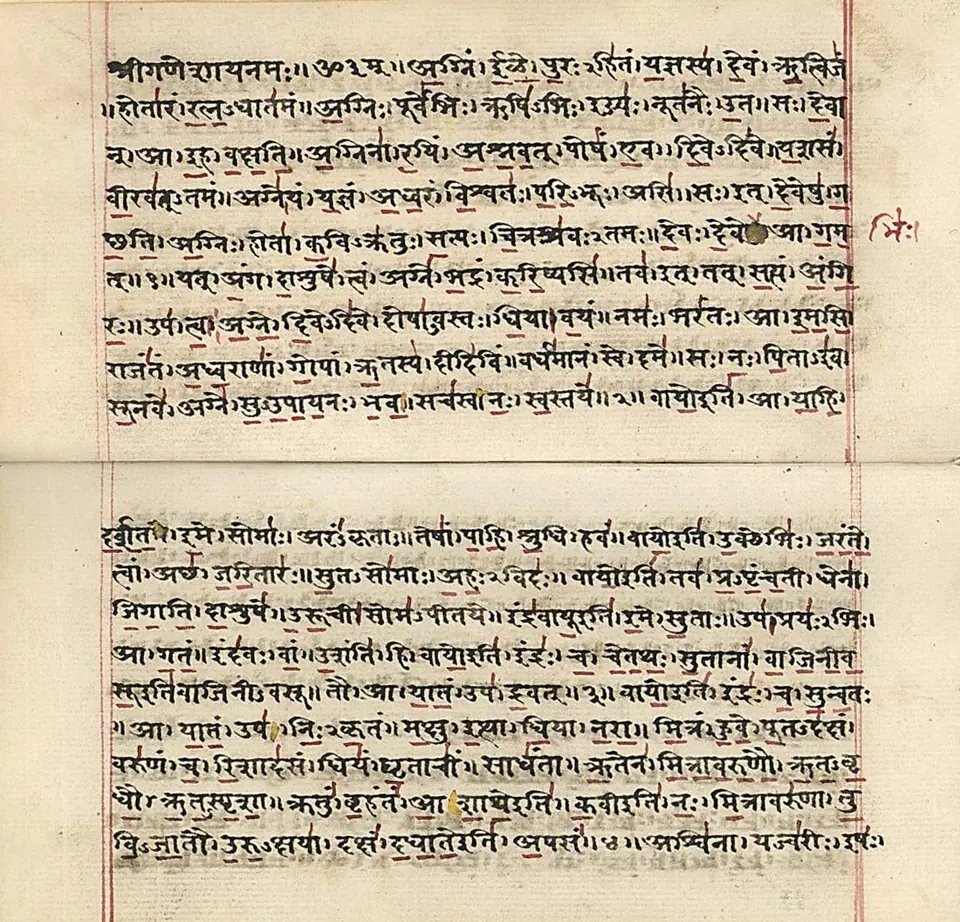
Indra was never abolished. He is still named in ritual, still king of the gods in story, still a character everyone knows. What he lost, over about fifteen hundred years, was the thing that made him central: being the god whose favour you most needed. No single event did it. Each major change in Indian religion, from the Brāhmaṇas to the Purāṇas, moved the centre somewhere Indra could not follow.
How big Indra was
By the crude but honest measure of hymn counts, the Rigveda belongs to Indra. Approximate dedications:[1]
| Deity | Rigveda hymns | Later fate |
|---|---|---|
| Indra | ~250 | a minor king of a lesser heaven |
| Agni | ~200 | survives as ritual apparatus |
| Soma | ~120 | the plant is lost; the name passes to the moon |
| Viṣṇu | ~5 | one of the two supreme gods |
| Rudra | ~3 | becomes Śiva, the other |
The defining act of Rigvedic religion is his:
इन्द्रस्य नु वीर्याणि प्र वोचं यानि चकार प्रथमानि वज्री । अहन्नहिमन्वपस्ततर्द प्र वक्षणा अभिनत्पर्वतानाम् ॥
índrasya nú vīryā̀ṇi prá vocaṃ yā́ni cakā́ra prathamā́ni vajrī́ | áhann áhim ánv apás tatarda prá vakṣáṇā abhinat párvatānām ||
“Now I proclaim the heroic deeds of Indra, the first that the wielder of the vajra performed. He slew the serpent, he bored through to the waters, he split open the bellies of the mountains.” — RV 1.32.1[2]
What it proves: the Rigveda’s supreme god is a young, violent, soma-drinking warrior who wins by force and is praised for it. He is not a moral lawgiver, not a creator, not a source of liberation, and not an object of loving surrender.[3] Consensus He fits his world exactly — a Punjab of cattle-raiding chiefdoms where the ordinary word for battle, gáviṣṭi, means “cattle-seeking.”[4] Every later decline follows from how that world changed.
The evidence: five demotions
1. The ritual becomes the power (c. 1000–800 BCE). In the Brāhmaṇas, correctly performed ritual compels the cosmos, and the gods become its beneficiaries rather than its masters.[5] The chief deity of the Śatapatha Brāhmaṇa is Prajāpati, the creator who is also the year and the altar; Indra is still present but increasingly a figure who needs the sacrifice.[4] Meanwhile Rudra acquires an entire liturgy and the epithet śiva, and Viṣṇu is identified with the sacrifice itself — yajño vai viṣṇuḥ.[6][7] The two gods who would replace Indra get their foothold in the same texts that sideline him. Consensus
2. The gods answer to brahman (c. 700–300 BCE). The Upaniṣads relocate ultimate reality into an impersonal absolute. The Kena Upaniṣad makes the point as a parable: a mysterious spirit challenges Agni to burn a blade of grass, and Vāyu to blow it away, and both fail; when Indra approaches, the spirit vanishes, and only then does he learn it was brahman, and that the gods’ power was never their own.[8] It does not abolish the gods; it makes them provincial. Consensus
3. The gods are inside saṃsāra (c. 500–200 BCE). The Buddha and Mahāvīra do not deny that gods exist; they deny that gods matter, since gods too are caught in rebirth and need liberating.[9] A sky-king who dispenses cattle and victory has nothing to offer someone seeking release. Majority
4. The epics humble him (c. 400 BCE – 400 CE). In the Mahābhārata Indra is Arjuna’s father and a somewhat ineffectual figure who is regularly outmatched, while Kṛṣṇa — with no significant Rigvedic presence at all — is God.[10] Devotion now runs to Vāsudeva-Kṛṣṇa, publicly inscribed by c. 110 BCE on the Heliodorus pillar, and to Śiva.[11] The best-known Kṛṣṇa story of Indra’s defeat — the lifting of Mount Govardhan to shelter the cowherds from Indra’s storm — belongs to the Kṛṣṇa childhood literature, which the epic proper does not narrate and which reaches its most influential form in the Bhāgavata Purāṇa, c. 900–1000 CE.[12][13] Majority
5. Furniture of the cosmos (c. 300–650 CE). In the Purāṇic age Indra, Agni and Varuṇa are reduced to lokapālas, guardians of the compass directions, while temples, images and sectarian worship go to Viṣṇu, Śiva and the Goddess.[13] Brahmā shares a version of the same fate: named creator, almost never worshipped. Consensus
A short timeline
| Date | What happens | Confidence |
|---|---|---|
| c. 1500–1000 BCE | Indra dominant in the Rigveda, ~250 hymns[1] | Consensus |
| c. 1350–1320 BCE | Indra (In-da-ra) named as a witness in the Mitanni treaty[14] | Consensus |
| c. 1000–800 BCE | Brāhmaṇas: Prajāpati supreme; ritual compels the gods[5] | Consensus |
| c. 500 BCE | Kena Upaniṣad: Indra learns the gods’ power is brahman’s[8] | Majority |
| c. 110 BCE | Heliodorus pillar: a Greek envoy is a devotee of Vāsudeva[11] | Consensus |
| c. 400 BCE – 400 CE | Mahābhārata: Indra a minor, outmatched figure[10] | Majority |
| c. 300–650 CE | Purāṇic age: Indra a lokapāla; temples to Viṣṇu, Śiva, Devī[13][15] | Consensus |
| c. 900–1000 CE | Bhāgavata Purāṇa, the classic Govardhan telling[12] | Majority |
What scholars disagree about
Why, rather than when. The sequence above is not seriously disputed; the causes are. One reading is social: Indra was the god of mobile cattle-raiding chiefdoms, and once the Vedic world settled into iron-and-rice agriculture and territorial kingdoms in the Ganga plain, a warband god fitted less well than a cosmic ritual order or, later, a protective, loving personal god.[4][16] A second reading is theological: each new doctrine — ritual efficacy, brahman, karma, bhakti — made petitionary sacrifice to a powerful but amoral god less necessary.[3] The two are compatible, and most accounts combine them. Majority
Was it a replacement or an absorption? Some emphasize continuity: Indra’s storm-and-waters myth, his vajra and his kingship survive into the epics and Purāṇas, and the Rigveda itself already hints that the gods are “one being, many names” (RV 1.164.46).[17] Others stress the break: the gods who became supreme were minor or absent in the Rigveda, and much of the later pantheon — Kṛṣṇa, the Goddess, Gaṇeśa, Skanda — came from outside the Vedic stream altogether.[18][19] Contested
How Hindu tradition reads it. Within the tradition, Indra’s lower rank is not decline but hierarchy: he is a deva, powerful but inside the cosmos, while Viṣṇu, Śiva or the Goddess is the supreme reality behind all the gods. That is itself a Purāṇic and Upanishadic theology, and it is the framework in which the demotion made sense to the people who carried it out.[8][20]
Common misconceptions
- “Indra was replaced by Shiva and Vishnu, who were new gods.” Both are in the Rigveda, just barely: Viṣṇu with about five hymns, Rudra with about three, and śiva only as an adjective meaning “auspicious.”[1]
- “Indra was never worshipped seriously.” He was the most-invoked god of the oldest Indian scripture, and important enough to be sworn by in a treaty in Syria.[14]
- “Indra disappeared completely.” He remains in the epics, Purāṇas and temple iconography as king of the devas and a directional guardian — demoted, not deleted.[13]
What this changes
Indra’s fall is the clearest single illustration that Hinduism was not handed down unchanged from the Vedas. The god who dominates the oldest scripture was steadily moved to the edge, and the gods who now define the tradition rose from its margins. That inversion — read top to bottom in the hymn-count table — is traced across §3, §4 and §8, with the Rigvedic evidence in full in §3.
References
- ^ a b c Stephanie W. Jamison & Joel P. Brereton, trans. The Rigveda: The Earliest Religious Poetry of India. Oxford University Press, 3 vols., 2014. The standard complete English translation. Supersedes Griffith entirely.
- ^ RV 1.32.1 — Rigveda. c. 1400 BCE. Vedic Sanskrit. Indra slays the serpent Vṛtra and releases the waters — the defining act of Rigvedic religion. read the text
- ^ a b Gavin Flood An Introduction to Hinduism. Cambridge University Press, 1996. open library The standard university textbook, and the most balanced single overview.
- ^ a b c Michael Witzel "Early Sanskritization: Origins and Development of the Kuru State". Electronic Journal of Vedic Studies 1, 1995. doi The Kuru state thesis — canonization as a political project.
- ^ a b Brian K. Smith Reflections on Resemblance, Ritual, and Religion. Oxford University Press, 1989. open library The best account of bandhu — the doctrine of hidden correspondences.
- ^ TS 4.5.8.1 — Taittirīya Saṃhitā (Śatarudrīya). c. 1000 BCE. Vedic Sanskrit. namaḥ śivāya ca śivatarāya ca — the first appearance of the most-recited mantra in Śaivism, as flattery of a feared god. read the text
- ^ ŚB 1.1.2.13 — Śatapatha Brāhmaṇa. c. 900 BCE. Vedic Sanskrit. yajño vai viṣṇuḥ — "the sacrifice is Viṣṇu." How Viṣṇu's three Rigvedic strides get him embedded in the ritual core just as ritual is declared supreme. read the text
- ^ a b c Kena 3 — Kena Upaniṣad. c. 500 BCE. Sanskrit. Agni cannot burn a blade of grass without brahman. The Vedic pantheon formally subordinated to an impersonal absolute. read the text
- ^ DN 2 — Sāmaññaphala Sutta (Dīgha Nikāya). c. 400–300 BCE. Pali. The six heterodox teachers — determinism, materialism, scepticism, atomism — the best map we have of the intellectual landscape, written by a rival. read the text
- ^ a b V. S. Sukthankar et al., eds. The Mahābhārata: Critical Edition. Bhandarkar Oriental Research Institute, Pune, 1966. full text Collated from c. 1,250 manuscripts; the archetype runs about a third shorter than the vulgate.
- ^ a b Heliodorus pillar — Besnagar (Vidiśā). c. 110 BCE. Prakrit in Brāhmī. A Greek ambassador calls himself a Bhāgavata and Vāsudeva the God of Gods. The oldest hard evidence for bhakti, and datable by Antialkidas's coinage. about
- ^ a b Friedhelm Hardy Viraha-Bhakti: The Early History of Kṛṣṇa Devotion in South India. Oxford University Press, 1983. full text
- ^ a b c d Ludo Rocher The Purāṇas. Harrassowitz, 1986. open library The standard survey, and the clearest statement of why Purāṇas resist dating.
- ^ a b Mitanni–Hittite treaty — Boğazköy archive. c. 1350–1320 BCE. Akkadian, with Indo-Aryan divine names. Invokes Mitra, Varuṇa, Indra and the Nāsatyas as witnesses — Indo-Aryan gods attested in writing in Syria two centuries before anything written in India. about
- ^ Michael W. Meister & M. A. Dhaky, eds. Encyclopaedia of Indian Temple Architecture. American Institute of Indian Studies, 1983. The reference work for temple dating and typology.
- ^ Romila Thapar Early India: From the Origins to AD 1300. Penguin, 2002. full text The best single-volume political and social history for this whole span.
- ^ RV 1.164.46 — Rigveda. c. 1100 BCE. Vedic Sanskrit. ekaṃ sad viprā bahudhā vadanti — "the One that is, the seers call by many names." Ancestor of every later Hindu claim that the gods are one. read the text
- ^ George L. Hart The Poems of Ancient Tamil: Their Milieu and Their Sanskrit Counterparts. University of California Press, 1975. open library On Sangam-era southern religion.
- ^ Thomas B. Coburn Devī-Māhātmya: The Crystallization of the Goddess Tradition. Motilal Banarsidass, 1984.
- ^ Devī Māhātmya 5 — Mārkaṇḍeya Purāṇa. c. 550–600 CE. Sanskrit. yā devī sarvabhūteṣu — the first text making a goddess the supreme reality and the source of the male gods' power. about