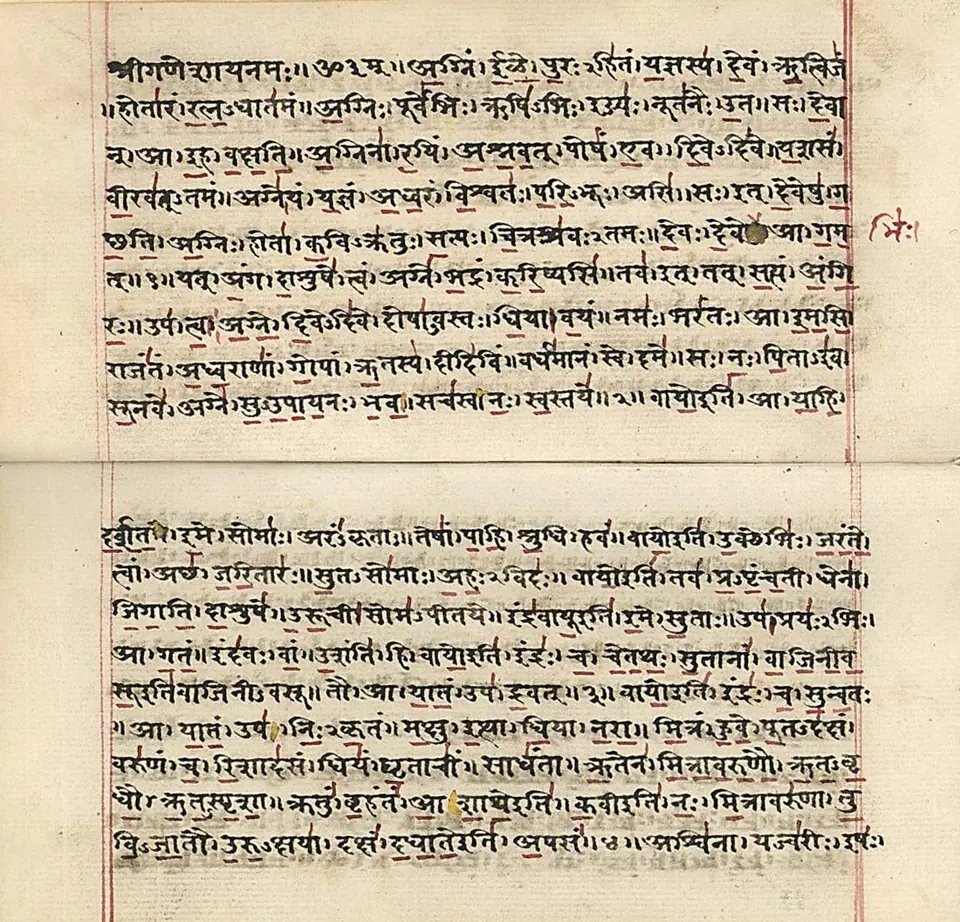
The accurate answer is “both, and more than both,” and that is not an evasion. Hinduism has no single creed; it is a tradition that accumulated several theologies over three thousand years and discarded almost none of them. A single Hindu household can hold a Vedic prayer, an Upanishadic teaching that only one reality exists, and daily devotion to Kṛṣṇa or Durgā as the supreme god, without feeling a contradiction.[1] Which label fits depends on which layer you look at, and the layers have dates.
Layer 1: the Rigveda, polytheism with a riddle in it
The oldest scripture is plainly polytheistic. Its gods are distinct persons with distinct appetites: Indra, with about 250 hymns, wins by force and drinks soma; Agni, with about 200, carries offerings to the others; Varuṇa guards cosmic order.[2] Consensus
But the hymns often praise whichever god they address as the greatest, as though for the moment he were the only one. Max Müller called this pattern henotheism: worship of one god at a time without denying the others.[1] And a late hymn goes further:
इन्द्रं मित्रं वरुणमग्निमाहुरथो दिव्यः स सुपर्णो गरुत्मान् । एकं सद्विप्रा बहुधा वदन्त्यग्निं यमं मातरिश्वानमाहुः ॥
índraṃ mitráṃ váruṇam agním āhur átho divyáḥ sá suparṇó garútmān | ékaṃ sád víprā bahudhā́ vadanty agníṃ yamáṃ mātaríśvānam āhuḥ ||
“They call it Indra, Mitra, Varuṇa, Agni — and it is the heavenly winged Garutmān. That which is, is One; the seers speak of it in many ways. They call it Agni, Yama, Mātariśvan.”[3]
What it proves: the idea that the many gods are names of one reality was available by the end of the Rigvedic period. But this sits in Maṇḍala 1, a late layer, in a famously riddling hymn. It is a flash of what was coming, not the operating theology of the oldest books. Majority
Layer 2: the Upanishads, monism
From about 700 BCE the early Upaniṣads make a far more radical claim: that the self within you is identical with brahman, the ground of all reality. “That which is the finest essence — this whole world has that as its self. That is the truth. That is the self. That you are, Śvetaketu.”[4] Other passages say “all this is indeed brahman” and define the absolute only by negation, “not this, not this.”[5][6]
This is monism, not monotheism. Brahman here is not a person who creates and commands; it is what everything is. The gods are not abolished but demoted. In the Kena Upaniṣad, Agni cannot burn a blade of grass and Vāyu cannot blow it away until they learn that their power was never their own.[7] Consensus
The Upaniṣads are not a single philosophy, though. They also contain a personal creator. The Śvetāśvatara Upaniṣad (c. 400–200 BCE) is openly theistic, makes Rudra-Śiva the supreme being, and uses the word bhakti, devotion, for the first time in the Vedic corpus.[8][9]
Layer 3: one supreme god, for those who love him
By the second century BCE, devotion to a single supreme god is carved in stone. At Besnagar, c. 110 BCE, a Greek ambassador named Heliodoros, calling himself a Bhāgavata, erected a pillar to “Vāsudeva, the God of Gods” — not one deity among many, but supreme.[10][11] The Bhagavad Gītā adds the avatāra doctrine: the supreme god descends in bodily form when order fails.[12]
Over the next centuries this becomes the shape of most Hindu religion. For Vaiṣṇavas, Viṣṇu is supreme; for Śaivas, Śiva; and from about 550 CE, for Śāktas, the Goddess. The Devī Māhātmya makes a goddess the supreme reality and the source of the male gods’ power, and absorbs a long list of local goddesses as her forms:[13]
या देवी सर्वभूतेषु शक्तिरूपेण संस्थिता ।
yā devī sarvabhūteṣu śakti-rūpeṇa saṃsthitā | “The Goddess who abides in all beings in the form of power.”[14]
What it proves: “many goddesses, one Goddess.” This is the machinery by which Hinduism keeps its many deities while making one of them ultimate. Within each tradition the structure looks a great deal like monotheism; across the traditions, the supreme god differs.[13] The Purāṇic “Trimūrti” of Brahmā, Viṣṇu and Śiva is a theological scheme more than a cult: Brahmā is named as creator and almost never worshipped.[1] Majority
Layer 4: Vedānta argues it out
Medieval philosophy turned the question into a formal debate over the same Upaniṣads:
| School | Teacher | What is ultimately real | Status of the personal God |
|---|---|---|---|
| Advaita (non-dualism) | Śaṅkara, c. 700–750 CE | Brahman alone; the world is superimposition | Real at the level of worship, not ultimately |
| Viśiṣṭādvaita (qualified non-dualism) | Rāmānuja, c. 1077–1157 | One Brahman, with souls and world as its body | Fully real, personal, loving |
| Dvaita (dualism) | Madhva, 1238–1317 | God, souls and world eternally distinct | Supreme and separate |
Śaṅkara’s commentary begins by arguing that subject and object “are by nature as opposed as darkness and light,” and that ordinary experience wrongly superimposes one on the other.[15] Rāmānuja answers that Brahman genuinely has attributes and that souls stay real in liberation.[16] If Śaṅkara is right, the god you love is ultimately unreal; Rāmānuja’s system exists to say he is not. That these systems are all defensible from one corpus shows how plural the corpus is.[17][9] Consensus
A short timeline
| Date | What happens | Confidence |
|---|---|---|
| c. 1500–1200 BCE | Rigveda’s oldest books: many distinct gods | Majority |
| Late Rigveda | “That which is, is One” (RV 1.164.46) | Majority |
| c. 700–500 BCE | Early Upaniṣads: ātman = brahman | Majority |
| c. 400–200 BCE | Śvetāśvatara: Rudra-Śiva supreme; bhakti | Majority |
| c. 110 BCE | Heliodorus pillar: “Vāsudeva, the God of Gods” | Consensus |
| c. 550–600 CE | Devī Māhātmya: the Goddess supreme | Majority |
| c. 700–750 CE | Śaṅkara’s Advaita | Contested dates |
| 12th–13th c. | Rāmānuja and Madhva | Majority |
| 1828 / 1893 | Rammohan Roy’s Upanishadic monotheism; Vivekananda’s Neo-Vedānta | Consensus |
What scholars disagree about
Was Hinduism “really” monotheistic all along? Nineteenth-century reformers said yes. Rammohan Roy derived a monotheism from the Upaniṣads and rejected image worship, and Dayānanda’s Ārya Samāj found an imageless monotheism in the Vedas. Historians note that both were answering missionary charges of polytheism, and that the Rigveda of the historical record is not monotheistic.[18][19] Majority
Is Advaita the essence? Vivekananda presented it as the heart of Hinduism in 1893, and much of the world now assumes so. In Śaṅkara’s own time it was one school among several, and Śaivism, not Vedānta, was the dominant religious force.[20][21] Majority
The traditional view. Many Hindus describe their tradition as worshipping one divine reality through many forms, chosen according to temperament: an iṣṭa-devatā, a personal chosen deity, within a larger unity. That self-understanding has deep roots in the texts above and is a fair description of much living practice. What the history adds is that the unity was argued for, in different ways, at different times, rather than given at the start.[1]
Common misconceptions
- “Śiva and Viṣṇu were always the great gods.” In the Rigveda, Viṣṇu has about five hymns and Rudra, later Śiva, about three. Their supremacy is post-Vedic.[2]
- “Brahmā is one of the three main Hindu gods.” In theology, yes; in worship, hardly at all.[1]
- “Monism and monotheism are the same thing.” Monotheism has one God distinct from the world; Advaita monism has one reality, and the world is not ultimately separate from it.[15]
Why it matters
Asking “polytheistic or monotheistic?” imports a choice from religions that define themselves by creed. Hinduism is better described by its history: a polytheism that learned to see the gods as one, a monism that made the gods provincial, and theologies of a single supreme god that kept the others as his or her forms.
For the full story, see §3 on the Rigvedic gods, §5 on the Upanishads, §8 on the Purāṇas and §9 on Vedānta.
References
- ^ a b c d e Gavin Flood An Introduction to Hinduism. Cambridge University Press, 1996. open library The standard university textbook, and the most balanced single overview.
- ^ a b Stephanie W. Jamison & Joel P. Brereton, trans. The Rigveda: The Earliest Religious Poetry of India. Oxford University Press, 3 vols., 2014. The standard complete English translation. Supersedes Griffith entirely.
- ^ RV 1.164.46 — Rigveda. c. 1100 BCE. Vedic Sanskrit. ekaṃ sad viprā bahudhā vadanti — "the One that is, the seers call by many names." Ancestor of every later Hindu claim that the gods are one. read the text
- ^ CU 6.8.7 — Chāndogya Upaniṣad. c. 700 BCE. Sanskrit. tat tvam asi — "that you are." The doctrinal core of Vedānta and the most influential sentence in Indian philosophy. read the text
- ^ CU 3.14.1 — Chāndogya Upaniṣad. c. 700 BCE. Sanskrit. sarvaṃ khalv idaṃ brahma — "all this is indeed brahman." read the text
- ^ BU 2.3.6 & 3.9.26 — Bṛhadāraṇyaka Upaniṣad. c. 700 BCE. Sanskrit. neti neti — "not this, not this." The absolute defined only by negation. read the text
- ^ Kena 3 — Kena Upaniṣad. c. 500 BCE. Sanskrit. Agni cannot burn a blade of grass without brahman. The Vedic pantheon formally subordinated to an impersonal absolute. read the text
- ^ ŚvU 6.23 — Śvetāśvatara Upaniṣad. c. 400–200 BCE. Sanskrit. The earliest use of the word bhakti in the Vedic corpus, in the first theistic Upaniṣad. read the text
- ^ a b Signe Cohen Text and Authority in the Older Upaniṣads. Brill, 2008. open library
- ^ Heliodorus pillar — Besnagar (Vidiśā). c. 110 BCE. Prakrit in Brāhmī. A Greek ambassador calls himself a Bhāgavata and Vāsudeva the God of Gods. The oldest hard evidence for bhakti, and datable by Antialkidas's coinage. about
- ^ Richard Salomon Indian Epigraphy. Oxford University Press, 1998. open library The standard handbook for inscriptions and their dating.
- ^ BhG 4.7–8 — Bhagavad Gītā. c. 200 BCE – 200 CE. Sanskrit. The avatāra doctrine, stated for the first time. Nothing in the Vedas has a god descending into history. read the text
- ^ a b Thomas B. Coburn Devī-Māhātmya: The Crystallization of the Goddess Tradition. Motilal Banarsidass, 1984.
- ^ Devī Māhātmya 5 — Mārkaṇḍeya Purāṇa. c. 550–600 CE. Sanskrit. yā devī sarvabhūteṣu — the first text making a goddess the supreme reality and the source of the male gods' power. about
- ^ a b Brahmasūtrabhāṣya, adhyāsa-bhāṣya — Śaṅkara. c. 700–750 CE. Sanskrit. Subject and object are as opposed as light and darkness — and we confuse them constantly. All of Advaita follows. read the text
- ^ Śrībhāṣya — Rāmānuja. c. 1100 CE. Sanskrit. The world and souls are the body of God. A theistic answer to Śaṅkara, giving Tamil devotion a Vedāntic defence. about
- ^ Wilhelm Halbfass Tradition and Reflection: Explorations in Indian Thought. SUNY Press, 1991. full text On Śaṅkara and his Mīmāṃsā opponents.
- ^ Kenneth W. Jones Socio-Religious Reform Movements in British India. Cambridge University Press, 1989. doi The survey that maps Brahmo, Arya Samaj, Prarthana and the rest against each other.
- ^ Richard King Orientalism and Religion: Postcolonial Theory, India and "The Mystic East". Routledge, 1999. full text
- ^ Andrew J. Nicholson Unifying Hinduism: Philosophy and Identity in Indian Intellectual History. Columbia University Press, 2010. full text Argues the unification of Hinduism began in the 12th–16th centuries, well before the British — a key correction to the strong constructionist thesis.
- ^ Elizabeth De Michelis A History of Modern Yoga: Patañjali and Western Esotericism. Continuum, 2004. full text The Vivekananda-to-modern-yoga line.