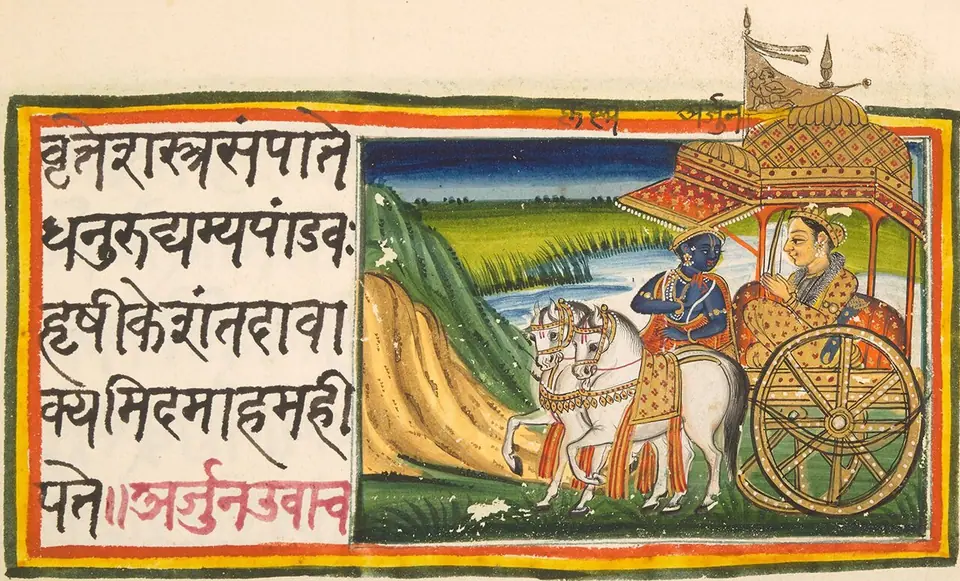
The short version: the Mahābhārata was not written at one moment. It was composed and expanded over roughly eight centuries, from about 400 BCE to about 400 CE, until it reached the size of some 100,000 verses that tradition gives it.[1][2] Nothing in the text states a date, and its manuscripts are far later than its composition. The window rests on the epic’s own account of its growth, on the evidence of its manuscripts, and on what its language and teachings presuppose. A separate question, when the war it describes took place, has no comparable answer.
The evidence for dating the Mahabharata
The epic describes its own growth
The Mahābhārata is unusually frank about its size. Its first book says the Bhārata runs to 24,000 verses without its side-stories, and it calls itself a work of 100,000 verses.[1] A third figure often quoted, 8,800 verses, refers in the text to deliberately obscure verses that only Vyāsa and a few others understand, not to an earlier, shorter epic.[1] It also opens with more than one beginning, nesting its story inside layers of narrators: Vyāsa teaches it to his pupil Vaiśaṃpāyana, who recites it at King Janamejaya’s snake sacrifice, and a bard later retells that recitation to sages in the forest.[2]
What it proves. A text that remembers being smaller is a text that grew. The two figures are not measurements, and scholars do not read them as a precise record of two editions. They do show that the epic’s own transmitters knew it had expanded, and they agree with what the manuscripts show. Majority
What the Critical Edition found
Between 1919 and 1966 the Bhandarkar Oriental Research Institute in Pune produced a Critical Edition of the epic. V. S. Sukthankar and his successors collated some 1,250 manuscripts from across India and reconstructed the oldest text they could reach: an archetype roughly a third shorter than the popular “vulgate” text.[1] Passages found in only some regional versions were moved to appendices. Many famous episodes turned out to be among them.
What it proves. The epic kept growing even after it was written down, and different regions added different material. The Critical Edition does not recover an “original” Mahābhārata. It recovers the common ancestor of the surviving manuscripts, which is itself the product of centuries of growth.[2] Consensus
Layers inside the text
Scholars can see layers in the reconstructed text as well.[2] The core is the war story: the quarrel between the Pāṇḍava and Kaurava cousins over the Kuru throne and the eighteen-day battle at Kurukṣetra. Around it sit enormous teaching books, above all the Śānti and Anuśāsana books, in which the dying Bhīṣma lectures on kingship, law and liberation. The Bhagavad Gītā, a 700-verse dialogue between Kṛṣṇa and Arjuna, is set into Book 6. Most scholars date it to roughly 200 BCE–200 CE, because it answers Buddhist and Sāṃkhya ideas.[3] Last comes the Harivaṃśa, an appendix that supplies Kṛṣṇa’s childhood and youth, which the epic proper does not narrate.[2]
What it proves. Kṛṣṇa becomes more clearly divine as one moves from the war story toward the Gītā and the Harivaṃśa. The same pattern appears in the Rāmāyaṇa, where Rāma is plainly divine only in the later first and last books.[4] In both epics a hero becomes a god inside the text’s own history. Majority
The earliest outside evidence
Pāṇini’s grammar, of about the 5th–4th century BCE, has a rule forming words for a devotee of Vāsudeva and a devotee of Arjuna.[5] Two of the epic’s central figures were therefore objects of devotion before most of the epic was composed. This dates the heroes and their cult, not the text. By about 110 BCE the Heliodorus pillar shows Vāsudeva worshipped as “God of Gods,” the religious world the later layers of the epic belong to.[6]
At the other end, a copper-plate land grant of the 530s CE, from a king ruling under the late Guptas, warns violators with verses it attributes to the Mahābhārata, “the collection of 100,000 verses,” by Vyāsa.[7] By then the epic existed in something like its large form and was being quoted as an authority.
Language
The Mahābhārata is in epic Sanskrit, a looser, more popular register than the Vedic language of the Brāhmaṇas and the early Upaniṣads, and close to the classical Sanskrit of the early centuries CE.[2] Its teaching books presuppose ideas, such as karma and rebirth, renunciation, Sāṃkhya and devotion to a personal god, that appear only after about 500 BCE. Taken together, these put the composition of the text in the second half of the first millennium BCE and the early first millennium CE, not in the second millennium BCE.
Who wrote the Mahabharata?
Tradition credits the Mahābhārata to the sage Vyāsa, also called Kṛṣṇa Dvaipāyana, who is himself a character in the story: the grandfather of both warring sides.[8] A popular later story has the god Gaṇeśa writing the epic down as Vyāsa dictates it. That episode is found only in some manuscripts, and the Critical Edition placed it outside the reconstructed text.[1]
Historically, no single author can be named. Most scholars see the epic as the work of many generations. Bards (sūtas) who sang of kings and battles came first, then Brahmin redactors who reshaped the story into a vast teaching on dharma.[2] On this accretion view, the text grew outward from a war narrative over many centuries.
Alf Hiltebeitel offers the main alternative. He reads the Mahābhārata as a deliberate composition, planned by learned Brahmin authors working over a much shorter span, perhaps a few generations around the last two centuries BCE. On his view its frames, digressions and teachings are design, not accumulation.[9] He also reads the epic as a sustained argument about what dharma means.[10] Both views leave the main composition in the same broad centuries, and both accept that material kept being added afterwards. They differ on whether the epic had a plan.
Did the Kurukshetra war happen?
This is a different question from when the text was written, and it is the one people most often mean.
The traditional answer. Hindu tradition places the war at the junction of two world ages: Kṛṣṇa leaves the world as the Kali Yuga, the present age, begins. A widely used reckoning puts the start of the Kali Yuga in 3102 BCE, and the astronomer Āryabhaṭa in 499 CE dated his own work by the years elapsed in it.[11] On this view the war happened around the end of the fourth millennium BCE. Other traditional reckonings give other dates, and modern attempts to date the war from planetary positions described in the text reach results thousands of years apart.
What historians can say. The epic preserves real names. Parikṣit and Janamejaya, in the epic the grandson and great-grandson of Arjuna, appear in Vedic texts as Kuru kings, and the Kuru realm in the Ganga–Yamuna doāb was the leading Vedic power around 1200–900 BCE.[12] Hastināpura, the Kuru capital of the story, is a real site with Painted Grey Ware levels from that period.[13] A conflict, or a memory of several conflicts, among Kuru-region lineages may lie behind the story. Contested
That is as far as the evidence goes. No inscription, archaeological layer or outside text records the war. A Painted Grey Ware village shows that people lived at Hastināpura, not that an eighteen-day battle was fought nearby. Historians therefore treat the war as possibly rooted in early first-millennium-BCE events, and greatly enlarged in the retelling.[14] Whether it happened is not something the evidence can settle.
A short timeline
| Date | What happens | Confidence |
|---|---|---|
| c. 1200–900 BCE | The Kuru realm dominates the doāb; Parikṣit and Janamejaya named as Kuru kings[12] | Majority |
| c. 1200–600 BCE | Painted Grey Ware sites, including Hastināpura[13] | Consensus |
| c. 5th–4th c. BCE | Pāṇini’s rule for devotees of Vāsudeva and Arjuna[5] | Majority |
| c. 400 BCE – 400 CE | The Mahābhārata composed and expanded toward 100,000 verses[1][2] | Majority |
| c. 200 BCE – 200 CE | Bhagavad Gītā composed and set into Book 6[3] | Majority |
| c. 110 BCE | Heliodorus pillar: Vāsudeva as “God of Gods”[6] | Consensus |
| 499 CE | Āryabhaṭa dates his work by the years of the Kali Yuga[11] | Consensus |
| 530s CE | A copper-plate grant cites the epic as 100,000 verses by Vyāsa[7] | Majority |
| 1919–1966 | The Pune Critical Edition collates about 1,250 manuscripts[1] | Consensus |
What scholars disagree about
Accretion or design. The majority picture is of an epic that grew in layers around a war story, and §7 follows it.[2] Hiltebeitel’s reading of a planned composition by Brahmin authors over a shorter period is the main alternative.[9] Contested
The edges of the window. “400 BCE to 400 CE” is the majority range, not a measurement. The earlier limit depends on when one thinks a recognisable Bhārata story first took literary form; the later depends on where one stops counting additions, since regional versions kept growing after 400 CE.[2][1] Majority
The traditional view. For many Hindus the Mahābhārata is itihāsa, “thus it was”: a record of events, composed by Vyāsa, who witnessed them, and set at the start of the Kali Yuga. That view deserves to be stated fairly. It is held with deep conviction, it rests on a long tradition of reckoning, and the epic presents itself as history. The historian’s objection is not to the tradition’s sincerity but to the evidence. The language and ideas of the text belong to the last centuries BCE and the first centuries CE, and nothing outside the text dates the war.[2] The question is also political, because an older epic is sometimes used as a claim about an older nation. Majority / Political
Common misconceptions
- “Vyāsa wrote it down in one sitting.” The Critical Edition shows centuries of growth, and its manuscripts differ by region.[1]
- “The Mahābhārata is older than the Vedas.” The Rigveda’s oldest books date to c. 1500–1200 BCE, more than a thousand years before the epic took literary shape (§3).[15]
- “If Hastināpura is real, the war is proven.” A real place shows that the story was set in a real landscape. It does not show that the battle happened.[13]
- “The Gītā is a separate book.” It is part of the Mahābhārata’s sixth book, and it is among the later layers, not the earliest.[3]
Why the date matters
Dating the Mahābhārata to 400 BCE–400 CE places it in the centuries when Hinduism as most people know it took shape: the first temples and images, devotion to Vāsudeva-Kṛṣṇa, the Manusmṛti, and the long reply to the Buddhist and Jain renouncers.[6][3] Read that way, the epic is not a fossil from a remote age. It is a record of a society working out its answers in real time. A war story among the Kurus became, over eight centuries, an encyclopedia of law, philosophy and devotion, and the layers of the text show the change happening.
For the full story of the epics, the Gītā and the first images, see Chapter 7: Epic and Classical Synthesis.
References
- ^ a b c d e f g h i V. S. Sukthankar et al., eds. The Mahābhārata: Critical Edition. Bhandarkar Oriental Research Institute, Pune, 1966. full text Pune critical edition (1919–1966): 1,259 manuscripts examined, 734 actually used; passages found only in some manuscripts relegated to footnotes and appendices.
- ^ a b c d e f g h i j k John Brockington The Sanskrit Epics. Brill, 1998. open library The standard handbook on both epics: their stages of growth, recensions and dating.
- ^ a b c d Angelika Malinar The Bhagavadgītā: Doctrines and Contexts. Cambridge University Press, 2007. The standard study of the Gītā's doctrines and its place in the epic and in post-Mauryan debates.
- ^ Robert P. Goldman et al., trans. The Rāmāyaṇa of Vālmīki: An Epic of Ancient India. Princeton University Press, 7 vols., 1984. The complete scholarly translation of the critical edition.
- ^ a b Aṣṭādhyāyī 4.3.98 — Pāṇini. c. 5th–4th c. BCE. Sanskrit. A grammatical rule forming the word for a devotee of Vāsudeva (and of Arjuna), in a section on objects of devotion (bhakti): Vāsudeva was already worshipped centuries before the Gītā. read the text
- ^ a b c Heliodorus pillar — Besnagar (Vidiśā). c. 110 BCE. Prakrit in Brāhmī. A Greek ambassador calls himself a Bhāgavata and Vāsudeva the God of Gods. The oldest hard evidence for bhakti, and datable by Antialkidas's coinage. about
- ^ a b J. F. Fleet Inscriptions of the Early Gupta Kings and Their Successors. Corpus Inscriptionum Indicarum III, 1888. open library Still the only edition for Gaṅgdhār, Eran and the Mandasor Yaśodharman records — the 1981 revision omits them.
- ^ Gavin Flood An Introduction to Hinduism. Cambridge University Press, 1996. open library The standard university textbook, and the most balanced single overview.
- ^ a b Alf Hiltebeitel Rethinking the Mahābhārata. University of Chicago Press, 2001. open library
- ^ Alf Hiltebeitel Dharma: Its Early History in Law, Religion, and Narrative. Oxford University Press, 2011.
- ^ a b Āryabhaṭīya — Āryabhaṭa. 499 CE. Sanskrit. Place-value numeration in an alphabetic notation, a sine table, planetary models and a rotating earth, dated by the author's statement that he was 23 when 3,600 years of the Kali age had elapsed (499 CE). about
- ^ a b Michael Witzel "Early Sanskritization: Origins and Development of the Kuru State". Electronic Journal of Vedic Studies 1(4); repr. in B. Kölver, ed., Recht, Staat und Verwaltung im klassischen Indien (Oldenbourg, 1997): 27–52, 1995. doi The Kuru state thesis — canonization as a political project.
- ^ a b c Robin Coningham & Ruth Young The Archaeology of South Asia: From the Indus to Asoka. Cambridge University Press, 2015. The standard synthesis for §§1–6.
- ^ Romila Thapar Early India: From the Origins to AD 1300. Penguin, 2002. full text The best single-volume political and social history for this whole span.
- ^ Stephanie W. Jamison & Joel P. Brereton, trans. The Rigveda: The Earliest Religious Poetry of India. Oxford University Press, 3 vols., 2014. The standard complete English translation. Supersedes Griffith entirely.