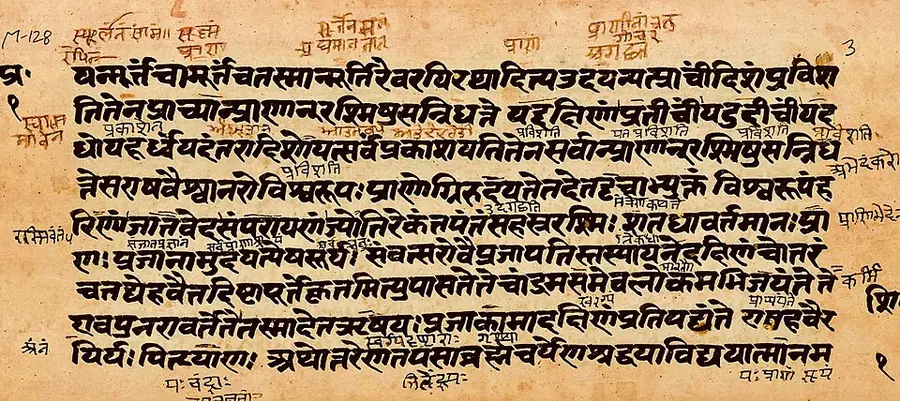
The idea of karma — that what you do determines what you become, in this life and the next — has a first appearance we can point to. It is in the Bṛhadāraṇyaka Upaniṣad, composed in the eastern Ganga plain around 700–600 BCE, and it arrives as a secret.[1][2] Before that, across roughly six hundred years of Vedic literature, it is simply not there. What nobody knows for certain is where the Upanishadic teachers got it.
The evidence: a doctrine caught arriving
The silence before. The Rigveda has no karma, no rebirth and no liberation. Neither do the other three Vedas or the Brāhmaṇas, thousands of pages that discuss death, the afterlife and right conduct at length.[3][4] Consensus In the Rigveda karman just means a deed, especially a ritual act. The dead go to the world of the fathers; the aim of life is cattle, sons and a full span of years.
The seed in the Brāhmaṇas. The ritual manuals of c. 1000–800 BCE worry about punarmṛtyu, “re-death”: that someone who reaches the next world “dies again and again there.”[5] The remedy is ritual — the sacrifice is how the sacrificer “conquers recurring death.”[6] This is the conceptual seed of saṃsāra, but it is not rebirth on earth, and it is not ethical. Consensus
The whisper. Then comes Bṛhadāraṇyaka 3.2.13. In a public debate at King Janaka’s court, Ārtabhāga asks Yājñavalkya what remains of a person when speech has gone into fire, breath into wind and the eye into the sun. Yājñavalkya will not answer in public:
आहर सौम्य हस्तमार्तभाग आवामेवैतस्य वेदिष्यावो न नावेतत्सजन इति । तौ होत्क्रम्य मन्त्रयांचक्राते । तौ ह यदूचतुः कर्म हैव तदूचतुः । पुण्यो वै पुण्येन कर्मणा भवति पापः पापेनेति ॥
āhara saumya hastam ārtabhāga | āvām evaitasya vediṣyāvo na nāv etat sajana iti | tau hotkramya mantrayāṃcakrāte | tau ha yad ūcatuḥ karma haiva tad ūcatuḥ | puṇyo vai puṇyena karmaṇā bhavati, pāpaḥ pāpeneti ||
“‘Take my hand, Ārtabhāga my friend. Only the two of us shall know this — this is not for us in public.’ So the two of them went out and deliberated. And what they spoke of was karman; what they praised was karman. One becomes good by good action, bad by bad action.”[1][2]
What it proves: in a genre where every other teaching is proclaimed, karma is handled as an esoteric secret. A tradition does not usually hide its own long-standing doctrine; it hides a new one. That this is the earliest clear attestation is Consensus; that the secrecy shows novelty is the Majority reading.
The settling. Later in the same text, BU 4.4.5 states it openly: “As one acts, as one conducts oneself, so one becomes. The doer of good becomes good; the doer of evil becomes evil.”[7] Inside a single Upaniṣad, an idea goes from private to canonical.
The kings who knew first. In Chāndogya 5.3 (paralleled at BU 6.2) the brahmin Śvetaketu cannot answer five questions about what happens after death, put to him by Pravāhaṇa Jaivali, king of Pañcāla. His father Uddālaka, a celebrated teacher, cannot answer them either. The king teaches both the doctrine of the five fires and the two paths of the dead, and says this knowledge has never before belonged to brahmins.[8] The pattern recurs: Ajātaśatru of Kāśī instructs the brahmin Gārgya Bālāki at BU 2.1.[9]
The same idea, everywhere at once. Within two centuries, karma and rebirth are common ground for movements that agree on almost nothing else. Buddhists, Jains and Ājīvikas accept karma, rebirth and liberation while rejecting the Veda, sacrifice and the brahmin (§6).[10][11] The disputes are over how karma works, not whether: the Ājīvika Makkhali Gosāla held a strict determinism in which effort changes nothing, and Pūraṇa Kassapa denied that action has moral consequence at all.[10][12]
A short timeline
| Date | What happens | Confidence |
|---|---|---|
| c. 1500–1000 BCE | Rigveda: no karma, rebirth or liberation; karman means a (ritual) deed[3] | Consensus |
| c. 1000–800 BCE | Brāhmaṇas: fear of punarmṛtyu, solved by ritual[5][6] | Consensus |
| c. 900–700 BCE | Āraṇyakas begin internalizing ritual as meditation[2] | Majority |
| c. 700–600 BCE | BU 3.2.13: karma taught in private; BU 4.4.5 and CU 5.3 state rebirth doctrine[1][8] | Majority |
| c. 700–500 BCE | Second urbanization: cities, coinage, merchants in the eastern plain[13] | Consensus |
| c. 480–400 BCE | The Buddha and Mahāvīra; karma shared across Śramaṇa movements[14][15] | Contested (dates) |
| c. 200 BCE – 200 CE | The Bhagavad Gītā reworks karma as action without attachment to its fruits (§7)[16] | Majority |
What scholars disagree about
Four proposals are live, and they are not mutually exclusive.[17][4]
1. It grew out of Vedic ritual thought. The Brāhmaṇas already hold that an act (karman, the ritual act) has hidden consequences that shape the sacrificer’s fate after death, and already fear re-death. Generalize “ritual act” to “any act” and add rebirth on earth, and you have karma. Herman Tull made the fullest case that karma develops from within the Vedic ritual cosmos.[18][5] Its strength is continuity of vocabulary; its weakness is that it does not explain why the idea surfaces suddenly, in secret, and in the east.
2. It came from kṣatriya circles. This is what the texts themselves say. Pravāhaṇa tells the brahmins the doctrine was never theirs.[8] The strongest argument for taking this at face value is that brahmin authors had no motive to invent stories of brahmin ignorance; texts rarely fabricate their own humiliation. The counter-argument is that the humbled brahmin student is a stock literary frame.[17] The chapter leans toward a real origin outside the priesthood. Contested
3. It came from an eastern, non-Vedic ascetic culture. Johannes Bronkhorst’s Greater Magadha thesis holds that the region east of the Vedic heartland had its own religious culture — renunciant, rebirth-believing, non-Vedic — which was the soil of both Buddhism and Jainism, and from which the Vedic tradition borrowed karma and rebirth.[17] Its load-bearing claim is chronological: that the rebirth passages of the older Upaniṣads may be as late as the Buddha. That runs against the majority dating of the Bṛhadāraṇyaka and Chāndogya as pre-Buddhist, and Michael Witzel’s rebuttal is the central one.[19] Geoffrey Samuel is a partial ally with a softer version.[20] Contested The observation beneath it is solid, though: the doctrines that define later Indian religion all appear first in the region the Vedic texts regard as peripheral.
4. It emerged regionally, in response to the same conditions. Iron ploughs, rice surplus, cities, coined money, merchants with wealth and no place in the sacrificial order: the eastern Ganga plain of c. 700–500 BCE was a new kind of society, and Vedic, Buddhist, Jain and Ājīvika thinkers may all have been answering it.[21][22] Richard Seaford ties ethicized karma specifically to monetization; Gananath Obeyesekere offers a comparative model of how rebirth beliefs become ethicized. In his 2022 reassessment Bronkhorst argues that the real puzzle is the ethicization of rebirth, not rebirth itself, and rejects both of those explanations.[23][24][4] Contested
A traditional Hindu view takes the question differently: karma is part of an eternal order revealed in the Veda, and the Upaniṣads — Vedānta, “the end of the Veda” — make explicit what the earlier texts presuppose. A historian can respect that as theology while noting that, as a matter of the surviving record, the idea is not attested before the Upaniṣads.[2]
Common misconceptions
- “Karma is in the Rigveda.” The word is; the doctrine is not. Karman there means a deed or ritual act, with no moral causation across lives.[3]
- “Buddhism took karma from Hinduism.” On the majority chronology the earliest Upanishadic statements are older than the Buddha, but the Upanishadic and Śramaṇa movements are best seen as contemporaneous strands of one ferment, not a sequence in which one copied the other.[2][19]
- “Karma means fate.” In its first statement it means the reverse: you become what you do. Strict fatalism was the Ājīvika position, and the other schools attacked it.[7][12]
Why it matters
Karma is the hinge of the whole later tradition. Once fate depends on action and knowledge rather than correct sacrifice, the priest’s monopoly weakens, renunciation becomes a rational choice, and a merchant or a king can pursue liberation without a ritual specialist (§5, §6).[21] Knowing that the idea arrives around 700 BCE, and arrives whispered, is what makes the Upanishadic turn visible as a turn. The full account of that turn, with the passages quoted in context, is in §5.
References
- ^ a b c BU 3.2.13 — Bṛhadāraṇyaka Upaniṣad. c. 700 BCE. Sanskrit. The single most important passage on this site: karma is taught in private, away from the assembly — which is how we know the idea was new. read the text
- ^ a b c d e Patrick Olivelle, trans. The Early Upaniṣads: Annotated Text and Translation. Oxford University Press, 1998. full text The scholarly standard. Its introduction is the best short account of the period.
- ^ a b c Michael Witzel "Tracing the Vedic Dialects". in Dialectes dans les littératures indo-aryennes, 1989. The foundational work on Rigvedic internal chronology and geography.
- ^ a b c Johannes Bronkhorst "Whence Karma?". Contributions to Indian Sociology 56, 2022. doi His revised position: the thing to explain is ethicization, not rebirth. Rejects both Obeyesekere and Seaford.
- ^ a b c ŚB 2.3.3.9 — Śatapatha Brāhmaṇa. c. 900 BCE. Vedic Sanskrit. Whoever goes to the next world without escaping Death "dies again and again there" — punarmṛtyu, the fear of re-death, which is the conceptual seed of saṃsāra but is solved by ritual, not knowledge. read the text
- ^ a b ŚB 10.1.4.14 — Śatapatha Brāhmaṇa. c. 900 BCE. Vedic Sanskrit. "Whereby the Sacrificer conquers recurring death" — punarmṛtyu, the anxiety that ritual is meant to solve and that saṃsāra later replaces. read the text
- ^ a b BU 4.4.5 — Bṛhadāraṇyaka Upaniṣad. c. 700 BCE. Sanskrit. "As one acts, so one becomes." Karma now stated openly as settled doctrine — inside the same text that whispered it. read the text
- ^ a b c CU 5.3–10 — Chāndogya Upaniṣad. c. 700 BCE. Sanskrit. Pañcāgni-vidyā. A kṣatriya king teaches rebirth to two brahmins who cannot answer his questions — the texts crediting the doctrine outside the priesthood. read the text
- ^ BU 2.1 — Bṛhadāraṇyaka Upaniṣad. c. 700 BCE. Sanskrit. Ajātaśatru, king of Kāśī, instructs the brahmin Gārgya Bālāki — another case of the texts crediting a kṣatriya. Not the Magadhan Ajātaśatru of §6. read the text
- ^ a b DN 2 — Sāmaññaphala Sutta (Dīgha Nikāya). c. 400–300 BCE. Pali. The six heterodox teachers — determinism, materialism, scepticism, atomism — the best map we have of the intellectual landscape, written by a rival. read the text
- ^ Paul Dundas The Jains. Routledge, 2nd ed., 2002. open library The standard survey.
- ^ a b Bhagavatī Sūtra 15 — Viyāhapannatti. c. 300 BCE. Ardhamāgadhī Prakrit. The Jain account of Makkhali Gosāla and his rupture with Mahāvīra — the fullest Ājīvika narrative anywhere, hostile but detailed. read the text
- ^ Robin Coningham & Ruth Young The Archaeology of South Asia: From the Indus to Asoka. Cambridge University Press, 2015. The standard synthesis for §§1–6.
- ^ Heinz Bechert, ed. The Dating of the Historical Buddha. Vandenhoeck & Ruprecht, 3 vols., 1991. The symposium that unsettled the traditional dates — and reached no consensus.
- ^ L. S. Cousins "The Dating of the Historical Buddha: A Review Article". Journal of the Royal Asiatic Society 6, 1996. doi Where the c. 400 BCE working default comes from.
- ^ BhG 2.47 — Bhagavad Gītā. c. 200 BCE – 200 CE. Sanskrit. Action without attachment to fruits — the answer to renunciation that rescues ordinary life. read the text
- ^ a b c Johannes Bronkhorst Greater Magadha: Studies in the Culture of Early India. Brill, 2007. full text The strongest case for an eastern, non-Vedic origin for karma and rebirth. Influential and contested.
- ^ Herman W. Tull The Vedic Origins of Karma: Cosmos as Man in Ancient Indian Myth and Ritual. SUNY Press, 1989. full text The case that karma develops from within Vedic ritual thought.
- ^ a b Michael Witzel "Moving Targets? Texts, Language, Archaeology and History in the Late Vedic and Early Buddhist Periods". Indo-Iranian Journal 52, 2009. doi The central chronological rebuttal to Bronkhorst.
- ^ Geoffrey Samuel The Origins of Yoga and Tantra: Indic Religions to the Thirteenth Century. Cambridge University Press, 2008. A partial ally of the Greater Magadha thesis, explicitly softer than Bronkhorst's binary.
- ^ a b Patrick Olivelle The Āśrama System: The History and Hermeneutics of a Religious Institution. Oxford University Press, 1993. Establishes that the āśramas began as alternatives, not stages.
- ^ Romila Thapar Early India: From the Origins to AD 1300. Penguin, 2002. full text The best single-volume political and social history for this whole span.
- ^ Richard Seaford The Origins of Philosophy in Ancient Greece and Ancient India. Cambridge University Press, 2020. The monetization thesis for the origin of ethicized karma. Bronkhorst rejects it on dating grounds.
- ^ Gananath Obeyesekere Imagining Karma: Ethical Transformation in Amerindian, Buddhist, and Greek Rebirth. University of California Press, 2002. full text The small-scale-society model of how rebirth becomes ethicized.