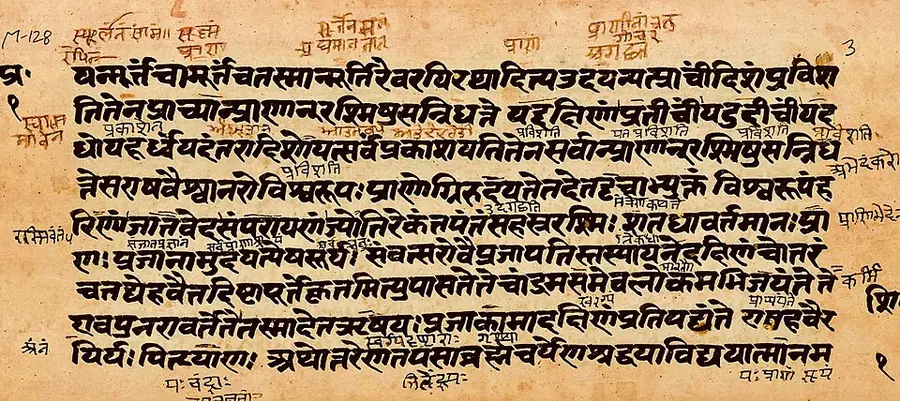
The Upaniṣads were not written in one go, or by one author, or even in one century. They are a collection of teachings composed over roughly five hundred years, and, like the rest of the Veda, they were composed and handed down orally long before anyone wrote them.[1] The dates below are for composition, by texts in groups, and every one of them is an estimate from the texts’ language, geography and relation to each other. None is dated by an inscription.
The dates, text by text
| Upaniṣad(s) | Form | Approximate date | Confidence |
|---|---|---|---|
| Bṛhadāraṇyaka, Chāndogya | prose; the oldest | c. 700–600 BCE[1][2] | Majority |
| Taittirīya, Aitareya, Kauṣītaki | prose | c. 600–500 BCE | Majority |
| Kaṭha, Kena, Īśā, Muṇḍaka | verse | c. 500–300 BCE[1] | Majority |
| Śvetāśvatara | verse; the first theistic Upaniṣad | c. 400–200 BCE[3] | Majority |
“Upaniṣad” — traditionally glossed upa-ni-ṣad, “sitting down close to” — names teachings passed privately from teacher to pupil. The texts were attached to the existing Vedic schools as their final portions, which is why the tradition calls them Vedānta, “the end of the Veda.”[1] Consensus
The evidence
Relative order from language. The two oldest are in archaic prose, embedded in the ritual literature of their Vedic schools, and full of the Brāhmaṇas’ concerns. The verse Upaniṣads use later language, more developed doctrine (meditation, breath control, a theistic god in the Śvetāśvatara), and increasingly respond to positions held by Buddhists and Jains.[1][2] Majority
Before the Upaniṣads. They presuppose the whole later Vedic world: the Brāhmaṇas (c. 1000–800 BCE) and their fear of punarmṛtyu, “re-death,” and the Āraṇyakas, “forest texts” (c. 900–700 BCE), which begin to internalize ritual as meditation.[4][1] The Upaniṣads’ prayer asato mā sad gamaya, “from the unreal lead me to the real,” is in origin a formula spoken during a soma sacrifice.[5]
Geography. The debates happen at the court of Janaka of Videha, in Kosala, Videha and Kāśī — modern eastern Uttar Pradesh and Bihar, well east of the Rigveda’s Punjab and the Brāhmaṇas’ doāb.[6] That fits a date after the eastward expansion that the Śatapatha Brāhmaṇa narrates as a migration myth (§4).[7] Majority
The social setting. The world in the background has cities, kings who argue philosophy, and wealth in quantity — the second urbanization of the eastern Ganga plain, marked by Northern Black Polished Ware from c. 700 BCE and punch-marked coins from the 6th to 4th centuries BCE.[8][9]
The Buddha as a marker. The Bṛhadāraṇyaka and Chāndogya do not respond to Buddhist positions; later Upaniṣads clearly do. On almost all reckonings that makes the two oldest pre-Buddhist. Since the Buddha’s own dates are uncertain (the working default is c. 400 BCE, give or take twenty years), this is a relative anchor, not an absolute one.[1][10][11]
A doctrine arriving. The oldest Upaniṣads contain the first statement of karma — taught in private at BU 3.2.13 and stated openly at BU 4.4.5 — which appears nowhere in the Vedas or Brāhmaṇas. The texts catch an idea at the moment of arrival.[12][13]
The late edge. The younger verse Upaniṣads stand further from the altar. The Muṇḍaka calls sacrificial rites “unsteady boats” — ritual demoted rather than rejected.[14] The Śvetāśvatara is theistic, makes Rudra-Śiva the supreme being, and at 6.23 contains the earliest use of the word bhakti in the Vedic corpus, a vocabulary that points directly at the Bhagavad Gītā (c. 200 BCE – 200 CE). That forward-looking theology is the main reason it is placed last in the classical group.[3][15] Majority
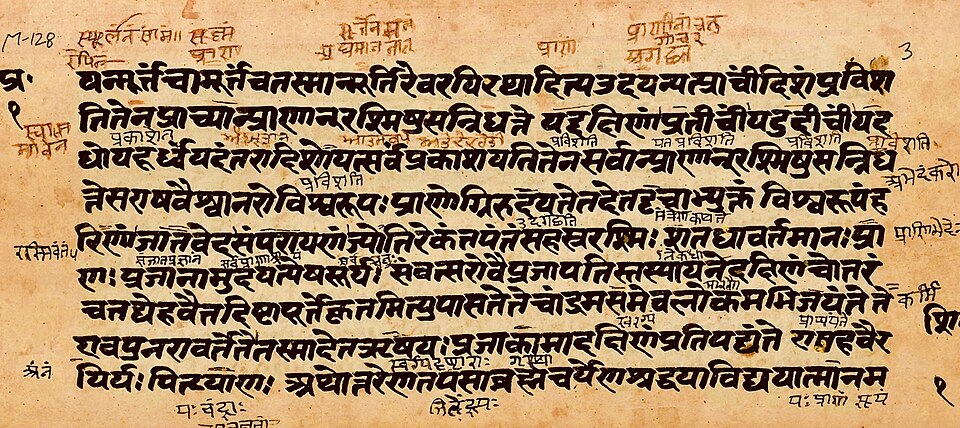
Composition versus writing. No writing is attested in India before the Ashokan edicts of c. 250 BCE, so the oldest Upaniṣads were in existence for three or four centuries before they could have been written down at all.[16] The genre also did not close when the classical ones were finished: when the Mughal prince Dārā Shukoh had them translated into Persian in 1657, he gathered some fifty texts under the name.[17]
A short timeline
| Date | What happens | Confidence |
|---|---|---|
| c. 1000–800 BCE | Brāhmaṇas: ritual theology; fear of re-death[4] | Majority |
| c. 900–700 BCE | Āraṇyakas internalize ritual as meditation[1] | Majority |
| c. 700–600 BCE | Bṛhadāraṇyaka and Chāndogya: karma, rebirth, tat tvam asi[12][18] | Majority |
| c. 600–500 BCE | Taittirīya, Aitareya, Kauṣītaki | Majority |
| c. 480–400 BCE | The Buddha (working default); Mahāvīra[19][11] | Contested |
| c. 500–300 BCE | Verse Upaniṣads: Kaṭha, Kena, Īśā, Muṇḍaka[1] | Majority |
| c. 400–200 BCE | Śvetāśvatara: Rudra-Śiva supreme; first Vedic use of bhakti[3] | Majority |
| c. 250 BCE | Earliest securely dated writing in India[20] | Consensus |
| c. 700–750 CE | Śaṅkara’s commentaries make the Upaniṣads the core of Advaita (§9)[21] | Contested (dates) |
| 1657 | Dārā Shukoh’s Sirr-i-Akbar: some fifty Upaniṣads in Persian[17] | Consensus |
| 1801–02 | Oupnek’hat: the Persian rendered into Latin; read by Schopenhauer[22] | Consensus |
What scholars disagree about
Were the oldest Upaniṣads before the Buddha? The majority says yes for the Bṛhadāraṇyaka and Chāndogya. Johannes Bronkhorst is the principal dissent: he argues that parts of the older Upaniṣads — possibly precisely the passages introducing rebirth and karma — were composed at or after the Buddha’s time, under the influence of an eastern ascetic culture he calls Greater Magadha.[23] Michael Witzel’s rebuttal defends the earlier chronology on linguistic and textual grounds.[10] A middle view treats the Upanishadic and Śramaṇa movements as contemporaneous strands of one ferment rather than a sequence. Contested
Who “wrote” them? No Upaniṣad has an author in the modern sense. They name teachers — Yājñavalkya, Uddālaka Āruṇi, the kings Janaka, Pravāhaṇa Jaivali and Ajātaśatru, and the women Gārgī and Maitreyī — but whether these are historical people or literary characters is debated. Steven Lindquist reads Yājñavalkya as a literary characterization, which cautions against treating his debates as reportage.[6][24] Contested
The traditional view. In Hindu tradition the Upaniṣads are śruti, revealed and authorless, belonging to the eternal Veda; the question “when were they written” concerns only when human beings received and transmitted them. A historian can state that view accurately while dating the surviving texts by their language and setting — the two questions are different in kind.[1]
Common misconceptions
- “The Upaniṣads are as old as the Rigveda.” They are centuries younger: the Rigveda’s oldest books are c. 1500–1200 BCE; the oldest Upaniṣads c. 700–600 BCE.[25][1]
- “The Upaniṣads teach one philosophy.” They contain a personal creator and an impersonal absolute, monism and theism, which is why Śaṅkara, Rāmānuja and Madhva could each build incompatible systems from the same texts.[2]
- “Their most famous line has one settled meaning.” Tat tvam asi (CU 6.8.7) is usually rendered “That you are,” following Śaṅkara. Joel Brereton reads it as “and that’s how you are, Śvetaketu,” and Olivelle’s standard translation adopts that construal.[18][26]
Why it matters
The date is what shows the scale of the change. Between the Brāhmaṇas and the oldest Upaniṣads, in perhaps two or three centuries, the sacred moves from the fire altar into the self, and karma, rebirth and liberation enter Indian religion for the first time.[1] Everything later schools of Vedānta argue about begins here. The texts, the passages and the debates are set out in full in §5.
References
- ^ a b c d e f g h i j k l Patrick Olivelle, trans. The Early Upaniṣads: Annotated Text and Translation. Oxford University Press, 1998. full text The scholarly standard. Its introduction is the best short account of the period.
- ^ a b c Signe Cohen Text and Authority in the Older Upaniṣads. Brill, 2008. open library
- ^ a b c ŚvU 6.23 — Śvetāśvatara Upaniṣad. c. 400–200 BCE. Sanskrit. The earliest use of the word bhakti in the Vedic corpus, in the first theistic Upaniṣad. read the text
- ^ a b ŚB 2.3.3.9 — Śatapatha Brāhmaṇa. c. 900 BCE. Vedic Sanskrit. Whoever goes to the next world without escaping Death "dies again and again there" — punarmṛtyu, the fear of re-death, which is the conceptual seed of saṃsāra but is solved by ritual, not knowledge. read the text
- ^ BU 1.3.28 — Bṛhadāraṇyaka Upaniṣad. c. 700 BCE. Sanskrit. asato mā sad gamaya — a soma-ritual formula that outlived the ritual and is recited in schools today. read the text
- ^ a b Steven E. Lindquist The Literary Life of Yājñavalkya. SUNY Press, 2023. doi Treats the Upaniṣads' central figure as literary characterization — a lever against reading BU 3–4 as doctrinal reportage.
- ^ ŚB 1.4.1.10–17 — Śatapatha Brāhmaṇa. c. 900 BCE. Vedic Sanskrit. Videgha Māthava carries Agni east across the Sadānīrā — the tradition's own memory of the frontier moving into the Ganga plain. read the text
- ^ Robin Coningham & Ruth Young The Archaeology of South Asia: From the Indus to Asoka. Cambridge University Press, 2015. The standard synthesis for §§1–6.
- ^ Upinder Singh A History of Ancient and Early Medieval India. Pearson, 2008. open library The best textbook on the archaeology-plus-text synthesis.
- ^ a b Michael Witzel "Moving Targets? Texts, Language, Archaeology and History in the Late Vedic and Early Buddhist Periods". Indo-Iranian Journal 52, 2009. doi The central chronological rebuttal to Bronkhorst.
- ^ a b L. S. Cousins "The Dating of the Historical Buddha: A Review Article". Journal of the Royal Asiatic Society 6, 1996. doi Where the c. 400 BCE working default comes from.
- ^ a b BU 3.2.13 — Bṛhadāraṇyaka Upaniṣad. c. 700 BCE. Sanskrit. The single most important passage on this site: karma is taught in private, away from the assembly — which is how we know the idea was new. read the text
- ^ BU 4.4.5 — Bṛhadāraṇyaka Upaniṣad. c. 700 BCE. Sanskrit. "As one acts, so one becomes." Karma now stated openly as settled doctrine — inside the same text that whispered it. read the text
- ^ Muṇḍaka 1.2.7 — Muṇḍaka Upaniṣad. c. 400 BCE. Sanskrit. Sacrificial rites called "unsteady boats" — ritual demoted rather than rejected, in the tradition's own words. read the text
- ^ Angelika Malinar The Bhagavadgītā: Doctrines and Contexts. Cambridge University Press, 2007.
- ^ Richard Salomon Indian Epigraphy. Oxford University Press, 1998. open library The standard handbook for inscriptions and their dating.
- ^ a b Sirr-i-Akbar — Dārā Shukoh. 1657 CE. Persian. Fifty Upaniṣads in Persian. Via Anquetil-Duperron's Latin it reached Schopenhauer — the Upaniṣads entered Western philosophy through a Mughal prince. about
- ^ a b CU 6.8.7 — Chāndogya Upaniṣad. c. 700 BCE. Sanskrit. tat tvam asi — "that you are." The doctrinal core of Vedānta and the most influential sentence in Indian philosophy. read the text
- ^ Heinz Bechert, ed. The Dating of the Historical Buddha. Vandenhoeck & Ruprecht, 3 vols., 1991. The symposium that unsettled the traditional dates — and reached no consensus.
- ^ Rock Edict 13 — Ashokan edicts. c. 256 BCE. Prakrit in Brāhmī. Names five Hellenistic kings whose reigns are independently dated — the peg the entire Indian chronology hangs from. read the text
- ^ Wilhelm Halbfass Tradition and Reflection: Explorations in Indian Thought. SUNY Press, 1991. full text On Śaṅkara and his Mīmāṃsā opponents.
- ^ Oupnek'hat — Anquetil-Duperron, trans.. 1801–02 CE. Latin. Dārā Shukoh's Persian Upaniṣads rendered into Latin. The text that reached Schopenhauer, and through him nineteenth-century European philosophy.
- ^ Johannes Bronkhorst Greater Magadha: Studies in the Culture of Early India. Brill, 2007. full text The strongest case for an eastern, non-Vedic origin for karma and rebirth. Influential and contested.
- ^ CU 5.3–10 — Chāndogya Upaniṣad. c. 700 BCE. Sanskrit. Pañcāgni-vidyā. A kṣatriya king teaches rebirth to two brahmins who cannot answer his questions — the texts crediting the doctrine outside the priesthood. read the text
- ^ Michael Witzel "Early Sanskritization: Origins and Development of the Kuru State". Electronic Journal of Vedic Studies 1, 1995. doi The Kuru state thesis — canonization as a political project.
- ^ Joel P. Brereton "Tat Tvam Asi in Context". Zeitschrift der Deutschen Morgenländischen Gesellschaft 136, 1986. The philological case against the familiar rendering of the most quoted sentence in the Upaniṣads.