The short version: the Rāmāyaṇa of Vālmīki was composed in stages, most likely between about the 5th century BCE and the 3rd century CE, and it reached the form we know within the same centuries as the Mahābhārata.[1][2] Its central books, the story of Rāma’s exile, Sītā’s abduction and the war on Laṅkā, are the older core. The first and last books were added later, and they are the books in which Rāma is openly a god.[1] No manuscript survives from anywhere near that time, and the text states no date. The window rests on the poem’s own layers, its language, the political world it describes, and its relation to the other epic.
The evidence for dating the Ramayana
Layers, and the divine frame
The Rāmāyaṇa has seven books (kāṇḍas). Books 2 to 6 tell one continuous story: Rāma’s exile from Ayodhyā, the forest years, the abduction of Sītā by Rāvaṇa, the alliance with the monkeys and the war. Book 1 (Bāla, “childhood”) adds Rāma’s birth and youth, and Book 7 (Uttara, “the last”) adds what happens after the return, including Sītā’s banishment.[1]
Scholars have long read Books 1 and 7 as later additions. They repeat and anticipate material from the core, and they change who Rāma is. In the core he is a heroic prince who suffers, grieves and doubts. The explicit identification of Rāma with Viṣṇu belongs to the added frame.[1]
What it proves. The poem was not composed at one sitting. Its older narrative was later wrapped in a frame that turned its hero into an incarnation of the supreme god, the same move that the avatāra idea of the Bhagavad Gītā makes possible for Kṛṣṇa (see Chapter 7: Epic and Classical Synthesis).[1][3] That gives a relative date: the core comes before the theology of Rāma’s divinity, and the frame comes with it. Majority
Language and metre: the “first poem”
The Rāmāyaṇa is in epic Sanskrit, mostly in the two-line śloka metre, and its style is already close to the ornamented court poetry (kāvya) of later centuries. The tradition calls it the ādikāvya, “the first poem,” and Vālmīki the ādikavi, “the first poet.”[1][4] Book 1 tells the origin story: Vālmīki sees a hunter kill one of a pair of birds, and his grief (śoka) comes out as the first verse (śloka).[1]
What it proves. The language is post-Vedic. It belongs with the epic and early classical literature, not with the Vedas, so the poem cannot be as old as the Rigveda’s c. 1500–1200 BCE. Note also where the “first poem” claim sits: in Book 1, one of the later books. The tradition’s own account of the poem’s origin is part of its growth.
The world the core describes
The core story is centred on the kingdom of Kosala and its capital Ayodhyā, in the middle Ganges plain, with Videha, Sītā’s homeland, as its neighbour. North India is described as a land of established kingdoms; the south is forest, hermitages and fabulous peoples.[1] Goldman argues from this political map, among other things, that the core may go back to roughly the 8th to 6th centuries BCE, before the rise of Magadha’s empire reshaped the region.[1][5] Most scholars place the central books somewhat later, in the second half of the first millennium BCE, and treat geography as weak evidence because poets can set a story in an older world on purpose. Contested
Relation to the Mahabharata
The Mahābhārata contains its own summary of the Rāma story, the Rāmopākhyāna, told in its third book.[2] So the Rāma story was known while the other epic was still growing, across roughly 400 BCE to 400 CE.[6][1] Whether that episode summarises Vālmīki’s poem or draws on an older, shared story is argued. Both epics grew over overlapping centuries, each with an early core and late additions, so “which is older” has no single answer.
Who wrote the Ramayana?
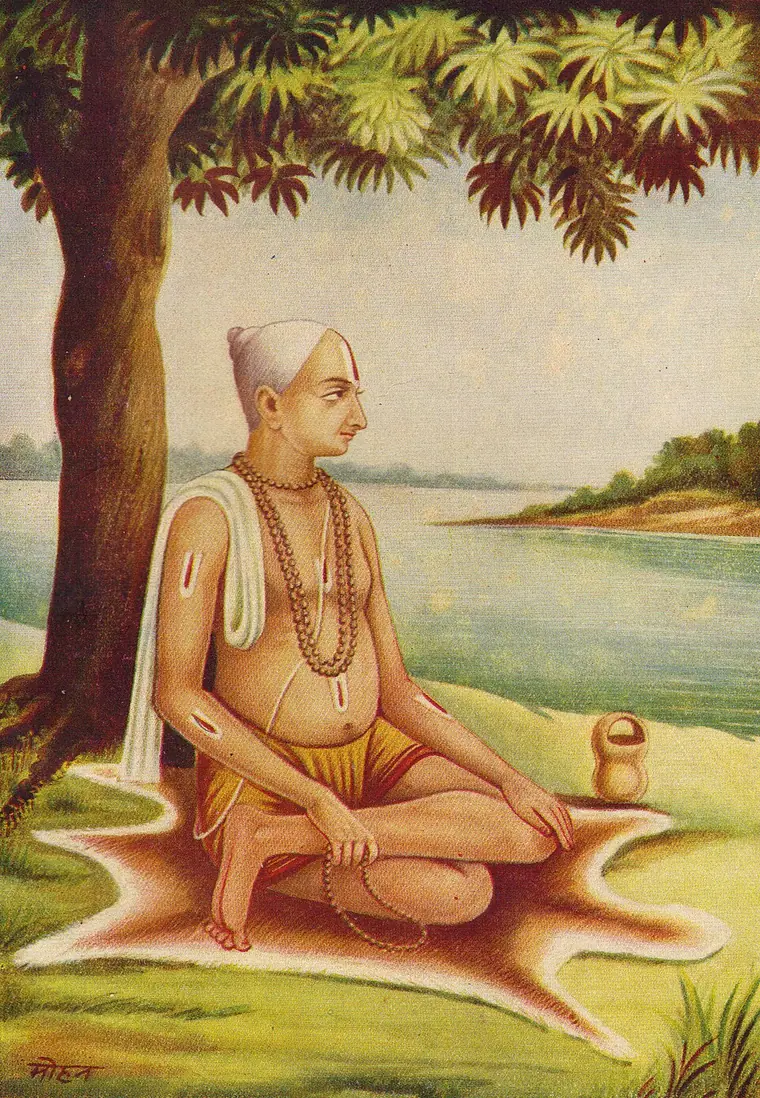
Tradition names the sage Vālmīki as its author, and the poem names him too: in Book 1 he composes it and teaches it to Rāma’s sons, who sing it before their father.[1] Historically, the core may well go back to one gifted poet, since its style and narrative are unusually unified. But the poem as it survives is the work of many hands across several centuries. The Critical Edition prepared at the Oriental Institute, Baroda, and completed in 1975, compared manuscripts from across India to reconstruct the oldest recoverable text; Goldman’s team translated that edition. Even that reconstructed text includes Books 1 and 7.[1]
Did Rama live? Is the Ramayana history?
For many Hindus, Rāma is a historical person and a god. Tradition places him in the Tretā Yuga, the second of the four world-ages, long before Kṛṣṇa, who belongs to the third. On that reckoning the Rāmāyaṇa describes events far older than any human record. That view deserves to be stated fairly: it treats the story as remembered history, and it is held with deep conviction.
Historians answer that there is no archaeological or independent textual evidence for a historical Rāma, and that the epics reflect the societies of the centuries in which they were composed rather than an earlier age.[5] Attempts to calculate a date for Rāma’s birth from the planetary positions the text describes rely on Book 1, the later frame, so at most they date the astronomy of that frame’s authors. A real local king may lie somewhere behind the story; nothing now known can identify him.
The question became political through the dispute over Ayodhyā. That dispute concerned a particular site claimed as Rāma’s birthplace; the Supreme Court decided it in 2019 as a question of title, and said explicitly that title could not rest on the archaeological findings.[7][8] It did not settle, and was not asked to settle, when or whether Rāma lived. Political
One story, many Ramayanas
Vālmīki’s poem is the oldest surviving full telling, but it was never the only one. A. K. Ramanujan’s essay “Three Hundred Rāmāyaṇas” surveyed tellings that differ sharply in plot, morals and even who the hero is.[9] A Buddhist jātaka tells the story without the abduction or the war.[10] Jain versions, beginning with Vimalasūri’s Prakrit Paumacariya (its date is disputed, but early centuries CE), recast Rāvaṇa as a learned, tragic figure. The Tamil poet Kamban retold it, and Thai, Malay and other Southeast Asian versions developed their own.[9]
In north India, the decisive retelling came much later. Tulsīdās began the Awadhi Rāmcaritmānas in 1574, a date he states in the text itself, and for the Hindi-speaking world it, not Vālmīki’s Sanskrit, became the Rāmāyaṇa recited and performed every year in the Rāmlīlā (see Chapter 10: Encounter with Islam).[11][12] Ramanand Sagar’s television serial of 1987–88, drawn largely from Tulsīdās, then made one telling the telling for a national audience.[13][14][15]
A short timeline
| Date | What happens | Confidence |
|---|---|---|
| c. 1500–1200 BCE | Rigveda, the oldest Hindu text, composed (§3)[16] | Majority |
| c. 8th–6th c. BCE | Earliest possible core of the Rāmāyaṇa, on Goldman’s argument[1] | Contested |
| c. 500–100 BCE | Books 2–6, the narrative core, take shape[1] | Majority |
| c. 400 BCE – 400 CE | Both epics grow; the Mahābhārata includes the Rāmopākhyāna[2][6] | Majority |
| c. 100 BCE – 300 CE | Books 1 and 7 added; Rāma identified with Viṣṇu[1] | Majority |
| Early centuries CE | Vimalasūri’s Jain Paumacariya[9] | Contested |
| 1574 | Tulsīdās begins the Rāmcaritmānas[11] | Consensus |
| 1975 | Baroda Critical Edition of the Rāmāyaṇa completed[1] | Consensus |
| 1987–88 | Sagar’s Rāmāyaṇ on national television[13] | Consensus |
| 2019 | Supreme Court judgment in the Ayodhyā dispute[7] | Consensus |
What scholars disagree about
How early the core is. Goldman argues that the core could go back to roughly the 8th to 6th centuries BCE.[1] Other scholars, John Brockington among them, put the earliest stage later, in the 5th or 4th century BCE or after, and trace the poem’s growth over many centuries.[6] All agree on stages; they differ on where the first stage falls. The range “about 500 BCE to 300 CE” is a majority window, not a measurement.
Which epic is older. The case for the Rāmāyaṇa: tradition puts Rāma’s age first, the Mahābhārata retells Rāma’s story while the Rāmāyaṇa never mentions the Pāṇḍavas, and Goldman’s early core would predate much of the other epic.[1][2] The case against a simple answer: the Mahābhārata’s war story may be just as old in conception, and the Rāmāyaṇa’s polished style looks later. Both grew side by side for centuries. Contested
The traditional view. For many Hindus the Rāmāyaṇa is history (itihāsa), composed by Vālmīki as a contemporary of Rāma in the Tretā Yuga. The historian’s objection is linguistic and structural: the poem’s Sanskrit is post-Vedic, and its layers show it growing over centuries. Majority / Political
Common misconceptions
- “The Ramayana is older than the Vedas.” Its language is later than the Rigveda’s by many centuries, and its theology of Rāma as Viṣṇu is later still.[1]
- “There is one Ramayana.” There are hundreds of tellings in many languages and religions; Vālmīki’s is the oldest full one to survive.[9]
- “Rama was always worshipped as God.” In the poem’s older core he is a hero. His divinity is explicit in the later frame, and he becomes the supreme popular deity of the north only in the second millennium CE (§10).[1][12]
- “The Ayodhya verdict proved Rama’s birthplace.” The Court decided a question of title, not of history.[7]
Why the date matters
Dating the Rāmāyaṇa between about 500 BCE and 300 CE puts it in the same centuries as the Bhagavad Gītā, the first Hindu images and the avatāra theology that made Rāma and Kṛṣṇa gods.[1][3] Its own layers show that change happening: a heroic prince in the older books, an incarnation of Viṣṇu in the newer ones. Read that way, the Rāmāyaṇa is not evidence of a lost age before history, but one of the clearest records of how Hindu devotion took shape within it.
For the full story of the epics, avatāras and the first images, see Chapter 7: Epic and Classical Synthesis.
References
- ^ a b c d e f g h i j k l m n o p q r s t u Robert P. Goldman et al., trans. The Rāmāyaṇa of Vālmīki: An Epic of Ancient India. Princeton University Press, 7 vols., 1984. The complete scholarly translation of the critical edition.
- ^ a b c d V. S. Sukthankar et al., eds. The Mahābhārata: Critical Edition. Bhandarkar Oriental Research Institute, Pune, 1966. full text Pune critical edition (1919–1966): 1,259 manuscripts examined, 734 actually used; passages found only in some manuscripts relegated to footnotes and appendices.
- ^ a b Gavin Flood An Introduction to Hinduism. Cambridge University Press, 1996. open library The standard university textbook, and the most balanced single overview.
- ^ Sheldon Pollock The Language of the Gods in the World of Men. University of California Press, 2006. open library The vernacular millennium, and the politics of Sanskrit.
- ^ a b Romila Thapar Early India: From the Origins to AD 1300. Penguin, 2002. full text The best single-volume political and social history for this whole span.
- ^ a b c John Brockington The Sanskrit Epics. Brill, 1998. open library The standard handbook on both epics: their stages of growth, recensions and dating.
- ^ a b c M Siddiq v. Mahant Suresh Das — Supreme Court of India. 2019 CE. English. The Ayodhya judgment. Records both the 1949 placing of idols and the 1992 demolition as unlawful, and awards the site for a temple. about
- ^ Christophe Jaffrelot The Hindu Nationalist Movement in India. Columbia University Press, 1996. open library
- ^ a b c d Paula Richman, ed. Many Rāmāyaṇas: The Diversity of a Narrative Tradition in South Asia. University of California Press, 1991. full text Contains Ramanujan's "Three Hundred Rāmāyaṇas."
- ^ Jātaka 461 (Dasaratha Jātaka) — Jātaka. Verses c. 3rd–1st c. BCE; prose commentary c. 5th c. CE. Pali. A Buddhist Rāma story in which the wise prince Rāma accepts exile calmly; the Buddha identifies Rāma as a past life of his own. read the text
- ^ a b Rāmcaritmānas, Bālkāṇḍ — Tulsīdās. 1574 CE. Awadhi. For hundreds of millions this, not Vālmīki, is the Rāmāyaṇa. Scripture in a spoken tongue, over pandits' objections. read the text
- ^ a b Philip Lutgendorf The Life of a Text: Performing the Rāmcaritmānas of Tulsidas. University of California Press, 1991.
- ^ a b Rāmāyaṇ (television serial) — Ramanand Sagar, Doordarshan. 1987–88. Hindi. 78 episodes drawn largely from Tulsīdās, watched by an estimated 80–100 million per episode. Broadcasting one telling to a hundred million people did what print never quite managed. about
- ^ Philip Lutgendorf "Ramayan: The Video". TDR: The Drama Review 34, 1990. doi Written while the serial was still airing. The best account of what mass broadcast did to a plural narrative tradition.
- ^ Arvind Rajagopal Politics after Television: Hindu Nationalism and the Reshaping of the Public in India. Cambridge University Press, 2001. full text The televised Rāmāyaṇ and its political afterlife.
- ^ Stephanie W. Jamison & Joel P. Brereton, trans. The Rigveda: The Earliest Religious Poetry of India. Oxford University Press, 3 vols., 2014. The standard complete English translation. Supersedes Griffith entirely.