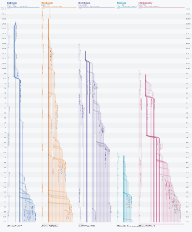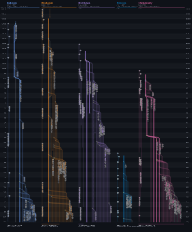
The short version: none of the four older traditions here began with heaven and hell. Their oldest texts send the dead somewhere, to the Fathers or to Sheol, but not to a place of reward or punishment. The idea that what you do decides where you go after death arrives later, and it arrives twice, by two different routes. In north India, around 700 BCE, it took the form of rebirth: the next life depends on conduct, and heavens and hells become stops in a cycle rather than final homes. In Judaism, around 165 BCE, it took the form of resurrection and judgment: the dead will rise, some to everlasting life and some to everlasting shame. Buddhism shared the first picture; the second spread into rabbinic Judaism and Christianity. Majority Sikhism, which began with Guru Nānak in Punjab in the early sixteenth century, inherited the first picture and taught release from the cycle by grace. This page sets the five histories side by side. It traces when each belief appears in the evidence; whether any of them is true is outside what history can test.
Hinduism: from the Fathers to rebirth
The Rigveda’s funeral hymns, in its latest book, give the oldest Indian picture. The cremation hymn asks Agni not to destroy the dead man but to “cook” him and send him on to the Fathers, the ancestors; it sends his eye to the sun and his breath to the wind.[1] The hymn to the Fathers counts the cremated and the buried alike as members of the world of the dead.[2] There is no judgment of conduct here and no return. In the Rigveda the dead go to the world of the Fathers, and the aim of life is cattle, sons and a full span of years (Hinduism §3). Consensus
The first worry appears in the Brāhmaṇas, the ritual manuals of c. 1000–800 BCE. They fear punarmṛtyu, “re-death”: that someone who reaches the next world “dies again and again there”. The remedy is ritual, by which the sacrificer “conquers recurring death”.[3][4] This is the seed of the later idea, but it is not rebirth on earth and it is not ethical (Hinduism §4). Consensus
Then, in the oldest Upaniṣads, c. 700 BCE, comes the first systematic theory of rebirth. In the Chāndogya, a king teaches two paths from the cremation fire: the path of the gods, from which there is no return, and the path of the Fathers, which leads to the moon, back to earth as rain and food, and into a new birth. The same passage already makes the next birth depend on conduct: those of pleasant behaviour enter a pleasant womb, those of foul behaviour the womb of a dog or a pig.[5][6] The world of the Fathers, once the goal, has become a station on the way back (Hinduism §5). Majority
With that change, heaven stopped being the highest goal. The Upaniṣads moved the goal from “the world of the fathers” to mokṣa, release from rebirth altogether. Heaven survives as a reward: the Heliodorus pillar of c. 110 BCE lists three “immortal precepts” that lead to heaven, self-restraint, renunciation and vigilance (Hinduism §7).[7] But it is a reward inside the cycle, not the end of it. Consensus For the debate over where karma and rebirth came from, see Where does karma come from?
Buddhism: heavens and hells inside the cycle
The Buddha did not invent karma and rebirth; they were shared with the Upaniṣads and the Jains, and whether he took them from the Upaniṣads or both drew on an older eastern culture is still debated (Buddhism §1).[6][8] Contested What he accepted was rebirth in many realms, driven by past action, with karma redefined as intention: “It is intention that I call deeds.”[9] Consensus
In this picture even the gods are inside the cycle. A god’s life is long and pleasant but finite; good karma runs out, and the god is reborn.[10] Heaven is therefore not salvation. The goal is nibbāna, the “blowing out” of craving that ends rebirth (Buddhism §2). Consensus The emperor Ashoka, in the third century BCE, preached an ethical dhamma to his subjects in which heaven is the reward, and that heaven is a good rebirth; nirvana is never mentioned in his edicts (Buddhism §4).[11][12] Consensus
Hells belong to the same cycle, and in China they became a family matter. In the Yulanpen Sūtra the monk Mulian rescues his mother from hell by making offerings to the monks, and the story became the basis of the Ghost Festival held every year in the seventh month. Its relation to any Indian original is uncertain (Buddhism §7).[13][14] Majority
The Pure Land is the nearest Buddhist parallel to a heaven, but it is not one in the ordinary sense. In the Larger Sukhāvatīvyūha, the monk Dharmākara vows that anyone who sincerely wishes to be born in his land and turns their mind to him even ten times will be reborn there; he becomes Amitābha, so the vow holds.[15][16] A Pure Land is a place where awakening is easy, not a heaven in the ordinary sense. Amitābha’s cult is attested in India by c. 153 CE (Buddhism §6).[17] Majority In thirteenth-century Japan, Shinran taught that birth in the Pure Land depends entirely on Amida’s vow: “Even the good person attains birth in the Pure Land, how much more so the evil person” (Buddhism §11).[18][19] Consensus
Sikhism: release from rebirth by grace
Guru Nānak (1469–1539) inherited the Indian picture of rebirth. In his hymns what binds a person to rebirth is haumai, “I-me”, the self-centredness that keeps a person from God. The remedy is to remember the divine Name (nām simaran), and nothing is attained without nadar, grace, the glance of God’s favour (Sikhism §2).[20][21][22] Consensus Ritual does not reach God: the first stanza of the Japjī, the poem that opens the scripture, says that bathing a hundred thousand times does not make one clean, and that the way is to walk in the hukam, the divine order.[23][21] Consensus on the text; translators divide on whether its first line means purity or thought. Majority on the reading. Nor does leaving the world. In the Siddh Goshṭ, a dialogue with the Nāth yogīs, one crosses “the ocean of existence” by fixing the mind on the Word and repeating the Name, like a lotus that stays untouched in the water.[24] Consensus on the text. W. H. McLeod counted liberation in this life among the teachings Guru Nānak shared with the Sant poets before him (Sikhism §1).[20] Majority
The Japjī describes the goal as the end of an ascent through five “realms” (khaṇḍs), of duty, knowledge, effort, grace and truth, the last being the sach khaṇḍ, “the realm of truth”, where the formless one dwells.[23][20][21] Consensus
Heaven and hell themselves are kept as images but not as goals (Sikhism §2). The hymns use the Indian figures of death and judgement, Jam (Yama), to whose city one without the Name goes bound, and Dharamrāj, who reads out each person’s good and bad deeds, and they use both narak, the Indian hell, and dojak (Persian dozakh), the Persian one.[25][26][27][20] Consensus on the texts. McLeod read these figures as images of separation from God and continued rebirth, with hell “demythologized”.[20] Majority A salok of Guru Nānak notes that “the Veda proclaims that merit and sin are the seed of heaven and hell” and answers that whoever sows truth finds a place in God’s court; a hymn on the time before creation counts both the Indian (naraku, suragu) and the Persian (dojaku, bhisatu) heavens and hells among the things that did not yet exist.[28][29] Consensus on the texts. Guru Arjan (1581–1606) makes heaven and hell stations on the round of rebirth, and asks for neither rule nor liberation, only love of God; the scripture keeps Kabīr’s “What is hell, what is heaven? The saints reject both.”[30][31][32] Consensus on the texts. In the Encyclopaedia of Sikhism’s words, “Sikhism does not stipulate heaven or hell wherein good and bad actions of men are rewarded or punished.”[33] Majority
The hymns also speak of a world beyond, where caste counts for nothing: “Recognise the light; do not ask about caste: in the world beyond there is no caste.”[34] Consensus on the text. The scripture also keeps Ravidās’s song of Begampurā, a city “without sorrow”, with no land tax and no second or third rank.[35] Consensus on the text.
Judaism: from Sheol to the world to come
For most of the Hebrew Bible, the dead go down to Sheol, a shadowy underworld where, in the words of a psalm, they cannot praise God.[36] There is no judgment and no return. Ezekiel’s vision of dry bones rising, in the sixth century BCE, is a metaphor for the nation’s return from exile, not a promise to individuals.[37] Consensus
Separate places for the dead appear first outside the Bible. The Book of the Watchers, probably of the third century BCE, describes hollow places in a mountain where the spirits of the righteous are kept apart from the sinners until the day of judgment.[38][39] Majority
The first unambiguous promise of individual resurrection is in Daniel, written during the persecution of Antiochus IV, c. 167–164 BCE: “many of those who sleep in the dust of the earth shall awake, some to everlasting life, and some to shame and everlasting contempt”.[40][41] The context explains the idea. The faithful were dying because they kept the Torah, and the old belief that God rewards the righteous in this life no longer worked. Resurrection answered the question of justice for the martyrs (Judaism §6). Majority
Judgment needed places, and two names arrived. Gehenna, Gē Hinnōm, was the valley south of Jerusalem where, according to Jeremiah, children had been burned; a cursed valley of fire became the name for the place where the wicked are punished.[42] The rabbis mostly made it temporary: “The judgment of the wicked in Gehinnom is twelve months.”[43] Paradise comes from Old Persian, a walled park, a word that appears only in late books of the Bible.[44] Consensus on Gehenna; Majority on paradise.
The belief did not convince everyone. Josephus reports that the Pharisees held that souls are rewarded or punished after death and the Sadducees denied it, and Ecclesiastes doubts any afterlife at all.[45][46] The rabbis, heirs of the Pharisees, made it a boundary: the Mishnah, c. 200 CE, denies a share in the world to come to anyone who says there is no resurrection of the dead (Judaism §7).[47] Maimonides made it the last of his Thirteen Principles in the twelfth century.[48] Consensus And the Pittsburgh Platform of 1885, the charter of Classical Reform Judaism in America, kept an immortal soul but rejected bodily resurrection and “Gehenna and Eden (Hell and Paradise)”.[49] Consensus The full story is in Where did the idea of resurrection come from?
Christianity: resurrection, hell and purgatory
Christianity began inside that late Second Temple world. Jesus began as a follower of John the Baptist and most scholars think he shared John’s expectation of imminent judgment (Christianity §2).[50][51] Majority The Sadducees’ question to Jesus about a woman married to seven brothers shows the resurrection dispute alive in the Gospels.[52] Consensus Within a few years of the crucifixion, his followers proclaimed that God had raised him; Paul quotes a formula that most scholars date to within about five years of it.[53][54][55] Majority on the date. Paul expected Jesus to return within his own lifetime, when the dead and the living would be “caught up… to meet the Lord in the air” (Christianity §3).[56] Majority The Greek of the Gospels calls the place of punishment Gehenna, the same valley of fire that the rabbis called Gehinnom. Consensus
What Christianity added was a middle state. Prayer for the dead is older than Christianity; 2 Maccabees already describes it.[57] Augustine speculated about a “purgatorial fire” for lesser sins, and Gregory the Great, pope from 590 to 604, was definite: “we must believe that before the day of judgment there is a Purgatory fire for certain small sins”.[58][59] The noun purgatorium, naming purgatory as a third place alongside heaven and hell, appears in the Paris schools around 1170–1180, and the Second Council of Lyon set out the doctrine in 1274 (Christianity §8).[58][60] Consensus The Orthodox churches pray for the dead but never adopted it, and purgatory’s system of masses and indulgences was what Luther attacked in 1517. See Where did purgatory come from?
Hell itself remained a preached reality. In 1741 Jonathan Edwards told a congregation in Enfield, Connecticut, that God held them “over the pit of hell, much as one holds a spider” (Christianity §12).[61] Majority that the sermon gives a one-sided picture of Edwards himself.
A rough timeline
| Date | Evidence | Confidence |
|---|---|---|
| Rigveda, latest book | Cremation sends the dead to the Fathers[1] | Consensus |
| Monarchy to Persian period | Sheol in the Hebrew Bible[36] | Consensus |
| c. 1000–800 BCE | The Brāhmaṇas fear “re-death”[3] | Consensus |
| c. 700 BCE | Upaniṣads: rebirth decided by conduct[5] | Majority |
| 5th–4th c. BCE | The Buddha: rebirth in many realms; even gods die[10] | Consensus |
| 3rd c. BCE | Book of the Watchers: places for the dead until judgment[38] | Majority |
| c. 165 BCE | Daniel 12:2: resurrection to life or shame[40] | Consensus |
| c. 153 CE | Amitābha’s cult attested in India[17] | Majority |
| c. 200 CE | Mishnah: the world to come; Gehinnom for twelve months[47][43] | Consensus |
| 590–604 | Gregory the Great’s purgatorial fire[59] | Consensus |
| 1274 | Second Council of Lyon sets out purgatory[60] | Consensus |
| Early 16th c. | Guru Nānak’s hymns: release from rebirth by grace and the Name[20][21] | Consensus |
What scholars disagree about
Whether Judaism took heaven and hell from Persia. Zoroastrianism teaches a final renovation of the world, a bodily resurrection and a judgment, and Judea was ruled by Persia for two centuries. A Greek writer of the fourth century BCE reports that the Magi taught that people will come to life again.[62][63] Against direct borrowing, the Zoroastrian books that describe the resurrection in detail were written down many centuries later, and the Jewish belief appears in Jewish terms, as an answer to a Jewish crisis.[64][65] Contested See Did Zoroastrianism influence Judaism?
Where karma and rebirth came from. The majority view is that they first appear in the oldest Upaniṣads, generally dated before the Buddha. Johannes Bronkhorst argues that an ascetic culture east of the Vedic heartland believed in rebirth first, and that both Buddhists and Upaniṣadic teachers drew on it.[6][8] Contested
How new purgatory was. Jacques Le Goff argued that the twelfth-century noun marked a new geography of the afterlife; Graham Robert Edwards replied that the belief had grown continuously and the noun named an old idea.[58][66] Contested on how much changed.
Common misconceptions
- “Hell is in the Old Testament.” Most of the Hebrew Bible knows only Sheol, where all the dead go without reward or punishment. Judgment after death first appears clearly in Daniel, c. 165 BCE. Consensus
- “Hindus and Buddhists have no heaven or hell.” Both have them, but as places of rebirth, temporary like every life in the cycle, and not the final goal. Consensus
- “The Pure Land is the Buddhist heaven.” It is better understood as a place where awakening is easy, reached through Amitābha’s vow, not a reward to enjoy for ever. Consensus
- “Purgatory is ancient church teaching.” Prayer for the dead is ancient; purgatory as a defined doctrine dates from 1274, and only in the Latin West. Consensus
- “Every Jew believes in heaven and hell.” The Sadducees denied any afterlife, the rabbis made Gehinnom temporary, and Classical Reform Judaism rejected Gehenna in 1885. Consensus
Why it matters
Ideas of reward and punishment after death feel like the core of religion, and they shape how many people think about justice, death and the people they have lost. The evidence shows them as answers to particular problems at particular times: a ritual worry about dying again in India, a crisis of martyrdom in Judea, a Punjabi teacher’s argument with ritual and asceticism, a church’s care for its dead in medieval Europe. The series on Hinduism, Buddhism, Sikhism, Judaism and Christianity trace each of those answers in its own setting.
References
- ^ a b RV 10.16 — Rigveda. c. 1100 BCE. Vedic Sanskrit. The cremation hymn: Agni is asked not to consume the dead man but to cook him and carry him to the Fathers. about
- ^ RV 10.15.14 — Rigveda. c. 1100 BCE. Vedic Sanskrit. "Those burned by fire and those not burned by fire": the Fathers include both the cremated and the buried, so the Rigveda knows two ways of disposing of the dead. about
- ^ a b ŚB 2.3.3.9 — Śatapatha Brāhmaṇa. c. 900–600 BCE. Vedic Sanskrit. Whoever goes to the next world without escaping Death "dies again and again there" — punarmṛtyu, the fear of re-death, which is the conceptual seed of saṃsāra but is solved by ritual, not knowledge. read the text
- ^ ŚB 10.1.4.14 — Śatapatha Brāhmaṇa. c. 900–600 BCE. Vedic Sanskrit. "Whereby the Sacrificer conquers recurring death" — punarmṛtyu, the anxiety that ritual is meant to solve and that saṃsāra later replaces. read the text
- ^ a b CU 5.3–10 — Chāndogya Upaniṣad. c. 700 BCE. Sanskrit. Pañcāgni-vidyā. A kṣatriya king teaches rebirth to two brahmins who cannot answer his questions — the texts crediting the doctrine outside the priesthood. read the text
- ^ a b c Patrick Olivelle, trans. The Early Upaniṣads: Annotated Text and Translation. Oxford University Press, 1998. full text The scholarly standard. Its introduction is the best short account of the period.
- ^ Heliodorus pillar — Besnagar (Vidiśā). c. 110 BCE. Prakrit in Brāhmī. A Greek ambassador calls himself a Bhāgavata and Vāsudeva the God of Gods. The oldest hard evidence for bhakti, and datable by Antialkidas's coinage. about
- ^ a b Johannes Bronkhorst Greater Magadha: Studies in the Culture of Early India. Brill, 2007. full text The strongest case for an eastern, non-Vedic origin for karma and rebirth. Influential and contested.
- ^ AN 6.63 — Nibbedhika Sutta (Aṅguttara Nikāya). c. 400–200 BCE. Pali. "It is intention that I call deeds. For after making a choice one acts by way of body, speech, and mind" (trans. Sujato). The Buddhist redefinition of karma as intention. read the text
- ^ a b AN 4.33 — Sīha Sutta (Aṅguttara Nikāya). c. 400–200 BCE. Pali. Long-lived gods who hear the Buddha's teaching realise with dismay that they too are impermanent: the gods are inside saṃsāra. read the text
- ^ Rock Edict 9 — Ashokan edicts. c. 257 BCE. Prakrit in Brāhmī. "Women are practising many and various vulgar and useless ceremonies" — the only contemporary description of ordinary, gendered domestic religion in the 3rd century BCE. read the text
- ^ E. Hultzsch Inscriptions of Asoka. Corpus Inscriptionum Indicarum I, Clarendon Press, 1925. full text The primary edition of the edicts. Public domain.
- ^ T 685 (Yulanpen jing) — Ullambana Sūtra. c. 5th–6th c. CE. Classical Chinese. Mulian rescues his mother from hell by offering food to the saṅgha on the fifteenth day of the seventh month: the scripture of the Ghost Festival. read the text
- ^ Stephen F. Teiser The Ghost Festival in Medieval China. Princeton University Press, 1988. The Yulanpen festival and how Buddhism made itself central to Chinese care for the dead.
- ^ Larger Sukhāvatīvyūha — Sūtra of the Land of Bliss. c. 1st–2nd c. CE (Chinese by 3rd c.). Buddhist Sanskrit. The monk Dharmākara's vows to create a pure land where anyone who calls on him with faith will be reborn. He becomes the Buddha Amitābha. The founding text of Pure Land devotion. read the text
- ^ Luis O. Gómez, trans. The Land of Bliss: The Paradise of the Buddha of Measureless Light. Sanskrit and Chinese Versions of the Sukhāvatīvyūha Sutras. University of Hawai'i Press, 1996. Annotated English translation of the Sanskrit and Chinese Pure Land sūtras, including Dharmākara's vows.
- ^ a b Govindnagar Amitābha pedestal — Mathurā Museum. Year 26 of Huviṣka, c. 153 CE. Sanskritised Prakrit in Brāhmī. A broken image base found at Mathurā in 1977, dated in Huviṣka's reign and naming the image as the Buddha Amitābha. The only Indian inscription naming a Mahāyāna Buddha before the fifth century.
- ^ Tannishō 3 — Tannishō (sayings of Shinran, compiled by Yuien). late 13th c. CE. Medieval Japanese. "Even the good person attains birth in the Pure Land, how much more so the evil person" (trans. Taitetsu Unno): birth depends on Amida's vow, not on one's own goodness.
- ^ Taitetsu Unno, trans. Tannisho: A Shin Buddhist Classic. Buddhist Study Center Press, rev. ed., 1996. A widely used English translation of the Tannishō; the source of the wording quoted for section 3.
- ^ a b c d e f W. H. McLeod Guru Nanak and the Sikh Religion. Clarendon Press, Oxford, 1968. The critical study of Nānak's life and theology, separating the janamsākhī tradition from the hymns.
- ^ a b c d Christopher Shackle and Arvind-pal Singh Mandair, trans. Teachings of the Sikh Gurus: Selections from the Sikh Scriptures. Routledge, 2005.
- ^ Eleanor Nesbitt Sikhism: A Very Short Introduction. Oxford University Press, 2nd ed., 2016.
- ^ a b Guru Granth Sāhib, ang 1 — Guru Nānak, Japu (Japjī). before 1539 CE (composed); 1604 CE (compiled). Punjabi in Gurmukhi. The first pauṛīs of the Japjī: cleansing, silence and cleverness do not make one true; the way is to walk in the hukam, outside which nothing stands. read the text
- ^ Guru Granth Sāhib, ang 938 — Guru Nānak, Rāmkalī, Siddh Goshṭ. before 1539 CE (composed); 1604 CE (compiled). Punjabi in Gurmukhi. The opening of the discourse with the Siddhs: Charpaṭ asks how the world-ocean is crossed; the lotus untouched in the water. read the text
- ^ Guru Granth Sāhib, ang 8 — Guru Nānak, Japu (Japjī), pauṛīs 37–38 and closing salok; So Dar. before 1539 CE (composed); 1604 CE (compiled). Punjabi in Gurmukhi. "Good deeds and bad, Dharam reads them out in the presence; by their own deeds some are near and some far"; the karam khaṇḍ; Chitr and Gupt the recorders and Dharam at God's door in So Dar. read the text
- ^ Guru Granth Sāhib, ang 1327 — Guru Nānak, Rāg Prabhātī. before 1539 CE (composed); 1604 CE (compiled). Punjabi in Gurmukhi. "Without the Name, bound, one goes to the city of Jam" (bin nāvai bādhī jam puri jāi): Yama as an image of the fate of the one without the Name. read the text
- ^ Guru Granth Sāhib, ang 471 — Guru Nānak, Āsā dī Vār. before 1539 CE (composed); 1604 CE (compiled). Punjabi in Gurmukhi. "Make compassion the cotton, contentment the thread": the salok on the sacred thread behind the janamsākhī story of the refused janeū. read the text
- ^ Guru Granth Sāhib, ang 1243 — Sāraṅg kī Vār, saloks of Guru Aṅgad and Guru Nānak. before 1552 CE (composed); 1604 CE (compiled). Punjabi in Gurmukhi. Guru Nānak: "the Veda proclaims that merit and sin are the seed of heaven and hell"; whoever sows truth finds a place in the court. Guru Aṅgad: the Veda's tales of sin and merit keep people born "into hell and heaven". read the text
- ^ Guru Granth Sāhib, ang 1035 — Guru Nānak, Mārū Solahe. before 1539 CE (composed); 1604 CE (compiled). Punjabi in Gurmukhi. Before creation there was only the hukam, and "no hell and no paradise" (dojaku bhisatu), "no hell and no heaven" (naraku suragu), no birth or death: both afterlives are part of creation. read the text
- ^ Guru Granth Sāhib, ang 278 — Guru Arjan, Sukhmanī, Rāg Gauṛī, aṣṭapadī 12. 1581–1606 CE. Punjabi in Gurmukhi. Penance done in pride brings birth "into hell and heaven, again and again" (narak surag phiri phiri avatār): heaven and hell as stations on the round. read the text
- ^ Guru Granth Sāhib, ang 534 — Guru Arjan, Rāg Devgandhārī. 1581–1606 CE. Punjabi in Gurmukhi. "I do not ask for rule, I do not ask for mukti; my mind loves the lotus feet" (rāju na chāhau mukati na chāhau). read the text
- ^ Guru Granth Sāhib, ang 969 — Kabīr, Rāg Rāmkalī. 1604 CE (compiled). Old Hindi (sant bhāṣā) in Gurmukhi. "What is hell, what is heaven? The saints reject both" (kavanu naraku kiā suragu bichārā santan doū rāde). read the text
- ^ Harbans Singh, ed. The Encyclopaedia of Sikhism. Punjabi University, Patiala, 4 vols, 1992. open access Published 1992–1998; the standard reference, with signed entries reporting both tradition and sources.
- ^ Guru Granth Sāhib, ang 349 — Guru Nānak, Āsā. before 1539 CE (composed); 1604 CE (compiled). Punjabi in Gurmukhi. "Recognise the light; do not ask about caste: in the world beyond there is no caste." read the text
- ^ Guru Granth Sāhib, ang 345 — Ravidās, Gauṛī (Begampurā). 1604 CE (compiled). Old Hindi (sant bhāṣā) in Gurmukhi. Begampurā, the city without sorrow, with no land tax (khirāj), no ranks, and a tanner set free as its citizen: Persian revenue vocabulary in a Sant's vision of heaven. read the text
- ^ a b Psalm 115:17 — Psalms (Hebrew Bible). uncertain; probably Persian period. Hebrew. 'The dead do not praise Yah, nor any who go down into silence': the older biblical view of the dead in Sheol. read the text
- ^ Ezekiel 37:1–14 — Ezekiel (Hebrew Bible). 6th c. BCE. Hebrew. The valley of dry bones: bones that rise and live are explained as 'the whole house of Israel', the nation restored from exile, not individuals raised from death. read the text
- ^ a b 1 Enoch 1–36 (Book of the Watchers) — 1 Enoch. 3rd c. BCE. Aramaic (surviving complete in Ge'ez). Two hundred Watchers descend to Mount Hermon, father giants and teach forbidden arts; evil comes from fallen angels. Aramaic fragments at Qumran date from the early 2nd c. BCE. about
- ^ George W. E. Nickelsburg 1 Enoch 1: A Commentary on the Book of 1 Enoch, Chapters 1–36; 81–108. Fortress Press (Hermeneia), 2001. The standard commentary on the Book of the Watchers.
- ^ a b Daniel 12:1–3 — Book of Daniel (Hebrew Bible). c. 165 BCE. Hebrew. Michael the great prince arises; 'many of those who sleep in the dust of the earth shall awake, some to everlasting life, and some to shame and everlasting contempt': the first clear biblical statement of resurrection and judgment. read the text
- ^ John J. Collins The Apocalyptic Imagination: An Introduction to Jewish Apocalyptic Literature. Eerdmans, 3rd ed., 2016. Daniel, Enoch and the rise of ideas about judgment, resurrection and the end.
- ^ Jeremiah 7:31 — Jeremiah (Hebrew Bible). late 7th–6th c. BCE. Hebrew. The high place of Topheth in the valley of the son of Hinnom, where children were burned: the place whose name became Gehinnom, Gehenna. read the text
- ^ a b m. Eduyot 2:10 — Mishnah. c. 200 CE. Hebrew. 'The judgment of the wicked in Gehinnom is twelve months': rabbinic Gehenna as a limited purgation for most, not eternal torment. read the text
- ^ Nehemiah 2:1–8 — Nehemiah (Hebrew Bible). Memoir set in 445 BCE. Hebrew. In the twentieth year of Artaxerxes, Nehemiah the king's cupbearer asks to be sent to rebuild Jerusalem. read the text
- ^ Josephus, Jewish War 2.119–166 — The Jewish War. c. 75–79 CE. Greek. The three Jewish 'philosophies': a long idealised account of the Essenes, and the Pharisees' belief in the survival of the soul and reward and punishment against the Sadducees' denial. read the text
- ^ Ecclesiastes 9:5–10 — Ecclesiastes (Hebrew Bible). c. 3rd c. BCE. Hebrew. The dead know nothing and have no more reward; there is no work or thought or knowledge or wisdom in Sheol. read the text
- ^ a b m. Sanhedrin 10:1 — Mishnah. c. 200 CE. Hebrew. Abba Saul adds to those with no share in the world to come 'one who pronounces the name according to its letters'. read the text
- ^ Maimonides, Commentary on Mishnah Sanhedrin 10 (Introduction to Perek Ḥeleq) — Commentary on the Mishnah. c. 1168 CE. Judeo-Arabic. The Thirteen Principles of faith; the eighth holds that the whole Torah now in our hands was given to Moses from heaven. about
- ^ Pittsburgh Platform — Conference of Reform rabbis, Pittsburgh. 16–19 November 1885. English. Classical Reform's charter: only the moral law binding; dietary and purity laws obsolete; Jews 'no longer a nation, but a religious community' expecting no return to Palestine. about
- ^ John P. Meier A Marginal Jew, vol. 2: Mentor, Message, and Miracles. Doubleday, 1994. John the Baptist, the kingdom of God and the miracle traditions.
- ^ E. P. Sanders Jesus and Judaism. Fortress Press, 1985. Starts from the Temple incident and places Jesus within Jewish restoration eschatology.
- ^ Mark 12:18–27 — Gospel of Mark (New Testament). c. 70 CE. Greek. Sadducees, 'who say there is no resurrection', test Jesus with the case of a woman married in turn to seven brothers; he answers from the Torah's 'God of Abraham, Isaac and Jacob'. read the text
- ^ 1 Corinthians 15:3–8 — Paul, First Letter to the Corinthians. c. 54 CE. Greek. A creed Paul 'received': Christ died, was buried, was raised on the third day, and appeared to Cephas, the Twelve, five hundred, James, all the apostles and Paul. read the text
- ^ James D. G. Dunn Jesus Remembered. Eerdmans, 2003. Jesus as remembered by his first followers, with a full treatment of the resurrection traditions.
- ^ Bart D. Ehrman How Jesus Became God: The Exaltation of a Jewish Preacher from Galilee. HarperOne, 2014. A developmental account of early Christology and the resurrection visions.
- ^ 1 Thessalonians 4:15–17 — Paul, First Letter to the Thessalonians. c. 50 CE. Greek. Paul expects that 'we who are alive, who are left until the coming of the Lord' will meet him in the air. read the text
- ^ 2 Maccabees 12:43–45 — 2 Maccabees. late 2nd or 1st c. BCE. Greek. Judas Maccabeus sends money for a sin offering for the fallen: 'he made atonement for the dead, so that they might be delivered from their sin' (NRSV). read the text
- ^ a b c Jacques Le Goff The Birth of Purgatory. University of Chicago Press (trans. Arthur Goldhammer; French 1981), 1984. Dates the noun purgatorium and the idea of purgatory as a place to c. 1170–1180.
- ^ a b Gregory the Great, Dialogues 4.39 (4.41 in some editions) — Dialogues. c. 593–594 CE. Latin. 'Before the day of judgment there is a Purgatory fire for certain small sins.' read the text
- ^ a b Second Council of Lyon (1274), profession of faith — Acts of the Second Council of Lyon. 1274 CE. Latin. Souls who die in charity before completing penance are cleansed after death and helped by the prayers and masses of the living. about
- ^ Jonathan Edwards, Sinners in the Hands of an Angry God — Sermon preached at Enfield, Connecticut. 8 July 1741. English. The best-known revival sermon of the Great Awakening, with its image of the sinner held over hell like a spider over a fire. about
- ^ Diogenes Laertius, Lives 1.9 (citing Theopompus) — Lives of the Eminent Philosophers. report of the 4th c. BCE, preserved 3rd c. CE. Greek. Theopompus, in book 8 of his Philippica, reports that according to the Magi people will come to life again and be immortal: early Greek evidence for a Persian belief in resurrection.
- ^ Mary Boyce Zoroastrians: Their Religious Beliefs and Practices. Routledge & Kegan Paul, 1979. open library Argues for an early date for Zarathustra; most scholars now place him later, and the range is wide.
- ^ James Barr The Question of Religious Influence: The Case of Zoroastrianism, Judaism, and Christianity. Journal of the American Academy of Religion 53, 1985. A sceptical assessment of claims that Persian religion shaped Jewish ideas of the afterlife and evil.
- ^ Alan F. Segal Life After Death: A History of the Afterlife in Western Religion. Doubleday, 2004. From Sheol to resurrection, with the Persian and Greek background.
- ^ Graham Robert Edwards Purgatory: 'Birth' or 'Evolution'?. Journal of Ecclesiastical History 36: 634–646, 1985. A critique of Le Goff's twelfth-century 'birth' of purgatory.