The short version: there is no single oldest religion, only a set of different records, each answering a different question. The oldest recorded religions are those of Mesopotamia and Egypt, and nobody practises them today. The oldest living tradition with datable scripture still in use is probably Hinduism’s Vedic layer, with Zoroastrianism a possible rival and Judaism’s earliest records somewhat later: about 140 years on the inscriptions, a few centuries on the oldest scriptures. Religious behaviour is older than any of them by tens of thousands of years. Contested on any single winner. This page sets the candidates side by side and ranks the evidence, not the faiths. Two companion pages take narrower versions of the question: Is Hinduism the oldest religion in the world? and Is Judaism older than Hinduism?
It depends what you count
“Oldest religion” hides at least five different questions, and each has a different answer.
- Oldest evidence of religious behaviour. Archaeology can find burials, offerings and ritual sites long before writing, but it cannot read the beliefs behind them. The answer lies tens of thousands of years back, and belongs to no named religion. Consensus
- Oldest recorded religion. The first gods named in writing are Mesopotamian and Egyptian, from the late fourth and third millennia BCE. Both religions died out. Consensus
- Oldest living religion. Which traditions still practised can show the oldest datable evidence? Here the Vedic hymns, the Zoroastrian Gāthās and the earliest records of Israel and of Shang China are the usual contenders, and each date is itself an argument. Contested
- Oldest founded religion. A religion traced to a known teacher can be dated by that teacher: Jainism’s Pārśva and Mahāvīra, Zarathustra, the Buddha, Jesus, Muhammad. Most of these dates are disputed too. Majority
- Oldest monotheism. This depends on what counts as monotheism, and is taken separately below.
Behind all five sits a sixth question: is it the same religion? A tradition that has changed its gods, its rituals and its scriptures may be continuous as a community and still not be “the same religion” in any simple sense. Hinduism’s oldest hymns praise gods that are barely worshipped today, and the religion of early Israel had a god among other gods (Judaism §2). Majority
The contenders
Prehistoric religion
At Qafzeh Cave in Israel, people buried their dead about 92,000 years ago, a boy with deer antlers placed against his chest, and pieces of red ochre in the graves.[1] At Lake Mungo in Australia, a man was buried about 40,000 years ago with red ochre scattered over the body.[2] Consensus that these are deliberate burials. What the people who made them believed cannot be recovered, and calling them “religion” is an inference from care and ritual, not a reading of minds. Contested
The best-known early ritual site is Göbekli Tepe in south-eastern Turkey, where huge carved pillars were set up c. 9500–8000 BCE, before farming was fully established. Its excavator, Klaus Schmidt, called it a sanctuary built by hunter-gatherers who gathered there for feasts and building work, and it is often described as the world’s first temple.[3] Edward Banning argued in 2011 that the line between “temple” and “house” may not apply there, and later excavations have found houses, hearths and rock-cut cisterns.[4] Consensus on the date; Contested on what the site was for.
Indigenous traditions
Aboriginal Australians have lived on the continent for about 50,000 years and perhaps as long as 65,000, and the Lake Mungo burials show ritual care for the dead from very early on.[2][5] Majority on about 50,000; Contested on 65,000. Aboriginal religious traditions, the complex of law, land and ancestral beings often called the Dreaming in English, are passed down orally and through ceremony.[6] They are often described as the world’s oldest living religious culture. That claim rests on the continuity of a people on their land, which is strong; it is harder to date particular beliefs or rituals, because oral tradition and archaeology answer different questions. Majority on continuity; specific beliefs cannot be dated the way a text can.
Mesopotamia and Egypt
The oldest religions known from writing come from the first literate civilisations. Mesopotamian scribes were listing gods by name by about 2600 BCE, and the temple cults behind those lists are older still.[7] Egypt’s Pyramid Texts, spells carved inside the pyramid of King Unas around 2350 BCE, are the oldest large body of religious writing to survive anywhere.[8] Consensus Both religions lasted for thousands of years and then died out as Christianity and, later, Islam spread; a moon-god cult at Harran, in what is now south-eastern Turkey, lasted into the eleventh century CE.[9] No community practises them in unbroken line today. Consensus If the question is simply “the oldest religion we have records of,” the answer is one of these two.
Hinduism’s Vedic layer
Hinduism’s oldest scripture, the Rigveda, was composed mainly c. 1500–1200 BCE on the mainstream dating and passed down orally for at least a thousand years before it was written.[10] Majority A treaty of c. 1350–1320 BCE between the Hittites and the Mitanni kingdom of northern Syria calls on Mitra, Varuṇa, Indra and the Nāsatyas, gods of the Rigveda, as witnesses.[11] Consensus The Rigveda is still recited, which gives Hinduism the strongest claim to the oldest datable scripture in continuous liturgical use. Majority
Claims that Hinduism is 5,000 or 10,000 years old rest on possible continuities with the Indus civilisation and earlier village religion, which are plausible but not demonstrable (Hinduism §1).[12] Contested Hindu tradition itself calls the dharma sanātana, eternal, and the Veda authorless, which is a theological claim, not one a historian can test.[13]
Zoroastrianism
Zoroastrianism’s oldest hymns, the Gāthās, are attributed to Zarathustra and come from the same Indo-Iranian world as the Rigveda; their language is close to Vedic Sanskrit. Their date is less secure than the Rigveda’s. Mary Boyce argued for the second millennium BCE, and Almut Hintze’s linguistic analysis also points early; many scholars place Zarathustra around 1000 BCE, and some as late as c. 500 BCE.[14][15] Contested On the early dates it is as old as the Vedic hymns; on the late ones it is centuries younger.
Chinese religion
The oldest religious writing from China is on Shang dynasty oracle bones from Anyang, c. 1250–1050 BCE. Kings asked questions of their ancestors and of a high god, Di, by cracking bones and shells with heat, and the answers were carved on them.[16] Consensus Ancestor veneration continued into later Chinese religion, though the Shang royal cult itself did not survive the dynasty. Majority
Judaism
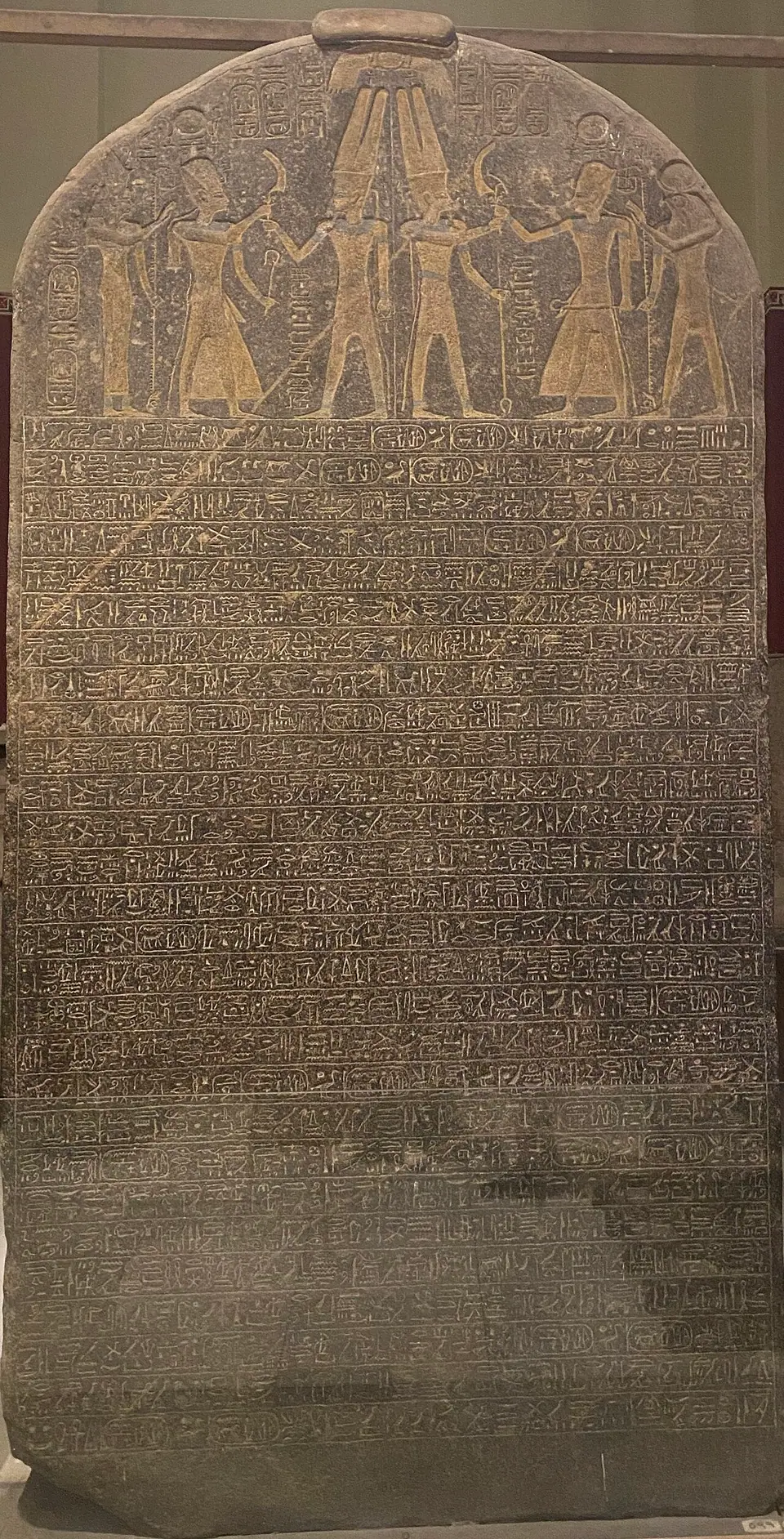
Israel first appears in writing as a people on the Merneptah Stele, an Egyptian victory inscription of c. 1208 BCE.[17] Consensus The god Yahweh is first securely named c. 840 BCE, on the Moabite Mesha Stele.[18] Majority The oldest parts of the Hebrew Bible were composed over the following centuries, and the series dates the first explicit monotheism to around the Babylonian exile (Judaism §4).[19] Majority On the datable evidence, Judaism’s earliest records are close to the Vedic ones on the inscriptions (the Egyptian “Shasu of Yhw” lists at Soleb, c. 1390–1350 BCE, are roughly contemporary with the Mitanni treaty, if the name is the god’s), and a few centuries younger on the dates of their oldest scriptures. Jewish tradition counts from the creation of the world, which it dates to 3761 BCE; that is the tradition’s reckoning, not a historical date. Consensus that this is the traditional count.
Jainism
Jain tradition holds that Mahāvīra was the last of twenty-four teachers, tīrthaṅkaras, stretching back into an immensely long past, and places the death of his predecessor Pārśva 250 years before Mahāvīra’s.[20] Historians date Mahāvīra to the fifth century BCE, a contemporary of the Buddha, and accept Pārśva as a historical figure of perhaps the eighth or seventh century BCE.[20] Majority That would make Jainism’s founding teachers older than the Buddha but younger than the Vedic hymns (Hinduism §6).
Buddhism, Christianity, Islam and Shinto
The Buddha probably died around 400 BCE, give or take twenty years.[21][22] Contested Jesus was crucified under Pontius Pilate Consensus, probably in 30 or 33 CE (Christianity §2). Majority Islam began with Muhammad’s preaching in Mecca in the early seventh century CE.[23] Consensus Shinto’s oldest texts, the Kojiki and Nihon shoki, date from 712 and 720 CE, and the historian Kuroda Toshio argued that Shinto as a religion distinct from Buddhism took shape much later.[24] Contested These are among the world’s largest religions; none is a contender for the oldest.
What about the oldest monotheism?
The answer depends on the definition.
- Akhenaten, pharaoh of Egypt c. 1350–1335 BCE, promoted the sun-disc, the Aten, above all other gods and closed their temples. Egyptologists disagree whether this was monotheism or the worship of one god among others, and it was reversed soon after his death.[25] Contested
- Zoroastrianism worships one supreme god, Ahura Mazdā, alongside lesser divine beings; whether that counts as monotheism, and how early its oldest hymns are, are both debated.[14] Contested
- Judaism. In the Judaism series, the worship of Yahweh alone grows out of a wider pantheon, and the first explicit statement that no other god exists is dated to around the Babylonian exile, in the sixth century BCE.[19] Majority It is the oldest monotheism with an unbroken living tradition, if the Zoroastrian question is set aside. Contested
A rough timeline
| Date | Evidence | Confidence |
|---|---|---|
| c. 92,000 years ago | Burials with grave goods at Qafzeh[1] | Consensus |
| c. 40,000 years ago | Ochre burial at Lake Mungo, Australia[2] | Consensus |
| c. 9500–8000 BCE | Göbekli Tepe’s carved enclosures[3] | Consensus (date) |
| by c. 2600 BCE | Mesopotamian gods named in writing[7] | Consensus |
| c. 2350 BCE | Egypt’s Pyramid Texts[8] | Consensus |
| c. 1500–1200 BCE | The Rigveda’s oldest hymns[10] | Majority |
| c. 1350 BCE | Akhenaten’s Aten cult; Vedic gods in the Mitanni treaty[25][11] | Consensus |
| c. 1250–1050 BCE | Shang oracle bones[16] | Consensus |
| c. 1208 BCE | “Israel” on the Merneptah Stele[17] | Consensus |
| 2nd millennium–6th c. BCE | Zoroastrian Gāthās (date disputed)[15] | Contested |
| c. 840 BCE | Yahweh named on the Mesha Stele[18] | Consensus |
| 5th c. BCE | Mahāvīra and the Buddha[20][21] | Majority (Mahāvīra); Contested (the Buddha’s dates) |
What scholars disagree about
Whether prehistoric remains count as “religion”. Some archaeologists read burials, ochre and monumental sites as clear evidence of belief in an afterlife or in spirits; others warn that care for the dead and communal building do not show what people believed. Contested
How to date oral traditions. The Rigveda and the Gāthās were kept by memory for centuries before they were written down, so their dates come from language, internal references and outside inscriptions rather than manuscripts. That is why their ranges are wide.[10][15] Majority
What “the same religion” means. A historian can show continuity of people, places and practices, but every tradition on this page has changed its beliefs over time. Whether that makes it the same religion is a philosophical question as much as a historical one. Contested
Common misconceptions
- “Hinduism is 10,000 years old.” Its oldest datable scripture is c. 1500–1200 BCE. Older roots are plausible but cannot be shown to be Hindu. Majority
- “Judaism is the oldest monotheism.” Akhenaten’s Aten cult is older, though short-lived and disputed as monotheism, and Zoroastrianism’s status is debated. Judaism’s explicit monotheism is dated to around the exile. Contested
- “Zoroastrianism is the oldest religion.” Only on the earliest proposed dates for its hymns, and those are disputed; Egypt and Mesopotamia are older on any dating. Contested
- “Göbekli Tepe was the first temple.” That was its excavator’s reading. Evidence of people living there has made “temple” a contested description. Contested
- “Aboriginal beliefs can be dated to 60,000 years.” People have been in Australia for 50,000–65,000 years, and the culture is among the oldest continuous cultures anywhere; but the age of particular beliefs cannot be measured that way. Majority
Why it matters
Claims to be “the oldest religion” are often claims to authority, and they are made for several traditions at once. The evidence supports more modest and more interesting statements: that religious behaviour is very old; that the oldest written religions are extinct; and that several living traditions, Hinduism, Zoroastrianism, Judaism and the religions of China among them, keep elements that are around three thousand years old, each transformed beyond what its earliest practitioners would recognise. The series on Hinduism, Buddhism, Judaism and Christianity trace those transformations one by one.
References
- ^ a b Qafzeh Cave burials — Qafzeh Cave, Lower Galilee, Israel. c. 92,000 years ago. Deliberate burials of early modern humans with grave goods: deer antlers against a boy's chest, and red ochre in the graves. about
- ^ a b c James M. Bowler et al. New ages for human occupation and climatic change at Lake Mungo, Australia. Nature 421: 837–840, 2003. Dates the Lake Mungo burials to about 40,000 years ago and human occupation there to about 50,000.
- ^ a b Klaus Schmidt Göbekli Tepe: A Stone Age Sanctuary in South-Eastern Anatolia. ex oriente, Berlin, 2012. The excavator's account of the site as a hunter-gatherer sanctuary.
- ^ E. B. Banning So Fair a House: Göbekli Tepe and the Identification of Temples in the Pre-Pottery Neolithic of the Near East. Current Anthropology 52: 619–660, 2011. Questions the separation of 'temple' and 'house' at Göbekli Tepe.
- ^ Chris Clarkson et al. Human occupation of northern Australia by 65,000 years ago. Nature 547: 306–310, 2017. Dates the lowest artefacts at Madjedbebe, Arnhem Land, to about 65,000 years ago; the dating is debated.
- ^ W. E. H. Stanner White Man Got No Dreaming: Essays 1938–1973. Australian National University Press, 1979. Includes 'The Dreaming' (1953), the classic account of Aboriginal religious thought.
- ^ a b Thorkild Jacobsen The Treasures of Darkness: A History of Mesopotamian Religion. Yale University Press, 1976. open library The classic history of Mesopotamian religion from the fourth millennium BCE.
- ^ a b James P. Allen, trans. The Ancient Egyptian Pyramid Texts. Society of Biblical Literature, 2005. open library The oldest Egyptian religious corpus, first carved in the pyramid of Unas in the 24th century BCE.
- ^ Tamara M. Green The City of the Moon God: Religious Traditions of Harran. Brill, 1992. The long survival of the moon-god cult at Harran into the Islamic period.
- ^ a b c Stephanie W. Jamison & Joel P. Brereton, trans. The Rigveda: The Earliest Religious Poetry of India. Oxford University Press, 3 vols., 2014. The standard complete English translation. Supersedes Griffith entirely.
- ^ a b Mitanni–Hittite treaty — Boğazköy archive. c. 1350–1320 BCE. Akkadian, with Indo-Aryan divine names. Invokes Mitra, Varuṇa, Indra and the Nāsatyas as witnesses — Indo-Aryan gods attested in writing in the Near East more than a thousand years before the earliest deciphered writing from India. about
- ^ Asko Parpola The Roots of Hinduism: The Early Aryans and the Indus Civilization. Oxford University Press, 2015. full text The fullest statement of the Dravidian-Indus case. Argued, not established.
- ^ Gavin Flood An Introduction to Hinduism. Cambridge University Press, 1996. open library The standard university textbook, and the most balanced single overview.
- ^ a b Mary Boyce Zoroastrians: Their Religious Beliefs and Practices. Routledge & Kegan Paul, 1979. open library Argues for an early date for Zarathustra; most scholars now place him later, and the range is wide.
- ^ a b c Almut Hintze "Zarathustra's Time and Homeland: Linguistic Perspectives". in Michael Stausberg & Yuhan Sohrab-Dinshaw Vevaina, eds., The Wiley Blackwell Companion to Zoroastrianism (Wiley Blackwell), pp. 31–38, 2015. doi A linguist's case, from the archaism of Old Avestan, for placing Zarathustra in the second millennium BCE; useful as a survey of the dating debate.
- ^ a b David N. Keightley Sources of Shang History: The Oracle-Bone Inscriptions of Bronze Age China. University of California Press, 1978. The standard study of the Shang oracle bones and the religion they record.
- ^ a b Merneptah Stele — Egyptian Museum, Cairo. c. 1208 BCE. Egyptian (hieroglyphic). A victory hymn of Pharaoh Merneptah naming "Israel" as a people: the earliest mention of Israel outside the Bible. about
- ^ a b Mesha Stele — Louvre AO 5066. c. 840 BCE. Moabite. King Mesha of Moab names Omri king of Israel and boasts of taking the vessels of YHWH from Nebo and dragging them before Chemosh: the earliest certain mention of Yahweh outside the Bible. about
- ^ a b Mark S. Smith The Early History of God: Yahweh and the Other Deities in Ancient Israel. Eerdmans, 2nd ed., 2002. open library How Israelite religion emerged from its Canaanite setting and became monotheistic.
- ^ a b c Paul Dundas The Jains. Routledge, 2nd ed., 2002. open library The standard survey.
- ^ a b L. S. Cousins "The Dating of the Historical Buddha: A Review Article". Journal of the Royal Asiatic Society 6, 1996. doi Where the c. 400 BCE working default comes from.
- ^ Heinz Bechert, ed. The Dating of the Historical Buddha. Vandenhoeck & Ruprecht, 3 vols., 1991. The symposium that unsettled the traditional dates — and reached no consensus.
- ^ Fred M. Donner Muhammad and the Believers: At the Origins of Islam. Belknap Press of Harvard University Press, 2010. Islam's origins in the early seventh-century preaching of Muhammad.
- ^ Kuroda Toshio, trans. James C. Dobbins and Suzanne Gay "Shinto in the History of Japanese Religion". Journal of Japanese Studies 7/1: 1–21, 1981. doi The classic argument that Shinto as an independent religion is a modern construction out of a combined kami-buddha system.
- ^ a b Erik Hornung (trans. David Lorton) Akhenaten and the Religion of Light. Cornell University Press, 1999. The standard account of Akhenaten's exclusive cult of the Aten and its reversal.