Buddhism in China in one paragraph
Buddhism entered China in the first century CE, carried by merchants and monks along the Silk Road from the Kushan and Parthian lands, and is first securely attested in 65 CE at the court of a Han prince who honoured the Buddha alongside the Daoist deities Huang-Lao. Over the next eight centuries it was translated, argued over, patronised and persecuted, and it became one of China’s three teachings alongside Confucianism and Daoism. In the process it changed profoundly.[1][2] Consensus
China did not simply receive Indian Buddhism. It read it through Daoist vocabulary, filtered it through family ethics, composed new scriptures in the Buddha’s name, built new schools on texts India had treated as minor, and invented a lineage of patriarchs to give the most Chinese of them, Chan, an Indian pedigree. Much of what East Asia and the modern West take to be Buddhism, including Zen, Pure Land devotion, Buddha-nature and the vegetarian monk, took its shape here. Majority
Timeline of Buddhism in China
| Date | Event | Confidence |
|---|---|---|
| 65 CE | Imperial edict praises Liu Ying, prince of Chu, for honouring the Buddha and feeding monks and lay followers[1] | Consensus |
| 148 onward | An Shigao, a Parthian, translates meditation and Abhidharma texts at Luoyang[3][4] | Consensus |
| 166 | Xiang Kai’s memorial: shrines to Huang-Lao and the Buddha in Emperor Huan’s palace[5] | Consensus |
| 179 | Lokakṣema’s dated translation of the Perfection of Wisdom in 8,000 Lines[6] | Consensus |
| 220–589 | Era of division; Buddhism spreads under northern non-Chinese dynasties and southern courts[2] | Consensus |
| 372 / 384 / 527–528 | Buddhism reaches the Korean kingdoms of Goguryeo, Baekje and (officially) Silla, by tradition[7] | Majority |
| 374 | Dao’an’s catalogue of translated scriptures[8] | Consensus |
| 399–412 | Faxian travels overland to India and returns by sea[9] | Consensus |
| 401–413 | Kumārajīva’s translation bureau at Chang’an[10] | Consensus |
| 404 | Huiyuan argues that monks need not bow to rulers[11] | Consensus |
| 421 | Dharmakṣema’s long Mahāparinirvāṇa Sūtra: all beings have Buddha-nature[12] | Consensus |
| 446 | Emperor Taiwu of the Northern Wei suppresses Buddhism[13] | Consensus |
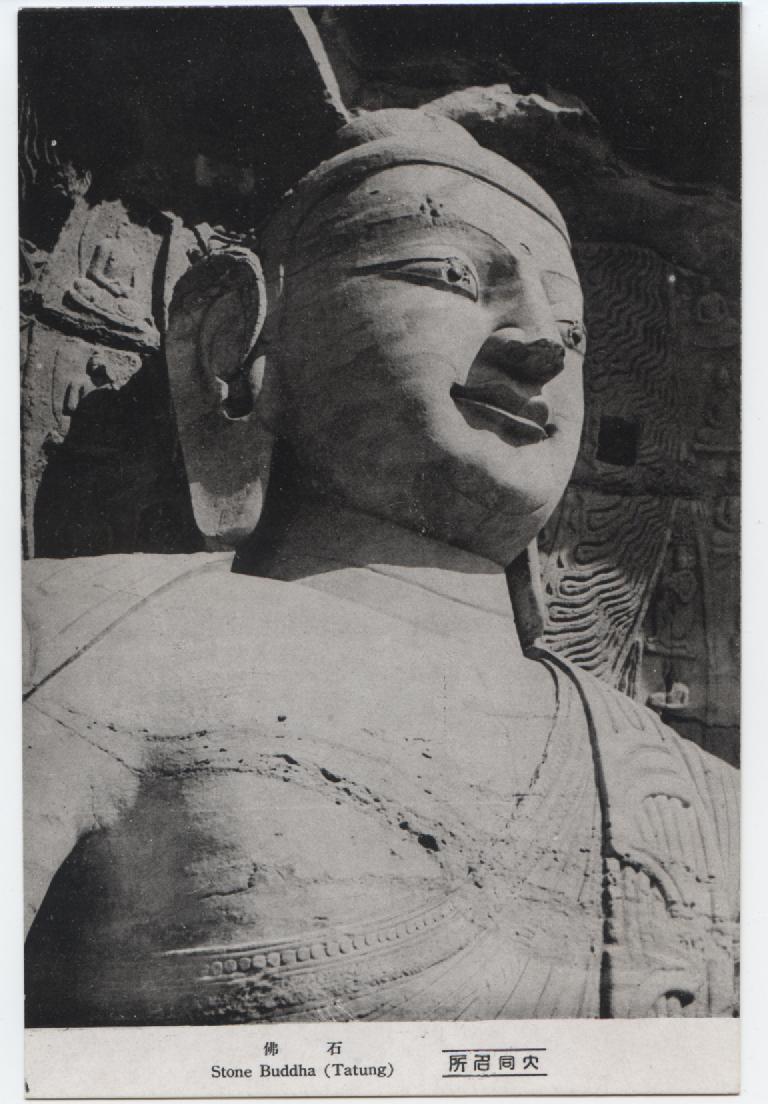
| c. 460–494 | Yungang caves carved for the Northern Wei court[13] | Consensus |
| 510s–520s | Emperor Wu of Liang requires monks to give up meat and wine[14] | Majority |
| 538 or 552 | Buddhism reaches the Japanese court from Baekje (§11)[15][16] | Majority |
| 547 | Earliest mention of Bodhidharma, in a guidebook to Luoyang’s monasteries[17] | Consensus |
| 553 | Date given for the Awakening of Faith “translation”[18] | Majority |
| 574–577 | Emperor Wu of the Northern Zhou suppresses Buddhism and Daoism[19] | Consensus |
| 629–645 | Xuanzang’s journey to India[20] | Consensus |
| 671–695 | Yijing travels to India and Śrīvijaya by sea[21] | Consensus |
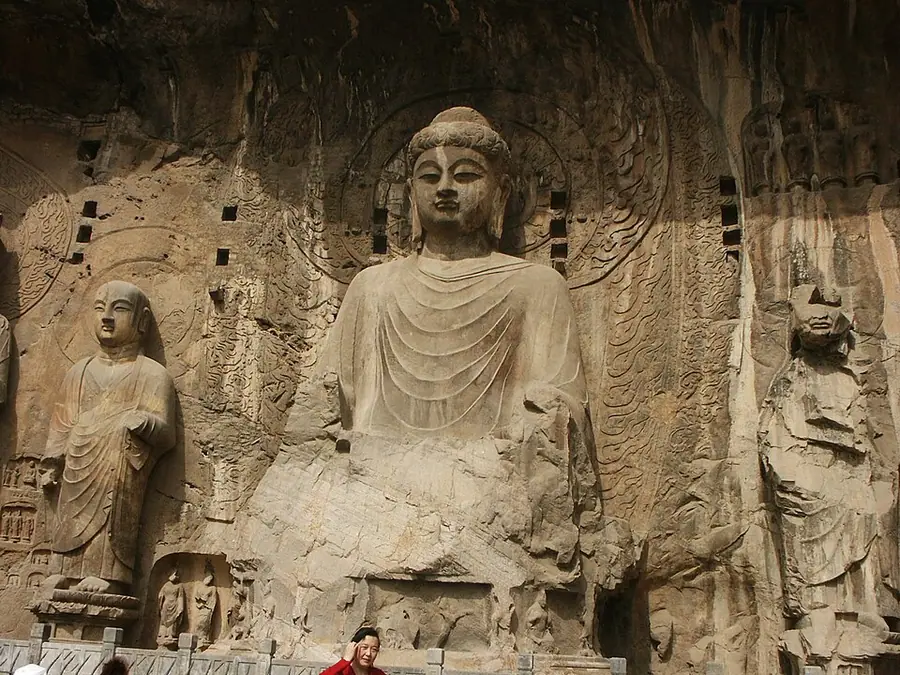
| 672–675 | Fengxian cave at Longmen with the colossal Vairocana[22] | Consensus |
| 732 | Shenhui attacks the “Northern school” at Huatai[23] | Consensus |
| c. 830–860 | The Dunhuang copies of the Platform Sūtra[24] | Majority |
| 842–846 | The Huichang suppression, peaking in 845[25][26] | Consensus |
| 868 | The Dunhuang Diamond Sūtra, the oldest complete dated printed book[27] | Consensus |
| 1004 | The Jingde Record of the Transmission of the Lamp fixes the Chan genealogy[28] | Consensus |
Where: the Silk Road, the two capitals and the south
Buddhism reached China by two routes. The older and busier ran overland from Gandhāra and Bactria through the oasis kingdoms of the Tarim basin, Kucha, Khotan, Turfan and Dunhuang, to Chang’an and Luoyang. A sea route from India and Sri Lanka through Southeast Asia reached the south coast and the Red River delta in what is now northern Vietnam.[2][29] Consensus
The people who carried it were mostly not Indian. The early translators in Luoyang were a Parthian (An Shigao), Kushans (Lokakṣema, Zhi Qian’s family), Sogdians and Kucheans. Their names preserve their origins: the Chinese surname An marks a Parthian, Zhi a Yuezhi or Kushan, Kang a Sogdian. Many early texts reached China not from India directly but from Central Asian Buddhist communities, in Gāndhārī or Central Asian Prakrits as well as Sanskrit.[2][4] Consensus
After the Han dynasty fell in 220, China was divided for more than three and a half centuries. The north was ruled by a succession of dynasties founded by steppe peoples, who had their own reasons to favour a religion that was, like them, foreign. The south was ruled from Jiankang (Nanjing) by Chinese courts where Buddhism spread among educated gentry who discussed it in the terms of “dark learning” (xuanxue) Daoist philosophy. The differences shaped Chinese Buddhism: in the north, monks served emperors and states paid for colossal cave temples; in the south, monks debated the nature of mind with aristocrats and argued for their independence from the throne.[2][30] Majority
Korea, Japan and Vietnam. By tradition Buddhism reached the Korean kingdom of Goguryeo in 372 with a monk sent by the Former Qin ruler Fu Jian, Baekje in 384, and Silla officially in the 520s after the martyrdom of the courtier Ichadon. From Baekje it reached the Japanese court in 538 or 552; the two dates come from different Japanese sources (§11).[7][15][16] The Korean dates come from a chronicle of 1145, which puts Silla’s acceptance in 528; another Korean tradition gives 527. In northern Vietnam, then under Chinese rule, later Vietnamese tradition makes the city of Luy Lâu a Buddhist centre on the sea route by the second or third century, and the Sogdian monk Kang Senghui grew up in Jiaozhi before reaching the southern capital in 247.[29][31] All three regions received Buddhism in Chinese translation and in Chinese forms. Majority
The evidence ledger for Buddhism in China
| Dimension | What we can say | Evidence | Confidence |
|---|---|---|---|
| Arrival | Present at a Han prince’s court by 65 CE; in the imperial palace by 166 | The Liu Ying edict; Xiang Kai’s memorial[1][5] | Consensus |
| Early images | Buddha figures appear on Sichuan funerary “money trees” and tomb walls from the late Han; their dating and meaning are debated | Excavated bronzes and reliefs[32] | Majority |
| Translation | Hundreds of texts translated, first with Daoist terms, then in a deliberately technical vocabulary | Dated translations and catalogues[4][8] | Consensus |
| Composed in China | Influential scriptures and treatises were written in China and attributed to India | The Awakening of Faith; the Ghost Festival sūtra; the Heart Sūtra question[18][33][34] | Majority (Contested on the Heart Sūtra) |
| Institutions | Monasteries became major landowners, lenders and tax shelters | The 845 edict; Ennin’s eyewitness diary[25][26] | Consensus |
| Monastic diet | Vegetarianism became compulsory for Chinese monks in the sixth century | Emperor Wu’s essay and assemblies[14][35] | Majority |
| Chan lineage | The genealogy from Bodhidharma to Huineng was assembled in the eighth century | Dunhuang manuscripts; Shenhui’s polemics[24][23][36] | Majority |
Primary sources
1. A Han prince honours the Buddha, 65 CE
In 65 CE Emperor Ming ordered that people guilty of capital crimes could redeem themselves with silk. His half-brother Liu Ying, prince of Chu, sent thirty bolts, saying his own faults had accumulated. The emperor sent them back with an edict, preserved in the History of the Later Han:
楚王誦黃老之微言,尚浮屠之仁祠,絜齋三月,與神為誓,何嫌何疑,當有悔吝?其還贖,以助伊蒲塞桑門之盛饌。
“The king of Chu recites the subtle words of Huang-Lao and honours the gentle sacrifices of the Buddha. He has purified himself and fasted for three months, and made a vow to the spirits. What suspicion is there, what doubt, that he should have cause for regret? Let the ransom be returned, to help provide lavish meals for the upāsakas and śramaṇas.”[1]
What it proves. Buddhism was present and respectable at a Han court by 65 CE, with lay followers (yipusai, a transcription of upāsaka) and monks (sangmen, śramaṇa) who received meals. It also shows how the Buddha was understood: as a deity honoured with offerings and fasting alongside Huang-Lao, the Yellow Emperor and Laozi, in a cult of immortality. Liu Ying’s court was at Pengcheng in the east, far from the Silk Road terminus, which suggests Buddhism had already spread with merchant communities.[2] Consensus
The famous alternative story, in which Emperor Ming dreams of a golden man, sends envoys west, and receives two Indian monks who found the White Horse Monastery at Luoyang, appears in sources of the third and fourth centuries onward; even the History of the Later Han reports it only as what is “commonly said” (世傳).[37][2] It is a foundation legend, probably composed to give Buddhism imperial sanction. Majority
2. The Buddha in the Han palace, 166 CE
A century later the scholar Xiang Kai submitted a memorial to Emperor Huan, criticising him for his luxurious life:
又聞宮中立黃、老、浮屠之祠。此道清虛,貴尚無為,好生惡殺,省欲去奢。……或言老子入夷狄為浮屠。
“I have also heard that in the palace shrines have been set up to Huang-Lao and the Buddha. This way is pure and empty, values non-action (wuwei), loves life and hates killing, reduces desires and rejects extravagance. … Some say that Laozi went among the barbarians and became the Buddha.”[5]
What it proves. By 166 the Buddha was honoured inside the imperial palace, still paired with Huang-Lao, and Chinese writers were already explaining him as a foreign form of Laozi. Xiang Kai goes on to cite the story of the Buddha rejecting beautiful women sent by a heavenly spirit as “a leather bag full of blood,” a passage that matches the Sūtra in Forty-Two Sections, so some Buddhist literature was already in circulation. The claim that Laozi had gone west and become the Buddha would later be written up as a Daoist scripture, the Conversion of the Barbarians, and become a centuries-long point of dispute.[5][2] Consensus
3. Translating with Daoist words, and the reaction
The first translators had to invent a vocabulary. Lokakṣema rendered tathatā, “suchness,” as benwu 本無, “original non-being,” a term from Daoist philosophy, and early texts used wuwei 無為, “non-action,” for nirvāṇa.[4][2] Fourth-century teachers went further, explaining Buddhist lists by pairing them with Chinese categories, a method called geyi, “matching meanings”: in the words of a sixth-century biographer, they “matched the numbered items in the sūtras with outside books” (以經中事數擬配外書).[38] Victor Mair argues that geyi was a short-lived device for these numbered lists, and that its reputation as the general method of early Buddhist translation is a modern scholarly construction.[39]
The monk Dao’an (312–385) rejected geyi (“the old geyi often goes against the principle”),[40] compiled the first catalogue of translations in 374 so that genuine texts could be told from forgeries, and in a preface warned that every translation suffers “five losses” of the original and “three difficulties.”[8] He also proposed that all monks and nuns take the surname Shi 釋, from Shijiamouni, Śākyamuni, so that they belonged to the Buddha’s family and not their own.[40]
Kumārajīva (344–413, though some early sources put his death in 409), son of an Indian father and a Kuchean princess, was brought to Chang’an at the end of 401 by the ruler Yao Xing and directed a translation bureau of hundreds of monks.[41] His versions of the Lotus Sūtra (406), the Vimalakīrti, the Diamond Sūtra and Nāgārjuna’s works were readable, elegant and doctrinally careful, and many remain the standard texts in East Asia today.[10]
What it proves. That Chinese Buddhists were aware of the translation problem from early on and worked to solve it. The solution was not to stop interpreting but to interpret better. Even Kumārajīva’s polished versions are interpretations: a Chinese reader of the Lotus read a text with its own rhythms and associations, not the Sanskrit (§0). Consensus
4. A monk does not bow to a king
In 404 the warlord Huan Xuan demanded that monks bow to the ruler like other subjects. Huiyuan (334–416), the leading monk of the south, replied with a treatise arguing that monks, having left the household, stood outside the ordinary order of rulers and subjects.[11]
In the north, at about the same time, the monk Faguo had taken the opposite line. The History of the Wei records that he called the Northern Wei founder “the Tathāgata of today” and bowed to him, saying, “It is not the Son of Heaven I am bowing to, I am simply paying homage to the Buddha.”[13]
What it proves. That the relationship between the saṅgha and the state, which in India had been a matter of patronage, became in China a matter of principle, argued in both directions. The northern model, in which monks served emperors and emperors were Buddhas, produced Yungang and Longmen; the southern model gave monks a claim to independence that the state never fully accepted. The state won in the end: Chinese monks were registered, licensed and supervised by state offices, and periodically purged.[42][30] Majority
5. The 845 edict
In the eighth month of 845 the Tang emperor Wuzong issued an edict justifying his suppression of Buddhism. It argues from economics and from Chineseness:
一夫不田,有受其飢者;一婦不蠶,有受其寒者。今天下僧尼,不可勝數,皆待農而食,待蠶而衣。……豈可以區區西方之教,與我抗衡哉!
“When one man does not farm, someone goes hungry; when one woman does not raise silkworms, someone goes cold. Now the monks and nuns of the empire are beyond counting, and all depend on farmers for their food and on silkworms for their clothes. … How can a petty teaching from the West be allowed to stand against us?”
It then gives figures: more than 4,600 monasteries destroyed, 260,500 monks and nuns returned to lay life and to the tax registers, more than 40,000 smaller shrines demolished, “several tens of millions of qing” of good land confiscated (a figure that cannot be literal), and 150,000 monastery slaves made taxpayers. Some 3,000 Christian and Zoroastrian clergy were also laicised.[25]
The Japanese monk Ennin, who was in China at the time, recorded the suppression in his diary as it happened: the expulsion of foreign monks, the burning of scriptures, the melting of bronze images for coin.[26]
What it proves. By the ninth century Buddhist monasteries were a major economic institution, with land, dependants and bronze, and the state could treat them as a fiscal problem. The edict’s numbers match a census of monasteries and clergy ordered in the fourth month of the same year, and may be rounded or inflated, but the scale is not in doubt.[25] The persecution lasted only until Wuzong’s death in 846, and much was restored, but the great scholastic schools, which depended on libraries and endowed monasteries, never fully recovered; the rebellions and disorder of the late Tang added to the damage. Chan and Pure Land, which needed neither, became dominant.[42] Majority
6. The oldest dated printed book
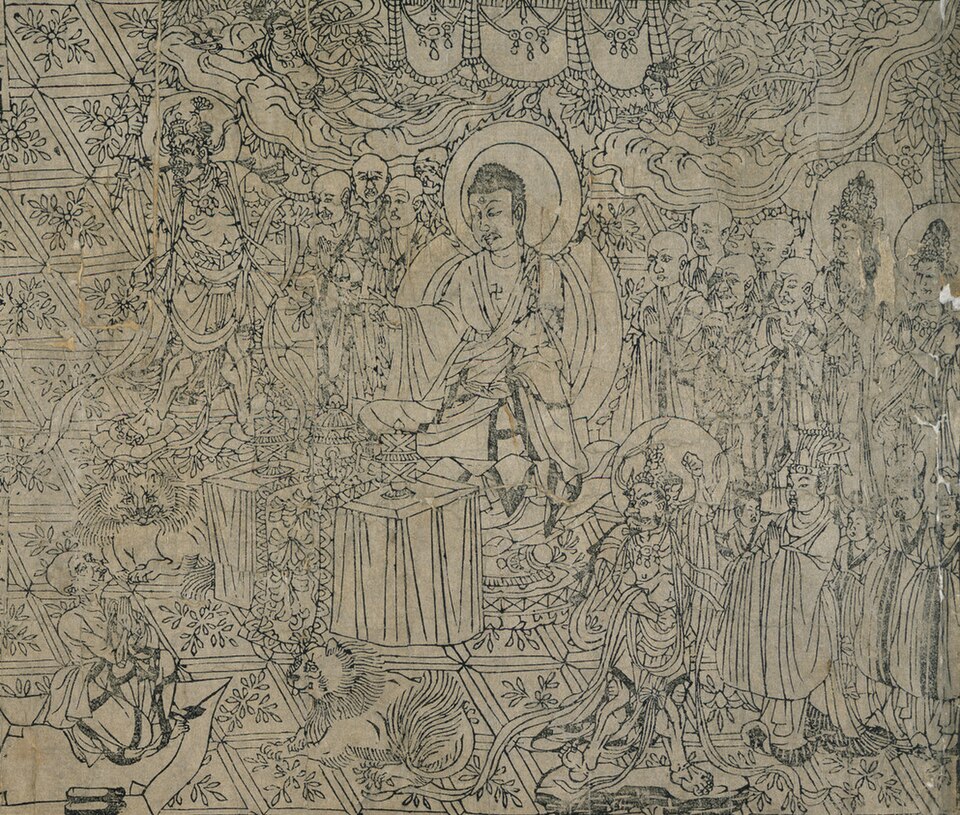
Among the manuscripts sealed in a cave at Dunhuang around 1000 and found in 1900 was a printed scroll of Kumārajīva’s Diamond Sūtra, about five metres long. Its colophon reads:
咸通九年四月十五日王玠為二親敬造普施
“Reverently made for universal free distribution by Wang Jie on behalf of his two parents, on the fifteenth day of the fourth month of the ninth year of Xiantong” (11 May 868).[27]
What it proves. That woodblock printing was used to make merit by multiplying scripture, the same logic as the cult of the book in early Mahāyāna (§6), and that it was mature by 868. It is the oldest complete printed book with a date. Printing then served the canon itself: the first printed Buddhist canon, the Kaibao edition, was cut in Sichuan between 971 and 983.[43] Consensus
How Buddhism became Chinese
The changes Buddhism underwent in China were not distortions of a pure original. They were how a religion made in one civilisation became at home in another. Five stand out.
1. Family and filial piety. Chinese critics said that monks, who left home, shaved the head their parents had given them and had no children, broke the first duty of a son.[44] Buddhists answered by making the care of dead parents a central Buddhist service. The Yulanpen Sūtra, in which the monk Mulian rescues his mother from hell by making offerings to the saṅgha, became the basis of the Ghost Festival held every year in the seventh month. Its relation to any Indian original is uncertain, and the festival as practised is Chinese.[33][45] Monks also made merit for their parents, as Indian monks had done in the donor inscriptions (§0).[46] Majority
2. Scriptures composed in China. Chinese Buddhists wrote texts in the Buddha’s name or attributed them to Indian authors. Catalogues from Dao’an onward tried to sort “genuine” from “suspect” scriptures, but many of the most influential survived the sorting:
- The Awakening of Faith in the Mahāyāna, attributed to Aśvaghoṣa and said to have been translated by Paramārtha in 553, has no Indian original and is now generally regarded as a Chinese composition. It became the basic text of East Asian ideas about the originally enlightened mind.[18][47] Majority
- The Heart Sūtra, the most recited Buddhist text in East Asia, may be Chinese too. Jan Nattier argued in 1992 that its core passage was lifted from Kumārajīva’s Chinese translation of the Large Perfection of Wisdom, and that the Sanskrit Heart Sūtra is a back-translation from Chinese.[34][48] Some scholars have tested her method and extended it; others, such as Harada Wasō, reject the conclusion and defend an Indian origin.[49][50] Contested
3. Buddha-nature. In India the idea that all beings contain the potential for Buddhahood was a minority teaching (§6). In China it became an assumption. The monk Daosheng (d. 434) taught, on the basis of a shorter translation that seemed to deny it, that even the icchantika, beings who had cut off all good roots, could become Buddhas; he was expelled for it.[51] When Dharmakṣema’s full translation of the Mahāparinirvāṇa Sūtra (421) reached the south around 430, it said what Daosheng had said, and he was vindicated.[12] The story became a model of insight running ahead of scripture. Tiantai, Huayan and Chan all took universal Buddha-nature as a starting point. Consensus
4. New schools built on new principles. Indian Buddhism had schools defined by monastic lineage and Abhidharma. China produced schools defined by a chosen scripture and a way of ranking all the others. Zhiyi (538–597) on Mount Tiantai organised the whole canon as stages of the Buddha’s teaching culminating in the Lotus.[52] Fazang (643–712) made the Avataṃsaka the summit of five grades of teaching in the Huayan system, with its vision of every phenomenon containing every other.[53] Pure Land teachers, Tanluan (476–542), Daochuo (562–645) and Shandao (613–681), taught that in a degenerate age the only sure path was to call on Amitābha and be reborn in his land (“only the one gate of the Pure Land offers a road through,” wrote Daochuo), and turned a minor Indian cult into a mass practice.[54][30] Consensus
5. The vegetarian monk. The Indian Vinaya let monks eat what they were given, meat included (§2). Mahāyāna sūtras translated into Chinese, notably the Mahāparinirvāṇa and the Laṅkāvatāra, condemned eating meat, as did the Brahmā’s Net Sūtra, itself probably composed in China.[12][55][47] Emperor Wu of Liang (r. 502–549), the most devout Buddhist ruler of the south, removed animal offerings from the imperial ancestral sacrifices in 517[56] and, in an Essay on Abstaining from Wine and Meat delivered to assemblies of monks in the late 510s or early 520s, required monks and nuns to give up both, threatening to laicise those who did not.[14][35] Vegetarianism became the norm of Chinese, Korean and Vietnamese monasticism, and a Chinese Buddhist identity marker that Indian Buddhists had never imposed. Majority
Chan: a lineage built after the fact
Chan (Japanese Zen) presents itself as a “separate transmission outside the scriptures,” passed from mind to mind through a line of patriarchs from the Buddha to Bodhidharma, who brought it to China, and on to the sixth patriarch Huineng (638–713). That line is a construction of the eighth century and later. Majority
Bodhidharma. The earliest mention of anyone of that name is in Yang Xuanzhi’s Record of the Buddhist Monasteries of Luoyang, written in 547. It describes a monk called Bodhidharma, “a man of Persia from the western regions,” who admired the great pagoda of the Yongning monastery and said he was 150 years old and had travelled through many countries.[17] A short text, the Two Entrances and Four Practices, preserves teachings attributed to him by a disciple, and Daoxuan’s biography of 645 makes him a south Indian brahmin, not a Persian.[57] The rest, his meeting with Emperor Wu of Liang, nine years facing a wall, the disciple Huike cutting off his own arm (Daoxuan says bandits cut it off), and his founding of Shaolin martial arts, appears in sources from the eighth century to the twentieth.[36][58] Whether the guidebook’s Bodhidharma and the Chan founder are the same person is unknowable. Contested
Shenhui and the Platform Sūtra. In the early eighth century the most prominent Chan teachers were Shenxiu (d. 706) and his disciples, honoured at the Tang court. In 732, at an open assembly at Huatai, the monk Shenhui attacked them as a mere side branch teaching a “gradual” path, and claimed that his own teacher Huineng, an obscure figure from the far south, was the true sixth patriarch and teacher of “sudden” awakening.[23] The dismissive label “Northern school” is his.[59]
The Platform Sūtra, which tells Huineng’s story, shows the lineage being written. In it the illiterate Huineng answers a verse by Shenxiu with a verse of his own. In the Dunhuang manuscripts, copied around 830–860, the verse reads:
菩提本無樹,明鏡亦無臺,佛性常清淨,何處有塵埃?
“Bodhi originally has no tree, the bright mirror has no stand. Buddha-nature is always pure: where is there any dust?”
Later editions, which became standard, change the third line to 本來無一物, “originally there is not a single thing.”[24][60] The most famous line of Chan poetry is a later revision.
What it proves. That the story Chan tells about itself was assembled through polemic and revision, and that the Dunhuang manuscripts allow it to be watched. By the Song dynasty the Jingde Record of the Transmission of the Lamp (1004) had fixed a genealogy of patriarchs back through Bodhidharma to the Buddha.[28] A century later, in the Zuting shiyuan of 1108, Chan’s four-line slogan, “a separate transmission outside the teachings, not founded on words and letters, pointing directly at the human mind, seeing one’s nature and becoming a Buddha” (教外別傳,不立文字,直指人心,見性成佛), appears as a single formula describing what Bodhidharma transmitted.[61] John McRae summed up the scholarly position in four “rules of Zen studies,” the first two of which are “It’s not true, and therefore it’s more important” and “Lineage assertions are as wrong as they are strong.”[36] The genealogies are not history, but they are evidence of how Chan understood authority. Majority
As §3 noted, early Indian Buddhism had no patriarch with authority over the saṅgha. Chinese schools needed lineages because Chinese culture understood legitimacy through descent, in families and in scholarly traditions alike. Tiantai, Huayan and Pure Land also produced patriarch lists, compiled retrospectively; the list of Pure Land patriarchs, for example, was assembled by Song authors.[62] Majority
The pilgrims who went back
Some Chinese monks travelled to India to find what their own texts lacked, especially complete monastic codes. Their accounts are among the best evidence for Indian Buddhism itself.
- Faxian left Chang’an in 399, crossed Central Asia, spent years in the Ganges valley and Sri Lanka copying Vinaya texts, and returned by sea in 412. His record describes Buddhist India under the Guptas.[9]
- Xuanzang left in 629, studied at Nālandā and travelled the length of India before returning to Chang’an in 645. His Record of the Western Regions (646) describes monasteries, schools and ruins across Central Asia and India, and is used by archaeologists to this day (§2, §8). He and his team translated seventy-five works in 1,335 fascicles.[20][63]
- Yijing went by sea in 671, stayed at Nālandā and in Śrīvijaya in Sumatra, and wrote a detailed account of Indian monastic practice that he urged Chinese monks to follow.[21]
What they show. Chinese Buddhists were conscious that their religion came from elsewhere and that their versions might be incomplete. The pilgrims went to fix that. They also record an Indian Buddhism that was already declining in places, with many monasteries in ruins in Xuanzang’s time (§8).[20] Consensus
Coda: Song China and the shape of later East Asian Buddhism
After 845 Chinese Buddhism reorganised around Chan and Pure Land. Under the Song (960–1279), Chan monasteries became the dominant public institutions, with abbots appointed by the state.[64] Chan masters’ encounters were collected as “public cases” (gong’an, Japanese kōan) for study and meditation. Lay Buddhists combined recitation of Amitābha’s name with Chan, and Neo-Confucian philosophers absorbed and attacked Buddhist ideas in equal measure. This is the form in which Buddhism reached Japan’s Kamakura reformers (§11) and, much later, the West (§12).[30] Consensus
Budai. The fat, laughing figure with a cloth sack, sold as “the Buddha” across the world, is a Chinese monk named Qici, from Fenghua in Zhejiang, who died in the early tenth century (the sources give 901–904 or 916). He was remembered as a wandering eccentric, and after his death was identified with Maitreya, the future Buddha. He is not Siddhārtha Gautama, whose images show a slender ascetic (§2).[65][66] Consensus
What is absent in early Chinese Buddhism
- A single Chinese Buddhism. Northern and southern Buddhism differed sharply until reunification in 589, and schools never formed separate denominations.[30] Consensus
- A closed canon. Chinese catalogues admitted new translations, and some Chinese compositions, for centuries.[43] Consensus
- Tantra as a system. Spells and esoteric rites were translated from early on, but the systematic esoteric Buddhism of Śubhākarasiṃha, Vajrabodhi and Amoghavajra arrived only in the eighth century (§8).[67] Consensus
- Independence from the state. After the Northern Wei, monks and monasteries were registered and licensed, and ordination certificates were sold by the government when it needed money.[42] Majority
- The Zen of the modern West. Chan was a monastic institution with liturgy, precepts and ritual, not a philosophy of spontaneity (§12).[64][68] Majority
Debates about Buddhism in China
Did Buddhism “conquer” China, or did China transform Buddhism?
Erik Zürcher’s The Buddhist Conquest of China (1959) traced how Buddhism won over the southern gentry by speaking their philosophical language. Kenneth Ch’en’s The Chinese Transformation of Buddhism (1973) stressed the opposite direction, how the religion was reshaped by Chinese ethics, politics and economics.[2][44] Most historians now see both: Buddhism changed Chinese material culture, art, language and ideas about death, and China changed Buddhism’s institutions, ethics and scriptures.[30] Majority
Was the Heart Sūtra composed in China?
Nattier’s argument rests on word-for-word identity between the Heart Sūtra’s core and Kumārajīva’s Chinese Large Perfection of Wisdom, and on Sanskrit phrasing in the Heart Sūtra that looks like a translation of the Chinese rather than the other way round.[34] Critics, including Harada Wasō in a book-length study, point to the lack of any Chinese record of such a compilation and argue the parallels could be explained in other ways.[50] The thesis has gained support since 1992, most fully in Jayarava Attwood’s comparisons of the Chinese and Sanskrit texts, but is not universally accepted.[49] Contested
Was Bodhidharma a real person?
A monk of that name was probably in Luoyang in the early sixth century, and a teacher named Bodhidharma probably taught a meditation practice that his followers recorded. Whether they are the same person, and whether he taught anything like later Chan, cannot be established. The legendary Bodhidharma is a Tang and Song creation.[17][57][36] Contested
Were the persecutions about religion or money?
The edicts of 446, 574 and 845 all invoke Chinese tradition against a foreign teaching, and Daoist priests were involved in at least two of them.[13][25] But each also came when monasteries held large untaxed estates, sheltered men from labour service and conscription, and absorbed bronze the state needed for coin. Most historians treat the economic motive as primary and the religious one as justification, while noting that Wuzong’s own Daoist enthusiasm was real.[42] Majority
Further reading
- Erik Zürcher, The Buddhist Conquest of China (3rd ed., Brill, 2007).
- Kenneth Ch’en, Buddhism in China: A Historical Survey (Princeton, 1964) and The Chinese Transformation of Buddhism (Princeton, 1973).
- John Kieschnick, The Impact of Buddhism on Chinese Material Culture (Princeton, 2003).
- John R. McRae, Seeing Through Zen (University of California Press, 2003).
- Philip B. Yampolsky, The Platform Sutra of the Sixth Patriarch (Columbia, 1967).
- Jan Nattier, “The Heart Sūtra: A Chinese Apocryphal Text?”, JIABS 15 (1992).
- Stanley Weinstein, Buddhism under the T’ang (Cambridge, 1987).
- Edwin O. Reischauer, trans., Ennin’s Diary (Ronald Press, 1955).
References
- ^ a b c d Hou Hanshu 42 (Liu Ying) — History of the Later Han. 65 CE (edict); compiled 5th c. CE. Classical Chinese. Emperor Ming's edict of 65 CE praising the prince of Chu, who 'recites the subtle words of Huang-Lao and honours the gentle sacrifices of the Buddha', and returning his silk to feed upāsakas and śramaṇas. read the text
- ^ a b c d e f g h i j Erik Zürcher The Buddhist Conquest of China: The Spread and Adaptation of Buddhism in Early Medieval China. Brill, 3rd ed., 2007. The classic account of how Buddhism entered Chinese elite culture up to the early fifth century. First published 1959.
- ^ T 602 (Anban shouyi jing) — An Shigao's translations. c. 148–170 CE. Classical Chinese. An Shigao's text on mindfulness of breathing, one of the first Buddhist meditation manuals in Chinese, from the Parthian translator who began work in Luoyang about 148. read the text
- ^ a b c d Jan Nattier A Guide to the Earliest Chinese Buddhist Translations. International Research Institute for Advanced Buddhology, Soka University, 2008. Which Han-dynasty translations are really by whom, and therefore which texts existed when.
- ^ a b c d Hou Hanshu 30B (Xiang Kai) — History of the Later Han. 166 CE (memorial). Classical Chinese. Xiang Kai's memorial to Emperor Huan: shrines to Huang-Lao and the Buddha stand in the palace, and 'some say Laozi went among the barbarians and became the Buddha'. read the text
- ^ T 224 (Daoxing banruo jing) — Lokakṣema's translations. 179 CE. Classical Chinese. Lokakṣema's Chinese translation of the Perfection of Wisdom in 8,000 Lines, dated by its colophon to 179 CE. A dated translation proves the source text existed by that year. read the text
- ^ a b Samguk sagi 18, 24 and 4 — Kim Pusik, History of the Three Kingdoms. compiled 1145. Classical Chinese. Fu Jian of the Former Qin sends the monk Sundo with images and scriptures to Goguryeo (Sosurim 2, 372); the 'foreign monk' Mālānanda reaches Baekje from Jin (Chimnyu 1, 384); in Silla 'the Buddhist law was first practised' in Beopheung 15 (528) after the death of Ichadon. read the text
- ^ a b c T 2145 (Chu sanzang jiji) — Sengyou's catalogue. c. 515 CE. Classical Chinese. Sengyou's catalogue of translations, which preserves Dao'an's lost catalogue of 374 and his preface on the 'five losses and three difficulties' of translation. read the text
- ^ a b Faxian, Record of Buddhist Kingdoms — Foguo ji. c. 416 CE. Classical Chinese. The pilgrim's account of India c. 399–414, describing monasteries as Mahāyāna, non-Mahāyāna or mixed, and the two kinds of monks living side by side; he also stayed two years in Sri Lanka and counted the monks of its great monasteries. read the text
- ^ a b T 262 (Miaofa lianhua jing) — Kumārajīva's Lotus Sūtra. 406 CE. Classical Chinese. Kumārajīva's translation of the Lotus Sūtra, made at Chang'an in 406 and still the standard text across East Asia. read the text
- ^ a b Shamen bu jing wangzhe lun — Huiyuan, in the Hongming ji (T 2102). 404 CE. Classical Chinese. Huiyuan's treatise 'A monk does not bow to a king': having left the household, monks stand outside the order of ruler and subject. read the text
- ^ a b c T 374 (Da banniepan jing) — Dharmakṣema's Mahāparinirvāṇa Sūtra. 421 CE. Classical Chinese. The long Mahāyāna Mahāparinirvāṇa Sūtra, translated at Liangzhou in 421, teaching that all beings, even icchantikas, have Buddha-nature; it vindicated Daosheng. read the text
- ^ a b c d Wei shu 114 (Shi-Lao zhi) — History of the Wei. 554 CE. Classical Chinese. The Treatise on Buddhism and Daoism: Faguo calls the Northern Wei founder 'the Tathāgata of today'; the suppression of 446; Tanyao's five cave temples west of the capital. read the text
- ^ a b c Duan jiurou wen, in Guang hongming ji 26 (T 2103) — Emperor Wu of Liang. c. 517–523 CE. Classical Chinese. Emperor Wu's essay on abstaining from wine and meat, read to assemblies of monks and nuns, requiring them to give up both on the authority of the Mahāparinirvāṇa Sūtra. The basis of Chinese monastic vegetarianism. read the text
- ^ a b Nihon shoki, Kinmei 13 — Nihon shoki. compiled 720 CE. Classical Chinese. The court chronicle's account of King Sŏng of Paekche sending a Buddha image and sūtras in 552, and the debate between the Soga and the Mononobe over whether to worship it. about
- ^ a b Richard Bowring The Religious Traditions of Japan, 500–1600. Cambridge University Press, 2005. The best single history of premodern Japanese religion, careful about what the chronicles can and cannot tell us.
- ^ a b c T 2092 (Luoyang qielan ji) — Yang Xuanzhi, Record of the Buddhist Monasteries of Luoyang. 547 CE. Classical Chinese. A memoir of Luoyang's monasteries; it mentions a western monk named Bodhidharma who admired the Yongning pagoda and said he was 150 years old. The earliest mention of the name. read the text
- ^ a b c T 1666 (Dasheng qixin lun) — Awakening of Faith in the Mahāyāna. c. 550 CE. Classical Chinese. Attributed to Aśvaghoṣa and to Paramārtha as translator (553); no Indian original exists and it is generally held to be a Chinese composition. The basic text of East Asian 'original enlightenment' thought. read the text
- ^ Zhou shu 5 (Wudi), Jiande 3 — History of the Northern Zhou. 574 CE (event); compiled 636. Classical Chinese. Fifth month of 574: 'for the first time Buddhism and Daoism were both abolished; scriptures and images were all destroyed, and monks and Daoist priests were dismissed and returned to the people'. read the text
- ^ a b c T 2087 (Da Tang Xiyu ji) — Xuanzang, Record of the Western Regions. 646 CE. Classical Chinese. Xuanzang's account of the lands and monasteries he saw between 629 and 645, from the Tarim basin to south India; still a guide for archaeologists. read the text
- ^ a b Yijing, Account of Buddhism Sent from the Southern Seas — Nanhai jigui neifa zhuan. c. 691 CE. Classical Chinese. Mahāyāna and non-Mahāyāna monks keep the same Vinaya; those who worship bodhisattvas and read Mahāyāna sūtras are called Mahāyānists. The clearest contemporary statement that Mahāyāna was not a separate order. read the text
- ^ Inscription of the Great Vairocana niche, Longmen (Quan Tang wen 987) — Heluo shangdu Longmen zhi yang da Lushena xiang kan ji. Tang, 8th c.. Classical Chinese. Records that Empress Wu gave 20,000 strings of cash from her cosmetics allowance in the fourth month of 672 and that the colossal Vairocana was completed on the last day of the twelfth month of 675. read the text
- ^ a b c Putidamo nanzong ding shifei lun — Shenhui, recorded by Dugu Pei. 732 CE (debate), recorded later. Classical Chinese. The record of Shenhui's attack at Huatai on the disciples of Shenxiu as a 'gradual' side branch, and his claim that Huineng was the true sixth patriarch. Survives in Dunhuang manuscripts.
- ^ a b c Platform Sūtra (Dunhuang, S. 5475) — Liuzu tanjing. copied c. 830–860 CE. Classical Chinese. The earliest surviving version of the Platform Sūtra, in which Huineng's verse reads 'Buddha-nature is always pure' where later editions read 'originally there is not a single thing'. about
- ^ a b c d e Jiu Tang shu 18A (Wuzong) — Old History of the Tang. 845 CE (edict); compiled 945. Classical Chinese. Wuzong's edict of 845: 'how can a petty teaching from the West stand against us?'; over 4,600 monasteries destroyed, 260,500 monks and nuns laicised, over 40,000 shrines demolished. read the text
- ^ a b c Nittō guhō junrei gyōki — Ennin's diary. 838–847 CE. Classical Chinese. The Japanese monk Ennin's day-by-day diary of his years in Tang China, including an eyewitness account of the Huichang suppression.
- ^ a b Diamond Sūtra, Dunhuang (BL Or. 8210/P.2) — Jingang bore boluomi jing. 868 CE. Classical Chinese. A woodblock-printed scroll of Kumārajīva's Diamond Sūtra, 'made for universal free distribution by Wang Jie on behalf of his two parents' on 11 May 868; the oldest complete dated printed book. about
- ^ a b T 2076 (Jingde chuandeng lu) — Record of the Transmission of the Lamp. 1004 CE. Classical Chinese. The Song compilation that fixed Chan's genealogy of patriarchs from the past Buddhas through Bodhidharma and Huineng, with their recorded encounters. read the text
- ^ a b Cuong Tu Nguyen Zen in Medieval Vietnam: A Study and Translation of the Thiền Uyển Tập Anh. University of Hawai'i Press, 1997. doi The standard study of early Vietnamese Buddhism and of how its later chronicles constructed a Chan-style lineage.
- ^ a b c d e f Kenneth K. S. Ch'en Buddhism in China: A Historical Survey. Princeton University Press, 1964. Still the most useful one-volume narrative of Chinese Buddhist history.
- ^ T 2059 (Gaoseng zhuan) 1 — Huijiao, Biographies of Eminent Monks. c. 519–530. Classical Chinese. Opens with Emperor Ming's dream and the legendary first monks; its life of Kang Senghui, a Sogdian raised in Jiaozhi, has him reach Jianye in 247 and build a monastery with Sun Quan's support. read the text
- ^ Wu Hung "Buddhist Elements in Early Chinese Art (2nd and 3rd Centuries A.D.)". Artibus Asiae 47, 1986. The Han and Three Kingdoms images, from money trees to tomb reliefs, and how Buddhist motifs were absorbed into Chinese funerary art.
- ^ a b T 685 (Yulanpen jing) — Ullambana Sūtra. c. 5th–6th c. CE. Classical Chinese. Mulian rescues his mother from hell by offering food to the saṅgha on the fifteenth day of the seventh month: the scripture of the Ghost Festival. read the text
- ^ a b c Jan Nattier "The Heart Sūtra: A Chinese Apocryphal Text?". Journal of the International Association of Buddhist Studies 15(2): 153–223, 1992. The argument that the Heart Sūtra was compiled in China and back-translated into Sanskrit. Contested, and the starting point for every discussion since.
- ^ a b John Kieschnick "Buddhist Vegetarianism in China". In Of Tripod and Palate, ed. Roel Sterckx, Palgrave Macmillan, 2005. How Chinese monks became vegetarian, centred on Emperor Wu of Liang.
- ^ a b c d John R. McRae Seeing Through Zen: Encounter, Transformation, and Genealogy in Chinese Chan Buddhism. University of California Press, 2003. The clearest statement of how Chan's lineage was constructed, with 'McRae's rules of Zen studies'.
- ^ Hou Hanshu 88 (Xiyu zhuan) — History of the Later Han. 5th c. CE. Classical Chinese. Fan Ye's account of the Western Regions gives Emperor Ming's dream of a golden man as something 'commonly said' (世傳), then notes Liu Ying and Emperor Huan as early followers. read the text
- ^ T 2059 (Gaoseng zhuan) 4, 'Zhu Faya' — Huijiao, Biographies of Eminent Monks. c. 519–530. Classical Chinese. The classic definition of geyi: Zhu Faya and Kang Falang 'matched the numbered items in the sūtras with outside [non-Buddhist] books, as a way of producing understanding; this was called geyi' (以經中事數擬配外書為生解之例謂之格義). read the text
- ^ Victor H. Mair "What Is Geyi, After All?". China Report 48(1–2): 29–59, 2012. doi Argues that geyi was a short-lived method for handling Indian numbered lists, and that its reputation as the general technique of early Buddhist translation is a modern scholarly construction.
- ^ a b T 2059 (Gaoseng zhuan) 5, 'Dao'an' and 'Sengxian' — Huijiao, Biographies of Eminent Monks. c. 519–530. Classical Chinese. Dao'an tells Sengxian that 'the old geyi often goes against the principle' (先舊格義,於理多違), and, since 'none is more honoured than Śākyamuni', has monks take Shi 釋 as their surname (乃以釋命氏), later confirmed by the Ekottarika's 'four rivers entering the sea'. read the text
- ^ T 2059 (Gaoseng zhuan) 2, 'Kumārajīva' — Huijiao, Biographies of Eminent Monks. c. 519–530. Classical Chinese. Kumārajīva, son of Kumārāyana and the Kuchean princess Jīva, reaches Chang'an on the twentieth day of the twelfth month of Hongshi 3 (early 402) and translates at Yao Xing's Xiaoyao park, replacing older versions that 'clung to the wording and to geyi'; Huijiao notes that the records disagree on the year of his death. read the text
- ^ a b c d Stanley Weinstein Buddhism under the T'ang. Cambridge University Press, 1987. Tang state policy toward Buddhism, including the Huichang suppression.
- ^ a b Jiang Wu and Lucille Chia, eds. Spreading Buddha's Word in East Asia: The Formation and Transformation of the Chinese Buddhist Canon. Columbia University Press, 2016. doi The history of the Chinese canon from manuscript catalogues to the printed editions beginning with the Kaibao canon.
- ^ a b Kenneth K. S. Ch'en The Chinese Transformation of Buddhism. Princeton University Press, 1973. How Chinese ethics, politics and economics reshaped Buddhism, including filial piety and monastic economics.
- ^ Stephen F. Teiser The Ghost Festival in Medieval China. Princeton University Press, 1988. The Yulanpen festival and how Buddhism made itself central to Chinese care for the dead.
- ^ Gregory Schopen Bones, Stones, and Buddhist Monks: Collected Papers on the Archaeology, Epigraphy, and Texts of Monastic Buddhism in India. University of Hawai'i Press, 1997. Includes the essays on relics as living presences, on the Buddha as a legal resident of monasteries, and on Indian monks' donations for their parents ('Filial Piety and the Monk in the Practice of Indian Buddhism').
- ^ a b Robert E. Buswell Jr., ed. Chinese Buddhist Apocrypha. University of Hawai'i Press, 1990. Studies of scriptures composed in China, and why they matter.
- ^ T 251 (Bore boluomiduo xin jing) — Heart Sūtra (Xuanzang's version). 649 CE. Classical Chinese. The standard Chinese Heart Sūtra, attributed to Xuanzang. Its core passage matches Kumārajīva's Large Perfection of Wisdom word for word, the basis of the argument that it was compiled in China. read the text
- ^ a b Jayarava Attwood "Heart to Heart: A Comparative Study of and Commentary on the Chinese and Sanskrit Heart Sutra Texts". Buddhist Studies Review 40(2): 159–188, 2024. doi A line-by-line comparison concluding that most differences between the Chinese and Sanskrit texts arise from translating the Chinese into Sanskrit; the fullest recent extension of Nattier's thesis.
- ^ a b Harada Wasō 原田和宗 「般若心経」成立史論:大乗仏教と密教の交差路 (A history of the formation of the Heart Sūtra). Daizō shuppan, 2010. A book-length defence of an Indian origin for the Heart Sūtra, in Japanese, that rejects Nattier's Chinese-origin argument.
- ^ T 2059 (Gaoseng zhuan) 7, 'Zhu Daosheng' — Huijiao, Biographies of Eminent Monks. c. 519–530. Classical Chinese. From the six-fascicle Nirvāṇa Daosheng argues that even icchantikas will become Buddhas, is expelled by the assembly, and is vindicated when the 'great text' reaches the south; he dies at Lushan in the eleventh month of Yuanjia 11 (434). read the text
- ^ T 1716 (Miaofa lianhua jing xuanyi) — Zhiyi, Profound Meaning of the Lotus Sūtra. 593 CE (lectures). Classical Chinese. Zhiyi's lectures on the Lotus, which review the earlier southern and northern schemes of 'five periods' of teaching and rank all the Buddha's teachings with the Lotus at their summit. read the text
- ^ T 1866 (Huayan yisheng jiaoyi fenqi zhang) — Fazang, Treatise on the Five Teachings of Huayan. late 7th c. CE. Classical Chinese. Fazang divides all the Buddha's teachings into five, Hīnayāna, elementary Mahāyāna, final, sudden and perfect, with the Avataṃsaka as the perfect teaching in which 'one is all and all is one'. read the text
- ^ T 1958 (Anle ji) — Daochuo, Collection on the Land of Peace and Bliss. 7th c. CE. Classical Chinese. 'Now is the age of the final Dharma, an evil world of five defilements; only the one gate of the Pure Land offers a road through' (當今末法,現是五濁惡世,唯有淨土一門,可通入路). read the text
- ^ Laṅkāvatāra Sūtra, ch. 8 — Laṅkāvatāra Sūtra. c. 4th–5th c. CE (chapter probably later). Buddhist Sanskrit. A chapter on the faults of eating meat, in which the Buddha says he has never permitted meat to anyone and never will; generally treated as a later addition to the sūtra. read the text
- ^ Liang shu 2 (Wudi), Tianjian 16 — History of the Liang. 517 CE (event); compiled 636. Classical Chinese. Fourth month of 517: 'for the first time animal victims were removed from the ancestral temple'; in the tenth month dried meat offerings were dropped too and 'vegetables and fruit were first used'. read the text
- ^ a b T 2060 (Xu gaoseng zhuan) 16 — Daoxuan, Continued Biographies of Eminent Monks. 645. Classical Chinese. Daoxuan's Bodhidharma: a South Indian brahmin who reached the south, went north to the Wei, and taught Daoyu and Huike 'wall contemplation' (biguan) and the two entrances of principle and practice. read the text
- ^ Meir Shahar The Shaolin Monastery: History, Religion, and the Chinese Martial Arts. University of Hawai'i Press, 2008. doi Shows that Shaolin's fighting tradition is documented from the Tang and its developed martial arts from the late Ming, and that the attribution to Bodhidharma begins with a seventeenth-century manual.
- ^ John R. McRae The Northern School and the Formation of Early Ch'an Buddhism. University of Hawai'i Press, 1986. doi Reconstructs Shenxiu's 'Northern school' from Dunhuang texts and shows how Shenhui's polemics created the label and the sudden–gradual divide.
- ^ Philip B. Yampolsky The Platform Sutra of the Sixth Patriarch. Columbia University Press, 1967. Translation of the Dunhuang text with a study of how the Huineng story was built.
- ^ X 1261 (Zuting shiyuan) 5 — Muan Shanqing, Collection from the Garden of the Patriarchs. 1108. Classical Chinese. A Song Chan reference work which, under 'single transmission', says Bodhidharma 'singly transmitted the mind-seal ... what is called a separate transmission outside the teachings, not founded on words and letters, pointing directly at the human mind, seeing one's nature and becoming a Buddha' (教外別傳,不立文字,直指人心,見性成佛), the four phrases together as one formula. read the text
- ^ Daniel A. Getz Jr. "T'ien-t'ai Pure Land Societies and the Creation of the Pure Land Patriarchate". In Buddhism in the Sung, ed. Peter N. Gregory and Daniel A. Getz Jr., University of Hawai'i Press, 477–523, 1999. doi Shows that the list of Pure Land patriarchs was assembled by Song Tiantai authors, centuries after the figures it names.
- ^ T 2154 (Kaiyuan shijiao lu) 8, 'Xuanzang' — Zhisheng, Kaiyuan Catalogue of Buddhist Teachings. 730 CE. Classical Chinese. From 645 to 664 Xuanzang 'produced in all seventy-five works in 1,335 fascicles' of sūtra, vinaya and treatise, and separately wrote the Record of the Western Regions. read the text
- ^ a b Morten Schlütter How Zen Became Zen: The Dispute over Enlightenment and the Formation of Chan Buddhism in Song-Dynasty China. University of Hawai'i Press, 2008. doi How Song state policy on 'public' monasteries and abbacies made Chan the dominant monastic institution.
- ^ T 2061 (Song gaoseng zhuan) 21, 'Qici' — Zanning, Song Biographies of Eminent Monks. 988. Classical Chinese. The earliest life of Budai: pot-bellied, wrinkled brow, begging with a cloth bag on a staff; a verse naming Maitreya; died in the Tianfu era (901–904); 'many paint his image' in Jiangsu and Zhejiang. read the text
- ^ T 2076 (Jingde chuandeng lu) 27, 'Budai' — Record of the Transmission of the Lamp. 1004. Classical Chinese. Lists Budai of Mingzhou among unaffiliated Chan adepts and gives his death in 916 at Yuelin monastery after the verse 'Maitreya, true Maitreya ... the people do not recognise him'. read the text
- ^ Charles D. Orzech, Henrik H. Sørensen and Richard K. Payne, eds. Esoteric Buddhism and the Tantras in East Asia. Brill, 2011. doi The reference handbook on esoteric Buddhism in China, Korea and Japan, from early spell texts to the eighth-century masters.
- ^ Robert H. Sharf "The Zen of Japanese Nationalism". History of Religions 33, 1993. Argues that Suzuki's Zen of pure experience was a modern construction shaped by Western philosophy and Japanese nationalism.