The short version: the case for influence rests on timing, and the case against rests on dating. The ideas that most clearly separate later Judaism from the religion of the Hebrew Bible appear after two centuries of Persian rule, and they look Zoroastrian. But the Zoroastrian side of the comparison is known mostly from texts written down a thousand years later, so it is hard to show who had the idea first.[1][2] The question is genuinely open, and both sides have strong points. Contested
The contact was real
Cyrus the Great took Babylon in 539 BCE, and Judea stayed under Persian rule until Alexander the Great’s conquest in 332. The Bible remembers Persia warmly. The exilic prophet of Isaiah 40–55 calls Cyrus Yahweh’s “anointed”, māšîaḥ, the only foreigner given that title in the Bible (§4).[3] Ezra and Nehemiah present the rebuilding of the Temple and the authority of the Torah as acts of Persian kings, and use Persian words such as dāt, “law” (§5).[4] The word pardēs, “park”, the origin of “paradise”, is an Old Persian loan that appears only in late biblical books.[5] Judeans lived in Persian Babylonia, served in Persian garrisons such as Elephantine, and wrote to Persian governors.[6] Linguistic borrowing is certain. Consensus
The case for influence
The timing. Resurrection and final judgment, a leader of evil opposed to God, named angels with ranks and duties, and heaven and hell as places of reward and punishment are all absent from the Torah and the older prophets. All of them appear in Jewish writing of the Persian and Hellenistic periods, roughly together (§6); the Book of the Watchers already names Michael, Gabriel and Raphael in the third century BCE.[7] They are also the core of Zoroastrian teaching about the end of the world. Majority on the timing.
The early report. The strongest piece of early evidence is Greek. Theopompus, a historian of the fourth century BCE, reported that according to the Magi people will come to life again and be immortal. The report survives in Diogenes Laertius, but it shows that a Persian doctrine of resurrection was known to outsiders more than a century before the book of Daniel.[8] Majority that the report is genuine.
The parallels in Isaiah. Mary Boyce argued that Zoroastrianism shaped Judaism profoundly and that the exilic prophet was the first point of contact.[1] Morton Smith listed parallels between Isaiah 40–55 and Persian sources in 1963.[9] The Gathas, the oldest Zoroastrian hymns, have Zarathustra ask Ahura Mazda which craftsman made light and darkness, sleep and waking; Isaiah has Yahweh say “I form light and create darkness”.[10][3] Contested
The case against
The dating problem. The Gathas are old, but their date is itself debated across several centuries, and their references to a final judgment are brief and allusive. The Avesta as a whole was written down only in late antiquity, and the detailed Zoroastrian accounts of the resurrection, the bridge of judgment and the final renovation come from Middle Persian books of the ninth century CE. By then Zoroastrians had lived alongside Jews for more than a thousand years, and alongside Christians and Muslims for centuries, so borrowing could have run the other way.[2] Majority
Native roots. Each Jewish idea has a visible Israelite ancestry. The angels descend from the divine council around El and Yahweh (§2).[11] Satan grows step by step from “the accuser” in God’s court, and as late as the fourth century BCE a satan is still only the adversary who takes over an act the older text gave to God (where Satan came from).[12][13] Resurrection appears first as an answer to a specific Jewish crisis, the martyrdoms under Antiochus IV (where resurrection came from).[14] James Barr concluded that influence was possible but unprovable, and that the Jewish ideas made sense on their own terms.[2] Majority
The difference that matters. Zoroastrianism sets two primal spirits against each other: the hostile spirit is a real rival of the good creator. Isaiah 45:7 goes the opposite way: “I make peace and create evil.” Some scholars read that verse as a deliberate rejection of Persian dualism. The Jewish satan, even at his largest, remains a creature under God. If Judaism borrowed, it changed what it borrowed.[3] Majority
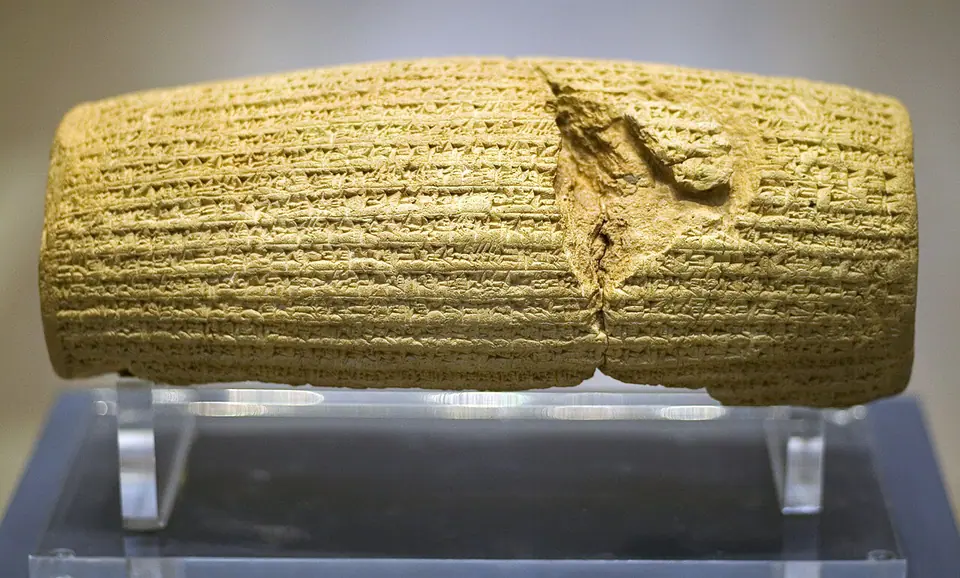
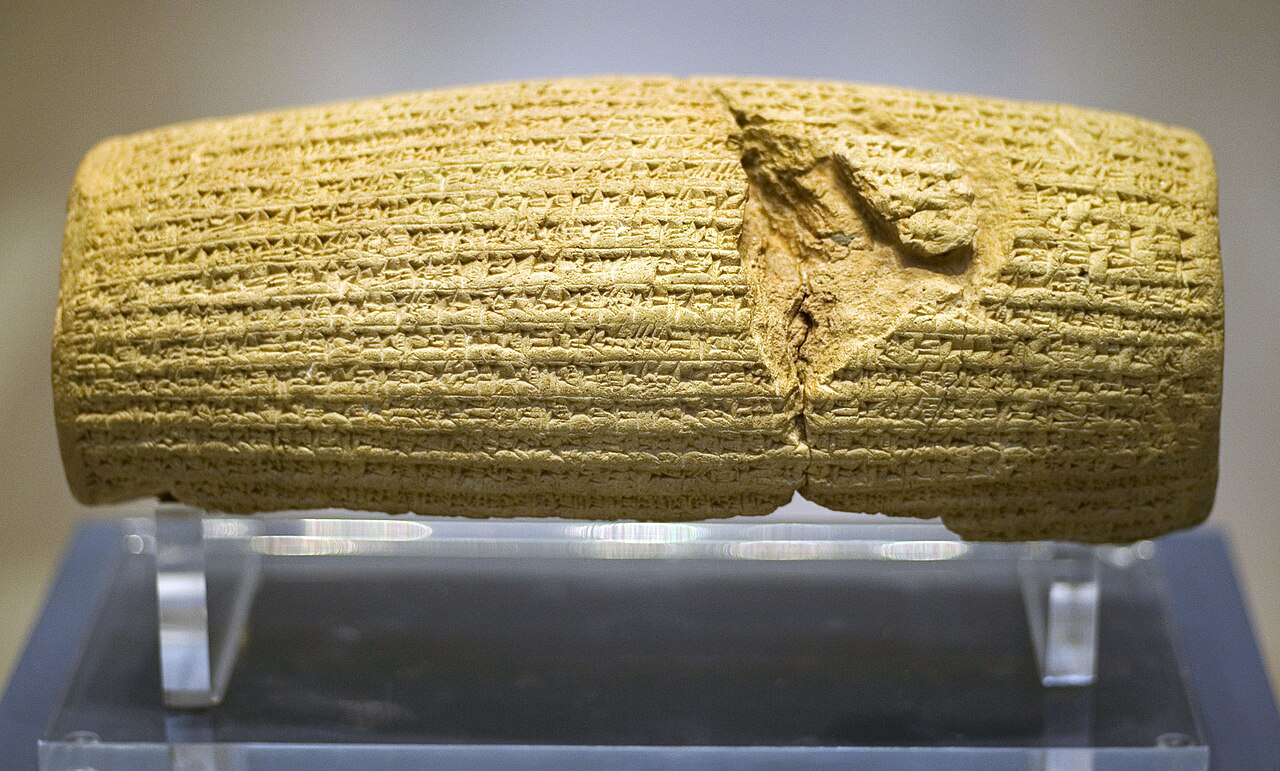
What the Persian kings believed. It is not even certain how Zoroastrian the early Achaemenid kings were. Cyrus’s own Babylonian proclamation credits the Babylonian god Marduk with calling him (§4).[15] Contested
Where most scholars stand
Between the two poles is the most common view: Judaism developed these ideas in a cosmopolitan world where Persian, Babylonian, Greek and Jewish thought circulated together, so influence is likely but diffuse, and cannot be traced from one text to another. John J. Collins and Alan Segal argue along these lines.[16][17] The parallel is real; proof of borrowing is not. Contested
| View | Claim | Proponents |
|---|---|---|
| Strong influence | Zoroastrianism supplied Judaism’s eschatology, angels and devil | Boyce[1] |
| Shared environment | Persian ideas were in the air; Judaism reshaped them in its own terms | Collins, Segal[16][17] |
| Internal development | The ideas grew from Israel’s own traditions under the pressure of exile and persecution | Barr[2] |
| Traditional | The ideas were revealed or implied in Israel’s scriptures; the rabbis read resurrection in the Torah itself | Rabbinic tradition (m. Sanhedrin 10:1)[18] |
Common misconceptions
- “Judaism copied monotheism from Zoroastrianism.” Explicit monotheism in Isaiah 40–55 grows out of the older movement to worship Yahweh alone (§3, §4), and its one God creates darkness too, which Zoroastrian dualism does not allow.[19][3]
- “Zoroastrianism is proven older than Judaism, so it must be the source.” Both have roots in the second millennium BCE, and the dates of Zarathustra range over centuries.[1] What matters is when each specific idea is attested, and on that the Jewish texts are often earlier than the surviving Zoroastrian ones.
- “Paradise proves it.” The word pardēs is Persian. The Persian word meant a royal park, and its use for a heavenly garden comes later, through Greek translation.[5]
Why it matters
If the influence is real, the ideas of heaven, hell, the devil and the resurrection that Christianity and Islam inherited from Judaism partly descend from the religion of ancient Iran. If it is not, they are a Jewish creation of the Second Temple period. Either way, the period of Persian rule was when the religion of ancient Israel turned into the Judaism the rabbis inherited (§5, §6).
For the full debate, see §6 (the new ideas) and §4 (Isaiah and Cyrus).
References
- ^ a b c d Mary Boyce Zoroastrians: Their Religious Beliefs and Practices. Routledge & Kegan Paul, 1979. open library Argues for an early date for Zarathustra; most scholars now place him later, and the range is wide.
- ^ a b c d James Barr The Question of Religious Influence: The Case of Zoroastrianism, Judaism, and Christianity. Journal of the American Academy of Religion 53, 1985. A sceptical assessment of claims that Persian religion shaped Jewish ideas of the afterlife and evil.
- ^ a b c d Isa 45:1–7 — Isaiah (Hebrew Bible). c. 550–539 BCE. Hebrew. Yahweh calls Cyrus his 'anointed' and declares 'I am Yahweh and there is no other; besides me there is no god ... I form light and create darkness, I make peace and create evil': the Bible's first explicit monotheism. read the text
- ^ Ezra 7:25–26 — Ezra (Hebrew Bible). c. 4th c. BCE (composition); set in 458 or 398 BCE. Aramaic. Artaxerxes' letter empowers Ezra to appoint judges and punish whoever will not obey "the law of your God and the law of the king" — the key text for the imperial-authorisation theory. read the text
- ^ a b Nehemiah 2:1–8 — Nehemiah (Hebrew Bible). Memoir set in 445 BCE. Hebrew. In the twentieth year of Artaxerxes, Nehemiah the king's cupbearer asks to be sent to rebuild Jerusalem. read the text
- ^ Petition to Bagavahya (TAD A4.7; Cowley 30) — Elephantine papyri. 407 BCE. Aramaic. The Elephantine priests ask the governor of Judah to help rebuild the temple of YHW destroyed in 410 BCE; it predates Cambyses (525 BCE), and they name the high priest Jehohanan and the sons of Sanballat of Samaria. about
- ^ 1 Enoch 1–36 (Book of the Watchers) — 1 Enoch. 3rd c. BCE. Aramaic (surviving complete in Ge'ez). Two hundred Watchers descend to Mount Hermon, father giants and teach forbidden arts; evil comes from fallen angels. Aramaic fragments at Qumran date from the early 2nd c. BCE. about
- ^ Diogenes Laertius, Lives 1.9 (citing Theopompus) — Lives of the Eminent Philosophers. report of the 4th c. BCE, preserved 3rd c. CE. Greek. Theopompus, in book 8 of his Philippica, reports that according to the Magi people will come to life again and be immortal: early Greek evidence for a Persian belief in resurrection.
- ^ Morton Smith II Isaiah and the Persians. Journal of the American Oriental Society 83, 1963. Parallels between Second Isaiah and Persian propaganda for Cyrus.
- ^ Yasna 44.5 — Gathas (Avesta). c. 1200–600 BCE (debated). Avestan. Zarathustra asks Ahura Mazda what craftsman made light and darkness, sleep and waking, dawn, noon and night: a Zoroastrian question often compared with Isaiah 45:7. about
- ^ Psalm 82 — Psalms (Hebrew Bible). c. 8th–6th c. BCE (debated). Hebrew. God stands "in the assembly of El" and judges among the gods, sentencing them to die like mortals: the divine council in session. read the text
- ^ 1 Chronicles 21:1 (cf. 2 Samuel 24:1) — Chronicles (Hebrew Bible). c. 4th c. BCE. Hebrew. Where Samuel says Yahweh incited David to take a census, Chronicles says "a satan stood up against Israel and incited David". read the text
- ^ Elaine Pagels The Origin of Satan. Random House, 1995. How the accuser of Job became the enemy of God in Jewish sectarian and early Christian writing.
- ^ Daniel 12:1–3 — Book of Daniel (Hebrew Bible). c. 165 BCE. Hebrew. Michael the great prince arises; 'many of those who sleep in the dust of the earth shall awake, some to everlasting life, and some to shame and everlasting contempt': the first clear biblical statement of resurrection and judgment. read the text
- ^ Cyrus Cylinder — British Museum 90920. 539/538 BCE. Akkadian. Cyrus's Babylonian proclamation: Marduk grasped his hand and called his name; he restored neglected cults and returned gods and peoples to their cities in Mesopotamia and western Iran. Judah is not mentioned. about
- ^ a b John J. Collins The Apocalyptic Imagination: An Introduction to Jewish Apocalyptic Literature. Eerdmans, 3rd ed., 2016. Daniel, Enoch and the rise of ideas about judgment, resurrection and the end.
- ^ a b Alan F. Segal Life After Death: A History of the Afterlife in Western Religion. Doubleday, 2004. From Sheol to resurrection, with the Persian and Greek background.
- ^ m. Sanhedrin 10:1 — Mishnah. c. 200 CE. Hebrew. Abba Saul adds to those with no share in the world to come 'one who pronounces the name according to its letters'. read the text
- ^ Mark S. Smith The Early History of God: Yahweh and the Other Deities in Ancient Israel. Eerdmans, 2nd ed., 2002. open library How Israelite religion emerged from its Canaanite setting and became monotheistic.