The short version: Guru Nānak was a Punjabi poet and teacher, born in 1469 and dead in 1539, whose followers became the Sikhs. A short life is close to certain; a body of teaching survives in his own words; and a much fuller life, rich in journeys and miracles, is the tradition’s, written down a century and more after him (§2).[1][2][3] Consensus What follows sorts the three.
For Sikhs he is the first Guru, sent by God, whose light passed to each of the nine Gurus after him and then into the scripture. That is a belief about who he was, not a claim that history can test, in either direction (How We Know).[4][5]
What is close to certain
The life W. H. McLeod could defend in 1968 fitted in a paragraph, and the field since has added detail without much changing it.[1][2] Majority
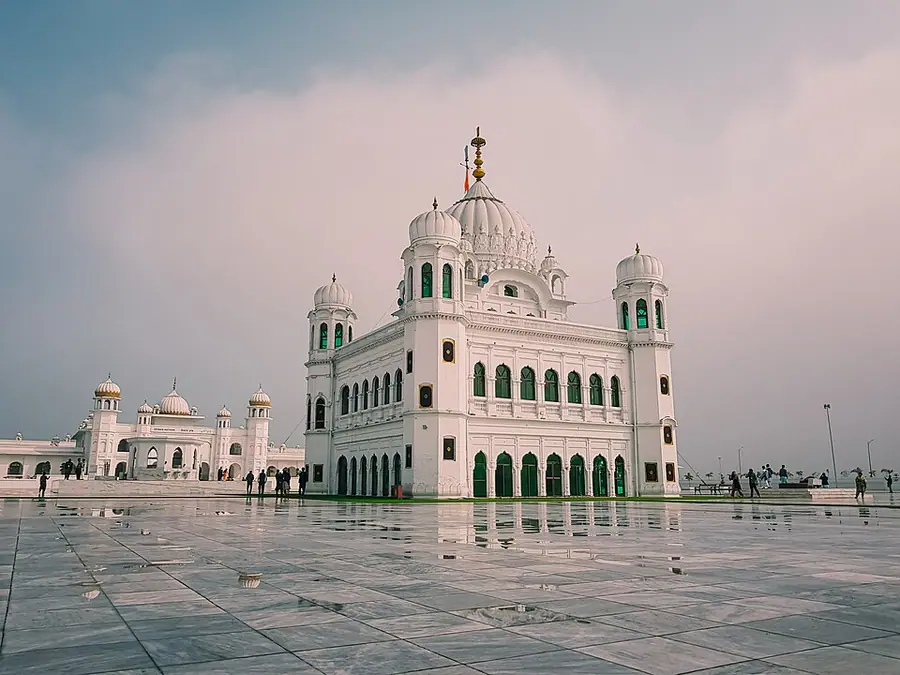
- Birth and family. Born in 1469 at Talvaṇḍī Rāi Bhoe, west of Lahore, a village held by a Muslim Bhaṭṭī landholder, Rāi Bulār; it is now Nankāṇā Sāhib, in Pakistan. His family were Khatrīs, a caste traditionally assigned trade and clerical work, of the Bedī sub-caste; his father, Kālū, was the village accountant. His mother is named Tṛiptā in the tradition, and he had an elder sister, Nānakī.[1][2][6] Majority
- Sultānpur. As a young man he worked at Sultānpur Lodhī as a keeper of stores for Daulat Khān Lodī, the Afghan governor of Lahore, where his sister’s husband was in the governor’s service. One hymn describes his calling in a minstrel’s words: “I was a minstrel without work, and the Lord gave me work”.[7] He married, by tradition Sulakhaṇī, and had two sons, Srī Chand and Lakhmī Dās.[1][2][8] Majority
- The road. He spent many years travelling, as his hymns, Bhāī Gurdās and every janamsākhī agree; his companion in every tradition is Mardānā, a Muslim hereditary musician from Talvaṇḍī who played the rabāb while the Guru sang.[1][9] Majority
- Kartārpur. In the 1520s he founded Kartārpur, “the Creator’s town”, on the Rāvī, and lived there with his family and disciples, farming, until he died in 1539.[1][2][10] Consensus on the year and the place.
Nothing outside the community records him in his lifetime. No Persian chronicle, Lodī or Mughal document, or traveller mentions him, apart from a disputed inscription at Baghdad; the first outside reference to any Guru is the emperor Jahāṅgīr’s, in 1606.[11][12] Consensus No portrait from life survives; the earliest dated paintings of him are in a janamsākhī of 1733.[13][14] Majority
The hymns: Guru Nānak in his own words
The best evidence for Guru Nānak is what he sang. Nearly a thousand of his hymns survive. Some are in the Goindvāl pothīs of about 1570–1572, a generation after his death, of which two volumes survive; all are in the Ādi Granth of 1604. Like all the Gurus, he signs them “Nānak”.[15][16][5] Majority
They place him in time. Four hymns, the Bābar-vāṇī, describe the Mughal invasions of Punjab as something seen: “Leading a wedding party of sin he has swept down from Kabul, and demands the bride by force, O Lālo.”[17][18][2] Consensus They also show his temper. Where the later stories have Bābur kneel to him, the hymns say “Not one Mughal went blind; no one worked a miracle”, and argue with God over the suffering of Hindu and Muslim women alike.[19][1] Majority
And they give his teaching. God is one, formless and unborn, and takes no incarnations; he is known through the nām, the divine Name, and the sabad, the Word the Guru reveals; everything happens within the hukam, the divine order; what keeps a person from God is haumai, the self-centred ego.[1][20] Consensus He used Hindu and Muslim names for God freely, Rām, Hari, Khudā, Allāh, while rejecting idols, pilgrimage, ritual purity and the authority of both Brahmin and qāzī.[1][5] Consensus He set the householder above the ascetic: one who calls himself guru or pīr and goes begging is not to be honoured; “one who eats what he has laboured for, and gives something from his own hand: Nānak, such people know the way”.[21] Consensus And he denied caste any worth before God: “Recognise the light; do not ask about caste: in the world beyond there is no caste.”[22] Consensus on the text.
The life the tradition tells
Most Sikhs know a fuller life from the janamsākhīs, the “birth stories”, written down from the seventeenth century onward: the child who confounded his teachers and refused the sacred thread, the cobra that shaded him, the three days in the river at Sultānpur, the four great journeys east, south, north and west, the debates with yogīs and qāzīs.[6][23][24] Consensus that this is the tradition’s account.
McLeod sorted 124 of these episodes in 1968, from the established to the impossible, and judged only about three dozen established or probable.[1] Majority His method produced three kinds of result (§2):
- Stories built on hymns. The refusal of the sacred thread dramatises a salok in which Guru Nānak tells a pandit to make compassion the cotton and contentment the thread; the carpenter Lālo of Saidpur takes his name from the hymn on Bābur.[25][24] Majority
- Stories improbable as told. The cobra, the Kaʿba that moved with his feet, the emperor at his feet.[1] Majority among historians.
- Stories that may keep a memory. Sultānpur, the travels and the early companions, attested by more than one line of tradition and in part by Bhāī Gurdās or the scripture.[1][2] Majority
Two well-known dates and sayings belong to this layer. The month of his birth is disputed: the older traditions give Vaisākh, April 1469, and the Bālā janamsākhī the Kārtik full moon, October–November; historians mostly prefer April, and Sikhs celebrate his birthday, Gurpurab, at the Kārtik full moon, usually in November.[6][23][1][26] Contested And the words “there is no Hindu, there is no Muslim”, which he is said to have spoken on coming out of the river, are the janamsākhīs’, not the scripture’s.[8] Majority The journey to Mecca has its own page.
The first succession
Guru Nānak’s choice of successor is one of the best-attested acts of his life, and the one that made a following into a tradition. He passed over his sons and installed Lahaṇā, a Khatrī trader who had been a devotee of the goddess, as Guru with the name Aṅgad, “limb”, as if part of his own body.[2][5] Majority A ballad in the scripture by the minstrels Sattā and Balvaṇḍ, composed in the time of the fifth Guru, says Guru Nānak “set the royal canopy over Lahaṇā’s head”, and that his sons did not keep his word and turned their backs.[27][28] Majority on the ballad’s date. The elder son, Srī Chand, was an ascetic; the Udāsī order later traced its origin to him, so the first succession also produced the first rival claim to Guru Nānak.[29][24] Majority
He died at Kartārpur in 1539, in September by the tradition’s reckoning. The janamsākhīs tell that his Hindu and Muslim followers quarrelled over whether to cremate or bury him, and found only flowers beneath the sheet; the same story is told of Kabīr.[8][1] Consensus that this is the tradition’s account.
Sant, reformer or founder?
What historians argue over is not his life but his place. McLeod set him in the Sant tradition of north Indian poets of the formless God, Kabīr and Ravidās among them, as its greatest exponent (§1). Many Sikh scholars replied that this reduced the founder of a revelation to one voice among many. Most historians now say he shared the Sant idiom and did what no Sant did: named a successor, founded a settled community and began a line of Gurus who made his hymns a scripture (§3).[1][30][31][3] Contested; Political
Common misconceptions
- “Guru Nānak wrote the Guru Granth Sāhib.” He wrote nearly a thousand of its hymns; the book was compiled by Guru Arjan, the fifth Guru, in 1604, with hymns of five Gurus and of poets from outside the line (Who wrote the Guru Granth Sahib?).[5] Consensus
- “His birthday is in November because he was born then.” November is the Bālā tradition’s date; the older lives say April.[1][32] Majority
- “His companion was Bhāī Bālā.” Mardānā is named by Bhāī Gurdās; Bālā appears only in the janamsākhī that bears his name.[9][23][24] Majority
- “There are portraits of him.” None from life; the images are of the late seventeenth century and after.[13] Majority
What the evidence cannot settle
The historian can date Guru Nānak’s hymns, trace the stories told of him and say when each first appears; the hymns themselves show a teacher of unusual force who was already building a community with its own songs, discipline and succession. What they do not show, and no evidence could, is whether the voice in them was, as Sikhs believe, the Guru’s revelation of God’s word (§0). Consensus
References
- ^ a b c d e f g h i j k l m n o p W. H. McLeod Guru Nanak and the Sikh Religion. Clarendon Press, Oxford, 1968. The critical study of Nānak's life and theology, separating the janamsākhī tradition from the hymns.
- ^ a b c d e f g h J. S. Grewal The Sikhs of the Punjab. The New Cambridge History of India II.3, Cambridge University Press, 1990. The standard narrative history; revised edition 1998.
- ^ a b Gurinder Singh Mann The Making of Sikh Scripture. Oxford University Press, New York, 2001. The manuscripts from the Goindvāl pothīs to the Damdamā recension.
- ^ Bhāī Gurdās, Vār 1.23 — Vārāṅ. early 17th c. CE. Punjabi in Gurmukhi. "The bountiful Lord heard the cry and sent Guru Nānak into the world": the first vār's history of the world reaches Nānak here, then follows his travels and the succession to Guru Hargobind. read the text
- ^ a b c d e Pashaura Singh The Guru Granth Sahib: Canon, Meaning and Authority. Oxford University Press, 2000. doi The formation of the Sikh canon, from the 1604 Ādi Granth to its installation as Guru.
- ^ a b c Purātan Janamsākhī — Lives of Nānak in the Colebrooke and Hāfizābād manuscripts. 17th c. CE. Punjabi in Gurmukhi. The tradition McLeod judged the least elaborated, and the basis of his sorting of the stories.
- ^ Guru Granth Sāhib, ang 150 — Guru Nānak, Vār Mājh. before 1539 CE (composed); 1604 CE (compiled). Punjabi in Gurmukhi. "I was a minstrel without work, and the Lord gave me work": Nānak's call in the language of a court minstrel. read the text
- ^ a b c Janamsākhīs — Sikh hagiographies. 17th c. CE onward. Punjabi. Where "na koī hindū na koī musalmān" comes from — the traditional life of Nānak, not the Guru Granth Sāhib itself.
- ^ a b Bhāī Gurdās, Vār 1.35 — Vārāṅ. early 17th c. CE. Punjabi in Gurmukhi. At Baghdad with "Mardānā the rabāb player"; the call to prayer, and the pīr Dastgīr's questions. read the text
- ^ Bhāī Gurdās, Vār 1.38 — Vārāṅ. early 17th c. CE. Punjabi in Gurmukhi. Back at Kartārpur the Guru puts off the udāsī's dress; Aṅgad set over the sons; the Japu recited at dawn and the Sodar and Āratī sung. read the text
- ^ V. L. Ménage The "Gurū Nānak" Inscription at Baghdad. Journal of the Royal Asiatic Society of Great Britain and Ireland 111 (1): 16–21, 1979. doi Replies to critics (Harbans Singh among them) of his note printed in McLeod 1968: the words read as "Bābā Nānak" break the metre, the date was retouched, and the chronogram points to 1811–12; accepts the reading faqīr.
- ^ Jahāṅgīrnāmā, regnal year 1 (1606) — Memoirs of Jahāṅgīr. 1606 CE. Persian. The emperor's own account of ordering Guru Arjan's execution, which he links to the Guru's blessing of the rebel prince Khusrau.
- ^ a b B40 Janamsākhī — British Library, MSS Panjabi B 40. 1733 CE. Punjabi in Gurmukhi. A dated and illustrated janamsākhī with 57 paintings, among the earliest surviving images of Guru Nānak.
- ^ Anne Murphy The Materiality of the Past: History and Representation in Sikh Tradition. Oxford University Press, New York, 2012.
- ^ Goindval Pothīs — Early Sikh manuscript collections. c. 1570s. Punjabi in Gurmukhi. The earliest written Sikh collections, and the earliest datable manuscript witnesses to Kabīr, Nāmdev and Ravidās.
- ^ Gurinder Singh Mann The Goindval Pothis: The Earliest Extant Source of the Sikh Canon. Harvard Oriental Series 51, Harvard University Press, 1996.
- ^ Guru Granth Sāhib, ang 722 — Guru Nānak, Tilang (Bābar-vāṇī). 1520s CE (the events); 1604 CE (compiled). Punjabi in Gurmukhi. "Leading a wedding party of sin he has swept down from Kabul… O Lālo" (aṅg 722–723): the invasion named and dated by its source, ending with the disputed numbers seventy-eight and ninety-seven. read the text
- ^ Guru Granth Sāhib, ang 360 — Guru Nānak, Āsā (Bābar-vāṇī). 1520s CE (the events); 1604 CE (compiled). Punjabi in Gurmukhi. Nānak on the Mughal invasion: "Having made Khurāsān his own, he has terrified Hindustan." The most securely datable lines in the scripture. read the text
- ^ Guru Granth Sāhib, ang 417 — Guru Nānak, Āsā (Bābar-vāṇī). 1520s CE (the events); 1604 CE (compiled). Punjabi in Gurmukhi. Two Bābar-vāṇī hymns (aṅg 417–418): the women of the defeated shorn and dishonoured, "Bābar's command has gone forth", and the holy men whose miracles blinded no Mughal. read the text
- ^ Christopher Shackle and Arvind-pal Singh Mandair, trans. Teachings of the Sikh Gurus: Selections from the Sikh Scriptures. Routledge, 2005.
- ^ Guru Granth Sāhib, ang 1245 — Sāraṅg kī Vār, salok of Guru Nānak. before 1539 CE (composed); 1604 CE (compiled). Punjabi in Gurmukhi. "One who eats what he has laboured for, and gives something from his own hand, knows the way": against the begging holy man. read the text
- ^ Guru Granth Sāhib, ang 349 — Guru Nānak, Āsā. before 1539 CE (composed); 1604 CE (compiled). Punjabi in Gurmukhi. "Recognise the light; do not ask about caste: in the world beyond there is no caste." read the text
- ^ a b c Bālā Janamsākhī — Life of Nānak claiming Bhāī Bālā as narrator. 17th c. CE onward. Punjabi in Gurmukhi. The most popular janamsākhī, which presents itself as an eyewitness account; Bālā is not named in earlier sources.
- ^ a b c d W. H. McLeod Early Sikh Tradition: A Study of the Janam-sākhīs. Clarendon Press, Oxford, 1980. The janamsākhī traditions, their manuscripts and how they grew.
- ^ Guru Granth Sāhib, ang 471 — Guru Nānak, Āsā dī Vār. before 1539 CE (composed); 1604 CE (compiled). Punjabi in Gurmukhi. "Make compassion the cotton, contentment the thread": the salok on the sacred thread behind the janamsākhī story of the refused janeū. read the text
- ^ Eleanor Nesbitt Sikhism: A Very Short Introduction. Oxford University Press, 2nd ed., 2016.
- ^ Guru Granth Sāhib, ang 966 — Sattā and Balvaṇḍ, Vār in Rāmkalī. late 16th c. CE. Punjabi in Gurmukhi. A minstrels' ballad, inside the scripture, on Nānak passing the Guruship to Lahaṇā (Aṅgad): the earliest account of the succession. read the text
- ^ Guru Granth Sāhib, ang 967 — Sattā and Balvaṇḍ, Vār in Rāmkalī. late 16th c. CE. Punjabi in Gurmukhi. The ballad continued: the laṅgar of the Guru's Word runs on, Nānak's sons turn their backs, and Khīvī distributes the bounty of Aṅgad's laṅgar: the earliest mention of a Guru's kitchen, and the only mention of a laṅgar in the scripture. read the text
- ^ Harjot Oberoi The Construction of Religious Boundaries: Culture, Identity, and Diversity in the Sikh Tradition. University of Chicago Press, 1994. The "Sanātan" Sikhism of the early nineteenth century and the Singh Sabhā's sharper boundaries.
- ^ Kharak Singh, G. S. Mansukhani and Jasbir Singh Mann, eds. Fundamental Issues in Sikh Studies. Institute of Sikh Studies, Chandigarh, 1992. Essays against McLeod's school, from its Sikh critics.
- ^ J. S. Grewal Guru Nanak in History. Panjab University, Chandigarh, 1969. Nānak set against the politics and the religious groups of fifteenth- and early sixteenth-century Punjab.
- ^ Karam Singh Kattak ki Visākh. n.d.; republished Patiala, 1912 (McLeod cites Amritsar, 1913), 1912. Argues from the janamsākhīs that Nānak was born in Vaisākh (April), not Kārtik.