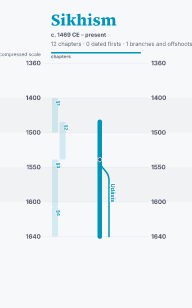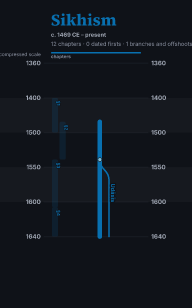
Guru Nānak (1469–1539) is the founder of the Sikh tradition and the first of its ten Gurus. He was a Punjabi poet who sang his hymns to the music of a Muslim companion, spent years on the road, and ended his life as the head of a farming community on the banks of the Rāvī, where his followers sang his hymns at dawn and dusk. His hymns survive, nearly a thousand of them, in manuscripts written within a generation of his death. The stories of his life were written down much later.[1][2][3] Consensus
That is the shape of this chapter. On one side is a short life that the evidence supports, and a body of teaching in Guru Nānak’s own words; on the other, the life that Sikhs know from the janamsākhīs, full of journeys, meetings and miracles, first written down a century and more later (§0). The argument here is that the historical Guru Nānak is best known from his hymns, and the hymns show a teacher who was already building something new: a community with its own songs, its own discipline and, before he died, its own succession.[1][2][4] Majority
Timeline
Most dates before 1520 are the tradition’s, and are marked as such; the sources are the janamsākhīs as McLeod sorted them, Grewal’s narrative, and the Guru’s own hymns.[1][2][5]
| Date | Event | Confidence |
|---|---|---|
| 1469 | Guru Nānak born at Talvaṇḍī (Nankāṇā Sāhib); April in the Purātan tradition, October–November (the Kārtik full moon; 20 October 1469 by McLeod’s reckoning) in the Bālā[6][7][1] | Consensus (year); Contested (month) |
| c. 1487 | Married to Sulakhaṇī, by tradition the daughter of Mūl Chand of Baṭālā[5] | Majority (the marriage) |
| 1494, 1496/1497 | Sons born: Srī Chand and Lakhmī Dās (traditional dates)[2] | Majority |
| c. 1500 | At Sultānpur Lodhī, in charge of the stores of Daulat Khān Lodī; his call, by tradition after vanishing in the river Veīṅ[1][6] | Majority (Sultānpur); Contested (date and details) |
| c. 1500–1520s | Years of travel (udāsīs) with the minstrel Mardānā[1][8] | Majority (travel); Contested (routes) |
| 1519–1526 | Bābur’s invasions of Punjab; Saidpur (Eminābād) sacked, probably in 1520 (Beveridge); the Bābar-vāṇī hymns[9][10][11] | Consensus (invasions); Majority (Saidpur) |
| 1526 | Bābur defeats Ibrāhīm Lodī at Pānīpat; the Mughal empire begins[2] | Consensus |
| 1520s | Settles at Kartārpur on the Rāvī[2][12] | Majority |
| 1539 | Lahaṇā installed as Guru Aṅgad; Guru Nānak dies at Kartārpur, in September by the tradition’s date[13][2] | Consensus (succession, year) |
| c. 1570–1572 | His hymns copied into the Goindvāl pothīs[14][15] | Majority |
| early 17th c. | Bhāī Gurdās tells his life and travels in Vār 1[16] | Consensus |
What is close to certain
The life that W. H. McLeod could defend in 1968 fitted in a paragraph, and the field since has added detail to it without much changing it (§0).[1][2] Majority On that outline:
- Birth and family. Guru Nānak was born in 1469 at Talvaṇḍī Rāi Bhoe, a village west of Lahore held by a Muslim Bhaṭṭī landholder, Rāi Bulār; it is now Nankāṇā Sāhib, in Pakistan. His family were Khatrīs, a caste of traders and clerks, of the Bedī sub-caste; his father, Kālū, was the village accountant (paṭvārī), and his mother is named Tṛiptā in the tradition. He had an elder sister, Nānakī.[1][2][6] Majority
- Sultānpur. As a young man he went to Sultānpur Lodhī, where Nānakī’s husband, Jai Rām, was in the service of Daulat Khān Lodī, the Afghan governor of the Lahore province, and worked there as a keeper of stores (modī). He married and had two sons.[1][2] Majority
- The travels. He spent many years on the road, as his hymns, Bhāī Gurdās and every janamsākhī agree; where he went is a separate question (below).[1][16] Majority on the travels; Contested on the routes.
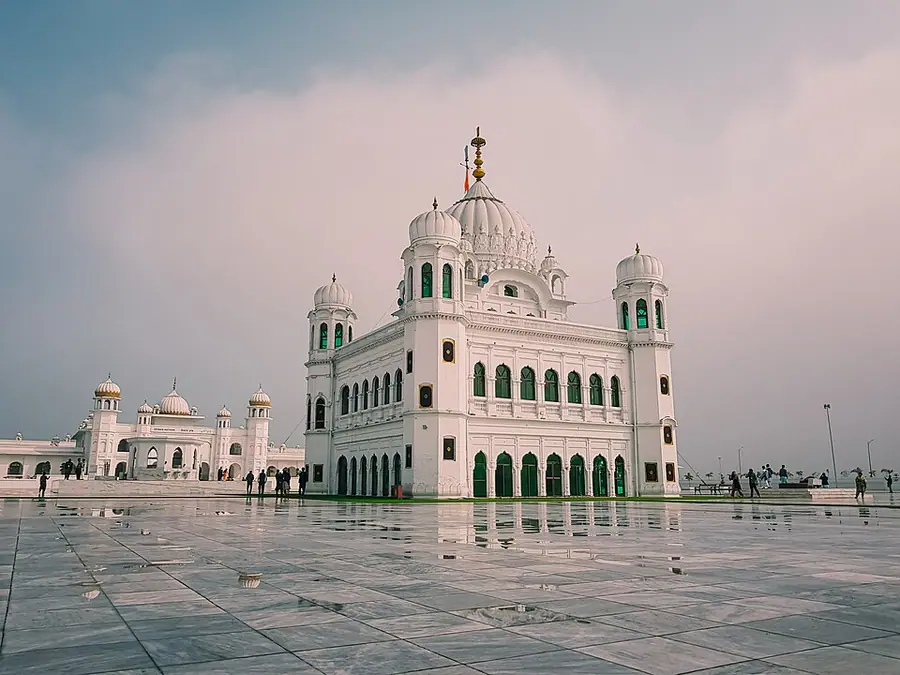
- Kartārpur. In his last years he lived at Kartārpur (“the Creator’s town”), a settlement on the right bank of the Rāvī that he founded, with his family and a growing community of disciples. He died there in 1539, having named a successor.[1][2][12] Consensus on the year and the place.
Kartārpur is now in Pakistan’s Nārowāl district, a few kilometres from the Indian border; the corridor that opened in 2019 to let pilgrims cross to it is part of §11.
The hymns themselves place him in time. Four of them, the Bābar-vāṇī, describe the Mughal invasions of the 1520s as recent and seen (below), and so show him alive and composing in that decade.[17][2] Consensus One describes his own call in the language of a court minstrel:
ਹਉ ਢਾਢੀ ਵੇਕਾਰੁ ਕਾਰੈ ਲਾਇਆ ॥ ਰਾਤਿ ਦਿਹੈ ਕੈ ਵਾਰ ਧੁਰਹੁ ਫੁਰਮਾਇਆ ॥
hau ḍhāḍhī vekāru kārai lāiā | rāti dihai kai vār dhurahu phuramāiā ||
“I was a minstrel without work, and the Lord gave me work; from the first he commanded me to sing his praise, night and day.”[18]
McLeod read lines like these as the Guru’s own testimony to an experience of calling, the one point in his life that the hymns describe from inside.[1] Majority What the experience was, historical method cannot say (§0).
The life the tradition tells
Every Sikh knows a fuller life. The infant Guru Nānak laughed at birth; he confounded his schoolmasters with the meaning of the alphabet; he refused the Brahmin’s sacred thread at his investiture; he spent the money his father gave him for a good bargain on feeding holy men; a cobra shaded him as he slept in the fields. At Sultānpur he went to bathe in the Veīṅ and vanished for three days, and came out of the water saying “there is no Hindu, there is no Muslim”. Then came the journeys, the debates with yogīs and qāzīs, the miracles, and at last Kartārpur.[6][7][19] Consensus that this is the tradition’s account.
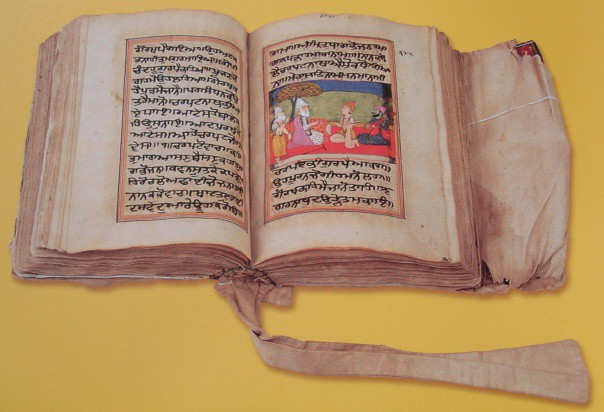
These stories come from the janamsākhīs, which were written down from the seventeenth century onward and disagree with one another (§0).[19][5] Consensus McLeod’s method was to set each episode against the hymns, against the other traditions and against what is known of the period. Applied to the stories above, it gives three kinds of result.[1] Majority
- Stories that grow out of hymns. The refusal of the sacred thread dramatises a salok of Guru Nānak in the Āsā dī Vār, which tells a pandit to make compassion the cotton and contentment the thread: if he has a thread like that for the soul, let him put it on.[20] The story of the carpenter Lālo of Saidpur, with whom the janamsākhīs have the Guru stay, takes its name from the hymn on Bābur that addresses “Lālo” in every line (below). In cases like these the hymn is early, and the story built round it is later.[1][19] Majority
- Stories that are improbable as told. The cobra, the Kaʿba that moved, the meeting with Bābur in which the emperor kneels to the Guru: McLeod placed them among the improbable or impossible, on grounds of nature or chronology.[1] Majority among historians.
- Stories that may preserve memory. The Sultānpur employment, the travels, and the companions named early are on firmer ground, because more than one independent line of tradition has them, and Bhāī Gurdās or the scripture confirms some of them.[1][2] Majority
The words “there is no Hindu, there is no Muslim” are the janamsākhīs’, not the scripture’s, and Hinduism §10 discusses what they have been made to mean.[5] Majority
April or November? The birth-date dispute
The janamsākhīs do not agree even on Guru Nānak’s birthday. The Purātan and Miharbān traditions give the third day of the bright half of Vaisākh, Sambat 1526, which falls in April 1469. The Bālā janamsākhī gives the full moon of Kārtik in the same year, in October or November (20 October 1469 by McLeod’s reckoning).[6][21][7][1] Consensus on what the texts say.
Because the Purātan is the older and less elaborated tradition, and the Bālā is the least reliable of the four (§0), most historians prefer April. Macauliffe had already argued against the Kārtik date in 1909; the case was argued at length by the Sikh historian Karam Singh in Kattak ki Visākh (“Kārtik or Vaisākh?”, c. 1912–13); and McLeod judged Vaisākh “much the more likely”.[22][23][1] Majority Sikh practice kept the Kārtik date, and why it prevailed is not settled. The Bālā was the most copied life and, from 1871, the most printed; Santokh Singh’s Nānak Prakāś (1823) followed it; and Macauliffe recorded a story, without good authority, that Bhāī Sant Singh fixed the Kārtik date at Amritsar to draw Sikhs away from a Hindu fair at Rām Tīrath. McLeod thought it impossible to give a satisfactory explanation.[1][22][19] Majority The festival of Gurpurab is still celebrated at the full moon of Kārtik, and moves each year with the lunar calendar.[24] Consensus When the Nanakshahi calendar of 2003 fixed most Sikh festivals to solar dates, it left Guru Nānak’s birthday on its lunar Kārtik date, one of three days kept lunar; the argument over it continues (§11). Contested
The journeys
The tradition’s four udāsīs
The janamsākhīs arrange the Guru’s travels as great journeys (udāsīs, “journeys of detachment”) toward the points of the compass, with shorter tours in Punjab between them. In the form most Sikhs now learn there are four:[6][1][24] Consensus that this is the tradition’s account.
| Journey | Places in the tradition | Earliest attestation |
|---|---|---|
| East | Hardwār, Banaras, Kāmrūp (Assam); Jagannāth Purī in some traditions, not the Purātan | Janamsākhīs, 17th c.[6][5] |
| South | The Deccan and Sri Lanka, where King Sivanābh becomes a disciple | Janamsākhīs; a short text on the route to Sivanābh’s kingdom[6][1] |
| North | The Himalayas and Mount Sumer, where he debates the Siddhs | Bhāī Gurdās, early 17th c.[16] |
| West | Mecca, Medina and Baghdad | Bhāī Gurdās, early 17th c.[25][8] |
The order of the journeys, their number and their dates differ between the traditions, and each tradition’s itinerary is longer than the last.[1][19] Majority Mount Sumer is the axis of the world in Indian cosmology; a meeting there with the immortal Siddhs is theology told as geography, whatever journey to the hills lies behind it.[1] Majority
What Bhāī Gurdās says
The earliest narrative of the travels is in Bhāī Gurdās’s first vār, written in the early seventeenth century by the scribe of the Ādi Granth (§0). It is not an itinerary. In pauṛīs 24–45 the Guru, having received the Name, puts on the dress of an udāsī and goes out to set the world right: to the pilgrimage places, to Mount Sumer and the Siddhs, to Mecca and Baghdad, back to Kartārpur, then to the Śivarātri fair at Achal Baṭālā and to Multan.[16][12] Consensus on the text.
The Mecca and Baghdad episodes take six stanzas:[25][8][2]
- Pauṛī 32. Dressed in blue, with staff, book, water-pot and prayer-mat, the Guru goes to Mecca and sleeps in the mosque with his feet towards the miḥrāb. A man named Jīvan kicks him and drags him by the legs, and Mecca turns.
- Pauṛī 33. The qāzīs and mullās ask him from his book whether the Hindu or the Muslim is the greater; he answers that without good deeds both will weep.
- Pauṛī 34. His sandal is kept at Mecca as a relic, and the whole world bows.
- Pauṛīs 35–36. At Baghdad, with “Mardānā the rabāb player”, he gives the call to prayer and the city falls silent; the pīr Dastgīr questions him, and the Guru shows the pīr’s son the countless worlds above and below. (Gursharan Kaur Jaggi’s critical edition differs from the common text in many small readings in pauṛī 35, fifteen by Santbir Singh’s count, but has the same rabābī Mardānā.)[26][27]
- Pauṛī 37. Baghdad, Mecca and Medina, the Siddhs and the six schools all submit; Hindus and Muslims alike bow.
Two things follow. The stories of the western journey were already told in the Gurus’ own circle within about seventy years of Guru Nānak’s death, earlier than any surviving janamsākhī manuscript. And they were already miracle stories, told to show the Guru’s victory over the holy men of every tradition.[2][1] Majority
The Baghdad inscription
Outside Baghdad, near the tomb of the Sufi Bahlūl, stood a small shrine to Bābā Nānak, which Sikh soldiers of the Indian Army found during the First World War. Set into it was a stone with an inscription in Ottoman Turkish recording the building of a structure for “Bābā Nānak”, with a date.[28][29] Consensus that the shrine and the stone existed; the shrine was damaged and the stone taken after the 2003 invasion of Iraq.
If it were of his own century, the inscription would be the only object outside India to name Guru Nānak in his lifetime. The stone’s date has been read as 917 or 927 of the Hijra (1511–12 or 1520–21); V. L. Ménage read its chronogram as 1226 (1811–12). A “date of 912” comes from a 1919 poem about an “Arabic inscription” that no one has found.[28][1][29] Contested McLeod, in 1968, printed a note by Ménage concluding that the inscription almost certainly did not name Guru Nānak and dated from the early nineteenth century, and withdrew it as evidence: the support claimed on its basis, he wrote, “must be withdrawn”.[1] Majority Ménage, an Ottomanist at SOAS, made the case first in that note and again in a 1979 article replying to his critics, Harbans Singh among them: the words read as “Bābā Nānak” break the verse’s metre, the date in the cartouche had been retouched, and the chronogram points to the early nineteenth century; in 1979 he accepted the reading faqīr.[29][30] Contested Many Sikh writers treat the stone as proof of the visit. Most historians treat the visit as unproven, and the inscription as uncertain evidence of anything earlier than the shrine’s existence when Sikh soldiers found it.[29][1][31] Majority
Did he go to Mecca?
There is no Muslim record of the visit, the janamsākhīs give different routes, and the Mecca story is a miracle story from its earliest telling.[1][25] Majority None of that makes a journey west impossible: Punjabi traders and pilgrims travelled to Arabia and Iraq, and the Guru’s hymns show close knowledge of Muslim practice, addressing qāzīs, mullās and the five daily prayers in their own vocabulary.[2][32] Majority The honest answer is that the tradition is early and confident, and the visit cannot be confirmed. Contested
The Bābar-vāṇī: the hymns on Bābur
Zahīr al-Dīn Muḥammad Bābur, the Timurid prince who ruled Kabul, raided Punjab from 1519 and defeated the last Lodī sultan, Ibrāhīm, at Pānīpat in 1526, founding the Mughal empire (Islam §9).[2] Consensus Four hymns of Guru Nānak describe the invasions. They are the Bābar-vāṇī, a name taken from a line in one of them that says “Bābar’s command (vāṇī) has gone forth”.[9][17][10] Consensus §0 quotes the first, on aṅg 360.
The tradition connects them with the sack of Saidpur, now Eminābād, near Gujrāṅwālā, and places the Guru in the town when it fell, probably in 1520, the date Annette Beveridge gave in her edition of Bābur’s memoir.[2][6][11] Majority Bābur’s own memoir, the Bāburnāma, has a gap for the years 1520–1525 and does not settle the point. The hymns themselves name no town.[2] Majority
The second hymn, in Āsā, describes what happened to the women of the defeated:
ਜਿਨ ਸਿਰਿ ਸੋਹਨਿ ਪਟੀਆ ਮਾਂਗੀ ਪਾਇ ਸੰਧੂਰੁ ॥ ਸੇ ਸਿਰ ਕਾਤੀ ਮੁੰਨੀਅਨਿੑ ਗਲ ਵਿਚਿ ਆਵੈ ਧੂੜਿ ॥
jin siri sohani paṭīā māṅgī pāi sandhūru | se sir kātī munnīani gal vichi āvai dhūṛi ||
“Those heads that were graced with braids, the partings filled with vermilion: those heads are shorn with shears, and dust chokes their throats.”[9]
Its companion hymn, on aṅgs 417–418, turns on the holy men who promised to stop the invader by their powers:
ਕੋਈ ਮੁਗਲੁ ਨ ਹੋਆ ਅੰਧਾ ਕਿਨੈ ਨ ਪਰਚਾ ਲਾਇਆ ॥
koī mugalu na hoā andhā kinai na parachā lāiā ||
“Not one Mughal went blind; no one worked a miracle.” (aṅg 418)[9]
It is worth setting that line beside the janamsākhīs. The Guru of the hymns says that miracles did not stop the Mughals; the Guru of the later stories is imprisoned by Bābur’s soldiers, makes the millstone turn by itself, and has the emperor at his feet.[1][5] Majority
The fourth hymn, in Tilang, is quoted below (Primary sources, 2). Near its end come two numbers, “they come in seventy-eight, they go in ninety-seven”, which commentators read as the Bikramī years 1578 and 1597, that is 1521 and 1540, the year Bābur’s son Humāyūn was driven out of India by Sher Shāh. Read that way the lines foretell Humāyūn’s fall; other commentators read the numbers differently.[10][32] Contested
What the four hymns share is an argument with God. The invasion is the Creator’s doing; the Lodī rulers lost their kingdom because they had lost their way in pleasure; Hindu and Muslim women suffered alike; and the poet asks how God could feel no pity. They are history as theology, which is how the scripture uses events.[4][2] Consensus
The Japjī
The scripture opens with the Japjī (Japu, “recitation”), thirty-eight stanzas (pauṛīs) with an opening and a closing salok, which Sikhs recite every morning. It begins with the Mūl Mantar, the creed-like statement of God’s nature that Hinduism §10 quotes and discusses, and a salok on God as true “in the beginning, through the ages, and now”.[33][34][4] Consensus
When it was composed is not known; the tradition places it among his later works. That it was recited at Kartārpur at dawn is attested early: Bhāī Gurdās says that there “the Japu was recited in the ambrosial hours”, with the evening hymns Sodar and Āratī sung at night.[12][3] Majority The first pauṛī states the problem the rest of the poem works through (Primary sources, 1). Ritual washing, silence, fasting and cleverness do not make a person true. The answer is to walk in the hukam, the divine order or command, which the second pauṛī says no one stands outside of; whoever understands it no longer speaks from haumai, the self.[34][32] Consensus on the text.
The Japjī then moves through the praise of God’s creation, the uselessness of mere hearing and reciting without understanding, and a closing ascent through five “realms” (khaṇḍs) of duty, knowledge, effort, grace and truth, ending in the sach khaṇḍ, “the realm of truth”, where the formless one dwells.[34][1][32] Consensus
The teaching
Guru Nānak’s teaching has to be read from his hymns, and the hymns are poetry, not a system. McLeod’s reconstruction of it in 1968 is still the starting point, though later scholars have put more weight on what was new in it and less on its debts to the Sants (§1).[1][4][35] Majority Its key terms are these:[1][32][24] Consensus
| Term | Meaning in the hymns |
|---|---|
| Nām | The divine Name: not a word to be chanted for its own sake but God’s whole nature as revealed; to “remember the Name” (nām simaran) is the centre of the discipline |
| Sabad (śabda) | The Word: the self-revelation of God, heard through the Guru and sung in the hymns |
| Guru | The teacher who reveals the Word; in Guru Nānak’s hymns above all the voice of God within, and only later the human Gurus and the scripture |
| Hukam | The divine order or command, within which everything happens |
| Sach | Truth: both God’s being (sat) and the truthful life that answers it |
| Haumai | “I-me”: the self-centredness that keeps a person from God and binds them to rebirth |
| Nadar | Grace, the glance of favour without which nothing is attained |
| Gurmukh / manmukh | The one turned towards the Guru, and the one ruled by the self |
| Sevā | Service, to the Guru and the community; at Kartārpur, physical work |
God in these hymns is nirguṇ, without attributes and without form, but also saguṇ, present in every created thing; is beyond birth and death; and takes no incarnations. The Guru uses Hindu and Muslim names for God freely (Rām, Hari, Gobind, Khudā, Allāh) while rejecting idols, pilgrimage, ritual purity and the authority of Brahmin and qāzī as ways to reach God.[1][4] Consensus Whether this makes Guru Nānak a Sant, a reformer, or the founder of something new is the question of §1 and of Hinduism §10. The Sikh tradition holds that he brought a new revelation; most historians now put the weight on a new tradition and community rather than a Sant variant.[4][35] Majority; Political
Rebirth, judgement and release
The hymns take over the Indian picture of rebirth and its vocabulary. Karam in them stands for two words: the Sanskrit karma, action and its consequence, and the Arabic karam, generosity, which in the hymns is another word for nadar, grace.[36][1] Consensus The fourth pauṛī of the Japjī sets the two side by side:
ਕਰਮੀ ਆਵੈ ਕਪੜਾ ਨਦਰੀ ਮੋਖੁ ਦੁਆਰੁ ॥
karamī āvai kapaṛā nadarī mokhu duāru ||
“By karam comes the robe; by grace, the door of release.”[37]
McLeod, the Encyclopaedia of Sikhism and the English translations of Sant Singh Khalsa and Manmohan Singh read karam here as action: past deeds bring the body, “the cloth”, and only grace opens the door. Sahib Singh’s commentary reads it as grace as well, and the robe as the robe of praise.[1][36][37][38] Contested on the reading. The same doubt hangs over the karam khaṇḍ, the Japjī’s fourth realm: most commentators make it the realm of grace, Macauliffe, Teja Singh and Khushwant Singh the realm of action, and McLeod proposed “the realm of fulfilment”.[1] Contested
That deeds bear fruit within the hukam is not in doubt: “you yourself sow and you yourself eat; Nānak, by the order we come and go.”[39] The salok that closes the Japjī brings in the judge: “Good deeds and bad, Dharam reads them out in the presence; by their own deeds some are near and some far.”[40] Consensus on the text. The figures of judgement are those the Sants used: Jam (Yama), to whose city one without the Name goes bound; Dharamrāj with his scribes Chitr and Gupt; and narak, hell.[41][40][1] McLeod read them as images of one thing: the separation from God, which is death, that haumai earns by keeping a person in the round of births. Hell, in his word, is “demythologized”.[1] Majority
As goals, heaven and hell count for little, though the images stay: in the Āsā dī Vār the dead man “goes naked to hell” (dojaki).[20] A salok of Guru Nānak in the Sāraṅg kī Vār says that “the Veda proclaims that merit and sin are the seed of heaven and hell”, and answers that whoever sows truth finds a place in the court (dargah); a salok of Guru Aṅgad (1539–1552) beside it says that the Veda’s tales of sin and merit keep people born “into hell and heaven”.[42] In a Mārū hymn on the time before creation there was “no hell and no paradise” (dojaku bhisatu, the Persian names) and “no hell and no heaven” (naraku suragu, the Indian ones), and no birth or death: both are part of the created order.[43][1] Consensus on the texts. The later Gurus are blunter. In the Sukhmanī of Guru Arjan (1581–1606) one who does penance in pride is born “into hell and heaven, again and again”, and in Devgandhārī he asks for neither rule nor mukti, only love of the Lord’s lotus feet; the scripture also keeps Kabīr’s line “What is hell, what is heaven? The saints reject both.”[44][45][46] Consensus on the texts. The Encyclopaedia of Sikhism’s entry on karma puts the modern reading plainly: “Sikhism does not stipulate heaven or hell wherein good and bad actions of men are rewarded or punished.”[36] Majority
What passes from life to life is not defined in a system. The hymns speak of the jīu or jīa, the ātmā and, above all, the man, which McLeod found to be mind, heart and soul at once: the part of a person “which does not perish with physical death” and must be carried across the ocean of existence, to merge at last, like light in light, with God.[1][36] Majority The count of births is the Indian one, lakh chaurāsīh, eighty-four lakh (8.4 million) forms of life. Guru Nānak puts the self-willed on “the round of eighty-four lakh” (Paṭṭī, aṅg 434); in Guru Amar Dās (1552–1574) and Guru Arjan the phrase is frequent. Guru Arjan lists the births, as worm and moth, elephant, fish and deer, and tells the hearer that after wandering through eighty-four lakh “you have obtained this birth so hard to gain”.[47][48][49] Consensus on the texts. The release they point to need not wait for death: the believer dies to the self while still alive.[1] The term jīvan mukti, release while living, is older than the Sikh scripture, and Guru Nānak already uses it: “he is called liberated while alive from within whom haumai goes” (Mārū, aṅg 1009); the later Gurus use it too.[50][36] Consensus
The householder, not the renouncer
The sharpest line Guru Nānak drew in his own world was against the Nāth yogīs, the ascetics with split ears, ashes and begging bowls who claimed descent from Gorakhnāth and were the most visible holy men of Punjab (§1).[1][2] Consensus In a hymn in Sūhī he says what yoga is not, the patched coat, the staff, the ashes, the earrings, the shaven head, the horn, and gives its refrain:
ਅੰਜਨ ਮਾਹਿ ਨਿਰੰਜਨਿ ਰਹੀਐ ਜੋਗ ਜੁਗਤਿ ਇਵ ਪਾਈਐ ॥
anjan māhi niranjani rahīai jog jugati iv pāīai ||
“Stay unstained in the midst of the soot: that is how the way of yoga is found.”[51]
The Siddh Goshṭ (“discourse with the Siddhs”), a long poem in Rāmkalī beginning on aṅg 938, is a dialogue between the Guru and the yogīs, who ask who he is, what his path is, and why he does not take up their dress (Primary sources, 3).[52][32] Consensus on the text. Bhāī Gurdās sets a version of it at the Śivarātri fair at Achal Baṭālā, where the yogī Bhaṅgar Nāth asks him why, having put on the dress of a renouncer, he has gone back to the life of a householder; the Guru answers that the renouncer still goes to the householder’s door to beg.[12][2] Majority on the reading.
The same point is made in a salok in Sāraṅg about the begging holy man: do not touch the feet of one who calls himself guru or pīr and goes out begging; the one who works for what he eats and gives some of it away knows the way (Primary sources, 5).[53] Consensus on the text. Modern Sikh teaching sums the ethic up in three phrases, nām japo, kirat karo, vaṇḍ chhako (remember the Name, work honestly, share what you have). The formula is modern; each of its parts is in the hymns.[24][1] Majority
Caste
Guru Nānak rejected caste as a measure of a person before God, in some of the scripture’s best-known lines. In Sirī Rāg he places himself with “the lowest of the low”, and in Āsā he tells his hearers to recognise the divine light in each person and not to ask about caste, since in the hereafter there is none:[54][55] Consensus
ਜਾਣਹੁ ਜੋਤਿ ਨ ਪੂਛਹੁ ਜਾਤੀ ਆਗੈ ਜਾਤਿ ਨ ਹੇ ॥
jāṇahu joti na pūchhahu jātī āgai jāti na he ||
“Recognise the light; do not ask about caste: in the world beyond there is no caste.”[55]
What that meant in practice is argued over. The hymns deny caste any value for salvation, and the community at Kartārpur ate and worshipped together. The Gurus themselves were Khatrīs, and they married their children within their caste, as did most Sikhs for centuries after; caste among Sikhs is a subject of §11.[1][2][56] Majority; Political
Women
In a salok of the Āsā dī Vār, against the belief that women, and the impurity of childbirth, pollute, Guru Nānak asks why one should call woman inferior when kings are born of her (Primary sources, 4).[57] Consensus on the text. His hymns also speak of the soul as a bride longing for her husband, God, as Sant and Sufi poetry did.[32][58] Consensus
How far this is equality is a question that the scholarship of the last thirty years has opened. Nikky-Guninder Kaur Singh reads the hymns’ feminine imagery, and the salok, as a vision of the divine that honours the feminine.[58] Doris Jakobsh points out that the salok defends women as mothers and wives, and that the Gurus’ world remained one in which men ruled; much of the “Sikh equality of women” in modern teaching is, she argues, a nineteenth- and twentieth-century reading.[59] Contested Both agree on what the text says.
Kartārpur: the first community
Kartārpur is where the community that became the Sikhs first took a shape. The Guru’s family lived there, farming land on the Rāvī, and disciples came to stay or to visit. Bhāī Gurdās describes the change of life: the Guru took off the dress of the udāsī, put on “worldly clothes”, and sat on a mañjī, a cot or seat, as a teacher; the Japjī was recited before dawn and the Sodar and Āratī sung in the evening, and there was constant discussion of the hymns.[12][2] Majority
McLeod and Grewal drew from these sources a picture of a disciplined day: rising before dawn, bathing and recitation, the day’s work in the fields, the singing of kīrtan (hymns sung to music) in the evening, and a shared meal.[1][2] Majority That Kartārpur had a regular order of worship sung in the Guru’s own hymns, and that the hymns were being collected and copied by the end of the century (§0), are among the best-supported conclusions about it.[3][15] Majority
When did laṅgar become an institution?
Sikh tradition credits Guru Nānak with the laṅgar, the free communal kitchen where all eat together regardless of caste, and today it is part of every gurdwara.[24] Consensus on the tradition. The earliest mention of a Guru’s laṅgar, and the only one in the scripture, is in the ballad of Sattā and Balvaṇḍ, from Guru Arjan’s time: in the stanza on Lahaṇā’s succession, the laṅgar of the Guru’s Word runs and its stores never fail, and in the next, Guru Aṅgad’s wife Khīvī distributes its bounty, rice pudding rich with ghee.[60] Majority on the date. A shared kitchen at Kartārpur is likely, given a resident community and a stream of visitors. The laṅgar as a rule of the faith, in which everyone eats seated in rows before seeing the Guru, is attributed to Guru Amar Dās at Goindvāl (§3).[2][1] Majority
Mardānā
In every tradition, the Guru’s companion on the road was Mardānā, a Muslim of the Ḍūm or Mirāsī caste of hereditary musicians, from Talvaṇḍī, who played the rabāb, a lute, while the Guru sang.[1][2] Majority He is attested early: Bhāī Gurdās names “Mardānā the rabāb player” in the Baghdad episode, and three saloks in the scripture, in the Vār in Bihāgaṛā, stand under headings bearing his name (with the numeral 1 of Nānak); most commentators read them as the Guru’s words addressed to him.[8][61][4] Majority The other companion of the janamsākhīs, Bhāī Bālā, is named only in the tradition that bears his name (§0).[7][19] Majority Mardānā’s descendants, the rabābīs, sang at the Gurus’ court and at the Harmandir Sāhib (the Golden Temple) into the twentieth century; their story belongs to later chapters.[24] Majority
The first succession
Guru Nānak had two sons. Srī Chand, the elder, lived as an ascetic and did not marry; Lakhmī Dās was a householder.[2][1] Majority Neither succeeded him. Before his death he chose a disciple, Lahaṇā, a Khatrī trader of the Trehaṇ clan who had been a devotee of the goddess before he came to Kartārpur, and installed him as Guru with the name Aṅgad, “limb”, as part of his own body.[2][4] Majority
The earliest account is in the scripture: Sattā and Balvaṇḍ’s ballad, which §0 quotes, says that Guru Nānak set the royal canopy over Lahaṇā’s head, bowed to his disciple while still alive, and that his sons did not keep his word and turned their backs.[13][60] Majority on the date. Bhāī Gurdās, writing a generation later, says the same in his own idiom: the Guru “made the Ganges flow backward” by placing Aṅgad over his sons, who were disobedient.[12] Consensus on the text. The janamsākhīs and later lives add a series of tests in which Lahaṇā obeys and the sons refuse, carrying bundles of wet grass, fetching a cup from a ditch, eating what seemed to be a corpse; they are the tradition’s.[19][4] Majority
Two things about this succession shaped everything after it. It made the Guruship an office that passed by the Guru’s choice, not by birth, though from the fourth Guru on it stayed in one family (§3). And the doctrine that the same light passed from one Guru to the next, which the ballad already states (“the light is the same, the way is the same; the king has only changed his body”), made the line of Gurus one Guru in ten bodies.[13][4][2] Consensus on the doctrine.
Srī Chand and the Udāsīs
Srī Chand lived on for decades, by tradition into the time of the sixth Guru. The ascetic order of the Udāsīs (“the detached”) traces its origin to him, kept the Guru’s hymns with ascetic practices the Gurus rejected, and became, in the eighteenth and nineteenth centuries, the custodians of many Sikh shrines (§3, §6).[62][2] Majority The first succession thus produced the first rival line, and the history of the Sikhs is from the start a history of competing claims to Guru Nānak (§0).[19] Majority
Death at Kartārpur
Guru Nānak died at Kartārpur in 1539, in September by the tradition’s reckoning, soon after installing Guru Aṅgad.[2][1] Consensus on the year. The janamsākhīs tell that his Hindu and Muslim followers quarrelled over whether to cremate or bury him, and that when the sheet over his body was lifted only flowers were found, which both sides took away; the same story is told of Kabīr (Hinduism §10).[5][1] Consensus that this is the tradition’s account. Guru Aṅgad moved to Khaḍūr, and Kartārpur passed to Guru Nānak’s sons; the centre of the community moved with the Guru (§3).[2] Majority
The evidence ledger
| Date | Evidence | Confidence |
|---|---|---|
| 1520s | The Bābar-vāṇī hymns on the Mughal invasions[17][9][10] | Consensus |
| before 1539 | Guru Nānak’s other hymns, among them the Japjī and the Siddh Goshṭ[34][52] | Consensus (authorship) |
| c. 1570–1572 | The Goindvāl pothīs: the earliest manuscripts of his hymns[14][15] | Majority |
| 1581–1604 | Sattā and Balvaṇḍ’s ballad: Lahaṇā’s succession, the sons, the laṅgar[13][60] | Majority (date) |
| 1604 | The Ādi Granth, with his hymns in their canonical order[63][4] | Consensus |
| early 17th c. | Bhāī Gurdās, Vār 1: the travels, Mecca, Baghdad, Kartārpur, Guru Aṅgad[25][12] | Consensus |
| 17th c. | The Purātan, Miharbān and Bālā janamsākhīs[6][21][7] | Majority |
| 1511–12 or 1520–21, or 1811–12 (as read) | The Baghdad inscription, read by some as naming “Bābā Nānak”[28][29] | Contested |
| 1733 | The B40 janamsākhī, dated and illustrated[64] | Consensus |
| early 20th c. | Karam Singh argues for an April birth date[23] | Consensus (the argument) |
Primary sources
Show the 6 primary sources
All translations are the site’s own, close to the standard versions; Shackle and Mandair (2005) translate the Japjī and a wide selection of the hymns quoted here.[32]
1. The first pauṛī of the Japjī: Guru Nānak, Japu, aṅg 1
ਸੋਚੈ ਸੋਚਿ ਨ ਹੋਵਈ ਜੇ ਸੋਚੀ ਲਖ ਵਾਰ ॥ ਚੁਪੈ ਚੁਪ ਨ ਹੋਵਈ ਜੇ ਲਾਇ ਰਹਾ ਲਿਵ ਤਾਰ ॥ ਭੁਖਿਆ ਭੁਖ ਨ ਉਤਰੀ ਜੇ ਬੰਨਾ ਪੁਰੀਆ ਭਾਰ ॥ ਸਹਸ ਸਿਆਣਪਾ ਲਖ ਹੋਹਿ ਤ ਇਕ ਨ ਚਲੈ ਨਾਲਿ ॥ ਕਿਵ ਸਚਿਆਰਾ ਹੋਈਐ ਕਿਵ ਕੂੜੈ ਤੁਟੈ ਪਾਲਿ ॥ ਹੁਕਮਿ ਰਜਾਈ ਚਲਣਾ ਨਾਨਕ ਲਿਖਿਆ ਨਾਲਿ ॥੧॥
sochai sochi na hovaī je sochī lakh vār | chupai chup na hovaī je lāi rahā liv tār | bhukhiā bhukh na utarī je bannā purīā bhār | sahas siāṇapā lakh hohi ta ik na chalai nāli | kiv sachiārā hoīai kiv kūṛai tuṭai pāli | hukami rajāī chalaṇā nānak likhiā nāli ||1||
“Cleansing does not make one clean, though one bathe a hundred thousand times. Silence does not bring stillness, though one sit rapt in unbroken meditation. The hunger of the hungry is not appeased, though one heap up the riches of the worlds. A thousand, a hundred thousand clevernesses, and not one goes with you. How, then, to become true? How is the wall of falsehood to be broken? By walking in the will of the Commander, Nānak, as it is written.”[34]
What it proves. The core of the teaching in the poem that opens the scripture: ritual purity, ascetic silence, possessions and learning do not reach God, and the way is to live within the hukam. Soch can mean both “purity” and “thought”, and translators divide on the first line.[32][1] Consensus on the text; Majority on the reading.
2. “O Lālo”: the Bābar-vāṇī in Tilang, aṅg 722
ਪਾਪ ਕੀ ਜੰਞ ਲੈ ਕਾਬਲਹੁ ਧਾਇਆ ਜੋਰੀ ਮੰਗੈ ਦਾਨੁ ਵੇ ਲਾਲੋ ॥ ਸਰਮੁ ਧਰਮੁ ਦੁਇ ਛਪਿ ਖਲੋਏ ਕੂੜੁ ਫਿਰੈ ਪਰਧਾਨੁ ਵੇ ਲਾਲੋ ॥
pāp kī jañ lai kābalahu dhāiā jorī maṅgai dānu ve lālo | saramu dharamu dui chhapi khaloe kūṛu phirai paradhānu ve lālo ||
“Leading a wedding party of sin he has swept down from Kabul, and demands the bride by force, O Lālo. Modesty and righteousness have both gone into hiding, and falsehood struts about as headman, O Lālo.”[10]
What it proves. That Guru Nānak witnessed the Mughal invasion of Punjab in the 1520s, or its aftermath, and named its source, Kabul. The image of the invasion as a wedding procession, with blood for saffron, is the poet’s; the address to “Lālo” became the janamsākhīs’ story of the carpenter of Saidpur. It is the clearest case of a hymn that dates itself.[2][1] Consensus
3. The lotus in the water: the Siddh Goshṭ, Rāmkalī, aṅg 938
ਦੁਨੀਆ ਸਾਗਰੁ ਦੁਤਰੁ ਕਹੀਐ ਕਿਉ ਕਰਿ ਪਾਈਐ ਪਾਰੋ ॥ ਚਰਪਟੁ ਬੋਲੈ ਅਉਧੂ ਨਾਨਕ ਦੇਹੁ ਸਚਾ ਬੀਚਾਰੋ ॥ … ਜੈਸੇ ਜਲ ਮਹਿ ਕਮਲੁ ਨਿਰਾਲਮੁ ਮੁਰਗਾਈ ਨੈ ਸਾਣੇ ॥ ਸੁਰਤਿ ਸਬਦਿ ਭਵ ਸਾਗਰੁ ਤਰੀਐ ਨਾਨਕ ਨਾਮੁ ਵਖਾਣੇ ॥
dunīā sāgaru dutaru kahīai kiu kari pāīai pāro | charapaṭu bolai audhū nānak dehu sachā bīchāro | … | jaise jal mahi kamalu nirālamu muragāī nai sāṇe | surati sabadi bhav sāgaru tarīai nānak nāmu vakhāṇe ||
“‘The world is called an ocean hard to cross: how is the far shore reached?’ says the ascetic Charpaṭ. ‘Nānak, give us your true thought.’ … As the lotus stays untouched in the water, and the water-bird in the stream, so, with the mind fixed on the Word, one crosses the ocean of existence, Nānak, by repeating the Name.”[52]
What it proves. The argument with the Nāth yogīs at the heart of Guru Nānak’s teaching: liberation is found inside the world, not by leaving it. The yogī Charpaṭ is named, and the poem is staged as a real debate with members of a living order. Whether it records one meeting or is a composed dialogue cannot be known. Consensus on the text; Contested on the occasion.
4. “Why call her inferior?”: the Āsā dī Vār, aṅg 473
ਭੰਡਿ ਜੰਮੀਐ ਭੰਡਿ ਨਿੰਮੀਐ ਭੰਡਿ ਮੰਗਣੁ ਵੀਆਹੁ ॥ ਭੰਡਹੁ ਹੋਵੈ ਦੋਸਤੀ ਭੰਡਹੁ ਚਲੈ ਰਾਹੁ ॥ ਭੰਡੁ ਮੁਆ ਭੰਡੁ ਭਾਲੀਐ ਭੰਡਿ ਹੋਵੈ ਬੰਧਾਨੁ ॥ ਸੋ ਕਿਉ ਮੰਦਾ ਆਖੀਐ ਜਿਤੁ ਜੰਮਹਿ ਰਾਜਾਨ ॥
bhaṇḍi jammīai bhaṇḍi nimmīai bhaṇḍi maṅgaṇu vīāhu | bhaṇḍahu hovai dosatī bhaṇḍahu chalai rāhu | bhaṇḍu muā bhaṇḍu bhālīai bhaṇḍi hovai bandhānu | so kiu mandā ākhīai jitu jammahi rājān ||
“Of woman we are born, in woman conceived; to woman we are betrothed and married. Through woman comes friendship, through woman the line goes on. When a woman dies, another woman is sought; through woman come the bonds of society. Why call her inferior, from whom kings are born?”[57]
What it proves. That Guru Nānak rejected the view, common in the religious literature of his day, that women were impure or spiritually lesser. It argues from woman’s place in birth, marriage and lineage, which is why it can be read both as a charter of equality and as a defence of women within the family order (above). Consensus on the text; Contested on how far it goes.
5. Work and give: Sāraṅg kī Vār, salok of Guru Nānak, aṅg 1245
ਗੁਰੁ ਪੀਰੁ ਸਦਾਏ ਮੰਗਣ ਜਾਇ ॥ ਤਾ ਕੈ ਮੂਲਿ ਨ ਲਗੀਐ ਪਾਇ ॥ ਘਾਲਿ ਖਾਇ ਕਿਛੁ ਹਥਹੁ ਦੇਇ ॥ ਨਾਨਕ ਰਾਹੁ ਪਛਾਣਹਿ ਸੇਇ ॥੧॥
guru pīru sadāe maṅgaṇ jāi | tā kai mūli na lagīai pāi | ghāli khāi kichhu hathahu dei | nānak rāhu pachhāṇahi sei ||1||
“One who calls himself guru or pīr and goes out begging: never fall at his feet. One who eats what he has laboured for, and gives something from his own hand: Nānak, such people know the way.”[53]
What it proves. The householder ethic in four lines: honest work and giving, against the begging holy man of either tradition. It is the scriptural root of the later formula kirat karo, vaṇḍ chhako, and of the working community at Kartārpur. Consensus
6. Mecca and Kartārpur: Bhāī Gurdās, Vār 1, pauṛīs 32 and 38
ਬਾਬਾ ਫਿਰਿ ਮੱਕੇ ਗਇਆ ਨੀਲ ਬਸਤ੍ਰ ਧਾਰੇ ਬਨਵਾਰੀ। … ਜਾ ਬਾਬਾ ਸੁਤਾ ਰਾਤਿ ਨੋ ਵਲਿ ਮਹਰਾਬੇ ਪਾਇ ਪਸਾਰੀ। … ਟੰਗੋਂ ਪਕੜਿ ਘਸੀਟਿਆ ਫਿਰਿਆ ਮੱਕਾ ਕਲਾ ਦਿਖਾਰੀ।
bābā phiri makke gaiā nīl basatr dhāre banavārī | … | jā bābā sutā rāti no vali maharābe pāi pasārī | … | ṭaṅgoṅ pakaṛi ghasīṭiā phiriā makkā kalā dikhārī |
“Then Bābā went to Mecca, the Lord dressed in blue. … When Bābā slept at night with his feet stretched toward the miḥrāb … [Jīvan] seized him by the legs and dragged him, and Mecca turned, showing the miracle.”[25]
ਫਿਰਿ ਬਾਬਾ ਆਇਆ ਕਰਤਾਰਪੁਰਿ ਭੇਖੁ ਉਦਾਸੀ ਸਗਲ ਉਤਾਰਾ। ਪਹਿਰਿ ਸੰਸਾਰੀ ਕਪੜੇ ਮੰਜੀ ਬੈਠਿ ਕੀਆ ਅਵਤਾਰਾ।
phiri bābā āiā karatārapuri bhekhu udāsī sagal utārā | pahiri sansārī kapaṛe mañjī baiṭhi kīā avatārā |
“Then Bābā came to Kartārpur and put off all the dress of the udāsī. He put on worldly clothes and sat on the seat [of the teacher], and so made himself manifest.”[12]
What it proves. That within about seventy years of Guru Nānak’s death, in the Gurus’ own circle, his life was already told as a journey to the holy places of Islam crowned with a miracle, followed by a return to the householder’s life at Kartārpur. It confirms the shape of the life (travel, then settlement) and shows how early the stories began to grow. It does not show that he reached Mecca. Consensus on the text and its date; Contested on the journey.
What is absent
- A record of Guru Nānak from outside the community in his lifetime. Apart from the disputed Baghdad inscription, no Persian chronicle, Lodī or Mughal document, or traveller mentions him; the first outside reference to a Guru is Jahāṅgīr’s, in 1606 (§0). Consensus
- Confirmation of the western journey. No Muslim source mentions a visit to Mecca or Baghdad, and the Baghdad inscription’s date and wording are disputed. Majority
- The month of his birth. The traditions disagree, and nothing earlier settles it. Consensus
- An autograph or a portrait. No hymn survives in his hand, and the earliest paintings of him are from the late seventeenth and eighteenth centuries (§0). Consensus
- Bhāī Bālā before the Bālā janamsākhī. Mardānā is named by Bhāī Gurdās; Bālā is not. Majority
- A rule of laṅgar in Guru Nānak’s time. A Guru’s kitchen is first mentioned in a ballad of Guru Arjan’s time, in its stanzas on Guru Aṅgad; the rule that all must eat together before seeing the Guru is Guru Amar Dās’s (§3). Majority
Debates
Did Guru Nānak travel to Mecca and Baghdad?
| View | Main argument | Main proponents |
|---|---|---|
| He did | Bhāī Gurdās, writing within seventy years, describes both visits; the Baghdad shrine and inscription confirm one of them | Much Sikh scholarship; Harbans Singh[30] |
| Improbable or unproven | The travels are certain, the routes are not; the episodes are miracle stories from their first telling, and the inscription is probably nineteenth-century | McLeod (Mecca “highly improbable”, Baghdad “remote”); Ménage on the inscription[1][29] |
| Memory, not itinerary | The journeys say who the Guru was for those who told them: a teacher above every tradition | Murphy, Mandair[31][35] |
Contested
Vaisākh or Kārtik?
The older traditions give April 1469, the Bālā tradition October–November (the Kārtik full moon; 20 October 1469 by McLeod’s reckoning); historians mostly prefer April, and Sikh practice keeps November.[1][23] Contested; the calendar dispute is in §11.
Sant, reformer or founder?
McLeod placed Guru Nānak within the Sant tradition of northern India, as its greatest exponent; his critics, and most of the field since, stress the community, the succession and the scripture he began, and treat him as the founder of a new tradition.[1][65][4][66] Contested; Political §1 sets out the argument.
Further reading
Show further reading (8 works)
- W. H. McLeod, Guru Nanak and the Sikh Religion (Clarendon, 1968): the life sorted, and the teaching reconstructed from the hymns.
- W. H. McLeod, Early Sikh Tradition: A Study of the Janam-sākhīs (Clarendon, 1980): where the stories come from.
- J. S. Grewal, Guru Nanak in History (Panjab University, 1969), and The Sikhs of the Punjab (Cambridge, 1990; revised 1998): Guru Nānak in the politics and religion of his time.
- Harbans Singh, Guru Nanak and Origins of the Sikh Faith (Asia Publishing House, 1969): the tradition’s life, told by a historian.
- Christopher Shackle and Arvind-pal Singh Mandair, trans., Teachings of the Sikh Gurus (Routledge, 2005): the Japjī and other hymns in English.
- Pashaura Singh, The Guru Granth Sahib: Canon, Meaning and Authority (Oxford, 2000): the hymns in the making of the scripture.
- Nikky-Guninder Kaur Singh, The Feminine Principle in the Sikh Vision of the Transcendent (Cambridge, 1993), and Doris R. Jakobsh, Relocating Gender in Sikh History (Oxford, 2003): two readings of the hymns on women.
- Anne Murphy, The Materiality of the Past (Oxford, 2012): the relics and shrines of Guru Nānak’s memory.
References
- ^ a b c d e f g h i j k l m n o p q r s t u v w x y z { | } ~ W. H. McLeod Guru Nanak and the Sikh Religion. Clarendon Press, Oxford, 1968. The critical study of Nānak's life and theology, separating the janamsākhī tradition from the hymns.
- ^ a b c d e f g h i j k l m n o p q r s t u v w x y z { | } ~ J. S. Grewal The Sikhs of the Punjab. The New Cambridge History of India II.3, Cambridge University Press, 1990. The standard narrative history; revised edition 1998.
- ^ a b c Gurinder Singh Mann The Making of Sikh Scripture. Oxford University Press, New York, 2001. The manuscripts from the Goindvāl pothīs to the Damdamā recension.
- ^ a b c d e f g h i j k l Pashaura Singh The Guru Granth Sahib: Canon, Meaning and Authority. Oxford University Press, 2000. doi The formation of the Sikh canon, from the 1604 Ādi Granth to its installation as Guru.
- ^ a b c d e f g Janamsākhīs — Sikh hagiographies. 17th c. CE onward. Punjabi. Where "na koī hindū na koī musalmān" comes from — the traditional life of Nānak, not the Guru Granth Sāhib itself.
- ^ a b c d e f g h i j Purātan Janamsākhī — Lives of Nānak in the Colebrooke and Hāfizābād manuscripts. 17th c. CE. Punjabi in Gurmukhi. The tradition McLeod judged the least elaborated, and the basis of his sorting of the stories.
- ^ a b c d e Bālā Janamsākhī — Life of Nānak claiming Bhāī Bālā as narrator. 17th c. CE onward. Punjabi in Gurmukhi. The most popular janamsākhī, which presents itself as an eyewitness account; Bālā is not named in earlier sources.
- ^ a b c d Bhāī Gurdās, Vār 1.35 — Vārāṅ. early 17th c. CE. Punjabi in Gurmukhi. At Baghdad with "Mardānā the rabāb player"; the call to prayer, and the pīr Dastgīr's questions. read the text
- ^ a b c d e Guru Granth Sāhib, ang 417 — Guru Nānak, Āsā (Bābar-vāṇī). 1520s CE (the events); 1604 CE (compiled). Punjabi in Gurmukhi. Two Bābar-vāṇī hymns (aṅg 417–418): the women of the defeated shorn and dishonoured, "Bābar's command has gone forth", and the holy men whose miracles blinded no Mughal. read the text
- ^ a b c d e Guru Granth Sāhib, ang 722 — Guru Nānak, Tilang (Bābar-vāṇī). 1520s CE (the events); 1604 CE (compiled). Punjabi in Gurmukhi. "Leading a wedding party of sin he has swept down from Kabul… O Lālo" (aṅg 722–723): the invasion named and dated by its source, ending with the disputed numbers seventy-eight and ninety-seven. read the text
- ^ a b Annette Susannah Beveridge, trans. The Bābur-nāma in English (Memoirs of Bābur). Luzac, London, 1922. Bābur's memoir in English; dates the sack of Saidpur to 1520.
- ^ a b c d e f g h i Bhāī Gurdās, Vār 1.38 — Vārāṅ. early 17th c. CE. Punjabi in Gurmukhi. Back at Kartārpur the Guru puts off the udāsī's dress; Aṅgad set over the sons; the Japu recited at dawn and the Sodar and Āratī sung. read the text
- ^ a b c d Guru Granth Sāhib, ang 966 — Sattā and Balvaṇḍ, Vār in Rāmkalī. late 16th c. CE. Punjabi in Gurmukhi. A minstrels' ballad, inside the scripture, on Nānak passing the Guruship to Lahaṇā (Aṅgad): the earliest account of the succession. read the text
- ^ a b Goindval Pothīs — Early Sikh manuscript collections. c. 1570s. Punjabi in Gurmukhi. The earliest written Sikh collections, and the earliest datable manuscript witnesses to Kabīr, Nāmdev and Ravidās.
- ^ a b c Gurinder Singh Mann The Goindval Pothis: The Earliest Extant Source of the Sikh Canon. Harvard Oriental Series 51, Harvard University Press, 1996.
- ^ a b c d Bhāī Gurdās, Vār 1.23 — Vārāṅ. early 17th c. CE. Punjabi in Gurmukhi. "The bountiful Lord heard the cry and sent Guru Nānak into the world": the first vār's history of the world reaches Nānak here, then follows his travels and the succession to Guru Hargobind. read the text
- ^ a b c Guru Granth Sāhib, ang 360 — Guru Nānak, Āsā (Bābar-vāṇī). 1520s CE (the events); 1604 CE (compiled). Punjabi in Gurmukhi. Nānak on the Mughal invasion: "Having made Khurāsān his own, he has terrified Hindustan." The most securely datable lines in the scripture. read the text
- ^ Guru Granth Sāhib, ang 150 — Guru Nānak, Vār Mājh. before 1539 CE (composed); 1604 CE (compiled). Punjabi in Gurmukhi. "I was a minstrel without work, and the Lord gave me work": Nānak's call in the language of a court minstrel. read the text
- ^ a b c d e f g h W. H. McLeod Early Sikh Tradition: A Study of the Janam-sākhīs. Clarendon Press, Oxford, 1980. The janamsākhī traditions, their manuscripts and how they grew.
- ^ a b Guru Granth Sāhib, ang 471 — Guru Nānak, Āsā dī Vār. before 1539 CE (composed); 1604 CE (compiled). Punjabi in Gurmukhi. "Make compassion the cotton, contentment the thread": the salok on the sacred thread behind the janamsākhī story of the refused janeū. read the text
- ^ a b Miharbān Janamsākhī — Life of Nānak from the Mīṇā line. 17th c. CE. Punjabi in Gurmukhi. Discourses attributed to Nānak, from the circle of Prithī Chand's descendants, rivals of the main line of Gurus.
- ^ a b Max Arthur Macauliffe The Sikh Religion: Its Gurus, Sacred Writings and Authors. Clarendon Press, Oxford, 6 vols., 1909. Written with Sikh scholars of the Singh Sabhā; the tradition's account in English.
- ^ a b c Karam Singh Kattak ki Visākh. n.d.; republished Patiala, 1912 (McLeod cites Amritsar, 1913), 1912. Argues from the janamsākhīs that Nānak was born in Vaisākh (April), not Kārtik.
- ^ a b c d e f Eleanor Nesbitt Sikhism: A Very Short Introduction. Oxford University Press, 2nd ed., 2016.
- ^ a b c d e Bhāī Gurdās, Vār 1.32 — Vārāṅ. early 17th c. CE. Punjabi in Gurmukhi. Nānak at Mecca in blue, feet towards the miḥrāb; Jīvan drags him and Mecca turns. The earliest telling of the Mecca story. read the text
- ^ Gursharan Kaur Jaggi, ed. Vārāṅ Bhāī Gurdās (sampādan ate pāṭh-nirdhāraṇ). Publication Bureau, Punjabi University, Patiala (Punjabi Bhasha Vikas Vibhag); second printing; ISBN 81-7380-506-7, 1999. open library Critical edition of the forty vārs: base text a manuscript in the Central Public Library, Patiala (no. 562), collated with manuscripts at Khalsa College Amritsar and the Languages Department, Patiala, a private manuscript, and the SGPC printed text; variants in footnotes. Year is the second printing (imprint 'dūjī vār 1999'); the first printing's date was not verified.
- ^ Santbir Singh "Getting Our Texts Right: The Need for Critical Editions of Sikh Writings". Inqlab (Substack), 9 October 2026, 2026. open library Compares a widely circulated online text of Bhāī Gurdās with Jaggi's critical edition: fifteen variants in Vār 1, pauṛī 35.
- ^ a b c Baghdad inscription (Bābā Nānak shrine) — Inscription in Ottoman Turkish at the shrine of Bābā Nānak near the tomb of Bahlūl, Baghdad. 917 or 927 AH as read (1511–12 or 1520–21 CE); 1226 AH (1811–12 CE) by Ménage's reading of the chronogram. Ottoman Turkish. A stone in Ottoman Turkish verse at the Bābā Nānak shrine near Bahlūl's tomb, noticed by Indian Army Sikh soldiers in the First World War and lost after 2003. Read by many Sikh writers as naming "Bābā Nānak" and dating to his lifetime; Ménage argued the name breaks the metre, the date was retouched, and the chronogram gives the early nineteenth century.
- ^ a b c d e f V. L. Ménage The "Gurū Nānak" Inscription at Baghdad. Journal of the Royal Asiatic Society of Great Britain and Ireland 111 (1): 16–21, 1979. doi Replies to critics (Harbans Singh among them) of his note printed in McLeod 1968: the words read as "Bābā Nānak" break the metre, the date was retouched, and the chronogram points to 1811–12; accepts the reading faqīr.
- ^ a b Harbans Singh Guru Nanak and Origins of the Sikh Faith. Asia Publishing House, Bombay, 1969. The traditional life, told by a historian.
- ^ a b Anne Murphy The Materiality of the Past: History and Representation in Sikh Tradition. Oxford University Press, New York, 2012.
- ^ a b c d e f g h i Christopher Shackle and Arvind-pal Singh Mandair, trans. Teachings of the Sikh Gurus: Selections from the Sikh Scriptures. Routledge, 2005.
- ^ Mūl Mantar — Guru Granth Sāhib. 1604 CE (compiled). Punjabi in Gurmukhi. "Unborn, self-existent" — ajūnī is a direct rejection of the avatāra doctrine. A scripture that also canonizes Kabīr, Ravidās and a Sufi. about
- ^ a b c d e Guru Granth Sāhib, ang 1 — Guru Nānak, Japu (Japjī). before 1539 CE (composed); 1604 CE (compiled). Punjabi in Gurmukhi. The first pauṛīs of the Japjī: cleansing, silence and cleverness do not make one true; the way is to walk in the hukam, outside which nothing stands. read the text
- ^ a b c Arvind-pal Singh Mandair Sikhism: A Guide for the Perplexed. Bloomsbury, 2013.
- ^ a b c d e Harbans Singh, ed. The Encyclopaedia of Sikhism. Punjabi University, Patiala, 4 vols, 1992. open access Published 1992–1998; the standard reference, with signed entries reporting both tradition and sources.
- ^ a b Guru Granth Sāhib, ang 2 — Guru Nānak, Japu (Japjī), pauṛī 4. before 1539 CE (composed); 1604 CE (compiled). Punjabi in Gurmukhi. "By karam comes the robe; by grace, the door of release" (karamī āvai kapaṛā nadarī mokhu duāru): read as action and grace by McLeod and the Khalsa and Manmohan Singh translations, as grace twice by Sahib Singh. read the text
- ^ Sahib Singh Srī Gurū Granth Sāhib Darpaṇ. Raj Publishers, Jalandhar, 10 vols, 1962–64, 1962. open access The standard Punjabi line-by-line commentary on the scripture; read here in its Punjabi text as given by BaniDB and in the Hindi version on srigranth.org.
- ^ Guru Granth Sāhib, ang 4 — Guru Nānak, Japu (Japjī), pauṛī 20. before 1539 CE (composed); 1604 CE (compiled). Punjabi in Gurmukhi. "You yourself sow and you yourself eat; Nānak, by the order we come and go": deeds and rebirth inside the hukam. read the text
- ^ a b Guru Granth Sāhib, ang 8 — Guru Nānak, Japu (Japjī), pauṛīs 37–38 and closing salok; So Dar. before 1539 CE (composed); 1604 CE (compiled). Punjabi in Gurmukhi. "Good deeds and bad, Dharam reads them out in the presence; by their own deeds some are near and some far"; the karam khaṇḍ; Chitr and Gupt the recorders and Dharam at God's door in So Dar. read the text
- ^ Guru Granth Sāhib, ang 1327 — Guru Nānak, Rāg Prabhātī. before 1539 CE (composed); 1604 CE (compiled). Punjabi in Gurmukhi. "Without the Name, bound, one goes to the city of Jam" (bin nāvai bādhī jam puri jāi): Yama as an image of the fate of the one without the Name. read the text
- ^ Guru Granth Sāhib, ang 1243 — Sāraṅg kī Vār, saloks of Guru Aṅgad and Guru Nānak. before 1552 CE (composed); 1604 CE (compiled). Punjabi in Gurmukhi. Guru Nānak: "the Veda proclaims that merit and sin are the seed of heaven and hell"; whoever sows truth finds a place in the court. Guru Aṅgad: the Veda's tales of sin and merit keep people born "into hell and heaven". read the text
- ^ Guru Granth Sāhib, ang 1035 — Guru Nānak, Mārū Solahe. before 1539 CE (composed); 1604 CE (compiled). Punjabi in Gurmukhi. Before creation there was only the hukam, and "no hell and no paradise" (dojaku bhisatu), "no hell and no heaven" (naraku suragu), no birth or death: both afterlives are part of creation. read the text
- ^ Guru Granth Sāhib, ang 278 — Guru Arjan, Sukhmanī, Rāg Gauṛī, aṣṭapadī 12. 1581–1606 CE. Punjabi in Gurmukhi. Penance done in pride brings birth "into hell and heaven, again and again" (narak surag phiri phiri avatār): heaven and hell as stations on the round. read the text
- ^ Guru Granth Sāhib, ang 534 — Guru Arjan, Rāg Devgandhārī. 1581–1606 CE. Punjabi in Gurmukhi. "I do not ask for rule, I do not ask for mukti; my mind loves the lotus feet" (rāju na chāhau mukati na chāhau). read the text
- ^ Guru Granth Sāhib, ang 969 — Kabīr, Rāg Rāmkalī. 1604 CE (compiled). Old Hindi (sant bhāṣā) in Gurmukhi. "What is hell, what is heaven? The saints reject both" (kavanu naraku kiā suragu bichārā santan doū rāde). read the text
- ^ Guru Granth Sāhib, ang 434 — Guru Nānak, Paṭṭī Likhī, Rāg Āsā. before 1539 CE (composed); 1604 CE (compiled). Punjabi in Gurmukhi. Pauṛī 27 of the acrostic: "the self-willed fools wander and do not remember; they fall into the round of eighty-four lakh" (lakh chaurāsīh pheru paiā). read the text
- ^ Guru Granth Sāhib, ang 176 — Guru Arjan, Gauṛī Guārerī. 1581–1606 CE. Punjabi in Gurmukhi. "In many births you were worm and moth, elephant, fish and deer… meet the Lord of the world: now is the time": the births before the human one. read the text
- ^ Guru Granth Sāhib, ang 50 — Guru Arjan, Sirī Rāg. 1581–1606 CE. Punjabi in Gurmukhi. "Wandering through eighty-four lakh, you have obtained this birth so hard to gain" (lakh chaurāsīh bhramatiā dulabh janamu pāioi). read the text
- ^ Guru Granth Sāhib, ang 1009 — Guru Nānak, Rāg Mārū. before 1539 CE (composed); 1604 CE (compiled). Punjabi in Gurmukhi. "He is called liberated while alive from within whom haumai goes" (jīvan mukatu so ākhīai jisu vichahu haumai jāi): the term jīvan mukti in Guru Nānak's own hymns. read the text
- ^ Guru Granth Sāhib, ang 730 — Guru Nānak, Sūhī. early 16th c. CE (composed); 1604 CE (compiled). Punjabi in Gurmukhi. "Yoga is not the patched coat, nor the staff, nor ash": Nānak lists the Nāth yogī's insignia and redefines yoga as living unstained in the world. read the text
- ^ a b c Guru Granth Sāhib, ang 938 — Guru Nānak, Rāmkalī, Siddh Goshṭ. before 1539 CE (composed); 1604 CE (compiled). Punjabi in Gurmukhi. The opening of the discourse with the Siddhs: Charpaṭ asks how the world-ocean is crossed; the lotus untouched in the water. read the text
- ^ a b Guru Granth Sāhib, ang 1245 — Sāraṅg kī Vār, salok of Guru Nānak. before 1539 CE (composed); 1604 CE (compiled). Punjabi in Gurmukhi. "One who eats what he has laboured for, and gives something from his own hand, knows the way": against the begging holy man. read the text
- ^ Guru Granth Sāhib, ang 15 — Guru Nānak, Sirī Rāgu. 1604 CE. Punjabi in Gurmukhi. "Nānak is with the lowest of the low" — the rejection of caste in the Gurus' own voice, not later apologetic. read the text
- ^ a b Guru Granth Sāhib, ang 349 — Guru Nānak, Āsā. before 1539 CE (composed); 1604 CE (compiled). Punjabi in Gurmukhi. "Recognise the light; do not ask about caste: in the world beyond there is no caste." read the text
- ^ W. H. McLeod Who Is a Sikh? The Problem of Sikh Identity. Clarendon Press, Oxford, 1989.
- ^ a b Guru Granth Sāhib, ang 473 — Guru Nānak, Āsā dī Vār. before 1539 CE (composed); 1604 CE (compiled). Punjabi in Gurmukhi. "Why call her inferior, from whom kings are born?" Nānak's salok against the inferiority of women. read the text
- ^ a b Nikky-Guninder Kaur Singh The Feminine Principle in the Sikh Vision of the Transcendent. Cambridge University Press, 1993.
- ^ Doris R. Jakobsh Relocating Gender in Sikh History: Transformation, Meaning and Identity. Oxford University Press, New Delhi, 2003.
- ^ a b c Guru Granth Sāhib, ang 967 — Sattā and Balvaṇḍ, Vār in Rāmkalī. late 16th c. CE. Punjabi in Gurmukhi. The ballad continued: the laṅgar of the Guru's Word runs on, Nānak's sons turn their backs, and Khīvī distributes the bounty of Aṅgad's laṅgar: the earliest mention of a Guru's kitchen, and the only mention of a laṅgar in the scripture. read the text
- ^ Guru Granth Sāhib, ang 553 — Bihāgaṛe kī Vār, saloks headed "Mardānā". before 1539 CE (composed); 1604 CE (compiled). Punjabi in Gurmukhi. Three saloks under headings bearing Mardānā's name (with the numeral 1 of Nānak), on the wine of the world and the true food; usually read as the Guru's words to his companion. read the text
- ^ Harjot Oberoi The Construction of Religious Boundaries: Culture, Identity, and Diversity in the Sikh Tradition. University of Chicago Press, 1994. The "Sanātan" Sikhism of the early nineteenth century and the Singh Sabhā's sharper boundaries.
- ^ Kartārpur bīṛ — The volume kept at Kartārpur (Jalandhar) by the Sodhī family. 1604 CE (by tradition and its own dating). Punjabi in Gurmukhi. Held by tradition to be Guru Arjan's master copy of the Ādi Granth; its status, and what its erasures and blank pages mean, are argued over.
- ^ B40 Janamsākhī — British Library, MSS Panjabi B 40. 1733 CE. Punjabi in Gurmukhi. A dated and illustrated janamsākhī with 57 paintings, among the earliest surviving images of Guru Nānak.
- ^ Kharak Singh, G. S. Mansukhani and Jasbir Singh Mann, eds. Fundamental Issues in Sikh Studies. Institute of Sikh Studies, Chandigarh, 1992. Essays against McLeod's school, from its Sikh critics.
- ^ J. S. Grewal Guru Nanak in History. Panjab University, Chandigarh, 1969. Nānak set against the politics and the religious groups of fifteenth- and early sixteenth-century Punjab.