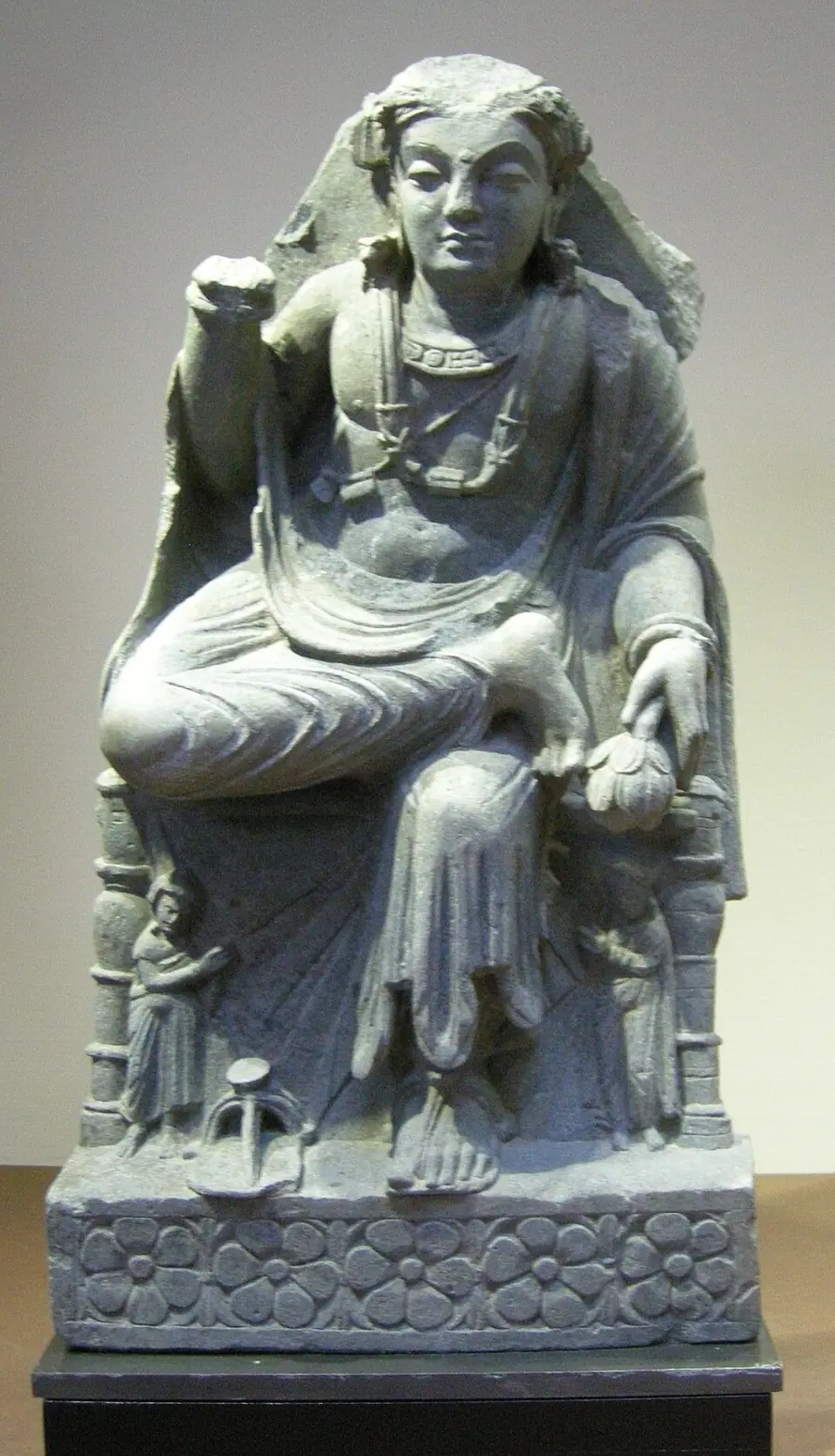
The Mahāyāna turn in one paragraph
Between roughly the first century BCE and the second century CE, Indian Buddhists began composing a new kind of scripture. These sūtras, presented as the word of the Buddha, taught that the highest goal was not to become an arhat, freed from rebirth, but to become a fully awakened Buddha for the benefit of all beings: the path of the bodhisattva. They called this the Mahāyāna, the “great vehicle”. Within a few centuries it had produced a new metaphysics of emptiness, a cosmos crowded with Buddhas and bodhisattvas, Pure Lands to be reborn in, and the philosophies of Nāgārjuna and Yogācāra. Consensus
What it did not produce, for a long time, was a separate institution. Mahāyāna monks were ordained under the same Vinaya rules as everyone else and lived in the same monasteries. In Indian inscriptions Mahāyāna is almost invisible until the fourth and fifth centuries.[1] Where it came from, who first followed it and why are among the most argued questions in Buddhist studies.[2] Contested
Timeline of the Mahāyāna turn
| Date | Event | Confidence |
|---|---|---|
| c. 1st c. BCE–1st c. CE | First Mahāyāna sūtras composed, probably including the Perfection of Wisdom in 8,000 Lines[3] | Majority |
| c. 47–147 CE | Split collection manuscript of the Aṣṭasāhasrikā Prajñāpāramitā: the oldest physical Mahāyāna text (radiocarbon)[4][5] | Consensus |
| c. late 1st–2nd c. CE | A Gāndhārī sūtra on the Buddha Akṣobhya and his paradise Abhirati, among the Bajaur scrolls[6][7] | Majority |
| c. 153 CE | Govindnagar pedestal, Mathurā: an image of the Buddha Amitābha, dated in Huviṣka’s reign[8][9][10] | Majority (date) |
| 179 CE | Lokakṣema in Luoyang translates the Perfection of Wisdom and the Pratyutpanna Samādhi Sūtra, which names Amitābha[11][12][13] | Consensus |
| c. 181 CE | Chinese translation of the Inquiry of Ugra (Ugraparipṛcchā), a manual for bodhisattvas[14][15] | Consensus |
| c. 150–250 CE | Nāgārjuna and the Mūlamadhyamakakārikā[16][17] | Majority |
| c. 250–300 CE | Ikṣvāku royal women fund the great stupa at Nāgārjunakoṇḍa; inscriptions name mainstream schools, not Mahāyāna[18] | Consensus |
| 286 CE | Dharmarakṣa’s Chinese translation of the Lotus Sūtra[19][20] | Consensus |
| c. 4th–5th c. CE | Asaṅga and Vasubandhu; Yogācāra; Tathāgatagarbha texts[21][22] | Majority |
| c. 4th–5th c. CE | Mahāyāna becomes visible in Indian donor inscriptions[1] | Majority |
| c. 400 CE | Faxian finds Mahāyāna, non-Mahāyāna and mixed monasteries across India[23] | Consensus |
| c. 690 CE | Yijing: Mahāyāna and non-Mahāyāna monks follow the same rules and differ only in what they worship and read[24] | Consensus |
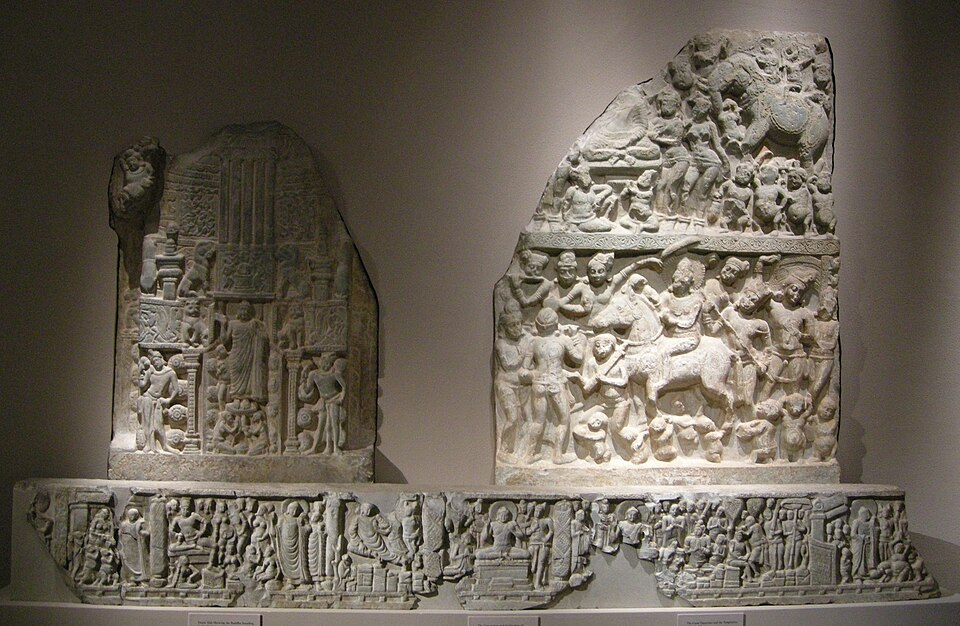
Where: Gandhāra, Mathurā, Āndhra and the routes north
Mahāyāna has no birthplace that can be pointed to. Its earliest physical traces are in the northwest, but the evidence is shaped by what happened to survive.
Gandhāra and the northwest. The oldest Mahāyāna manuscripts are birch-bark scrolls from the Pakistan–Afghanistan borderlands, written in Gāndhārī (§0, §5). The first translators into Chinese, Lokakṣema among them, came from the Kushan lands, and the Indian originals of their texts seem to have been in Gāndhārī.[5][13] So the northwest is where Mahāyāna can first be seen. Its dry climate also preserves birch bark, as the humid south does not, so this is partly an accident of preservation. Majority
Mathurā. The great Kushan-period sculpture workshop on the Yamunā produced the one early inscription that names a Mahāyāna Buddha (see Primary sources 3).
Āndhra. The lower Krishna valley, with its great stupas at Amarāvatī and Nāgārjunakoṇḍa, is connected by tradition with Nāgārjuna, and some scholars have argued that Prajñāpāramitā literature began there, perhaps among Mahāsāṃghika monks.[3][2] The inscriptions of the region, however, record mainstream schools (see Primary sources 6).[18] The southern-origin case rests mainly on statements in the texts themselves and in later tradition, not on archaeology. Contested
The routes north. Mahāyāna sūtras travelled up the Kushan trade roads into Central Asia and China almost as soon as they were written, which is why Chinese translations are often the earliest evidence for them.[13] China is where many of these texts found their largest audience (§7).
The evidence ledger for the Mahāyāna turn
| Dimension | What we can say | Evidence | Confidence |
|---|---|---|---|
| Texts | New sūtras presented as the Buddha’s word, composed from c. 1st c. BCE | Gāndhārī manuscripts; dated Chinese translations from 179 CE[5][13] | Consensus |
| Goal | Full Buddhahood for the sake of all beings, not individual liberation | Prajñāpāramitā, Ugra, Lotus[15][25] | Consensus |
| Institution | No separate ordination; Mahāyāna monks under ordinary Vinaya in shared monasteries | Faxian, Xuanzang, Yijing; surviving Vinaya lineages[23][24] | Majority |
| Inscriptions | Almost absent until the 4th–5th c.; one Amitābha image c. 153 CE | Govindnagar; Schopen’s surveys[1][9] | Majority |
| Ritual | Worship of the written sūtra promoted alongside or above stupa worship | Vajracchedikā and Aṣṭasāhasrikā passages[26][27] | Majority |
| Cosmology | Many Buddhas in many worlds at once; Pure Lands; celestial bodhisattvas | Akṣobhya and Amitābha texts; Lotus[6][28] | Consensus |
| Philosophy | Emptiness (Madhyamaka); mind-only (Yogācāra); Buddha-nature | Nāgārjuna, Vasubandhu, Tathāgatagarbha texts[16][21][22] | Consensus |
| Patrons | Uncertain; the rare early donors include merchants and monks | Govindnagar; later donor formulae[9][1] | Contested |
What “Mahāyāna” meant
The word names a vehicle, a destination and a way of getting there. To join the Mahāyāna was to take the vow of a bodhisattva: to aim at full Buddhahood, however many lives it took, in order to bring all beings to liberation.
The bodhisattva was not new. The early texts already call the Buddha, before his awakening, a bodhisatta, and the Jātaka stories of his past lives describe a long career of virtue (§2). Several mainstream schools taught a bodhisattva path for the rare person who would become the next Buddha. What changed was that the new sūtras recommended that path to others: to monks, and in principle to laypeople, as the goal they should choose.[3][15] Consensus
The arhat was demoted. In the older texts the arhat, freed from rebirth, has reached the same liberation as the Buddha; the Buddha is distinguished as the one who found the path and taught it. Mahāyāna sūtras treat the arhat’s liberation as incomplete or provisional, and some call the path to it the hīnayāna, the “inferior vehicle”. That word was always polemical. No school called itself Hīnayāna, and it is not a historical name for Theravāda, which is one surviving lineage of the older schools. Scholars now speak of “mainstream” or “Nikāya” Buddhism instead.[3][15][29] Consensus
It was a movement within the order, not beside it. Monastic identity in India came from ordination lineage, and ordination came from a Vinaya. There is no Mahāyāna Vinaya. A Mahāyāna monk was ordained as a Dharmaguptaka, a Sarvāstivādin or a member of some other mainstream lineage, and followed its rules. The Chinese still ordain under the Dharmaguptaka Vinaya and the Tibetans under the Mūlasarvāstivāda Vinaya, both mainstream codes. Heinz Bechert drew the conclusion that is now broadly accepted: Mahāyāna was not a schism in the Vinaya sense at all.[3][24] Majority
Primary sources
1. The oldest Mahāyāna manuscript
The Aṣṭasāhasrikā Prajñāpāramitā, the Perfection of Wisdom in 8,000 Lines, is widely regarded as one of the oldest Mahāyāna sūtras. A birch-bark manuscript of its first chapter in Gāndhārī, part of the privately held Split collection, was published by Harry Falk and Seishi Karashima in 2012 and radiocarbon dated, with about 81 per cent probability, to 47–147 CE.[4][5]
Its wording is close to Lokakṣema’s Chinese translation of 179 CE and differs in many details from the later Sanskrit versions: the sūtra kept growing for centuries after this copy was made.[11][5] A second Gāndhārī scroll, among the Bajaur manuscripts, preserves part of a sūtra about the Buddha Akṣobhya and his eastern paradise Abhirati, dated on palaeographic grounds to the late first or second century CE.[6][7]
What it proves. Mahāyāna sūtras were being copied in Gandhāra in the first century CE, in the same language and script as mainstream texts, and probably by the same scribes. By then they were already established enough to have their own textual history: the Split manuscript is not a first draft. Mahāyāna is therefore older than the first century CE, but not by an amount anyone can measure. Consensus
2. “That spot of earth will become a shrine”
The Perfection of Wisdom sūtras make an extraordinary claim for themselves. The Vajracchedikā, the Diamond Sūtra, says of any place where even four lines of it are recited or taught:
sa pṛthivīpradeśaś caityabhūto bhavet
“That spot of earth will become a shrine.” (Our translation.)[26][27]
The Aṣṭasāhasrikā goes further. In its third chapter the Buddha asks whether more merit comes from filling the whole continent with stupas full of relics, or from copying the Perfection of Wisdom, making a book of it and worshipping the book with flowers, incense and banners. The book wins: the relics are worshipped only because the Buddha’s body was produced by the perfection of wisdom.[30]
What it proves. In 1975 Gregory Schopen argued from these passages that early Mahāyāna was a cult of the book. The relic stupa was the centre of mainstream lay and monastic worship (§4); the new sūtras set up their own physical text as a rival centre, a portable shrine that a small group could carry anywhere.[27] Schopen himself later qualified parts of the thesis.[31] David Drewes has argued more sharply that there is no evidence for shrines built around books, that honouring sūtras was common to all Buddhists, and that the Mahāyāna sūtras recommend memorising and reciting themselves more often than writing.[32][2] The book cult is now seen as one feature of some early Mahāyāna communities at most, rather than the key to the whole movement. The passages remain the clearest evidence that Mahāyāna authors were competing with the relic cult for devotion, and that writing itself had become sacred. Majority
3. Amitābha at Mathurā
In August 1977 a broken sculpture pedestal was recovered at Govindnagar, on the western edge of Mathurā. Only the feet of the figure survive. The inscription on the base dates it to the twenty-sixth year of the great king Huviṣka, and names the image as one of the Buddha Amitābha.[8][9]
The year is counted in the Kushan era. On the start date most scholars now accept, 127 CE, it falls around 153 CE; Schopen’s original publication, using an older reckoning of the era, gave 104 CE.[10][9]
What it proves. That Amitābha, the Buddha of the western Pure Land, had a cult in northern India by the mid-second century, the same decades in which Lokakṣema was translating the first sūtra to name him. It also shows how unusual that was. In 1987 Schopen pointed out that this is the only Indian inscription naming a Mahāyāna Buddha before the fifth century, and that Amitābha does not appear again in Indian inscriptions for centuries. A claimed second early reference, on a Gandhāran relief, was shown in 2002 to be a misreading, leaving Govindnagar “the sole undoubted reference to Amitābha in early Indian epigraphy”.[33] Hundreds of donative inscriptions survive from the same period, and they name Śākyamuni, relics, stupas and the mainstream schools.[9][1] Majority
When Mahāyāna does become visible, in the fourth and fifth centuries, it does so through a formula. Donors begin to describe themselves as śākyabhikṣu, “Buddhist monk”, and to dedicate their gifts “for the attainment of supreme knowledge by all beings”: the bodhisattva’s aspiration, written into the donation.[1] L. S. Cousins later questioned whether śākyabhikṣu marks a Mahāyāna monk at all, since the title has close equivalents in non-Mahāyāna sources.[34] Majority
4. A path for “a few good men”
The Inquiry of Ugra (Ugraparipṛcchā) was translated into Chinese by about 181 CE, which makes it one of the earliest Mahāyāna sūtras that can be dated.[14] It is a manual for bodhisattvas, both householders and monks.
It does not describe a popular lay religion. The householder bodhisattva is told to keep strict precepts, to see his wife and children as obstacles and to aspire to go forth; the monastic bodhisattva is told that the ideal is to live in the wilderness, practising austerities. Worship at stupas is mentioned only briefly.[15]
What it proves. In A Few Good Men (2003), Jan Nattier argued from the Ugra that at least one early Mahāyāna community saw the bodhisattva path as a hard, heroic vocation for a small elite of monks, not a democratic opening to the laity. Its picture of the forest as the bodhisattva’s proper home fits the forest-ascetic hypothesis below. Majority on the reading; Contested on how typical it was
5. Skilful means and the one vehicle
The Lotus Sūtra (Saddharmapuṇḍarīka) was translated into Chinese by Dharmarakṣa in 286 CE and, in the version that became standard in East Asia, by Kumārajīva in 406.[19][35] Its second chapter makes a claim that reorganises all earlier Buddhism: the Buddha taught different paths to different people as skilful means (upāya), but there is in truth only one vehicle (ekayāna), the path to Buddhahood.[25]
The third chapter illustrates it with a parable. A rich man’s house is on fire and his children, absorbed in play, will not come out. He promises them carts drawn by goats, deer and oxen, which they love. When they run out, he gives each of them something better: a great carriage drawn by white oxen. The three carts are the paths of the disciple, the solitary Buddha and the bodhisattva; the one great carriage is Buddhahood for all.[25]
What it proves. That Mahāyāna authors had to explain why the Buddha’s earlier teachings, preserved in texts everyone accepted, said something different from their own. The answer, that the old teaching was true but provisional, allowed them to keep the whole older canon while placing it beneath the new sūtras. It also gave later Buddhists a tool for absorbing almost anything, and it became one of the most influential ideas in East Asian Buddhism (§7, §11). Consensus
The Lotus also contains the chapter devoted to the bodhisattva Avalokiteśvara, who hears the cries of beings and saves those who call his name from fire, drowning, bandits and prison. That chapter circulated separately and became the basis of the cult of Guanyin in China.[35][36]
6. Nāgārjunakoṇḍa: royal women, stupas and mainstream schools
In the third century CE the Ikṣvāku kings ruled the lower Krishna valley from Vijayapurī, now Nāgārjunakoṇḍa. Royal women, above all Cāṃtisirī, the sister of the king Vāsiṣṭhīputra Cāṃtamūla, paid for the great stupa (mahācaitya) and many of the monasteries around it. Their inscriptions, published by J. Ph. Vogel, record gifts to named schools: the Aparamahāvinaseliyas, the Bahuśrutīyas, the Mahīśāsakas and monks from Sri Lanka described as Theriyas.[18][37]
What it proves. That the region later tradition links with Nāgārjuna was, in the century after him, a centre of mainstream Buddhism with no Mahāyāna named in its inscriptions. This does not mean there were no Mahāyāna monks there: in a shared monastery a Mahāyāna monk would still be recorded under his ordination lineage. It does mean that Mahāyāna was not what royal patrons were paying for. The inscriptions also show how much of Indian Buddhism’s money came from women. Consensus
7. Nāgārjuna: emptiness is dependent origination
Nāgārjuna (c. 150–250 CE) is the founder of the Madhyamaka, the “middle way” school. Tradition makes him a monk from the south and a correspondent of a Sātavāhana king; Joseph Walser argues that he probably advised the Sātavāhana king Yajñaśrī Sātakarṇi in the later second century.[17] His his Root Verses on the Middle Way (Mūlamadhyamakakārikā) argue, chapter by chapter, that nothing has svabhāva, independent self-existence. Things exist only in dependence on causes, parts and the concepts used to pick them out. The central verse is 24.18:
yaḥ pratītyasamutpādaḥ śūnyatāṃ tāṃ pracakṣmahe sā prajñaptir upādāya pratipat saiva madhyamā
“Whatever is dependent origination, that we call emptiness. That is a dependent designation; that itself is the middle way.” (Our translation.)[16][38]
What it proves. That the most radical-sounding Mahāyāna idea, “emptiness” (śūnyatā), was presented as a rereading of the oldest Buddhist doctrine of all, dependent origination (§2). Emptiness is not a void or a hidden absolute; it is the absence of independent existence in things that arise dependently. Nāgārjuna cites the early discourses, not Mahāyāna sūtras, in the Root Verses: the one text he names is the Buddha’s instruction to Kātyāyana on avoiding “it is” and “it is not”.[39] Some scholars have even questioned whether that work is specifically Mahāyāna. Other works attributed to him, such as the Ratnāvalī, clearly are.[3][17] Majority
8. Mind only
In the fourth and fifth centuries the brothers Asaṅga and Vasubandhu, from Puruṣapura (Peshawar) according to Paramārtha’s sixth-century Life of Vasubandhu,[40] became the leading teachers of a second Mahāyāna philosophy, the Yogācāra, “practice of yoga”. Vasubandhu’s Twenty Verses (Viṃśatikā) opens with its thesis: everything in the three realms is “mere representation” (vijñaptimātra), like the appearance of hairs to a man with an eye disease.[21]
What it proves. That Mahāyāna produced not one philosophy but several, often in debate with each other. Yogācāra analysed experience into layers of consciousness, including a store-consciousness (ālayavijñāna) that carries karmic seeds from life to life, and grew out of the meditative traditions its name refers to.[41] Whether it denies the external world outright or only describes how the world is experienced is still argued over.[42][43] Contested
The Buddhas, bodhisattvas and Pure Lands
The early texts say that two Buddhas cannot arise in the same world at the same time (§2).[44] Mahāyāna sūtras fill the universe with Buddhas, each presiding over a world of his own, and with bodhisattvas powerful enough to answer prayers.
- Buddhas in other worlds. Akṣobhya rules the eastern world Abhirati, already in a Gāndhārī sūtra of the first or second century.[6] Amitābha rules Sukhāvatī, the “land of bliss” in the west. In the Larger Sukhāvatīvyūha, the monk Dharmākara vows, ages ago, that when he becomes a Buddha anyone who sincerely wishes to be born in his land and turns their mind to him even ten times will be reborn there; he becomes Amitābha, so the vow holds.[28][45] A Pure Land is a place where awakening is easy, not a heaven in the ordinary sense.
- Celestial bodhisattvas. Avalokiteśvara, the bodhisattva of compassion (Primary sources 5), and Mañjuśrī, the bodhisattva of wisdom, who is already a leading figure in Lokakṣema’s translations. Maitreya, the future Buddha, was older and shared with the mainstream schools.[13]
- The Buddha who never died. The Lotus reveals that Śākyamuni’s lifespan is immeasurable and that his death was a display for those who needed it.[46] The human teacher of the early texts, who grew old and died at Kusinārā, becomes a manifestation.
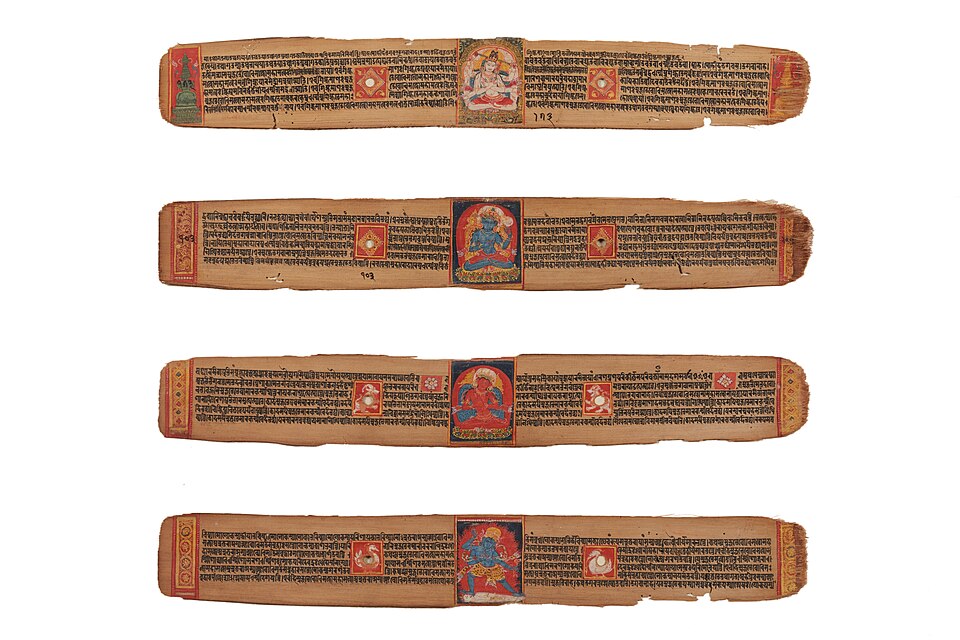
This expansion connects Mahāyāna to the devotional religion growing around it in India. The same centuries saw the spread of cult images of Viṣṇu and Śiva, the Bhagavad Gītā’s teaching of devotion and the rise of image worship (Hinduism §7). Buddhists and Brahmanical worshippers were developing the practice of devotion to a saviour figure at the same time and in the same cities. Majority
Buddha-nature. A later group of texts, the Tathāgatagarbha Sūtra, the Śrīmālādevī and the Ratnagotravibhāga, taught that every being contains the “embryo” (garbha) of a Buddha, obscured by defilements like gold fallen in filth or a Buddha image wrapped in rags.[22][47] Indian critics found the idea uncomfortably close to the ātman the Buddha had denied; the Laṅkāvatāra Sūtra raises the objection itself and answers that the teaching is a skilful means.[48] In the 1980s and 1990s the Japanese “Critical Buddhism” scholars Hakamaya Noriaki and Matsumoto Shirō revived the charge, arguing that Buddha-nature thought is not Buddhist at all.[49] It had a modest life in India and an enormous one in China, where “Buddha-nature” became a basic assumption of Chan (Zen) and much else (§7). Majority
What is absent in the Mahāyāna turn
- A Mahāyāna Vinaya or ordination. Mahāyāna monks were ordained in mainstream lineages. Majority
- A founder. No person is credited with starting the movement; the sūtras present themselves as the Buddha’s own teaching, preserved by bodhisattvas or by nāgas until people were ready for it. Consensus
- Mahāyāna in early Indian inscriptions. Apart from the Govindnagar pedestal, none before the fourth or fifth century. Majority
- “Hīnayāna” as anyone’s self-description. It is only ever a term of polemic. Consensus
- Tantra. Spells (dhāraṇī) appear in Mahāyāna sūtras, but the ritual systems of tantric Buddhism come later (§8). Consensus
- Zen and mass Pure Land devotion. Both are East Asian developments of Indian materials (§7, §11). Consensus
Debates about Mahāyāna origins
Did Mahāyāna begin among the laity?
For much of the twentieth century the standard answer was yes. In 1963 Akira Hirakawa argued that Mahāyāna arose among lay communities that gathered around stupas, which he took to be lay-run institutions outside monastic control, and that the bodhisattva ideal expressed lay religious aspirations.[50]
The theory is now largely abandoned. Inscriptions show monks and nuns controlling and funding stupas (§0, §4); the earliest Mahāyāna sūtras that can be dated, such as the Ugra, are written by and for monks and treat household life as an obstacle; and the Perfection of Wisdom texts, far from centring on stupas, set the book above them.[27][15][51][2] Laypeople were certainly involved in Mahāyāna, as donors and as readers, but the movement’s authors and leaders appear to have been monks. Majority
Did it begin in the forest?
Reginald Ray and Paul Harrison argued that some of the earliest Mahāyāna sūtras come from monks who lived as ascetics in the wilderness, practising meditation and visualisation, and who saw the settled monasteries of the towns as lax. In this reading the bodhisattva path revived the heroic austerity of the Buddha’s own career.[52][51] The Ugra’s praise of forest life supports it, as does the Rāṣṭrapālaparipṛcchā, studied by Daniel Boucher.[15][53] Critics point out that other early sūtras are thoroughly urban and monastic, and that wilderness dwelling could be an ideal praised by town monks as easily as a practice.[2] Contested
Was it a cult of the book?
Schopen’s 1975 argument (Primary sources 2) explains why so many Mahāyāna sūtras praise themselves, and why they arose when writing was spreading in the Buddhist world. It fits the Perfection of Wisdom literature best and the devotional sūtras less well.[27][32] Contested
Was it a movement of preachers?
David Drewes, reviewing the field in 2010, proposed that early Mahāyāna is best understood as a textual movement centred on preachers of the dharma (dharmabhāṇaka), who memorised, recited and expounded the new sūtras, much as reciters had carried the older texts (§0). Mahāyāna in this view was not a community at all, but a set of texts and the people who taught them, accepted by some monks in otherwise ordinary monasteries. It explains why the movement left almost no institutional trace.[2] Contested
Did Mahāyāna grow out of one of the old schools?
An older theory derived Mahāyāna from the Mahāsāṃghikas, whose Lokottaravāda branch taught a “supramundane” Buddha in the Mahāvastu (§2, §3).[54] Ideas certainly passed that way, but Mahāyāna sūtras were transmitted by monks of many lineages, including the Sarvāstivāda and Dharmaguptaka. Most scholars now think Mahāyāna had several origins in several schools and regions, which is one reason no single theory has won.[3][2] Majority
Was it a schism?
No, in the technical sense. A schism (saṅghabheda) in Buddhist law is a split in the communal performance of monastic acts, and Mahāyāna monks continued to perform them with non-Mahāyāna monks under the same rules (§3). The Chinese pilgrims make this plain. Around 400 CE Faxian describes monasteries that are Mahāyāna, non-Mahāyāna or mixed.[23] Around 690 Yijing writes that both “adopt one and the same discipline (Vinaya)”, and that “those who worship the Bodhisattvas and read the Mahāyāna Sūtras are called the Mahāyānists (the Great), while those who do not perform these are called the Hīnayānists (the Small).” (Trans. J. Takakusu.)[24][55] The difference was in devotion and scripture, not in rules or membership. Majority
Further reading
- Paul Williams, Mahāyāna Buddhism: The Doctrinal Foundations (2nd ed., Routledge, 2009) — the standard introduction.
- Jan Nattier, A Few Good Men: The Bodhisattva Path according to the Inquiry of Ugra (University of Hawai’i Press, 2003).
- David Drewes, “Early Indian Mahāyāna Buddhism I and II,” Religion Compass 4 (2010) — the best short survey of the origins debate.
- Gregory Schopen, Figments and Fragments of Mahāyāna Buddhism in India (University of Hawai’i Press, 2005) — his essays on the book cult and the inscriptions, with later reflections.
- Paul Harrison, “Searching for the Origins of the Mahāyāna: What Are We Looking For?”, The Eastern Buddhist 28 (1995).
- Mark Siderits and Shōryū Katsura, trans., Nāgārjuna’s Middle Way: Mūlamadhyamakakārikā (Wisdom, 2013).
- 84000, The White Lotus of the Good Dharma and The Diamond Sūtra — free translations from the Tibetan.
References
- ^ a b c d e f Gregory Schopen "Mahāyāna in Indian Inscriptions". Indo-Iranian Journal 21, 1979. Shows that Mahāyāna becomes visible in inscriptions only from the 4th–5th c., through the śākyabhikṣu donor formula.
- ^ a b c d e f g David Drewes "Early Indian Mahāyāna Buddhism I: Recent Scholarship" and "II: New Perspectives". Religion Compass 4, 2010. The best short survey of the origins debate; proposes Mahāyāna as a textual movement of preachers.
- ^ a b c d e f g Paul Williams Mahāyāna Buddhism: The Doctrinal Foundations. Routledge, 2nd ed., 2009. The standard introduction to Mahāyāna thought and to the origins debate.
- ^ a b Split collection Aṣṭasāhasrikā, parivarta 1 — Prajñāpāramitā (Gāndhārī). c. 47–147 CE (radiocarbon). Gāndhārī in Kharoṣṭhī. The oldest surviving Mahāyāna manuscript: a birch-bark copy of the Perfection of Wisdom in 8,000 Lines, close to the text Lokakṣema translated into Chinese in 179 CE. about
- ^ a b c d e Harry Falk & Seishi Karashima "A First-Century Prajñāpāramitā Manuscript from Gandhāra — parivarta 1". Annual Report of the International Research Institute for Advanced Buddhology 15: 19–61, 2012. Edition and radiocarbon date of the oldest Mahāyāna manuscript.
- ^ a b c d Bajaur Mahāyāna sūtra (BC 2) — Bajaur collection. c. late 1st–2nd c. CE. Gāndhārī in Kharoṣṭhī. Part of a Mahāyāna sūtra about the Buddha Akṣobhya and his eastern buddha-field Abhirati, on birch bark. Evidence that Pure Land ideas were circulating in Gandhāra almost as early as the Perfection of Wisdom. about
- ^ a b Ingo Strauch "More Missing Pieces of Early Pure Land Buddhism: New Evidence for Akṣobhya and Abhirati in an Early Mahāyāna Sūtra from Gandhāra". The Eastern Buddhist 41: 23–66, 2010. open access Edition and study of the Bajaur Akṣobhya sūtra.
- ^ a b Govindnagar Amitābha pedestal — Mathurā Museum. Year 26 of Huviṣka, c. 153 CE. Sanskritised Prakrit in Brāhmī. A broken image base found at Mathurā in 1977, dated in Huviṣka's reign and naming the image as the Buddha Amitābha. The only Indian inscription naming a Mahāyāna Buddha before the fifth century.
- ^ a b c d e f Gregory Schopen "The Inscription on the Kuṣān Image of Amitābha and the Character of the Early Mahāyāna in India". Journal of the International Association of Buddhist Studies 10: 99–137, 1987. Publishes the Govindnagar pedestal and draws out how isolated it is.
- ^ a b Harry Falk "The yuga of Sphujiddhvaja and the Era of the Kuṣāṇas". Silk Road Art and Archaeology 7: 121–136, 2001. Fixes the start of Kaniṣka's era in 127 CE from an astrological text; now the standard Kushan chronology.
- ^ a b T 224 (Daoxing banruo jing) — Lokakṣema's translations. 179 CE. Classical Chinese. Lokakṣema's Chinese translation of the Perfection of Wisdom in 8,000 Lines, dated by its colophon to 179 CE. A dated translation proves the source text existed by that year. read the text
- ^ T 418 (Banzhou sanmei jing) — Lokakṣema's translations. 179 CE. Classical Chinese. Lokakṣema's translation of the Pratyutpanna Samādhi Sūtra, a meditation in which the practitioner sees the Buddhas of the present, Amitābha among them. The earliest dated text to name Amitābha. read the text
- ^ a b c d e Jan Nattier A Guide to the Earliest Chinese Buddhist Translations. International Research Institute for Advanced Buddhology, Soka University, 2008. Which Han-dynasty translations are really by whom, and therefore which texts existed when.
- ^ a b T 322 (Fa jing jing) — Inquiry of Ugra (Ugraparipṛcchā). c. 181 CE. Classical Chinese. The earliest Chinese translation of the Inquiry of Ugra, a guide for householder and monastic bodhisattvas that praises renunciation and life in the wilderness. read the text
- ^ a b c d e f g Jan Nattier A Few Good Men: The Bodhisattva Path according to The Inquiry of Ugra (Ugraparipṛcchā). University of Hawai'i Press, 2003. Translation and study of one of the earliest datable Mahāyāna sūtras; argues the early bodhisattva path was an elite monastic vocation.
- ^ a b c Mūlamadhyamakakārikā 24.18 — Nāgārjuna. c. 150–250 CE. Sanskrit. "Whatever is dependent origination, that we call emptiness": Nāgārjuna identifies emptiness with the oldest Buddhist doctrine of causation and calls it the middle way.
- ^ a b c Joseph Walser Nāgārjuna in Context: Mahāyāna Buddhism and Early Indian Culture. Columbia University Press, 2005. doi Places Nāgārjuna in the Sātavāhana Deccan of the later second century and asks how a Mahāyāna author worked inside mainstream monasteries.
- ^ a b c Nāgārjunakoṇḍa Mahācaitya inscriptions — Nāgārjunakoṇḍa. c. 3rd c. CE. Prakrit in Brāhmī. Records of gifts by Ikṣvāku royal women, led by Cāṃtisirī, to the great stupa and to monasteries of named mainstream schools, among them the Aparamahāvinaseliyas, Bahuśrutīyas, Mahīśāsakas and Theriyas from Sri Lanka. about
- ^ a b T 263 (Zheng fahua jing) — Dharmarakṣa's Lotus Sūtra. 286 CE. Classical Chinese. Dharmarakṣa's translation of the Lotus Sūtra, made at Chang'an in 286: the earliest surviving Chinese version and the earliest firm date for the sūtra. read the text
- ^ Daniel Boucher "Gāndhārī and the Early Chinese Buddhist Translations Reconsidered: The Case of the Saddharmapuṇḍarīkasūtra". Journal of the American Oriental Society 118: 471–506, 1998. doi Studies Dharmarakṣa's 286 CE Lotus translation and the language of its Indian source.
- ^ a b c Viṃśatikā 1 — Vasubandhu. c. 4th–5th c. CE. Sanskrit. The opening of Vasubandhu's Twenty Verses: the three realms are mere representation (vijñaptimātra), like hairs seen by someone with an eye disease. The classic statement of Yogācāra.
- ^ a b c Tathāgatagarbha Sūtra — Sūtra of the Buddha-embryo. c. 3rd c. CE (Chinese 420 CE). Buddhist Sanskrit (lost); Chinese and Tibetan. Every being contains a Buddha-embryo hidden by defilements, compared to honey among bees, gold in filth and a Buddha image wrapped in rags. The starting point of Buddha-nature doctrine.
- ^ a b c Faxian, Record of Buddhist Kingdoms — Foguo ji. c. 416 CE. Classical Chinese. The pilgrim's account of India c. 399–414, describing monasteries as Mahāyāna, non-Mahāyāna or mixed, and the two kinds of monks living side by side; he also stayed two years in Sri Lanka and counted the monks of its great monasteries. read the text
- ^ a b c d Yijing, Account of Buddhism Sent from the Southern Seas — Nanhai jigui neifa zhuan. c. 691 CE. Classical Chinese. Mahāyāna and non-Mahāyāna monks keep the same Vinaya; those who worship bodhisattvas and read Mahāyāna sūtras are called Mahāyānists. The clearest contemporary statement that Mahāyāna was not a separate order. read the text
- ^ a b c Saddharmapuṇḍarīka 2–3 — Lotus Sūtra. c. 1st–2nd c. CE (Chinese 286 CE). Buddhist Sanskrit. Skilful means (upāya) and the one vehicle (ekayāna): the earlier paths were provisional, and the parable of the burning house shows all three carts replaced by one great carriage of Buddhahood. read the text
- ^ a b Vajracchedikā 12 — Diamond Sūtra. c. 2nd–4th c. CE. Sanskrit. Any place where even four lines of this sūtra are recited "will become a shrine" (caityabhūta). The phrase Schopen used to argue for a Mahāyāna cult of the book. read the text
- ^ a b c d e Gregory Schopen "The Phrase 'sa pṛthivīpradeśaś caityabhūto bhavet' in the Vajracchedikā: Notes on the Cult of the Book in Mahāyāna". Indo-Iranian Journal 17: 147–181, 1975. The cult-of-the-book thesis: the written sūtra as a rival to the relic stupa.
- ^ a b Larger Sukhāvatīvyūha — Sūtra of the Land of Bliss. c. 1st–2nd c. CE (Chinese by 3rd c.). Buddhist Sanskrit. The monk Dharmākara's vows to create a pure land where anyone who calls on him with faith will be reborn. He becomes the Buddha Amitābha. The founding text of Pure Land devotion. read the text
- ^ Todd LeRoy Perreira "Whence Theravāda? The Modern Genealogy of an Ancient Term". In How Theravāda is Theravāda?, ed. P. Skilling et al., Silkworm Books, 2012. open library Traces 'Theravāda Buddhism' as a denominational label to the 20th century and the 1950 World Fellowship of Buddhists.
- ^ Aṣṭasāhasrikā 3 — Perfection of Wisdom in 8,000 Lines. c. 1st c. BCE–1st c. CE, expanded later. Sanskrit. Copying and worshipping the written Perfection of Wisdom earns more merit than filling the continent with relic stupas, since the Buddha's body itself was produced by the perfection of wisdom.
- ^ Gregory Schopen Figments and Fragments of Mahāyāna Buddhism in India: More Collected Papers. University of Hawai'i Press, 2005. doi Schopen's collected Mahāyāna essays, reprinting the cult-of-the-book and inscription studies with later reflections.
- ^ a b David Drewes "Revisiting the Phrase 'sa pṛthivīpradeśaś caityabhūto bhavet' and the Mahāyāna Cult of the Book". Indo-Iranian Journal 50: 101–143, 2007. doi The main critique of Schopen's cult-of-the-book thesis.
- ^ Richard Salomon & Gregory Schopen "On an Alleged Reference to Amitābha in a Kharoṣṭhī Inscription on a Gandhāran Relief". Journal of the International Association of Buddhist Studies 25, 2002. Rejects the reading of Amitābha on a Gandhāran relief, leaving the Govindnagar pedestal as the sole undoubted early Indian reference to him.
- ^ L. S. Cousins "Sākiyabhikkhu/Sakyabhikkhu/Śākyabhikṣu: A Mistaken Link to the Mahāyāna?". Nagoya Studies in Indian Culture and Buddhism: Saṃbhāṣā 23: 1–27, 2003. Questions Schopen's use of the śākyabhikṣu title as a marker of Mahāyāna monks.
- ^ a b T 262 (Miaofa lianhua jing) — Kumārajīva's Lotus Sūtra. 406 CE. Classical Chinese. Kumārajīva's translation of the Lotus Sūtra, made at Chang'an in 406 and still the standard text across East Asia. read the text
- ^ Chün-fang Yü Kuan-yin: The Chinese Transformation of Avalokiteśvara. Columbia University Press, 2001. The standard history of how the Lotus Sūtra's Avalokiteśvara became the Chinese Guanyin.
- ^ J. Ph. Vogel "Prakrit Inscriptions from a Buddhist Site at Nagarjunikonda". Epigraphia Indica 20, 1929. The primary edition of the Ikṣvāku queens' donative records.
- ^ Mark Siderits & Shōryū Katsura, trans. Nāgārjuna's Middle Way: Mūlamadhyamakakārikā. Wisdom Publications, 2013. Translation with the classical Indian commentary, verse by verse.
- ^ Mūlamadhyamakakārikā 15.7 — Nāgārjuna. c. 150–250 CE. Sanskrit. Nāgārjuna cites the Buddha's instruction to Kātyāyana (the Kaccānagotta discourse, SN 12.15), in which both 'it is' and 'it is not' are rejected: the only discourse named in the Root Verses, and an early, not a Mahāyāna, text.
- ^ T 2049 (Posoupandou fashi zhuan) — Paramārtha, Life of Vasubandhu. c. 546–569 CE. Classical Chinese. Paramārtha's biography of Vasubandhu, making him and Asaṅga brothers from a brahmin family of Puruṣapura (Peshawar) and describing Asaṅga's conversion of Vasubandhu to Mahāyāna. read the text
- ^ Lambert Schmithausen Ālayavijñāna: On the Origin and the Early Development of a Central Concept of Yogācāra Philosophy. International Institute for Buddhist Studies, Tokyo (Studia Philologica Buddhica Monograph Series 4), 1987. Traces the store-consciousness to its first appearance in the Yogācārabhūmi, in a discussion of the meditative attainment of cessation.
- ^ Birgit Kellner & John Taber "Studies in Yogācāra-Vijñānavāda Idealism I: The Interpretation of Vasubandhu's Viṃśikā". Asiatische Studien / Études Asiatiques 68: 709–756, 2014. doi Argues that the Twenty Verses do argue for idealism, denying external objects.
- ^ Dan Lusthaus Buddhist Phenomenology: A Philosophical Investigation of Yogācāra Buddhism and the Ch'eng Wei-shih lun. RoutledgeCurzon, 2002. doi The main case for reading Yogācāra as a phenomenology of experience rather than metaphysical idealism.
- ^ MN 115 — Bahudhātuka Sutta (Majjhima Nikāya). c. 400–200 BCE. Pali. Among the things that are impossible: for two fully awakened Buddhas to arise in the same world-system at the same time. The early view that Mahāyāna's many simultaneous Buddhas in other worlds had to work around. read the text
- ^ Luis O. Gómez, trans. The Land of Bliss: The Paradise of the Buddha of Measureless Light. Sanskrit and Chinese Versions of the Sukhāvatīvyūha Sutras. University of Hawai'i Press, 1996. Annotated English translation of the Sanskrit and Chinese Pure Land sūtras, including Dharmākara's vows.
- ^ Saddharmapuṇḍarīka (whole) — Lotus Sūtra. c. 1st–3rd c. CE, in layers (Chinese 286 and 406 CE). Buddhist Sanskrit. The full Lotus Sūtra, including its later chapters: the Buddha's lifespan as immeasurable, his death a display for the sake of beings, and the chapter on Avalokiteśvara that circulated on its own in East Asia. read the text
- ^ Michael Zimmermann A Buddha Within: The Tathāgatagarbhasūtra. Bibliotheca Philologica et Philosophica Buddhica 6, International Research Institute for Advanced Buddhology, Soka University, 2002. Edition, translation and study of the earliest Buddha-nature sūtra and its nine similes.
- ^ Laṅkāvatāra Sūtra, ch. 2 — Laṅkāvatāra Sūtra. c. 4th–5th c. CE. Buddhist Sanskrit. Mahāmati asks whether the tathāgatagarbha is not the same as the self (ātman) taught by non-Buddhist philosophers; the Buddha replies that it is taught as a skilful means to draw those attached to a self, and means emptiness. read the text
- ^ Jamie Hubbard & Paul L. Swanson, eds. Pruning the Bodhi Tree: The Storm over Critical Buddhism. University of Hawai'i Press, 1997. doi Translations and responses around Hakamaya Noriaki and Matsumoto Shirō's claim that Buddha-nature thought is not Buddhism.
- ^ Akira Hirakawa "The Rise of Mahāyāna Buddhism and Its Relationship to the Worship of Stūpas". Memoirs of the Research Department of the Toyo Bunko 22, 1963. The classic statement of the lay-stupa theory of Mahāyāna origins, now largely abandoned.
- ^ a b Paul Harrison "Searching for the Origins of the Mahāyāna: What Are We Looking For?". The Eastern Buddhist 28, 1995. A clear critique of the lay theory and a case for ascetic, monastic origins.
- ^ Reginald A. Ray Buddhist Saints in India: A Study in Buddhist Values and Orientations. Oxford University Press, 1994. Argues for a forest-renunciant strand in Indian Buddhism behind early Mahāyāna.
- ^ Daniel Boucher Bodhisattvas of the Forest and the Formation of the Mahāyāna: A Study and Translation of the Rāṣṭrapālaparipṛcchā-sūtra. University of Hawai'i Press, 2008. doi A second early sūtra that praises wilderness asceticism and criticises lax town monks; key evidence for the forest hypothesis.
- ^ Mahāvastu — Lokottaravāda Vinaya. c. 2nd c. BCE–4th c. CE. Buddhist Hybrid Sanskrit. A sprawling biography of the Buddha embedded in a monastic code, built up over centuries. One of the first texts to tell the life at length, with many Jātaka stories. about
- ^ J. Takakusu, trans. A Record of the Buddhist Religion as Practised in India and the Malay Archipelago (A.D. 671–695), by I-tsing. Clarendon Press, 1896. full text Yijing's account of monastic life, including Nālandā's size, endowment and curriculum.