Japanese Buddhism in one paragraph
Buddhism reached the Japanese court from Korea in the mid-sixth century as part of a package of continental civilisation: writing, architecture, metalwork and a state ritual that promised to protect the realm. For five centuries it was mostly the religion of court, aristocracy and great monasteries, and the buddhas were worshipped together with the native kami, who came to be explained as their local manifestations. From the late twelfth century a series of monks trained on Mount Hiei, Hōnen, Shinran, Dōgen and Nichiren among them, broke from that establishment and taught that a single practice was enough: calling the name of Amida Buddha, entrusting oneself to it, sitting in meditation, or chanting the title of the Lotus Sūtra. Their movements eventually became the largest denominations of Japanese Buddhism. Consensus
How quickly they did so is the main historical argument of the period. Older textbooks treat the Kamakura period (1185–1333) as a Japanese “Reformation”. Kuroda Toshio argued instead that the old Tendai, Shingon and Nara schools remained dominant for centuries and the new schools only became mass institutions in the fifteenth and sixteenth centuries. After that came two further transformations imposed from outside: the Tokugawa regime made every household register at a Buddhist temple, and the Meiji state in 1868 separated buddhas from kami and in 1872 stopped enforcing clerical celibacy. The married temple priest of modern Japan is the product of all three.[1][2][3] Majority
Timeline of Buddhism in Japan
| Date | Event | Confidence |
|---|---|---|
| 538 or 552 | Paekche sends a Buddha image and sūtras to the Yamato court; both dates are later reconstructions[4][5] | Majority (mid-6th c.); Contested (year) |
| 587 | Soga no Umako defeats the Mononobe; the Soga sponsor the first temples (Asukadera, c. 588–596)[4][5] | Majority |
| 604 | Seventeen-Article Constitution, attributed to Prince Shōtoku by the Nihon shoki[6][7] | Contested (authorship) |
| 741 | Emperor Shōmu orders a state temple and nunnery (kokubunji) in every province[5] | Consensus |
| 752 | Eye-opening of the Great Buddha (Vairocana) at Tōdaiji, Nara[8][5] | Consensus |
| 788 | Saichō founds a hall on Mount Hiei, later Enryakuji[9] | Majority |
| 805–806 | Saichō and Kūkai return from China; Tendai recognised (806); Kūkai brings esoteric (Shingon) teaching[9][10] | Consensus |
| 1052 | Widely reckoned the first year of mappō, the final age of the dharma[11] | Consensus |
| 1175 | Hōnen turns to the exclusive nembutsu[12][13] | Consensus |
| 1191 | Eisai returns from his second trip to China with Linji (Rinzai) Chan[14] | Consensus |
| 1207 | Nembutsu banned; Hōnen and Shinran exiled[13] | Consensus |
| 1227–1253 | Dōgen returns from China (1227), writes the Shōbōgenzō, founds Eiheiji (1244)[15][16] | Consensus |
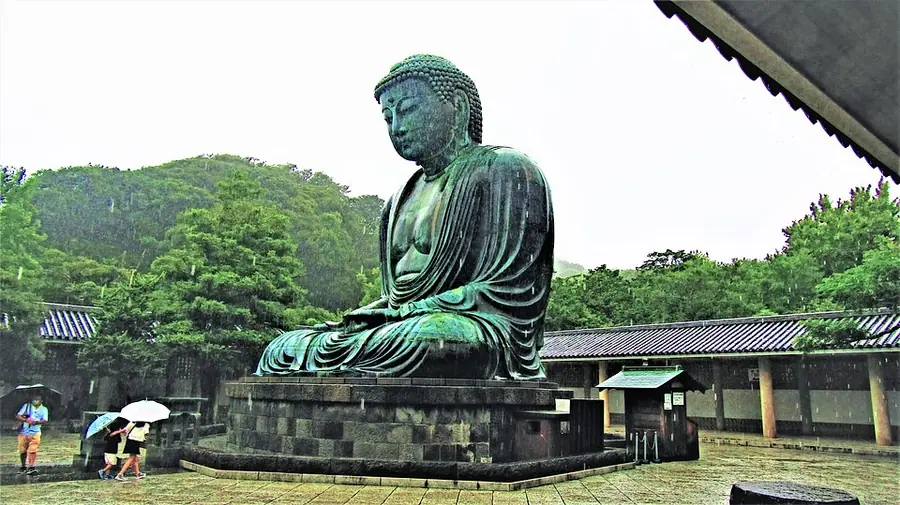
| 1252 | Casting of the Great Buddha of Kamakura begins[17] | Majority |
| 1260 | Nichiren submits the Risshō ankoku ron to the former regent Hōjō Tokiyori[18] | Consensus |
| 1386 | Ashikaga Yoshimitsu fixes the ranking of the Five Mountains (gozan) Zen temples[19] | Majority |
| 1488 | Ikkō ikki (Honganji leagues) take control of Kaga province[13] | Consensus |
| 1571 | Oda Nobunaga burns Enryakuji on Mount Hiei[5] | Consensus |
| 1630s–1660s | Temple certification (terauke) of every household against Christianity[2] | Consensus |
| 1868 | Edicts separating kami and buddhas (shinbutsu bunri); haibutsu kishaku[20][21] | Consensus |
| 1872 | Decree 133 ends state enforcement of clerical celibacy and meat avoidance[22][3] | Consensus |
Where: Nara, Mount Hiei, Kamakura and the provinces
Japanese Buddhism had a sequence of centres, each tied to a seat of power: the Asuka and Nara courts, the mountain monasteries above Heian (Kyoto), the warrior capital at Kamakura, and finally every village in the country.
Nara. The capital from 710 to 784 was laid out on the Chinese model, with great state temples inside and around it: Tōdaiji, Kōfukuji, Yakushiji, Daianji. The “six Nara schools” were not separate churches but curricula of study inherited from China (Kegon, Hossō, Sanron, Ritsu and two Abhidharma traditions), often taught side by side in the same temples.[5] Consensus
Mount Hiei and Mount Kōya. When the capital moved to Heian in 794, the new court favoured two monks who had studied in China. Saichō’s Enryakuji on Mount Hiei, overlooking Kyoto, became the largest monastic complex in Japan and the training ground of almost every Kamakura founder. Kūkai’s Kongōbuji on Mount Kōya, south of Nara, and the Tōji in Kyoto became the centres of Shingon. Both monasteries grew into landholding powers with armed forces of their own.[9][10] Consensus
Kamakura. In 1185 the Minamoto established a warrior government at Kamakura, in eastern Japan. The Hōjō regents who ran it patronised Chinese Chan monks and built Kenchōji (1253) and Engakuji (1282), and a great bronze Amida was cast there from 1252. Kamakura is also where Nichiren preached in the streets and was nearly executed in 1271.[19][17][23] Consensus
The provinces. The new schools grew outside the capitals. Shinran preached for twenty years in the Kantō; Dōgen’s successors spread Sōtō Zen through rural Hokuriku and beyond; Rennyo (1415–1499) organised Shin congregations across the Hokuriku provinces. By the Tokugawa period every village was attached to a temple of one school or another.[13][16][2] Majority
The evidence ledger for Japanese Buddhism
| Dimension | What we can say | Evidence | Confidence |
|---|---|---|---|
| Arrival | Mid-6th century, from Paekche, through court diplomacy and immigrant lineages | Nihon shoki; temple records; archaeology of Asukadera[4][5] | Majority |
| Patrons | First the Soga clan, then the imperial state, then aristocrats, warriors and finally villages | Temple foundations; Shōmu’s edicts; Kamakura-period subscriptions[8][5] | Consensus |
| Purpose | Ritual protection of the realm, healing and care of the dead before personal liberation | Kokubunji system; sūtra recitations for state protection[5][14] | Majority |
| Kami and buddhas | Worshipped together for a thousand years; kami explained as manifestations of buddhas | Shrine-temples (jingūji); honji suijaku identifications[24] | Consensus |
| Kamakura founders | New single-practice movements, mostly founded by monks trained on Mount Hiei | Senchakushū; Tannishō; Shōbōgenzō; Risshō ankoku ron[12][25][15][18] | Consensus |
| Their weight | Marginal for two to three centuries; mass institutions only from the 15th–16th c. | Kuroda’s kenmitsu thesis; land-holding and court ritual records[1] | Majority |
| Tokugawa | Buddhism as state registry and funeral provider | Terauke certificates; temple registers[2] | Consensus |
| Meiji | Kami separated from buddhas; celibacy no longer enforced | 1868 edicts; Decree 133 (1872)[20][22][3] | Consensus |
Primary sources
1. The arrival as the Nihon shoki tells it
The Nihon shoki, the court chronicle completed in 720, places the arrival in the thirteenth year of Emperor Kinmei, which it equates with 552. King Sŏng of Paekche sends a gilt-bronze image of Śākyamuni, banners and sūtras, with a memorial praising the doctrine:
“This doctrine is amongst all doctrines the most excellent. But it is hard to explain, and hard to comprehend. Even the Duke of Chow and Confucius had not attained to a knowledge of it.”[4]
The emperor asks his ministers whether to worship the image. Soga no Iname says all the western lands worship it; the Mononobe and Nakatomi object:
“Those who have ruled the Empire in this our State have always made it their care to worship in Spring, Summer, Autumn and Winter the 180 Gods of Heaven and Earth … If just at this time we were to worship in their stead foreign Deities, it may be feared that we should incur the wrath of our National Gods.”[4]
What it proves. Less about 552 than about 720. The chronicle’s version is composed: the memorial quotes phrasing from a version of the Sūtra of Golden Light that was translated into Chinese only in 703, and the year 552 may have been chosen because some Buddhists reckoned it the first year of the age of decline. Other early sources, a Gangōji temple record and a biography of Prince Shōtoku, give 538.[5] What the account does preserve is the shape of the conflict: Buddhism as a foreign cult sponsored by one powerful clan, the Soga, against clans whose standing rested on service to the native gods. The Soga won the war of 587, and the first great temple, Asukadera, was theirs. Majority
2. “Sincerely reverence the three treasures”
The Nihon shoki attributes to Prince Shōtoku (Umayado, 574–622) a Seventeen-Article Constitution of 604. Article 2 reads:
“Sincerely reverence the three treasures. The three treasures, viz. Buddha, the Law and the Priesthood, are the final refuge of the four generated beings, and are the supreme objects of faith in all countries.”[6]
What it proves. That by 720 the court wanted its founding political charter to place Buddhism at the centre of government. Whether Shōtoku wrote it is another matter. A prince Umayado existed and was associated with the founding of Hōryūji, but the Shōtoku of later tradition, author of sūtra commentaries, founder of Japanese Buddhism and eventually an incarnation of Avalokiteśvara, grew by accretion; Ōyama Seiichi argued in 1999 that the Shōtoku of the Nihon shoki is largely a creation of its compilers. Shōtoku became for Japan what Ashoka was for India: a royal patron to whom later institutions attached their origins (§4).[7][26] Majority on the legend's growth; Contested on how much is invented
3. An emperor’s Buddha
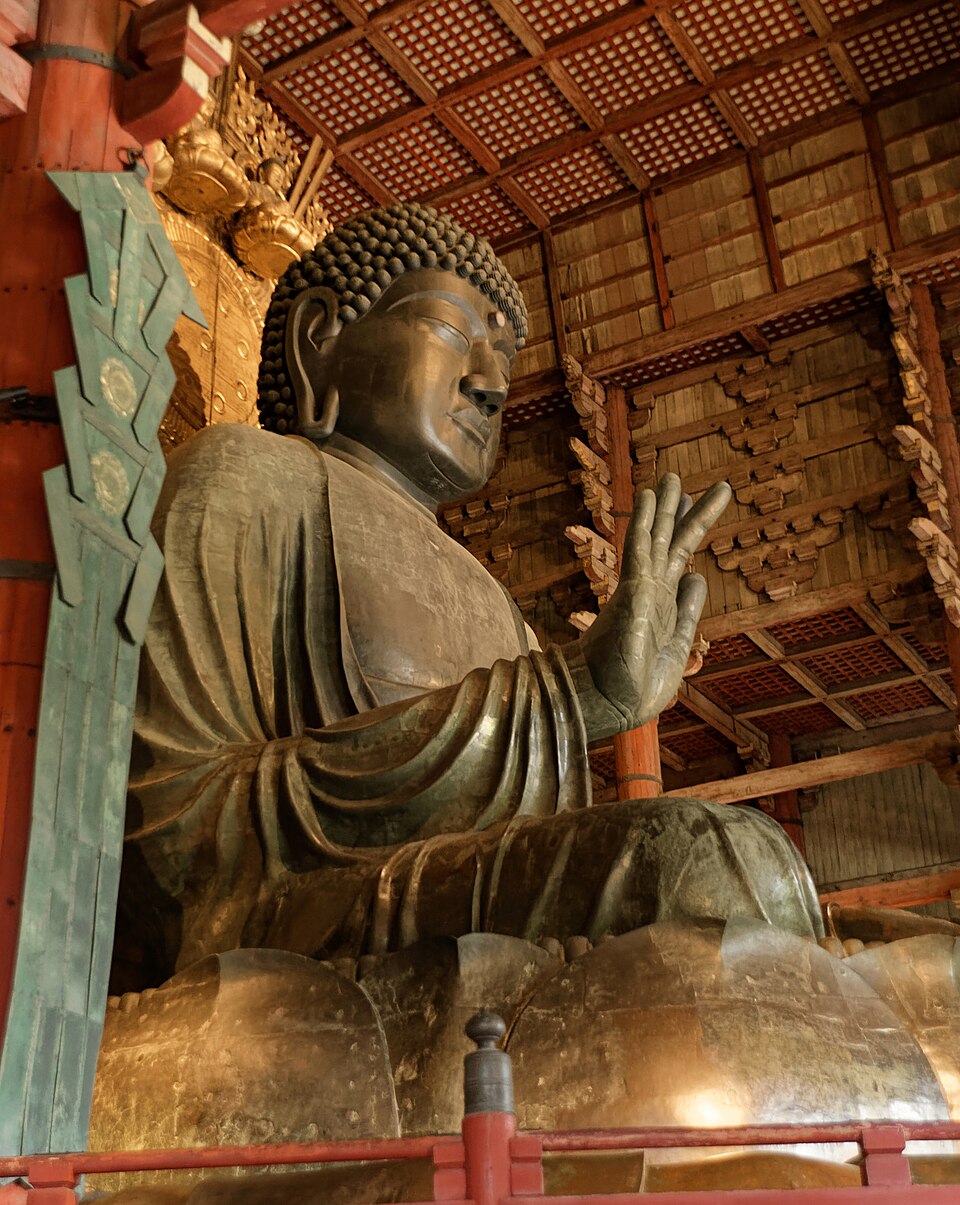
In 743 Emperor Shōmu issued an edict announcing a colossal gilt-bronze Vairocana. It says, in substance, that the one who holds the wealth of the realm is the emperor, and the one who holds its power is the emperor, and that with this wealth and power the image could easily be made; but he wants anyone who wishes to contribute, even a single twig or a handful of earth, to be allowed to help.[8]
What it proves. Nara Buddhism was a state project. The Vairocana of the Avataṃsaka Sūtra, the cosmic Buddha of whom all others are emanations, mirrored the emperor at the centre of a network of provincial temples (the kokubunji ordered in 741). The appeal for small contributions also shows the state using a popular preacher, Gyōki, who had earlier been censured for preaching outside official control. The eye-opening ceremony in 752 was performed by an Indian monk, Bodhisena.[5][27] Consensus
4. Treasures of the nation
When Saichō petitioned the court in 818 for a separate Mahāyāna ordination platform on Mount Hiei, he defined what his monks were for (in Paul Groner’s translation):
“What is the treasure of the nation? It is our religious nature. Thus those who have this religious nature are the treasures of the nation. Long ago a man said, ‘Ten large pearls do not constitute the nation’s treasure, but he who sheds his light over a corner of the country is the nation’s treasure.’”[28][9]
What it proves. Even the most independent-minded Heian founder framed his community as serving the state. Saichō wanted his monks trained for twelve years on the mountain and ordained under the bodhisattva precepts of the Brahmā Net Sūtra, not the full Vinaya used everywhere else in East Asia. The court granted the platform only days after his death in 822. It was a fateful step: Japan became the one major Buddhist country where most monks were not ordained under a Vinaya, and that made later departures from monastic discipline, including marriage, easier to justify.[9][3] Majority
5. Hōnen: the nembutsu alone
In 1175 Hōnen (1133–1212), a learned Tendai monk, read a passage in the Chinese master Shandao’s commentary saying that the practice which accords with Amida’s vow is to recite his name single-mindedly. In 1198 he set out the consequence in the Senchaku hongan nembutsu shū, “Passages on the Nembutsu Selected in the Original Vow”: in the final age, all other practices should be set aside for the recitation namu Amida butsu.[12][13]
What it proves. That the decisive Kamakura move was not a new doctrine but a radical narrowing. Amida and the nembutsu had been part of Tendai practice for centuries (§7). What was new was exclusivity: one practice, available to anyone, with everything else declared unnecessary. The established temples recognised the threat at once. Kōfukuji petitioned the court in 1205, and in 1207 the exclusive nembutsu was banned and Hōnen and several disciples, including Shinran, were laicised and exiled.[13] Consensus
6. Shinran: “how much more so an evil person”
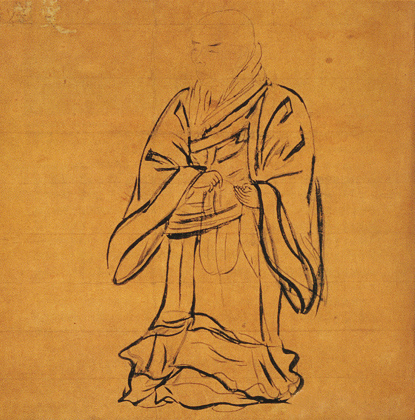
Shinran (1173–1263) took Hōnen’s teaching a step further. The Tannishō, a record of his sayings compiled by his disciple Yuien after his death, opens its third section:
善人なほもて往生をとぐ、いはんや悪人をや
zennin naomote ōjō wo togu, iwanya akunin wo ya
“Even the good person attains birth in the Pure Land, how much more so the evil person.” (trans. Taitetsu Unno)[25][29]
And in the postscript to his own Kyōgyōshinshō, writing of his laicisation, he describes himself as hisō hizoku, which Richard Jaffe renders “neither monk nor layman.”[30][3]
What it proves. Shinran inverted the logic of merit. If birth in the Pure Land depends on Amida’s vow and not on one’s own effort, then the person who knows they cannot save themselves is closer to it than the person who trusts their own goodness. Even saying the nembutsu becomes an expression of gratitude rather than a practice. In life, he married (his wife Eshinni’s letters survive), had children and lived as neither monk nor layman, and his descendants led the Honganji. Jōdo Shinshū is the clearest case in Buddhist history of a married, hereditary clergy built on doctrine rather than compromise.[31][13] Consensus
7. Dōgen: to study the self is to forget the self
Dōgen (1200–1253) trained on Mount Hiei and at Kenninji, then went to China (1223–1227) and returned with the Caodong (Sōtō) lineage.[16] The Genjōkōan (1233), the opening essay of his Shōbōgenzō, contains its most quoted lines:
仏道をならふといふは、自己をならふなり。自己をならふといふは、自己をわするるなり。自己をわするるといふは、万法に証せらるるなり。
“To study the Buddha Way is to study the self. To study the self is to forget the self. To forget the self is to be actualized by myriad things.” (trans. Robert Aitken and Kazuaki Tanahashi)[15][32]
What it proves. Dōgen’s answer to the problem of the final age was the opposite of Hōnen’s. He denied that practice and realisation are two things: sitting in meditation (shikantaza, “just sitting”) is itself the expression of awakening, not a means to it, and he wrote in Japanese prose of a philosophical density unmatched in his time. But Dōgen’s writings were little read for centuries. The Sōtō school that spread across rural Japan did so mainly through funerals, precept ceremonies and prayer rituals, and the Shōbōgenzō was rediscovered as philosophy only in the twentieth century.[16] Majority
8. Nichiren: the threefold world as the Buddha land
Nichiren (1222–1282), another Mount Hiei monk, concluded that only the Lotus Sūtra was valid in the final age, and that the earthquakes, famines and epidemics of the 1250s were the result of the country’s devotion to false teachings, above all Hōnen’s nembutsu. In 1260 he submitted the Risshō ankoku ron, “On Establishing the Correct Teaching for the Peace of the Land,” to Hōjō Tokiyori. Its host, Nichiren’s voice, closes his final argument:
“Therefore, you must quickly reform the tenets that you hold in your heart and embrace the one true vehicle, the single good doctrine [of the Lotus Sutra]. If you do so, then the threefold world will become the Buddha land, and how could a Buddha land ever decline?”[18]
What it proves. That Kamakura reform could be political as well as devotional. Nichiren’s practice was the chanting of the sūtra’s title, namu myōhō renge kyō, and his message was that the state’s safety depended on its religious choices. He was exiled twice (1261 and 1271) and nearly executed. His followers’ exclusivism and their claim on the nation’s welfare run through Nichiren Buddhism to its modern lay movements (§13).[23][33] Consensus
Old Buddhism and new: was Kamakura a Reformation?
The traditional story says the Kamakura founders replaced an aristocratic, ritualistic Buddhism with popular movements of faith and meditation. Kuroda Toshio argued that this reads the later importance of their schools back into a period when they were small and marginal.
The traditional picture. Hōnen, Shinran, Dōgen, Eisai and Nichiren are presented as founders of “Kamakura New Buddhism”, and their single practices as a democratisation of religion comparable to Protestant Europe. Modern Japanese schools, which trace themselves to these founders, naturally favoured this account, and it shaped Western textbooks.[1][34]
Kuroda’s reconstruction. In a series of studies from the 1970s, Kuroda argued that the real orthodoxy of medieval Japan was what he called the kenmitsu taisei, the “exoteric–esoteric system”: the Tendai, Shingon and Nara schools, bound together by esoteric ritual and integrated with the court and the warrior government as landholders and providers of state rituals. The new movements were heterodox reform movements on its fringes. Their great expansion came later: Shin Buddhism under Rennyo in the fifteenth century, Zen with Ashikaga patronage, Nichiren Buddhism among the urban merchants of Kyoto.[1] Majority
The qualifications. Critics accept the main point but note that Zen was quickly absorbed into the establishment rather than standing outside it, and that “old” Buddhism also reformed itself in the same period: Myōe and Jōkei revived Kegon and Hossō practice, and Eison’s Ritsu movement restored Vinaya ordinations and ran large charitable works. Kamakura saw a broad renewal across all schools, not a single new church replacing an old one.[34][35][36] Majority
Mappō as context. Behind the whole period lay the belief that the world had entered the final age of the dharma (mappō), widely reckoned to have begun in 1052, when the teaching survives but no one can realise it through traditional practice. Each founder offered a different answer to the same problem: rely on Amida’s power (Hōnen, Shinran), on the Lotus (Nichiren), or deny that the age prevents awakening here and now (Dōgen).[11] Consensus
Kami and buddhas
For a thousand years most Japanese did not experience Buddhism and the worship of the kami as two religions. Shrines had temples attached, monks performed rituals for the kami, and the kami were explained as local forms of buddhas and bodhisattvas.[24]
The theory was called honji suijaku, “original ground and manifest trace”: a buddha is the original ground, and a kami is the trace it leaves in Japan to reach its people. The war god Hachiman was honoured as a great bodhisattva from the eighth century; by the Kamakura period the sun goddess Amaterasu was commonly identified with Mahāvairocana (Dainichi). Shrine-temple complexes (jingūji) were run by Buddhist clergy.[24] Consensus
From the late medieval period some shrine priests reversed the hierarchy, making the kami original and the buddhas their traces, and Tokugawa scholars of “national learning” argued for a pure Japanese way uncontaminated by Buddhism. These arguments supplied the ideology for the separation of 1868 (below). What is called “Shinto” as a distinct religion is in large part a product of that separation, as Kuroda Toshio argued; Mark Teeuwen and others reply that a self-conscious discourse of a Japanese “way of the kami” was already taking shape in the medieval period.[37][38] Majority
Zen, warriors and the Five Mountains
Zen arrived in Japan as an elite import from Song China, patronised by warrior rulers who valued its Chinese learning as much as its meditation. The image of Zen as the spirit of the samurai is mostly modern.
Eisai (Yōsai, 1141–1215) returned from China in 1191 with the Linji (Rinzai) lineage and wrote the Kōzen gokokuron, “Promoting Zen for the Protection of the Country” (1198), arguing that Zen would strengthen the state and the precepts, not threaten Tendai.[14] Chinese monks fleeing the Mongol conquest of the Song were welcomed by the Hōjō regents. Under the Ashikaga shoguns the leading Rinzai temples of Kyoto and Kamakura were organised into the gozan (“Five Mountains”) system, ranked in 1386, which served as an academy of Chinese poetry, painting and diplomacy and as an arm of shogunal administration.[19] Consensus
Warriors patronised Zen, but they also patronised every other school; most rural Zen temples spread by offering funerals and ordinations to local families, and Zen monks served warlords as secretaries and envoys more often than as masters of the sword. The idea that Zen is the essence of bushidō and of Japanese culture was developed in the Meiji period and popularised abroad by D. T. Suzuki from the 1930s.[16][39] The link was not invented from nothing: the Rinzai monk Takuan Sōhō (1573–1645) wrote Fudōchi shinmyōroku for the sword master Yagyū Munenori, applying Zen ideas of the unattached mind to swordsmanship.[40][41] Its uses in twentieth-century militarism, documented by Brian Victoria, belong to §12 and §13; how far Suzuki himself endorsed them is disputed, and Satō Kemmyō Taira has argued from his letters and talks that he opposed the drift to war.[42][43] Majority
Armed temples, unifiers and the danka system
By the sixteenth century the great monasteries were political powers, and the unifiers of Japan broke them. The Tokugawa regime then made Buddhism into an arm of the state.
Armed monasteries. Enryakuji, Kōfukuji and other great temples kept forces of armed monks and descended on Kyoto to press their claims. The Honganji leagues (ikkō ikki) governed Kaga province for nearly a century after 1488.[13] Oda Nobunaga burned Enryakuji and killed thousands on Mount Hiei in 1571, and fought the Honganji’s fortress at Ishiyama (Osaka) until its surrender in 1580.[5] Consensus
The danka system. After banning Christianity, the Tokugawa shogunate required every household to obtain annual certification (terauke) from a Buddhist temple that its members were not Christians, and from the 1660s compiled religious inspection registers across the country. Each household became a parishioner (danka) of a temple, which handled its funerals and memorial rites and recorded its births, deaths and movements. Buddhism became the registry office and the funeral service of the state.[2] Consensus
The system made temples secure and ubiquitous, and it fixed the association of Japanese Buddhism with death that persists in the phrase “funeral Buddhism” (sōshiki bukkyō). It also made Buddhism the visible instrument of an unpopular regime, which mattered when that regime fell.[2] Majority
1868 and 1872: separation and marriage
In 1868 the new Meiji government ordered the separation of kami and buddhas; in 1872 it ended state enforcement of the Buddhist precepts. Together they produced the institutional shape of modern Japanese Buddhism.
The separation orders (shinbutsu hanzen rei, 1868) required Buddhist images, objects and titles to be removed from shrines and monks serving at shrines to return to lay life or become shrine priests.[20] In several domains this became a campaign to “abolish Buddhism and destroy Śākyamuni” (haibutsu kishaku): temples were closed and merged, images and scriptures burned or sold, and monks laicised. In Satsuma all of the domain’s temples, more than a thousand, were abolished in 1869. The violence was brief, largely over by the mid-1870s, but the loss of land and status was permanent.[21] Consensus
In 1872 the Council of State issued Proclamation 133, in Richard Jaffe’s translation: “From now on Buddhist clerics shall be free to eat meat, marry, grow their hair, and so on. Furthermore, there will be no penalty if they wear ordinary clothing when not engaged in religious activities.”[22][44] The decree did not command marriage; it removed the state’s role in enforcing the precepts, as part of turning the clergy into ordinary subjects, and a second edict the following year extended it to nuns. Senior clergy protested, but marriage spread rapidly, and today most temples in most schools are run by married priests and passed down within families.[44][3] Consensus
What is absent from Japanese Buddhism before 1872
- A Vinaya ordination for most monks after the ninth century. Tendai’s bodhisattva-precept ordination became the norm for most schools; the full Vinaya survived mainly in the Ritsu revival.[9] Majority
- A lasting lineage of fully ordained nuns. Japan had nuns from the sixth century, but official ordination of nuns lapsed in the Heian period; Eison’s Ritsu movement re-established a nuns’ ordination lineage at Hokkeji in the thirteenth century, though it never became the norm.[36] Majority
- A separate “Shinto” as an independent religion before the Meiji separation; kami worship and Buddhism were institutionally intertwined.[37] Majority
- “Zen” as a solitary meditation discipline detached from ritual, funerals and patronage; that image is largely modern (§12).[39] Majority
- Theravāda or Indian Mahāyāna monastic models. Japanese Buddhism came almost entirely through China and Korea, in Chinese translation.[5] Consensus
Debates about Japanese Buddhism
When did Buddhism arrive: 538 or 552?
Neither date is secure. The Nihon shoki’s 552 sits in a composed narrative and coincides with one reckoning of the start of the final age; the 538 of the Gangōji records and the Shōtoku biography comes from sources that are themselves later than they claim. Most historians accept that an official transmission from Paekche took place in the mid-sixth century, and that immigrants from the Korean peninsula had brought Buddhist practice earlier.[5] Contested
Was Prince Shōtoku real?
A prince called Umayado existed, but his role as founder of Japanese Buddhism and author of the Constitution and of sūtra commentaries is largely the work of later tradition. Ōyama Seiichi’s argument that the Nihon shoki’s Shōtoku is a fabrication is a minority view in its strong form; that the image grew by accretion is widely accepted.[7][26] Contested
Was Kamakura Buddhism a Reformation?
As a description of new ideas, partly: the single-practice teachings were genuinely new and were later compared to Luther by Japanese and Western writers alike. As a description of what happened in the thirteenth century, no: the established schools remained dominant for centuries, and reform took place within them too.[1][34] Majority
Was Zen the religion of the samurai?
Some warrior regimes patronised Zen heavily, but the identification of Zen with the warrior ethos is a modern construction, though premodern texts such as Takuan’s treatise for a sword master show a real older connection. See §12 for how and why the modern image was made.[19][39][40] Majority
Further reading
- Richard Bowring, The Religious Traditions of Japan, 500–1600 (Cambridge, 2005).
- Kuroda Toshio, “The Development of the Kenmitsu System as Japan’s Medieval Orthodoxy,” trans. James C. Dobbins, Japanese Journal of Religious Studies 23 (1996).
- James C. Dobbins, Jōdo Shinshū: Shin Buddhism in Medieval Japan (Indiana, 1989).
- William M. Bodiford, Sōtō Zen in Medieval Japan (Hawai’i, 1993).
- Jacqueline I. Stone, Original Enlightenment and the Transformation of Medieval Japanese Buddhism (Hawai’i, 1999).
- Martin Collcutt, Five Mountains: The Rinzai Zen Monastic Institution in Medieval Japan (Harvard, 1981).
- Nam-lin Hur, Death and Social Order in Tokugawa Japan (Harvard, 2007).
- James Edward Ketelaar, Of Heretics and Martyrs in Meiji Japan (Princeton, 1990).
- Richard M. Jaffe, Neither Monk nor Layman: Clerical Marriage in Modern Japanese Buddhism (Princeton, 2001).
References
- ^ a b c d e Kuroda Toshio "The Development of the Kenmitsu System as Japan's Medieval Orthodoxy". Trans. James C. Dobbins, Japanese Journal of Religious Studies 23: 233–269, 1996. open access The kenmitsu thesis in English: the old schools as medieval orthodoxy, the Kamakura founders as reformers at its edges.
- ^ a b c d e f Nam-lin Hur Death and Social Order in Tokugawa Japan: Buddhism, Anti-Christianity, and the Danka System. Harvard University Asia Center, 2007. The definitive study of temple certification and funeral Buddhism.
- ^ a b c d e f Richard M. Jaffe Neither Monk nor Layman: Clerical Marriage in Modern Japanese Buddhism. Princeton University Press, 2001. open library How the 1872 decree and its aftermath made married priests the norm.
- ^ a b c d e Nihon shoki, Kinmei 13 — Nihon shoki. compiled 720 CE. Classical Chinese. The court chronicle's account of King Sŏng of Paekche sending a Buddha image and sūtras in 552, and the debate between the Soga and the Mononobe over whether to worship it. about
- ^ a b c d e f g h i j k l m n Richard Bowring The Religious Traditions of Japan, 500–1600. Cambridge University Press, 2005. The best single history of premodern Japanese religion, careful about what the chronicles can and cannot tell us.
- ^ a b Nihon shoki, Suiko 12 (Seventeen Articles) — Nihon shoki. dated 604; compiled 720 CE. Classical Chinese. The Seventeen-Article Constitution attributed to Prince Shōtoku; Article 2 orders reverence for the three treasures as the final refuge of all beings. about
- ^ a b c Michael I. Como Shōtoku: Ethnicity, Ritual, and Violence in the Japanese Buddhist Tradition. Oxford University Press, 2008. How immigrant lineages built the Shōtoku cult.
- ^ a b c Shoku Nihongi, Tenpyō 15 (743) — Shoku Nihongi. 743 CE. Classical Chinese. Emperor Shōmu's edict announcing the Great Buddha of Tōdaiji: he holds the realm's wealth and power, yet invites anyone to help with even a twig or a handful of earth.
- ^ a b c d e f Paul Groner Saichō: The Establishment of the Japanese Tendai School. Berkeley Buddhist Studies Series, 1984. Saichō's life, his petitions and the fight for the Mahāyāna ordination platform.
- ^ a b Ryūichi Abé The Weaving of Mantra: Kūkai and the Construction of Esoteric Buddhist Discourse. Columbia University Press, 1999. Kūkai and the place of esoteric ritual in the Heian state.
- ^ a b Jacqueline I. Stone Original Enlightenment and the Transformation of Medieval Japanese Buddhism. University of Hawai'i Press, 1999. Tendai thought, mappō and the intellectual setting of the Kamakura founders, especially Nichiren.
- ^ a b c Senchaku hongan nembutsu shū — Hōnen. 1198 CE. Classical Chinese. Hōnen's argument that in the final age all other practices should be set aside for the recitation of Amida's name, the practice chosen in Amida's original vow.
- ^ a b c d e f g h James C. Dobbins Jōdo Shinshū: Shin Buddhism in Medieval Japan. Indiana University Press, 1989. Hōnen, Shinran, the Honganji and the ikkō ikki.
- ^ a b c Kōzen gokokuron — Eisai (Yōsai). 1198 CE. Classical Chinese. "Promoting Zen for the Protection of the Country": Eisai argues that Chan practice and strict precepts will strengthen the state and support Tendai, not threaten it.
- ^ a b c Shōbōgenzō, Genjōkōan — Dōgen. 1233 CE. Medieval Japanese. "To study the Buddha Way is to study the self. To study the self is to forget the self" (trans. Robert Aitken and Kazuaki Tanahashi): practice and realisation are one.
- ^ a b c d e William M. Bodiford Sōtō Zen in Medieval Japan. University of Hawai'i Press, 1993. How Sōtō Zen actually spread: funerals, precept rites and rural patrons, not Dōgen's philosophy.
- ^ a b Great Buddha of Kōtoku-in — Kamakura. cast from 1252 CE. A colossal bronze Amida Buddha raised by public subscription in the warrior capital; its hall was lost in the late fifteenth century.
- ^ a b c Risshō ankoku ron — Nichiren. 1260 CE. Medieval Japanese (kanbun). Nichiren's treatise to Hōjō Tokiyori blaming disasters on the nembutsu and urging the country to embrace the Lotus Sūtra so that "the threefold world will become the Buddha land." read the text
- ^ a b c d Martin Collcutt Five Mountains: The Rinzai Zen Monastic Institution in Medieval Japan. Harvard University Press, 1981. The gozan system as institution and bureaucracy.
- ^ a b c Shinbutsu hanzen rei — Meiji government edicts. 1868 CE. Japanese. Orders separating kami from buddhas: Buddhist images and titles removed from shrines, and monks serving shrines to become shrine priests or return to lay life.
- ^ a b James Edward Ketelaar Of Heretics and Martyrs in Meiji Japan: Buddhism and Its Persecution. Princeton University Press, 1990. The separation of 1868, haibutsu kishaku and the Buddhist response.
- ^ a b c Dajōkan Proclamation 133 — Meiji Council of State. 1872 CE. Japanese. "From now on Buddhist clerics shall be free to eat meat, marry, grow their hair, and so on" (trans. Richard Jaffe): the state stops enforcing the precepts. about
- ^ a b Shuju onfurumai gosho (The Actions of the Votary of the Lotus Sutra) — Nichiren. 1276 CE. Medieval Japanese. Nichiren's own account, written to the lay nun Kōnichi, of his arrest in 1271, his near-execution at Tatsunokuchi near Kamakura and his exile to Sado. read the text
- ^ a b c Mark Teeuwen & Fabio Rambelli, eds. Buddhas and Kami in Japan: Honji Suijaku as a Combinatory Paradigm. RoutledgeCurzon, 2003. How kami and buddhas were combined for a thousand years.
- ^ a b Tannishō 3 — Tannishō (sayings of Shinran, compiled by Yuien). late 13th c. CE. Medieval Japanese. "Even the good person attains birth in the Pure Land, how much more so the evil person" (trans. Taitetsu Unno): birth depends on Amida's vow, not on one's own goodness.
- ^ a b Ōyama Seiichi 〈聖徳太子〉の誕生 (The Birth of 'Prince Shōtoku'). Yoshikawa Kōbunkan, 1999. The strong sceptical case that the Shōtoku of the Nihon shoki is a compilers' creation.
- ^ Jonathan Morris Augustine Buddhist Hagiography in Early Japan: Images of Compassion in the Gyōki Tradition. RoutledgeCurzon, 2005. Gyōki's career, his censure by the court and his recruitment for the Great Buddha project, and the legends that grew around him.
- ^ Sange gakushō shiki (Regulations in Six Articles) — Saichō. 818 CE. Classical Chinese. Saichō's petitions for training Tendai monks on Mount Hiei: "What is the treasure of the nation? It is our religious nature" (trans. Paul Groner); he who sheds light over a corner of the country is the nation's treasure.
- ^ Taitetsu Unno, trans. Tannisho: A Shin Buddhist Classic. Buddhist Study Center Press, rev. ed., 1996. A widely used English translation of the Tannishō; the source of the wording quoted for section 3.
- ^ Kyōgyōshinshō, postscript — Shinran. c. 1224–1250s CE. Classical Chinese. Shinran recalls the 1207 ban on the nembutsu and his laicisation, and calls himself "neither monk nor layman" (hisō hizoku). read the text
- ^ James C. Dobbins Letters of the Nun Eshinni: Images of Pure Land Buddhism in Medieval Japan. University of Hawai'i Press, 2004. The letters of Shinran's wife, the main contemporary evidence for his married life and family.
- ^ Kazuaki Tanahashi, ed. Moon in a Dewdrop: Writings of Zen Master Dōgen. North Point Press, 1985. full text Contains the Robert Aitken and Kazuaki Tanahashi translation of Genjōkōan quoted here.
- ^ Jacqueline I. Stone "Rebuking the Enemies of the Lotus: Nichirenist Exclusivism in Historical Perspective". Japanese Journal of Religious Studies 21/2–3: 231–259, 1994. doi How Nichiren's exclusivism and his claim on the nation's welfare were carried and reinterpreted by later Nichiren movements.
- ^ a b c Richard K. Payne, ed. Re-Visioning "Kamakura" Buddhism. University of Hawai'i Press, 1998. doi Essays testing the 'Kamakura New Buddhism' model against Kuroda's thesis and the reform movements within the older schools.
- ^ James L. Ford Jōkei and Buddhist Devotion in Early Medieval Japan. Oxford University Press, 2006. doi The Hossō monk Jōkei as a reformer within 'old' Buddhism and a critic of Hōnen.
- ^ a b Lori R. Meeks Hokkeji and the Reemergence of Female Monastic Orders in Premodern Japan. University of Hawai'i Press, 2010. How the nuns of Hokkeji, with the Ritsu revivalist Eison, re-established a nuns' ordination lineage in the thirteenth century.
- ^ a b Kuroda Toshio, trans. James C. Dobbins and Suzanne Gay "Shinto in the History of Japanese Religion". Journal of Japanese Studies 7/1: 1–21, 1981. doi The classic argument that Shinto as an independent religion is a modern construction out of a combined kami-buddha system.
- ^ Mark Teeuwen "From Jindō to Shinto: A Concept Takes Shape". Japanese Journal of Religious Studies 29/3–4: 233–263, 2002. doi Qualifies Kuroda by tracing how the concept of Shinto as a distinct way formed in medieval texts.
- ^ a b c Robert H. Sharf "The Zen of Japanese Nationalism". History of Religions 33, 1993. Argues that Suzuki's Zen of pure experience was a modern construction shaped by Western philosophy and Japanese nationalism.
- ^ a b Fudōchi shinmyōroku (The Mysterious Record of Immovable Wisdom) — Takuan Sōhō. early 17th c. CE. Early modern Japanese. The Rinzai monk Takuan's treatise for the sword master Yagyū Munenori, explaining swordsmanship through the Zen idea of a mind that does not stop or attach anywhere. about
- ^ Takuan Sōhō, trans. William Scott Wilson The Unfettered Mind: Writings of the Zen Master to the Sword Master. Kodansha International, 1986. full text English translation of Fudōchi shinmyōroku and two related texts, the premodern basis for the Zen-and-swordsmanship link.
- ^ Brian Daizen Victoria Zen at War. Weatherhill, 1997. Zen institutions and teachers in support of Japanese militarism; the start of the debate over the modern 'Zen and the samurai' image.
- ^ Kemmyō Taira Satō, trans. Thomas Kirchner "D. T. Suzuki and the Question of War". The Eastern Buddhist n.s. 39, no. 1, pp. 61–120, 2008. The fullest defence of Suzuki against Victoria, arguing from his letters, articles and talks that he consistently distrusted State Shinto and opposed the drift to war.
- ^ a b Richard M. Jaffe "Meiji Religious Policy, Sōtō Zen, and the Clerical Marriage Problem". Japanese Journal of Religious Studies 25/1–2: 45–85, 1998. doi Translates the 1872 Grand Council of State decree on meat-eating and marriage and traces the Sōtō school's struggle over it, including the 1873 extension to nuns.