Ashoka and Buddhism in one paragraph
Around 260 BCE the Mauryan emperor Ashoka, ruler of most of the subcontinent, declared himself a lay follower of the Buddha, and over the next quarter century he carved his views on rocks and pillars from Kandahar to Karnataka. Those inscriptions are the first dated evidence for Buddhism anywhere (§0). They show a king who visited the Buddha’s sites, gave to the saṅgha, recommended specific texts and wanted the order kept united, while preaching to his empire a public ethic of restraint and tolerance that never mentions nirvana. Consensus
Around this real figure, Buddhists built a legend: a cruel prince who killed his brothers, ran a torture prison, converted, opened the Buddha’s tombs and built 84,000 stupas, and sent missionaries to every land. The legend is younger by centuries and grew the way the Buddha’s own biography did (§2). What the period really changed is easier to see in stone than in story. Buddhism became a religion of relics and stupas, supported by thousands of ordinary donors, and its first great monuments, at Sanchi and Bharhut, show the Buddha’s life in detail without ever showing the Buddha. Majority
The Hinduism series covers Ashoka from the other side, as the emperor who banned sacrifice and funded the Ājīvikas as well as the Buddhists: see Hinduism §6. This chapter stays with the Buddhist story.
Timeline of Ashoka and early Buddhist monuments
| Date | Event | Confidence |
|---|---|---|
| c. 268 BCE | Ashoka consecrated at Pāṭaliputra, after a disputed succession[1] | Majority |
| c. 261 BCE | Conquest of Kalinga (Odisha), in his eighth regnal year[2] | Consensus |
| c. 260–258 BCE | Becomes a lay follower; after more than a year draws near to (or visits) the saṅgha[3] | Consensus |
| c. 258 BCE | Goes to Sambodhi (Bodh Gaya); Greek and Aramaic edict at Kandahar in his tenth year[4][5] | Consensus |
| c. 256 BCE | Rock Edict 13: remorse for Kalinga and “conquest by dhamma” as far as the Greek kingdoms and Sri Lanka[2] | Consensus |
| c. 250 BCE | Calcutta-Bairāṭ edict recommends seven texts; schism edicts at Sarnath, Sanchi and Kauśāmbī[6][7] | Consensus |
| c. 249 BCE | Pilgrimage to Lumbini and Nigali Sagar[8][9] | Consensus |
| c. 250 BCE | Mahinda’s mission to Sri Lanka, according to the chronicles[10][11] | Contested |
| c. 232 BCE | Death of Ashoka[1] | Majority |
| c. 185 BCE | Fall of the Mauryas; Puṣyamitra Śuṅga takes power[1] | Consensus |
| c. 150 BCE | Great Stupa at Sanchi enlarged and cased in stone; Stupa 2 built with relics of named Mauryan-era teachers[12][13] | Majority |
| c. 125–75 BCE | Bharhut railing and gateway, with labelled narrative reliefs[14][15] | Majority |
| c. 50 BCE–25 CE | The four carved gateways of the Great Stupa at Sanchi[16] | Majority |
| c. 2nd c. CE | The Aśokāvadāna takes its finished form; Chinese translation c. 300 CE[17][18] | Majority |
Where: an empire written in stone
Ashoka’s inscriptions mark out the empire: rock edicts at its edges, from Kandahar and Shahbazgarhi in the northwest to Girnar in Gujarat, Kalsi in the Himalayan foothills, Dhauli and Jaugada in Kalinga and Brahmagiri in Karnataka; polished sandstone pillars in the Ganga heartland. Most are in Prakrit in the Brāhmī script, the northwestern ones in Kharoṣṭhī, and those in Afghanistan in Greek and Aramaic.[19][20] Consensus
The Buddhist inscriptions cluster in a narrower area. The pillars at Lumbini and Nigali Sagar stand in the Buddha’s homeland; the schism edicts stand at Sarnath, Sanchi and Kauśāmbī, all major monastic centres; Bairāṭ, in Rajasthan, had a Mauryan-period circular shrine. Sanchi, on a hill near the city of Vidiśā in central India, was the site of a Mauryan stupa and an Ashokan pillar; Bharhut, about 340 km to the east-northeast, became the great monument of the following century.[21][22]
The evidence ledger for Ashoka’s Buddhism
| Dimension | What we can say | Evidence | Confidence |
|---|---|---|---|
| Personal faith | A Buddhist lay follower from about his eighth or ninth year, soon after Kalinga, by his own statement | Minor Rock Edict 1; Calcutta-Bairāṭ edict[3][6] | Consensus |
| Pilgrimage | Visited the sites of the awakening and the birth, and the stupa of a past Buddha | RE 8; Rummindei and Nigali Sagar pillars[4][8][9] | Consensus |
| Saṅgha policy | Wanted the order united; schismatic monks and nuns to be expelled | Sarnath, Sanchi, Kauśāmbī edicts[7] | Consensus |
| Public dhamma | Ethical, not doctrinal: restraint, generosity, respect for parents, teachers and all sects | Rock Edicts 9, 12, 13; Kandahar bilingual[23][2][5] | Consensus |
| Patronage | Supported Buddhists, brahmins, Ājīvikas and Jains alike | Pillar Edict 7; Barabar caves[24][25] | Consensus |
| Monuments | Mauryan-period stupas and pillars at Buddhist sites; most attributions are later | Sanchi brick core; Nigali Sagar; the Bodh Gaya diamond throne[12][9][20] | Majority |
| Missions | Dhamma “reached” Greek kingdoms and Sri Lanka; the named monastic missions are chronicle tradition | RE 13 against Mahāvaṃsa 12; Sanchi relic caskets[2][10][13] | Contested |
| Lay practice | Stupa worship, relic cult and merit-making by many small donors | Bharhut and Sanchi donor inscriptions[26][27] | Consensus |
Primary sources
1. Kalinga and the remorse of a conqueror
Rock Edict 13, c. 256 BCE (Shahbazgarhi version, translated by E. Hultzsch, who renders dhamma as “morality”):
“When king Devānāṁpriya Priyadarśin had been anointed eight years, (the country of) the Kaliṅgas was conquered by (him). One hundred and fifty thousand in number were the men who were deported thence, one hundred thousand in number were those who were slain there, and many times as many those who died. After that, now that (the country of) the Kaliṅgas has been taken, Devānāṁpriya (is devoted) to a zealous study of morality, to the love of morality, and to the instruction (of people) in morality. This is the repentance of Devānāṁpriya on account of his conquest of (the country of) the Kaliṅgas.”[2][19]
The edict goes on to say that the deaths of brahmins, renunciants and ordinary householders in the war weigh on him, that he now counts “conquest by dhamma” (dhamma-vijaya) the highest conquest, and that this conquest has been won as far as the kingdoms of five Greek kings and in the south as far as the Cholas, Pandyas and Tambapaṃṇi (Sri Lanka).[2][19]
What it proves. A Mauryan emperor publicly confessing the human cost of his own war has few if any parallels in the ancient world, and it is the hinge of Ashoka’s self-presentation. Two details sharpen it. First, the edict never mentions the Buddha; its language of remorse and dhamma would have been intelligible to any of his subjects. Second, at Dhauli and Jaugada, inside Kalinga itself, this edict was not carved: two “Separate Edicts” addressed to his officials there take its place, urging them to treat the people justly.[28][19] The emperor confessed to the empire, not to the conquered. Consensus on the text; Majority on the reading
2. Ashoka’s own account of becoming a Buddhist
Minor Rock Edict 1, c. 258 BCE (Brahmagiri version, translated by E. Hultzsch):
“More than two and a half years (have passed) since I (am) a lay-worshipper (upāsaka). But indeed I had not been very zealous for one year. But indeed a year and somewhat more (has passed) since I have visited the Saṁgha and have been very zealous.”[3][19]
What it proves. That the conversion was a process, not a moment, and that the king himself dated it in two stages: lay affiliation first, close engagement with the monastic community later. The verb (upayīte at Brahmagiri, upagate at Maski), which Hultzsch translates “visited” and others “drew near to” or “went to”, has been read as a formal visit, a period of residence with monks, or simply growing closeness; it does not mean he was ordained. Several versions of this edict, including one at Maski discovered in 1915, are the only inscriptions that call him by the personal name Asoka; elsewhere he is Devānaṃpiya Piyadasi, “Beloved of the Gods, of gracious mien.”[19][20] Consensus
3. “Whatever the Lord Buddha said is well said”
Calcutta-Bairāṭ edict, c. 250 BCE, addressed to the saṅgha (translated by E. Hultzsch):
“The Magadha king Priyadarśin, having saluted the Saṁgha, hopes they are both well and comfortable. It is known to you, Sirs, how great is my reverence and faith in the Buddha, the Dharma, (and) the Saṁgha. Whatsoever, Sirs, has been spoken by the blessed Buddha, all that is quite well spoken.”[6][19]
He then names seven texts he wants monks, nuns and lay followers to hear often (listed in §0).
What it proves. That Ashoka’s private language was fully Buddhist: the three refuges, the Buddha as Bhagavā, the authority of his word. It is the strongest single argument against reading him as a neutral philosopher-king. It also shows him telling the saṅgha what to study, a king presuming to direct the order. Whether monks welcomed that is not recorded. Consensus
4. Dhamma in Greek
Kandahar bilingual inscription, Greek and Aramaic, in his tenth regnal year (c. 258 BCE), found in 1958 at Chehel Zina near Kandahar and first published by Daniel Schlumberger, Louis Robert, André Dupont-Sommer and Émile Benveniste. The Greek begins (the site’s own translation):
“Ten years being completed, King Piodasses made known piety (eusebeia) to men, and from that time he has made men more pious, and everything thrives throughout the whole world.”[5][29]
What it proves. How Ashoka’s own chancery translated dhamma for Greek readers: as eusebeia, the ordinary Greek word for piety and right conduct towards gods, parents and others. The Greek text goes on to mention abstaining from killing animals and obedience to parents and elders, not the Buddha or nirvana. The Aramaic version on the same rock uses qšyṭ, “truth.”[5][29] Where a translator had to choose, he chose the civic sense. That does not settle what dhamma meant to Ashoka, but it does show what he wanted it to mean to the empire. Majority
5. Eight shares of the Buddha
Dīgha Nikāya 16 (Mahāparinibbāna Sutta) ends with a dispute over the Buddha’s remains. Seven claimants, among them a brahmin, send envoys to Kusinārā, the Mallas refuse to give anything up, and the brahmin Doṇa averts a war by dividing the relics into eight equal shares. The claimants are Ajātasattu of Magadha, the Licchavis of Vesālī, the Sakyas of Kapilavatthu, the Bulis of Allakappa, the Koliyas of Rāmagāma, a brahmin of Veṭhadīpa, the Mallas of Pāvā and the Mallas of Kusinārā. Doṇa takes the urn, and the Moriyas of Pipphalivana, arriving late, take the embers. Ten stupas are built.[30]
What it proves. That relic worship is as old as the canon’s narrative of the Buddha’s death, and that relics were political objects from the start: kings and clans fought over them. The Moriyas are probably the clan the Mauryan dynasty claimed descent from, which gave the legend of Ashoka’s redistribution of the relics a family logic.[30][1] The relic cult did not need Ashoka to begin, but it needed something like him to become empire-wide. Majority
6. Relic caskets that name the missionaries
In 1851 Alexander Cunningham opened Stupa 2 at Sanchi and found a stone box with four soapstone caskets of bone. The inscription on the box reads, in N. G. Majumdar’s translation: “(Relics) of all the teachers, including ara Kasapagota (Arhat Kāśyapa-gotra) and ara Vachi (Arhat Vātsī)-Suvijayita, the teacher (or teachers).” The caskets name ten teachers individually, among them Kāsapagota, “teacher of all the Hemavatas,” Majhima and Mogaliputa. Similar caskets from stupas at Sonari and Andher near Vidiśā repeat several of the names, and a Sonari casket adds Dudubhisara.[13][12][31]
What it proves. The Dīpavaṃsa and Mahāvaṃsa say that after the third council under Moggaliputta Tissa, Majjhima was sent with four companions, including Kassapagotta, to the Himalayan region (Himavanta).[10][11] The caskets, written about a century after the events and three or four centuries before the chronicles, name the same men and connect Kassapagotta with the Himalaya; Dudubhisara matches the Dīpavaṃsa’s Dundubhissara, another of the five. At least part of the mission story is independent of the chronicles, and older than them. One caution: N. G. Majumdar read “Hemavata” as a member of the Haimavata school, a branch of the Sthaviras, rather than “of the Himalaya”, which makes the casket a witness to a monastic lineage more than to a mission; he also doubted that this Mogaliputa is the chronicles’ Moggaliputta Tissa.[12] Majority
7. Labels at Bharhut: the absent Buddha named
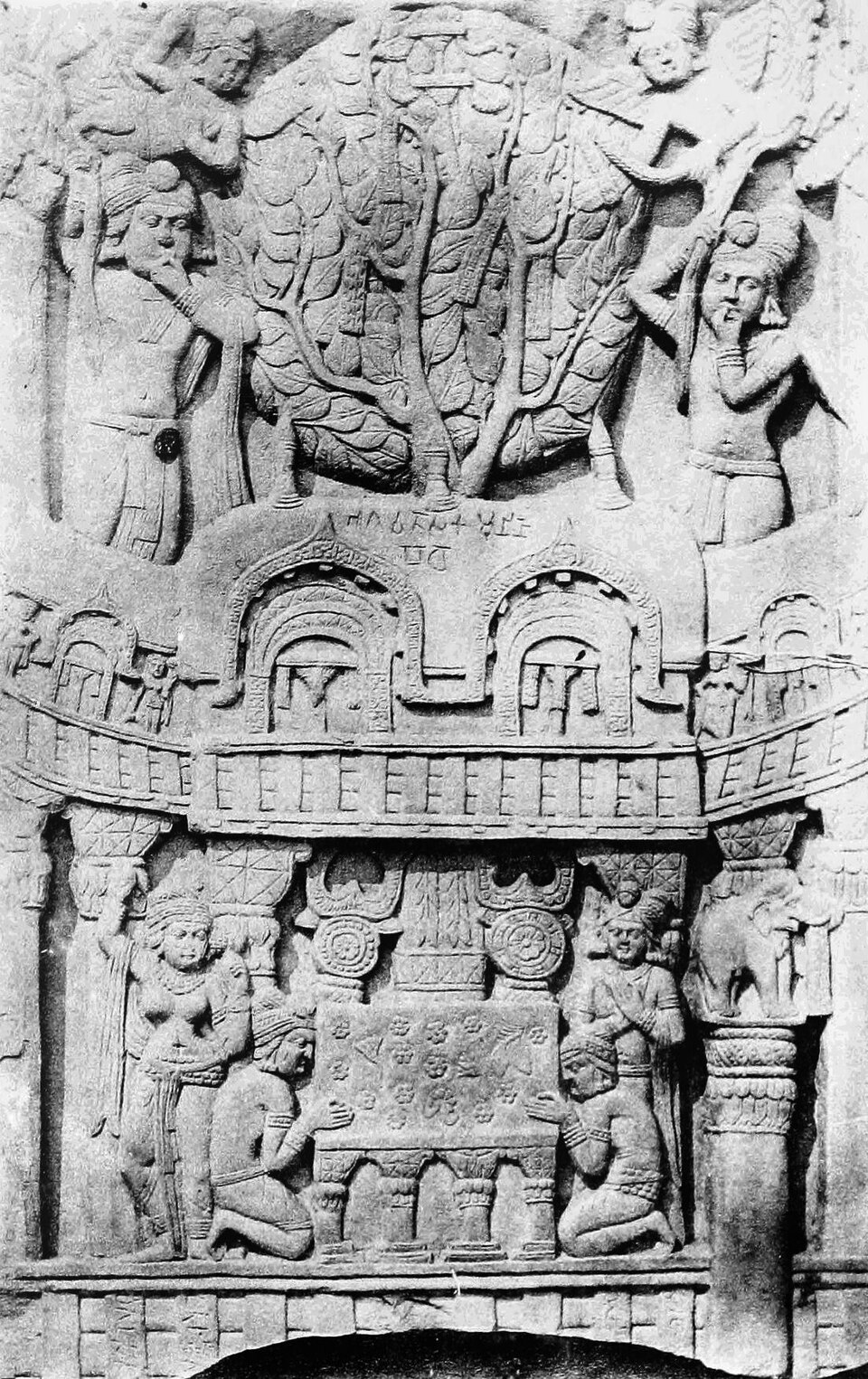
The Bharhut railing, now mostly in the Indian Museum in Kolkata, carries short labels identifying its scenes. Two are decisive for how early Buddhists showed the Buddha (readings from Lüders; the first translation is his, the second the site’s own):
Ajātasatu bhagavato vaṃdate — “Ajātasatu (Ajātaśatru) worships the Holy One.”
bhagavato sakamunino bodho — “The Bodhi (tree) of the Blessed Śākyamuni.”[14][27]
In the first relief King Ajātasattu, who in the canon visits the Buddha to ask about the fruits of renunciation (DN 2), kneels before an empty seat marked with footprints. In the second a pipal tree rises above a seat inside a pillared, two-storeyed shrine.
What it proves. That the sculptors and their audience knew exactly whom an empty seat represented: the label says Ajātasattu worships the Holy One, and the Holy One is not there in human form. It also shows, in the Bodhi relief, a shrine built around the tree, matching the tradition that Ashoka built a temple there. Both labels matter to the aniconism debate below. Consensus
The legend of Ashoka
The Ashoka most Buddhists know comes from texts written between four and eight centuries after his death: the Sanskrit Aśokāvadāna (finished c. 2nd century CE, translated into Chinese c. 300) and the Pali chronicles of Sri Lanka, the Dīpavaṃsa (c. 4th century) and the Mahāvaṃsa (c. 5th–6th century).[17][18][10] Consensus
The legend runs in three movements:
- The past. In a former life, as a small boy named Jaya, Ashoka put a handful of dirt into the Buddha’s begging bowl as an offering, and the Buddha predicted he would become a great king. The dirt explains both his empire and, in some tellings, his rough skin.[17][18]
- The cruel king. “Caṇḍāśoka,” Ashoka the Fierce, takes the throne violently (the Mahāvaṃsa has him kill 99 half-brothers),[32] and builds a prison of exquisite tortures, “Ashoka’s hell,” run by an executioner named Caṇḍagirika. A monk thrown into it cannot be harmed, and his calm converts the king.[17][18]
- The righteous king. “Dharmāśoka” opens seven of the eight original relic stupas and divides the relics among 84,000 new ones, built in a single moment across Jambudvīpa. Guided by the monk Upagupta of Mathurā, he makes a pilgrimage to the Buddha’s sites. In old age his ministers stop his gifts to the saṅgha until he has only half a myrobalan fruit left to give.[17][18]
Set against the inscriptions, the legend inverts what Ashoka says about himself. His edicts place the turning point at a war of conquest and its remorse; the legend makes him cruel by nature and converts him by a miracle. His edicts mention the households of his brothers and sisters as places his dhamma officers were active; the chronicles have him kill nearly all his brothers. Hultzsch drew the conclusion a century ago: the fratricide tradition “is opposed to facts.”[33][32][19][1] His edicts do record a pilgrimage, and the legend’s Upagupta guides him on one, so the legend keeps real events while changing their meaning. Majority
Why the legend grew. John Strong argues that the Aśokāvadāna is not a failed history but a teaching about kingship and gift: Ashoka is the model donor, whose gifts to the saṅgha are infinitely fruitful, and whose life shows a lay ruler’s path to merit.[18] The Sri Lankan chronicles have a different purpose. They tie the Sri Lankan saṅgha and its kings to Ashoka through Mahinda, and make the Mahāvihāra the heir of the “third council” (§3).[10][11] Like the Buddha’s own biography (§2), the legend grows by turning a life into a pattern, here the pattern of the ideal Buddhist king, the cakkavatti who rules by dhamma. Kings across Buddhist Asia later modelled themselves on it. Majority
Relics and stupas: where lay Buddhism happened
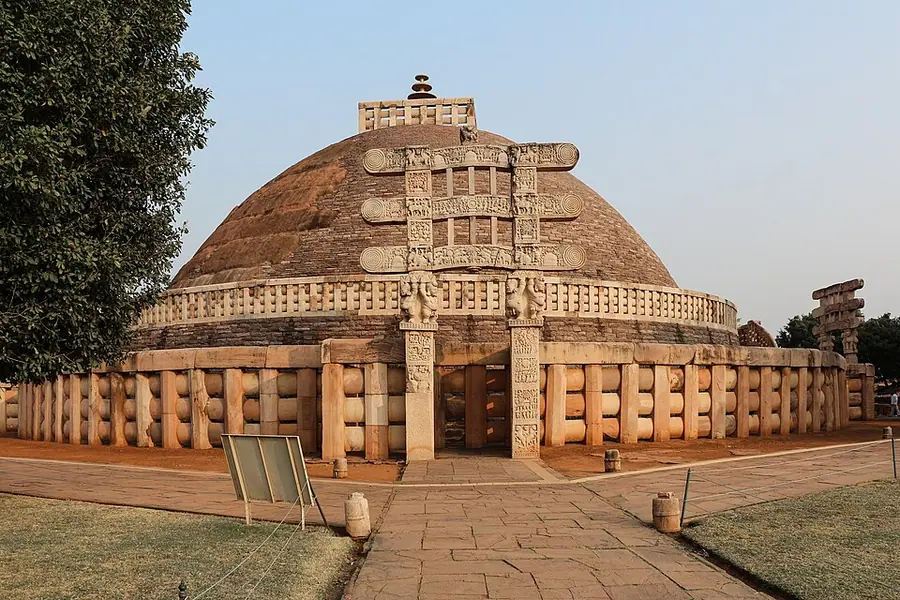
A stupa is a solid mound over relics, round in plan, which worshippers walk around clockwise. From Ashoka’s time onward the stupa, not the monastery or the text, was the centre of Buddhist practice for most lay people.
What the stupa was for. In the Mahāparinibbāna Sutta the Buddha says a stupa should be built for a Buddha’s remains at a crossroads, and that those who place garlands, scent or paint there, or make their hearts calm there, will benefit for a long time.[30] The relic was not a memorial but a presence: inscriptions speak of relics as living, and offerings to them as offerings to the Buddha. Gregory Schopen has argued that monks treated the relic as a legal person who could own property and live in a monastery.[34] Majority
What the archaeology shows. The Great Stupa at Sanchi began as a Mauryan brick structure about half its present diameter, probably associated with the Ashokan pillar that stands beside it. In the second century BCE it was nearly doubled in size and cased in stone, with a terrace and railing; its four gateways were added around the turn of the era. The south gateway carries an inscription recording it as the gift of Ānanda, foreman of the artisans of King Siri Sātakaṇi.[12][16] Ashoka records the same kind of enlargement himself at the stupa of Konākamana.[9] Stupas were built, rebuilt and enlarged over generations, which is why so few can be dated to one reign. Consensus
Who paid. The donative inscriptions at Sanchi and Bharhut, more than eight hundred at Sanchi and well over a hundred at Bharhut, record gifts of single railing posts, crossbars and coping stones. The donors are monks, nuns, householders, merchants, guilds, and a large number of women, who give in their own names. Very few are royal.[26][27][12][35] The great monuments of early Buddhism were collective projects of a broad, prosperous lay and monastic public, not imperial commissions. That is the real social change of the period: Buddhism had become a religion of many small patrons, which gave it a base that did not depend on any one king. Consensus
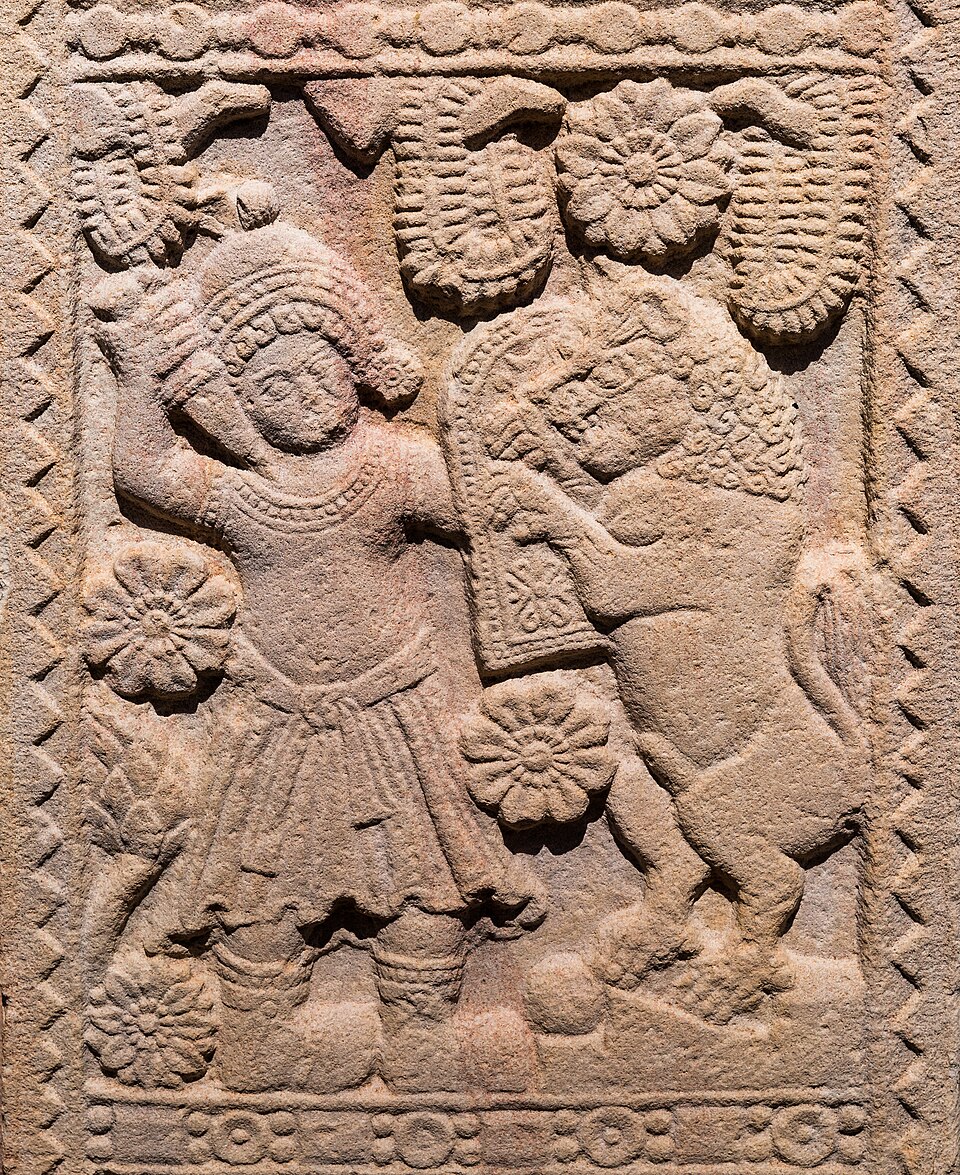
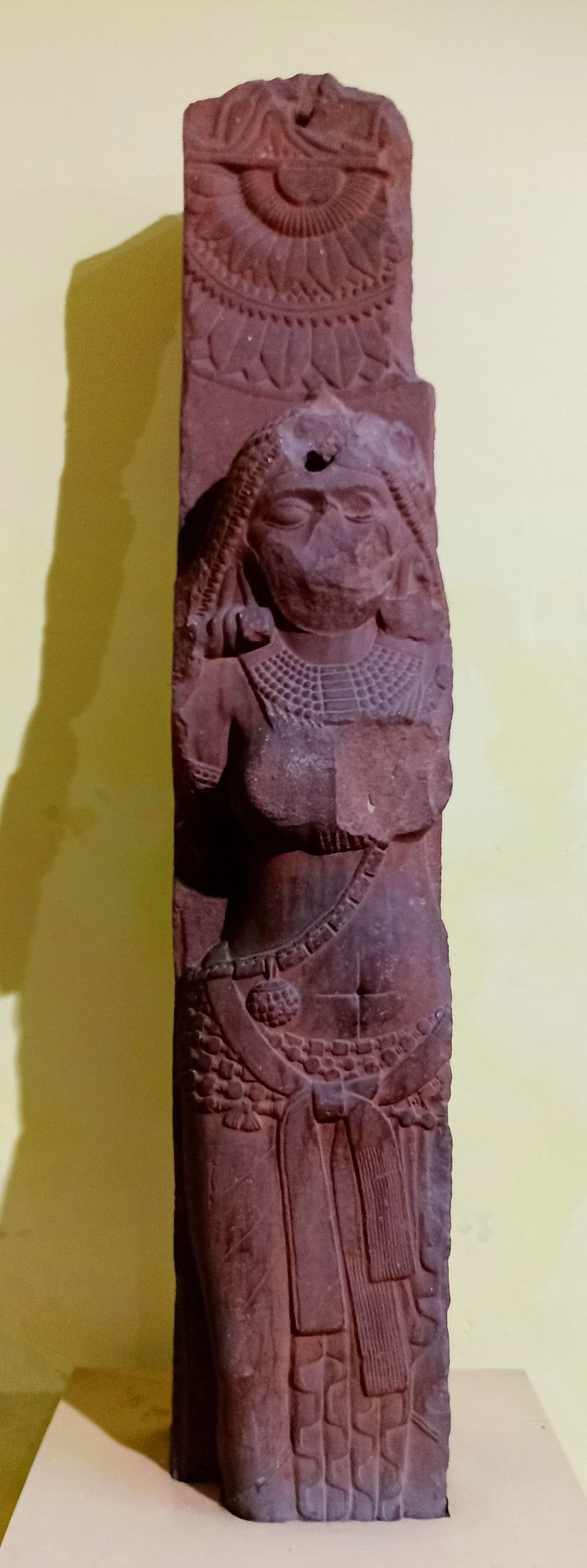
The yakṣas move in. Carved on the Bharhut railing posts, life-size and labelled, stand yakṣas and yakṣīs, nature and tree spirits of popular religion: Kubera, king of the yakṣas, the yakṣī Candā, and others, and the goddess Sirimā.[27] They guard the stupa. Local deities who already had worshippers were given a place in the Buddhist monument, a pattern repeated wherever Buddhism spread. The Hinduism series traces the same yakṣa cults into early image worship (Hinduism §6). Majority
The missions: chronicle and evidence
The Sri Lankan chronicles say that after the third council, held at Pāṭaliputra under Ashoka’s patronage, the elder Moggaliputta Tissa sent nine missions to the borderlands. The best known are Mahinda, Ashoka’s son, to Sri Lanka, and the elders Soṇa and Uttara to Suvaṇṇabhūmi, the “Land of Gold.”[10][11] Contested
| Missionary (chronicle) | Destination | Independent evidence |
|---|---|---|
| Majjhantika | Kashmir and Gandhāra | Buddhism well established in Gandhāra by the 1st c. BCE (§5) |
| Majjhima, Kassapagotta and others | The Himalayan region | Sanchi and Sonari relic caskets naming Kāsapagota “teacher of all the Hemavatas” and Majhima[13] |
| Mahinda and Saṅghamittā | Sri Lanka | Early Brāhmī cave inscriptions donating caves to the saṅgha, 3rd–2nd c. BCE[36] |
| Soṇa and Uttara | Suvaṇṇabhūmi | None for this period; identified variously with Lower Burma or Thailand |
| Mahārakkhita | The Yona (Greek) country | Ashoka’s own edicts in Greek; no Buddhist evidence for this period |
| Yona Dhammarakkhita, a Greek monk | Aparantaka, western India | None specific |
What Ashoka says. His edicts claim that his dhamma has reached the Greek kings Antiochus, Ptolemy, Antigonus, Magas and Alexander, and Sri Lanka in the south. They describe envoys (dūta) and officers, not monks, and the content is his ethical dhamma, not Buddhist doctrine.[2] Nothing in the inscriptions says he sent monastic missionaries anywhere. Consensus
Sri Lanka. The chronicles’ Mahinda is Ashoka’s son; the Chinese pilgrim Xuanzang, drawing on North Indian tradition, calls Mahendra his younger brother.[10][37] The Sri Lankan king who received him, Devānaṃpiya Tissa, bore Ashoka’s own title, “Beloved of the Gods,” which suggests real contact with the Mauryan court.[10] Hundreds of short Brāhmī inscriptions recording caves given “to the saṅgha of the four quarters, present and absent” show an established monastic community in Sri Lanka by the second century BCE at the latest.[36] A mission in Ashoka’s time is therefore plausible; its royal details are the chronicle’s. Majority
The safest reading is that monks spread along trade and political routes that the Mauryan empire had opened, and that the chronicles later organised that spread into nine missions launched by a council, giving the Theravāda of Sri Lanka a single, authorised origin. Majority
The absent Buddha: aniconism at Bharhut and Sanchi
For two centuries or more, the earliest Buddhist reliefs show the Buddha’s life in detail without showing the Buddha as a human figure. He is a tree, an empty seat, a pair of footprints, a wheel, a parasol over nothing, a stupa, or a riderless horse leaving the palace. Consensus
At Bharhut and Sanchi, where narrative reliefs are labelled or easy to identify, the pattern holds in every scene of the last life:
- The great departure at Sanchi: the horse Kanthaka leaves the city with a parasol held over its empty back.
- The awakening: an empty seat under the Bodhi tree, surrounded by worshippers or by Māra’s army.
- The first sermon: a wheel on a pillar, with deer below for the Deer Park.
- The descent from the heaven of the thirty-three: a ladder with footprints on the top and bottom steps.
The same sculptors had no difficulty carving humans. Kings, crowds, gods, yakṣīs, animals and the Buddha’s own past lives as a monkey, an elephant or a deer (the Jātakas) are shown in full figure. The absence is selective, and confined to the Buddha in his last life. Consensus
The first anthropomorphic Buddhas appear in Gandhāra and Mathurā in the first or second century CE (§5). This chapter ends on the eve of that change.
Huntington and Dehejia: was there a rule?
The standard explanation, developed by Alfred Foucher in the early twentieth century, was that early Buddhists considered it improper or impossible to depict a Buddha who had passed into final nirvana, and so used symbols. Scholars spoke of an “aniconic period.”[38][39] Contested
In 1990 Susan Huntington challenged the whole idea. She argued that many of these reliefs do not show events of the Buddha’s life with the Buddha left out, but show later worship at the holy sites associated with those events: people venerating the Bodhi tree at Bodh Gaya, the wheel at Sarnath, a stupa at Kusinārā. The Bharhut relief of the Bodhi tree in its shrine looks exactly like such a scene, since the shrine around the tree was built after the Buddha’s time.[39]
Vidya Dehejia replied in 1991 that the emblems are multivalent: the same empty seat can represent the Buddha present at an event, a site where that event happened, or the Buddha being worshipped now, and the viewer read it from context. The Ajātasattu relief, labelled “Ajātasatu (Ajātaśatru) worships the Holy One,” shows that at least some empty seats stand for the living Buddha at a moment in his life, which, Dehejia argued, Huntington’s site reading struggles to accommodate.[40][14]
Where this series lands. Both are partly right. Some reliefs plainly depict pilgrimage sites; others plainly depict the Buddha’s life with his body not shown. No text from the period forbids images of the Buddha. The nearest thing is a passage in the Sarvāstivāda Vinaya, translated into Chinese in 404 CE, in which Anāthapiṇḍika, on the premise that the Buddha’s bodily image should not be made, asks to make bodhisattva attendant images instead; it is centuries later than Bharhut and Sanchi, so “rule” remains too strong a word for their time.[41][39] What is certain is a long, consistent artistic convention of not giving the Buddha a human body, followed by a fairly sudden change in the northwest and at Mathurā. Contested
What is absent in the age of Ashoka
- Images of the Buddha in human form. None before the first century CE. Consensus
- Doctrine in the edicts. Ashoka never mentions nirvana, the four truths, not-self or meditation; his public dhamma is ethical, and his heaven is a good rebirth (§0).[42][19] Consensus
- Royal monopoly. The great monuments are mostly paid for by ordinary donors, not kings. Consensus
- Mahāyāna. No bodhisattva cults, no Amitābha, no Mahāyāna texts; the Bharhut Jātakas celebrate the Buddha’s past lives as a bodhisatta, but nothing yet suggests a path for others to follow (§6). Consensus
- Written scripture. Ashoka names texts but there is no sign they were written down; the Pali canon was written in Sri Lanka two centuries later (§0, §5).[43][44] Majority
- Persecution of non-Buddhists. The edicts command respect for all sects and record gifts to rivals of the saṅgha.[23][25] Consensus
Debates about Ashoka and early Buddhism
Was Ashoka a Buddhist king or a pluralist one?
Both, in different registers. To the saṅgha he spoke as a committed Buddhist, praising the Buddha’s word and naming texts; to the empire he spoke of an ethics anyone could accept, translated into Greek as piety. Romila Thapar reads his dhamma as a political instrument for holding together a diverse empire; Patrick Olivelle, in a recent study, reads Ashoka as a moral philosopher whose dhamma was his own synthesis, shaped by Buddhism but not identical with it.[1][45] The opposite reading goes back to D. R. Bhandarkar, who argued that Ashoka, a householder preaching to householders, taught exactly the dhamma Buddhism reserved for the laity, closest to the duties of the Sigālovāda Sutta, which is why nirvana is absent and heaven is the reward.[46][47] The Hinduism series sets out the pluralist side in full (Hinduism §6). Contested
Did Ashoka make Buddhism a world religion?
He made it pan-Indian. His patronage, his pilgrimages and his schism edicts show a saṅgha present from Afghanistan to Karnataka, and stupas at the empire’s main centres. Whether he sent missionaries abroad is not shown by his own words. The expansion into Sri Lanka, Gandhāra and beyond was real and began in or near his reign, but the chronicles’ picture of a single coordinated mission programme is a later construction. Majority
Were the missions real?
Partly. The Sanchi caskets show that Majjhima and Kassapagotta were real teachers venerated as linked to the Himalaya within about a century, independently of the chronicles. Sri Lanka’s monastic community is attested early enough to make a mission under Ashoka plausible. The Suvaṇṇabhūmi mission has no early evidence, and modern claims about it in Myanmar and Thailand are bound up with national histories. Contested
Did the Śuṅgas destroy Ashoka’s stupas?
Buddhist sources accuse Puṣyamitra Śuṅga of persecution.[17][18] John Marshall suggested the brick stupa at Sanchi had been damaged before it was rebuilt in stone. But the rebuilding, enlargement and decoration of Sanchi and Bharhut happened under Śuṅga rule, and the Bharhut gateway was given “in the reign of the Śuṅgas” (the usual reading of an inscription that is not quite unambiguous) by a local donor.[15][12] Buddhism flourished in their territory. The argument is laid out in Hinduism §6. Contested
Was there an aniconic period?
There was a long convention of not showing the Buddha’s body; whether it rested on a doctrinal rule, and whether every emblem stands for the absent Buddha, is debated (see above). Contested
Further reading
- John S. Strong, The Legend of King Aśoka: A Study and Translation of the Aśokāvadāna (Princeton, 1983).
- Nayanjot Lahiri, Ashoka in Ancient India (Harvard, 2015).
- Romila Thapar, Aśoka and the Decline of the Mauryas (3rd ed., Oxford, 2012).
- Patrick Olivelle, Ashoka: Portrait of a Philosopher King (Yale, 2023).
- E. Hultzsch, Inscriptions of Asoka, Corpus Inscriptionum Indicarum I (1925) — the primary edition.
- Susan L. Huntington, “Early Buddhist Art and the Theory of Aniconism,” Art Journal 49 (1990), and Vidya Dehejia, “Aniconism and the Multivalence of Emblems,” Ars Orientalis 21 (1991) — read as a pair.
- John Marshall and Alfred Foucher, The Monuments of Sāñchī (3 vols., 1940).
- Michael Willis, Buddhist Reliquaries from Ancient India (British Museum, 2000).
References
- ^ a b c d e f Romila Thapar Aśoka and the Decline of the Mauryas. Oxford University Press, 3rd ed., 2012. open library
- ^ a b c d e f g Rock Edict 13 — Ashokan edicts. c. 256 BCE. Prakrit in Brāhmī. Names five Hellenistic kings whose reigns are independently dated — the peg the entire Indian chronology hangs from. read the text
- ^ a b c Minor Rock Edict 1 — Ashokan edicts. c. 258 BCE. Prakrit in Brāhmī. Names the king as Asoka personally and records that he has been a lay follower for over two and a half years — his Buddhist affiliation in his own voice. read the text
- ^ a b Rock Edict 8 — Ashokan rock edicts. c. 258 BCE. Prakrit in Brāhmī. Ashoka says that in his tenth regnal year he "went to Sambodhi", replacing pleasure tours with tours of dhamma. The earliest reference to the place of the awakening. read the text
- ^ a b c d Kandahar bilingual inscription — Chehel Zina, Kandahar. c. 258 BCE. Greek and Aramaic. Ashoka's tenth-year edict in Greek and Aramaic. The Greek renders dhamma as eusebeia, piety, and speaks of abstaining from killing and obeying parents, never of the Buddha. about
- ^ a b c Calcutta-Bairāṭ edict — Bairāṭ, Rajasthan. c. 250 BCE. Prakrit in Brāhmī. Ashoka addresses the saṅgha directly and names seven texts he wants monks, nuns and laypeople to hear often. The only Ashokan list of Buddhist texts, and several can be matched to suttas that still survive. read the text
- ^ a b Sarnath schism edict — Sarnath pillar. c. 250 BCE. Prakrit in Brāhmī. Ashoka orders that any monk or nun who splits the saṅgha be dressed in white and made to live apart. Division within the order was already a royal concern. read the text
- ^ a b Rummindei pillar — Lumbinī. c. 249 BCE. Prakrit in Brāhmī. Lumbinī freed of the bali tax and liable to only an eighth share because "here the Buddha was born, the Sakyamuni" — the earliest datable evidence for veneration of the birthplace.
- ^ a b c d Nigali Sagar pillar — Nigali Sagar, Nepal. c. 249 BCE. Prakrit in Brāhmī. Ashoka records that he enlarged the stupa of the past Buddha Konākamana to double its size in his fourteenth year and came to worship in his twentieth. A cult of earlier Buddhas already existed by c. 250 BCE. read the text
- ^ a b c d e f g h Mahāvaṃsa 12–14 — Mahāvaṃsa. c. 5th–6th c. CE. Pali. After the third council Moggaliputta Tissa sends nine missions to the borderlands, and Ashoka's son Mahinda converts King Devānaṃpiya Tissa of Sri Lanka. about
- ^ a b c d Dīpavaṃsa 8 — Dīpavaṃsa. c. 4th c. CE. Pali. The earlier Sri Lankan chronicle's list of the missions sent after the third council, including Majjhima and Kassapagotta to the Himalayan region. about
- ^ a b c d e f g John Marshall & Alfred Foucher The Monuments of Sāñchī. Manager of Publications, Delhi, 3 vols., 1940. The excavation and building history of Sanchi, with the inscriptions, from the 1912–19 restoration.
- ^ a b c d Sanchi Stupa 2 reliquary inscriptions — Sanchi. c. 2nd c. BCE. Prakrit in Brāhmī. Relic caskets of ten teachers, among them Kāsapagota, 'teacher of all the Hemavatas', Majhima and Mogaliputa: names the Dīpavaṃsa gives for the Himalayan mission, written centuries earlier. Majumdar read 'Hemavata' as the Haimavata school rather than the Himalaya. about
- ^ a b c Bharhut label inscriptions — Bharhut stupa railing. c. 125–75 BCE. Prakrit in Brāhmī. Short labels naming the scenes, including 'Ajātasatu worships the Holy One' (Lüders) over an empty seat and 'the Bodhi of the Blessed Śākyamuni' over a tree shrine. read the text
- ^ a b Bharhut gateway inscription — Bharhut stupa. c. 100 BCE. Prakrit in Brāhmī. Records the gateway as the gift of Vātsīputra Dhanabhūti 'in the reign of the Śuṅgas' (suganaṃ raje), the usual reading. Buddhist building under the dynasty accused of persecution. about
- ^ a b Sanchi south gateway inscription — Sanchi Stupa 1. c. 1st c. BCE. Prakrit in Brāhmī. The gateway is the gift of Ānanda, son of Vāsiṭhī, foreman of the artisans of King Siri Sātakaṇi: the Great Stupa's carved gateways belong to the Sātavāhana period. about
- ^ a b c d e f Aśokāvadāna — Divyāvadāna. c. 2nd c. CE. Buddhist Sanskrit. The North Indian legend of Ashoka: the dirt offering of his past life, the hell-prison, conversion by a monk, 84,000 stupas, the pilgrimage with Upagupta, and the half myrobalan given at his death. about
- ^ a b c d e f g John S. Strong The Legend of King Aśoka: A Study and Translation of the Aśokāvadāna. Princeton University Press, 1983. Translation and study of the North Indian legend, read as a theology of kingship and gift rather than as failed history.
- ^ a b c d e f g h i E. Hultzsch Inscriptions of Asoka. Corpus Inscriptionum Indicarum I, Clarendon Press, 1925. full text The primary edition of the edicts. Public domain.
- ^ a b c Harry Falk Aśokan Sites and Artefacts: A Source-book with Bibliography. Philipp von Zabern, 2006. The archaeological handbook for the edicts.
- ^ Julia Shaw Buddhist Landscapes in Central India: Sanchi Hill and Archaeologies of Religious and Social Change. British Association for South Asian Studies, 2007. full text Landscape archaeology around the site §7 and §8 both use.
- ^ Nayanjot Lahiri Ashoka in Ancient India. Harvard University Press, 2015. open library The current biography, strong on the archaeology.
- ^ a b Rock Edict 12 — Ashokan edicts. c. 257 BCE. Prakrit in Brāhmī. Honour other sects; praising your own by disparaging others harms your own. A novel theory of plural government. read the text
- ^ Pillar Edict 7 — Ashokan edicts. c. 242 BCE. Prakrit in Brāhmī. Names saṅgha, brahmins-and-Ājīvikas, Nirgranthas and "various sects" as distinct bodies each needing its own officers — the best contemporary evidence for a plural religious economy. read the text
- ^ a b Barabar cave dedications — Ashoka and Daśaratha. c. 250–230 BCE. Prakrit in Brāhmī. Rock-cut caves endowed to the **Ājīvikas** by name — the only contemporary documentary evidence for the sect. At one cave the word "Ājīvika" was later effaced. read the text
- ^ a b Sanchi and Bharhut railings — Madhya Pradesh. c. 150–50 BCE. Stūpa railings carrying donative inscriptions in quantity — including gifts by named women, nuns and guilds, evidence of a broad lay donor economy. about
- ^ a b c d Heinrich Lüders Bharhut Inscriptions. Corpus Inscriptionum Indicarum II.2, rev. E. Waldschmidt & M. A. Mehendale, 1963. full text The standard edition of the Bharhut donor and label inscriptions.
- ^ Separate Edicts (Dhauli and Jaugada) — Ashokan edicts. c. 256 BCE. Prakrit in Brāhmī. In conquered Kalinga, Rock Edict 13's confession of remorse is left out and two edicts to local officials, urging just treatment of the people, are carved instead. about
- ^ a b Daniel Schlumberger, Louis Robert, André Dupont-Sommer & Émile Benveniste "Une bilingue gréco-araméenne d'Asoka". Journal Asiatique 246: 1–48, 1958. The first edition of the Kandahar Greek-Aramaic edict, where dhamma appears as Greek eusebeia and Aramaic qšyṭ, 'truth'.
- ^ a b c DN 16 — Mahāparinibbāna Sutta (Dīgha Nikāya). c. 400–200 BCE, with later layers. Pali. The last months of the Buddha's life: his age (80), the last meal of sūkaramaddava at Cunda's house, the death at Kusinārā and the division of the relics into eight shares. read the text
- ^ Michael Willis Buddhist Reliquaries from Ancient India. British Museum Press, 2000. The Sanchi-area relic caskets, including those naming Kāsapagota and Majhima.
- ^ a b Mahāvaṃsa 5 — Mahāvaṃsa. c. 5th–6th c. CE. Pali. The Theravāda chronicle's account of the Third Council: uposatha suspended for seven years at Ashoka's monastery, Moggaliputta Tissa examines the monks, the vibhajjavāda is declared the true teaching and the Kathāvatthu is composed.
- ^ Rock Edict 5 — Ashokan edicts. c. 256 BCE. Prakrit in Brāhmī. Creates officers of dhamma (dhamma-mahāmātras) and sends them among all sects and into the households of the king's brothers and sisters, which tells against the legend that he killed his brothers. about
- ^ Gregory Schopen Bones, Stones, and Buddhist Monks: Collected Papers on the Archaeology, Epigraphy, and Texts of Monastic Buddhism in India. University of Hawai'i Press, 1997. Includes the essays on relics as living presences, on the Buddha as a legal resident of monasteries, and on Indian monks' donations for their parents ('Filial Piety and the Monk in the Practice of Indian Buddhism').
- ^ Vidya Dehejia "The Collective and Popular Basis of Early Buddhist Patronage: Sacred Monuments, 100 BC–AD 250". In The Powers of Art: Patronage in Indian Culture, ed. Barbara Stoler Miller, Oxford University Press, 1992. Who paid for Sanchi and Bharhut: many small donors, monks and nuns among them.
- ^ Xuanzang, Record of the Western Regions 11 — Da Tang Xiyu ji. 646 CE. Classical Chinese. On Sri Lanka, from reports: the Mahāvihāra monks reject the Mahāyāna, while the Abhayagiri monks study both vehicles. Both groups are called Sthaviras. about
- ^ Alfred Foucher L'art gréco-bouddhique du Gandhâra. Leroux, 2 vols. in 3, 1905. The classic argument that Greek-trained artists in Gandhāra invented the Buddha image. Published 1905–1951.
- ^ a b c Susan L. Huntington "Early Buddhist Art and the Theory of Aniconism". Art Journal 49: 401–408, 1990. open access Argues that many 'aniconic' reliefs show later worship at holy sites rather than the Buddha's life with the Buddha left out.
- ^ Vidya Dehejia "Aniconism and the Multivalence of Emblems". Ars Orientalis 21, 1991. The reply to Huntington: the same emblem can stand for the Buddha, a site or present-day worship, read from context.
- ^ T 1435 (Shisong lü), fasc. 48 — Sarvāstivāda Vinaya (Daśādhyāya Vinaya). trans. 404 CE. Classical Chinese. Anāthapiṇḍika asks: since an image of the Buddha's body should not be made (如佛身像不應作), may he make bodhisattva attendant images? The Buddha permits it (T23:352a). The closest thing to a textual ban on Buddha images, and centuries later than Bharhut and Sanchi. read the text
- ^ Rock Edict 9 — Ashokan edicts. c. 257 BCE. Prakrit in Brāhmī. "Women are practising many and various vulgar and useless ceremonies" — the only contemporary description of ordinary, gendered domestic religion in the 3rd century BCE. read the text
- ^ Dīpavaṃsa 20.20–21 — Dīpavaṃsa. c. 4th c. CE. Pali. Sri Lanka's oldest chronicle says that under King Vaṭṭagāmaṇi the monks, seeing beings decline, wrote down the Piṭakas and commentary, which had until then been passed on by mouth. read the text
- ^ Mahāvaṃsa 33 — Mahāvaṃsa. c. 5th–6th c. CE. Pali. Vaṭṭagāmaṇi's defeat by a brahmin rebel and Tamil invaders, fourteen years of exile, his return, the founding of the Abhayagiri and the writing down of the texts. read the text
- ^ Patrick Olivelle Ashoka: Portrait of a Philosopher King. Yale University Press, 2023. Reads Ashoka's dhamma as his own moral philosophy, shaped by Buddhism but addressed to everyone.
- ^ D. R. Bhandarkar Asoka (Carmichael Lectures, 1923). University of Calcutta, 1925. full text The classic case that Ashoka's public dhamma was the Buddhist ethic for laypeople, modelled on the Sigālovāda Sutta.
- ^ DN 31 — Sigālovāda Sutta (Dīgha Nikāya). c. 400–200 BCE. Pali. The Buddha's code for householders: duties to parents, teachers, spouse, friends, servants and ascetics. Bhandarkar's main parallel for Ashoka's public dhamma. read the text