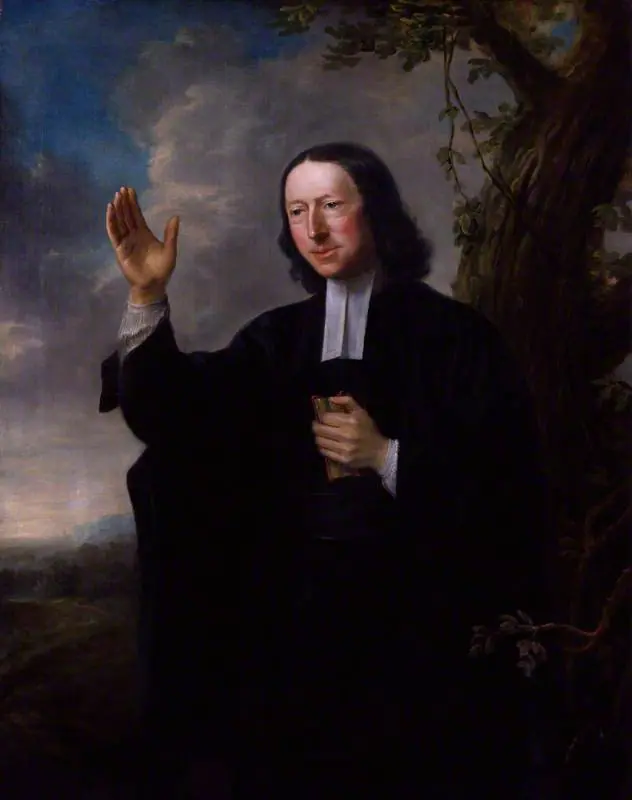
After the wars of religion (§9), European Christianity faced two challenges at once, one from inside and one from outside. From inside came a demand for a religion of the heart: Pietists in Germany, Methodists in Britain and revivalists in America taught that faith had to be felt and that each person needed a conversion of their own. Out of them came evangelicalism, which became the dominant form of Protestantism in Britain and America. From outside came the Enlightenment’s demand for evidence: Deists questioned revelation, Hume questioned miracles, and scholars from Spinoza to Strauss read the Bible as a collection of human documents with a history. Protestant theologians responded by rebuilding faith on experience and ethics; the Catholic Church responded by defining its own authority more sharply than ever, culminating in papal infallibility in 1870. In the American religious marketplace, new churches appeared that claimed to restore lost truths: Latter-day Saints, Adventists, Jehovah’s Witnesses, Christian Scientists. And a small British sect gave the world the Rapture. Majority
None of this means that the period was one of decline. Church membership in the United States rose steeply in the nineteenth century, missions spread worldwide (§10), and the nineteenth century has been called the great age of Christian expansion. What changed was not how many people believed but how belief was justified: increasingly by inner experience, by the authority of a church, or by a literal reading of the Bible defended against its critics. Those three answers still divide Christians (§12, §13). Majority
Timeline
| Date | Event or evidence | Confidence |
|---|---|---|
| 1670 | Spinoza’s Theological-Political Treatise argues that Moses did not write the Pentateuch[1] | Consensus |
| 1675 | Philipp Jakob Spener’s Pia Desideria, the programme of German Pietism[2] | Consensus |
| 1678 | Richard Simon’s Critical History of the Old Testament, suppressed in France[3] | Consensus |
| 1696 | John Toland’s Christianity Not Mysterious; Deism becomes a public position[4] | Consensus |
| 1722–1727 | Moravian refugees settle at Herrnhut on Count Zinzendorf’s estate; the community’s renewal of August 1727[5] | Consensus |
| 1734–1735 | Revival at Northampton, Massachusetts, under Jonathan Edwards[6] | Consensus |
| 24 May 1738 | John Wesley’s heart is “strangely warmed” at Aldersgate Street, London[7] | Consensus |
| 1739–1741 | George Whitefield’s preaching tour of the American colonies; Edwards preaches “Sinners in the Hands of an Angry God” (1741)[8][9] | Consensus |
| 1748 | David Hume’s essay “Of Miracles”, in what was titled from 1758 An Enquiry concerning Human Understanding[10] | Consensus |
| 1774–1778 | Lessing publishes the “fragments” of Hermann Samuel Reimarus, the first attempt to write a historical Jesus against the Gospels[11] | Consensus |
| 1784 | Wesley ordains ministers for America; the Methodist Episcopal Church is founded in Baltimore[12] | Consensus |
| 1794–1807 | Thomas Paine’s The Age of Reason[13] | Consensus |
| 1799 | Schleiermacher’s On Religion: Speeches to Its Cultured Despisers[14] | Consensus |
| 1801 | The camp meeting at Cane Ridge, Kentucky; the Second Great Awakening[15] | Consensus |
| 1807, 1833 | Britain abolishes the slave trade, then slavery in its colonies, after campaigns led largely by evangelicals and Quakers[16][17] | Majority |
| 1830 | The Book of Mormon is published and the Church of Christ organised by Joseph Smith[18][19] | Consensus |
| early 1830s | John Nelson Darby develops the teaching of a pre-tribulation Rapture among the Brethren[20][21] | Majority |
| 1833 | John Keble’s sermon “National Apostasy” begins the Oxford Movement[22] | Consensus |
| 1835 | David Friedrich Strauss’ Life of Jesus Critically Examined[23] | Consensus |
| 22 October 1844 | The “Great Disappointment”: the Second Coming predicted by Millerite preachers does not occur[24] | Consensus |
| 1845 | John Henry Newman becomes a Catholic and publishes An Essay on the Development of Christian Doctrine[25] | Consensus |
| 1854 | Pius IX defines the Immaculate Conception of Mary[26] | Consensus |
| 1859 | Darwin’s On the Origin of Species[27] | Consensus |
| 1863 | Ernest Renan’s Life of Jesus; the Seventh-day Adventist Church is organised[28][24] | Consensus |
| 1864 | The Syllabus of Errors[29] | Consensus |
| 18 July 1870 | The First Vatican Council defines papal infallibility[30] | Consensus |
| 1874, 1896 | Draper and White publish histories of a “conflict” or “warfare” between science and religion[31][32] | Consensus |
| 1879 | Charles Taze Russell’s Zion’s Watch Tower; Mary Baker Eddy’s Church of Christ, Scientist chartered[33][34] | Consensus |
| 1900 | Adolf von Harnack’s lectures What Is Christianity?[35] | Consensus |
Where: Halle to Utah
The religious centres of this period were new. Halle, where August Hermann Francke built an orphanage and a school system from the 1690s and, in 1710, a Bible institute, and Herrnhut in Saxony, the Moravian settlement that sent missionaries to the Caribbean from 1732, were the capitals of Pietism.[5] Consensus London and Bristol, where Whitefield and Wesley began preaching in the open air in 1739, were the first fields of Methodism, which spread fastest among miners, artisans and the new industrial towns of the north.[12] Majority
In America the revivals ran from the Connecticut River valley under Edwards to the frontier camp meetings of Kentucky and Tennessee after 1800. Western New York, swept by so many revivals and new movements that it was called the “burned-over district”, produced Mormonism, Millerism, Spiritualism and Charles Finney’s revivals within twenty years.[15] Consensus The Latter-day Saints moved from New York to Ohio, Missouri and Illinois, and after Joseph Smith’s murder in 1844 trekked under Brigham Young to the Great Salt Lake (1847).[19] Consensus
The critics worked mostly in universities: Tübingen, where F. C. Baur and Strauss taught; Halle and Berlin, where Schleiermacher taught, and Göttingen. Rome, losing its temporal power to a united Italy in 1870, became the centre of a more centralised Catholic Church. Consensus
The religion of the heart
Pietism
Philipp Jakob Spener, a Lutheran pastor in Frankfurt, published Pia Desideria (“Pious Desires”) in 1675. It called for Bible study in small groups, the collegia pietatis, a greater role for lay people, and a faith shown in a changed life rather than in correct doctrine alone.[2] Consensus His follower August Hermann Francke turned Halle into a model of practical Christianity, and Count Nikolaus von Zinzendorf gave refuge to Moravian Brethren at Herrnhut, whose community experienced a collective renewal in August 1727 and kept up a continuous prayer watch for a century.[5] Majority Moravian missionaries went to the Caribbean in 1732 and later to Greenland, America and South Africa (§10). The historian W. R. Ward traced the “evangelical awakening” of the eighteenth century to these Central European roots rather than to Britain alone.[5] Majority
Wesley and Methodism
John Wesley, an Anglican priest, had already led a disciplined student society at Oxford (mocked as “Methodists”) and failed as a missionary in Georgia when, on 24 May 1738, he went “very unwillingly” to a society meeting in Aldersgate Street, London. His journal records what happened (source 1 below): someone was reading Luther’s preface to Romans, and he “felt [his] heart strangely warmed”.[7] Consensus His Moravian contacts had taught him to seek such assurance.
In 1739 Wesley followed George Whitefield into field preaching. For the next fifty years he travelled, on the usual estimate, around a quarter of a million miles, organising converts into societies, classes and bands under lay preachers.[12] Majority He never intended to leave the Church of England, and died an Anglican priest in 1791. But in 1784, with American independence leaving Methodists there without clergy, he ordained ministers for America himself, and that December the Methodist Episcopal Church was founded in Baltimore. In Britain, the “Plan of Pacification” of 1795 allowed Methodist preachers to administer communion in their own chapels, and the separation became a fact.[12] Consensus
Methodism allowed a few women to preach, especially as Wesley came to accept an “extraordinary call”, and it spread fastest where the parish system was weakest.[12] Majority
The Awakenings in America
At Northampton, Massachusetts, in 1734–1735, Jonathan Edwards’ congregation underwent a revival that he described in A Faithful Narrative of the Surprising Work of God (1737), a book that circulated on both sides of the Atlantic and became a model for revivals elsewhere.[6] Consensus From 1739 Whitefield, a young Anglican with an actor’s voice, preached through the colonies in a voice Benjamin Franklin calculated could be heard by more than thirty thousand people at once.[8] Majority Congregations split between “New Lights”, who welcomed the revivals, and “Old Lights”, who distrusted their emotion. Edwards’ sermon “Sinners in the Hands of an Angry God” (1741) is its best-remembered text (source 2).[9]
Whether this was one “Great Awakening” is debated (below). The term was first used in 1842, a century later.[36][8] Consensus
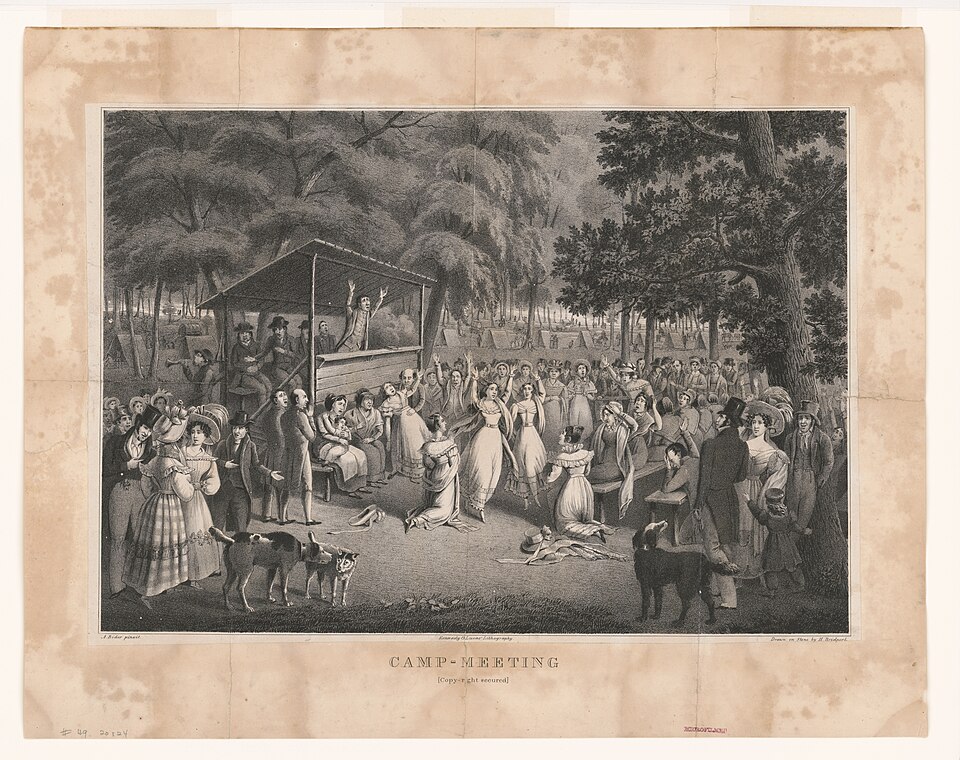
The Second Great Awakening, from about 1790 to 1840, was larger. The camp meeting at Cane Ridge, Kentucky, in August 1801 drew crowds reported in the tens of thousands, with fainting, shouting and “jerks”. Charles Finney, a lawyer turned revivalist, taught that revivals could be produced by the right “new measures”: protracted meetings, the “anxious bench”, women praying in public.[15] Majority Methodists and Baptists, with lay and largely uneducated preachers, grew fastest: by one widely used estimate, Methodists went from about 2.5 per cent of American church adherents in 1776 to about 34 per cent in 1850.[37] Majority Nathan Hatch called this “the democratization of American Christianity”.[15] Majority
Enslaved Africans and free Black Americans joined the revivals in large numbers, and formed churches of their own: Richard Allen’s Bethel church in Philadelphia (1794) became the mother church of the African Methodist Episcopal Church in 1816 (§10). On plantations, what the historian Albert Raboteau called the “invisible institution” met in secret, beyond white supervision, and produced the spirituals.[38] Majority
What “evangelical” meant
David Bebbington’s widely used definition names four marks of the movement that came out of these revivals: conversionism (lives need to be changed), activism (the gospel must be spread), biblicism (a particular regard for the Bible) and crucicentrism (a stress on Christ’s death on the cross).[39] Majority Evangelicals created Sunday schools, missionary societies, Bible societies, temperance movements and the campaign against the slave trade.
Abolition, and Christians on both sides
The movement to end the slave trade and slavery was among the most Christian of political causes, and was fought by Christians against Christians. Quakers began disowning members who traded in slaves in the eighteenth century; in Britain, evangelicals around William Wilberforce and the Clapham group led the parliamentary campaign, alongside Quakers and the formerly enslaved writer Olaudah Equiano. Parliament abolished the slave trade in 1807 and slavery in most of its colonies by the Act of 1833.[17][16] Majority
In the United States the Bible was quoted on both sides: abolitionists cited the golden rule and the unity of humankind, slaveholders cited Abraham’s servants, the Mosaic law and Paul’s “slaves, obey your earthly masters”. The Methodist (1844) and Baptist (1845) churches split into northern and southern bodies over slavery, and the Presbyterians divided by 1861. Mark Noll has argued that the Civil War was also a theological crisis, because Protestants who shared a common way of reading the Bible could not settle from it what the Bible taught on slavery.[40] Majority Frederick Douglass, who had escaped slavery, drew the line in 1845 (source 9). Consensus on the events; Political in their modern use.
The challenge of reason
Deism
English writers from the 1690s argued that true religion was “natural”: a creator God, a moral law and a future judgement, all knowable by reason, with no need for miracles, mysteries or a special revelation. John Toland’s Christianity Not Mysterious (1696) and Matthew Tindal’s Christianity as Old as the Creation (1730) were its manifestos.[4] Consensus Voltaire carried the attack to France with the slogan écrasez l’infâme, “crush the infamous thing”, meaning the persecuting church. Thomas Paine’s The Age of Reason (1794–1807), widely read in America, attacked the Bible as a human book, and Thomas Jefferson cut the miracles out of the Gospels with a razor to leave what he took to be the moral teaching of Jesus, the work now called the Jefferson Bible (completed around 1820, acquired by the Smithsonian in 1895 and first printed in 1904).[13][41] Consensus
Hume on miracles
The most influential argument came from the Scottish philosopher David Hume, in section 10 of his Philosophical Essays concerning Human Understanding (1748; retitled An Enquiry concerning Human Understanding in 1758). Since the laws of nature rest on uniform experience, he argued, the testimony for any miracle must always be weaker than the evidence against it (source 3).[10] Consensus on the argument; whether it succeeds is still debated by philosophers. Historians since have usually adopted a methodological version of it: they do not judge whether miracles happen (§0).
Reading the Bible as history
The critical study of the Bible begins in this period. Its methods for the Hebrew Bible are told in the Judaism series (Judaism §0); this section follows the New Testament and the life of Jesus.
- Spinoza and Simon. Baruch Spinoza’s Theological-Political Treatise (1670) argued that Moses could not have written the Pentateuch and that the Bible must be read like any other book, from its own history.[1] The French Oratorian Richard Simon’s Critical History of the Old Testament (1678), written to show that Protestants could not rely on Scripture alone, was suppressed in France and most of the first printing destroyed; it circulated in later Dutch editions.[3] Consensus
- Reimarus and Lessing. Hermann Samuel Reimarus, a Hamburg teacher, wrote a defence of rational religion that he dared not publish. After his death, Gotthold Ephraim Lessing published extracts from it as anonymous “fragments” (1774–1778). The last argued that Jesus was a Jewish messianic claimant whose disciples, after his failure, stole his body and invented the resurrection.[11] Consensus on what Reimarus argued. Lessing himself added that “accidental truths of history can never become the proof of necessary truths of reason” (source 4).
- Strauss. David Friedrich Strauss’ Life of Jesus Critically Examined (1835–1836) argued that the Gospel miracles were neither supernatural events nor misunderstood natural ones but “myths”, the early church’s expression of its faith in narrative form. It cost him his post at Tübingen and, in George Eliot’s English translation of 1846, reached a wide British public.[23] Consensus
- Baur and Tübingen. Ferdinand Christian Baur read early Christian history as a conflict between a Jewish Christianity led by Peter and a gentile Christianity led by Paul, resolved only in the second century, and dated many New Testament books late. His dates have mostly been abandoned, but the questions he asked, about Paul and Jerusalem, shape §3 and §4.[42] Majority
- Renan. Ernest Renan’s Life of Jesus (1863), a lyrical portrait of a gentle Galilean preacher without miracles, was a European bestseller; Renan, already suspended in 1862, was dismissed from the Collège de France in 1864.[28] Consensus
- Schweitzer. In 1906 Albert Schweitzer surveyed the whole “quest” from Reimarus on and concluded that each writer had found the Jesus he wanted; his own Jesus was an apocalyptic prophet who expected the end. That conclusion still frames the debate (§0, §2).[43] Consensus
Hans Frei has argued that what changed in the eighteenth century was not only the answers but the question: readers stopped treating the biblical story as the world they lived in and began asking whether it referred to events outside itself.[44] Majority
Faith rebuilt: the liberal answer
Friedrich Schleiermacher, a Reformed preacher in Berlin raised among the Moravians, answered the “cultured despisers” of religion in 1799 that religion was neither metaphysics nor morality but “intuition and feeling” of the infinite.[14] In The Christian Faith (1821–1822) he grounded doctrine in the “feeling of absolute dependence” on God, and treated Christian doctrines as descriptions of that consciousness rather than as information about God (source 5).[45] Consensus He is often called the father of liberal Protestant theology. Majority
The nineteenth-century liberal tradition that followed him stressed the ethical teaching of Jesus, the fatherhood of God and the brotherhood of man, and treated the creeds of §6 as Greek overgrowth. Its classic statement is Adolf von Harnack’s lectures What Is Christianity? (Berlin, 1899–1900), which sought the “kernel” of the gospel inside the “husk” of dogma.[35] Consensus
Development
From the opposite direction, John Henry Newman, a leader of the Oxford Movement in the Church of England who became a Catholic in 1845, asked the question this whole series asks: how can a religion change over centuries and remain the same religion? His Essay on the Development of Christian Doctrine (1845) argued that true doctrines unfold over time like an idea working itself out, and proposed tests to tell genuine development from corruption (source 6).[25] Consensus on the argument. Harnack and Newman offer the two classic ways of reading the history in this series: as a pure origin overlaid by later additions, or as a seed growing into a tree. Majority
The Oxford Movement, begun by John Keble’s sermon on “National Apostasy” in 1833, sought to recover the Church of England’s Catholic inheritance of sacraments, bishops and the early fathers; its Tracts for the Times gave its members the name Tractarians.[22] Consensus
Darwin and the churches
Charles Darwin’s On the Origin of Species (24 November 1859) explained the variety of life by natural selection over immense time, without design in each species. It contradicted a literal reading of Genesis and, more seriously for theologians of the day, the argument from design popularised by William Paley. Darwin himself added “by the Creator” to the closing sentence in the second edition of January 1860 (source 7).[27] Consensus
The reaction was mixed:
- The Oxford meeting of 1860. At the British Association in Oxford in June 1860, Bishop Samuel Wilberforce is said to have asked T. H. Huxley whether he claimed descent from an ape through his grandfather or his grandmother, and Huxley to have replied that he would rather have an ape for a grandfather than a man who misused his gifts. No verbatim record exists, the exchange was told differently by different witnesses, and the version that made it a victory of science over religion took shape decades later.[46] Majority
- Acceptance. The clergyman and novelist Charles Kingsley wrote to Darwin in 1859 that it was “just as noble a conception of Deity” to believe God created self-developing forms. In America the botanist Asa Gray, an orthodox Presbyterian, championed Darwin. By 1889 the Anglo-Catholic theologian Aubrey Moore could write, in the collection Lux Mundi, that Darwinism “under the disguise of a foe, did the work of a friend” by ending the picture of God as an occasional visitor to nature.[47][48] Majority
- Rejection. Others, like the Princeton theologian Charles Hodge (What Is Darwinism?, 1874), concluded that natural selection excluded design and was “atheism”. Opposition to evolution as a defining mark of conservative Protestantism belongs mostly to the twentieth century (§12).[47][49] Majority
The conflict thesis
The idea of a long “war” between science and religion was itself a product of these decades. John William Draper’s History of the Conflict between Religion and Science (1874), aimed chiefly at the Catholic Church, and Andrew Dickson White’s A History of the Warfare of Science with Theology in Christendom (1896) told the story of science as a long liberation from theology.[31][32] Consensus on the books. Historians of science since the 1970s, among them John Hedley Brooke and Ronald Numbers, have rejected the conflict thesis as a general account: many of its stock episodes are legends (that medieval people thought the earth was flat, for instance), and the actual relations between science and religion have been complex and varied.[50][49] Majority Real conflicts there were, most visibly over Galileo and later over evolution in American schools.
Rome answers the age
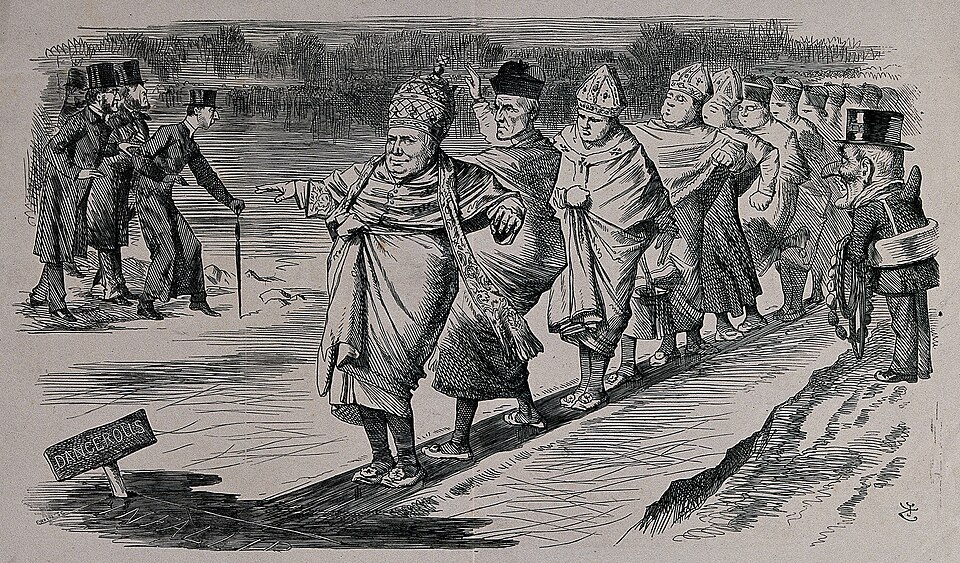
The French Revolution’s attack on the church, the loss of church lands and, in 1870, the loss of Rome itself to the new kingdom of Italy pushed the Catholic Church towards ultramontanism, looking “over the mountains” to the pope as the centre of authority.[51] Majority Three acts of Pius IX (pope 1846–1878) defined the result:
- The Immaculate Conception (1854). In the bull Ineffabilis Deus Pius IX defined that Mary was preserved from original sin from the moment of her conception. The doctrine had been argued over for centuries, opposed by Bernard of Clairvaux and Thomas Aquinas and defended by Duns Scotus; Pius defined it after consulting the bishops by letter, not through a council.[26] Consensus
- The Syllabus of Errors (1864). A list of eighty condemned propositions, ending with the claim that the pope “can, and ought to, reconcile himself, and come to terms with progress, liberalism and modern civilization”.[29] Consensus on the text; how far it condemned modern liberty as such, or only its anticlerical forms, was argued over at once. Contested
- Papal infallibility (1870). The First Vatican Council, opened in December 1869, adopted the constitution Pastor aeternus on 18 July 1870 by 533 votes to 2, after about sixty opponents had left Rome rather than vote against the pope (source 8). The next day France declared war on Prussia; French troops left Rome, which fell to Italy on 20 September, and the council never reconvened.[30][51] Consensus The historian Ignaz von Döllinger, who refused to accept the decree, was excommunicated in 1871; his supporters formed the Old Catholic churches. Consensus
Infallibility was defined narrowly. It covers only solemn definitions of faith or morals made ex cathedra, and since 1870 only one, the Assumption of Mary (1950), is generally agreed to have been made in that way. Majority
The century also saw a revival of popular Catholicism: Marian apparitions at La Salette (1846) and Lourdes (1858), mass pilgrimage by railway, and a flowering of new religious orders, many of them of women.[51] Majority
New churches from the American frontier
The disestablished, competitive religious marketplace of the young United States produced movements that claimed to restore lost truth, and some of them became world religions. Majority
- The Latter-day Saints. Joseph Smith, a young farmer in the burned-over district, said he had been led by an angel to golden plates, which he translated as the Book of Mormon (published March 1830), a history of Israelites in ancient America. He organised a church in April 1830, received further revelations, and was killed by a mob in Carthage, Illinois, in 1844. His followers regard him as a prophet; historians of every view treat the movement as one of the most important new religions of the modern world.[18][19] Consensus on the events. Plural marriage was publicly taught from 1852 and officially ended in 1890. Consensus
- Adventists. William Miller, a Baptist farmer, calculated from Daniel that Christ would return around 1843–1844; his followers settled on 22 October 1844. After the “Great Disappointment”, one group, guided by the visions of Ellen G. White, reinterpreted the date and adopted the seventh-day Sabbath; the Seventh-day Adventist Church was organised in 1863.[24] Consensus
- Jehovah’s Witnesses. Charles Taze Russell’s Bible Student movement, influenced by Adventist calculation, began publishing Zion’s Watch Tower in 1879; the name Jehovah’s Witnesses was adopted in 1931.[33] Consensus
- Christian Science. Mary Baker Eddy’s Science and Health (1875) taught that matter and illness are illusions to be overcome by spiritual understanding; her Church of Christ, Scientist, was chartered in 1879.[34] Consensus
Whether these are Christian churches is itself disputed: most other Christians do not regard the Latter-day Saints, Jehovah’s Witnesses or Christian Scientists as Christian in the sense of the creeds of §6, while the movements themselves claim to restore original Christianity. This series describes them without ruling. Contested
Where the Rapture came from
Most Christians, from the early church on, have expected Christ to return once, visibly, at the end of history, to judge the living and the dead. The pre-tribulation Rapture is a distinct and much newer doctrine. Consensus
The text. Paul tells the Thessalonians that at the Lord’s coming the dead in Christ will rise, and “we who are alive, who are left, will be caught up in the clouds together with them to meet the Lord in the air” (1 Thess 4:17). The Latin Vulgate’s rapiemur, “we shall be caught up”, gives the English word.[52] Consensus For most of Christian history this was read as part of the single Second Coming.
The doctrine. John Nelson Darby, a former Church of Ireland priest and a leader of the Plymouth Brethren, developed in the early 1830s a scheme of history divided into “dispensations”. Israel and the church, he taught, are two distinct peoples of God with distinct destinies; before God resumes his dealings with Israel in a seven-year “tribulation”, the church will be secretly removed from the earth. Only after the tribulation does Christ return visibly.[20][21] Majority
Precursors. Earlier writers had imagined parts of this. The Welsh-American Baptist Morgan Edwards, in a student essay published in 1788, placed a rapture of the saints before the reign of Antichrist.[53] In 1830 a young Scottish woman, Margaret MacDonald, had a vision that some have read as the source of Darby’s teaching; most historians think the resemblance is loose and that Darby’s ideas developed from his own reading and from the prophecy conferences of the time, including those at Powerscourt in Ireland (1831–1833) and around Edward Irving.[54][21] Contested
The spread. Darby made several long tours of North America between 1862 and 1877. His scheme was taken up by American Bible conferences, above all the Niagara Bible Conference (1876–1897), and fixed for millions of readers in the notes of the Scofield Reference Bible (1909).[20][55] Majority Its twentieth-century career, from Hal Lindsey’s The Late Great Planet Earth (1970) to the Left Behind novels (1995–2007), belongs to §12.
Who holds it. The pre-tribulation Rapture is taught mainly in dispensationalist, many Baptist, Pentecostal and independent evangelical churches, largely in the United States. Catholic, Orthodox, Lutheran, Reformed, Anglican and Methodist teaching does not include it. Consensus
The evidence
| Question | What the evidence supports | Key evidence | Confidence |
|---|---|---|---|
| Origins of evangelicalism | Central European Pietism, British Methodism and American revivals, connected by letters, books and travelling preachers | Spener; Moravians; Wesley’s journal; Edwards[2][7][6][5] | Majority |
| The Great Awakening | Real revivals of the 1730s–40s; whether they formed a single movement is debated | Edwards; Whitefield; Butler[8][36] | Consensus (revivals); Contested (unity) |
| American growth | Methodists and Baptists grew fastest after 1790 | Finke and Stark[37][15] | Majority |
| Biblical criticism | From 1670, the Bible read as human documents with a history | Spinoza; Simon; Reimarus; Strauss[1][3][11][23] | Consensus |
| Liberal theology | Faith grounded in experience and ethics | Schleiermacher; Harnack[45][35] | Consensus |
| Darwin | Mixed reception; acceptance by many theologians by the 1880s | Kingsley; Gray; Lux Mundi; Hodge[47][48] | Majority |
| Conflict thesis | A historiographical construction of the 1870s–1890s, rejected as a general account | Draper; White; modern historians[31][32][50][49] | Majority |
| Catholic centralisation | Defined by papal acts and Vatican I | 1854; 1864; 1870[26][29][30] | Consensus |
| New movements | LDS, Adventists, Witnesses, Christian Science from the American religious market | Book of Mormon; Millerism[18][24] | Consensus |
| The Rapture | Systematised by Darby in the 1830s; spread by conferences and Scofield | Darby; Niagara; Scofield[20][21][55] | Majority |
Primary sources
Show the 10 primary sources
1. “Strangely warmed”: John Wesley’s Journal, 24 May 1738
“In the evening I went very unwillingly to a society in Aldersgate Street, where one was reading Luther’s preface to the Epistle to the Romans. About a quarter before nine, while he was describing the change which God works in the heart through faith in Christ, I felt my heart strangely warmed. I felt I did trust in Christ, Christ alone, for salvation; and an assurance was given me that he had taken away my sins, even mine, and saved me from the law of sin and death.”[7]
What it proves. The founding experience of Methodism was an assurance felt in the heart, reached through Luther’s reading of Paul and mediated by Moravian friends. It is the model of the evangelical conversion: dated, personal, inward. Consensus
2. “Sinners in the Hands of an Angry God”: Jonathan Edwards, Enfield, 8 July 1741
“The God that holds you over the pit of hell, much as one holds a spider, or some loathsome insect over the fire, abhors you, and is dreadfully provoked.”[9]
What it proves. The revival preaching of the 1740s could be terrifying, and was meant to bring hearers to a crisis of conversion. The sermon is now the most anthologised American sermon, and gives a one-sided picture of Edwards, whose writing on beauty, the “religious affections” and the experience of grace is as central to his work. Majority
3. Hume, “Of Miracles”, 1748
“A miracle is a violation of the laws of nature; and as a firm and unalterable experience has established these laws, the proof against a miracle, from the very nature of the fact, is as entire as any argument from experience can possibly be imagined… no testimony is sufficient to establish a miracle, unless the testimony be of such a kind, that its falsehood would be more miraculous, than the fact, which it endeavours to establish.”[10]
What it proves. The classic argument against believing reports of miracles. It does not prove that miracles cannot happen; it sets a standard of evidence that historical testimony is unlikely ever to meet. It still frames how historians treat miracle stories (§0, §2). Consensus
4. Lessing’s “ugly, broad ditch”, 1777
In “On the Proof of the Spirit and of Power”, Lessing argued that “accidental truths of history can never become the proof of necessary truths of reason”, and called the gap between the two “the ugly, broad ditch which I cannot get across, however often and however earnestly I have tried to make the leap” (trans. Henry Chadwick).[56]
What it proves. Once the Gospels were treated as historical documents, faith could no longer rest simply on their factual accuracy, since history yields only probabilities. Much of modern theology, liberal and conservative, has been an attempt to cross Lessing’s ditch. Majority
5. “The feeling of absolute dependence”: Schleiermacher, The Christian Faith §4, 1830
Schleiermacher defined the common element in all expressions of piety as “the consciousness of being absolutely dependent, or, which is the same thing, of being in relation with God” (trans. H. R. Mackintosh and J. S. Stewart).[45]
What it proves. Liberal theology relocated religion from proof to experience. Doctrines became descriptions of the Christian’s consciousness of God, which protected them from the critics and also made them, in the eyes of their opponents, merely human. Majority
6. “To live is to change”: Newman, Essay on the Development of Christian Doctrine, 1845
“In a higher world it is otherwise; but here below to live is to change, and to be perfect is to have changed often.”[25]
What it proves. A Christian thinker could accept that doctrine has a history, as this series assumes, and treat development as a mark of life rather than of corruption. Newman’s tests for a true development, among them preservation of type, continuity of principles and power of assimilation, were his answer to the Protestant charge that Catholic doctrine was a late addition. Consensus
7. The last sentence of the Origin, 1859 and 1860
First edition: “There is grandeur in this view of life, with its several powers, having been originally breathed into a few forms or into one”. The second edition (January 1860) reads “originally breathed by the Creator into a few forms or into one”.[27]
What it proves. Darwin, by then no longer a believing Christian, chose to make room for a Creator in the book’s most quoted sentence within weeks of publication. The early reception of evolution was not a straightforward contest of science against faith. Majority
8. Pastor aeternus, chapter 4, 18 July 1870
“We teach and define as a divinely revealed dogma that when the Roman pontiff speaks ex cathedra, that is, when, in the exercise of his office as shepherd and teacher of all Christians, in virtue of his supreme apostolic authority, he defines a doctrine concerning faith or morals to be held by the whole church, he possesses, by the divine assistance promised to him in blessed Peter, that infallibility which the divine Redeemer willed his church to enjoy in defining doctrine concerning faith or morals. Therefore, such definitions of the Roman pontiff are of themselves, and not by the consent of the church, irreformable.” (trans. Norman Tanner)[30]
What it proves. The text is both strong and narrow. “Not by the consent of the church” excluded the view that papal definitions needed the bishops’ agreement; the conditions limit infallibility to solemn definitions, which is why it has been invoked so rarely. Consensus
9. “The Christianity of this land”: Frederick Douglass, 1845
“What I have said respecting and against religion, I mean strictly to apply to the slaveholding religion of this land, and with no possible reference to Christianity proper; for, between the Christianity of this land, and the Christianity of Christ, I recognize the widest possible difference.”[57]
What it proves. The sharpest critique of American slaveholding Christianity came from within Christianity, by a formerly enslaved man appealing to Christ against the churches. The appendix to his Narrative is evidence for how Black Christians separated the faith from its use by slaveholders. Majority
10. “Caught up”: 1 Thessalonians 4:17 and the Rapture
epeita hēmeis hoi zōntes hoi perileipomenoi hama syn autois harpagēsometha en nephelais eis apantēsin tou kyriou eis aera.
“Then we who are alive, who are left, will be caught up in the clouds together with them to meet the Lord in the air.”[52]
What it proves. The verse every Christian tradition reads. Apantēsis, “meeting”, was the word for citizens going out to welcome a visiting dignitary and escort him back into the city, which is why most interpreters read it as part of Christ’s coming to earth rather than a removal from it. Dispensationalists read it as a distinct event. The verse alone does not settle the question; the doctrine depends on how it is combined with Daniel and Revelation. Majority
What is absent
- Fundamentalism and “inerrancy” as a fighting word. The Princeton theologians A. A. Hodge and B. B. Warfield defined biblical inerrancy in an essay of 1881, but the fundamentalist movement and its pamphlets came after 1910 (§12). Consensus
- Pentecostalism. Speaking in tongues as the sign of the Spirit’s baptism appears as a movement only from 1901 (§12). Consensus
- Opposition to evolution as a test of faith. Many conservative theologians of the 1870s–1890s accepted an old earth and some form of evolution; “young-earth creationism” as a movement dates from the 1960s (§12). Majority
- Ecumenism. There was co-operation between Protestant missions, but no World Council of Churches or Catholic participation (§12). Consensus
- Ordained women in most churches. A few exceptions: the Congregationalist Antoinette Brown was ordained in 1853, and Quakers, Salvationists and some holiness groups had women preachers. Consensus
Debates
Was there a “Great Awakening”?
| View | Position | Main proponents |
|---|---|---|
| An interpretative fiction | Local and scattered revivals were made into a single “Great Awakening” by nineteenth-century writers with their own agenda | Jon Butler[36] |
| A real, connected movement | The revivals of the 1740s were linked by print, correspondence and Whitefield’s tours, and created evangelicalism in America | Thomas Kidd[8] |
| Transatlantic | The American revivals were one part of a Protestant awakening from Central Europe to New England | W. R. Ward[5] |
Contested
Did science and religion go to war?
| View | Position | Main proponents |
|---|---|---|
| Conflict | Science advanced by freeing itself from theology | Draper, White[31][32] |
| Complexity | Relations varied widely by period, place and person; many scientists were believers, and many episodes of “conflict” are legends | Brooke, Numbers[50][49] |
The complexity thesis is the majority view among historians of science; public belief in the conflict model remains widespread. Majority
Where did the pre-tribulation Rapture come from?
| View | Position | Main proponents |
|---|---|---|
| Darby’s own system | Darby developed it from his reading of Scripture and his dispensational scheme in the early 1830s | Sandeen, Gribben[20][21] |
| Borrowed from Margaret MacDonald or the Irvingites | Darby took the idea from a vision of 1830 or from Irving’s circle | MacPherson[54] |
| Earlier roots | The idea appears, in parts, in earlier writers such as Morgan Edwards (1788) | Dispensationalist historians[53] |
Contested on the source; Consensus that the system as now taught dates from Darby’s generation.
Corruption or development?
Harnack and Newman stand for two ways of telling the history of Christianity: as an original gospel progressively overlaid with Greek philosophy, institutions and dogma, or as a living idea unfolding over time.[35][25] Most historians today use neither as a framework, but both still shape how believers and critics read the evidence in §§4–8 of this series. Majority
Further reading
Show further reading (11 works)
- W. R. Ward, The Protestant Evangelical Awakening (Cambridge, 1992): the European roots.
- David Hempton, Methodism: Empire of the Spirit (Yale, 2005).
- Thomas S. Kidd, The Great Awakening: The Roots of Evangelical Christianity in Colonial America (Yale, 2007).
- Nathan O. Hatch, The Democratization of American Christianity (Yale, 1989).
- Albert J. Raboteau, Slave Religion: The “Invisible Institution” in the Antebellum South (Oxford, 1978).
- Mark A. Noll, The Civil War as a Theological Crisis (North Carolina, 2006).
- Hans W. Frei, The Eclipse of Biblical Narrative (Yale, 1974): what biblical criticism changed.
- John Hedley Brooke, Science and Religion: Some Historical Perspectives (Cambridge, 1991), and Ronald L. Numbers, ed., Galileo Goes to Jail and Other Myths about Science and Religion (Harvard, 2009).
- John W. O’Malley, Vatican I: The Council and the Making of the Ultramontane Church (Harvard, 2018).
- Richard Lyman Bushman, Joseph Smith: Rough Stone Rolling (Knopf, 2005).
- Ernest R. Sandeen, The Roots of Fundamentalism (Chicago, 1970), and Crawford Gribben, Evangelical Millennialism in the Trans-Atlantic World, 1500–2000 (Palgrave, 2011): the origins of the Rapture.
References
- ^ a b c Spinoza, Tractatus Theologico-Politicus, ch. 8 — Tractatus Theologico-Politicus (Amsterdam, 1670). 1670 CE. Latin. Spinoza decodes Ibn Ezra's hints and argues openly that the Pentateuch was written not by Moses but by someone who lived many centuries after him. about
- ^ a b c Philipp Jakob Spener, Pia Desideria — Pia Desideria (Frankfurt). 1675. German. The programme of German Pietism: Bible study in small groups, a larger role for the laity, and faith shown in a changed life. about
- ^ a b c Richard Simon, Histoire critique du Vieux Testament — Histoire critique du Vieux Testament (Paris). 1678. French. A Catholic Oratorian's critical history of the Old Testament text, suppressed in France; it denied Mosaic authorship of the whole Pentateuch. about
- ^ a b John Toland, Christianity Not Mysterious — Christianity Not Mysterious (London). 1696. English. Argues that nothing in true Christianity is contrary to or above reason; a founding text of English Deism. about
- ^ a b c d e f W. R. Ward The Protestant Evangelical Awakening. Cambridge University Press, 1992. Traces the evangelical revival to Central European Pietism and the Moravians.
- ^ a b c Jonathan Edwards, A Faithful Narrative of the Surprising Work of God — A Faithful Narrative (London). 1737. English. Edwards' account of the Northampton revival of 1734–1735, read widely in Britain and America as a model of revival. about
- ^ a b c d John Wesley, Journal, 24 May 1738 — The Journal of John Wesley. 1738. English. Wesley's account of the evening at Aldersgate Street when he 'felt [his] heart strangely warmed'. about
- ^ a b c d e Thomas S. Kidd The Great Awakening: The Roots of Evangelical Christianity in Colonial America. Yale University Press, 2007. Defends the Great Awakening as a real, connected movement.
- ^ a b c Jonathan Edwards, Sinners in the Hands of an Angry God — Sermon preached at Enfield, Connecticut. 8 July 1741. English. The best-known revival sermon of the Great Awakening, with its image of the sinner held over hell like a spider over a fire. about
- ^ a b c David Hume, An Enquiry concerning Human Understanding, section 10, 'Of Miracles' — Philosophical Essays concerning Human Understanding (London; titled An Enquiry from 1758). 1748. English. No testimony suffices to establish a miracle unless its falsehood would be more miraculous than the fact it reports. read the text
- ^ a b c Hermann Samuel Reimarus, Wolfenbüttel Fragments (ed. Lessing) — Fragmente eines Ungenannten. 1774–1778. German. Extracts from Reimarus' unpublished defence of rational religion; the last presents Jesus as a failed messianic claimant whose disciples invented the resurrection. about
- ^ a b c d e David Hempton Methodism: Empire of the Spirit. Yale University Press, 2005. Methodism as a transatlantic popular movement.
- ^ a b Thomas Paine, The Age of Reason — The Age of Reason. 1794–1807. English. A Deist attack on revealed religion and the Bible as a human book, widely read in Britain and America. read the text
- ^ a b Friedrich Schleiermacher, On Religion: Speeches to Its Cultured Despisers — Über die Religion (Berlin). 1799. German. Religion is neither metaphysics nor morality but intuition and feeling of the infinite. about
- ^ a b c d e Nathan O. Hatch The Democratization of American Christianity. Yale University Press, 1989. Popular preachers and new movements in the early American republic.
- ^ a b Slavery Abolition Act 1833 — Act of the Parliament of the United Kingdom (3 & 4 Will. IV c. 73). 1833. English. Abolished slavery in most British colonies from 1834, with compensation to slave-owners and a period of 'apprenticeship'. about
- ^ a b Adam Hochschild Bury the Chains: Prophets and Rebels in the Fight to Free an Empire's Slaves. Houghton Mifflin, 2005. The British abolition campaign and its Quaker and evangelical leaders.
- ^ a b c The Book of Mormon — Book of Mormon (Palmyra, New York). March 1830. English. Published by Joseph Smith as a translation of golden plates recording Israelite peoples in ancient America. about
- ^ a b c Richard Lyman Bushman Joseph Smith: Rough Stone Rolling. Knopf, 2005. The standard biography of Joseph Smith.
- ^ a b c d e Ernest R. Sandeen The Roots of Fundamentalism: British and American Millenarianism, 1800–1930. University of Chicago Press, 1970. Darby's dispensationalism and its spread through the American Bible conferences.
- ^ a b c d e Crawford Gribben Evangelical Millennialism in the Trans-Atlantic World, 1500–2000. Palgrave Macmillan, 2011. The long history of Protestant end-time beliefs, including Darby.
- ^ a b John Keble, National Apostasy — Assize sermon, Oxford. 14 July 1833. English. The sermon Newman regarded as the start of the Oxford Movement. about
- ^ a b c D. F. Strauss, Das Leben Jesu, kritisch bearbeitet — The Life of Jesus Critically Examined (Tübingen; English by George Eliot, 1846). 1835–1836. German. Reads the Gospel miracles as myths expressing the early church's faith; cost Strauss his post at Tübingen. about
- ^ a b c d Ronald L. Numbers and Jonathan M. Butler, eds. The Disappointed: Millerism and Millenarianism in the Nineteenth Century. Indiana University Press, 1987. Millerism, the Great Disappointment and the origins of Seventh-day Adventism.
- ^ a b c d John Henry Newman, An Essay on the Development of Christian Doctrine — An Essay on the Development of Christian Doctrine (London). 1845 (rev. 1878). English. Doctrine develops over time like a living idea; tests distinguish true development from corruption. read the text
- ^ a b c Pius IX, Ineffabilis Deus — Apostolic constitution. 8 December 1854. Latin. Defines that Mary was preserved from original sin from the first moment of her conception. read the text
- ^ a b c Charles Darwin, On the Origin of Species — On the Origin of Species (London, John Murray). 24 November 1859 (2nd ed. January 1860). English. Natural selection explains the variety of species; the second edition adds 'by the Creator' to the closing sentence. read the text
- ^ a b Ernest Renan, Vie de Jésus — Vie de Jésus (Paris). 1863. French. A bestselling portrait of Jesus as a gentle Galilean preacher, without miracles. about
- ^ a b c Pius IX, Syllabus of Errors — Syllabus Errorum, issued with the encyclical Quanta Cura. 8 December 1864. Latin. Eighty condemned propositions, the last that the pope ought to reconcile himself with 'progress, liberalism and modern civilization'. read the text
- ^ a b c d First Vatican Council, Pastor aeternus — Dogmatic constitution on the Church of Christ. 18 July 1870. Latin. Defines papal primacy and the infallibility of the pope's ex cathedra definitions of faith and morals. read the text
- ^ a b c d J. W. Draper, History of the Conflict between Religion and Science — History of the Conflict between Religion and Science (New York). 1874. English. The founding text of the 'conflict thesis', aimed chiefly at the Catholic Church. about
- ^ a b c d A. D. White, A History of the Warfare of Science with Theology in Christendom — A History of the Warfare of Science with Theology in Christendom (New York). 1896. English. Two volumes presenting the history of science as a long war against dogmatic theology. about
- ^ a b M. James Penton Apocalypse Delayed: The Story of Jehovah's Witnesses. University of Toronto Press, 3rd ed., 2015. The standard history of the Bible Student movement and the Watch Tower Society.
- ^ a b Mary Baker Eddy, Science and Health — Science and Health (Boston). 1875. English. The textbook of Christian Science, teaching healing through spiritual understanding; Eddy's church was chartered in 1879. about
- ^ a b c d Adolf von Harnack Das Wesen des Christentums (What Is Christianity?). J. C. Hinrichs, Leipzig, 1900. Lectures seeking the gospel's kernel in the fatherhood of God and the value of the soul, beneath the husk of dogma.
- ^ a b c Jon Butler Enthusiasm Described and Decried: The Great Awakening as Interpretative Fiction. Journal of American History 69: 305–325, 1982. Argues that the 'Great Awakening' was a nineteenth-century construction from scattered local revivals.
- ^ a b Roger Finke and Rodney Stark The Churching of America, 1776–1990. Rutgers University Press, 1992. Estimates of American denominational market shares; Methodists rise from about 2.5 to 34 per cent of adherents by 1850.
- ^ Albert J. Raboteau Slave Religion: The 'Invisible Institution' in the Antebellum South. Oxford University Press, 1978. The religion of enslaved Africans in the United States.
- ^ David W. Bebbington Evangelicalism in Modern Britain: A History from the 1730s to the 1980s. Unwin Hyman, 1989. Defines evangelicalism by conversionism, activism, biblicism and crucicentrism.
- ^ Mark A. Noll The Civil War as a Theological Crisis. University of North Carolina Press, 2006. How American Protestants read the Bible on slavery, and the church splits of the 1840s.
- ^ Thomas Jefferson, The Life and Morals of Jesus of Nazareth — The 'Jefferson Bible' (Smithsonian Institution). c. 1820. English, Greek, Latin, French. Jefferson's cut-and-pasted Gospels, without miracles or resurrection. about
- ^ Michael C. Legaspi The Death of Scripture and the Rise of Biblical Studies. Oxford University Press, 2010. The making of academic biblical criticism in eighteenth-century German universities.
- ^ Albert Schweitzer Von Reimarus zu Wrede (The Quest of the Historical Jesus). Mohr Siebeck, 1906. The history of the quest, ending in an apocalyptic Jesus who expected the end.
- ^ Hans W. Frei The Eclipse of Biblical Narrative: A Study in Eighteenth and Nineteenth Century Hermeneutics. Yale University Press, 1974. How modern readers came to ask whether the biblical story referred to real events outside itself.
- ^ a b c Friedrich Schleiermacher, The Christian Faith §4 — Der christliche Glaube (2nd ed.). 1830–1831 (1st ed. 1821–1822). German. The essence of piety is the consciousness of being absolutely dependent, that is, of being in relation with God. about
- ^ J. R. Lucas Wilberforce and Huxley: A Legendary Encounter. The Historical Journal 22: 313–330, 1979. Reconstructs the Oxford exchange of 1860 and how its legend grew.
- ^ a b c James R. Moore The Post-Darwinian Controversies. Cambridge University Press, 1979. How Protestant theologians in Britain and America came to terms with Darwin, 1870–1900.
- ^ a b Aubrey Moore, 'The Christian Doctrine of God', in Lux Mundi — Lux Mundi, ed. Charles Gore (London). 1889. English. 'Darwinism appeared, and, under the disguise of a foe, did the work of a friend', by ending the picture of God as an occasional visitor to nature. about
- ^ a b c d Ronald L. Numbers, ed. Galileo Goes to Jail and Other Myths about Science and Religion. Harvard University Press, 2009. Twenty-five historians on myths of science-and-religion history.
- ^ a b c John Hedley Brooke Science and Religion: Some Historical Perspectives. Cambridge University Press, 1991. The complexity thesis against the conflict thesis.
- ^ a b c John W. O'Malley Vatican I: The Council and the Making of the Ultramontane Church. Harvard University Press, 2018. The background, debates and outcome of the First Vatican Council.
- ^ a b 1 Thessalonians 4:15–17 — Paul, First Letter to the Thessalonians. c. 50 CE. Greek. Paul expects that 'we who are alive, who are left until the coming of the Lord' will meet him in the air. read the text
- ^ a b Morgan Edwards, Two Academical Exercises on Subjects Bearing the Following Titles; Millennium, Last-Novelties — Two Academical Exercises (Philadelphia). 1788 (written 1742–1744). English. A Baptist student essay that places a rapture of the saints before the reign of Antichrist, cited as an early anticipation of the pre-tribulation Rapture. about
- ^ a b Dave MacPherson The Incredible Cover-Up. Logos International, 1975. Argues that Darby took the pre-tribulation Rapture from Margaret MacDonald's vision of 1830; a minority view.
- ^ a b Timothy P. Weber Living in the Shadow of the Second Coming: American Premillennialism, 1875–1982. University of Chicago Press, enlarged ed., 1987. Premillennialism in America from the Bible conferences to the late twentieth century.
- ^ G. E. Lessing, On the Proof of the Spirit and of Power — Über den Beweis des Geistes und der Kraft. 1777. German. Accidental truths of history can never become the proof of necessary truths of reason: 'the ugly, broad ditch'. about
- ^ Frederick Douglass, Narrative of the Life of Frederick Douglass, Appendix — Narrative of the Life of Frederick Douglass, an American Slave (Boston). 1845. English. Distinguishes 'the slaveholding religion of this land' from 'the Christianity of Christ'. read the text