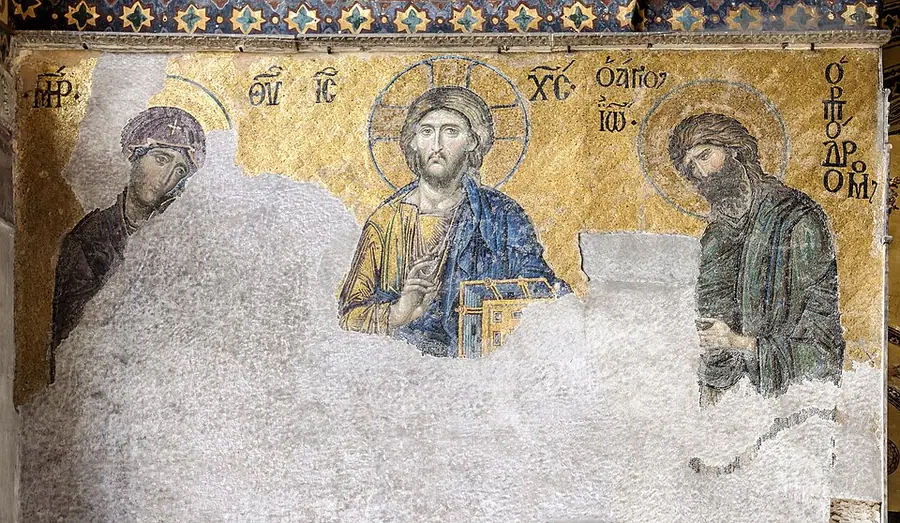
Between about 500 and 1300, the Latin church of western Europe became an institution unlike any other Christian body before it. Monks living under rules, above all the Rule of Benedict, carried learning and liturgy through the collapse of Roman government in the West. The bishops of Rome, beginning with Gregory the Great (590–604), sent missions north, and over some eight centuries the peoples of Britain, Germany, Scandinavia and central Europe became Christian, some by persuasion and some by conquest. From the eleventh century reforming popes claimed authority over kings and imposed celibacy on the clergy; councils defined doctrines such as transubstantiation and purgatory; friars preached in the new towns; crusades were launched against Muslims in the East and against heretics at home; and inquisitors were appointed to find and correct dissent. Meanwhile the Greek church of Byzantium drifted away, in language, ritual and claims to authority, until the sack of Constantinople by Western crusaders in 1204 made the separation real. Majority
None of this was planned, and much of it was contested at the time. The medieval church that Protestant reformers attacked in the sixteenth century (§9) and the Catholic Church that defended itself were both, in large part, products of these centuries rather than of the early church described in §1–§6. Majority
Timeline
| Date | Event or evidence | Confidence |
|---|---|---|
| c. 530 | Benedict of Nursia writes his Rule for monks, drawing heavily on the earlier anonymous Rule of the Master[1][2] | Majority |
| 590–604 | Gregory the Great is bishop of Rome[3] | Consensus |
| 591 | Gregory’s Homily 33 merges Mary Magdalene with the “sinful woman” of Luke 7 and Mary of Bethany[4][5] | Majority (date); Consensus (content) |
| 597 | Augustine, sent by Gregory, lands in Kent; King Æthelberht is baptised soon after[6] | Consensus |
| 601 | Gregory writes that English temples should be turned into churches, not destroyed[7] | Consensus |
| 664 | The Synod of Whitby adopts the Roman date of Easter in Northumbria[8] | Consensus |
| c. 730–787 | The first period of Byzantine iconoclasm; the Second Council of Nicaea restores icons in 787[9][10] | Majority (start date); Consensus (787) |
| 754 | Boniface, missionary to the Germans, is killed at Dokkum in Frisia[11] | Consensus |
| 772–804 | Charlemagne’s wars against the Saxons; the Royal Frankish Annals record 4,500 Saxons executed at Verden in 782[12] | Consensus (wars); Majority (number) |
| 25 December 800 | Pope Leo III crowns Charlemagne emperor in St Peter’s, Rome[13] | Consensus |
| 815–843 | The second period of iconoclasm; icons restored in 843, still celebrated as the “Triumph of Orthodoxy”[10] | Consensus |
| 863 | Cyril and Methodius begin their mission to Moravia with a Slavonic liturgy[14] | Consensus |
| c. 965 | Harald Bluetooth’s runestone at Jelling says he “made the Danes Christian”[15] | Consensus |
| c. 988 | Vladimir of Kiev is baptised; the year is disputed[16][17] | Majority |
| 1000 | The Icelandic Althing accepts Christianity by agreement[18] | Consensus |
| c. 1014 | The filioque is sung in the creed at Rome[19] | Majority |
| 16 July 1054 | Papal legates lay a bull excommunicating Patriarch Michael Cerularius on the altar of Hagia Sophia; he excommunicates them in return[20][21] | Consensus |
| 1075 | Gregory VII’s Dictatus papae claims that the pope may depose emperors[22] | Majority (date) |
| 1077 | Emperor Henry IV does penance before Gregory VII at Canossa[23] | Consensus |
| 1095–1099 | Urban II preaches the First Crusade at Clermont; Jerusalem is taken in 1099 with a massacre[24][25] | Consensus |
| 1123, 1139 | The First and Second Lateran Councils forbid clerical marriage[26][27] | Consensus |
| 1184 | Pope Lucius III’s Ad abolendam orders bishops to search out heretics[28] | Consensus |
| April 1204 | The Fourth Crusade sacks Constantinople and installs a Latin patriarch[29] | Consensus |
| 1209–1229 | The Albigensian Crusade in southern France; Béziers is sacked in July 1209[30] | Consensus |
| 1215 | The Fourth Lateran Council defines transubstantiation and requires annual confession[31][32] | Consensus |
| 1216–1223 | The Dominican order is approved (1216); Francis’ final Rule is approved (1223)[33] | Consensus |
| 1231–1233 | Gregory IX appoints papal inquisitors, mostly Dominican friars, in Germany and southern France[34] | Majority |
| 1274 | The profession of faith accepted at the Second Council of Lyon sets out purgatory; the council proclaims a short-lived union with the Greeks[35] | Consensus |
Where: from Rome to the edges of Europe
In 500 the Latin church was a church of the Mediterranean and of the old Roman provinces: Italy, Gaul, Spain, North Africa and the British lowlands. By 1300 it reached from Iceland and Norway to Poland and Hungary, and from Ireland to the Crusader outposts of Syria. Its centre of gravity moved north, to the Frankish kingdoms, to Germany and to the schools of Paris. Consensus
The Greek church of Byzantium, ruled from Constantinople, shared the same creeds and the first seven councils, and for most of this period both sides thought of themselves as one church. But fewer and fewer Latins read Greek and fewer Greeks read Latin, and each developed its own liturgy, law and theology. The Slavs in between were converted from both directions: Bulgaria, Serbia and the Rus’ from Constantinople, the Poles, Czechs, Croats and Hungarians from the West.[14][36] Consensus The churches east of Byzantium, in Persia, India and China, are described in §7.
Monks: the Rule of Benedict
Monasticism began in the deserts of Egypt and Syria (§6). In the West, the decisive text was the Rule written around 530 by Benedict of Nursia, who founded a monastery at Monte Cassino between Rome and Naples. What is known of Benedict’s life comes from the second book of Gregory the Great’s Dialogues, written about sixty years later, which is more a collection of miracles than a biography.[37][2] Majority
Benedict described the monastery as dominici schola servitii, “a school for the Lord’s service”, and his Rule is practical: monks pray the divine office together seven times a day and once at night, work with their hands, read, eat two meals a day in summer and one in winter, obey an abbot they have elected, and stay in one community for life. “Idleness is the enemy of the soul” (otiositas inimica est animae), says chapter 48.[1] Consensus on the text. Much of it is adapted from a longer and harsher text, the Rule of the Master; Benedict’s moderation is his own.[2] Majority
The Rule was one among many for two centuries. It became the standard for Western monasteries only under the Carolingian rulers, who imposed it at the councils of Aachen in 816–817. Benedictine houses kept libraries and copied manuscripts, and most Latin classical literature that survives passed through their hands.[2] Majority
Gregory the Great and the conversion of the north
Gregory
Gregory, a Roman aristocrat turned monk, was elected bishop of Rome in 590, when the city was hit by plague and threatened by the Lombards. He organised famine relief, negotiated with kings, wrote a handbook for bishops and preached constantly. He called himself servus servorum Dei, “servant of the servants of God”, a title his successors still use.[3] Consensus
The English mission
In 596 Gregory sent a party of monks under Augustine, prior of his own monastery, to the English kingdoms. They landed in Kent in 597, where the king, Æthelberht, had a Christian Frankish wife, Bertha, and he was baptised soon afterwards.[6] Consensus In 601 Gregory sent new instructions, preserved by Bede:
“…the temples of the idols in that nation ought not to be destroyed; but let the idols that are in them be destroyed; let holy water be made and sprinkled in the said temples, let altars be erected, and relics placed.” (trans. after J. A. Giles, rev. L. C. Jane, 1903; Internet Medieval Sourcebook)[7]
What this shows. The missionaries’ policy was to convert places and festivals, not only people. Gregory adds that the English, used to sacrificing oxen, should hold feasts on saints’ days instead. Much of what later looked like “pagan survivals” in Christian practice began as deliberate adaptation. Majority
The English church was also shaped by Irish missionaries in the north. At the Synod of Whitby in 664, the king of Northumbria chose the Roman method of dating Easter over the Irish one, and Northumbria followed Rome.[8] Consensus
Ireland and the Continent
Ireland was converted in the fifth century, partly through the work of Patrick, a Romano-British Christian whose own Confession survives; his dates are uncertain.[38] Majority Irish monks then became missionaries in their turn: Columbanus (d. 615) founded monasteries at Luxeuil in Gaul and Bobbio in Italy. English missionaries followed. Boniface, from Wessex, organised the church in Germany in the eighth century; his biographer Willibald says he felled a great oak at Geismar, which Willibald calls the oak of Jupiter and historians identify with the god Donar, and he was killed by robbers in Frisia in 754.[11][14] Majority
Conversion by conquest: the Saxons
The conversion of the Saxons, in what is now northern Germany, was a war. Charlemagne fought them from 772 to 804. The Royal Frankish Annals record that in 782, after a Saxon rising, he had 4,500 of them executed at Verden; some historians think the figure is exaggerated.[12] Majority His law for the conquered territory, the Capitulatio de partibus Saxoniae (usually dated 782 or 785), made paganism a capital crime:
“If any one of the race of the Saxons hereafter concealed among them shall have wished to hide himself unbaptized, and shall have scorned to come to baptism and shall have wished to remain a pagan, let him be punished by death.” (trans. D. C. Munro)[39]
Cremating the dead “in accordance with pagan rites” was also punishable by death. Not everyone at court agreed. Charlemagne’s adviser Alcuin wrote in 796 that faith is an act of the will that cannot be compelled, and that baptism without teaching was useless; tithes imposed on new converts, he warned, were driving the Saxons away.[40][13] Majority
Scandinavia and the East
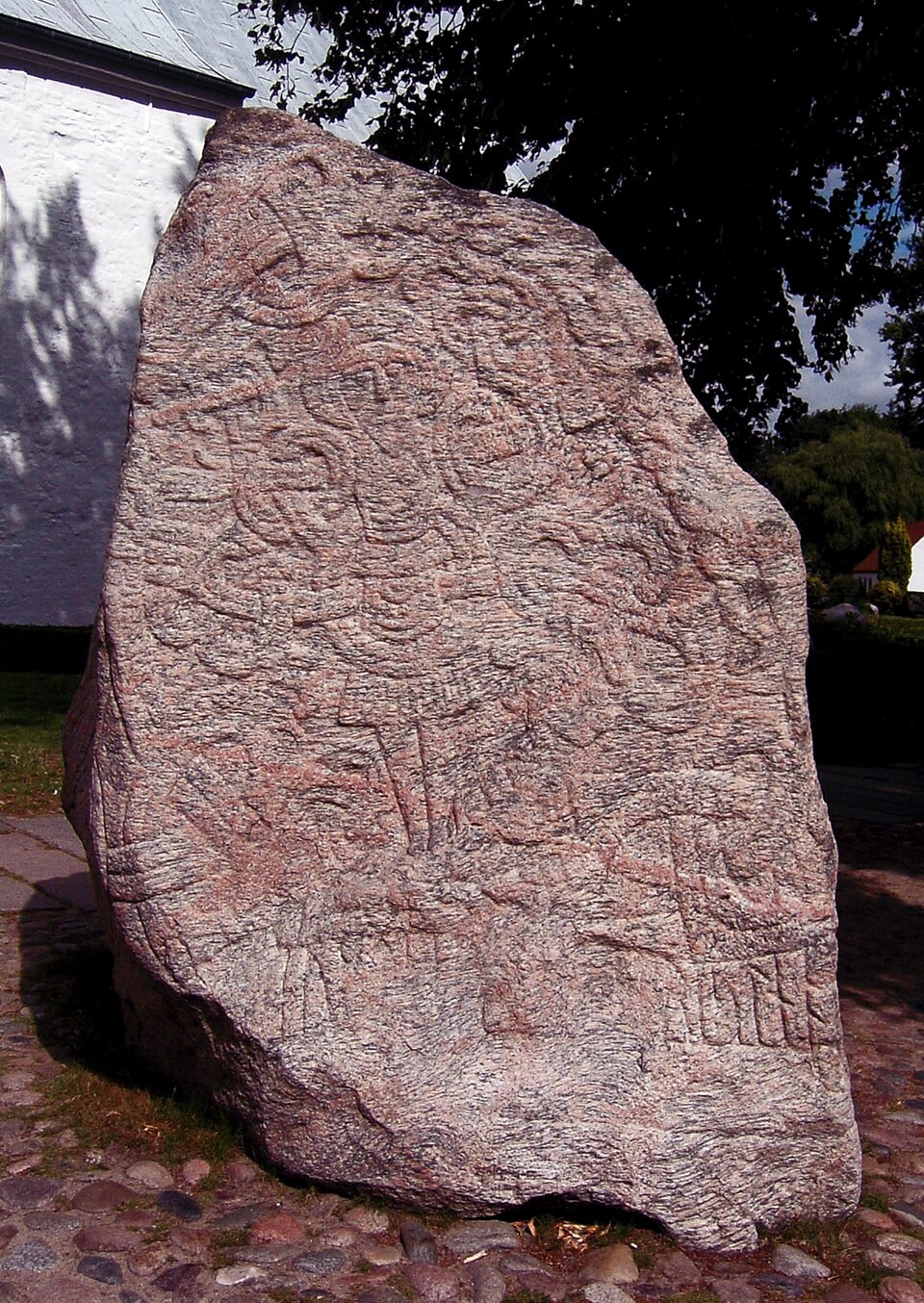
Scandinavia was converted over three centuries, mostly from the top down. Harald Bluetooth’s great runestone at Jelling, raised around 965, says he was “that Harald who won for himself all Denmark and Norway and made the Danes Christian”, and carries one of the oldest images of Christ in Scandinavia.[15][41] Majority In Iceland, according to Ari Thorgilsson’s Book of the Icelanders (c. 1122–1133), the Althing settled a dispute between Christians and pagans in 1000 by adopting Christianity as the law of the land, while allowing private pagan sacrifice for a time.[18] Majority Sweden was largely Christian only in the twelfth century, and Lithuania was the last European state to accept baptism, in 1387. Consensus
To the east, the Byzantine missionaries Cyril and Methodius created a Slavonic alphabet and liturgy for Moravia from 863; Boris of Bulgaria was baptised in the 860s.[14] Consensus The Rus’ of Kiev followed under Vladimir, traditionally in 988. The Russian Primary Chronicle, compiled in the early twelfth century, tells how Vladimir’s envoys, sent to compare religions, found nothing on earth to match the beauty of the liturgy in Hagia Sophia; historians read the story as a later explanation of a political choice, which brought Vladimir a Byzantine princess.[16][17] Majority
Images: the iconoclast controversy
In the eighth century the Byzantine emperors attacked the veneration of icons, images of Christ, Mary and the saints. The traditional account has Leo III order an image of Christ removed from the palace gate in 726 and issue a ban in 730; Leslie Brubaker and John Haldon have argued that most of this story was written later by the victors, and that imperial iconoclasm began more gradually than the sources say.[10] Contested on the beginning.
The Second Council of Nicaea, in 787, restored icons and drew the distinction that has defined Orthodox practice since. Images may receive
“due salutation and honourable reverence (aspasmon kai timētikēn proskynēsin), not indeed that true worship of faith (latreian) which pertains alone to the divine nature… For the honour which is paid to the image passes on to that which the image represents.” (trans. H. R. Percival)[9]
A second iconoclast period followed from 815 until 843, when the empress Theodora restored the icons for good; the Orthodox churches still celebrate the “Triumph of Orthodoxy” on the first Sunday of Lent.[10][36] Consensus
The West’s response shows how far apart the two churches already were. Charlemagne’s theologians, working from a faulty Latin translation of the Nicene acts that seemed to demand worship of images, rejected the council in the Opus Caroli regis (the “Libri Carolini”, c. 790–793), and the Synod of Frankfurt in 794 condemned it.[42] Majority The papacy accepted Nicaea II; the Frankish church did not, for a time.
“And the Son”: the filioque
The creed of 381 (§6) says that the Holy Spirit “proceeds from the Father”. Latin theologians, following Augustine, taught that the Spirit proceeds from the Father and the Son, in Latin filioque. The word entered the creed itself in Spain: the Third Council of Toledo, in 589, which marked the Visigothic king Reccared’s conversion from Arian to Nicene Christianity, recited the creed with it.[19] Majority Whether the word stood in the council’s original text has been questioned.
From Spain it spread to the Frankish church, where Charlemagne promoted it. Rome resisted. In about 810, Pope Leo III, while accepting the doctrine, refused to add the word to the creed and had the creed without it engraved in Greek and Latin on two silver shields in St Peter’s.[19] Majority In 867 the patriarch of Constantinople, Photius, denounced the filioque as a heresy. Rome itself first sang the creed with the word, under pressure from the German emperor Henry II, around 1014.[19] Majority
Eastern theologians object on two grounds: that the doctrine confuses the persons of the Trinity, and that one part of the church had no right to change a creed agreed by an ecumenical council. Western theologians reply that the addition only made explicit what the fathers had taught.[19][36] Consensus that both objections are made.
1054: the schism that was a process
What happened
In 1054 Pope Leo IX sent three legates to Constantinople, led by Cardinal Humbert of Silva Candida, to negotiate an alliance against the Normans in southern Italy and to answer Greek attacks on Latin customs, above all the use of unleavened bread (azymes) in the Eucharist. The patriarch, Michael Cerularius, had closed the Latin churches in the city the year before. The talks failed. On 16 July 1054, three months after the pope had died, the legates laid a bull excommunicating Cerularius on the altar of Hagia Sophia; days later a synod in Constantinople excommunicated the legates.[20][21] Consensus
Why historians no longer call it the split
The excommunications were personal: Humbert’s bull condemned the patriarch and his supporters, not the Greek church, and the Greek synod condemned the legates, not the pope. Leo IX was already dead, so the legates’ authority was doubtful. Contemporaries did not treat 1054 as a turning point, and contacts, negotiations and even shared worship continued for generations.[21][43] Majority
The issues, however, were real and long-standing:
| Issue | Latin position | Greek position | Confidence |
|---|---|---|---|
| Papal authority | The bishop of Rome holds jurisdiction over the whole church | Rome has a primacy of honour among the patriarchs, not universal jurisdiction | Consensus |
| The filioque | The Spirit proceeds from the Father and the Son | The Spirit proceeds from the Father; the creed may not be changed | Consensus |
| Bread | Unleavened bread, like the Passover | Leavened bread | Consensus |
| Clergy | Priests must be celibate (required by law from 1123/1139) | Married men may be ordained priests | Consensus |
| Purgatory (later) | Set out in 1274 | Prayers for the dead, but no Latin doctrine of purgatory | Consensus |
Tia Kolbaba has shown that Byzantine writers kept lists of “errors of the Latins”, many of them about fasting, beards and ritual, and that these mattered to ordinary believers as much as the theology.[43] Majority
1204: the real break
What turned estrangement into schism was the Fourth Crusade. Diverted from its goal of Egypt by debts to Venice and by a Byzantine pretender’s promises, the crusading army sacked Constantinople in April 1204, looting churches, including Hagia Sophia, and installed a Latin emperor and a Latin patriarch. Pope Innocent III condemned the violence but accepted the conquest.[29][44] Consensus For Greek Christians the Latins were now occupiers. Unions agreed at the councils of Lyon (1274) and Florence (1439) were rejected by most Greek clergy and people.[21] Consensus
1965
On 7 December 1965, Pope Paul VI and Patriarch Athenagoras I of Constantinople issued a joint declaration. They said the censures of 1054 “were not intended to break ecclesiastical communion” between the two sees, and declared that they
“regret and remove both from memory and from the midst of the Church the sentences of excommunication which followed these events… and they commit these excommunications to oblivion.”[45]
The declaration did not restore communion, and the two churches remain separate. Consensus (§12)
Popes and kings: the Gregorian reform
In the eleventh century a reform movement, centred on the papacy and on monasteries such as Cluny, attacked three abuses: lay rulers appointing bishops (investiture), the buying and selling of church offices (simony), and married or cohabiting clergy. Its most forceful leader, Gregory VII (1073–1085), had a set of propositions entered in his register in 1075, the Dictatus papae:
“That the Roman pontiff alone can with right be called universal… That it may be permitted to him to depose emperors… That the Roman church has never erred; nor will it err to all eternity, the Scripture bearing witness.” (trans. Ernest F. Henderson)[22]
The quarrel with Emperor Henry IV over the appointment of bishops led Gregory to excommunicate and depose him; Henry, deserted by his nobles, stood as a penitent in the snow at Canossa in January 1077 to be absolved. The dispute was settled by compromise at the Concordat of Worms in 1122.[23][46] Consensus The papacy that emerged claimed, and in the thirteenth century under Innocent III (1198–1216) largely exercised, a jurisdiction over the whole Latin church: legal appeals came to Rome, and church law was systematised in Gratian’s Decretum (c. 1140). Majority
Clerical celibacy
Married clergy were normal in the early church: Peter was married (Mark 1:30), and the Pastoral letters require a bishop to be “the husband of one wife”.[47][48] Consensus From the fourth century, Western councils began requiring married bishops, priests and deacons to abstain from sex with their wives, but marriage of clergy remained common in the West until the reformers attacked it.[49] Majority The First Lateran Council of 1123 ruled:
“We absolutely forbid priests, deacons or subdeacons to live with concubines and wives.” (canon 7; trans. Norman Tanner)[26]
The Second Lateran Council of 1139 went further, ordering such couples separated: “we do not deem there to be a marriage which, it is agreed, has been contracted against ecclesiastical law”.[27] Consensus Enforcement took generations, and clerical concubinage remained common into the sixteenth century. Majority The Eastern churches never adopted the rule for parish priests, though their bishops must be unmarried. Consensus
Crusades
On 27 November 1095, at Clermont in France, Pope Urban II called on Western knights to go to the aid of the Christians of the East and to free Jerusalem. No text of his speech survives; five versions, written by chroniclers years later, differ widely. Fulcher of Chartres, who was probably present, has Urban promise:
“All who die by the way, whether by land or by sea, or in battle against the pagans, shall have immediate remission of sins.” (trans. after O. J. Thatcher)[24]
Tens of thousands went. On the way, in spring 1096, crusading bands massacred the Jewish communities of the Rhineland, at Speyer, Worms and Mainz (Judaism §9).[50][51] Consensus Jerusalem fell on 15 July 1099, and the crusaders killed many of its Muslim and Jewish inhabitants. Benjamin Kedar’s study of the sources concludes that the massacre was unusually extensive; the figures range from about 3,000 in al-Aqsa, given by the near-contemporary Ibn al-ʿArabi, to the 70,000 claimed a century later by Ibn al-Athir.[25] Majority on the scale; Contested on the numbers.
Crusading became a permanent institution: expeditions to the East until 1291, crusades in Spain, in the Baltic, and against heretics and political enemies of the papacy in Europe itself. Consensus
How historians read the crusades
How to understand the crusades is argued over, and the argument has modern politics in it.
| View | Main argument | Main proponents |
|---|---|---|
| A long act of intolerance | The crusades were aggressive wars that destroyed Byzantium and poisoned relations with Islam | Runciman[44] |
| Penitential war | Crusaders were mostly motivated by piety and the promise of remission; the crusade was a form of armed pilgrimage, understood by contemporaries as an act of love | Riley-Smith[52] |
| A plural movement | No single motive or definition fits; crusading was adapted to many ends by popes, kings and knights over four centuries | Tyerman[53] |
Political The crusades are invoked today both by those who see a long conflict between Christianity and Islam and by those who see Western aggression; most historians resist both readings as projections of modern concerns.[53] Majority
Doctrine defined: purgatory and the Eucharist
Purgatory
Christians prayed for the dead from early times; the practice appears in Jewish texts too (2 Maccabees 12:43–45). Augustine wrote of a “purgatorial fire” for some souls, and Gregory the Great taught it firmly:[54][55] Consensus
“But yet we must believe that before the day of judgment there is a Purgatory fire for certain small sins.” (Dialogues 4.39, 4.41 in some editions; trans. 1608, revised by Edmund Gardner, 1911)[56]
In The Birth of Purgatory (1981), Jacques Le Goff argued that the noun purgatorium, naming purgatory as a place, first appears in the Paris schools between about 1170 and 1180, and that this “birth” changed how Christians imagined the afterlife and their obligations to the dead.[55] Majority on the word. Critics, among them Graham Robert Edwards, replied that the belief had developed continuously for centuries and that the new noun named an old idea.[57] Contested on how much changed.
The profession of faith accepted at the Second Council of Lyon, in 1274, set out for the first time in a council that souls who die in charity but before completing penance are cleansed after death and are helped by the prayers, masses and alms of the living.[35] Consensus The Greeks at Lyon accepted it for the sake of union; the Orthodox churches never adopted the doctrine. It became the basis of the late medieval system of masses for the dead and of indulgences, which Luther attacked in 1517 (§9). Consensus
Transubstantiation and confession: Lateran IV, 1215
The Fourth Lateran Council, called by Innocent III, was the largest council of the Middle Ages. Its first canon, a profession of faith, declared:
“There is one Universal Church of the faithful, outside of which there is absolutely no salvation. In which there is the same priest and sacrifice, Jesus Christ, whose body and blood are truly contained in the sacrament of the altar under the forms of bread and wine; the bread being changed (transsubstantiatio) by divine power into the body, and the wine into the blood.” (trans. H. J. Schroeder)[31]
The term had been used by theologians since the twelfth century; this was its first use by a council, and the philosophical explanation in terms of substance and accidents was worked out later, by Thomas Aquinas among others.[58] Majority Canon 21 required every Christian “of both sexes” who had reached the age of discretion to confess to their own priest at least once a year and to receive communion at least at Easter, on pain of being barred from church in life and denied Christian burial in death.[32] Consensus Canon 68 required Jews and Muslims to wear distinguishing dress (Judaism §9).[59] Consensus Miri Rubin has shown how the council’s eucharistic teaching shaped a new devotion, including the feast of Corpus Christi, instituted in 1264.[58] Majority
Friars and the new towns
The towns that grew from the eleventh century produced new religious movements, many of them led by lay people, which embraced poverty and preaching. Some were condemned, such as the Waldensians of Lyon; two were absorbed.[60] Majority
- Francis of Assisi (1181/2–1226), a merchant’s son, renounced his inheritance and gathered followers who owned nothing and begged for their food. Innocent III approved his way of life orally around 1209–1210; the final Rule was approved in 1223. Francis’ insistence on absolute poverty divided his order bitterly after his death.[33] Consensus
- Dominic (c. 1170–1221), a Castilian canon, founded the Order of Preachers to answer the heretics of southern France with learned preaching; it was approved in 1216. Dominicans and Franciscans dominated the new universities and, from the 1230s, supplied most inquisitors.[34] Consensus
Heretics: Cathars, crusade and inquisitors
The Cathars
In the twelfth century church writers reported, in southern France, northern Italy and the Rhineland, communities of dualist heretics, often linked to the Bogomils of the Balkans, who held that the material world was the work of an evil principle and were led by ascetic “perfect” men and women. Modern scholars call them Cathars. Majority Mark Pegg and R. I. Moore have argued that “Catharism” as a coherent church with a dualist theology is largely a construction of the inquisitors who interrogated it and of later historians; others, including several contributors to the collection Cathars in Question (2016), reply that the evidence of a real dissenting movement is too strong to dismiss.[61][62][63] Contested
The Albigensian Crusade
In 1208 a papal legate was murdered in Languedoc, and Innocent III proclaimed a crusade. On 22 July 1209 the crusaders took Béziers and killed most of its inhabitants. The papal legate Arnaud Amalric reported to the pope that the crusaders spared no one, whatever their rank, sex or age, and put the dead at almost 20,000, probably an exaggeration.[30] Majority The famous order “Kill them all; God will know his own” is attributed to Arnaud by the Cistercian Caesarius of Heisterbach, writing a decade later; whether Arnaud said it is doubtful.[64] Majority The war lasted until 1229 and ended with Languedoc under the French crown. In 1244 the fortress of Montségur surrendered and about two hundred of those inside were burned.[65] Majority
The inquisitions
“The Inquisition” as a single institution did not exist in the Middle Ages; the Spanish Inquisition, founded in 1478, is a later and different body (§9). Consensus What existed were procedures. In 1184 Pope Lucius III’s decree Ad abolendam ordered bishops to seek out heretics in their dioceses; from 1231–1233 Gregory IX appointed papal inquisitors, mostly Dominican friars, in Germany and southern France, who summoned whole districts, heard confessions and denunciations, and imposed sentences.[28][34] Majority
The surviving registers give a picture different from the popular one. Bernard Gui, inquisitor of Toulouse, recorded his sentences from 1308 to 1323: of 636 people convicted, the great majority were imprisoned, ordered to wear yellow crosses on their clothing, or sent on pilgrimages, and recent studies count no more than about 45 handed over to the secular authorities to be burned.[66][34] Majority James Given has shown that the inquisitors’ real power lay in their records: lists of names, confessions and relationships that made whole communities visible to authority.[34] Majority
Political The inquisitions have long served polemical purposes, Protestant and anticlerical writers emphasising their cruelty, Catholic apologists their restraint. R. I. Moore’s argument that twelfth- and thirteenth-century Europe became “a persecuting society”, turning on heretics, Jews, lepers and homosexuals with new institutions of exclusion, has been widely influential and widely debated.[60] Contested
Women in the medieval church
Women could not be ordained, but medieval Christianity gave them roles that the early church had narrowed (§4). Abbesses ruled great double monasteries, such as Hilda at Whitby, host of the synod of 664.[8] Consensus
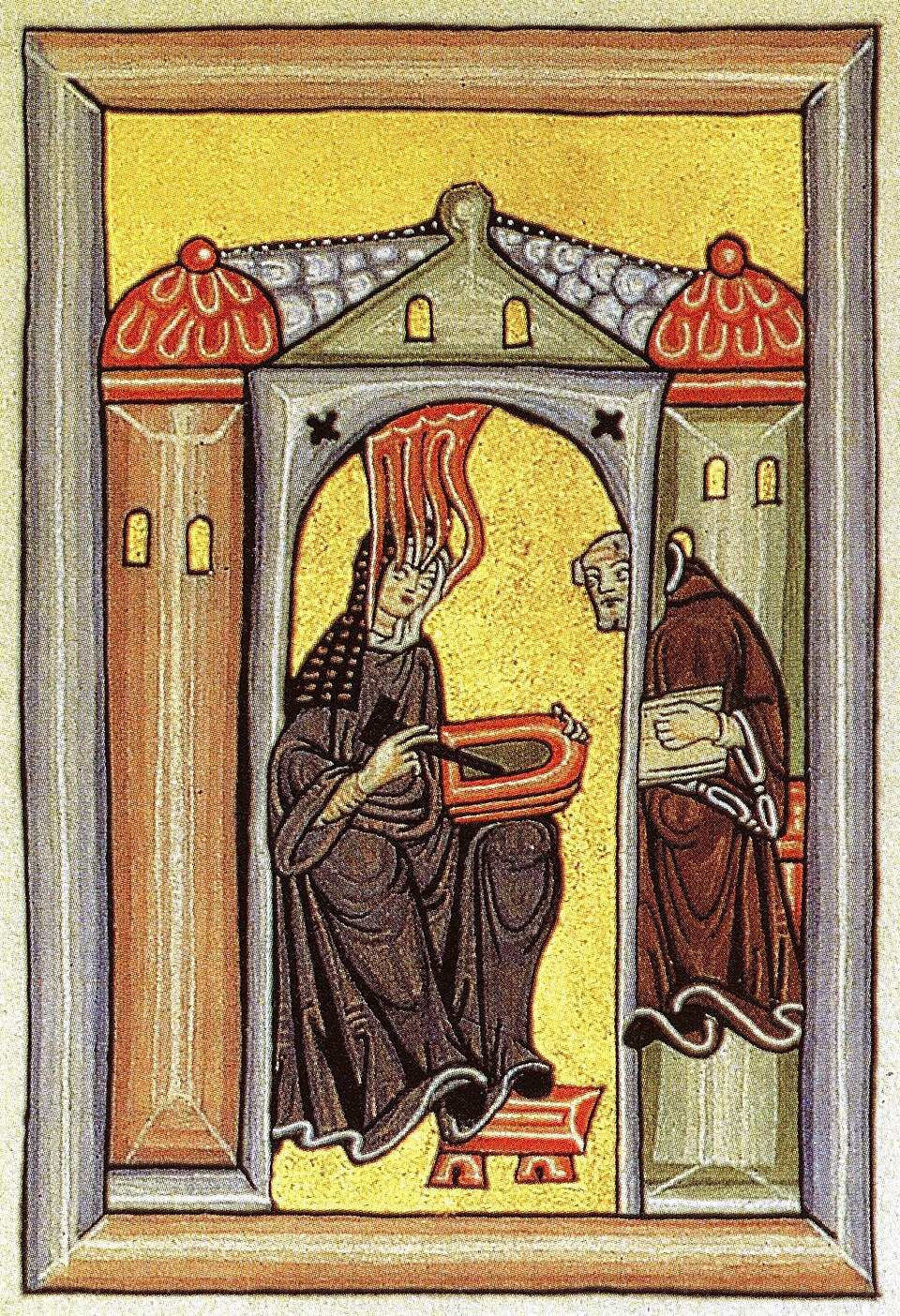
- Hildegard of Bingen (1098–1179), abbess of Rupertsberg, recorded visions in Scivias (c. 1141–1151), wrote on medicine and natural history, left one of the largest bodies of surviving medieval chant, and corresponded with popes and emperors. Benedict XVI declared her a Doctor of the Church in 2012.[67][68] Consensus
- Beguines, from about 1200, were laywomen in the towns of the Low Countries and the Rhineland who lived together in poverty and chastity without taking permanent vows. They were admired and suspected in equal measure; the beguine Marguerite Porete was burned in Paris in 1310 for her mystical book The Mirror of Simple Souls, and the Council of Vienne (1311–1312) condemned beguine life.[69][70] Consensus
- Holy women such as Clare of Assisi, whose Rule for her sisters was approved by the pope in 1253, days before her death, and the many women saints whose fasting and devotion to the Eucharist Caroline Walker Bynum studied, made the female body a site of religious meaning.[71] Majority
Mary Magdalene: how a disciple became a penitent
What the Gospels say
The New Testament says these things about Mary Magdalene, and only these:
- Jesus had cast seven demons out of her, and she was one of the women who travelled with him and provided for the group “out of their resources” (Luke 8:1–3).[72]
- She watched the crucifixion (Mark 15:40–41) and went to the tomb on Easter morning (Mark 16:1–8).[73][74]
- In John, she is the first to see the risen Jesus, and he sends her to tell the disciples (John 20:11–18).[75]
Two other women in the Gospels anoint Jesus. In Luke 7:36–50 an unnamed “woman in the city, who was a sinner” anoints his feet in a Pharisee’s house; in John 12:1–8 Mary of Bethany, sister of Martha and Lazarus, does the same in her own home.[76][77] Neither is identified with Mary Magdalene in the text, and Luke introduces Mary Magdalene in the next chapter as a new character. Consensus
Gregory’s sermon
In a homily preached in Rome, usually dated to 591, Gregory the Great joined the three women into one:
Hanc vero quam Lucas peccatricem mulierem, Iohannes Mariam nominat, illam esse Mariam credimus de qua Marcus septem daemonia eiecta fuisse testatur. Et quid per septem daemonia, nisi universa vitia designantur?
“She whom Luke calls a sinful woman, and John names Mary, we believe to be the Mary from whom, Mark testifies, seven demons were cast out. And what are the seven demons, if not all the vices?”[4]
Gregory went on to say that the ointment she poured on Jesus’ feet was the perfume she had once used on her own body in sin. For the Western church she became the model penitent, the sinner whose love won forgiveness, and in art and legend a former prostitute.[5][78] Consensus Medieval writers nonetheless kept her older title too: Peter Abelard, Thomas Aquinas and a twelfth-century Life of the Magdalen attributed to Rabanus Maurus all called her apostolorum apostola, “apostle of the apostles”, because she was sent to announce the resurrection.[78][79] Majority Legends brought her to Provence; her supposed relics were venerated at Vézelay from the eleventh century and at Saint-Maximin from 1279.[5] Majority
The Greek church never accepted the merger. It honours Mary Magdalene as a myrrh-bearer and “equal to the apostles”, and keeps separate days for her, for Mary of Bethany and for the sinful woman.[5] Majority
1969 and 2016
In 1969, the revision of the Roman calendar removed the identification: the feast of 22 July was to commemorate only the Mary Magdalene to whom the risen Christ appeared, and the Gospel reading was changed from Luke 7 to John 20.[5] Majority On 3 June 2016, a decree of the Congregation for Divine Worship raised her memorial to a feast, the rank given to the apostles, and an accompanying article by its secretary, Arthur Roche, cited Rabanus Maurus and Thomas Aquinas for the title “apostle of the apostles”.[79] Consensus The prostitute of popular imagination survives regardless. Majority
The evidence
| Question | What the evidence supports | Key evidence | Confidence |
|---|---|---|---|
| Benedict’s Rule | Written c. 530, adapting the Rule of the Master; standard only from 816–817 | The Rule; Gregory’s Dialogues[1][37][2] | Majority |
| Conversion of the north | Seven centuries; sometimes by persuasion and adaptation, sometimes by force | Gregory’s letter; Saxon capitulary; Jelling; Íslendingabók[7][39][15][18] | Consensus |
| Icons | Restored at Nicaea II (787) with a distinction between veneration and worship | Nicaea II definition[9] | Consensus |
| The filioque | Added in Spain (589), adopted at Rome c. 1014 | Siecienski[19] | Majority |
| 1054 | Personal excommunications, not a declared schism of churches | Humbert’s bull; Chadwick[20][21] | Majority |
| 1204 | The sack of Constantinople made the division real | Phillips[29] | Majority |
| Papal power | Claimed universal jurisdiction from 1075; exercised it widely by 1215 | Dictatus papae; Lateran IV[22][31] | Majority |
| Clerical celibacy | Required by law in the West from 1123/1139 | Lateran I and II[26][27] | Consensus |
| Purgatory | Belief developed over centuries; the noun c. 1170–1180; set out at Lyon II, 1274 | Gregory; Le Goff; Lyon II[56][55][35] | Majority |
| Transubstantiation | First used by a council in 1215 | Lateran IV canon 1[31] | Majority |
| Inquisitorial executions | A minority of those convicted; the registers record mostly penances and prison | Gui’s sentences; Given[66][34] | Majority |
| Mary Magdalene as prostitute | A sixth-century identification, absent from the Gospels | Gregory’s Homily 33; Luke 7, 8; John 20[4][76][75] | Consensus |
Primary sources
Show the 10 primary sources
1. A school for the Lord’s service: the Rule of Benedict, c. 530
Constituenda est ergo nobis dominici schola servitii… Otiositas inimica est animae.
“We must therefore establish a school for the Lord’s service… Idleness is the enemy of the soul.” (Prologue 45; chapter 48)[1]
What it proves. The Rule presents monastic life as training, not escape: prayer, work and reading in a fixed rhythm, under an abbot. Its practicality is why it outlasted its rivals. Consensus
2. Converting the temples: Gregory to Mellitus, 601
Quoted above. What it proves. The papal strategy for England was to reuse pagan sites and festivals. It shows conversion as a negotiation with existing religion rather than its replacement. Majority
3. Baptism or death: the Saxon capitulary, 782 or 785
Quoted above. What it proves. Under Charlemagne, refusing baptism and cremating the dead were capital crimes. Conversion in the Carolingian empire could be an act of state. Consensus
4. Honour passes to the prototype: the Second Council of Nicaea, 787
Quoted above. What it proves. The council distinguished the veneration given to images (proskynēsis) from the worship given only to God (latreia). The distinction remains the basis of Orthodox and Catholic teaching on images. Consensus
5. The pope may depose emperors: the Dictatus papae, 1075
Quoted above. What it proves. By the late eleventh century the papacy claimed a universal, juridical authority over the church and over secular rulers. Whether the Dictatus was a program, a list of headings for a collection of canons, or private notes is debated; that it records Gregory VII’s convictions is not. Majority
6. Remission of sins: Urban II at Clermont, 1095
Quoted above. What it proves. In Fulcher’s version, the pope promised remission of sins to those who died on the expedition, joining warfare to penance. Because all versions were written after the crusade’s success, they show how Urban was remembered as much as what he said. Majority
7. “Not a marriage”: the Second Lateran Council, 1139
Quoted above. What it proves. The Western church now treated marriages of priests, deacons, subdeacons, monks and canons as void, a legal change from the practice of the first millennium. Consensus
8. The bread changed: the Fourth Lateran Council, 1215
Quoted above. What it proves. The council made transubstantiation part of a conciliar profession of faith, and with canon 21 bound every adult Western Christian to annual confession and Easter communion. Consensus
9. The seven demons are all the vices: Gregory’s Homily 33, c. 591
Quoted above. What it proves. The identification of Mary Magdalene with the sinful woman of Luke 7 is Gregory’s interpretation, made over five centuries after the Gospels. It became Western tradition without being a Gospel claim. Consensus
10. Committed to oblivion: the joint declaration of 1965
Quoted above. What it proves. Rome and Constantinople jointly declared that the 1054 sentences were directed at persons, not churches, and withdrew them. The declaration is itself evidence that the two churches no longer regard 1054 as the definition of their division. Consensus
What is absent
- A single schism date. No council or document of either side declared the churches divided; 1054 is a later convention. Majority
- “The Inquisition.” There was no central inquisitorial office until the Roman Inquisition of 1542 (§9). Consensus
- Celibacy as universal law. Until the twelfth century many Western priests were married, and the Eastern churches never required it of parish clergy. Consensus
- A Bible in the people’s languages. Scripture was read in Latin; vernacular translations existed (in Old English, Old French and others) but were partial and, in places, restricted. Majority
- Purgatory in the East. The Orthodox churches pray for the dead but never adopted the Latin doctrine. Consensus
- Mary Magdalene the prostitute in the Gospels. The figure exists in Western sermons, art and legend, not in the New Testament. Consensus
Debates
When did the churches split?
| View | Date or process | Main proponents |
|---|---|---|
| 1054 | The mutual excommunications mark the formal break | Older textbooks |
| A long estrangement | No single date; language, liturgy and authority drifted apart over centuries | Chadwick, Ware[21][36] |
| 1204 | The sack of Constantinople and Latin occupation made the division popular and permanent | Phillips, Runciman[29][44] |
| Later still | The rejection of Florence (1439–1484) or the Greek decision to rebaptise Latins (1755) completed it | Various |
Majority for a process rather than a date.
Did the “birth of purgatory” happen?
| View | Main argument | Main proponents |
|---|---|---|
| A twelfth-century birth | The new noun and the idea of a place transformed the afterlife and the church’s role in it | Le Goff[55] |
| Evolution | The belief in purification after death and prayer for the dead developed continuously from the early church | Edwards[57] |
Contested
Were the Cathars real?
| View | Main argument | Main proponents |
|---|---|---|
| A dualist counter-church | Organised communities with their own rituals and bishops, linked to the Bogomils | Older consensus; several contributors to Sennis (ed.)[63] |
| An inquisitors’ construction | “Catharism” as a coherent religion is a product of inquisitorial questioning and later scholarship | Pegg, Moore[61][62] |
Contested
A persecuting society?
R. I. Moore argued in 1987 that between the eleventh and thirteenth centuries Latin Europe developed new institutions for defining and excluding heretics, Jews, lepers and others, driven by clerical and royal elites; critics have questioned how new the persecution was and how unified its causes.[60] Contested
Further reading
Show further reading (10 works)
- R. W. Southern, Western Society and the Church in the Middle Ages (Penguin, 1970). Still the best short account.
- Peter Brown, The Rise of Western Christendom (Blackwell, 2nd ed. 2003): the conversion of Europe, 200–1000.
- C. H. Lawrence, Medieval Monasticism (Longman, 3rd ed. 2001).
- Henry Chadwick, East and West: The Making of a Rift in the Church (Oxford, 2003): the schism from the apostles to Florence.
- A. Edward Siecienski, The Filioque: History of a Doctrinal Controversy (Oxford, 2010).
- Christopher Tyerman, God’s War: A New History of the Crusades (Allen Lane, 2006).
- Jacques Le Goff, The Birth of Purgatory (Chicago, 1984).
- R. I. Moore, The Formation of a Persecuting Society (Blackwell, 1987).
- Susan Haskins, Mary Magdalen: Myth and Metaphor (HarperCollins, 1993) and Katherine Ludwig Jansen, The Making of the Magdalen (Princeton, 2000).
- Barbara Newman, Sister of Wisdom: St Hildegard’s Theology of the Feminine (California, 1987).
References
- ^ a b c d Rule of Benedict, Prologue and ch. 48 — Regula Benedicti. c. 530 CE. Latin. The monastery as 'a school for the Lord's service'; 'idleness is the enemy of the soul'; prayer, work and reading under an abbot. read the text
- ^ a b c d e C. H. Lawrence Medieval Monasticism: Forms of Religious Life in Western Europe in the Middle Ages. Longman, 3rd ed., 2001. The standard survey, from Benedict to the friars.
- ^ a b R. A. Markus Gregory the Great and His World. Cambridge University Press, 1997. Gregory's thought and pontificate.
- ^ a b c Gregory the Great, Homilies on the Gospels 33 — Homiliae in Evangelia. c. 591 CE. Latin. Gregory identifies the sinful woman of Luke 7 and Mary of Bethany with Mary Magdalene, and reads her seven demons as all the vices. about
- ^ a b c d e Susan Haskins Mary Magdalen: Myth and Metaphor. HarperCollins, 1993. The making of the Magdalen from the Gospels to the twentieth century.
- ^ a b Bede, Ecclesiastical History 1.25–26 — Ecclesiastical History of the English People. 731 CE. Latin. Augustine and his companions land in Kent in 597 and are received by King Æthelberht, who is baptised. read the text
- ^ a b c Bede, Ecclesiastical History 1.30 — Ecclesiastical History of the English People. 731 CE (letter of 601). Latin. Gregory's letter to Mellitus: the temples of the English should be purified and turned into churches, and their feasts replaced by saints' days. read the text
- ^ a b c Bede, Ecclesiastical History 3.25 — Ecclesiastical History of the English People. 731 CE. Latin. The Synod of Whitby (664), held at Hilda's monastery, adopts the Roman reckoning of Easter. read the text
- ^ a b c Second Council of Nicaea, definition (787) — Acts of the Second Council of Nicaea. 787 CE. Greek. Images receive honourable reverence (proskynēsis), not the worship (latreia) due to God alone; the honour passes to the prototype. read the text
- ^ a b c d Leslie Brubaker and John Haldon Byzantium in the Iconoclast Era, c. 680–850: A History. Cambridge University Press, 2011. Argues that much of the traditional story of iconoclasm was written later by the victors.
- ^ a b Willibald, Life of Boniface 6 — Vita Bonifatii. c. 760s CE. Latin. Boniface fells the great oak at Geismar, which Willibald calls the oak of Jupiter. about
- ^ a b Royal Frankish Annals, 782 — Annales regni Francorum. late 8th c. CE. Latin. After a Saxon rising, Charlemagne has 4,500 Saxons executed at Verden. about
- ^ a b Rosamond McKitterick Charlemagne: The Formation of a European Identity. Cambridge University Press, 2008. Charlemagne's rule, including the Saxon wars and church reform.
- ^ a b c d Ian Wood The Missionary Life: Saints and the Evangelisation of Europe, 400–1050. Longman, 2001. The missionaries and their biographers.
- ^ a b c Jelling runestone of Harald Bluetooth (DR 42) — Runestone, Jelling, Denmark. c. 965 CE. Old Norse (runic). Harald raised the stone for his parents, 'that Harald who won for himself all Denmark and Norway and made the Danes Christian'. about
- ^ a b Russian Primary Chronicle, entries for 986–988 — Povest' vremennykh let. early 12th c. CE. Old East Slavic. Vladimir's envoys compare religions and are overwhelmed by the liturgy in Constantinople; Vladimir is baptised and marries a Byzantine princess. about
- ^ a b Simon Franklin and Jonathan Shepard The Emergence of Rus, 750–1200. Longman, 1996. Kievan Rus' and its conversion, read critically against the Primary Chronicle.
- ^ a b c Ari Thorgilsson, Íslendingabók 7 — Íslendingabók (Book of the Icelanders). c. 1122–1133 CE. Old Norse. The Althing accepts Christianity in 1000 on the lawspeaker Thorgeir's proposal, with private pagan worship allowed for a time. about
- ^ a b c d e f A. Edward Siecienski The Filioque: History of a Doctrinal Controversy. Oxford University Press, 2010. The standard history of the filioque from the fathers to the present.
- ^ a b c Bull of excommunication against Michael Cerularius (16 July 1054) — Papal legates' bull, Hagia Sophia. 1054 CE. Latin. Cardinal Humbert's bull excommunicating the patriarch and his supporters, laid on the altar of Hagia Sophia after Leo IX's death. about
- ^ a b c d e f Henry Chadwick East and West: The Making of a Rift in the Church: From Apostolic Times until the Council of Florence. Oxford University Press, 2003. The schism as a long estrangement rather than an event.
- ^ a b c Gregory VII, Dictatus papae — Register of Gregory VII. 1075 CE. Latin. Propositions that the pope alone is universal, may depose emperors, and that the Roman church has never erred. read the text
- ^ a b Uta-Renate Blumenthal The Investiture Controversy: Church and Monarchy from the Ninth to the Twelfth Century. University of Pennsylvania Press, 1988. The standard account of the conflict between popes and emperors.
- ^ a b Fulcher of Chartres, Urban II's speech at Clermont — Historia Hierosolymitana. c. 1100–1105 CE (speech 1095). Latin. Urban promises 'immediate remission of sins' to those who die on the way or in battle against the pagans. read the text
- ^ a b Benjamin Z. Kedar The Jerusalem Massacre of July 1099 in the Western Historiography of the Crusades. Crusades 3: 15–75, 2004. Weighs the sources for the 1099 massacre.
- ^ a b c First Lateran Council (1123), canon 7 — Canons of the First Lateran Council. 1123 CE. Latin. Priests, deacons and subdeacons are absolutely forbidden to live with wives or concubines. read the text
- ^ a b c Second Lateran Council (1139), canon 7 — Canons of the Second Lateran Council. 1139 CE. Latin. Clergy in major orders, monks and canons who marry are to be separated; such a union is not deemed a marriage. read the text
- ^ a b Bernard Hamilton The Medieval Inquisition. Edward Arnold, 1981. A short account of inquisitorial procedure from 1184.
- ^ a b c d Jonathan Phillips The Fourth Crusade and the Sack of Constantinople. Jonathan Cape, 2004. The diversion of the crusade and the sack of 1204.
- ^ a b Arnaud Amalric, letter to Innocent III (August 1209) — Papal legate's report on Béziers. 1209 CE. Latin. The crusaders took Béziers and spared no one, killing almost 20,000 people by the legate's count. about
- ^ a b c d Fourth Lateran Council (1215), canon 1 — Canons of the Fourth Lateran Council. 1215 CE. Latin. The profession of faith: no salvation outside the one church; bread and wine 'transubstantiated' into Christ's body and blood. read the text
- ^ a b Fourth Lateran Council (1215), canon 21 (Omnis utriusque sexus) — Canons of the Fourth Lateran Council. 1215 CE. Latin. Every Christian of the age of discretion must confess to their own priest at least once a year and receive communion at Easter. read the text
- ^ a b Augustine Thompson Francis of Assisi: A New Biography. Cornell University Press, 2012. A critical biography separating Francis from his legends.
- ^ a b c d e f James B. Given Inquisition and Medieval Society: Power, Discipline, and Resistance in Languedoc. Cornell University Press, 1997. How inquisitors used records and sentences to control communities.
- ^ a b c Second Council of Lyon (1274), profession of faith — Acts of the Second Council of Lyon. 1274 CE. Latin. Souls who die in charity before completing penance are cleansed after death and helped by the prayers and masses of the living. about
- ^ a b c d Timothy (Kallistos) Ware The Orthodox Church: An Introduction to Eastern Christianity. Penguin, new ed., 2015. The standard introduction, updated for the post-communist revival.
- ^ a b Gregory the Great, Dialogues 2 — Dialogues. c. 593–594 CE. Latin. The life and miracles of Benedict of Nursia, the only early source for his biography. read the text
- ^ Richard Fletcher The Conversion of Europe: From Paganism to Christianity, 371–1386 AD. HarperCollins, 1997. Published in the US as The Barbarian Conversion.
- ^ a b Capitulatio de partibus Saxoniae — Capitulary of Charlemagne for Saxony. 782 or 785 CE (perhaps later). Latin. Death for Saxons who hide to avoid baptism, for cremating the dead by pagan rites and for eating meat in Lent. read the text
- ^ Alcuin, letters of 796 to Charlemagne and Meginfrid — Letters of Alcuin. 796 CE. Latin. Alcuin warns that faith cannot be compelled, that teaching must come before baptism, and that tithes are alienating the Saxons. about
- ^ Anders Winroth The Conversion of Scandinavia: Vikings, Merchants, and Missionaries in the Remaking of Northern Europe. Yale University Press, 2012. Conversion as a long process driven by kings and gift exchange.
- ^ Opus Caroli regis contra synodum (Libri Carolini) — Treatise of Charlemagne's court theologians. c. 790–793 CE. Latin. The Frankish court's rejection of the Second Council of Nicaea, based partly on a faulty Latin translation of its acts. about
- ^ a b Tia M. Kolbaba The Byzantine Lists: Errors of the Latins. University of Illinois Press, 2000. Byzantine lists of Latin 'errors', mostly about ritual and custom.
- ^ a b c Steven Runciman A History of the Crusades. Cambridge University Press, 3 vols., 1951–1954, 1951. The classic narrative, sympathetic to Byzantium and hostile to the crusaders.
- ^ Catholic–Orthodox Joint Declaration (7 December 1965) — Paul VI and Athenagoras I. 7 December 1965. Latin and Greek. The pope and the patriarch regret the events of 1054 and 'commit these excommunications to oblivion'. read the text
- ^ Colin Morris The Papal Monarchy: The Western Church from 1050 to 1250. Oxford University Press, 1989. The reform papacy and its church.
- ^ Mark 1:29–31 — Gospel of Mark (New Testament). c. 70 CE. Greek. Jesus heals Simon Peter's mother-in-law, evidence that Peter was married. read the text
- ^ 1 Timothy 3:2 — First Letter to Timothy (New Testament). c. 100 CE (disputed). Greek. A bishop must be 'above reproach, married only once' (literally 'husband of one wife'). read the text
- ^ Peter Brown The Body and Society: Men, Women, and Sexual Renunciation in Early Christianity. Columbia University Press, 1988. Asceticism, virginity and the desert.
- ^ Chronicle of Solomon bar Samson — Hebrew chronicles of the First Crusade. c. 1140 CE. Hebrew. The longest Hebrew account of the 1096 massacres in Speyer, Worms, Mainz and other towns, celebrating those who chose death over baptism as sanctifying God's name. about
- ^ Robert Chazan European Jewry and the First Crusade. University of California Press, 1987. The 1096 massacres and the Hebrew chronicles, with translations.
- ^ Jonathan Riley-Smith The First Crusade and the Idea of Crusading. Athlone Press, 1986. The crusade as penitential war.
- ^ a b Christopher Tyerman God's War: A New History of the Crusades. Allen Lane, 2006. Crusading as a varied, adaptable institution.
- ^ 2 Maccabees 12:43–45 — 2 Maccabees. late 2nd or 1st c. BCE. Greek. Judas Maccabeus sends money for a sin offering for the fallen: 'he made atonement for the dead, so that they might be delivered from their sin' (NRSV). read the text
- ^ a b c d Jacques Le Goff The Birth of Purgatory. University of Chicago Press (trans. Arthur Goldhammer; French 1981), 1984. Dates the noun purgatorium and the idea of purgatory as a place to c. 1170–1180.
- ^ a b Gregory the Great, Dialogues 4.39 (4.41 in some editions) — Dialogues. c. 593–594 CE. Latin. 'Before the day of judgment there is a Purgatory fire for certain small sins.' read the text
- ^ a b Graham Robert Edwards Purgatory: 'Birth' or 'Evolution'?. Journal of Ecclesiastical History 36: 634–646, 1985. A critique of Le Goff's twelfth-century 'birth' of purgatory.
- ^ a b Miri Rubin Corpus Christi: The Eucharist in Late Medieval Culture. Cambridge University Press, 1991. Eucharistic doctrine and devotion after 1215.
- ^ Fourth Lateran Council, canon 68 — Canons of the Fourth Lateran Council. 1215 CE. Latin. Orders that Jews and Muslims of both sexes be publicly distinguished from Christians "by the quality of their garment". read the text
- ^ a b c R. I. Moore The Formation of a Persecuting Society: Power and Deviance in Western Europe, 950–1250. Blackwell, 1987. Argues that medieval Europe built new institutions for persecuting heretics, Jews and others.
- ^ a b Mark Gregory Pegg The Corruption of Angels: The Great Inquisition of 1245–1246. Princeton University Press, 2001. Reads inquisitorial records against the idea of a Cathar church.
- ^ a b R. I. Moore The War on Heresy. Profile Books, 2012. Argues that medieval 'heresy' was largely constructed by its persecutors.
- ^ a b Antonio Sennis, ed. Cathars in Question. York Medieval Press, 2016. Essays for and against the existence of a Cathar church.
- ^ Caesarius of Heisterbach, Dialogus miraculorum 5.21 — Dialogue on Miracles. c. 1219–1223 CE. Latin. The story that Arnaud Amalric answered 'Kill them all; the Lord knows his own' at Béziers. about
- ^ Mark Gregory Pegg A Most Holy War: The Albigensian Crusade and the Battle for Christendom. Oxford University Press, 2008. A narrative of the Albigensian Crusade, 1209–1229, and its aftermath.
- ^ a b Bernard Gui, Liber sententiarum — Book of Sentences of the Inquisition of Toulouse. 1308–1323 CE. Latin. Gui's register of 636 people convicted; most were imprisoned, made to wear crosses or sent on pilgrimage; a minority were burned. about
- ^ Hildegard of Bingen, Scivias — Scivias (Know the Ways). c. 1141–1151 CE. Latin. Hildegard's first book of visions, with her account of receiving them. about
- ^ Barbara Newman Sister of Wisdom: St. Hildegard's Theology of the Feminine. University of California Press, 1987. Hildegard's theology and visions.
- ^ Walter Simons Cities of Ladies: Beguine Communities in the Medieval Low Countries, 1200–1565. University of Pennsylvania Press, 2001. The beguines and their communities.
- ^ Marguerite Porete, The Mirror of Simple Souls — Le Mirouer des simples ames. c. 1290s CE. Old French. A mystical treatise on the annihilated soul; its author was burned as a relapsed heretic in Paris in 1310. about
- ^ Caroline Walker Bynum Holy Feast and Holy Fast: The Religious Significance of Food to Medieval Women. University of California Press, 1987. Fasting, the Eucharist and women's religious authority.
- ^ Luke 8:1–3 — Gospel of Luke (New Testament). c. 80–90 CE. Greek. Women travel with Jesus and the Twelve and provide for them: Mary Magdalene, Joanna wife of Herod's steward Chuza, Susanna and many others. read the text
- ^ Mark 15:40–41 — Gospel of Mark (New Testament). c. 70 CE. Greek. Women who had followed Jesus in Galilee, including Mary Magdalene, watch the crucifixion. read the text
- ^ Mark 16:1–8 — Gospel of Mark (New Testament). c. 70 CE. Greek. Women find the tomb empty; a young man tells them Jesus has been raised. read the text
- ^ a b John 20:11–18 — Gospel of John (New Testament). c. 90–110 CE. Greek. The risen Jesus appears first to Mary Magdalene and sends her to tell the disciples. read the text
- ^ a b Luke 7:36–50 — Gospel of Luke (New Testament). c. 80–90 CE. Greek. An unnamed 'woman in the city, who was a sinner' anoints Jesus' feet in a Pharisee's house. read the text
- ^ John 12:1–8 — Gospel of John (New Testament). c. 90–110 CE. Greek. Mary of Bethany, sister of Martha and Lazarus, anoints Jesus' feet and wipes them with her hair. read the text
- ^ a b Katherine Ludwig Jansen The Making of the Magdalen: Preaching and Popular Devotion in the Later Middle Ages. Princeton University Press, 2000. Mary Magdalene in medieval sermons, including the title apostolorum apostola.
- ^ a b Congregation for Divine Worship, decree on the feast of Mary Magdalene (3 June 2016), with Arthur Roche's article — Vatican decree and commentary. 3 June 2016. Latin and English. Raises Mary Magdalene's memorial to a feast, citing Rabanus Maurus and Thomas Aquinas for the title 'apostle of the apostles'. read the text