The Second Temple period in one paragraph
When Alexander the Great took the Levant in 332 BCE, Judea was a small temple-state governed by its high priests under Persian rule (§5). Over the next four centuries it passed to the Ptolemies of Egypt, then to the Seleucids of Syria, won independence under the Hasmonean dynasty after the Maccabean revolt of 167–164 BCE, and fell to Rome in 63 BCE. In those centuries Judaism became a religion of two languages, Hebrew and Aramaic in the homeland and Greek in a diaspora that by the first century CE probably outnumbered it; it split into rival schools, the Pharisees, Sadducees and Essenes; and it took up ideas that are absent from most of the Hebrew Bible: the resurrection of the dead, a final judgment, named angels, Satan as God’s adversary and an end-time Messiah. All of them passed into rabbinic Judaism (§7) and into Christianity, which began as one of the Jewish movements of this period. Majority
The period’s sources are unusually rich: the books of Maccabees, Daniel and the other late books of the Bible; the Dead Sea Scrolls; the Greek writings of Philo of Alexandria and Josephus; and inscriptions, coins and buildings. They are also partisan. Almost everything about the Maccabean revolt comes from the Hasmoneans’ own court histories, and almost everything about the Jewish schools comes from Josephus, a priest and Pharisee sympathiser writing for Romans after 70 CE.[1] Consensus
Timeline of the Second Temple period and its evidence
| Date | Event or evidence | Confidence |
|---|---|---|
| 332 BCE | Alexander the Great takes the Levant; Judea passes to Greek rule[2] | Consensus |
| 301–200 BCE | Judea under the Ptolemies of Egypt; a large Jewish community grows in Alexandria[3] | Consensus |
| mid-3rd c. BCE | The Torah is translated into Greek in Alexandria, the beginning of the Septuagint[4][5] | Majority |
| 246–221 BCE | Jews of Schedia, near Alexandria, dedicate a “prayer house” (proseuchē) for King Ptolemy III, the earliest dated synagogue[6] | Consensus |
| 3rd c. BCE | The Book of the Watchers (1 Enoch 1–36): fallen angels, the judgment of the dead[7] | Majority |
| 200 BCE | Antiochus III takes Judea from the Ptolemies[8] | Consensus |
| 175–172 BCE | Jason buys the high priesthood and makes Jerusalem a Greek city with a gymnasium[9] | Majority |
| 167 BCE | Antiochus IV bans Jewish practice; the “abomination of desolation” on the Temple altar[10] | Majority |
| c. 165 BCE | The visions of Daniel 7–12 are written, with the first clear promise of resurrection[11] | Majority |
| Dec. 164 BCE | Judah Maccabee retakes and rededicates the Temple: the first Hanukkah[12] | Consensus |
| 152–140 BCE | Jonathan and then Simon become high priests; Simon’s rule is confirmed by a popular decree[13] | Consensus |
| c. 110 BCE | John Hyrcanus destroys the Samaritan temple on Mount Gerizim[14][15] | Consensus |
| c. 100 BCE | Settlement at Qumran begins (on the dating of Jodi Magness)[16] | Majority |
| 1st c. BCE | The Community Rule from Qumran; the Psalms of Solomon expect a Davidic Messiah[17][18] | Majority |
| 63 BCE | Pompey takes Jerusalem and enters the Holy of Holies; Judea becomes a Roman client state[19] | Consensus |
| 37–4 BCE | Herod rules as king of Judea; his rebuilding of the Temple starts c. 20/19 BCE[20] | Consensus |
| c. 20 BCE–c. 50 CE | Philo of Alexandria writes his allegorical commentaries on the Torah[21] | Consensus |
| c. 30 CE | Jesus of Nazareth crucified in Jerusalem under Pontius Pilate[22] | Majority |
| 1st c. CE | Synagogue buildings at Gamla, Magdala, Masada and Herodium; the Theodotos inscription in Jerusalem[23] | Majority |
| 66–70 CE | The revolt against Rome; the Temple is destroyed in August 70 (§7)[24] | Consensus |
Under Greek rule: a religion in two languages
Alexander’s conquest did not, at first, change much in Judea. Under the Ptolemies the high priests in Jerusalem governed the temple-state and collected its taxes, and Greek administrators, soldiers and merchants came and went. The large change happened abroad. Jews had lived in Egypt since at least the sixth century BCE (the Elephantine garrison, §5), and under the Ptolemies a large Jewish community grew in Alexandria, the new capital, and in the towns of the Nile valley. By the first century CE there were Jewish communities from Babylonia to Rome, and Jews living outside Judea probably outnumbered those inside it.[3] Majority
Diaspora Jews spoke Greek, and their Bible had to be in Greek. The Septuagint, the Greek translation, began with the Torah in Alexandria in the third century BCE. The Letter of Aristeas, a Jewish work in Greek of the second century BCE, tells how King Ptolemy II asked the high priest for a translation for his library and how seventy-two elders, six from each tribe, completed it in seventy-two days.[4] The story is a legend meant to give the translation authority, and the number gave the Septuagint its name (septuaginta, “seventy”), but its date fits the evidence of the translation’s own Greek. The rest of the Hebrew books were translated over the next two centuries; the grandson of Ben Sira, writing in Egypt after 132 BCE, already knew Greek versions of “the Law itself, the Prophecies, and the rest of the books” (in the NRSV’s words).[5][25] Majority
The Septuagint mattered in three ways. It made the Jewish scriptures readable by non-Jews, many of whom were drawn to the synagogue as sympathisers. It preserves a Hebrew text that sometimes differs from the later standard one, as at Deuteronomy 32:8 (§2) and in a shorter Jeremiah (§0). And it became the Old Testament of the early Christians, who quoted it in Greek, one reason later Jews turned away from it.[25][26] Philo of Alexandria, the greatest Jewish writer of the diaspora, records that in his day Alexandrian Jews still held an annual festival on the island of Pharos, where the translation was said to have been made.[27] Consensus
Philo (c. 20 BCE–c. 50 CE) read the Torah through Greek philosophy, mostly Platonic and Stoic. In his allegories the patriarchs are stages of the soul, and God acts in the world through his Logos, his reason or word. He insisted that the commandments must still be kept literally, and he led an embassy of Alexandrian Jews to the emperor Gaius in 40 CE after riots against the city’s Jews.[28] Philo had little influence on later Jewish tradition, which forgot him; Christian writers preserved his works.[21] Consensus
How “Hellenised” Judea itself was is a long-running debate. Martin Hengel argued in 1969 that from about the middle of the third century BCE all Judaism, in the homeland as well as abroad, was deeply shaped by Greek culture, so that “Judaism” and “Hellenism” cannot be set against each other.[29] Critics accept the Greek loanwords, Greek names and Greek-style buildings, but argue that Hengel underplayed how much of Judean culture remained traditional, especially outside Jerusalem’s elite.[30] Majority on wide Greek influence; Contested on its depth.
The Maccabean revolt and the first Hanukkah
In 200 BCE the Seleucid king Antiochus III took Judea from the Ptolemies and confirmed the Jews’ right to live by their ancestral laws.[8] A generation later, the Temple became the prize in a contest between Jerusalem’s priestly families. In 175 BCE Jason, brother of the high priest Onias III, paid the new king Antiochus IV for the high priesthood and for permission to turn Jerusalem into a Greek city, with a gymnasium and a list of citizens. According to 2 Maccabees, priests left the altar to take part in the wrestling.[9] Three years later a rival, Menelaus, outbid Jason for the office, and the two factions fought for control of the city. Majority
Then, in 167 BCE, Antiochus IV did something no Persian or Greek ruler had done before: he banned the practice of the Jewish religion. According to 1 Maccabees, he forbade sacrifices in the Temple, circumcision, the Sabbath and the festivals, ordered copies of the Torah burned, and had pigs sacrificed. On 15 Kislev the “abomination of desolation” of Daniel was set up on the altar, and from 25 Kislev pagan sacrifices were offered on an altar built on top of the old one.[10][31] Those who refused were killed; 2 Maccabees tells of the old scribe Eleazar and of a mother and her seven sons martyred for refusing pork.[32] Majority on the decree; the martyr stories are literary.
Resistance began in the village of Modein, where an old priest named Mattathias killed a Jew who was sacrificing on the king’s altar and fled to the hills with his five sons. His son Judah, called Maccabee (“the hammer”), led a guerrilla war that defeated several Seleucid armies.[33] In December 164 BCE, three years after the profanation, Judah’s forces retook the Temple, cleansed it, built a new altar and rededicated it on 25 Kislev with eight days of celebration.[12] Consensus
Hanukkah (“dedication”) was instituted then as an annual eight-day festival. 2 Maccabees explains the eight days by comparison with Sukkot, the festival of booths, which the rebels had not been able to keep in the hills.[34] Josephus, writing c. 93 CE, calls the festival “Lights” and can only guess at the reason for the name: that liberty had “appeared” to the Jews beyond their hopes.[35] The story of a single flask of pure oil that burned for eight days first appears in the Babylonian Talmud (Shabbat 21b), in a passage that asks “What is Hanukkah?” and answers with the miracle.[36] Historians accept the rededication as historical and treat the oil story as a later tradition that moved the festival’s meaning from a military victory to a divine sign. Majority
Why did Antiochus ban Judaism?
The decree is puzzling: Hellenistic kings generally did not interfere with local cults, and Antiochus did not ban other religions.
| Explanation | Argument | Main proponents |
|---|---|---|
| Jewish Hellenizers | The initiative came from Menelaus and his party, who wanted to reform Judaism into a universal cult; the king backed his clients | Bickerman[37] |
| Suppression of a revolt | Fighting in Jerusalem between Jason’s and Menelaus’ factions looked like rebellion; the ban was punishment, and the persecution followed the revolt rather than causing it | Tcherikover[38] |
| Money and the Temple | The conflict was about taxes and control of the Temple’s treasury; the “persecution” was shaped later by Hasmonean historians | Honigman[39] |
| Traditional | A pagan tyrant tried to destroy the faith of Israel; faithful Jews resisted and God gave them victory | 1 and 2 Maccabees; Jewish tradition |
All modern explanations agree that the conflict began among Jews before it was a war against a foreign king. The traditional account and the modern ones also agree on the core: in 167 BCE observing the Torah became a capital offence, and many Jews chose to die rather than abandon it. Contested on the causes.
The Hasmonean state
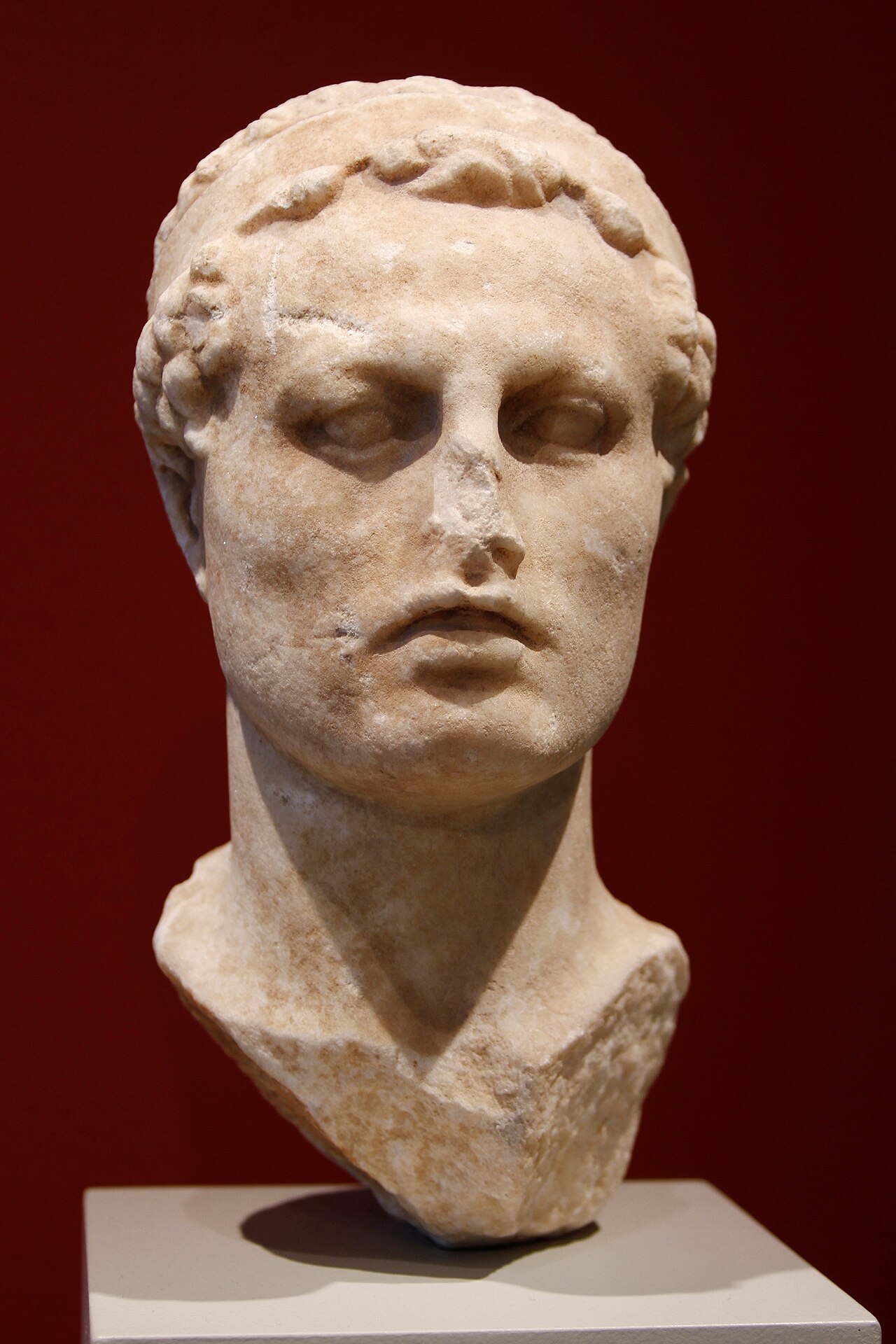
The Maccabees did not stop at religious freedom. Judah’s brothers Jonathan and Simon became high priests, though they were not of the family that had held the office, and in 140 BCE an assembly in Jerusalem decreed, in the Revised Standard Version’s words, that Simon should be their “leader and high priest for ever, until a trustworthy prophet should arise”.[13] Under John Hyrcanus (134–104 BCE) and Alexander Jannaeus (103–76 BCE) the Hasmonean state conquered Samaria, Galilee, Idumea and much of Transjordan. Hyrcanus destroyed the Samaritan temple on Mount Gerizim c. 110 BCE and, according to Josephus, made the Idumeans adopt circumcision and the Jewish laws.[14] The Hasmoneans took the title of king from about 104 BCE.[40] Consensus
The irony was noticed at the time. A dynasty founded in resistance to Greek kings became a Hellenistic monarchy, with Greek names, mercenaries and coins in Greek and Hebrew. The combination of king and high priest in one family offended many pious Jews, and several of the period’s religious movements, including the community behind the Dead Sea Scrolls, defined themselves against the Hasmonean priesthood.[40] A civil war between two Hasmonean brothers gave Rome its opening: in 63 BCE Pompey took Jerusalem and entered the Holy of Holies.[19] Majority
Herod’s Temple
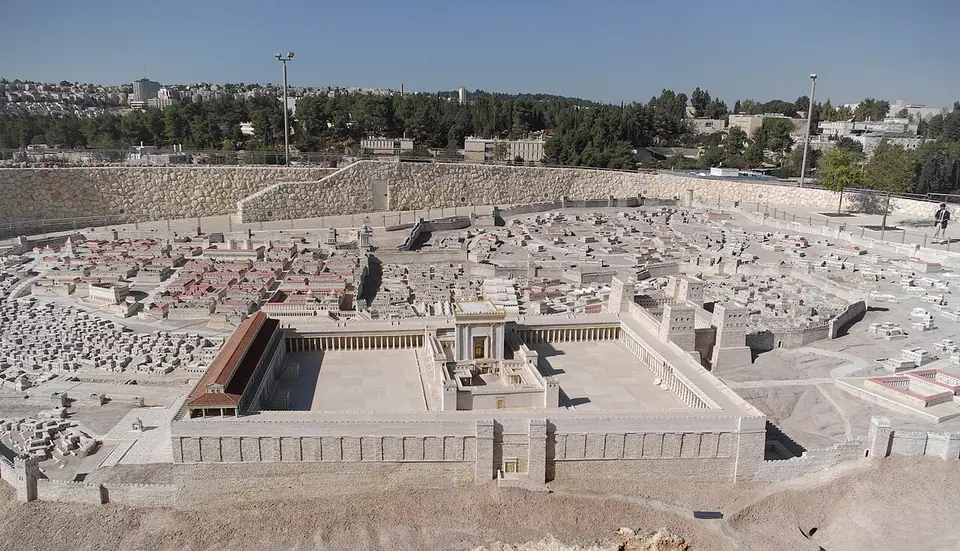
Rome ruled Judea through client kings and governors. Herod (king 37–4 BCE), an Idumean whose family had converted under the Hasmoneans, was the most ambitious builder in the region’s history. From c. 20/19 BCE he rebuilt the Temple on a vast new platform, the Temple Mount whose retaining walls, including the Western Wall, still stand. Josephus describes the complex in detail,[20] and the rabbis later said that “one who has not seen Herod’s building has never seen a beautiful building in his life” (in the William Davidson translation).[41] Consensus
The Temple was the centre of Jewish life for Jews everywhere. Diaspora Jews paid an annual half-shekel tax for its upkeep, and pilgrims came in tens or hundreds of thousands for the festivals. Its courts were graded by holiness, and a stone barrier marked how far non-Jews could go. Two of the Greek warning inscriptions set into that barrier have been found.[42] E. P. Sanders called the shared practice of this period, centred on the Temple, the Torah and the festivals, “common Judaism”: the beliefs and practices that most Jews shared, whatever school they favoured.[43] Majority
New ideas: resurrection, angels, Satan and the Messiah
Much of what later Jews and Christians took for granted about God’s world appears in Jewish writing for the first time in the Persian and Hellenistic periods. None of these ideas is found in the Torah. Consensus
The dead will rise
For most of the Hebrew Bible, the dead go down to Sheol, a shadowy underworld where, in the words of a psalm, they cannot praise God.[44] There is no judgment and no return. Ezekiel’s vision of dry bones rising (Ezekiel 37, sixth century BCE) is explicitly a metaphor for the nation’s return from exile.[45] Consensus
The first unambiguous promise of an individual resurrection is in the book of Daniel, whose visions (chapters 7–12) were written during the persecution of Antiochus IV, c. 167–164 BCE. In the NRSV’s words, “many of those who sleep in the dust of the earth shall awake, some to everlasting life, and some to shame and everlasting contempt”.[11][46] The context explains the idea. Under persecution, the faithful were dying because they kept the Torah, and the old belief that God rewards the righteous in this life no longer worked. Resurrection answered the question of justice for the martyrs. In 2 Maccabees the third of the seven brothers holds out his hands to be cut off, saying he hopes to receive them back from God.[32] Majority
From then on, belief in resurrection spread, but not to everyone. Josephus reports that the Pharisees believed in it and the Sadducees did not, and the dispute is still alive in the Gospels and in the Mishnah, which denies a share in the world to come to anyone who says there is no resurrection of the dead (§0).[47][48] The book of Ecclesiastes, from roughly the same centuries, doubts any afterlife at all.[49] Consensus
Angels with names, and the watchers
The divine council of §2 became, in this period, an army of angels with names, ranks and tasks. The book of Daniel is the first biblical book to name them: Gabriel, who explains Daniel’s visions, and Michael, the “great prince” who stands over Israel.[50][11] Raphael appears in the book of Tobit, and Uriel in 1 Enoch.[51][7] Consensus
The Book of the Watchers (1 Enoch 1–36), one of the oldest Jewish texts outside the Bible and probably of the third century BCE, retells the brief, strange story of Genesis 6 in which “the sons of God” took human wives. In Enoch, two hundred angels, the Watchers, descend to Mount Hermon, father giants, and teach humanity metalwork, cosmetics and sorcery; evil in the world comes from them, not from Adam. Aramaic fragments of it were found at Qumran, and the oldest date from the early second century BCE.[7][52] Majority
Satan
The Hebrew word śāṭān means “adversary” or “accuser”. In the books of Job and Zechariah it is a role, not a name: haśśāṭān, “the accuser”, with the definite article, is a member of God’s council who tests or prosecutes human beings with God’s permission.[53][54] Consensus
A comparison of two parallel passages shows the change. In 2 Samuel 24:1, Yahweh, angry with Israel, incites David to take a census and then punishes him for it. When the Chronicler retold the story, probably in the fourth century BCE, the verse became “Satan stood up against Israel and incited David to number Israel”, now without the article, as a proper name.[55] An action that an earlier writer was willing to attribute to God was now moved to another being. Majority
In the second and first centuries BCE that figure grew into the leader of the forces of evil, under several names: Mastema in the book of Jubilees, Belial in the Dead Sea Scrolls, where “the sons of light” fight “the sons of darkness” under the “dominion of Belial”. By the first century CE the Gospels and Paul take for granted a Satan, or devil, who rules a kingdom opposed to God’s.[56][57] Majority
The Messiah
Māšîaḥ, “anointed”, in the Hebrew Bible is a title of the reigning king, of the high priest, and once of the Persian king Cyrus (Isaiah 45:1). The prophets hoped for a future king of David’s line who would rule justly, but they did not use the word “Messiah” for him as a title.[58][59] Consensus
An expected end-time “Messiah” appears clearly in the first century BCE. The Psalms of Solomon, a collection written in Jerusalem after Pompey’s conquest of 63 BCE, pray for God to raise up “the son of David” to purge Jerusalem of gentiles and unrighteous rulers, and call him “the Lord Messiah”.[18] The Community Rule from Qumran expects two: “the Messiahs of Aaron and Israel”, a priestly and a royal one.[17][56] Messianic expectation was varied and not universal; many Jewish texts of the period do not mention a Messiah at all.[59] Majority
Was it Persian influence?
All of these ideas, resurrection, final judgment, a cosmic adversary, heaven and hell, ranks of angels, have close parallels in Zoroastrianism, the religion of the Persian kings under whom Judea lived for two centuries. Contested
| View | Argument | Main proponents |
|---|---|---|
| Persian influence | The ideas appear in Judaism only after two centuries of Persian rule, all together, and they form the core of Zoroastrian belief. A Greek historian of the fourth century BCE, Theopompus, reports that the Magi taught that people will come to life again and be immortal | Boyce[60][61] |
| Internal development | Each idea has roots inside Israelite tradition (the divine council, the accuser, Ezekiel’s dry bones, the Davidic hope) and grew under the pressure of exile and persecution; most Zoroastrian texts were written down only in the ninth century CE, so the direction of borrowing cannot be shown | Barr[62] |
| Shared environment | Persian, Greek and Jewish ideas developed in the same cosmopolitan world; influence is likely but diffuse, and cannot be traced text by text | Collins, Segal[46][63] |
| Traditional | The ideas were revealed or implied in Israel’s scriptures from the beginning; the rabbis found resurrection in the Torah itself by interpretation | Rabbinic tradition (m. Sanhedrin 10:1)[48] |
The parallel is real; proof of borrowing is not. The dating problem in the Zoroastrian sources is serious, and the Greek report is the strongest piece of early evidence for the Persian side. Contested
The schools: Pharisees, Sadducees, Essenes
Josephus describes Judaism in his day as having three “philosophies”, and later adds a fourth, the movement of Judas the Galilean, who in 6 CE called for resistance to Roman taxation in the name of God’s sole rule.[47][64] He presents them to Greek readers as schools like the Stoics and Epicureans, and his account is the starting point for all modern descriptions. Consensus on what Josephus says.
The Pharisees. Josephus says they “delivered to the people a great many observances by succession from their fathers, which are not written in the laws of Moses”, and that the Sadducees rejected these.[65] They believed in fate and free will together, in the immortality of the soul and in reward and punishment after death. They were influential with the people and, under Queen Salome Alexandra (76–67 BCE), at court.[66] The Gospels present them as Jesus’ main opponents in debates about the Sabbath and purity, a picture shaped by later conflict between the church and the synagogue. The rabbis of the Mishnah regarded the Pharisees as their predecessors, and their idea of an “Oral Torah” alongside the written one continues the Pharisaic “traditions of the fathers” (§7).[43][67] Majority
The Sadducees. Associated with the priestly aristocracy and the high priests, they accepted only the written law, denied fate, and denied the survival of the soul and resurrection. All our descriptions come from their opponents, and they disappear from history after the Temple fell.[47][2] Majority
The Essenes. Philo, Josephus and the Roman writer Pliny the Elder all describe them. They lived in disciplined communities, held property in common, admitted members after a probation of several years, bathed before communal meals and kept strict purity and Sabbath rules. Philo and Josephus both put their number at more than four thousand.[68][64] Pliny, writing in the 70s CE, places a celibate community of Essenes on the western shore of the Dead Sea, with the town of Ein Gedi “below” them.[69] Consensus on the descriptions.
Josephus’ three schools were small. He gives the Pharisees about six thousand members in Herod’s time.[70] Most Jews belonged to none of them and practised the “common Judaism” of the Temple, the Sabbath and the festivals.[43][2] Majority
The Dead Sea Scrolls and Qumran
Between 1947 and 1956, Bedouin shepherds and archaeologists found the remains of about nine hundred manuscripts in eleven caves near Khirbet Qumran, a ruin on the northwestern shore of the Dead Sea. About a quarter, some 230 manuscripts, are copies of biblical books, the oldest by a thousand years (§0). The rest include works known before, such as 1 Enoch and Jubilees, and works unknown before: community rules, hymns, commentaries on the prophets that read them as predictions of the group’s own history, and a “War Scroll” describing the final battle between the sons of light and the sons of darkness.[71] Consensus
The sectarian texts describe a community, the yaḥad, led by priests, that had separated from the Temple, which it regarded as polluted, under a figure called the Teacher of Righteousness. It followed a solar calendar of 364 days instead of the Temple’s lunar one, a difference that meant celebrating the festivals on different days.[71] Consensus
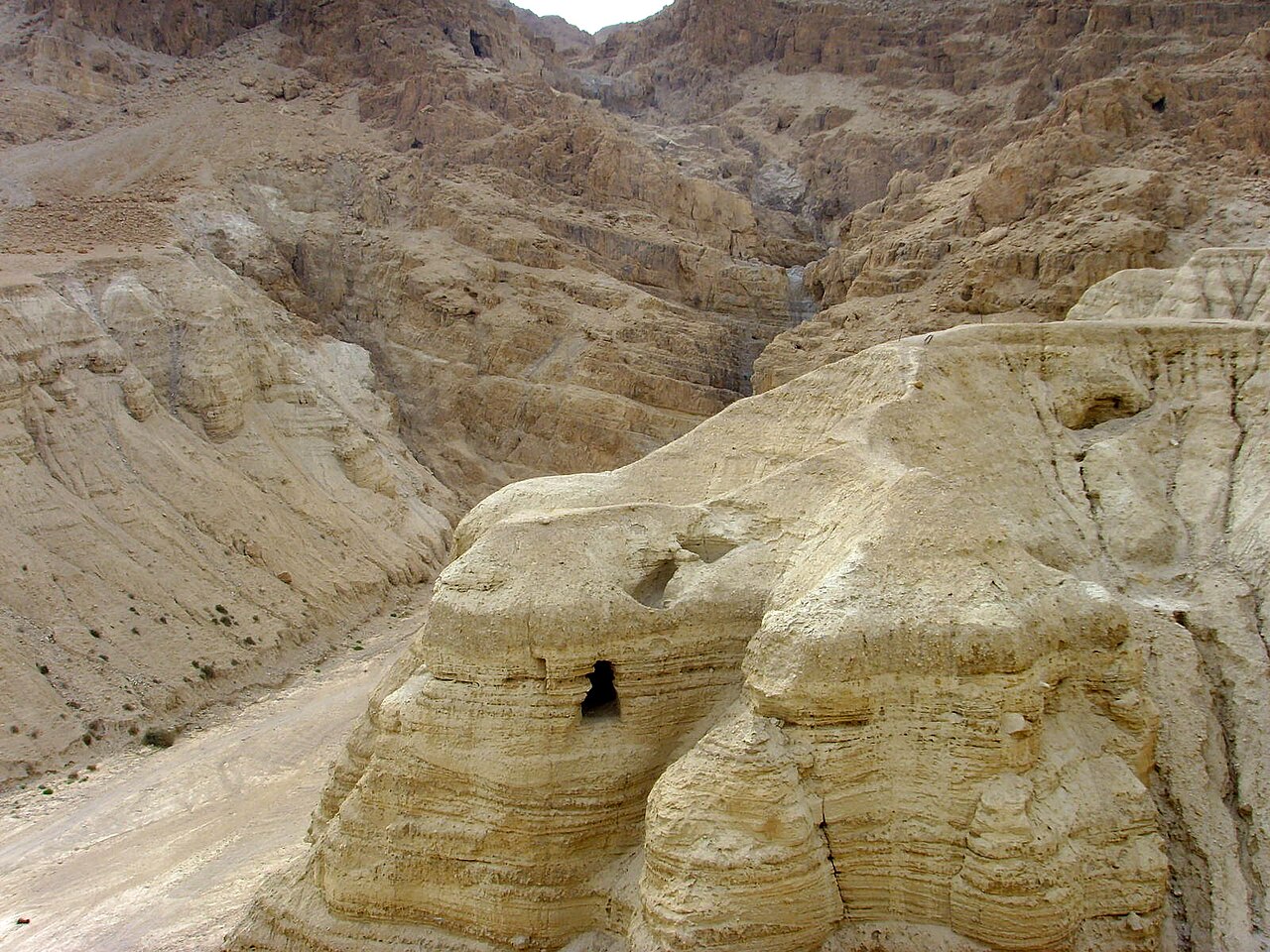
Were they Essenes? Since the first scrolls were published, the majority view, developed by Roland de Vaux and others, has been that Qumran was a settlement of Essenes, or of a group related to them, and that the scrolls were their library. The rules of admission, the common property, the communal meals and the purity rules match the classical descriptions closely, and Pliny’s location fits. Jodi Magness’s study of the site’s archaeology supports a sectarian settlement inhabited from about 100 BCE until the Romans destroyed it in 68 CE.[16] Majority
A minority disagrees. Norman Golb argued that the scrolls came from libraries in Jerusalem, hidden in the caves during the revolt against Rome, and that their variety of views shows they were not the library of a single sect.[72] Others have interpreted the site as a fortress, a villa or a pottery workshop with no connection to the caves.[73] Many scholars now take a middle view: the scrolls belonged to a wider movement with several communities, of which Qumran was one.[74] Contested
The first synagogues
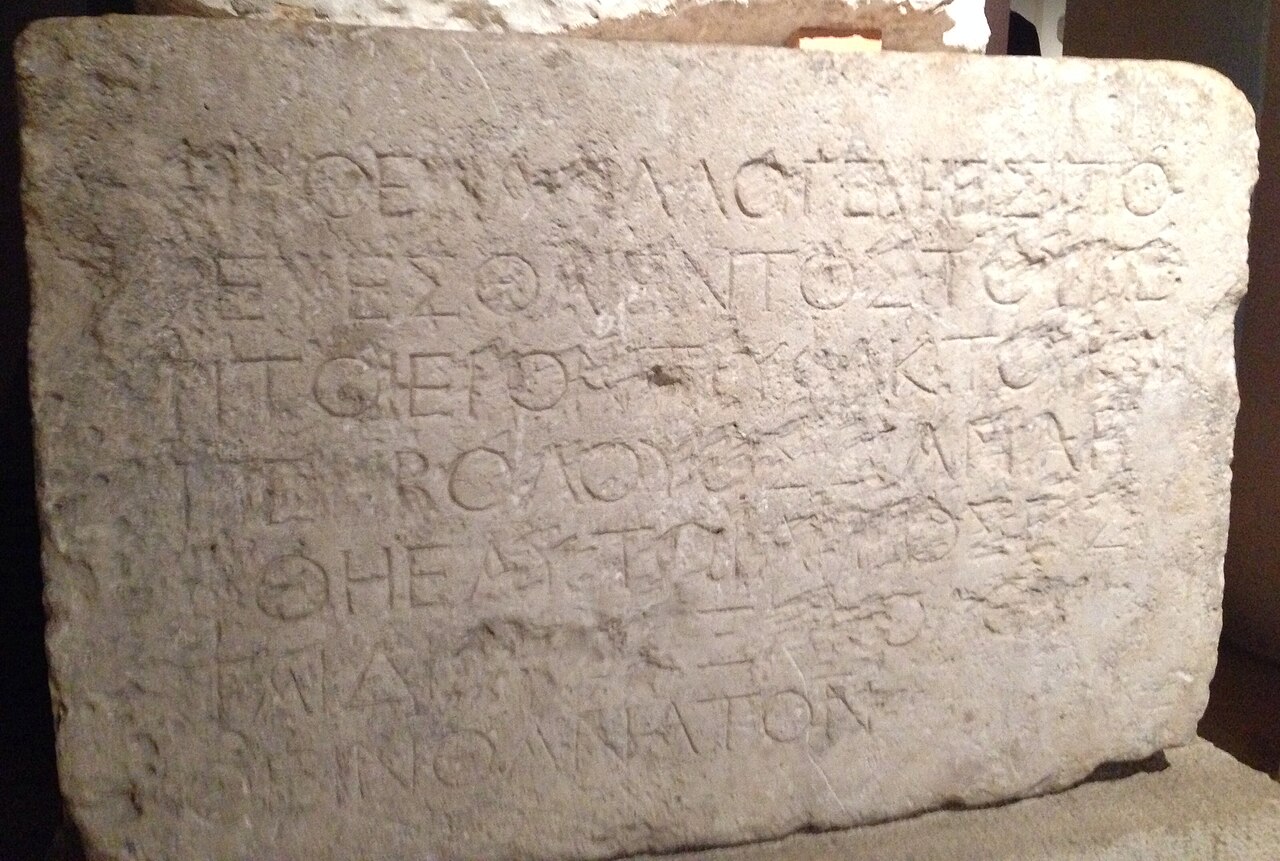
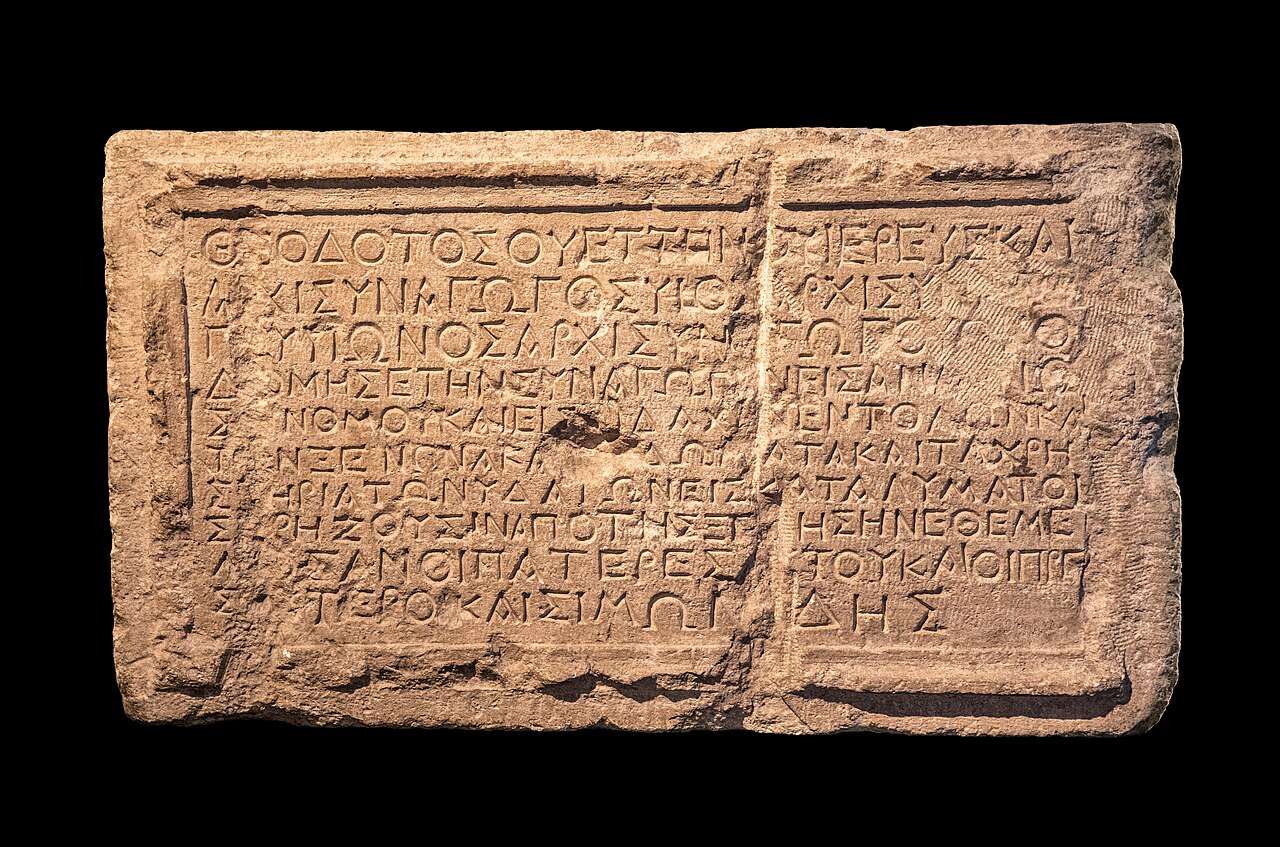
The synagogue, which became the centre of Jewish life after 70 CE (§7), existed before it. Its origins are not known. Some scholars place them in the Babylonian exile, but there is no evidence for that.[75] The earliest secure evidence is from Ptolemaic Egypt: dedicatory inscriptions for Jewish proseuchai, “prayer houses”, the oldest from Schedia near Alexandria, dedicated (in this site’s translation of the Greek) “on behalf of King Ptolemy and Queen Berenice his sister and wife and their children”, that is Ptolemy III, who reigned 246–221 BCE.[6][76][75] Consensus
In the land of Israel, synagogue buildings of the first century BCE and first century CE have been excavated at Gamla, Magdala, Masada, Herodium and several other sites: halls with benches around the walls, facing the centre, where a community sat to hear the Torah read.[77] In 2009 the synagogue at Magdala on the Sea of Galilee produced a carved stone block decorated with a seven-branched menorah.[78] Majority
The most informative evidence is an inscription found in Jerusalem in 1913, now displayed in the Israel Museum. The translation below is this site’s own, from the Greek text as edited in the Corpus Inscriptionum Iudaeae/Palaestinae.
Greek: Theodotos Vettēnou, hiereus kai archisynagōgos … ōkodomēse tēn synagōgēn eis anagnōsin nomou kai eis didachēn entolōn
“Theodotos son of Vettenos, priest and head of the synagogue, son of a head of the synagogue, grandson of a head of the synagogue, built the synagogue for the reading of the Law and the teaching of the commandments, and the guest house and the rooms and the water installations as lodging for those from abroad who need them, which his fathers, the elders and Simonides founded.”[23][79]
What it proves. That synagogues existed in Jerusalem itself while the Temple stood, that a priest could lead one, and what they were for: reading and teaching the Torah, and housing pilgrims. The inscription says nothing about prayer. Most scholars date it before 70 CE from its script and the place it was found; a few have argued for a later date.[80] Majority
The Jesus movement
Jesus of Nazareth was a Galilean Jew who taught in synagogues, went up to Jerusalem for Passover and was crucified by the Roman governor Pontius Pilate around 30 CE. His followers were, at first, one more Jewish group of the period, distinguished by their belief that he was the Messiah and had risen from the dead, both ideas that only make sense against the background described in this chapter.[22] Josephus mentions “the brother of Jesus, who was called Christ, whose name was James”, executed in Jerusalem in 62 CE on the order of the high priest.[81] Majority
How and when this movement became a separate religion, Christianity, is a question for the Christianity series and for §7, which deals with the “parting of the ways”. For this chapter, the point is that early Christianity is one of the best-documented branches of Second Temple Judaism: its earliest texts, the letters of Paul from the 50s CE, are among the few Jewish writings of the period by a named Pharisee.[82] Majority
The evidence ledger for Second Temple Judaism
| Question | What the evidence supports | Key evidence | Confidence |
|---|---|---|---|
| Greek scripture | The Torah was in Greek by the later third century BCE; the rest followed by the first century BCE | Letter of Aristeas; Ben Sira’s prologue; Qumran Greek fragments[4][5][25] | Majority |
| The Maccabean crisis | A Jewish civil war over the high priesthood and Greek ways, followed by a royal ban on Jewish practice in 167 BCE and a revolt | 1 and 2 Maccabees; Daniel 11[10][9][31] | Majority (events); Contested (causes) |
| Hanukkah | Rededication of the Temple, 164 BCE; the oil miracle is first recorded in the Talmud | 1 Macc 4; Josephus; b. Shabbat 21b[12][35][36] | Consensus |
| Resurrection | First clearly in Daniel, c. 165 BCE; accepted by Pharisees, denied by Sadducees | Daniel 12; 2 Macc 7; Josephus[11][32][47] | Consensus |
| Satan | The accuser in God’s council becomes a proper name by the 4th c. BCE and leader of evil by the 2nd–1st c. BCE | Zechariah 3; 1 Chronicles 21:1; Dead Sea Scrolls[54][55][57] | Majority |
| The Messiah | An expected end-time anointed figure appears clearly in the 1st c. BCE; expectation varied | Psalms of Solomon 17; 1QS 9:11[18][17] | Majority |
| The schools | Pharisees, Sadducees and Essenes existed and differed over oral tradition, afterlife and purity; most Jews belonged to none | Josephus; Pliny; Dead Sea Scrolls[47][65][69] | Consensus (existence); Majority (details) |
| Qumran | A sectarian community, probably related to the Essenes, owned the scrolls | Community Rule; archaeology of the site[17][16] | Majority; Contested by a minority |
| Synagogues before 70 | Egyptian prayer houses from the 3rd c. BCE; buildings in Judea and Galilee in the 1st c. CE, for Torah reading | Schedia; Theodotos; Gamla, Magdala[6][23][77] | Consensus |
| Persian influence | Parallels are real; borrowing cannot be demonstrated | Theopompus’ report; late Zoroastrian texts[61][62] | Contested |
Primary sources
1. The translation legend: Letter of Aristeas 301–307
A Greek work presenting itself as a letter by a courtier of Ptolemy II (285–246 BCE), probably written in the second century BCE. The seventy-two elders work on the island of Pharos (in H. T. Andrews’s translation, from R. H. Charles’s 1913 edition):
“So they set to work comparing their several results and making them agree, and whatever they agreed upon was suitably copied out under the direction of Demetrius … And it so chanced that the work of translation was completed in seventy-two days, just as if this had been arranged of set purpose.”[4][83]
What it proves. Not the details, which are legendary, but that by the second century BCE Alexandrian Jews held their Greek Torah to be as authoritative as the Hebrew, and told a story to prove it. Philo later added that the translators, as if inspired, all arrived at the very same words, as though an unseen prompter had dictated them.[27] Majority
2. The ban: 1 Maccabees 1:41–64
1 Maccabees was written in Hebrew, probably in the late second century BCE, as a history of the Hasmonean family; it survives only in Greek. In the Revised Standard Version:
“Then the king wrote to his whole kingdom that all should be one people, and that each should give up his customs … to forbid burnt offerings and sacrifices and drink offerings in the sanctuary, to profane sabbaths and feasts … to leave their sons uncircumcised … Now on the fifteenth day of Chislev, in the one hundred and forty-fifth year, they erected a desolating sacrilege upon the altar of burnt offering.”[10]
What it proves. That a royal decree in 167 BCE (year 145 of the Seleucid era) targeted the central practices of Judaism: sacrifice, Sabbath, circumcision and Torah. The claim that the king wanted “all to be one people” across his kingdom is not supported by other evidence; the decree seems to have applied to Judea. 1 Maccabees is a court history of the dynasty that won, and gives the Maccabean family the credit for everything. Majority
3. The rededication: 1 Maccabees 4:52–59
In the Revised Standard Version:
“Early in the morning on the twenty-fifth day of the ninth month, which is the month of Chislev, in the one hundred and forty-eighth year, they rose and offered sacrifice, as the law directs, on the new altar of burnt offering which they had built … Then Judas and his brothers and all the assembly of Israel determined that every year at that season the days of the dedication of the altar should be observed with gladness and joy for eight days.”[12]
What it proves. The date (December 164 BCE), the eight days and the reason for the festival as the participants’ own descendants told it: the dedication of a new altar. There is no oil and no miracle. Consensus
4. The oil: Babylonian Talmud, Shabbat 21b
Hebrew: mai ḥanukkah? … šekəšenikhnəsu yəvanim lahêkhal ṭimʾu kol haššəmanim šebahêkhal … lo māṣəʾu ʾelā pakh ʾeḥād šel šemen … naʿăśāh bo nēs wəhidliqu mimmennu šəmonāh yāmim
In this site’s literal translation from the Aramaic and Hebrew:
“What is Hanukkah? … When the Greeks entered the Sanctuary they defiled all the oils in it … they found only one flask of oil … and a miracle was done with it, and they lit from it for eight days.”[36]
What it proves. That by the time of the Babylonian Talmud, redacted in the fifth to seventh centuries CE from earlier traditions, the festival was explained by a miracle of light rather than by the victory. The shift fits rabbinic unease with the Hasmoneans, whose dynasty ended badly, and with celebrating military success. Majority on the interpretation.
5. The first resurrection: Daniel 12:1–3
Hebrew (12:2): wərabbîm miyyəšēnê ʾadmat-ʿāpār yāqîṣû, ʾēlleh ləḥayyê ʿôlām wəʾēlleh laḥărāpôt lədirʾôn ʿôlām.
In the New Revised Standard Version:
“At that time Michael, the great prince, the protector of your people, shall arise … Many of those who sleep in the dust of the earth shall awake, some to everlasting life, and some to shame and everlasting contempt. Those who are wise shall shine like the brightness of the sky.”[11]
What it proves. The first clear statement in the Hebrew Bible of the resurrection of individuals followed by judgment, and the first biblical book to name an angel, Michael. The vision in chapter 11 describes Antiochus IV’s actions accurately up to about 165 BCE and then predicts his death wrongly, which is how scholars date it: Porphyry, a pagan critic of the third century CE, had already made this argument.[84] Jewish and Christian tradition has read Daniel as a prophet of the Babylonian exile, which is how the book presents itself. Majority on the date.
6. The accuser becomes Satan: Zechariah 3:1–2 and 1 Chronicles 21:1
Both translations are this site’s own, kept literal to show the article.
Zechariah 3:1 (late 6th c. BCE): wayyarʾēnî ʾet-yəhôšuaʿ hakkōhēn haggādôl ʿōmēd lipnê malʾak YHWH wəhaśśāṭān ʿōmēd ʿal-yəmînô ləśiṭnô.
“Then he showed me Joshua the high priest standing before the angel of Yahweh, and the accuser standing at his right hand to accuse him.”[54]
1 Chronicles 21:1 (c. 4th c. BCE): wayyaʿămōd śāṭān ʿal-yiśrāʾēl wayyāset ʾet-dāwîd limnôt ʾet-yiśrāʾēl.
“Satan stood up against Israel, and incited David to count Israel.”[55]
What it proves. In Zechariah, “the accuser” (with the article) is a prosecutor in the heavenly court, rebuked by God. In Chronicles, the same word without the article stands in the place where the older text, 2 Samuel 24:1, had Yahweh himself. Some translators and scholars think Chronicles still means “an adversary” here, so the shift to a proper name is itself debated, but the move away from attributing the census to God is clear.[85] Majority
7. Three schools: Josephus, Jewish War 2.119–166
Josephus, a priest from Jerusalem who fought in the revolt against Rome, surrendered and wrote his histories in Rome, finished the Jewish War in the 70s CE. In William Whiston’s 1737 translation:
“For there are three philosophical sects among the Jews. The followers of the first of which are the Pharisees, of the second, the Sadducees, and the third sect, which pretends to a severer discipline, are called Essens.”[47][86]
On the afterlife: the Pharisees say that “all souls are incorruptible, but that the souls of good men only are removed into other bodies, but that the souls of bad men are subject to eternal punishment”; the Sadducees “take away the belief of the immortal duration of the soul, and the punishments and rewards in Hades”.
What it proves. That in the first century CE the afterlife was a matter of open disagreement among Jews, and that the schools differed on it as much as on law. Josephus’ Greek categories (fate, souls) are his own framing for Roman readers, and his account of the Essenes, the longest, is idealised. Majority
8. The Essenes by the Dead Sea: Pliny, Natural History 5.73
In the translation of John Bostock and H. T. Riley (1855):
“Lying on the west of Asphaltites, and sufficiently distant to escape its noxious exhalations, are the Esseni, a people that live apart from the world, and marvellous beyond all others throughout the whole earth, for they have no women among them; to sexual desire they are strangers; money they have none; the palm-trees are their only companions … Below this people was formerly the town of Engadda.”[69][87]
What it proves. That a Roman writer of the 70s CE knew of an Essene settlement on the western shore of the Dead Sea above Ein Gedi, which is where Qumran lies, if “below” means downstream or to the south. This is the main reason for identifying the Qumran community with the Essenes. Whether Pliny meant a site above Ein Gedi on the cliffs, or north of it at Qumran, is debated. Contested
9. Two messiahs: the Community Rule (1QS 9:9–11)
Hebrew: wənišpəṭû bammišpāṭîm hāriʾšônîm … ʿad bôʾ nābîʾ ûməšîḥê ʾahărôn wəyiśrāʾēl.
In Geza Vermes’s translation:
“They shall depart from none of the counsels of the Law to walk in all the stubbornness of their hearts, but shall be ruled by the primitive precepts in which the men of the Community were first instructed until there shall come the Prophet and the Messiahs of Aaron and Israel.”[17][56]
What it proves. That the Qumran community expected two anointed leaders at the end of days, one priestly (“of Aaron”) and one royal (“of Israel”), together with a prophet. Messianic hope in this period did not have a single shape; the expectation of one Davidic king, which Christianity and rabbinic Judaism both inherited, was one form among several. Majority
10. The son of David: Psalms of Solomon 17
A collection of eighteen psalms in Greek, translated from Hebrew, written in Jerusalem in the decades after Pompey’s conquest in 63 BCE. Psalm 17 condemns the Hasmoneans as usurpers of David’s throne and prays, in G. B. Gray’s translation from R. H. Charles’s 1913 edition:
“Behold, O Lord, and raise up unto them their king, the son of David … that he may purge Jerusalem from nations that trample (her) down to destruction … And there shall be no unrighteousness in his days in their midst, for all shall be holy and their king the anointed of the Lord.”[18][83]
What it proves. One of the earliest Jewish texts in which “Messiah” is a title for the expected Davidic king of the end time, a generation before Jesus. The Greek manuscripts read christos kyrios, “the Lord Messiah”, which many scholars, including the translator quoted here, G. B. Gray, take to be a mistranslation of “the Lord’s anointed”; either way the figure is a human king, not a divine being. Majority
What is absent from Second Temple Judaism
- The Talmud and the rabbis. The Mishnah and the rabbinic movement are later (§7). The Pharisees had oral traditions, but there was no written code of them. Consensus
- A closed canon. The Torah and the Prophets were authoritative; the third part of the Hebrew Bible was still open, and some groups treated books such as 1 Enoch and Jubilees as scripture (§0). Majority
- Prayer services as the centre of worship. Sacrifice in the Temple was the centre; the synagogue was a place of reading and study. Fixed daily prayers developed later. Majority
- A single Judaism. There was a shared core, but no authority that could define orthodoxy for all Jews. Consensus
- “Judaism” as a word for a religion. The Greek Ioudaismos first appears in 2 Maccabees, where it means something like loyalty to Judean ways as opposed to Greek ones (§0).[88][89] Majority
Debates about Second Temple Judaism
Was Judaism “Hellenised”?
Hengel’s thesis that Greek culture penetrated all of Judaism is widely accepted in a moderate form: Greek language, names, architecture and ideas are found everywhere, including in Jerusalem and in texts that oppose Greek ways. The counter-argument is that Hellenisation was uneven and selective, strongest among the elite and in the diaspora, and that it was adaptation rather than surrender. The traditional reading of Hanukkah, as the victory of Jewish faith over Greek culture, is closer to the second view, though the Hasmoneans themselves became Hellenistic kings.[29][2] Contested
Who wrote the Dead Sea Scrolls?
The majority view ties the scrolls to a sectarian community at Qumran related to the Essenes. Its strongest arguments are the match between the community rules and the descriptions of the Essenes, Pliny’s location, the closeness of Cave 4 to the settlement, and pottery that links the caves to the site.[16][71] The minority view, at its strongest, points to the large number of different scribal hands, the variety of opinions in the texts, and the absence of any document at Qumran that names the Essenes, and argues that the caves held libraries from Jerusalem.[72] Contested
Pharisees: a sect or the mainstream?
One view, traditional in Jewish teaching and influential among twentieth-century scholars, held that the Pharisees effectively led Judaism and that rabbinic Judaism was simply Pharisaism continued. At its strongest it points to Josephus, who says the people followed the Pharisees and that even Sadducees in office had to defer to their views.[64] Sanders argued instead that the Pharisees were a small, respected group without power to enforce their views, and that “common Judaism” was set by the priests and the Temple.[43] Most scholars now take an intermediate position: the Pharisees were influential but not dominant, and the rabbis after 70 CE drew on them without being identical to them (§7). Majority
Further reading
- Shaye J. D. Cohen, From the Maccabees to the Mishnah (3rd ed., Westminster John Knox, 2014) — the standard short introduction.
- E. P. Sanders, Judaism: Practice and Belief, 63 BCE–66 CE (SCM, 1992) — “common Judaism”.
- Martin Hengel, Judaism and Hellenism (Fortress, 1974).
- James C. VanderKam, The Dead Sea Scrolls Today (2nd ed., Eerdmans, 2010), with Jodi Magness, The Archaeology of Qumran and the Dead Sea Scrolls (Eerdmans, 2002).
- John J. Collins, The Apocalyptic Imagination (3rd ed., Eerdmans, 2016) — Daniel, Enoch and the new ideas about the end.
- Lee I. Levine, The Ancient Synagogue: The First Thousand Years (2nd ed., Yale, 2005).
- Elaine Pagels, The Origin of Satan (Random House, 1995).
- Josephus, The Jewish War (Penguin, trans. G. A. Williamson, revised by E. Mary Smallwood).
References
- ^ Josephus, Life 10–12 — The Life of Flavius Josephus. c. 94–100 CE. Greek. Josephus describes trying out the three Jewish schools as a youth and, at nineteen, beginning to conduct his public life following the school of the Pharisees.
- ^ a b c d Shaye J. D. Cohen From the Maccabees to the Mishnah. Westminster John Knox, 3rd ed., 2014. The standard short introduction to Second Temple and early rabbinic Judaism.
- ^ a b Erich S. Gruen Diaspora: Jews amidst Greeks and Romans. Harvard University Press, 2002. open library A study of Jewish life in the Hellenistic and Roman diaspora, stressing its size and its confidence.
- ^ a b c d Letter of Aristeas 301–307 — Letter of Aristeas. 2nd c. BCE. Greek. Legend of seventy-two Jewish elders translating the Torah into Greek for Ptolemy II in seventy-two days on the island of Pharos; shows the Greek Torah's authority among Alexandrian Jews. about
- ^ a b c Sirach, Prologue — Wisdom of Ben Sira (Greek translation). soon after 132 BCE. Greek. Ben Sira's grandson speaks of 'the Law and the Prophets and the others that followed them': a three-part collection whose third part has no fixed name yet. about
- ^ a b c Schedia proseuchē inscription (JIGRE 22) — Dedication of a Jewish prayer house, Schedia, Egypt. 246–221 BCE. Greek. The Jews of Schedia dedicate a proseuchē 'on behalf of King Ptolemy and Queen Berenice his sister and wife and their children': the earliest dated evidence for a synagogue.
- ^ a b c 1 Enoch 1–36 (Book of the Watchers) — 1 Enoch. 3rd c. BCE. Aramaic (surviving complete in Ge'ez). Two hundred Watchers descend to Mount Hermon, father giants and teach forbidden arts; evil comes from fallen angels. Aramaic fragments at Qumran date from the early 2nd c. BCE. about
- ^ a b Josephus, Antiquities 12.138–144 — Jewish Antiquities. c. 93 CE. Greek. Josephus quotes a letter of Antiochus III, after his conquest of Judea c. 200 BCE, granting the Jews the right to live by their ancestral laws and supporting the Temple. read the text
- ^ a b c 2 Maccabees 4:7–17 — 2 Maccabees. late 2nd–1st c. BCE. Greek. Jason buys the high priesthood from Antiochus IV, founds a gymnasium in Jerusalem and enrols citizens of Antioch; priests neglect the altar for the wrestling arena. read the text
- ^ a b c d 1 Maccabees 1:41–64 — 1 Maccabees. late 2nd c. BCE. Greek (from a lost Hebrew original). Antiochus IV forbids sacrifice, Sabbath, festivals and circumcision; on 15 Kislev of year 145 (167 BCE) a 'desolating sacrilege' is set on the Temple altar; Torah scrolls are burned. read the text
- ^ a b c d e Daniel 12:1–3 — Book of Daniel (Hebrew Bible). c. 165 BCE. Hebrew. Michael the great prince arises; 'many of those who sleep in the dust of the earth shall awake, some to everlasting life, and some to shame and everlasting contempt': the first clear biblical statement of resurrection and judgment. read the text
- ^ a b c d 1 Maccabees 4:52–59 — 1 Maccabees. late 2nd c. BCE. Greek (from a lost Hebrew original). On 25 Kislev of year 148 (164 BCE) sacrifice resumes on a new altar, and Judah and the assembly decree an annual eight-day festival of dedication. No oil miracle is mentioned. read the text
- ^ a b 1 Maccabees 14:41–47 — 1 Maccabees. late 2nd c. BCE. Greek (from a lost Hebrew original). The Jews and priests decree in 140 BCE that Simon shall be their leader and high priest 'for ever, until a trustworthy prophet should arise'. read the text
- ^ a b Josephus, Antiquities 13.254–258 — Jewish Antiquities. c. 93 CE. Greek. John Hyrcanus takes Shechem and destroys the temple on Mount Gerizim, then conquers Idumea and makes the Idumeans adopt circumcision and the Jewish laws. read the text
- ^ Mount Gerizim sacred precinct — Excavations of Yitzhak Magen, 1983–2006. mid-5th c. BCE – c. 110 BCE. A temple of Yahweh on Mount Gerizim built by the mid-fifth century BCE, enlarged in the Hellenistic period and destroyed by John Hyrcanus c. 112–110 BCE. about
- ^ a b c d Jodi Magness The Archaeology of Qumran and the Dead Sea Scrolls. Eerdmans, 2002. Dates the settlement from c. 100 BCE to 68 CE and defends its link to the scrolls.
- ^ a b c d e 1QS 9:9–11 (Community Rule) — Community Rule (Serekh ha-Yaḥad), Qumran Cave 1. c. 100–75 BCE (manuscript). Hebrew. The community is to keep its first ordinances 'until there shall come a prophet and the messiahs of Aaron and Israel': two expected anointed leaders, priestly and royal. about
- ^ a b c d Psalms of Solomon 17 — Psalms of Solomon. after 63 BCE. Greek (from Hebrew). A prayer for God to raise up 'the son of David' to purge Jerusalem, calling him christos kyrios, 'the Lord Messiah' (often emended to 'the Lord's anointed'): one of the earliest texts using Messiah as a title for the expected Davidic king. about
- ^ a b Josephus, Antiquities 14.69–73 — Jewish Antiquities. c. 93 CE. Greek. Pompey takes the Temple in 63 BCE and enters the Holy of Holies with his men, but leaves its treasures untouched. read the text
- ^ a b Josephus, Antiquities 15.380–425 — Jewish Antiquities. c. 93 CE. Greek. Herod, in his eighteenth year (20/19 BCE), undertakes to rebuild the Temple; Josephus describes the enlarged platform, porticoes, courts and the warning barrier for gentiles. read the text
- ^ a b Maren R. Niehoff Philo of Alexandria: An Intellectual Biography. Yale University Press, 2018. doi The standard modern account of Philo's life, the embassy to Gaius, and the development of his writings.
- ^ a b Tacitus, Annals 15.44 — Annals. c. 116 CE. Latin. Explaining the name of the Christians blamed for the fire of Rome, Tacitus says Christus was executed in the reign of Tiberius by the procurator Pontius Pilate.
- ^ a b c Theodotos inscription — Synagogue dedication from the City of David, Jerusalem. 1st c. BCE–70 CE (majority view). Greek. Theodotos son of Vettenos, priest and archisynagōgos, built the synagogue 'for the reading of the Law and the teaching of the commandments', with a guest house for visitors from abroad. Found 1913. about
- ^ Josephus, Jewish War 6.236–266 — Jewish War. c. 75–79 CE. Greek. An eyewitness on the Roman side describes Titus's council of war and the burning of the Temple in the summer of 70 CE, claiming Titus wished to spare it. read the text
- ^ a b c Jennifer M. Dines The Septuagint. T&T Clark, 2004. Short, reliable introduction to how and when the Greek Bible was made.
- ^ Emanuel Tov Textual Criticism of the Hebrew Bible. Fortress Press, 3rd ed., 2012. The standard work on the Masoretic text, Septuagint, Samaritan Pentateuch and Scrolls.
- ^ a b Philo, Life of Moses 2.25–44 — On the Life of Moses. c. 20–50 CE. Greek. Philo retells the Septuagint legend, says the translators, as if inspired, all used the very same words, and records an annual festival on Pharos celebrating the translation.
- ^ Philo, Embassy to Gaius — Legatio ad Gaium. c. 41 CE. Greek. Philo's own account of the riots against Alexandria's Jews in 38 CE and of the embassy he led to the emperor Gaius (Caligula) in 40 CE.
- ^ a b Martin Hengel Judaism and Hellenism: Studies in Their Encounter in Palestine during the Early Hellenistic Period. Fortress Press, 2 vols. (German original 1969), 1974. The classic argument that Greek culture shaped all Judaism, in Judea as well as abroad.
- ^ Louis H. Feldman Judaism and Hellenism Reconsidered. Brill (JSJ Supplements 107), 2006. doi Collected studies, including 'How Much Hellenism in the Land of Israel?', arguing against Hengel that Hellenisation in Judea was limited.
- ^ a b Daniel 11:31 — Book of Daniel (Hebrew Bible). c. 167–164 BCE. Hebrew. Forces of the king 'shall profane the temple and fortress and abolish the regular burnt offering and set up the abomination that makes desolate', describing Antiochus IV's actions of 167 BCE. read the text
- ^ a b c 2 Maccabees 7 — 2 Maccabees. late 2nd–1st c. BCE. Greek. A mother and her seven sons are martyred for refusing pork; the brothers declare their hope that God will raise them up and restore their bodies. read the text
- ^ 1 Maccabees 2:1–28 — 1 Maccabees. late 2nd c. BCE. Greek (from a lost Hebrew original). The priest Mattathias of Modein and his five sons; Mattathias kills a Jew sacrificing on the king's altar, and the family flees to the hills. read the text
- ^ 2 Maccabees 10:5–8 — 2 Maccabees. late 2nd or 1st c. BCE. Greek. The purification of the sanctuary on 25 Chislev, celebrated for eight days 'in the manner of the feast of booths', which the rebels had missed while hiding in the mountains; decreed for the whole nation every year. read the text
- ^ a b Josephus, Antiquities 12.323–325 — Jewish Antiquities. c. 93 CE. Greek. Josephus describes the Temple's rededication and says the festival is called 'Lights', supposing the name comes from liberty having 'appeared' to the Jews beyond their hopes. read the text
- ^ a b c b. Shabbat 21b — Babylonian Talmud. redacted c. 5th–7th c. CE. Hebrew and Aramaic. 'What is Hanukkah?': the Greeks defiled the Temple oils, one sealed flask was found, and it burned for eight days. The earliest source for the oil miracle. read the text
- ^ Elias J. Bickerman The God of the Maccabees: Studies on the Meaning and Origin of the Maccabean Revolt. Brill (German original 1937), 1979. Argues that Jewish Hellenizers, not the king, initiated the religious reform of 167 BCE.
- ^ Victor Tcherikover Hellenistic Civilization and the Jews. Jewish Publication Society, 1959. Argues that the revolt preceded the persecution, which was the king's response to unrest in Jerusalem.
- ^ Sylvie Honigman Tales of High Priests and Taxes: The Books of the Maccabees and the Judean Rebellion against Antiochos IV. University of California Press, 2014. Reads the Maccabean crisis as a conflict over taxes and the Temple, recast by Hasmonean historians.
- ^ a b Eyal Regev The Hasmoneans: Ideology, Archaeology, Identity. Vandenhoeck & Ruprecht, 2013. The Hasmonean state from coins, buildings and texts.
- ^ b. Bava Batra 4a — Babylonian Talmud. redacted c. 5th–7th c. CE. Hebrew and Aramaic. The story of Herod and Bava ben Buta, in which Herod rebuilds the Temple; the Sages say that one who has not seen Herod's building has never seen a beautiful building. read the text
- ^ Temple Warning inscription — Balustrade inscription from Herod's Temple. c. 20 BCE–70 CE. Greek. Forbids any foreigner to pass the barrier around the inner Temple courts on pain of death; one complete copy found in 1871, a fragment in 1935. about
- ^ a b c d E. P. Sanders Judaism: Practice and Belief, 63 BCE–66 CE. SCM Press / Trinity Press International, 1992. Introduces 'common Judaism': what most Jews shared, centred on Temple, Torah and festivals.
- ^ Psalm 115:17 — Psalms (Hebrew Bible). uncertain; probably Persian period. Hebrew. 'The dead do not praise Yah, nor any who go down into silence': the older biblical view of the dead in Sheol. read the text
- ^ Ezekiel 37:1–14 — Ezekiel (Hebrew Bible). 6th c. BCE. Hebrew. The valley of dry bones: bones that rise and live are explained as 'the whole house of Israel', the nation restored from exile, not individuals raised from death. read the text
- ^ a b John J. Collins The Apocalyptic Imagination: An Introduction to Jewish Apocalyptic Literature. Eerdmans, 3rd ed., 2016. Daniel, Enoch and the rise of ideas about judgment, resurrection and the end.
- ^ a b c d e f Josephus, Jewish War 2.119–166 — The Jewish War. c. 75–79 CE. Greek. The three Jewish 'philosophies': a long idealised account of the Essenes, and the Pharisees' belief in the survival of the soul and reward and punishment against the Sadducees' denial. read the text
- ^ a b m. Sanhedrin 10:1 — Mishnah. c. 200 CE. Hebrew. Abba Saul adds to those with no share in the world to come 'one who pronounces the name according to its letters'. read the text
- ^ Ecclesiastes 9:5–10 — Ecclesiastes (Hebrew Bible). c. 3rd c. BCE. Hebrew. The dead know nothing and have no more reward; there is no work or thought or knowledge or wisdom in Sheol. read the text
- ^ Daniel 8:16; 9:21 — Book of Daniel (Hebrew Bible). c. 165 BCE. Hebrew. The angel Gabriel is named and sent to explain Daniel's visions: the first angel named in the Hebrew Bible. read the text
- ^ Tobit 12:15 — Tobit. c. 3rd–2nd c. BCE. Aramaic/Hebrew (surviving complete in Greek). The angel reveals himself: 'I am Raphael, one of the seven angels who stand ready and enter before the glory of the Lord.' read the text
- ^ George W. E. Nickelsburg 1 Enoch 1: A Commentary on the Book of 1 Enoch, Chapters 1–36; 81–108. Fortress Press (Hermeneia), 2001. The standard commentary on the Book of the Watchers.
- ^ Job 1:6–12 — Job (Hebrew Bible). probably Persian period (debated). Hebrew. 'The satan' comes among the sons of God before Yahweh and, with Yahweh's permission, tests Job: a member of the divine council, not a rebel. read the text
- ^ a b c Zechariah 3:1–2 — Zechariah (Hebrew Bible). c. 520 BCE. Hebrew. "The satan" stands at the high priest Joshua's right hand to accuse him, and Yahweh rebukes him: an accuser in the divine court, not yet a rebel. read the text
- ^ a b c 1 Chronicles 21:1 (cf. 2 Samuel 24:1) — Chronicles (Hebrew Bible). c. 4th c. BCE. Hebrew. Where Samuel says Yahweh incited David to take a census, Chronicles says "a satan stood up against Israel and incited David". read the text
- ^ a b c Geza Vermes, trans. The Complete Dead Sea Scrolls in English. Penguin, rev. ed., 2004. open library The standard one-volume English translation of the non-biblical scrolls; quoted here for 1QS 9:9–11 and the 'dominion of Belial'.
- ^ a b Elaine Pagels The Origin of Satan. Random House, 1995. How the accuser of Job became the enemy of God in Jewish sectarian and early Christian writing.
- ^ Isa 45:1–7 — Isaiah (Hebrew Bible). c. 550–539 BCE. Hebrew. Yahweh calls Cyrus his 'anointed' and declares 'I am Yahweh and there is no other; besides me there is no god ... I form light and create darkness, I make peace and create evil': the Bible's first explicit monotheism. read the text
- ^ a b John J. Collins The Scepter and the Star: Messianism in Light of the Dead Sea Scrolls. Eerdmans, 2nd ed., 2010. open library The standard study of Jewish messianic expectations, including the two messiahs of the Qumran texts and the variety of messianic figures.
- ^ Mary Boyce Zoroastrians: Their Religious Beliefs and Practices. Routledge & Kegan Paul, 1979. open library Argues for an early date for Zarathustra; most scholars now place him later, and the range is wide.
- ^ a b Diogenes Laertius, Lives 1.9 (citing Theopompus) — Lives of the Eminent Philosophers. report of the 4th c. BCE, preserved 3rd c. CE. Greek. Theopompus, in book 8 of his Philippica, reports that according to the Magi people will come to life again and be immortal: early Greek evidence for a Persian belief in resurrection.
- ^ a b James Barr The Question of Religious Influence: The Case of Zoroastrianism, Judaism, and Christianity. Journal of the American Academy of Religion 53, 1985. A sceptical assessment of claims that Persian religion shaped Jewish ideas of the afterlife and evil.
- ^ Alan F. Segal Life After Death: A History of the Afterlife in Western Religion. Doubleday, 2004. From Sheol to resurrection, with the Persian and Greek background.
- ^ a b c Josephus, Antiquities 18.11–25 — Jewish Antiquities. c. 93 CE. Greek. The Pharisees, Sadducees and Essenes (more than four thousand), and the 'fourth philosophy' of Judas the Galilean, founded in opposition to the Roman census of 6 CE. read the text
- ^ a b Josephus, Antiquities 13.297–298 — Jewish Antiquities. c. 93 CE. Greek. The Pharisees 'delivered to the people a great many observances by succession from their fathers, which are not written in the laws of Moses'; the Sadducees rejected them and accepted only the written law. read the text
- ^ Josephus, Antiquities 13.408–409 — Jewish Antiquities. c. 93 CE. Greek. Queen Alexandra gives the Pharisees power in government and restores the practices they had introduced by tradition of the fathers. read the text
- ^ Shaye J. D. Cohen The Significance of Yavneh: Pharisees, Rabbis, and the End of Jewish Sectarianism. Hebrew Union College Annual 55, 27–53, 1984. Yavneh as a 'grand coalition' that ended sectarianism by tolerating dissent.
- ^ Philo, Every Good Man Is Free 75–91 — Quod omnis probus liber sit. early 1st c. CE. Greek. Philo describes the Essenes as more than four thousand in number, living in villages, holding property in common and keeping the Sabbath strictly.
- ^ a b c Pliny, Natural History 5.73 — Natural History. c. 77 CE. Latin. A celibate community of Essenes without money lives on the west side of the Dead Sea, with Ein Gedi 'below' them: the main evidence linking the Essenes to Qumran. read the text
- ^ Josephus, Antiquities 17.41–42 — Jewish Antiquities. c. 93 CE. Greek. Josephus says the Pharisees, who refused an oath of loyalty to Herod, numbered above six thousand. read the text
- ^ a b c James C. VanderKam The Dead Sea Scrolls Today. Eerdmans, 2nd ed., 2010. The clearest introduction to the Scrolls and the debates around them.
- ^ a b Norman Golb Who Wrote the Dead Sea Scrolls? The Search for the Secret of Qumran. Scribner, 1995. The strongest statement of the minority view that the scrolls came from Jerusalem libraries.
- ^ Yizhar Hirschfeld Qumran in Context: Reassessing the Archaeological Evidence. Hendrickson, 2004. open library The fullest case that Qumran was a fortified manor house unconnected with the scrolls.
- ^ John J. Collins Beyond the Qumran Community: The Sectarian Movement of the Dead Sea Scrolls. Eerdmans, 2010. open library Argues that the yaḥad was a movement with several settlements, of which Qumran was only one.
- ^ a b Lee I. Levine The Ancient Synagogue: The First Thousand Years. Yale University Press, 2nd ed., 2005. The standard history of the synagogue from its origins to late antiquity.
- ^ William Horbury and David Noy Jewish Inscriptions of Graeco-Roman Egypt. Cambridge University Press, 1992. open library The corpus (JIGRE) of Jewish inscriptions from Egypt, including the Schedia proseuchē dedication (no. 22).
- ^ a b Anders Runesson, Donald D. Binder and Birger Olsson The Ancient Synagogue from Its Origins to 200 C.E.: A Source Book. Brill, 2008. Every text and site for the early synagogue, with translations.
- ^ Mordechai Aviam The Decorated Stone from the Synagogue at Migdal: A Holistic Interpretation and a Glimpse into the Life of Galilean Jews at the Time of Jesus. Novum Testamentum 55, pp. 205–220, 2013. doi Publication and interpretation of the menorah stone found in the first-century synagogue at Magdala in 2009.
- ^ Hannah M. Cotton et al., eds. Corpus Inscriptionum Iudaeae/Palaestinae, Vol. I: Jerusalem, Part 1. De Gruyter, 2010. open library The current critical corpus of inscriptions from Jerusalem, including the Theodotos synagogue inscription.
- ^ John S. Kloppenborg Verbin Dating Theodotos (CIJ II 1404). Journal of Jewish Studies 51, pp. 243–280, 2000. doi Answers the arguments for a post-70 date and defends a date before the destruction of the Temple.
- ^ Josephus, Antiquities 20.200 — Jewish Antiquities. c. 93 CE. Greek. The high priest Ananus has 'the brother of Jesus who was called Christ, whose name was James' stoned in 62 CE; the passage is generally accepted as authentic. read the text
- ^ Philippians 3:5 — Paul, Letter to the Philippians. c. 50s CE. Greek. Paul describes himself as circumcised on the eighth day, of the tribe of Benjamin, a Hebrew of Hebrews, 'as to the law a Pharisee'. read the text
- ^ a b R. H. Charles, ed. The Apocrypha and Pseudepigrapha of the Old Testament in English, Vol. 2: Pseudepigrapha. Clarendon Press, Oxford, 1913. full text The classic English edition; source of H. T. Andrews's translation of the Letter of Aristeas and G. B. Gray's of the Psalms of Solomon quoted here.
- ^ John J. Collins Daniel: A Commentary on the Book of Daniel (Hermeneia). Fortress Press, 1993. open library The standard critical commentary on Daniel, including its Maccabean dating and Porphyry's early argument for it.
- ^ Peggy L. Day An Adversary in Heaven: śāṭān in the Hebrew Bible. Scholars Press (Harvard Semitic Monographs 43), 1988. open library Argues that śāṭān in the Hebrew Bible, including 1 Chronicles 21:1, is a common noun, 'an adversary', not yet the proper name Satan.
- ^ William Whiston, trans. The Genuine Works of Flavius Josephus, the Jewish Historian. London, 1737. The public-domain English translation of Josephus quoted throughout this chapter.
- ^ John Bostock and H. T. Riley, trans. The Natural History of Pliny. Henry G. Bohn, London, 1855. The public-domain English translation of Pliny's Natural History quoted for the Essenes by the Dead Sea.
- ^ 2 Maccabees 2:21 — 2 Maccabees. late 2nd–1st c. BCE. Greek. Praises those who fought bravely 'for Judaism' (Ioudaismos): the earliest attestation of the word. read the text
- ^ Steve Mason Jews, Judaeans, Judaizing, Judaism: Problems of Categorization in Ancient History. Journal for the Study of Judaism 38, 2007. Argues that Ioudaios should be translated 'Judean' throughout antiquity.