Purgatory has no founder and no single starting point. It grew out of something older and much more widespread, the custom of praying for the dead, and took shape over more than a thousand years: a cleansing fire in Augustine and Gregory the Great, a new noun in twelfth-century Paris, a conciliar statement in 1274. Its history is a good example of how a doctrine can be both very old and quite recent, depending on which part of it is meant.[1][2] Majority
Prayer for the dead
Christians prayed for their dead from the earliest centuries, in inscriptions and in the liturgy. The practice had Jewish roots. In 2 Maccabees, written in the late second or early first century BCE, Judas Maccabeus collects money for a sin offering for soldiers who had died wearing idolatrous amulets: “he made atonement for the dead, so that they might be delivered from their sin”.[3] Consensus If prayers could help the dead, the dead were in a state where help was possible: not yet in heaven, not beyond hope. That inference is the seed of the later doctrine.
The biblical texts
No biblical passage names purgatory. The Catechism says that the church’s tradition, “by reference to certain texts of Scripture, speaks of a cleansing fire”, citing among them 2 Maccabees, which Catholics count as scripture and Protestants do not.[4] Consensus Two texts became central:
- 1 Corinthians 3:11–15. Paul says that each builder’s work will be tested by fire on the Day: “If the work is burned up, the builder will suffer loss; the builder will be saved, but only as through fire.”[5] Catholic interpreters from Augustine on read this as a purification after death; many modern exegetes read it as a picture of the final judgment of Christian teachers’ work. Contested on the meaning.
- Matthew 12:32. Jesus says that a sin against the Holy Spirit will not be forgiven “either in this age or in the age to come”, which Gregory the Great took to imply that some sins can be forgiven in the age to come.[6][7] Consensus on Gregory’s reading.
The Protestant Reformers rejected 2 Maccabees as scripture, which is one reason the argument over purgatory and the argument over the canon went together in the sixteenth century (§9).[8][9] Consensus
The fire: Augustine and Gregory
Augustine (354–430) speculated that some believers might pass through a “purgatorial fire” after death for lesser sins, though he presented this as a possibility rather than a settled teaching.[1] Majority Gregory the Great, pope from 590 to 604, was more definite. In the fourth book of his Dialogues he told stories of souls doing penance after death and wrote:
“But yet we must believe that before the day of judgment there is a Purgatory fire for certain small sins.” (trans. 1608, revised by Edmund Gardner, 1911)[7]
Consensus Gregory’s stories of the dead appearing to ask for masses were widely copied in the Middle Ages, and they tied the fate of the dead to the masses said by the living.
The birth of a place
In The Birth of Purgatory (French 1981, English 1984), Jacques Le Goff argued that the noun purgatorium, naming purgatory as a third place alongside heaven and hell, first appears in the Paris schools between about 1170 and 1180. Before then writers spoke of “purgatorial fires” or “purgatorial punishments”, using an adjective. For Le Goff, the new noun marked a new geography of the afterlife, and with it a new relationship between the living and the dead, managed by the church.[1] Majority on the word.
His critics agreed about the word but not about its importance. Graham Robert Edwards argued that the belief in purification after death and the practice of prayer for the dead developed continuously from the early church, and that the twelfth-century noun named an old idea rather than creating a new one.[2] Contested on how much changed.
The councils
The first council to state the doctrine was the Second Council of Lyon in 1274, where a profession of faith accepted by the Greek envoys said that souls who die in charity but before completing penance are cleansed after death and are helped by the prayers, masses and alms of the living.[10] Consensus It was a statement made for the sake of union with the Greek church, which rejected the union soon afterwards.
At Ferrara in 1438, in the first sessions of the Council of Ferrara–Florence, the question was argued again with the Greeks. Their spokesman, Mark, metropolitan of Ephesus, objected above all to the Latin idea of a purgatorial fire.[11] The decree of 6 July 1439 says that the souls of the truly penitent who die before making satisfaction “are cleansed after death by cleansing pains”, helped by “sacrifices of masses, prayers, almsgiving”; it does not mention fire or define purgatory as a place.[12] Consensus
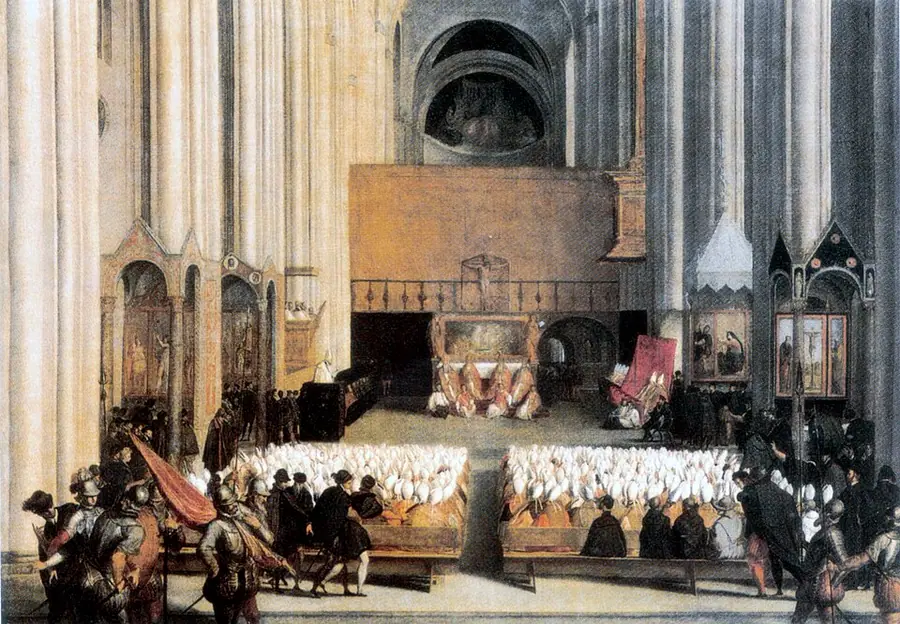
The Council of Trent, answering the Reformers, reaffirmed in 1563 “that there is a Purgatory, and that the souls there detained are helped by the suffrages of the faithful”, and told bishops to keep “the more difficult and subtle questions” out of popular preaching.[13] Consensus Modern Catholic teaching follows the same restraint. The Catechism of the Catholic Church calls purgatory “this final purification of the elect, which is entirely different from the punishment of the damned”,[4] and John Paul II told a general audience in 1999 that the term “does not indicate a place, but a condition of existence”.[14] Consensus
Purgatory, money and the Reformation
By the later Middle Ages purgatory sustained an economy. Chantries, endowed masses for the dead, guilds that prayed for their members, and indulgences that remitted temporal punishment, applicable by the fifteenth century to souls in purgatory, all depended on it.[15][16] Majority It was the sale of such an indulgence that provoked Luther’s theses in 1517: “They preach man who say that so soon as the penny jingles into the money-box, the soul flies out [of purgatory].” (trans. Henry E. Jacobs and Adolph Spaeth)[17] Consensus
The Reformers went further than Luther’s theses. Lutheran, Reformed and Anglican churches rejected purgatory altogether. The Church of England’s Article 22 calls “the Romish Doctrine concerning Purgatory” “a fond thing vainly invented, and grounded upon no warranty of Scripture”.[18][9] Consensus With purgatory went masses for the dead, chantries and the guilds’ prayers, a change that Eamon Duffy’s study of English parishes shows reaching into every parish.[15] Majority
The Orthodox position
The Orthodox churches pray for the dead, in the liturgy and in memorial services, and believe the prayers help them. They did not adopt the Latin doctrine, rejecting in particular its language of satisfaction and fire, and they treat the state of the dead before the final judgment as a mystery rather than a defined process.[19] Majority Purgatory therefore appears in the lists of disagreements between the churches (see the question on why they split).
The case on each side
| View | Main argument | Main proponents |
|---|---|---|
| A twelfth-century invention | The noun, the idea of a place and the system of payments transformed the afterlife | Le Goff[1] |
| A slow development | Purification after death and prayer for the dead grew continuously from the early church | Edwards[2] |
| An apostolic teaching | Purgatory is implied by scripture and the church’s ancient prayer for the dead | Catholic teaching[4] |
| A human invention | No scriptural warrant; it undermines salvation by grace | The Reformers; Article 22[18] |
Historians can date the word, the councils and the practices; whether the doctrine is true is a question for theology, not history (§0). Contested on the historical question of how new it was.
Common misconceptions
- “Purgatory was invented in the Middle Ages.” The noun was; prayer for the dead and the idea of a cleansing fire are much older. Majority
- “The church teaches that purgatory is a place of fire.” Neither Lyon, Florence nor Trent defined it as a place or a fire, though the Catechism, following Gregory, still speaks of a “cleansing fire”; popular preaching and art made it a place. Consensus
- “Purgatory is in the Bible.” No text names it; the doctrine rests on tradition and on readings of a few passages, including 2 Maccabees, which Protestants do not accept as scripture. Consensus
- “The Orthodox do not pray for the dead.” They do; they reject the Latin doctrine, not the prayers. Consensus
Why it matters
Purgatory shows how a doctrine can be built from practice upward: first people prayed for the dead, then theologians explained why the prayers worked, then councils defined the explanation. It shaped medieval religion and money, set off the Reformation, and still separates Catholics from both Protestants and the Orthodox (§8, §9).
References
- ^ a b c d Jacques Le Goff The Birth of Purgatory. University of Chicago Press (trans. Arthur Goldhammer; French 1981), 1984. Dates the noun purgatorium and the idea of purgatory as a place to c. 1170–1180.
- ^ a b c Graham Robert Edwards Purgatory: 'Birth' or 'Evolution'?. Journal of Ecclesiastical History 36: 634–646, 1985. A critique of Le Goff's twelfth-century 'birth' of purgatory.
- ^ 2 Maccabees 12:43–45 — 2 Maccabees. late 2nd or 1st c. BCE. Greek. Judas Maccabeus sends money for a sin offering for the fallen: 'he made atonement for the dead, so that they might be delivered from their sin' (NRSV). read the text
- ^ a b c Catechism of the Catholic Church 1030–1032 — Catechism of the Catholic Church. 1992/1997. English (Latin typical edition 1997). Purgatory is 'this final purification of the elect, which is entirely different from the punishment of the damned'; the church's tradition, 'by reference to certain texts of Scripture, speaks of a cleansing fire'. read the text
- ^ 1 Corinthians 3:11–15 — Paul, First Letter to the Corinthians. c. 54 CE. Greek. Each builder's work will be tested by fire; if it is burned up, 'the builder will be saved, but only as through fire'. read the text
- ^ Matthew 12:32 — Gospel of Matthew (New Testament). c. 80–90 CE. Greek. A sin against the Holy Spirit will not be forgiven 'either in this age or in the age to come'. read the text
- ^ a b Gregory the Great, Dialogues 4.39 (4.41 in some editions) — Dialogues. c. 593–594 CE. Latin. 'Before the day of judgment there is a Purgatory fire for certain small sins.' read the text
- ^ Council of Trent, Session 4, Decree concerning the Canonical Scriptures (8 April 1546) — Canons and Decrees of the Council of Trent. 1546. Latin. Receives Scripture and unwritten traditions with equal reverence and lists the canonical books, including the deuterocanonical ones, under anathema. read the text
- ^ a b Carlos M. N. Eire Reformations: The Early Modern World, 1450–1650. Yale University Press, 2016. The Reformations in the plural, including Catholic renewal.
- ^ Second Council of Lyon (1274), profession of faith — Acts of the Second Council of Lyon. 1274 CE. Latin. Souls who die in charity before completing penance are cleansed after death and helped by the prayers and masses of the living. about
- ^ Mark of Ephesus, writings against purgatory at Ferrara–Florence — Mark Eugenikos, metropolitan of Ephesus. 1438–1439. Greek. The Greek spokesman at Ferrara–Florence argues against the Latin doctrine of purgatory, above all against a purgatorial fire. about
- ^ Council of Florence, Laetentur caeli (6 July 1439) — Decree of union with the Greeks. 1439 CE. Latin and Greek. Accepts the filioque as licitly added, allows leavened or unleavened bread, and says the souls of the penitent 'are cleansed after death by cleansing pains', without mentioning fire. read the text
- ^ Council of Trent, Session 25, Decree concerning Purgatory (3 December 1563) — Canons and Decrees of the Council of Trent. 1563 CE. Latin. Reaffirms 'that there is a Purgatory' helped by the suffrages of the faithful, and excludes 'the more difficult and subtle questions' from popular preaching. read the text
- ^ John Paul II, General Audience (4 August 1999) — Papal general audience. 1999. Italian (English translation). The term purgatory 'does not indicate a place, but a condition of existence'. read the text
- ^ a b Eamon Duffy The Stripping of the Altars: Traditional Religion in England, c. 1400–c. 1580. Yale University Press, 1992. Late-medieval English Catholicism as vigorous and popular.
- ^ Diarmaid MacCulloch Reformation: Europe's House Divided, 1490–1700. Allen Lane, 2003. The standard one-volume history, Catholic and Protestant together.
- ^ Martin Luther, Ninety-five Theses and letter to Albrecht of Mainz (31 October 1517) — Disputation on the Power and Efficacy of Indulgences. 1517. Latin. The theses against the preaching of indulgences, with Luther's covering letter to Archbishop Albrecht dated 31 October 1517; thesis 27 attacks the claim that the soul flies out of purgatory when the penny jingles. read the text
- ^ a b Thirty-nine Articles, Article 22: Of Purgatory — Articles of Religion of the Church of England. 1563/1571. English. 'The Romish Doctrine concerning Purgatory… is a fond thing vainly invented, and grounded upon no warranty of Scripture.' read the text
- ^ Timothy (Kallistos) Ware The Orthodox Church: An Introduction to Eastern Christianity. Penguin, new ed., 2015. The standard introduction, updated for the post-communist revival.