Rabbinic Judaism in one paragraph
In 70 CE the Romans burned the Temple in Jerusalem, and with it the centre of Jewish religion as it had been practised for centuries: sacrifice, the priesthood, and pilgrimage to a single holy place. Sixty-five years later a second revolt ended with Jerusalem turned into a Roman colony that Jews could not enter. Out of these disasters a group of scholars, who called their teachers rabbi, “my master”, built a religion that could be practised anywhere: daily prayer in place of the daily offering, the synagogue and the study house in place of the Temple, and an expanding body of law, which they called the Oral Torah and traced back to Moses. They compiled it in the Mishnah around 200 CE and debated it for another four centuries in the Talmuds of Galilee and Babylonia. Their authority grew slowly, and the archaeology of the period shows a Jewish world more varied than their writings admit. But by the time the Arab armies arrived in the 630s, the rabbis’ Judaism was well on the way to becoming simply Judaism. Majority
The traditional account, preserved in the rabbis’ own writings, presents this as continuity: the sages at Yavneh received the tradition from their teachers, who received it in an unbroken chain from Moses at Sinai. Historians see a real continuity with the Pharisees of the Second Temple period (§6), but also a reinvention, and the gap between those two pictures is the subject of this chapter. Majority
Timeline of rabbinic Judaism and its evidence
| Date | Event or evidence | Confidence |
|---|---|---|
| 66 CE | Revolt against Rome breaks out in Judaea[1] | Consensus |
| 70 CE (summer) | Titus captures Jerusalem; the Temple is burned[1] | Consensus |
| c. 70–90 CE | Rabbinic tradition places Yohanan ben Zakkai and then Rabban Gamaliel II at Yavneh[2][3] | Majority (a circle at Yavneh); Contested (its role) |
| 71 and 81 CE | Titus’s triumph in Rome; the Arch of Titus shows the Temple’s menorah carried as spoils[4] | Consensus |
| 73 or 74 CE | Fall of Masada, the last rebel fortress[5] | Consensus |
| 115–117 CE | Jewish revolts in Egypt, Cyrene and Cyprus devastate the great diaspora communities[6][7] | Consensus |
| 132–135/6 CE | The Bar Kokhba revolt; Jerusalem refounded as Aelia Capitolina[8][9] | Consensus |
| mid-2nd c. CE | The rabbinic centre moves to Galilee: Usha, Beth Sheʿarim, Sepphoris, later Tiberias[10] | Majority |
| c. 200 CE | The Mishnah compiled under Rabbi Judah the Patriarch[11][10] | Majority |
| early 3rd c. CE | Rav and Shmuel found the Babylonian rabbinic schools at Sura and Nehardea (traditional dates)[12][13] | Majority |
| 244/245 CE | The painted synagogue at Dura-Europos on the Euphrates is rebuilt with biblical frescoes[14] | Consensus |
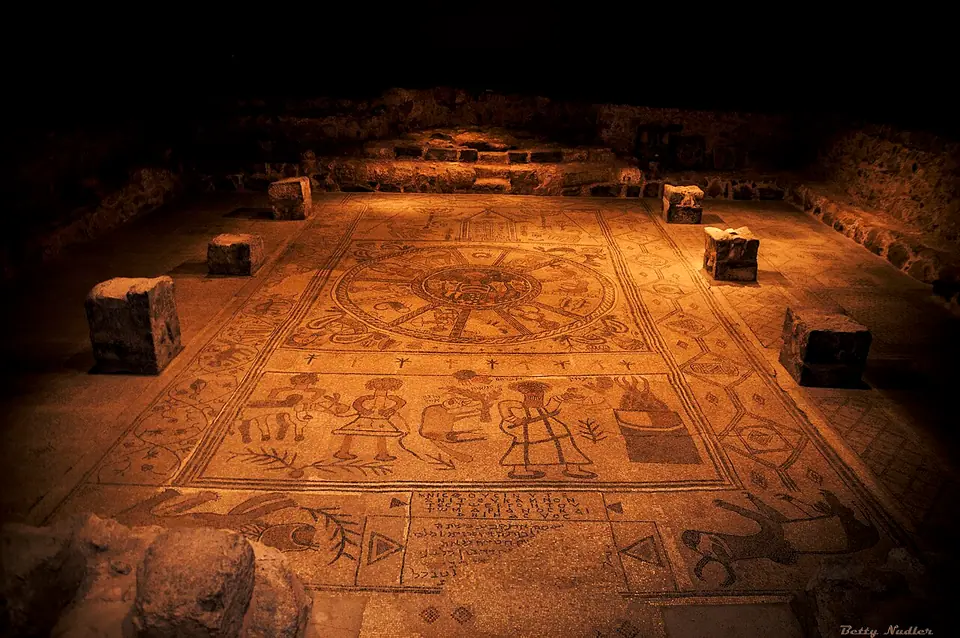
| 4th or early 5th c. CE | The Hammat Tiberias synagogue floor shows Helios and the zodiac[15][16] | Majority |
| 363 CE | The emperor Julian’s attempt to rebuild the Temple is abandoned[17] | Consensus |
| c. 400 CE | The Jerusalem Talmud is completed in Galilee[10] | Majority |
| c. 429 CE | The office of the Jewish Patriarch in the land of Israel lapses under Roman law[18][19] | Majority |
| 6th–7th c. CE | The Beit Alfa synagogue mosaic; the Rehob inscription of agricultural law[20][21] | Majority |
| c. 500–700 CE | The Babylonian Talmud reaches its final form through anonymous editors[22] | Majority |
| 614–638 CE | Persian, then Arab conquest of Jerusalem (§8) | Consensus |
The destruction and its aftermath
The revolt that began in 66 CE ended in the summer of 70, when Titus’s legions broke into the Temple precinct. Josephus, a former rebel general who watched the siege from the Roman side, describes the sanctuary burning and claims Titus had wanted to spare it; the Christian writer Sulpicius Severus, writing around 400 and possibly following Tacitus, says Titus ordered it destroyed. Either way, the building and its rites ended.[1][23][7] Consensus on the destruction; Contested on Titus’s intent.
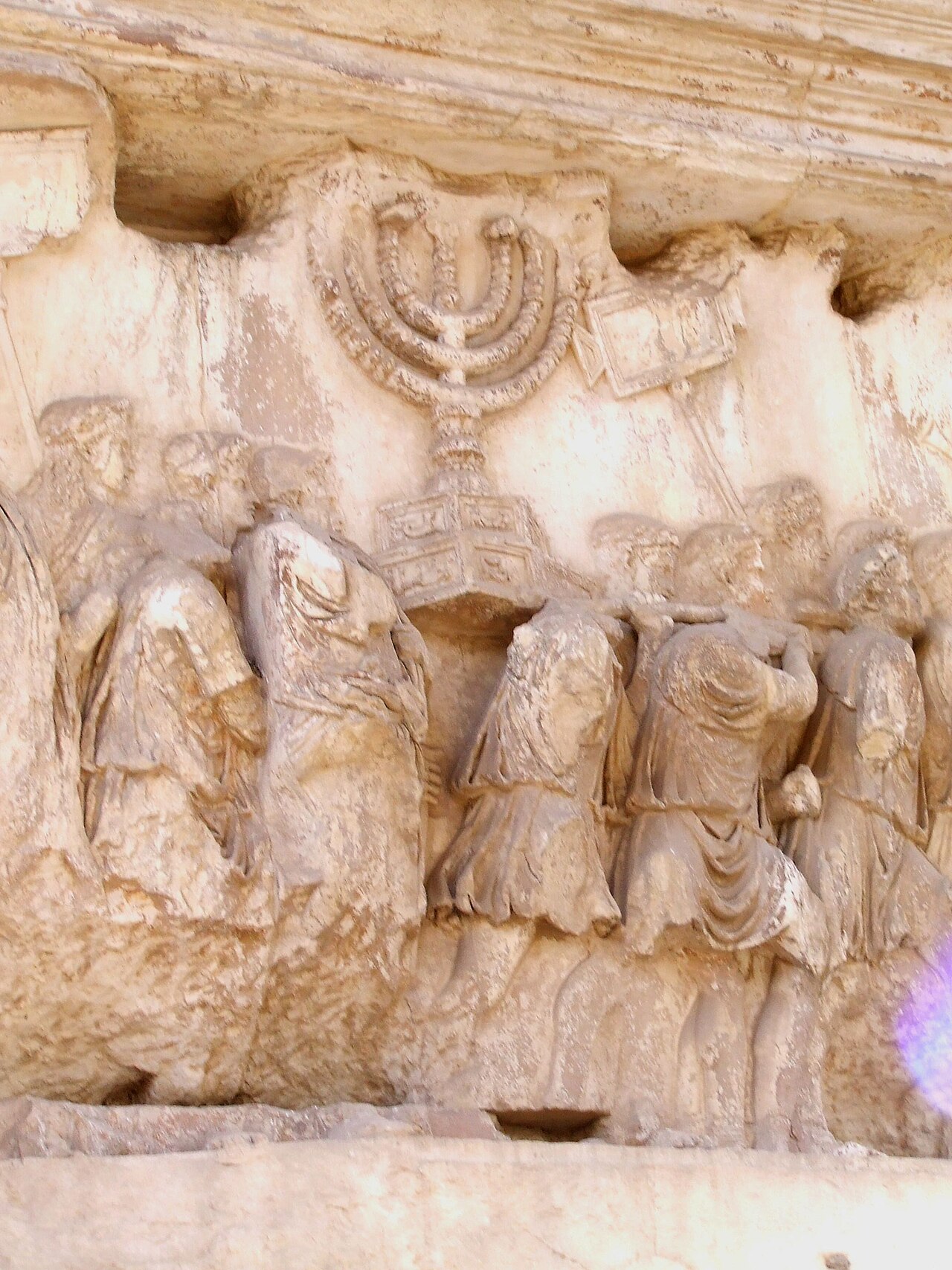
What the destruction removed was enormous. The Torah’s laws of purity, atonement and the festivals were written around a sanctuary. The high priest’s rite on the Day of Atonement, the Passover lamb, the first fruits, the half-shekel tax: all assumed the Temple. Rome turned the half-shekel into the fiscus Iudaicus, a tax paid by Jews to the temple of Jupiter Capitolinus in Rome.[24] Consensus
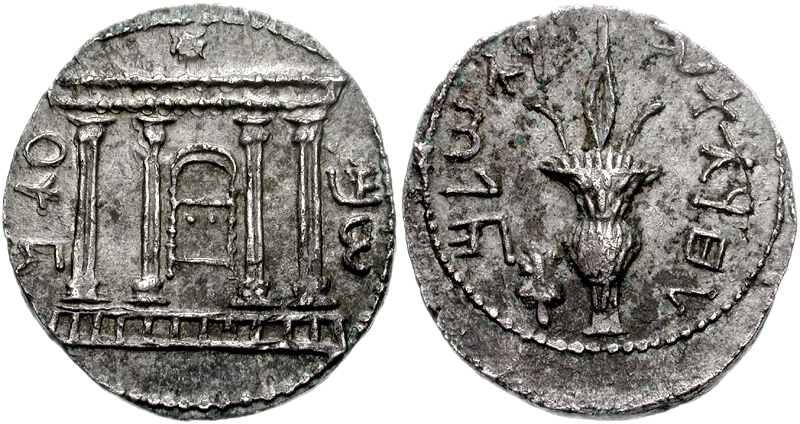
Many Jews expected the Temple to be rebuilt, as it had been after the Babylonian destruction (§5). That hope drove the next great revolt. The causes of the Bar Kokhba war of 132 are disputed: Cassius Dio blames Hadrian’s plan to refound Jerusalem as a Roman colony with a temple of Jupiter; a late Roman source blames a ban on circumcision.[8][25] Its leader, Shimon bar Kosiba, minted coins reading “Year one of the redemption of Israel” and “For the freedom of Jerusalem”, and styled himself nĕśîʾ yiśrāʾēl, “prince of Israel”.[26][27] Dio reports 580,000 Jewish dead and 985 villages destroyed; the figure is probably exaggerated, but the devastation of Judaea is confirmed by archaeology.[8][28] Majority
After 135, Jews were forbidden to enter Jerusalem except, by later accounts, on the anniversary of the destruction. Judaea was depopulated; the province was renamed Syria Palaestina. The surviving Jewish population and its scholars moved north, to Galilee, where the rabbinic movement would grow for the next five centuries.[28][7] Majority
Yavneh: what happened, and what did not
The rabbis’ own story of their origins begins with an escape. During the siege, Yohanan ben Zakkai has his disciples carry him out of Jerusalem in a coffin, meets the Roman general Vespasian, predicts that he will become emperor, and asks for a single favour: “Give me Yavneh and its sages.”[29][2] At Yavneh, a small town near the coast, the sages are said to have reconstituted the religion. Consensus on what the sources say.
The story is a founding legend, told in its full form in texts written centuries later; a version in which Vespasian is greeted as emperor appears in Josephus too, applied to Josephus himself.[30] Most historians accept that a circle of sages gathered at Yavneh after 70 under Yohanan ben Zakkai and then Rabban Gamaliel II, but not the dramatic details.[3] Majority
The Council of Jamnia. A great deal was later loaded onto Yavneh. In 1871 the historian Heinrich Graetz proposed that a council there, around 90 CE, closed the canon of the Hebrew Bible, and for a century textbooks repeated it. The only rabbinic evidence is a debate in the Mishnah about whether the Song of Songs and Ecclesiastes “defile the hands”, that is, have the sanctity of Scripture, decided “on the day they seated Rabbi Eleazar ben Azariah” as head of the academy.[31] Rabbi Akiva’s verdict on the first book is famous: “all the writings are holy but the Song of Songs is the holy of holies” (Joshua Kulp’s translation). In 1964 Jack P. Lewis showed that nothing in the sources describes a council deciding the canon, and most scholars now treat “Jamnia” as a modern construction. The scriptures used at Yavneh were largely those Josephus already counts as twenty-two books (§0); the edges remained debated afterwards.[32][33] Majority
A grand coalition. In an influential article of 1984, Shaye Cohen argued that Yavneh’s real significance was the end of sectarianism. Before 70 there were Pharisees, Sadducees, Essenes and others, each claiming to be the true Israel (§6). The rabbis at Yavneh, he argued, created a community that tolerated disagreement within itself, recording majority and minority opinions side by side, rather than splitting into sects.[3] The Mishnah and Talmuds do preserve dissenting views as a matter of principle. Majority on the pattern; Contested on how early it began.
Were the rabbis Pharisees? The rabbinic sages descend in large part from the Pharisees, whom Josephus describes as experts in “ancestral traditions” not written in the law of Moses.[34] Hillel and Shammai, the great teachers of the generation before the destruction, appear in rabbinic texts as founders of two schools. But the rabbis rarely called themselves Pharisees, and they absorbed priestly and scribal traditions as well.[3][35] Majority
The Oral Torah and the Mishnah
The central idea of rabbinic Judaism is that God gave Moses two Torahs at Sinai: the written one, and an oral one that explains it. The tractate Avot, “the Fathers”, opens with the chain of transmission: Moses received the Torah at Sinai and passed it to Joshua, Joshua to the elders, the elders to the prophets, the prophets to the men of the Great Assembly, and from them through pairs of teachers to Hillel and Shammai and the rabbis.[11] Consensus on the text.
Historians read this chain as a claim of authority, not a record. Its earliest stages are legendary, and the “men of the Great Assembly” are otherwise almost unknown. It allowed the rabbis to present their rules, many of them clearly developed in their own time, as ancient and Mosaic. The rabbis themselves were not naive about this; one of the most striking stories in the Talmud, quoted below, has Moses visit Rabbi Akiva’s classroom and fail to understand the teaching attributed to him.[36] Majority
The Mishnah. Around 200 CE, in Galilee, the circle of Rabbi Judah the Patriarch (Rabbi Yehudah ha-Nasi, often just “Rabbi”) produced the Mishnah, “repetition” or “teaching”. It is a law code in Hebrew, organised in six orders and sixty-three tractates: agriculture, festivals, women and marriage, damages and courts, sacrifices, and purity. Its most remarkable feature is how much of it concerns things that no longer existed. The fifth and sixth orders describe Temple sacrifice and priestly purity in exact detail, more than a century after the Temple fell.[10][37] Consensus
Jacob Neusner argued that the Mishnah should be read as a utopian document, a vision of an ordered, holy Israel built in the mind by sages who had lost the real Temple, not a description of how Jews lived.[37] Others stress that the Mishnah preserves earlier traditions and real legal practice. Both are probably right for different parts of it. Contested
Whether the Mishnah was written down by Rabbi Judah or memorised and recited is itself debated. The Talmuds speak of professional reciters, tannaim, who memorised it, and of a rule against writing the oral teaching; a famous letter of Sherira Gaon in 987 CE survives in two versions that disagree on exactly this point.[12][10] Contested
Midrash. Alongside the Mishnah, the rabbis produced commentaries that derive law and teaching from the verses of Scripture: the Mekhilta on Exodus, the Sifra on Leviticus, the Sifre on Numbers and Deuteronomy, and later collections such as Genesis Rabbah. These show how the rabbis read the Bible: word by word, connecting distant verses, and finding new meaning in every repetition.[10] Consensus
The two Talmuds
The Mishnah became the textbook of the rabbinic schools, and the discussions of it, called gemara, “completion”, eventually filled two enormous works.[10] Consensus
| Jerusalem Talmud (Yerushalmi) | Babylonian Talmud (Bavli) | |
|---|---|---|
| Where | Galilee, mainly Tiberias | Sasanian Iraq: Sura, Pumbedita, Nehardea, Mahoza |
| Completed | c. 400 CE | named rabbis to c. 500; anonymous editing c. 500–700 |
| Language | Hebrew and Galilean Aramaic | Hebrew and Babylonian Aramaic |
| Scope | 39 tractates, strong on agricultural law of the land | 37 tractates, much longer and more developed |
| Authority | Secondary in later Jewish law | The Talmud of later Judaism |
The Babylonian Talmud’s anonymous layer, the stam, frames and connects the statements of named rabbis, and in the view of David Weiss Halivni, Shamma Friedman and Jeffrey Rubenstein it was composed by editors who lived after the last named authorities. These editors created the Talmud’s characteristic dialectic, its back-and-forth of question, objection and resolution.[22] Majority
Babylonia mattered because Jews there lived outside the Roman Empire, under Parthian and then Sasanian Persian rule, with their own recognised leader, the exilarch (rêš gālûtā), who claimed descent from King David. The community was large and old, going back to the exile of 586 BCE (§4). Its academies would dominate Jewish learning for centuries after the Talmud was finished (§8).[13] Majority
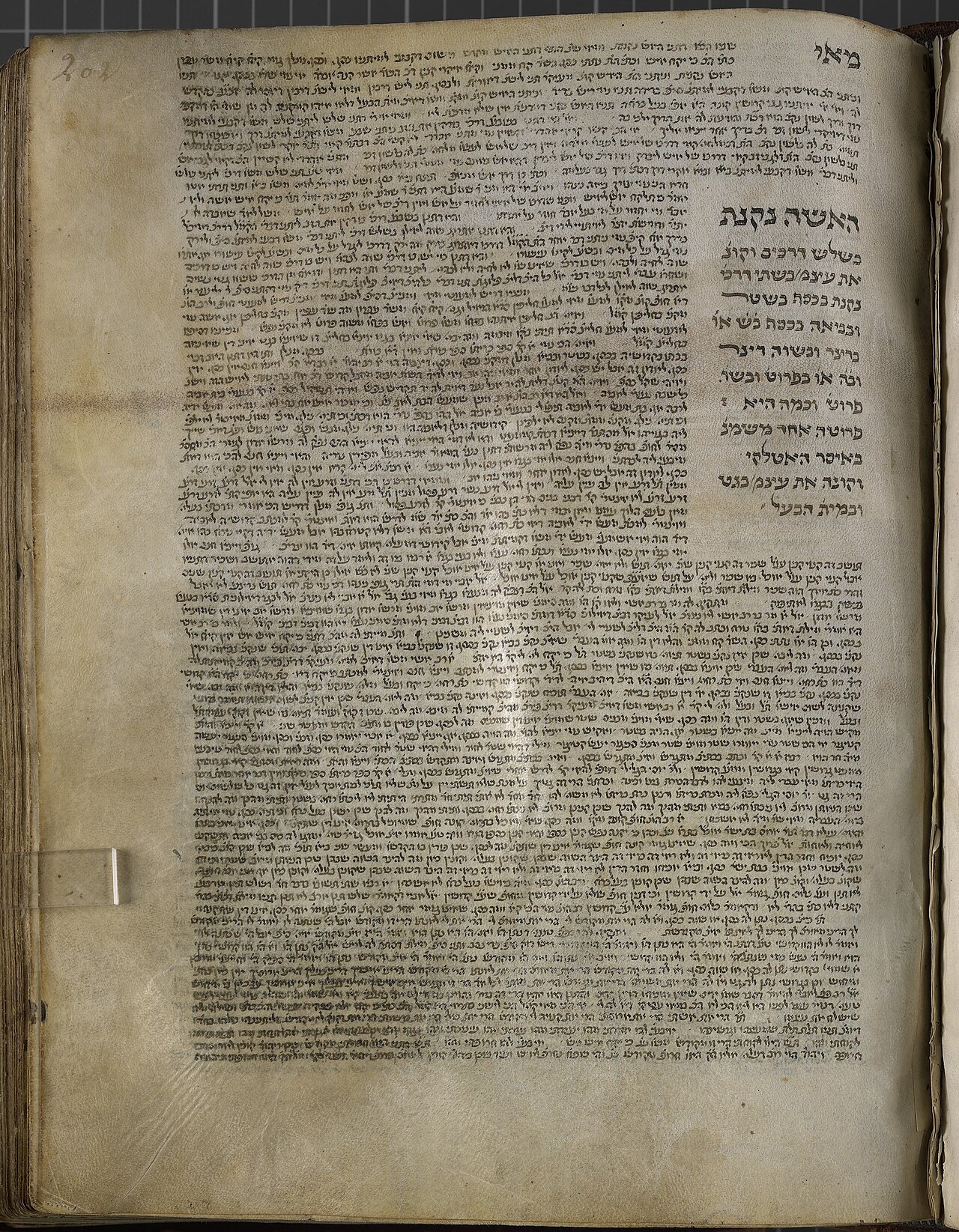
From oral to written. No manuscript of either Talmud survives from late antiquity. The oldest fragments are from the Cairo Geniza (§0, §8); the only nearly complete manuscript of the Babylonian Talmud is the Munich codex of 1342. The first complete printed edition of the Babylonian Talmud, by the Christian printer Daniel Bomberg in Venice in 1520–23, fixed the page numbering still used today.[38][10] Consensus
Prayer instead of sacrifice
The most important change was in daily religious life. Without sacrifice, the rabbis taught, prayer and good deeds atoned. A story in Avot de-Rabbi Natan has Yohanan ben Zakkai walking past the ruins with his disciple Rabbi Joshua, who laments that the place where Israel’s sins were atoned is destroyed. Yohanan answers: “My son, be not grieved, for we have another means of atonement which is as effective, and that is, the practice of lovingkindness, as it is stated, For I desire lovingkindness and not sacrifice” (Hosea 6:6; A. Cohen’s Soncino translation).[2][39] Consensus on the text.
The daily services were modelled on the Temple’s timetable. The Talmud records Rabbi Yehoshua ben Levi’s view that “the prayers were instituted based on the daily offerings” (William Davidson translation): the morning prayer to the morning offering, the afternoon prayer to the afternoon offering.[40] The core of each service became the ʿAmidah, the “standing prayer” of eighteen blessings, whose arrangement the Talmud attributes to the sages at Yavneh under Rabban Gamaliel II.[41] The exact wording was not fixed for centuries; the first prayer books appear only in the ninth and tenth centuries (§8).[42] Majority
Other Temple rites were translated into home and synagogue. The Passover seder, with its order of cups, questions and foods and its retelling of the Exodus, took its classic form in the Mishnah’s tractate Pesaḥim, in place of the Passover lamb.[43] Scholars debate how much of it predates 70 and how far it was shaped by Greco-Roman symposium customs.[44] Contested
The synagogue and its floors
Synagogues existed before 70, as places for reading the Torah (§6). After 70 they became the main institution of local Jewish life. Most of the surviving synagogue buildings in the land of Israel, however, date from the fourth to the seventh centuries, not from the generation of Yavneh.[45] Majority
The archaeology of these synagogues produced one of the great surprises of the twentieth century. Their mosaic floors show biblical scenes, but also the zodiac, the four seasons as women, and at the centre the Greek sun god Helios driving his chariot.[45]
- Dura-Europos (Syria), rebuilt in 244/245 CE: walls covered with frescoes of biblical scenes, including Moses, the Exodus, Ezekiel’s vision of the dry bones and the Temple, in a period when the rabbis’ texts discourage images.[14] Consensus
- Hammat Tiberias, 4th century in the excavator Moshe Dothan’s dating (Jodi Magness argues for the late 4th or early 5th): a zodiac wheel with Helios at its centre, the seasons in the corners and a Torah shrine flanked by menorahs, in a synagogue whose donor calls himself a “pupil of the most illustrious patriarchs”.[15][46][16] Majority on the date.
- Beit Alfa, 6th century: a cruder but complete version of the same scheme, with the binding of Isaac below the zodiac, signed by the craftsmen Marianos and his son Hanina.[20] Majority
- Rehob, near Beth Shean, 6th–7th century: a mosaic of 29 lines and 364 words of Hebrew legal text on the sabbatical year and tithes, closely parallel to the Tosefta and Jerusalem Talmud, the oldest physical copy of a rabbinic text.[21] Majority
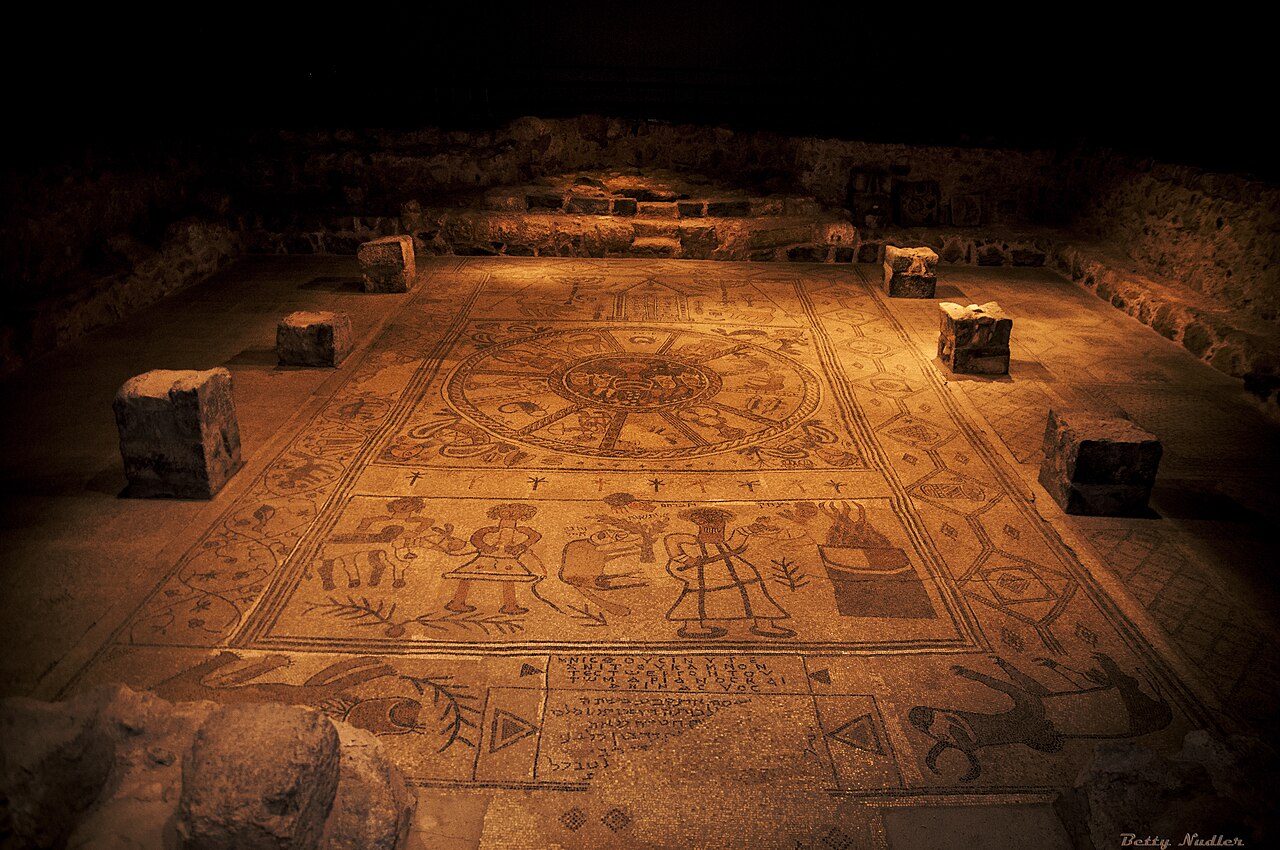
What did Helios mean to the congregations who walked over him? Proposals range from a symbol of God’s power over the cosmos, to the calendar on which the festivals depended, to an angelic being, to an image that had lost any specific religious meaning.[45][16] What these floors show beyond doubt is that synagogue communities chose and paid for imagery that the rabbinic texts do not mention, and that the rabbis did not control every synagogue. The Rehob floor shows the opposite case: a community that wrote rabbinic law into its pavement. Majority
How influential were the rabbis?
The Talmud presents the rabbis as Israel’s natural leaders. The other evidence suggests that for a long time they were a small, self-selected scholarly class. Majority
Catherine Hezser’s study of the rabbinic movement in Roman Palestine found a loose network of teachers and disciples, not an institution, with no power to enforce its rulings except through persuasion and the patronage of the Patriarch.[47] Rabbinic texts complain about the ʿam ha-ʾareṣ, “the people of the land”, who did not observe the sages’ rules on purity and tithes.[47] Majority
Seth Schwartz went further. In Imperialism and Jewish Society (2001) he argued that after the disasters of 70 and 135, Jewish society in Palestine largely dissolved into the surrounding Roman culture; the rabbis were marginal; and Judaism was reconstituted as a religion of synagogue communities only in the fourth century and later, partly in reaction to a Christian empire that treated Jews as a religious group.[35] Critics answer that the absence of evidence for Jewish practice in the second and third centuries is partly an accident of what survives, and that the rabbinic texts themselves show wide social contact.[45] Contested
What is not in doubt is the long-term result. By the early Islamic period the Babylonian Talmud was being studied across the Jewish world, and the leaders of the Babylonian academies were answering legal questions from Spain to Yemen (§8). Consensus
Who is a Jew? The matrilineal rule
In the Bible, descent runs through the father. Joseph’s sons by his Egyptian wife Asenath become two of the tribes of Israel; Moses marries Zipporah, a Midianite; David’s ancestor Boaz marries Ruth the Moabite.[48][49][50] The book of Ezra, in the Persian period, demands the expulsion of foreign wives and their children, but does not state a principle of descent through the mother (§5).[51][52] Consensus
The matrilineal rule appears first in the Mishnah. Tractate Kiddushin sets out who the child of a union belongs to, and ends with any woman who cannot contract a valid betrothal with that man or with others: “the child follows her status. And what case is this? The child issue of a female slave or a gentile woman” (Joshua Kulp’s translation).[53] Shaye Cohen has argued that the principle was a rabbinic innovation of the second century CE. Among possible reasons he discusses the Roman law rule that the child of a marriage without legal capacity follows the mother, and the biblical laws against mixtures of kinds.[52] Majority
The traditional view holds that the rule is ancient, derived by the rabbis from Deuteronomy 7:3–4 (“he will turn away your son from following me”), which the Talmud reads as referring to the gentile father’s influence on the grandson through a Jewish mother.[54][55] Reform Judaism in the United States has since 1983 also recognised children of Jewish fathers raised as Jews (§13).[56] Contested
Judaism and the rise of Christianity
The followers of Jesus began as a Jewish movement (§6). How and when the two became separate religions is one of the most debated questions of the period. Contested
The Birkat ha-Minim, “the blessing concerning heretics”, is the twelfth blessing of the ʿAmidah. The Talmud says Samuel the Small composed it at Yavneh at Rabban Gamaliel’s request.[41] Versions from the Cairo Geniza curse the minim, heretics, and the noṣrim, Christians. An older scholarly consensus read the blessing as a deliberate expulsion of Jewish Christians from the synagogues around 90 CE, and connected it with the Gospel of John’s references to believers being put out of the synagogue. Reuven Kimelman argued in 1981 that the word noṣrim is not found in the oldest evidence and may have been added later, and that minim covered many kinds of heretics.[57] Joel Marcus has replied that the blessing was aimed at Jewish followers of Jesus from an early date, as the Gospel of John and later Christian writers suggest.[58] Contested
Since the 1990s, many scholars have argued that the “parting of the ways” was slow and uneven. In Antioch in 386–387, John Chrysostom preached eight sermons against Christians who attended synagogue and kept Jewish festivals, which shows that ordinary people did not yet see a sharp boundary.[59] Daniel Boyarin has argued that the boundary was drawn mainly by heresiologists and rabbis of the fourth and fifth centuries, each defining the other as outsiders, and enforced by the laws of the Christian empire.[60] Majority that the separation was gradual; Contested on its timing.
The Christian empire changed the conditions of Jewish life. Laws in the Theodosian Code forbade Jews to own Christian slaves, to marry Christians or to build new synagogues, and the office of the Patriarch lapsed around 429.[19][18] The hope of rebuilding the Temple flared once, in 363, when the pagan emperor Julian authorised it; the attempt ended within months, after a fire and Julian’s death on campaign.[17] Majority
The evidence ledger for rabbinic Judaism
| Question | What the evidence supports | Key evidence | Confidence |
|---|---|---|---|
| The destruction | The Temple burned in 70 CE; sacrifice ended | Josephus; Arch of Titus[1][4] | Consensus |
| Yavneh | A circle of sages formed after 70; no council closed the canon | m. Yadayim 3:5; Lewis; Cohen[31][32][3] | Majority |
| Bar Kokhba | A messianic revolt, 132–135, with a religiously observant leader | Letters from the Judaean desert; coins; Dio[9][8] | Consensus |
| The Mishnah | Compiled c. 200 CE in Galilee, in Hebrew, much of it about a Temple that no longer existed | The text itself; later tradition[10][37] | Majority |
| The Talmuds | Jerusalem c. 400; Babylonian edited c. 500–700 | The texts; anonymous layer[22] | Majority |
| Prayer | Daily prayer modelled on the Temple timetable; fixed texts only later | b. Berakhot[40][41] | Majority |
| Rabbinic influence | Limited at first, growing in late antiquity | Hezser; Schwartz; synagogue art[47][35][45] | Majority (limited); Contested (how limited) |
| Matrilineal descent | First stated c. 200 CE; not biblical | m. Kiddushin 3:12; Cohen[53][52] | Majority |
| Synagogue imagery | Biblical scenes, Helios and the zodiac in the 3rd–6th centuries | Dura; Hammat Tiberias; Beit Alfa[14][15][20] | Consensus |
| Parting from Christianity | Gradual, not completed until the 4th–5th centuries in many places | Chrysostom; Birkat ha-Minim debate[57][60] | Majority (gradual); Contested (dates) |
Primary sources
1. The chain of tradition: Mishnah Avot 1:1
Hebrew: Mōšeh qibbēl tôrâ missînay ûmĕsārāh lîhôšuaʿ, wîhôšuaʿ lizqēnîm, ûzqēnîm linbîʾîm, ûnbîʾîm mĕsārûhā lĕʾanšê kĕneset haggĕdôlâ.
“Moses received the Torah at Sinai and transmitted it to Joshua, Joshua to the elders, and the elders to the prophets, and the prophets to the Men of the Great Assembly.” (Joshua Kulp’s translation)[11]
What it proves. That by the third century the rabbis presented their own teaching as part of a single tradition reaching back to Sinai. The chain skips the priests, who in the Bible are the guardians of the law, and runs through prophets and sages to the rabbis. It is a claim to authority by a class of scholars, not priests. Tractate Avot is probably later than most of the Mishnah, from the mid-third century.[10] Majority
2. Yavneh and the canon: Mishnah Yadayim 3:5
Hebrew (abridged): kol kitbê haqqōdeš mĕṭammĕʾîn ʾet hayyādayim. šîr haššîrîm wĕqōhelet mĕṭammĕʾîn ʾet hayyādayim … ʾāmar rabbî ʿăqîbā … šekkol hakkĕtûbîm qōdeš, wĕšîr haššîrîm qōdeš qodāšîm.
“All the Holy Scriptures defile the hands. The Song of Songs and Kohelet (Ecclesiastes) defile the hands … Rabbi Akiba said: … for all the writings are holy but the Song of Songs is the holy of holies.” (Joshua Kulp’s translation)[31]
What it proves. That the sages at Yavneh discussed the status of two disputed books, and that the dispute continued to be remembered with several views. It does not describe a council deciding the whole canon, and it shows that most books were already taken for granted. “Defiling the hands” was a purity rule that protected scrolls of Scripture from careless handling. Majority
3. Another atonement: Avot de-Rabbi Natan A 4
“It happened once that Rabban Joḥanan b. Zakkai was coming out of Jerusalem, followed by R. Joshua, and he beheld the Temple in ruins. ‘Woe to us,’ cried R. Joshua, ‘for this house that lies in ruins, the place where atonement was made for the sins of Israel!’ Rabban Joḥanan said to him, ‘My son, be not grieved, for we have another means of atonement which is as effective, and that is, the practice of lovingkindness, as it is stated, For I desire lovingkindness and not sacrifice’.” (A. Cohen’s Soncino translation)[2][39]
What it proves. How the rabbis, writing in late antiquity, wanted the transition remembered: not as a catastrophe that ended Judaism, but as a turn to ethics, study and prayer that the prophets had already announced. The same chapter tells the coffin story of the escape to Yavneh. Consensus on the text; Majority that it is a later legend about real figures.
4. Moses in Akiva’s classroom: Babylonian Talmud, Menahot 29b
The Talmud tells that when Moses went up to receive the Torah, he found God attaching small crowns to its letters. God explains that in a future generation a man named Akiva will derive “mounds upon mounds of halakhot” from each crown. Moses asks to see him, and sits at the end of the eighth row of Akiva’s study hall:
”… and did not understand what they were saying. Moses’ strength waned … When Rabbi Akiva arrived at the discussion of one matter, his students said to him: My teacher, from where do you derive this? Rabbi Akiva said to them: It is a halakha transmitted to Moses from Sinai. When Moses heard this, his mind was put at ease.” (William Davidson translation)[36]
What it proves. That the rabbis knew their teaching looked very different from the written Torah, and could reflect on that difference with humour and boldness. The story affirms the Mosaic origin of the Oral Torah while admitting that Moses himself would not recognise it. It is one of the clearest expressions of how the rabbis understood tradition: as a living development that remains faithful to its source. Majority
5. “It is not in heaven”: Babylonian Talmud, Bava Metzia 59b
In a legal dispute about the purity of an oven, Rabbi Eliezer brings miraculous proofs for his view: a carob tree uproots itself, a stream flows backwards, the walls of the study house lean, and finally a heavenly voice declares that the law follows him. Rabbi Joshua stands and quotes Deuteronomy 30:12, lōʾ baššāmayim hîʾ, “It is not in heaven”, and Rabbi Jeremiah explains: the Torah has already been given at Sinai, and decisions follow the majority. Elijah later reports that God smiled and said, “My children have triumphed over Me” (William Davidson translation).[61]
What it proves. The rabbis’ principle that authority lies in the reasoned interpretation of the sages by majority, not in prophecy or revelation. Prophecy, in rabbinic teaching, had ceased; the age of the sage had replaced it. Consensus on the text; Majority on its significance.
6. The four species in wartime: a letter of Bar Kosiba, c. 134 CE
In March 1960 Yigael Yadin found in the “Cave of Letters” in Naḥal Ḥever, above the Dead Sea, a bundle of fifteen letters, most of them from Shimon bar Kosiba to his officers, in Aramaic, Hebrew and Greek. One, in Aramaic, concerns the festival of Sukkot:
“Shimeon to Yehudah bar Menashe to Qiryath ‘Arab(v)aya. I have sent to you two donkeys that you shall send with them two men to Yehonathan bar Be’ayan and to Masabala in order that they shall pack and send to the camp, towards you, palm branches and citrons. And you, from your place, send others who will bring you myrtles and willows.” (Yadin’s translation)[9][62]
What it proves. That the leader of the revolt, in the middle of a losing war, took trouble to obtain the four plant species for the festival as prescribed in Leviticus 23:40. Observance of Pharisaic-rabbinic practice was part of the rebellion’s religious identity. The name “Bar Kokhba”, “son of the star”, is a pun used by his supporters; the letters show his real name was bar Kosiba. Consensus
7. “This is the King Messiah”: Jerusalem Talmud, Taʿanit 4:5
“Rebbi Simeon ben Yohai stated: Aqiba my teacher used to preach, there appeared a star out of Jacob (Numbers 24:17), there appeared Koziba out of Jacob. When Rebbi Aqiba saw Bar Koziba he said, this is King Messias. Rebbi Joḥanan ben Torta said to him, Aqiba! Grass will grow from your jaws and still David’s son will not have come.” (Heinrich Guggenheimer’s translation)[63]
What it proves. That later rabbinic tradition remembered the revolt as messianic, and remembered that one of its own greatest teachers had supported it, along with a rabbi who mocked him for it. The rabbis’ later caution about calculating the end may owe much to this memory. Majority
8. The child follows the mother: Mishnah Kiddushin 3:12
“Wherever there is kiddushin and there is no transgression, the child goes after the status of the male … And any [woman] who can not contract kiddushin with that particular person or with others, the child follows her status. And what case is this? The child issue of a female slave or a gentile woman.” (Joshua Kulp’s translation)[53]
What it proves. The earliest statement of the rule that the child of a gentile mother is a gentile. Combined with other rulings, it produces the principle that the child of a Jewish mother is Jewish whatever the father. It is formulated as part of a legal system about the status of children, not as a statement about Jewish identity in the modern sense. Consensus on the text.
What is absent from the record of the rabbinic period
- A Temple, sacrifice, or a high priest. None after 70. Priests kept their genealogies, and some synagogue inscriptions list the priestly courses, but they lost their central role.[45] Consensus
- A fixed prayer book. Rabbinic sources describe the blessings and their themes; written prayer books appear only in the ninth and tenth centuries.[42] Majority
- A council that defined the Bible or the faith. Rabbinic Judaism had no creed until the Middle Ages (§8) and no central council with power to define doctrine. Majority
- Rabbis as congregational clergy. A rabbi in this period is a scholar and teacher of law, not the leader of a synagogue; the paid communal rabbi is a medieval development.[47][45] Majority
- Bat mitzvah, women’s study of Talmud, or women as rabbis. All are modern (§11, §13). Consensus
- Manuscripts of the Talmud from the period. The oldest fragments are centuries later. Consensus
Debates about the rabbinic period
Continuity or invention?
| View | Main argument | Main proponents |
|---|---|---|
| Traditional | The rabbis received and transmitted the Oral Torah given at Sinai; the destruction changed its circumstances, not its content | Rabbinic tradition; the chain in Avot 1 |
| Pharisaic continuity | The rabbis carried forward the Pharisees’ traditions and methods; much of their law predates 70 | Many historians of the Second Temple period |
| Reinvention | The rabbis built a new religious system after 70, drawing on earlier traditions but shaping them into something new | Neusner; Cohen[37][3] |
| Late consolidation | Rabbinic Judaism became the norm only in late antiquity, in synagogue communities shaped by the Christian empire | Schwartz[35] |
These views overlap more than the table suggests. Nearly all historians accept that rabbinic law contains much older material and that its organisation as a system is a post-70 achievement. Contested
Did the rabbis control the synagogues?
Lee Levine argues that synagogues were community institutions run by local leaders, and that rabbis had only partial and growing influence over them; the zodiac floors are evidence of that independence.[45] Others note that the Rehob inscription, the priestly-course lists and the Hebrew and Aramaic inscriptions show rabbinic ideas entering synagogues by the sixth century, and that a Geniza fragment of the Jerusalem Talmud reports that “in the days of Rebbi Abun they started depicting by mosaics and he did not protest against it” (Guggenheimer’s translation): the images need not mean defiance of the rabbis.[64] Majority that rabbinic control was partial.
Was the matrilineal rule ancient?
Shaye Cohen argues for a second-century origin, pointing to the biblical evidence of patrilineal descent and the absence of the rule in Second Temple sources, including Josephus and Philo.[52] The traditional view, and some scholars, see the rule as already implicit in Ezra’s expulsion of foreign wives and their children, in the son of an Israelite mother and Egyptian father counted among Israel in Leviticus 24:10, and in the way the rabbis read Deuteronomy 7.[51][65][54] Contested
Further reading
- Shaye J. D. Cohen, From the Maccabees to the Mishnah (3rd ed., Westminster John Knox, 2014), and “The Significance of Yavneh”, Hebrew Union College Annual 55 (1984).
- Seth Schwartz, Imperialism and Jewish Society, 200 B.C.E. to 640 C.E. (Princeton, 2001).
- Lee I. Levine, The Ancient Synagogue: The First Thousand Years (2nd ed., Yale, 2005).
- H. L. Strack and Günter Stemberger, Introduction to the Talmud and Midrash (Fortress, 1996) — the standard reference on dates and texts.
- Jeffrey L. Rubenstein, The Culture of the Babylonian Talmud (Johns Hopkins, 2003).
- Daniel Boyarin, Border Lines: The Partition of Judaeo-Christianity (Pennsylvania, 2004).
- Martin Goodman, Rome and Jerusalem: The Clash of Ancient Civilizations (Allen Lane, 2007).
- Barry W. Holtz, ed., Back to the Sources: Reading the Classic Jewish Texts (Summit, 1984) — a practical introduction to reading Mishnah, Talmud and midrash.
- The Mishnah and both Talmuds in Hebrew and English are on Sefaria, free.
References
- ^ a b c d Josephus, Jewish War 6.236–266 — Jewish War. c. 75–79 CE. Greek. An eyewitness on the Roman side describes Titus's council of war and the burning of the Temple in the summer of 70 CE, claiming Titus wished to spare it. read the text
- ^ a b c d Avot de-Rabbi Natan A 4 — Avot de-Rabbi Natan. c. 3rd–9th c. CE (redaction debated). Hebrew. Yohanan ben Zakkai's escape from Jerusalem in a coffin, and his answer to Rabbi Joshua at the ruined Temple: acts of loving-kindness atone as sacrifice did. read the text
- ^ a b c d e f Shaye J. D. Cohen The Significance of Yavneh: Pharisees, Rabbis, and the End of Jewish Sectarianism. Hebrew Union College Annual 55, 27–53, 1984. Yavneh as a 'grand coalition' that ended sectarianism by tolerating dissent.
- ^ a b Arch of Titus, spoils relief — Arch of Titus, Roman Forum. after 81 CE. Latin. Roman soldiers carry the Temple's menorah, trumpets and table in Titus's triumph of 71 CE: Rome's own record of the spoils of Jerusalem. about
- ^ Josephus, Jewish War 7.252–406 — Jewish War. c. 75–79 CE. Greek. The Roman siege and fall of Masada, the last rebel fortress, under Flavius Silva, with Eleazar ben Yair's speeches and the defenders' mass suicide. read the text
- ^ Eusebius, Ecclesiastical History 4.2 — Ecclesiastical History. early 4th c. CE. Greek. The Jewish uprisings of 115–117 in Alexandria, the rest of Egypt and Cyrene, and their suppression by Trajan's generals. read the text
- ^ a b c Martin Goodman Rome and Jerusalem: The Clash of Ancient Civilizations. Allen Lane, 2007. Why Rome destroyed the Temple and refused to let it be rebuilt.
- ^ a b c d Cassius Dio, Roman History 69.12–14 — Roman History. early 3rd c. CE. Greek. Blames the Bar Kokhba revolt on Hadrian's refounding of Jerusalem as a Roman colony with a temple of Jupiter, and reports 580,000 Jewish dead and 985 villages destroyed. read the text
- ^ a b c Bar Kosiba letter on the four species (P.Yadin 57) — Bar Kokhba letters, Cave of Letters, Naḥal Ḥever. c. 134 CE. Aramaic. Shimon bar Kosiba orders an officer to send palm branches, citrons, myrtles and willows to his camp for Sukkot: religious observance in the middle of the revolt. about
- ^ a b c d e f g h i j H. L. Strack and Günter Stemberger Introduction to the Talmud and Midrash. Fortress Press, 2nd ed., 1996. The standard reference on the dates, manuscripts and editions of rabbinic texts.
- ^ a b c m. Avot 1:1 — Mishnah. c. 200 CE. Hebrew. Moses received the Torah at Sinai and handed it to Joshua, the elders, the prophets and the men of the Great Assembly. read the text
- ^ a b Letter of Sherira Gaon (987 CE) — Iggeret Rav Sherira Gaon. 987 CE. Aramaic and Hebrew. The head of the Pumbedita academy answers the Jews of Kairouan on how the Mishnah and Talmud were composed; its two recensions disagree on whether the Mishnah was written down. about
- ^ a b Isaiah Gafni The Political, Social, and Economic History of Babylonian Jewry, 224–638 CE. in Steven T. Katz, ed., The Cambridge History of Judaism, vol. 4, Cambridge University Press, 792–820, 2006. doi The exilarchate, the academies and Jewish life under the Sasanians.
- ^ a b c Dura-Europos synagogue — Synagogue at Dura-Europos, Syria (frescoes now in the National Museum, Damascus). 244/245 CE. Aramaic and Greek. A synagogue on the Euphrates rebuilt in 244/245 CE with walls painted with biblical scenes, preserved when it was buried under a rampart in 256. about
- ^ a b c Hammat Tiberias synagogue mosaic — Synagogue of Severus, Hammat Tiberias. 4th or early 5th c. CE. Greek and Aramaic. A synagogue floor with Helios in his chariot, the zodiac, the seasons and a Torah shrine, donated by a 'pupil of the most illustrious patriarchs'. about
- ^ a b c Jodi Magness Heaven on Earth: Helios and the Zodiac Cycle in Ancient Palestinian Synagogues. Dumbarton Oaks Papers 59, 1–52, 2005. What the sun god meant on synagogue floors.
- ^ a b Ammianus Marcellinus 23.1.2–3 — Res Gestae. c. 390 CE. Latin. Julian plans at vast cost to restore the Temple in Jerusalem, entrusts the work to Alypius of Antioch, and abandons it when 'terrifying balls of flame' burst from the foundations. read the text
- ^ a b Codex Theodosianus 16.8.29 (429 CE) — Codex Theodosianus. 30 May 429 CE. Latin. An imperial law ordering that the dues Jews had paid to their patriarchs be collected for the imperial treasury now that the patriarchs have passed away: the end of the patriarchate.
- ^ a b Amnon Linder The Jews in Roman Imperial Legislation. Wayne State University Press and Israel Academy of Sciences and Humanities, 1987. open library The Roman and Theodosian laws on Jews in text, translation and commentary, including the end of the patriarchate.
- ^ a b c Beit Alfa synagogue mosaic — Synagogue floor, Beit Alfa, Jezreel Valley. 6th c. CE. Aramaic and Greek. A complete synagogue floor of the 6th century: the binding of Isaac, the zodiac with Helios, and a Torah shrine, signed by the craftsmen Marianos and his son Hanina. about
- ^ a b Rehob mosaic inscription — Synagogue floor at Rehob, near Beth Shean (Israel Museum). c. 6th–7th c. CE. Hebrew. A 29-line, 364-word mosaic of agricultural law on the sabbatical year and tithes, closely parallel to the Tosefta and Jerusalem Talmud: the oldest physical copy of a rabbinic text. about
- ^ a b c Jeffrey L. Rubenstein The Culture of the Babylonian Talmud. Johns Hopkins University Press, 2003. The anonymous editors of the Bavli and the academy culture they created.
- ^ Sulpicius Severus, Chronica 2.30 — Chronica (Sacred History). c. 403 CE. Latin. Says Titus held a council and decided the Temple should be destroyed, to root out the religion of Jews and Christians; often thought to follow a lost passage of Tacitus. read the text
- ^ Josephus, Jewish War 7.218 — Jewish War. c. 75–79 CE. Greek. After the war Vespasian ordered every Jew to pay two drachmae a year to the Capitol in Rome, as they had formerly paid to the Temple: the origin of the fiscus Iudaicus. read the text
- ^ Historia Augusta, Hadrian 14.2 — Historia Augusta. late 4th c. CE. Latin. 'At this time also the Jews began war, because they were forbidden to practice circumcision': the late Roman explanation of the Bar Kokhba revolt. read the text
- ^ Bar Kokhba silver sela, undated (year 3) — Coinage of the Bar Kokhba revolt. 134/135 CE. Hebrew (palaeo-Hebrew script). Temple facade with a star above and the name Shimon; on the reverse the lulav and etrog with 'For the freedom of Jerusalem' (this specimen Mildenberg 85, Meshorer 233). about
- ^ Leo Mildenberg The Coinage of the Bar Kokhba War. Sauerländer (Typos 6), Aarau, 1984. open library The die study of the revolt's coins, with their legends, types and year sequence.
- ^ a b Hanan Eshel The Bar Kochba Revolt, 132–135. in Steven T. Katz, ed., The Cambridge History of Judaism, vol. 4: The Late Roman-Rabbinic Period, Cambridge University Press, 105–127, 2006. doi The revolt in the light of the documents and coins.
- ^ b. Gittin 56a–b — Babylonian Talmud. c. 500–700 CE. Aramaic and Hebrew. The Talmud's version of Yohanan ben Zakkai's escape and his request to Vespasian: 'Give me Yavneh and its sages.' read the text
- ^ Josephus, Jewish War 3.399–408 — Jewish War. c. 75–79 CE. Greek. The captured Josephus tells Vespasian that he and his son will be emperors: the same prophecy the rabbinic legend later gives to Yohanan ben Zakkai. read the text
- ^ a b c m. Yadayim 3:5 — Mishnah. c. 200 CE. Hebrew. The debate over whether the Song of Songs and Ecclesiastes 'defile the hands', with Akiva's verdict that the Song is 'the holy of holies': the only rabbinic basis for the 'Council of Jamnia'. read the text
- ^ a b Jack P. Lewis What Do We Mean by Jabneh?. Journal of Bible and Religion 32, 125–132, 1964. The article that dismantled the 'Council of Jamnia'.
- ^ Josephus, Against Apion 1.38–41 — Against Apion. c. 95 CE. Greek. Josephus counts twenty-two authoritative books (five of Moses, thirteen of prophets, four of hymns and precepts) and says later books lack equal authority because the succession of prophets failed. read the text
- ^ Josephus, Antiquities 13.297–298 — Jewish Antiquities. c. 93 CE. Greek. The Pharisees 'delivered to the people a great many observances by succession from their fathers, which are not written in the laws of Moses'; the Sadducees rejected them and accepted only the written law. read the text
- ^ a b c d Seth Schwartz Imperialism and Jewish Society, 200 B.C.E. to 640 C.E.. Princeton University Press, 2001. Argues Jewish society largely dissolved after 135 and was rebuilt around synagogues in the Christian empire.
- ^ a b b. Menahot 29b — Babylonian Talmud. c. 500–700 CE. Aramaic and Hebrew. Moses sits in Rabbi Akiva's class and cannot follow it, until Akiva attributes a ruling to 'a law given to Moses at Sinai'. read the text
- ^ a b c d Jacob Neusner Judaism: The Evidence of the Mishnah. University of Chicago Press, 1981. The Mishnah as a utopian system built after the loss of the Temple.
- ^ Munich, Bayerische Staatsbibliothek, Cod. hebr. 95 — Babylonian Talmud manuscript. 1342 CE. Aramaic and Hebrew. The only nearly complete manuscript of the Babylonian Talmud, copied in 1342. about
- ^ a b A. Cohen, ed. The Minor Tractates of the Talmud. Soncino Press, 2 vols., 1965. open library The Soncino English translation of the minor tractates, including Avot de-Rabbi Natan; the version quoted in this chapter.
- ^ a b b. Berakhot 26b — Babylonian Talmud. c. 500–700 CE. Aramaic and Hebrew. The view that the daily prayers 'were instituted to correspond to the daily offerings' of the Temple. read the text
- ^ a b c b. Berakhot 28b–29a — Babylonian Talmud. c. 500–700 CE. Aramaic and Hebrew. Attributes the ordering of the eighteen blessings to the sages at Yavneh under Rabban Gamaliel, and the blessing against heretics to Samuel the Small. read the text
- ^ a b Seder Rav Amram Gaon — Order of prayer of Amram Gaon. c. 860–875 CE. Hebrew and Aramaic. The oldest surviving complete Jewish prayer book (its text later expanded and altered by copyists), sent by the gaon of Sura in reply to a request from Spain; the basis of later Sephardi and Ashkenazi rites. about
- ^ m. Pesaḥim 10 — Mishnah. c. 200 CE. Hebrew. The order of the Passover evening meal: four cups of wine, the child's questions, the retelling from 'a wandering Aramean' and the Hallel. read the text
- ^ Baruch M. Bokser The Origins of the Seder: The Passover Rite and Early Rabbinic Judaism. University of California Press, 1984. open library How the Mishnah's seder replaced the Passover sacrifice, and how far it drew on Greco-Roman banquet custom.
- ^ a b c d e f g h Lee I. Levine The Ancient Synagogue: The First Thousand Years. Yale University Press, 2nd ed., 2005. The standard history of the synagogue from its origins to late antiquity.
- ^ Moshe Dothan Hammath Tiberias: Early Synagogues and the Hellenistic and Roman Remains. Israel Exploration Society, 1983. open library The excavation report of the Severus synagogue and its zodiac mosaic, with the excavator's 4th-century dating.
- ^ a b c d Catherine Hezser The Social Structure of the Rabbinic Movement in Roman Palestine. Mohr Siebeck, 1997. The rabbis as a loose network of teachers, not an institution.
- ^ Genesis 41:50–52 — Genesis (Hebrew Bible). 1st millennium BCE. Hebrew. Joseph's sons Manasseh and Ephraim are born to Asenath, daughter of an Egyptian priest of On. read the text
- ^ Exodus 2:21–22 — Exodus (Hebrew Bible). 1st millennium BCE. Hebrew. Moses marries Zipporah, daughter of the Midianite priest, and she bears his son Gershom. read the text
- ^ Ruth 4:13–17 — Ruth (Hebrew Bible). Persian period (debated). Hebrew. Boaz marries Ruth the Moabite; their son Obed is the grandfather of David. read the text
- ^ a b Ezra 9–10 — Ezra (Hebrew Bible). c. 4th c. BCE (composition). Hebrew. Ezra mourns that "the holy seed" has mixed with the peoples of the lands; the assembly resolves to send away foreign wives and their children. read the text
- ^ a b c d Shaye J. D. Cohen The Beginnings of Jewishness: Boundaries, Varieties, Uncertainties. University of California Press, 1999. When Ioudaios came to mean a religious identity, and how conversion and matrilineal descent arose.
- ^ a b c m. Kiddushin 3:12 — Mishnah. c. 200 CE. Hebrew. The child of a gentile or slave woman 'is like her': the earliest statement of the matrilineal principle. read the text
- ^ a b Deuteronomy 7:3–4 — Deuteronomy (Hebrew Bible). 7th–6th c. BCE. Hebrew. Forbids marriage with the peoples of Canaan, 'For he will turn away thy son from following Me'; the verse from which the Talmud derives the matrilineal rule. read the text
- ^ b. Kiddushin 68b — Babylonian Talmud. redacted c. 5th–7th c. CE. Hebrew and Aramaic. Rabbi Yoḥanan in the name of Rabbi Shimon bar Yoḥai reads Deuteronomy 7:4: your son by an Israelite woman is called your son, your son by a gentile woman is not; Ravina infers that a daughter's son by a gentile father is called your son. read the text
- ^ CCAR resolution, 15 March 1983 — Status of Children of Mixed Marriages (Central Conference of American Rabbis). 1983. English. Declares the child of one Jewish parent, mother or father, presumptively Jewish, the status to be established by public acts of Jewish identification such as a Hebrew name, Torah study and bar/bat mitzvah. read the text
- ^ a b Reuven Kimelman Birkat Ha-Minim and the Lack of Evidence for an Anti-Christian Jewish Prayer in Late Antiquity. in E. P. Sanders, A. I. Baumgarten and Alan Mendelson, eds., Jewish and Christian Self-Definition, vol. 2: Aspects of Judaism in the Graeco-Roman Period, Fortress Press, 226–244, 1981. Questions whether the blessing against heretics was aimed at Christians.
- ^ Joel Marcus Birkat Ha-Minim Revisited. New Testament Studies 55, 523–551, 2009. doi The case that the blessing against heretics was aimed at Jewish Christians, answering Kimelman.
- ^ John Chrysostom, Adversus Judaeos, Homily 1 — Adversus Judaeos (Against the Judaizers). 386 CE. Greek. The first of eight sermons preached at Antioch against Christians who went to the synagogue and kept the Jewish festivals. read the text
- ^ a b Daniel Boyarin Border Lines: The Partition of Judaeo-Christianity. University of Pennsylvania Press, 2004. The boundary between Judaism and Christianity as drawn late, by heresiologists on both sides.
- ^ b. Bava Metzia 59b — Babylonian Talmud. c. 500–700 CE. Aramaic and Hebrew. The oven of Akhnai: the sages overrule miracles and a heavenly voice because the Torah 'is not in heaven'; law follows the majority. read the text
- ^ Yigael Yadin Bar-Kokhba: The Rediscovery of the Legendary Hero of the Last Jewish Revolt against Imperial Rome. Weidenfeld and Nicolson, London (US edition: Random House, as '... of the Second Jewish Revolt against Rome'), 1971. The excavator's popular account of the Cave of Letters.
- ^ y. Taʿanit 4:5 (68d) — Jerusalem Talmud. c. 400 CE. Aramaic and Hebrew. Rabbi Akiva hails bar Kosiba as 'the King Messiah'; Rabbi Yohanan ben Torta replies that grass will grow from Akiva's cheeks before the son of David comes. read the text
- ^ y. Avodah Zarah 3:3 (42d) — Jerusalem Talmud. c. 400 CE. Aramaic and Hebrew. In the days of Rabbi Yohanan they began painting on walls, and in the days of Rabbi Abun depicting with mosaics, and neither rabbi protested; the Abun line survives in a Cairo Geniza fragment and is missing from the Leiden manuscript. read the text
- ^ Leviticus 24:10–11 — Leviticus (Hebrew Bible). Priestly material, c. 6th–5th c. BCE. Hebrew. The son of an Israelite woman and an Egyptian father goes out among the Israelites and quarrels in the camp; cited in debates over whether descent through the mother is biblical. read the text