The short version: in Hinduism, Buddhism, Judaism and Christianity alike, the oldest evidence shows women with more visible religious roles than the rules written down a few centuries later allowed. Each tradition then narrowed women’s authority, in its own way and for its own reasons, and each has partly reopened it since the nineteenth century, often over fierce internal opposition. The pattern is not a straight line of progress, and it is not a fall from a golden age either: the early sources record women’s voices without describing anything like equality. Majority
This page sets the four traditions side by side. Each section links to the chapter that argues it in full, and each series has a timeline of women’s roles in its Hinduism, Buddhism, Judaism and Christianity threads.
Hinduism: from women’s hymns to the state as legislator
The earliest layer. The Rigveda is a priestly anthology composed overwhelmingly by men, but it preserves a handful of hymns in which women speak in the first person. Lopāmudrā argues with her ascetic husband Agastya and wins;[1] Apālā presses soma with her teeth, outside the priestly ritual;[2] a woman in RV 10.159 calls herself “the banner and the head” over her co-wives.[3] Because the tradition sometimes credits a hymn to its speaker, it cannot be shown that a woman composed each of these; what is certain is that women’s voices were recorded and canonized in the oldest scripture (Hinduism §3).[4] Majority The funeral hymn RV 10.18.8 also tells the widow to “rise, come to the world of the living”, the decisive Vedic passage against sati having any Vedic warrant.[5][4] Consensus on the Rigvedic reading
The narrowing begins early. In the later Vedic ritual the wife is required at the sacrifice, but her authority narrows. A Yajurveda text, Taittirīya Saṃhitā 6.5.8.2, says outright that “women are powerless, have no inheritance, and speak more humbly than even a bad man” (Hinduism §4).[6][7] Yet around 700 BCE the Upaniṣads show Gārgī Vācaknavī questioning the great teacher Yājñavalkya in open debate at Janaka’s court and forcing him to his deepest answer,[8] and Maitreyī choosing his teaching over his property (Hinduism §5).[9][10] Consensus on the text; Contested on how representative it was
Doctrine of subordination. By the turn of the era the restriction is stated as law. Manusmṛti 9.3: “Her father guards her in her childhood, her husband guards her in her youth, and her sons guard her in her old age; a woman is not qualified to act independently.” The Bhagavad Gītā promises the highest goal to women through devotion, in a verse that also groups them among those “of sinful birth” (Hinduism §7).[11][12][13] Consensus that the texts say this. Devotion also opened a door: Āṇṭāḷ, the only woman among the twelve Tamil Ālvār poet-saints, wrote the Tiruppāvai, still recited across Tamil Nadu every Mārgaḻi month (Hinduism §9).[14][15]
Modern change came mostly through law. Sati was abolished in Bengal in 1829 (Hinduism §11).[16] After independence the Hindu Code Bills of 1955–56 made monogamy compulsory, allowed divorce and gave daughters inheritance rights, and a 2005 amendment gave daughters equal rights in ancestral property (Hinduism §12).[17][18] Consensus Ritual authority has moved least: legal rights are transformed, but priesthood remains largely male, and the 2018 Supreme Court ruling admitting women of all ages to the Sabarimala temple met mass protests.[19] Majority
Buddhism: an order of nuns, lost and restarted
The nuns’ order. Every school’s monastic code tells how Mahāpajāpatī Gotamī, the Buddha’s aunt and foster-mother, asked to be ordained, and how the Buddha, asked by Ānanda whether women can reach every stage of awakening, said that they can (Buddhism §3).[20][21] The founding of a nuns’ order is not in doubt. Majority The nuns’ own voices survive in the Therīgāthā, about 520 verses often called the oldest anthology of women’s religious poetry in India, which celebrate release from household drudgery and marriage as well as from rebirth.[22][23] Majority At Sanchi and Bharhut in the second and first centuries BCE, nuns appear in large numbers among the donors of railings and gateways, giving in their own names.[24][25] Consensus
The heavy rules. The same story makes acceptance conditional on eight “heavy rules”: a nun ordained for a hundred years must bow to a monk ordained that day, and the teaching, it predicts, will last five hundred years instead of a thousand because women joined.[21] Bhikkhu Anālayo argues, from the versions in Pali, Chinese, Sanskrit and Tibetan, that the rules and the prediction grew into the story later; standard histories such as Hirakawa’s take them as the Buddha’s own arrangements.[26][27] Contested
The order disappears. In Sri Lanka the nuns’ order vanishes from the record after the Cōḷa conquest of 993–1017, and when ordination was restored from Burma no nuns’ lineage came with it; in Burma the nuns fall silent in the inscriptions after the thirteenth century (Buddhism §10).[28][29] Majority Full ordination for nuns never died out in East Asia.
The revival. On 8 December 1996 at Sarnath, ten Sri Lankan nuns received full ordination with Korean nuns in the assembly, and in 1998 more than a hundred women were ordained at Bodh Gaya. Sri Lanka now has several hundred fully ordained nuns, though the state does not formally recognise them (Buddhism §13).[30] Consensus A 1928 ruling of Thailand’s Supreme Patriarch still forbids monks to ordain women.[31] In 2016 Tibetan nuns received the geshema, the highest scholastic degree, for the first time, and in 2022 Bhutan’s Je Khenpo fully ordained 144 nuns.[32][33] Consensus
Judaism: from the household cult to the rabbinate
Ancient Israel. Pillar figurines of a woman supporting her breasts are found in hundreds of Judahite homes and tombs of the eighth to early sixth centuries BCE, and inscriptions bless people “by Yahweh and his asherah” (Judaism §2).[34][35] Consensus on the finds; Contested on what “his asherah” refers to. When the book of the law was found in the Temple in 622 BCE, Josiah’s officials consulted the prophetess Huldah; his reform then destroyed the houses where women wove for Asherah in the Temple (Judaism §3).[36][37] Majority
Rabbinic law. Rabbinic law did not admit women as witnesses, judges or members of the prayer quorum, and no woman was a rabbi (Judaism §13).[38] Consensus The rabbis also made Jewish status pass through the mother, where in the Bible descent had run through the father (Judaism §7). Majority Hasidic courts were male: in the nineteenth century Hannah Rachel Verbermacher, the “Maiden of Ludmir”, gathered followers of her own but was quickly pushed aside.[39] Majority
Reform and the rabbinate. Isaac Mayer Wise introduced mixed family pews at Albany in 1851, and Mordecai Kaplan held the first public bat mitzvah in America for his daughter Judith in 1922.[40][41] Consensus On 27 December 1935 Regina Jonas was ordained privately in Offenbach after the Berlin seminary refused; she served as a rabbi in Berlin and Theresienstadt and was murdered at Auschwitz in 1944.[42] Consensus Reform seminaries ordained Sally Priesand in 1972, the Reconstructionists Sandy Eisenberg Sasso in 1974 and the Conservative movement Amy Eilberg in 1985.[38] Consensus Orthodoxy divides: Sara Hurwitz was ordained with the new title maharat in 2009, and in 2017 the Orthodox Union ruled that women should not serve in clergy positions in its synagogues.[43] Consensus on the events; Contested inside Orthodoxy.
Christianity: from apostles to the long exclusion and back
The first generation. Luke names women who travelled with Jesus and supported the group “out of their resources”, and all four Gospels make women the witnesses of the crucifixion and the empty tomb (Christianity §2).[44][45] Majority Paul commends Phoebe, “a deacon of the church at Cenchreae”, and greets Junia as “prominent among the apostles” (Christianity §3).[46] Consensus that Junia was a woman; Majority that Paul counts her as an apostle.
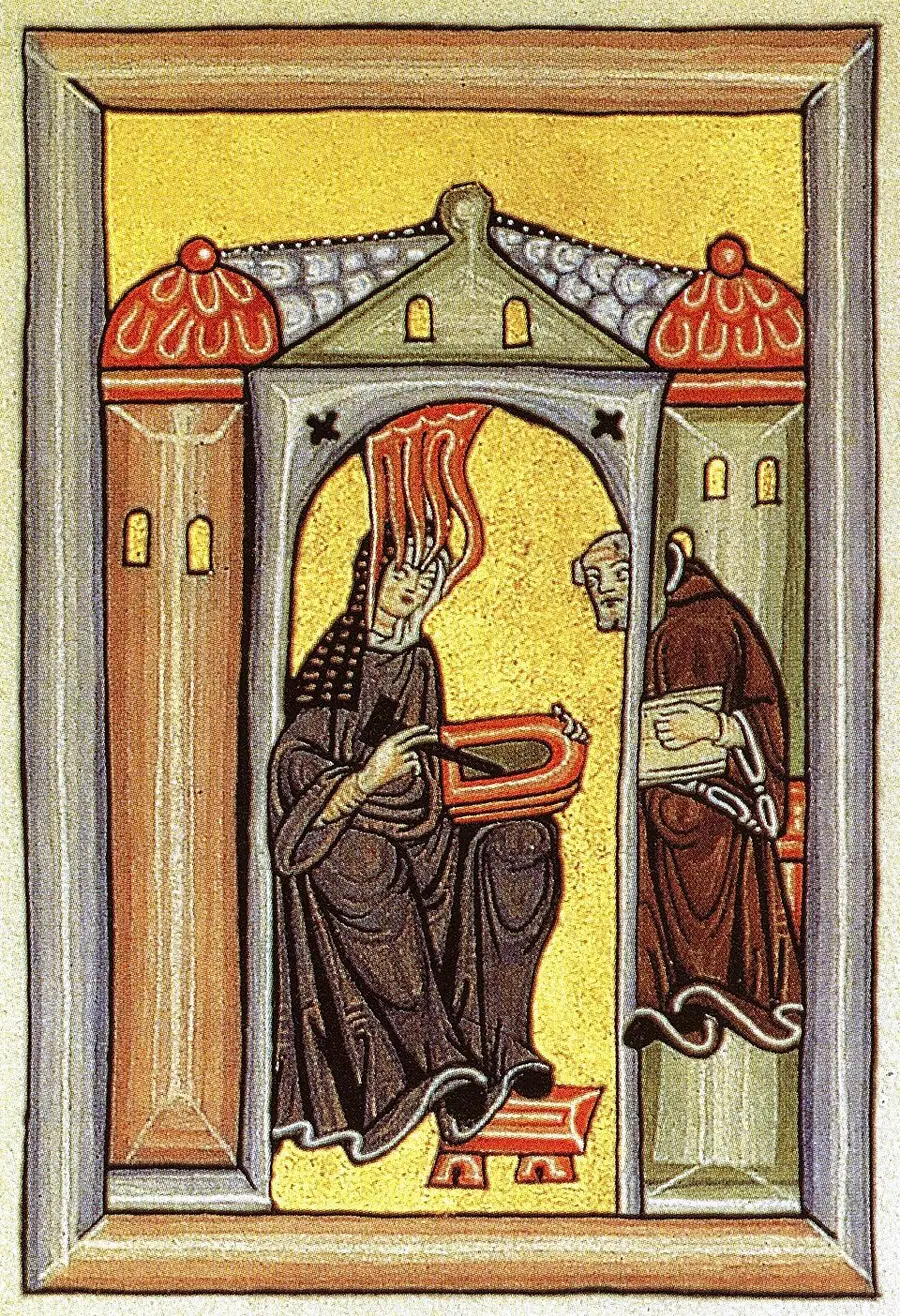
The narrowing. The Pastoral letters, written in Paul’s name around 100–120 CE, say: “I permit no woman to teach or to have authority over a man; she is to keep silent” (Christianity §4).[47] Consensus on the text. The second-century Acts of Paul and Thecla tells the opposite story, and around 200 Tertullian complained that some women cited Thecla to claim the right to teach and baptise.[48][49] Women could not be ordained in the medieval church, but abbesses ruled great monasteries, and Hildegard of Bingen recorded her visions, wrote on medicine and music, and corresponded with popes and emperors (Christianity §8).[50][51] Consensus The beguine Marguerite Porete was burned in Paris in 1310 for her mystical book.[52][53] Consensus
Ordination. The Congregationalist Antoinette Brown was ordained in 1853, an exception in her century. In 1944 Florence Li Tim-Oi was ordained priest in the Anglican diocese of Hong Kong (Christianity §12).[54] Consensus The US Episcopal Church approved women priests in 1976 and the Church of England ordained them from 1994; in 2025 Sarah Mullally was named the first woman Archbishop of Canterbury.[55][56] In December 2025 a Vatican study commission advised against ordaining women as deacons, and the Catholic and Orthodox churches do not ordain women as priests (Christianity §13).[57] Consensus
A rough timeline
| Date | Event | Confidence |
|---|---|---|
| c. 1500–1200 BCE | Rigvedic hymns preserve women’s first-person voices[1] | Majority |
| c. 900 BCE | A Yajurveda text calls women “powerless”[6] | Consensus |
| c. 800 BCE | “By Yahweh and his asherah” at Kuntillet ʿAjrud[35] | Consensus |
| c. 700 BCE | Gārgī debates Yājñavalkya in the Upaniṣads[8] | Consensus (text) |
| 622 BCE | The prophetess Huldah is consulted on the law book[36] | Majority |
| c. 5th–4th c. BCE | An order of Buddhist nuns is founded[21] | Majority |
| c. 200 BCE – 300 CE | Manusmṛti: lifelong male guardianship[11] | Consensus (text) |
| c. 56–57 CE | Paul greets Phoebe the deacon and Junia the apostle[46] | Majority |
| c. 100–120 CE | “I permit no woman to teach”[47] | Majority (date) |
| 993–1017 | The nuns’ order vanishes in Sri Lanka[28] | Majority |
| 1829 | Sati abolished in Bengal[16] | Consensus |
| 1935 | Regina Jonas, the first woman rabbi[42] | Consensus |
| 1944 | Florence Li Tim-Oi, the first Anglican woman priest[54] | Consensus |
| 1955–56 | Hindu Code Bills rewrite family law[17] | Consensus |
| 1996–98 | Theravāda nuns ordained again at Sarnath and Bodh Gaya[30] | Consensus |
| 2025 | First woman Archbishop of Canterbury; Vatican commission advises against women deacons[56][57] | Consensus |
What scholars disagree about
Whether the nuns’ heavy rules go back to the Buddha. Comparison of the Vinayas suggests the rules and the prophecy of decline were added to the founding story; the opposing view treats them as the Buddha’s own arrangements. Both agree the story served a monastic community run by men.[26][27] Contested
How representative Gārgī was. The Upaniṣads introduce Gārgī and Maitreyī without any attempt to justify a woman’s taking part, which suggests the later exclusion of women from Vedic study was a development, not an eternal rule; how far two named women speak for their period is debated.[10] Contested
Whether “women should be silent” is Paul’s. 1 Corinthians 14:34–35 moves to a different place in some manuscripts, and some textual critics think a later copyist added it.[58][59] Contested
What “his asherah” means. Because Hebrew does not normally attach “his” to a personal name, some scholars read it as Yahweh’s cult object, the sacred pole or tree that stood for the goddess; others, notably William Dever, argue that Asherah was worshipped as Yahweh’s consort in popular religion (Judaism §2).[60][61][62] Contested
Common misconceptions
- “Girls lost the sacred-thread initiation in the Vedic age.” Often repeated, but there is no evidence for it from the Brāhmaṇa period, only from much later legal digests (Hinduism §4). Majority
- “Junias was a man.” The masculine name is unattested in antiquity; early writers, including John Chrysostom, praised Junia as a woman apostle, and the standard critical editions restored her name in 1998.[63] Consensus that Junia was a woman.
- “Mary Magdalene was a prostitute.” No Gospel says so. The image goes back to a sermon of Gregory the Great in 591 that merged her with other women of the Gospels; see Was Mary Magdalene a prostitute?[64][65] Consensus on the sermon’s content.
- “Millions of women were burned as witches.” Most historians estimate about 40,000–60,000 executions across Europe between 1450 and 1750, roughly three-quarters of them women (Christianity §9).[66][67] Majority Claims of millions are not supported by the trial records. Consensus
Why it matters
Arguments about women’s roles today, whether over Theravāda nuns, women rabbis, women priests or temple entry, are argued from the past. Each side cites the oldest texts it can find. The history shows that those texts rarely say only one thing: the same tradition that canonized Gārgī wrote Manusmṛti, the same canon that preserves the Therīgāthā preserves the heavy rules, and the same New Testament contains Junia and “I permit no woman to teach”. Knowing which layer came first does not settle what a community should do now, but it shows that the restrictions, like the openings, have dates. For how these and other ideas line up across the four traditions, see When did the big religious ideas first appear?
References
- ^ a b RV 1.179 — Rigveda. c. 1300 BCE. Vedic Sanskrit. Lopāmudrā demands sex from her ascetic husband Agastya, and wins the argument. Griffith exiled it to an appendix with lines left in Latin. read the text
- ^ RV 8.91 — Rigveda. c. 1200 BCE. Vedic Sanskrit. Apālā finds soma and presses it with her teeth — a woman performing a pressing outside the priestly apparatus. (Griffith numbers this 8.80.) read the text
- ^ RV 10.159 — Rigveda. c. 1100 BCE. Vedic Sanskrit. "I am the banner and the head" — a woman's voice claiming dominance over husband and co-wives, inside scripture. read the text
- ^ a b Stephanie W. Jamison Sacrificed Wife / Sacrificer's Wife: Women, Ritual, and Hospitality in Ancient India. Oxford University Press, 1996. The standard study of women in śrauta ritual.
- ^ RV 10.18.8 — Rigveda. c. 1200 BCE. Vedic Sanskrit. "Rise, come unto the world of life, O woman" — the widow is raised from the pyre and returned to the living. The definitive verse against satī having any Vedic warrant. read the text
- ^ a b TS 6.5.8.2 — Taittirīya Saṃhitā. c. 900 BCE. Vedic Sanskrit. Soma could not bear being drawn for women — "therefore women are powerless, have no inheritance, and speak more humbly than even a bad man." A hard, datable Yajurvedic statement. read the text
- ^ Arthur Berriedale Keith, trans. The Veda of the Black Yajus School, entitled Taittirīya Sanhitā. Harvard Oriental Series 18–19, 1914. full text Source for the Śatarudrīya and TS 6.5.8.2.
- ^ a b BU 3.6 & 3.8 — Bṛhadāraṇyaka Upaniṣad. c. 700 BCE. Sanskrit. Gārgī Vācaknavī argues Yājñavalkya to his deepest answer in open assembly, and is credited by name in scripture. read the text
- ^ BU 2.4.5 — Bṛhadāraṇyaka Upaniṣad. c. 700 BCE. Sanskrit. Yājñavalkya to Maitreyī: everything is loved for the sake of the self. Supplies Vedānta's method — hear, reason, meditate. read the text
- ^ a b Patrick Olivelle, trans. The Early Upaniṣads: Annotated Text and Translation. Oxford University Press, 1998. full text The scholarly standard. Its introduction is the best short account of the period.
- ^ a b Manusmṛti 9.3 — Mānava Dharmaśāstra. c. 2nd–3rd c. CE (Olivelle); older estimates 200 BCE – 200 CE. Sanskrit. "A woman is not qualified to act independently" (trans. Olivelle). Many centuries after Gārgī. read the text
- ^ Patrick Olivelle, trans. Manu's Code of Law: A Critical Edition and Translation. Oxford University Press, 2005. full text The critical edition, plus the standard account of the text's real historical status.
- ^ BhG 9.32 — Bhagavad Gītā. c. 200 BCE – 200 CE. Sanskrit. Liberation opened to women, vaiśyas and śūdras — in a sentence that also calls them "of sinful birth." Both halves are the text. read the text
- ^ Tiruppāvai — Āṇṭāḷ. c. 9th c. CE. Tamil. Thirty verses recited across Tamil Nadu every Mārgaḻi month, twelve centuries later — a woman's voice organising a collective vow. about
- ^ Archana Venkatesan The Secret Garland: Āṇṭāḷ's Tiruppāvai and Nācciyār Tirumoḻi. Oxford University Press, 2010. The only woman among the twelve Ālvārs, in full.
- ^ a b Bengal Sati Regulation XVII — Government of Bengal. 1829 CE. English. Sati abolished, after campaigning by Rammohan Roy — the first major legal intervention by a state into Hindu religious practice. about
- ^ a b Hindu Code Bills — Parliament of India. 1955–56 CE. English. A secular legislature imposes monogamy, permits divorce, and grants daughters inheritance — the largest single change in Hindu practice in this history. about
- ^ Vineeta Sharma v. Rakesh Sharma — Supreme Court of India, (2020) 9 SCC 1. 2020 CE. English. Daughters' coparcenary rights are retroactive by birth — without this, the 2005 amendment would have excluded a large share of them. about
- ^ Indian Young Lawyers Assn. v. Kerala — Supreme Court of India, (2019) 11 SCC 1. 2018 CE. English. Sabarimala opened to women of all ages, 4:1. Referred onward in 2019 but never stayed; a nine-judge bench reserved judgment in May 2026. read the text
- ^ Cullavagga 10 (Bhikkhunikkhandhaka) — Vinaya Piṭaka. c. 300–100 BCE. Pali. The Vinaya's chapter on nuns: Mahāpajāpatī's going forth, the eight heavy rules, and how her companions were ordained by monks before a nuns' order existed. read the text
- ^ a b c AN 8.51 — Gotamī Sutta (Aṅguttara Nikāya). c. 300–100 BCE. Pali. Mahāpajāpatī's request, Ānanda's question whether women can reach awakening (the Buddha says they can), the eight heavy rules and the prediction that the teaching will last five hundred years instead of a thousand. read the text
- ^ K. R. Norman Pāli Literature. Harrassowitz, 1983. Short, dense and still reliable on the layers of the canon and the dialect problem.
- ^ Charles Hallisey, trans. Therigatha: Poems of the First Buddhist Women. Murty Classical Library of India, Harvard University Press, 2015. The best modern translation, with the Pali on facing pages.
- ^ Vidya Dehejia "The Collective and Popular Basis of Early Buddhist Patronage: Sacred Monuments, 100 BC–AD 250". In The Powers of Art: Patronage in Indian Culture, ed. Barbara Stoler Miller, Oxford University Press, 1992. Who paid for Sanchi and Bharhut: many small donors, monks and nuns among them.
- ^ Alice Collett Lives of Early Buddhist Nuns: Biographies as History. Oxford University Press, 2016. Uses texts and inscriptions together to recover early nuns as historical people.
- ^ a b Bhikkhu Anālayo The Foundation History of the Nuns' Order. Hamburg Buddhist Studies 6, Projektverlag, 2016. open library Compares every version of Mahāpajāpatī's ordination and argues the refusal, heavy rules and decline prediction grew into the story.
- ^ a b Akira Hirakawa A History of Indian Buddhism: From Śākyamuni to Early Mahāyāna. Trans. Paul Groner, University of Hawai'i Press (Asian Studies at Hawaii 36), 1990. full text Standard Japanese-school survey; treats the Vesālī dispute over the ten points as the cause of the basic schism (pp. 81–82) and notes that many more than twenty school names are known (p. 2).
- ^ a b R. A. L. H. Gunawardana Robe and Plough: Monasticism and Economic Interest in Early Medieval Sri Lanka. University of Arizona Press, 1979. The economics behind the Mahāvihāra–Abhayagiri rivalry.
- ^ Than Tun The Buddhist Church in Burma during the Pagan Period, 1044–1287. PhD thesis, SOAS, University of London, 1955. Built on the Pagan inscriptions; documents nuns into the 13th century.
- ^ a b Thea Mohr & Jampa Tsedroen, eds. Dignity and Discipline: Reviving Full Ordination for Buddhist Nuns. Wisdom Publications, 2010. The papers of the 2007 Hamburg congress: the Vinaya arguments for and against reviving the order.
- ^ Monica Lindberg Falk Making Fields of Merit: Buddhist Female Ascetics and Gendered Orders in Thailand. NIAS Press, 2007. Ethnography of Thai mae chi and the bhikkhunī question, including the 1928 ban and Dhammananda's ordination.
- ^ First geshema degrees, 22 December 2016 — Tibetan Nuns Project / Central Tibetan Administration. 2016. Tibetan. Twenty Tibetan nuns receive the geshema, the highest Geluk scholastic degree, from the Dalai Lama at Drepung in south India: the first women to hold it.
- ^ Bhutan full ordination of nuns, June 2022 — Lion's Roar report. 2022. English. Bhutan's Je Khenpo gives full ordination to 144 nuns at Punakha, the first such ordination in the Himalayan Vajrayana world in modern times. about
- ^ Judean pillar figurines — Clay figurines from Judahite houses and tombs. 8th–early 6th c. BCE. Hundreds of small clay women supporting their breasts, the most common religious objects of late-monarchic Judah; read as Asherah or as household protective figures. about
- ^ a b Kuntillet ʿAjrud, Pithos A — Kuntillet ʿAjrud inscriptions (Meshel 2012). c. 800 BCE. Hebrew. Blessing written on a storage jar at a Sinai way-station: 'I bless you by Yahweh of Samaria and by his Asherah.' A second jar names 'Yahweh of Teman and his Asherah'. about
- ^ a b 2 Kgs 22:8 — 2 Kings (Hebrew Bible). c. 6th c. BCE. Hebrew. The high priest Hilkiah 'finds the book of the law' in the Temple in Josiah's reign (622 BCE); since de Wette (1805) identified with an early form of Deuteronomy. read the text
- ^ 2 Kings 23:4–7 — Kings (Hebrew Bible). c. late 7th–6th c. BCE. Hebrew. Josiah removes from the Temple the vessels made for Baal, Asherah and the host of heaven, burns the asherah, and destroys the houses where women wove for Asherah. read the text
- ^ a b Pamela S. Nadell Women Who Would Be Rabbis: A History of Women's Ordination, 1889–1985. Beacon Press, 1998. The history of the debate over women rabbis from the first proposals to Amy Eilberg's ordination.
- ^ Ada Rapoport-Albert On Women in Hasidism, S. A. Horodecky and the Maid of Ludmir Tradition. In A. Rapoport-Albert and S. J. Zipperstein, eds., Jewish History: Essays in Honour of Chimen Abramsky (Peter Halban), 1988. Shows that the image of Hasidism as egalitarian towards women is a modern construction.
- ^ Jonathan D. Sarna American Judaism: A History. Yale University Press, 2004. The standard history, from colonial congregations to the present.
- ^ Mordecai M. Kaplan Judaism as a Civilization: Toward a Reconstruction of American-Jewish Life. Macmillan, 1934. The founding text of Reconstructionism: Judaism as the evolving religious civilization of the Jewish people.
- ^ a b Elisa Klapheck Fräulein Rabbiner Jonas: The Story of the First Woman Rabbi. Jossey-Bass, 2004. Biography of Regina Jonas with an English translation of her thesis.
- ^ Orthodox Union statement, 1 February 2017 — Statement on halakhically valid roles for women in synagogue leadership. 2017. English. Adopting the responses of a seven-member rabbinic panel, rules that 'a woman should not be appointed to serve in a clergy position' in OU synagogues, barring clergy functions (ruling on law, officiating, preaching) with or without title, while encouraging other roles such as advanced Torah teaching, family-purity advising and pastoral counselling. about
- ^ Luke 8:1–3 — Gospel of Luke (New Testament). c. 80–90 CE. Greek. Women travel with Jesus and the Twelve and provide for them: Mary Magdalene, Joanna wife of Herod's steward Chuza, Susanna and many others. read the text
- ^ Mark 15:40–41 — Gospel of Mark (New Testament). c. 70 CE. Greek. Women who had followed Jesus in Galilee, including Mary Magdalene, watch the crucifixion. read the text
- ^ a b Romans 16:1–7 — Paul, Letter to the Romans. c. 56–57 CE. Greek. Phoebe, deacon of Cenchreae; Prisca and Aquila; Andronicus and Junia, 'prominent among the apostles'. read the text
- ^ a b 1 Timothy 2:11–15 — First Letter to Timothy (New Testament). c. 100–120 CE. Greek. 'I permit no woman to teach or to have authority over a man; she is to keep silent', grounded in Adam's priority and Eve's deception. read the text
- ^ Acts of Paul and Thecla — Acts of Paul. 2nd c. CE (before c. 200). Greek. Thecla of Iconium leaves her fiancé to follow Paul, survives pyre and arena, baptises herself and is sent to teach. about
- ^ Tertullian, On Baptism 17 — On Baptism. c. 200 CE. Latin. Women citing Thecla's example to claim the right to teach and baptise are answered: the presbyter in Asia who wrote the Acts of Paul was convicted and removed from office. read the text
- ^ Bede, Ecclesiastical History 3.25 — Ecclesiastical History of the English People. 731 CE. Latin. The Synod of Whitby (664), held at Hilda's monastery, adopts the Roman reckoning of Easter. read the text
- ^ Hildegard of Bingen, Scivias — Scivias (Know the Ways). c. 1141–1151 CE. Latin. Hildegard's first book of visions, with her account of receiving them. about
- ^ Walter Simons Cities of Ladies: Beguine Communities in the Medieval Low Countries, 1200–1565. University of Pennsylvania Press, 2001. The beguines and their communities.
- ^ Marguerite Porete, The Mirror of Simple Souls — Le Mirouer des simples ames. c. 1290s CE. Old French. A mystical treatise on the annihilated soul; its author was burned as a relapsed heretic in Paris in 1310. about
- ^ a b Ordination of Florence Li Tim-Oi — Anglican diocese of Victoria (Hong Kong). 25 January 1944. Chinese and English. Bishop Ronald Hall ordains the first woman priest in the Anglican Communion, for wartime ministry in Macau. about
- ^ Ordination of women in the Episcopal Church — General Convention of the Episcopal Church (USA). 1974 (irregular); 1976 (authorised). English. Eleven women are ordained irregularly in Philadelphia in 1974; the General Convention authorises women priests in 1976. about
- ^ a b GAFCON statement on the See of Canterbury — GAFCON Primates' Council. 16 October 2025. English. After Sarah Mullally is named the first woman Archbishop of Canterbury, GAFCON says it no longer recognises Canterbury as first among equals and calls itself the Global Anglican Communion. about
- ^ a b Synthesis of the study commission on the female diaconate — Commission chaired by Cardinal Giuseppe Petrocchi, published by order of Leo XIV. December 2025. Italian. Advises against ordaining women as deacons, publishes members' votes, and proposes new lay ministries for women. about
- ^ 1 Corinthians 14:34–35 — Paul, First Letter to the Corinthians. c. 54 CE. Greek. 'Women should be silent in the churches'; placed after 14:40 in some Western manuscripts. read the text
- ^ Gordon D. Fee The First Epistle to the Corinthians (NICNT). Eerdmans, 1987. Includes the argument that 1 Corinthians 14:34–35 is an interpolation.
- ^ J. A. Emerton New Light on Israelite Religion: The Implications of the Inscriptions from Kuntillet ʿAjrud. Zeitschrift für die alttestamentliche Wissenschaft 94, 1982. The grammatical argument that "his asherah" is a cult object, not a goddess's name.
- ^ Judith M. Hadley The Cult of Asherah in Ancient Israel and Judah: Evidence for a Hebrew Goddess. Cambridge University Press, 2000. The inscriptions and biblical texts on asherah, and how a goddess became a cult symbol.
- ^ William G. Dever Did God Have a Wife? Archaeology and Folk Religion in Ancient Israel. Eerdmans, 2005. The case for Asherah as Yahweh's consort in popular religion, from the excavator of Khirbet el-Qom.
- ^ Eldon Jay Epp Junia: The First Woman Apostle. Fortress Press, 2005. The textual and translation history of Romans 16:7.
- ^ Gregory the Great, Homilies on the Gospels 33 — Homiliae in Evangelia. c. 591 CE. Latin. Gregory identifies the sinful woman of Luke 7 and Mary of Bethany with Mary Magdalene, and reads her seven demons as all the vices. about
- ^ Susan Haskins Mary Magdalen: Myth and Metaphor. HarperCollins, 1993. The making of the Magdalen from the Gospels to the twentieth century.
- ^ Brian P. Levack The Witch-Hunt in Early Modern Europe. Routledge, 4th ed., 2016. The standard survey, with estimates of prosecutions and executions.
- ^ Wolfgang Behringer Witches and Witch-Hunts: A Global History. Polity, 2004. Places the European witch-hunt's peak between about 1560 and 1630.