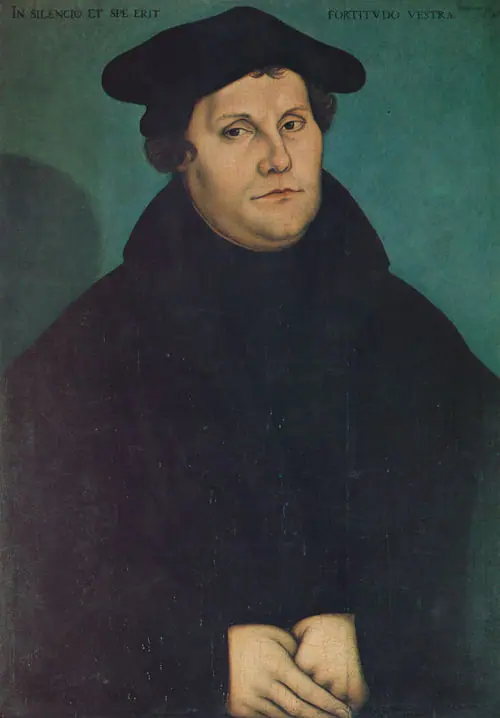
In 1517 a friar and professor of theology at Wittenberg, Martin Luther, challenged the way indulgences were being sold, and within four years he had been excommunicated by the pope and outlawed by the emperor. His teaching that sinners are justified by faith alone, and that Scripture alone is the final authority, spread with the printing press and found protection among German princes and city councils. Others went further or in different directions: Zwingli in Zurich, the Anabaptists who rejected infant baptism, Calvin in Geneva, and in England a king who made himself head of the church for reasons of his own. Rome answered with the Council of Trent, new religious orders and a renewed discipline. By 1648 Latin Christianity had split into Catholic, Lutheran, Reformed and Anglican churches and many smaller groups, after a century of persecution and war settled by treaties that let rulers decide their subjects’ religion. Consensus
Historians now speak of “Reformations” in the plural. There was not one movement that broke away from a corrupt church, but several reform movements, Catholic as well as Protestant, competing to renew a Christianity that most people on all sides still took very seriously. Much of what follows is the work of the last half-century, which has questioned both the Protestant story of a liberation and the Catholic story of a revolt.[1][2] Majority
Timeline
| Date | Event or evidence | Confidence |
|---|---|---|
| 1415 | Jan Hus, who had attacked indulgences and papal power, is burned at the Council of Constance (§8)[1] | Consensus |
| c. 1455 | Gutenberg’s Bible printed at Mainz; by 1500 presses work in more than 200 European towns[3][4] | Consensus |
| 1515 | Leo X proclaims a plenary indulgence for the rebuilding of St Peter’s, preached in Albrecht of Brandenburg’s territories; half the proceeds will repay Albrecht’s debt to the Fugger bank[5][1] | Consensus |
| 1516 | Erasmus publishes the Greek New Testament with a new Latin translation[1] | Consensus |
| 31 Oct 1517 | Luther sends his Ninety-five Theses to Archbishop Albrecht with a covering letter[5] | Consensus |
| 1520 | Luther’s three great treatises; the bull Exsurge Domine threatens him with excommunication, and he burns it[6][7] | Consensus |
| Apr–May 1521 | Luther refuses to recant at the Diet of Worms; the Edict of Worms outlaws him[8] | Consensus |
| 1522 | Luther’s German New Testament (the “September Testament”); Zwingli’s reform begins in Zurich[9][10] | Consensus |
| Jan 1525 | First adult baptisms in Zurich: the Anabaptist movement begins[11] | Consensus |
| 1524–1525 | The German Peasants’ War; the Twelve Articles; Luther’s tract against the peasants; tens of thousands killed[12][13][14] | Majority (numbers) |
| 1529 | The “Protestation” at the Diet of Speyer gives Protestants their name; Luther and Zwingli fail to agree at Marburg[15][1] | Consensus |
| 1530 | The Augsburg Confession, written by Melanchthon[16] | Consensus |
| 1534 | Act of Supremacy: Henry VIII “supreme head” of the Church of England; Luther’s complete German Bible[17][9] | Consensus |
| 1534–1535 | Radical Anabaptists rule Münster until the city is retaken[11] | Consensus |
| 1536 | Calvin’s Institutes first published; Tyndale executed near Brussels[18][19] | Consensus |
| 1540 | Paul III approves the Society of Jesus[20][21] | Consensus |
| 1543 | Luther’s On the Jews and Their Lies[22] | Consensus |
| 1545–1563 | The Council of Trent; the canon decree of April 1546[23][24] | Consensus |
| 1553 | Michael Servetus burned in Geneva for denying the Trinity[18] | Consensus |
| 1555 | Peace of Augsburg: each prince of the Empire chooses between Catholicism and Lutheranism[25] | Consensus |
| 1559–1563 | Elizabethan settlement; Thirty-Nine Articles (1563, final form 1571)[26] | Consensus |
| 24 Aug 1572 | St Bartholomew’s Day massacre of Huguenots in Paris and other cities[27] | Consensus |
| 1598 | Edict of Nantes grants French Protestants limited toleration[28] | Consensus |
| 1611 | The King James Bible[29] | Consensus |
| 1618–1648 | Thirty Years’ War, ended by the Peace of Westphalia[30][31] | Consensus |
Where: a map of divided Christendom
In 1517 Latin Christianity stretched from Portugal to Poland and from Iceland to Sicily, under one pope and one liturgical language. By 1600 its map had broken into blocs. Northern and much of central Germany, Scandinavia and the Baltic were Lutheran. Switzerland was divided between Reformed cities (Zurich, Bern, Basel, Geneva) and Catholic rural cantons. Scotland and the northern Netherlands were Reformed; England had its own national church; France had a large Reformed minority, the Huguenots, in the south and west. Italy, Spain and Portugal remained Catholic, and Poland, Bavaria, Austria and the southern Netherlands were won back for Catholicism over the following century.[1][32] Consensus
The Holy Roman Empire mattered most. It was a patchwork of several hundred principalities, bishoprics and free cities under an elected emperor, and that fragmentation is why the Reformation survived: Luther’s own ruler, Frederick the Wise of Saxony, protected him, and princes and city councils could adopt the new teaching in their own territories whatever the emperor wanted.[30][7] Majority Religious divisions often ran through towns and families rather than between countries; Benjamin Kaplan’s history of toleration shows how neighbours of different confessions lived side by side in cities such as Augsburg, Amsterdam and Utrecht.[32] Majority
Before Luther: reform without schism
Calls to reform the church “in head and members” were old by 1517 (§8). John Wyclif in England (d. 1384) had attacked the wealth of the clergy and the doctrine of transubstantiation, and inspired the first complete English Bible; Jan Hus in Bohemia was burned at the Council of Constance in 1415 for similar teaching, and his followers held much of Bohemia against crusading armies.[1] Consensus The fifteenth-century councils had tried to reform the papacy and failed. Humanist scholars, led by Erasmus of Rotterdam, called for a simpler Christianity drawn from the Bible and the church fathers, and in 1516 Erasmus published the first printed Greek New Testament to be released (the Complutensian Polyglot’s was printed in 1514 but released only in the 1520s).[1][2] Consensus
The late-medieval church was not, as older Protestant histories said, simply decadent. Eamon Duffy’s study of English parishes found a lay religion that was vigorous and popular on the eve of the Reformation: guilds, shrines, bequests for masses, and new church building.[33] Majority What it also had was a theology of merit and a system of payments around purgatory that critics found easy to attack, and a papacy in Rome deeply involved in Italian politics and in raising money.[2] Majority
Indulgences
An indulgence remitted the temporal punishment still owed for sins already forgiven in confession, drawing on the “treasury of merits” of Christ and the saints that the pope was held to administer. By the fifteenth century they could be applied to souls in purgatory, and they were sold. In 1515 Leo X proclaimed a plenary indulgence to fund the rebuilding of St Peter’s basilica. In the lands of Albrecht of Brandenburg, archbishop of Mainz and Magdeburg, half the proceeds were secretly to repay the Fugger bank, which had lent Albrecht the fees for a papal dispensation to hold several sees at once. The Dominican Johann Tetzel preached it near Wittenberg in 1517.[5][1] Consensus
Luther
The theses, 1517
Martin Luther (1483–1546), an Augustinian friar and professor of Bible at the new university of Wittenberg in Electoral Saxony, had warned against indulgences in sermons since 1516. On 31 October 1517 he sent Archbishop Albrecht a letter with ninety-five Latin theses for an academic disputation.[5] Consensus They did not reject indulgences outright, the papacy or the sacrament of penance; the word “faith” does not appear in them. They attacked the preaching that promised salvation for money:
“27. They preach man who say that so soon as the penny jingles into the money-box, the soul flies out [of purgatory].” (trans. Henry E. Jacobs and Adolph Spaeth)[5]
Printers in Leipzig, Nuremberg and Basel had the theses out within weeks, and soon in German. Luther was not the first to make such criticisms, but he was the first whose criticism reached a mass public through print, and he became the best-selling author of the age.[4] Majority
Whether he also nailed the theses to the door of the Castle Church is uncertain (see Debates).
From protest to break, 1518–1521
Under pressure, Luther’s position hardened. At the Leipzig debate of 1519, Johann Eck pushed him into saying that councils could err and that some of Hus’s views were Christian. In 1520 he published three treatises that set out a programme: To the Christian Nobility of the German Nation, calling on the laity to reform the church because all baptised Christians are priests; The Babylonian Captivity of the Church, reducing the sacraments from seven to two or three; and The Freedom of a Christian, on justification by faith.[7][34] Consensus In June 1520 the bull Exsurge Domine condemned forty-one of his propositions; on 10 December he burned it, with the canon law books, outside Wittenberg’s walls, and in January 1521 he was excommunicated.[6] Consensus
In April 1521 he was summoned before the young emperor Charles V at the Diet of Worms and asked to recant. He refused. The best-known version of his answer ends with the words “Here I stand”, which appear in the earliest printed accounts but not in the diet’s official record (see Primary sources).[8][7] Majority The Edict of Worms declared him an outlaw. Frederick the Wise had him “kidnapped” on the road home and hidden in the Wartburg castle, where in eleven weeks he translated the New Testament into German.[9][7] Consensus
What Luther taught
At the centre was a doctrine of grace: sinners are justified, made right with God, by faith in Christ alone, not by works; Christ’s righteousness is credited to them. Scripture alone is the supreme authority, above popes and councils. All baptised believers are priests. Only baptism and the Lord’s Supper are sacraments instituted by Christ, and in the Supper Christ’s body and blood are really present “in, with and under” the bread and wine, a view Luther defended against Rome and against other reformers.[34][16] Consensus Monastic vows, clerical celibacy, the Mass as a sacrifice, purgatory and the invocation of saints were rejected. In 1525 Luther, an ex-friar, married Katharina von Bora, an ex-nun.[7] Consensus
Heiko Oberman insisted that Luther must be read as a late-medieval man who expected the devil’s assaults and the end of the world, not as a precursor of modern freedom; Lyndal Roper’s biography stresses his body, his anger and his friendships as well as his theology.[34][7] Majority
The Peasants’ War, 1524–1525
In 1524–1525 peasants and townsmen across southern and central Germany rose against their lords. The Twelve Articles drawn up at Memmingen in March 1525 demanded that communities choose their own pastors, that serfdom end because Christ had redeemed all, and that rights to woods, water and commons be restored, each demand backed by Scripture.[12][14] Consensus Many rebels believed they were applying Luther’s gospel. Luther first urged both sides to peace, then, in May 1525, wrote Against the Robbing and Murdering Hordes of Peasants, calling on the princes to strike the rebels down without mercy.[13] Consensus The armies of the princes crushed the rising; the radical preacher Thomas Müntzer was captured after the battle of Frankenhausen and executed. Estimates of the dead run from about 70,000 to 100,000.[14][35] Majority Peter Blickle called the rising “the revolution of the common man”; Friedrich Engels, in 1850, had read it as an early class war betrayed by Luther.[14][36] Contested on the interpretation.
Zurich, Marburg and the radicals
Zwingli
Huldrych Zwingli, people’s priest at the Great Minster of Zurich from 1519, reached conclusions close to Luther’s by partly independent routes, through humanism and Erasmus. In 1522 he defended friends who broke the Lenten fast by eating sausages, and in 1523 the city council held public disputations and adopted his reform: images were removed, the Mass abolished in 1525 and replaced by a simple communion service.[10] Consensus Zwingli read Christ’s words “This is my body” as “This signifies my body”: the Supper was a memorial. Luther held to a real presence. In October 1529 Philip of Hesse brought them together at Marburg, hoping for a Protestant alliance; they agreed on fourteen of fifteen articles and divided on the fifteenth, the Supper.[15][10] Consensus Zwingli was killed in battle against the Catholic cantons at Kappel in 1531.
The Anabaptists
Some of Zwingli’s own followers decided that the reform had stopped halfway. If faith came before baptism, infants could not be baptised. On 21 January 1525, in a house in Zurich, Conrad Grebel baptised George Blaurock, and Blaurock baptised the others: the first “rebaptisms” that gave their opponents the name Anabaptists.[11] Consensus Rebaptism was already a capital crime in Roman law, and Catholic and Protestant authorities alike enforced it. Zurich drowned Felix Manz in the Limmat in January 1527; Catholic authorities burned Michael Sattler in May of the same year.[11] Consensus
Sattler had just drafted the Schleitheim Confession (1527), which defined a church of believers separated from “the world”: no oaths, no bearing of the sword, no part in government.[37] Consensus A different, apocalyptic strand took over the city of Münster in 1534, proclaimed it the New Jerusalem under Jan van Leiden, introduced community of goods and polygamy, and was crushed in 1535; the cages in which the leaders’ bodies were displayed still hang from the tower of St Lambert’s church.[11] Consensus Münster fixed the image of Anabaptists as revolutionaries for generations. The peaceable tradition survived through the former priest Menno Simons, from whom the Mennonites take their name; the Hutterites grew up alongside them in Tyrol and Moravia, and the Amish later split from the Mennonites (1693). Consensus
Calvin and the Reformed churches
John Calvin (1509–1564), a French lawyer turned theologian, fled France after 1534 and published the first edition of his Institutes of the Christian Religion in Basel in 1536; he expanded it until the final Latin edition of 1559.[18] Consensus Called to Geneva in 1536, expelled in 1538 and recalled in 1541, he organised the city’s church through the Ecclesiastical Ordinances: four offices (pastors, teachers, elders and deacons) and a Consistory of pastors and elders that disciplined morals, from adultery to absence from sermons.[18] Consensus
Calvin’s theology was close to Luther’s on justification but stricter on images, which he called idolatry, and he taught double predestination: that God has eternally chosen some for salvation and others for damnation. Later Reformed theology made predestination more central than Calvin himself had.[18][1] Majority Geneva trained pastors for France, the Netherlands, Scotland and beyond; the Reformed, or Calvinist, family became the most international of the Protestant traditions, with confessions such as the Heidelberg Catechism (1563) and the Synod of Dort (1618–1619).[1] Consensus
In 1553 the Spanish physician Michael Servetus, who denied the Trinity and had been condemned by the Catholic Inquisition in France, was arrested in Geneva, tried and burned alive. Calvin had pressed for his conviction, though he asked for a less cruel death. Sebastian Castellio replied that killing a man was not defending a doctrine; his argument for tolerance was published in full only in 1612.[18] Consensus
England: a king’s reformation
England’s break with Rome began with Henry VIII’s wish to annul his marriage to Catherine of Aragon. When Pope Clement VII, under the power of Catherine’s nephew Charles V, would not grant it, Parliament cut the church’s ties with Rome in a series of statutes. The Act of Supremacy of 1534 declared that the king
“shall be taken, accepted, and reputed the only supreme head in earth of the church of England, called Anglicana Ecclesia.” (1534, text as printed in 1845)[17]
Consensus Henry dissolved the monasteries between 1536 and 1540 and sold their lands, but remained conservative in doctrine. Under his son Edward VI (1547–1553), Archbishop Thomas Cranmer introduced a Protestant Book of Common Prayer (1549, revised 1552). Mary I (1553–1558) restored Catholicism and burned about 280 Protestants, Cranmer among them. Elizabeth I’s settlement of 1559 and the Thirty-Nine Articles established a Protestant national church with bishops and much of the old liturgical order.[26][33] Consensus
How willingly the English changed is one of the field’s great debates (see below). Scotland’s reformation, led by John Knox, was a Reformed revolt against a Catholic queen; the Scottish Parliament abolished papal authority in 1560.[1] Consensus
Rome’s answer: Trent and the Jesuits
The Council of Trent, 1545–1563
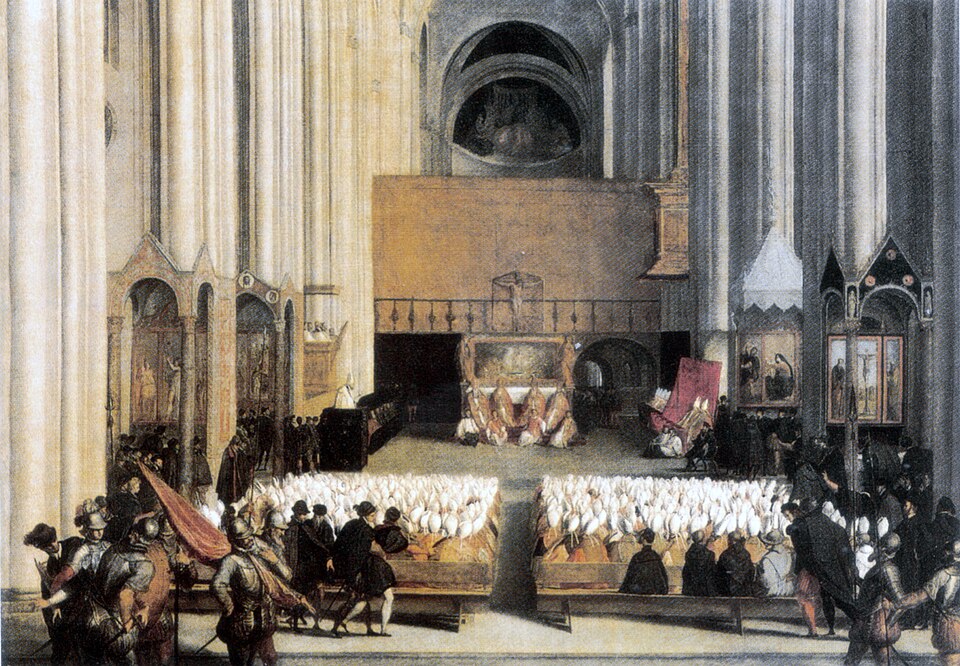
Pope Paul III finally convened the council that reformers and the emperor had demanded for decades at Trent, a prince-bishopric of the Empire in the Alps. It met in three periods, 1545–1547, 1551–1552 and 1562–1563, and no Protestants took part.[24] Consensus Its decrees answered the reformers point by point:
- Scripture and tradition. On 8 April 1546 it declared that saving truth is contained “in the written books, and the unwritten traditions”, and listed the canonical books, including Tobit, Judith, Wisdom, Sirach, Baruch and 1–2 Maccabees, which Protestants were relegating to an “Apocrypha”. It was the first time a council made a list of the Bible’s books a dogma, with an anathema (§5).[23] Consensus The Latin Vulgate was declared authentic for public use.
- Justification. The decree of January 1547 taught that justification begins with grace but requires human cooperation and grows through good works, rejecting “faith alone”.[24] Consensus
- Sacraments and the Mass. Seven sacraments, transubstantiation (already defined in 1215, §8), and the Mass as a true sacrifice were affirmed.[24] Consensus
- Reform. Bishops were ordered to reside in their dioceses; each diocese was to found a seminary to train priests (1563); clandestine marriages were invalidated; religious women were to be strictly enclosed.[24] Consensus A catechism (1566), a breviary (1568) and a missal (1570) followed.
Repression grew alongside reform: the Roman Inquisition was founded in 1542 and the first papal Index of Prohibited Books issued in 1559.[38] Consensus
The Jesuits
Ignatius of Loyola, a Basque soldier converted while recovering from wounds, gathered companions in Paris, and in 1540 Paul III approved them as the Society of Jesus.[20] Consensus Founded to help souls rather than to fight Protestants, the Jesuits became within decades the church’s leading educators, with hundreds of colleges, and its leading missionaries, from Japan to Brazil (§10).[21] Majority New women’s congregations, such as Angela Merici’s Ursulines (1535), and reformers such as Teresa of Ávila, were part of the same renewal, though Trent’s enclosure rules limited what religious women could do outside convents.[38] Majority
Wars, peace and the limits of toleration
Every side assumed that a realm could have only one true church. In the Empire, after the Schmalkaldic War of 1546–1547, the Peace of Augsburg of 1555 allowed each prince to choose Catholicism or the Augsburg Confession for his territory; subjects who disagreed could emigrate. Calvinists and Anabaptists were excluded. The famous summary cuius regio, eius religio, “whose the realm, his the religion”, is a jurists’ formula from around 1600, not the treaty’s wording.[25][32] Consensus
France fought eight civil wars between 1562 and 1598. On St Bartholomew’s Day, 24 August 1572, Catholic mobs and royal troops killed Huguenot leaders gathered in Paris for a royal wedding, and the killing spread to other cities; estimates run to about 2,000–3,000 dead in Paris and several thousand more in the provinces.[27] Majority The Edict of Nantes (1598) gave Huguenots freedom of conscience, limited rights of worship and fortified towns; Louis XIV revoked it in 1685.[28] Consensus
The Thirty Years’ War began in 1618 when Bohemian Protestants threw two imperial regents from a window of Prague castle, and widened into a European war in which Catholic France fought on the Protestant side against the Habsburgs. Peter Wilson estimates that the Empire lost perhaps a fifth of its population, most of them to disease and hunger rather than battle.[30] Majority The Peace of Westphalia (1648) added the Reformed to the confessions recognised in the Empire and fixed 1624 as the “normative year” for church property. Pope Innocent X condemned the treaties as null and void; the powers ignored him.[31][30] Consensus Whether the wars were “religious” or political is a long debate; most historians now see them as both at once.[30][27] Majority
The witch trials
The same century saw Europe’s great witch-hunt. Its theory was older: the Malleus Maleficarum (1486/1487), by the Dominican inquisitor Heinrich Kramer, portrayed witches as women in a pact with the devil.[39] But the mass trials came later, between about 1560 and 1630, in both Catholic and Protestant lands.[40][41] Majority Most historians now estimate about 40,000–60,000 executions across Europe between 1450 and 1750, roughly three-quarters of them women. The worst were in the small territories of the Holy Roman Empire, such as the prince-bishoprics of Würzburg and Bamberg and the electorate of Trier; most trials were run by secular courts, while the Spanish and Roman Inquisitions, sceptical of the evidence, executed very few.[40][41] Majority Older claims of millions of victims are not supported by the trial records. Consensus
Bibles for everyone
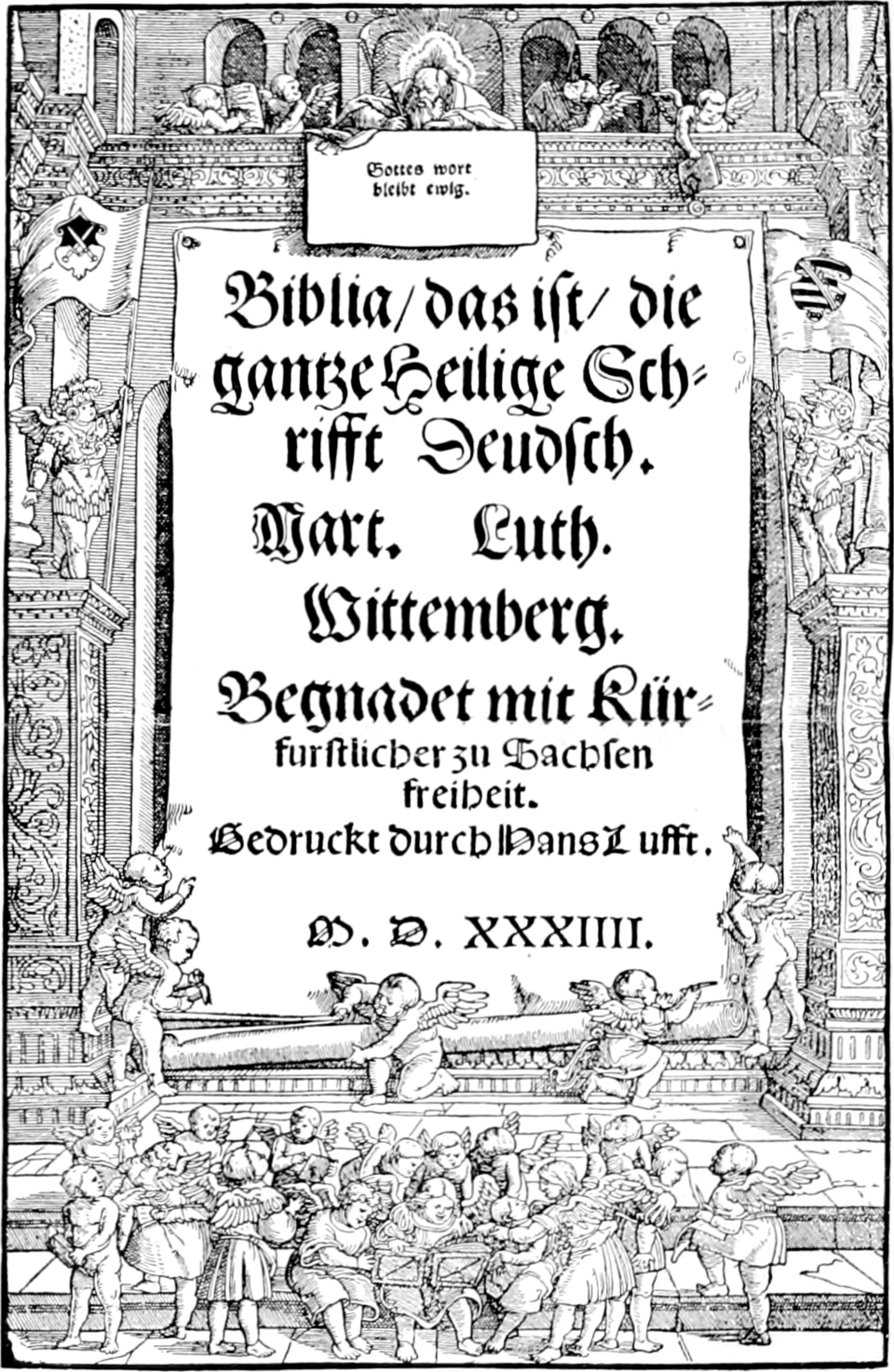
The reformers wanted the Bible in the language of the people, and print made that possible. Luther’s New Testament of September 1522 and his complete Bible of 1534, revised until his death, shaped the German language itself.[9] Majority William Tyndale translated the New Testament from Greek into English, printed at Worms in 1526 and smuggled into England; he was strangled and burned near Brussels in 1536.[19] Consensus The first complete printed English Bible (Coverdale, 1535), the Great Bible (1539) and the Geneva Bible (1560) followed.
The King James Version of 1611 was made by about fifty scholars working from these earlier English versions as much as from the Hebrew and Greek, as its preface says:
“wee never thought from the beginning, that we should neede to make a new Translation, nor yet to make of a bad one a good one… but to make a good one better, or out of many good ones, one principall good one.” (1611 spelling)[29]
A study by Jon Nielson and Royal Skousen estimated that about 83 percent of the King James New Testament’s wording comes from Tyndale.[42] Majority Catholics answered with the Douai–Rheims translation (New Testament 1582). Consensus
Luther and the Jews
Luther’s attitude to Jews changed for the worse. In That Jesus Christ Was Born a Jew (1523) he blamed the church’s cruelty for Jews’ refusal to convert and urged that they be treated kindly.[43] Consensus Twenty years later, in On the Jews and Their Lies (1543), he called on rulers to burn synagogues and Jewish schools, destroy Jews’ houses, take away their prayer books and Talmuds, forbid rabbis to teach on pain of death, abolish their safe-conduct on the roads, seize their money and put them to forced labour.[22][44] Consensus on the text. Some Lutheran princes expelled their Jews; others ignored the advice. Nazi propagandists reprinted the tract four centuries later.[44] Consensus
How far Luther’s hostility was traditional Christian anti-Judaism and how far it anticipated racial antisemitism is debated. Heiko Oberman placed it within the religious anti-Judaism of his time while stressing its violence;[34] Thomas Kaufmann argues that Luther also absorbed and spread a pre-modern, “proto-racist” antisemitism, so the line between the two cannot be cleanly drawn.[44] Political In 1994 the Evangelical Lutheran Church in America formally rejected these writings, and other Lutheran churches have made similar declarations.[45] Consensus For Jewish life in this period, see Judaism §9.
The evidence
| Question | What the evidence supports | Key evidence | Confidence |
|---|---|---|---|
| The trigger | A dispute over the preaching of indulgences, made public by print | The theses and Luther’s letter to Albrecht[5][4] | Consensus |
| The theses on the door | Possible, even likely, but first printed after Luther’s death | Melanchthon; Rörer’s note; Iserloh’s critique[46][47] | Contested |
| Luther’s core teaching | Justification by faith alone; Scripture as supreme authority; priesthood of all believers | 1520 treatises; Augsburg Confession[16][34] | Consensus |
| Peasants’ War | A mass rising inspired partly by Reformation preaching; Luther sided with the princes | Twelve Articles; Luther’s tract[12][13] | Consensus |
| Many reformations | Lutheran, Reformed, Anabaptist and English reformations with distinct theologies | Marburg; Schleitheim; Act of Supremacy[15][37][17] | Consensus |
| Catholic response | Doctrinal definition, internal reform and repression together | Trent; Jesuits; Index[23][38] | Consensus |
| The canon | First made a dogma by a council in 1546 | Trent, Session 4[23] | Consensus |
| Religious settlements | Rulers chose; dissenters could emigrate; toleration was limited and pragmatic | Augsburg; Nantes; Westphalia[25][28][31] | Consensus |
| Witch trials | About 40,000–60,000 executions, mostly 1560–1630, mostly women, mostly secular courts | Trial records[40][41] | Majority |
| Vernacular Bible | Luther’s and Tyndale’s translations shaped German and English | KJV preface; Nielson and Skousen[29][42] | Majority |
Primary sources
Show the 10 primary sources
1. The money-box: Ninety-five Theses 27–28 and 86, 1517
“27. They preach man who say that so soon as the penny jingles into the money-box, the soul flies out [of purgatory]. 28. It is certain that when the penny jingles into the money-box, gain and avarice can be increased, but the result of the intercession of the Church is in the power of God alone… 86. Again:—‘Why does not the pope, whose wealth is to-day greater than the riches of the richest, build just this one church of St. Peter with his own money, rather than with the money of poor believers?’” (trans. Henry E. Jacobs and Adolph Spaeth, 1915)[5]
What it proves. The theses attack the preaching and the money, not the papacy or indulgences as such; thesis 86 is framed as a question that laymen might ask. They show how far Luther still was, in 1517, from the break of 1520. Consensus
2. The door: Georg Rörer’s note
Luther’s secretary Georg Rörer wrote a Latin note in his copy of the revised New Testament of around 1540, recording that on the eve of All Saints in 1517 Doctor Martin Luther posted theses about indulgences on the doors of Wittenberg’s churches (paraphrased). The note was identified in 2006.[47]
What it proves. A witness close to Luther, writing in his lifetime, believed the theses had been posted, and on church doors in the plural, which was how Wittenberg University announced disputations. It is not an eyewitness account. Majority that it strengthens the case for a posting.
3. Before the emperor: Worms, 18 April 1521
”…I neither can nor will retract anything; for it can not be right for a Christian to speak against his conscience. I stand here and can say no more. God help me. Amen.” (trans. H. White from Merle d’Aubigné’s reconstruction, 1840s; reprinted 1906)[8]
What it proves. The refusal itself is certain. The closing words come from the first printed editions of the speech, issued in Wittenberg soon after; the imperial record has only the appeal to Scripture and conscience. A slogan may have been added by printers who knew what would sell.[7] Majority
4. A peasants’ gospel: the Twelve Articles, 1525
Drafted at Memmingen in March 1525 by the furrier Sebastian Lotzer and the preacher Christoph Schappeler, the articles demand the right of each community to choose and dismiss its pastor, the end of serfdom because Christ redeemed all people with his blood, peasant and lord alike (the third article, paraphrased), and the return of common woods and waters. Each article cites Scripture.[12][14]
What it proves. The rebels used the Reformation’s own principle, Scripture as the measure of all things, to judge their lords. The articles were reprinted many times within weeks. Consensus
5. Luther against the rebels, May 1525
In Against the Robbing and Murdering Hordes of Peasants, Luther told the princes that rebels had forfeited body and soul, and that anyone who could should strike them down, secretly or openly, as one kills a mad dog (paraphrase).[13]
What it proves. Luther drew a sharp line between the spiritual freedom he preached and any claim to social or political freedom. The tract was published as the princes were already winning, and many of his supporters were shocked. Consensus
6. A church apart: the Schleitheim Confession, 1527
Its seven articles commit the “brothers and sisters” to believers’ baptism, the ban (excommunication) for the erring, a Lord’s Supper only for the baptised, separation from “the abomination” of the world, pastors chosen by the congregation, no use of the sword, and no oaths.[37]
What it proves. The earliest Anabaptist confession defined a voluntary church of committed adults, distinct from both the state churches of the Reformation and Rome. Consensus
7. The king as head of the church: Act of Supremacy, 1534
Quoted above. What it proves. The English break with Rome was made by statute; the act claims to recognise a supremacy the king already had rather than to create one. Doctrine was hardly touched until 1547. Consensus
8. The canon becomes dogma: Trent, Session 4, 8 April 1546
“…perceiving that this truth and discipline are contained in the written books, and the unwritten traditions… [the synod] receives and venerates with equal affection of piety, and reverence, all the books both of the Old and of the New Testament… But if any one receive not, as sacred and canonical, these same books entire with all their parts, as they have been used to be read in the Catholic Church, and as they are contained in the old Latin vulgate edition… let him be anathema.” (trans. Theodore A. Buckley, 1851)[23]
What it proves. The council made the Catholic canon, including the books Protestants called Apocrypha, a binding dogma for the first time, and set “unwritten traditions” beside Scripture. It is the clearest single difference of principle between Trent and the reformers. Consensus
9. Whose realm: the Peace of Augsburg, 1555
The treaty forbids war over religion between the Catholic estates and those of the Augsburg Confession, leaves each ruler free to choose between them, and allows subjects of the other faith to sell their property and emigrate.[25]
What it proves. The first legal settlement of the split recognised two churches but gave the choice to rulers, not to individuals. The right to emigrate was the main concession to conscience. Consensus
10. Making a good one better: the King James Bible, 1611
Quoted above. What it proves. The translators described their work as a revision of existing English Bibles, which is why so much of Tyndale survives in it. Consensus
What is absent
- “Protestants.” The name comes from the protest of the evangelical estates at the Diet of Speyer in 1529; the reformers called themselves “evangelical”.[1] Consensus
- Denominations. No one in 1517 imagined several legitimate churches side by side. Each side claimed to be the true church; the plural came by exhaustion, not by principle. Majority
- A dogmatically closed Catholic canon. The list of books was practice, not dogma, until 1546. Consensus
- Religious freedom. Apart from a few voices such as Castellio and some Anabaptists, no party argued that individuals should choose their faith; that argument belongs to the next century (§11). Majority
- Separation of church and state. Reformers relied on princes and city councils; only the Anabaptists rejected the sword for Christians altogether. Consensus
- A Lutheran or Calvinist church. Luther disliked his opponents’ label “Lutheran”, and Calvin’s followers called themselves Reformed. Consensus
Debates
Did Luther nail up the theses?
| View | Argument | Main proponents |
|---|---|---|
| Legend | No source from 1517 mentions it; Melanchthon, who arrived in 1518, told the story after Luther died; Luther himself never mentions it | Iserloh[46] |
| Likely posted | Posting on church doors was how the university announced disputations; Rörer’s note, written in Luther’s lifetime, says so | Treu and others[47] |
Contested. The date, 31 October 1517, is secure either way, because of the letter to Albrecht.
Reformation or reformations, revolt or renewal?
| View | Position | Main proponents |
|---|---|---|
| Protestant classic | A corrupt church; a rediscovered gospel; a liberation of conscience | Older Protestant historiography |
| Catholic Reformation | Catholic renewal began before Luther and was not only a reaction | Jedin (who also used “Counter-Reformation”)[48] |
| Early Modern Catholicism | Neither label captures the period’s Catholic missions, art and spirituality | O’Malley[38] |
| Confessionalisation | Lutheran, Reformed and Catholic states alike used religion to discipline subjects and build states | Schilling, Reinhard[49][50] |
Majority for treating the Catholic and Protestant movements as parallel; Contested on how far confessionalisation explains them.
Was the English Reformation popular?
A. G. Dickens argued in 1964 that Protestantism spread quickly from below in a country already anticlerical.[51] Christopher Haigh and Eamon Duffy argued that late-medieval English Catholicism was popular and that change was imposed from above, slowly and against much resistance.[26][33] Most historians now accept much of the revisionist case, while noting strong Protestant regions such as London and the south-east. Majority
Did Protestantism make capitalism?
Max Weber argued in 1904–1905 that a Calvinist ethic of disciplined work and anxiety about salvation helped create the “spirit of capitalism”.[52] Economists Sascha Becker and Ludger Woessmann found that Protestant regions of Prussia were richer mainly because Protestants learned to read the Bible, and so were more literate.[53] Contested
Luther and modern antisemitism
| View | Position | Main proponents |
|---|---|---|
| A line to Nazism | Luther’s 1543 programme anticipated the Nazi persecution and was used by it | Some historians and popular writers, e.g. William Shirer; cited by Nazi propagandists[54] |
| Proto-racist antisemitism | Religious and ethnic hostility were already fused in Luther’s late writings | Kaufmann[44] |
| Religious anti-Judaism | Luther’s hatred was theological and shared with his age, though extreme; its later racial use was a distortion that the text nonetheless made possible | Oberman[34] |
Political
Further reading
Show further reading (11 works)
- Diarmaid MacCulloch, Reformation: Europe’s House Divided, 1490–1700 (Allen Lane, 2003): the best single-volume history.
- Carlos M. N. Eire, Reformations: The Early Modern World, 1450–1650 (Yale, 2016).
- Lyndal Roper, Martin Luther: Renegade and Prophet (Bodley Head, 2016), and Heiko A. Oberman, Luther: Man between God and the Devil (Yale, 1989).
- Andrew Pettegree, Brand Luther: 1517, Printing, and the Making of the Reformation (Penguin, 2015).
- Bruce Gordon, Calvin (Yale, 2009).
- C. Arnold Snyder, Anabaptist History and Theology (Pandora, 1995).
- Eamon Duffy, The Stripping of the Altars (Yale, 1992), and Christopher Haigh, English Reformations (Oxford, 1993).
- John W. O’Malley, Trent: What Happened at the Council (Harvard, 2013) and Trent and All That (Harvard, 2000).
- Peter H. Wilson, Europe’s Tragedy: A History of the Thirty Years War (Allen Lane, 2009).
- Brian P. Levack, The Witch-Hunt in Early Modern Europe (Routledge, 4th ed. 2016).
- Benjamin J. Kaplan, Divided by Faith: Religious Conflict and the Practice of Toleration in Early Modern Europe (Harvard, 2007).
References
- ^ a b c d e f g h i j k l m Diarmaid MacCulloch Reformation: Europe's House Divided, 1490–1700. Allen Lane, 2003. The standard one-volume history, Catholic and Protestant together.
- ^ a b c Carlos M. N. Eire Reformations: The Early Modern World, 1450–1650. Yale University Press, 2016. The Reformations in the plural, including Catholic renewal.
- ^ Elizabeth L. Eisenstein The Printing Press as an Agent of Change. Cambridge University Press, 1979. The classic argument for print's role in the Reformation and early modern culture.
- ^ a b c Andrew Pettegree Brand Luther: 1517, Printing, and the Making of the Reformation. Penguin Press, 2015. How Luther and Wittenberg's printers made each other.
- ^ a b c d e f g Martin Luther, Ninety-five Theses and letter to Albrecht of Mainz (31 October 1517) — Disputation on the Power and Efficacy of Indulgences. 1517. Latin. The theses against the preaching of indulgences, with Luther's covering letter to Archbishop Albrecht dated 31 October 1517; thesis 27 attacks the claim that the soul flies out of purgatory when the penny jingles. read the text
- ^ a b Leo X, Exsurge Domine (15 June 1520) — Papal bull. 1520. Latin. Condemns forty-one propositions from Luther's writings and gives him sixty days to recant; Luther burned it on 10 December 1520. about
- ^ a b c d e f g h Lyndal Roper Martin Luther: Renegade and Prophet. Bodley Head, 2016. Biography stressing Luther's body, emotions and relationships.
- ^ a b c Martin Luther, speech before the Diet of Worms (18 April 1521) — Speech at the Diet of Worms. 1521. Latin and German. Luther refuses to recant unless convinced by Scripture or plain reason; the closing 'I stand here' comes from the first printed editions, not the diet's record. read the text
- ^ a b c d Luther's German Bible (New Testament 1522; complete Bible 1534) — Biblia, das ist, die gantze Heilige Schrifft Deudsch. 1522–1534. German. The 'September Testament' translated from Erasmus' Greek at the Wartburg, and the complete Bible of 1534, revised until Luther's death. about
- ^ a b c Bruce Gordon The Swiss Reformation. Manchester University Press, 2002. Zwingli, Zurich and the Reformed cities.
- ^ a b c d e C. Arnold Snyder Anabaptist History and Theology: An Introduction. Pandora Press, 1995. The Swiss Brethren, Münster and the Mennonites.
- ^ a b c d The Twelve Articles (Memmingen, March 1525) — Twelve Articles of the Upper Swabian peasants. 1525. German. The peasants' manifesto: communities to choose their pastors, serfdom to end because Christ redeemed all, commons restored, each demand backed by Scripture. about
- ^ a b c d Martin Luther, Against the Robbing and Murdering Hordes of Peasants (May 1525) — Wider die räuberischen und mörderischen Rotten der Bauern. 1525. German. Luther urges the princes to strike down the rebels without mercy, as one would kill a mad dog. about
- ^ a b c d e Peter Blickle The Revolution of 1525: The German Peasants' War from a New Perspective. Johns Hopkins University Press, 1981. The Peasants' War as a 'revolution of the common man'.
- ^ a b c Marburg Articles (October 1529) — Marburg Colloquy. 1529. German. Luther, Zwingli and their colleagues agree on fourteen of fifteen articles and divide on the presence of Christ in the Lord's Supper. about
- ^ a b c Augsburg Confession (25 June 1530) — Confessio Augustana. 1530. German and Latin. Melanchthon's statement of Lutheran belief presented to Charles V at the Diet of Augsburg; justification by faith (art. 4) and the real presence (art. 10). about
- ^ a b c Act of Supremacy 1534 (26 Hen. VIII c. 1) — Statute of the Parliament of England. 1534. English. Declares the king 'the only supreme head in earth of the church of England'. read the text
- ^ a b c d e f Bruce Gordon Calvin. Yale University Press, 2009. The standard biography, including the Servetus case.
- ^ a b David Daniell William Tyndale: A Biography. Yale University Press, 1994. Tyndale's translations and his death.
- ^ a b Paul III, Regimini militantis Ecclesiae (27 September 1540) — Papal bull. 1540. Latin. Approves the Society of Jesus founded by Ignatius of Loyola and his companions. about
- ^ a b John W. O'Malley The First Jesuits. Harvard University Press, 1993. The Society of Jesus in its first generation.
- ^ a b Martin Luther, On the Jews and Their Lies (1543) — Von den Juden und ihren Lügen. 1543. German. Urges rulers to burn synagogues and schools, destroy Jewish houses, confiscate prayer books, forbid rabbis to teach and impose forced labour. about
- ^ a b c d e Council of Trent, Session 4, Decree concerning the Canonical Scriptures (8 April 1546) — Canons and Decrees of the Council of Trent. 1546. Latin. Receives Scripture and unwritten traditions with equal reverence and lists the canonical books, including the deuterocanonical ones, under anathema. read the text
- ^ a b c d e John W. O'Malley Trent: What Happened at the Council. Harvard University Press, 2013. The council's three periods, decrees and politics.
- ^ a b c d Peace of Augsburg (25 September 1555) — Recess of the Imperial Diet of Augsburg. 1555. German. Ends religious war in the Empire between Catholic and Lutheran estates, leaves the choice to each ruler, and allows dissenting subjects to emigrate. about
- ^ a b c Christopher Haigh English Reformations: Religion, Politics, and Society under the Tudors. Clarendon Press, 1993. The English Reformation as slow and imposed from above.
- ^ a b c Mack P. Holt The French Wars of Religion, 1562–1629. Cambridge University Press, 2nd ed., 2005. The wars, St Bartholomew's Day and the Edict of Nantes.
- ^ a b c Edict of Nantes (April 1598) — Royal edict of Henry IV of France. 1598. French. Grants Huguenots freedom of conscience, limited public worship and security towns; revoked by Louis XIV in 1685. about
- ^ a b c 'The Translators to the Reader', King James Bible (1611) — The Holy Bible (King James Version). 1611. English. The translators say they set out not to make a new translation 'but to make a good one better'. read the text
- ^ a b c d e Peter H. Wilson Europe's Tragedy: A History of the Thirty Years War. Allen Lane, 2009. The war as political as well as religious; estimates of the population loss.
- ^ a b c Peace of Westphalia (October 1648) — Treaties of Osnabrück and Münster. 1648. Latin. Ends the Thirty Years' War, extends the Augsburg settlement to the Reformed, and fixes 1624 as the normative year for church property. about
- ^ a b c Benjamin J. Kaplan Divided by Faith: Religious Conflict and the Practice of Toleration in Early Modern Europe. Harvard University Press, 2007. How people of different confessions lived together in practice.
- ^ a b c Eamon Duffy The Stripping of the Altars: Traditional Religion in England, c. 1400–c. 1580. Yale University Press, 1992. Late-medieval English Catholicism as vigorous and popular.
- ^ a b c d e f Heiko A. Oberman Luther: Man between God and the Devil. Yale University Press, 1989. Luther as a late-medieval man expecting the devil and the end; first published in German in 1982.
- ^ Tom Scott and Bob Scribner, eds. The German Peasants' War: A History in Documents. Humanities Press, 1991. Sources in translation, with an introduction.
- ^ Friedrich Engels Der deutsche Bauernkrieg (The Peasant War in Germany). Neue Rheinische Zeitung: Politisch-ökonomische Revue, 1850. The Marxist reading of 1525 as an early revolution betrayed by Luther.
- ^ a b c Schleitheim Confession (24 February 1527) — Brotherly Union of a Number of Children of God. 1527. German. Seven articles of the Swiss Brethren drafted by Michael Sattler: believers' baptism, the ban, separation from the world, no sword, no oaths. about
- ^ a b c d John W. O'Malley Trent and All That: Renaming Catholicism in the Early Modern Era. Harvard University Press, 2000. Proposes 'Early Modern Catholicism' in place of 'Counter-Reformation'.
- ^ Heinrich Kramer, Malleus Maleficarum (1486/1487) — Malleus Maleficarum. 1486/1487. Latin. A Dominican inquisitor's treatise presenting witchcraft as a pact with the devil made chiefly by women. about
- ^ a b c Brian P. Levack The Witch-Hunt in Early Modern Europe. Routledge, 4th ed., 2016. The standard survey, with estimates of prosecutions and executions.
- ^ a b c Wolfgang Behringer Witches and Witch-Hunts: A Global History. Polity, 2004. Places the European witch-hunt's peak between about 1560 and 1630.
- ^ a b Jon Nielson and Royal Skousen How Much of the King James Bible Is William Tyndale's?. Reformation 3: 49–74, 1998. Estimates that about 83 percent of the KJV New Testament is Tyndale's wording.
- ^ Martin Luther, That Jesus Christ Was Born a Jew (1523) — Dass Jesus Christus ein geborener Jude sei. 1523. German. Blames the church's cruelty for Jews' refusal to convert and urges that they be treated kindly. about
- ^ a b c d Thomas Kaufmann Luther's Jews: A Journey into Anti-Semitism. Oxford University Press, 2017. Luther's writings on the Jews in their context and their later use.
- ^ Declaration of the Evangelical Lutheran Church in America to the Jewish Community (18 April 1994) — Evangelical Lutheran Church in America. 1994. English. The ELCA rejects Luther's anti-Jewish writings and expresses its 'deep and abiding sorrow' over their tragic effects. about
- ^ a b Erwin Iserloh The Theses Were Not Posted: Luther between Reform and Reformation. Beacon Press, 1968. The case, first made in 1961, that the theses were sent, not nailed up.
- ^ a b c Joachim Ott and Martin Treu, eds. Luthers Thesenanschlag – Faktum oder Fiktion. Evangelische Verlagsanstalt, 2008. Includes Treu's publication of Georg Rörer's note on the posting of the theses.
- ^ Hubert Jedin Katholische Reformation oder Gegenreformation?. Josef Stocker, 1946. Argues for using both 'Catholic Reformation' and 'Counter-Reformation'.
- ^ Heinz Schilling Religion, Political Culture and the Emergence of Early Modern Society. Brill, 1992. Essays setting out the confessionalisation thesis.
- ^ Wolfgang Reinhard Zwang zur Konfessionalisierung? Prolegomena zu einer Theorie des konfessionellen Zeitalters. Zeitschrift für historische Forschung 10: 257–277, 1983. The other founding statement of the confessionalisation thesis.
- ^ A. G. Dickens The English Reformation. Batsford, 1964. The classic case for a rapid, popular Protestant Reformation.
- ^ Max Weber Die protestantische Ethik und der Geist des Kapitalismus. Archiv für Sozialwissenschaft und Sozialpolitik 20–21, 1905. The Protestant ethic thesis, published in two parts in 1904–1905.
- ^ Sascha O. Becker and Ludger Woessmann Was Weber Wrong? A Human Capital Theory of Protestant Economic History. Quarterly Journal of Economics 124: 531–596, 2009. Explains Protestant prosperity in Prussia by literacy.
- ^ William L. Shirer The Rise and Fall of the Third Reich. Simon & Schuster, 1960. A popular history that drew a line from Luther's anti-Jewish writings to Nazism.