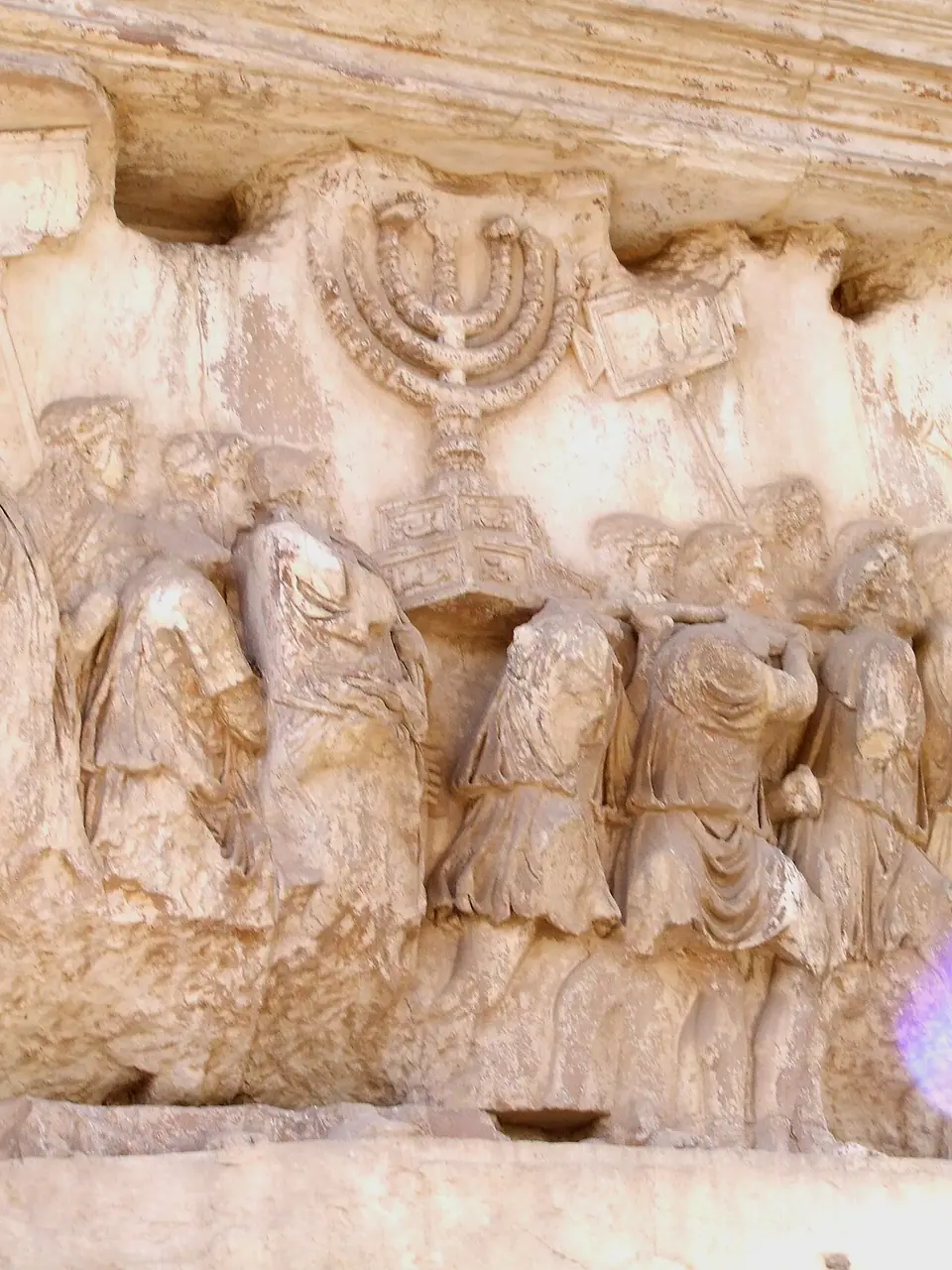
In the summer of 70 CE a Roman army burned the Temple in Jerusalem, ending the Jewish revolt that had begun in 66. Within the next fifty years the followers of Jesus wrote the four Gospels, a history of their own beginnings (Acts), and a series of letters in the names of Paul, Peter and other apostles. Their leaders, at first a mixture of travelling apostles, prophets and local elders, began to settle into the offices of bishop, presbyter and deacon. Most new converts were now gentiles, and both Roman officials and Christian writers began to treat “Christians” as a group distinct from Jews. By about 150, Christian authors were claiming that the church was the true Israel and that the Jews had lost their covenant; Jewish followers of Jesus who kept the Law were becoming a minority labelled heretics by both sides. Majority
This chapter follows the change through the texts each community produced. None of them was written as history in the modern sense, but each preserves the questions its writers were trying to answer. The parting of Christianity from Judaism is also told from the Jewish side, in the Judaism series (Judaism §7); this chapter tells the Christian side and links rather than repeats.
Timeline
| Date | Event or evidence | Confidence |
|---|---|---|
| 62 CE | James, the brother of Jesus and leader of the Jerusalem church, is stoned on the high priest’s orders[1] | Consensus |
| 64 CE | Nero blames the fire of Rome on the “Christians”; tradition places the deaths of Peter and Paul in this persecution[2][3] | Consensus (persecution); Majority (deaths) |
| 66–70 CE | The Jewish revolt; tradition says the Jerusalem church fled to Pella across the Jordan[4] | Consensus (revolt); Contested (flight) |
| 70 CE | Titus’ army burns the Temple; the spoils are paraded in Rome in 71 and carved on the Arch of Titus[5][6] | Consensus |
| c. 66–74 CE | The Gospel of Mark[7] | Majority |
| c. 80–90 CE | The Gospels of Matthew and Luke, and Acts[8] | Majority |
| c. 80–100 CE | Ephesians, and perhaps Colossians and 2 Thessalonians, written in Paul’s name[9] | Majority (Ephesians); Contested (Colossians, 2 Thessalonians) |
| 96 CE | Nerva’s coins advertise the end of abuses in collecting the Jewish tax (fiscus Iudaicus)[10][11] | Consensus |
| c. 95 CE | Revelation, “toward the end of Domitian’s reign” according to Irenaeus[12] | Majority |
| c. 96 CE | 1 Clement: the church of Rome writes to the church of Corinth about deposed presbyters[13] | Majority |
| c. 90–110 CE | The Gospel of John[14] | Majority |
| c. 50–120 CE | The Didache, a church manual compiled from older material[15][16] | Majority (range) |
| c. 100–120 CE | The Pastoral letters (1–2 Timothy, Titus)[17] | Majority |
| c. 110 CE | Ignatius of Antioch writes seven letters on his way to execution in Rome; the first “catholic church” and the first single bishops[18][19] | Majority (date contested) |
| c. 112 CE | Trajan tells Pliny that Christians are not to be hunted out, but punished if accused and they refuse to sacrifice[20] | Consensus |
| c. 100–150 CE | 2 Peter, probably the latest New Testament book[21] | Majority |
| c. 130 CE | The Epistle of Barnabas claims the covenant belongs to Christians alone[22] | Majority |
| 132–135 CE | The Bar Kokhba revolt; Justin says its leader punished Christians who would not deny Jesus[23][24] | Majority |
| after 135 CE | Jerusalem refounded as Aelia Capitolina; Jews barred; its church is led for the first time by gentile bishops[25] | Majority |
| c. 155–160 CE | Justin Martyr’s Dialogue with Trypho: Christians as “the true Israel”[26] | Consensus |
| c. 160–170 CE | Melito of Sardis, On Pascha: “God has been murdered”[27] | Consensus |
Where: from Jerusalem to the cities of the empire
Before 70, the movement’s centre was Jerusalem, where James and the apostles led a church of Jewish believers who still worshipped in the Temple (Acts 21:20–26).[28] After 70 that centre was gone. The Gospels and letters of the next fifty years come from the cities of the eastern Mediterranean and Rome: Antioch in Syria, the cities of western Asia Minor (Ephesus, Smyrna, Sardis), Corinth, Rome itself, and probably Alexandria.[29][30] Majority None of the Gospels states where it was written, and the traditional locations (Mark in Rome, John in Ephesus) are second-century guesses or later inferences from the texts, and Antioch for Matthew is a modern proposal. Contested
Eusebius, writing around 320, says the Jerusalem church fled before the war to Pella, a gentile city of the Decapolis east of the Jordan, after an oracle told them to leave.[4] Some historians accept a migration of this kind; others see the story as a later legend that gave churches east of the Jordan an apostolic pedigree. Contested What is clear is that no Jerusalem church of Jewish believers had the authority after 70 that James’ church had before it. Majority
The Gospels, each for its own audience
All four Gospels tell the same core story, from John the Baptist to the empty tomb. Each tells it for a particular audience with a particular set of problems, and the differences between them show what those problems were. Since the 1950s, scholars have read each Gospel as the product of a community. Richard Bauckham and others argued in 1998 that the Gospels were written for any Christian who might read them, not for one community, and many scholars now speak of a Gospel’s “audience” more cautiously.[31] Contested
Mark: a Gospel for a church at war
Mark is the shortest and earliest Gospel. Its Jesus is a man of action and of suffering, who keeps his identity secret and is misunderstood by his own disciples until the end. Its long speech about the future (Mark 13) predicts the Temple’s destruction and warns:
hotan de idēte to bdelygma tēs erēmōseōs hestēkota hopou ou dei, ho anaginōskōn noeitō
“But when you see the desolating sacrilege set up where it ought not to be (let the reader understand), then those in Judea must flee to the mountains.”[7]
The aside “let the reader understand” is the writer’s, not Jesus’. Most scholars read the chapter as written during the war of 66–70 or just after it, for readers who needed to know that the end had not yet come.[32] Majority Mark explains Jewish customs (“the Pharisees, and all the Jews, do not eat unless they thoroughly wash their hands”, 7:3) and translates Aramaic, so its audience was largely gentile.[33] Consensus Whether it was written in Rome, as second-century tradition says, or in Syria or Galilee, is debated. Contested
Matthew: a Jewish Gospel, quarrelling with other Jews
Matthew copies about 90 percent of Mark but reshapes it for a community that still saw itself as Jewish (§0). Its Jesus is the new Moses who teaches on a mountain and says:
“Do not think that I have come to abolish the law or the prophets; I have come not to abolish but to fulfil… not one letter, not one stroke of a letter, will pass from the law until all is accomplished.”[34]
Matthew is also the Gospel most hostile to the Pharisees. Chapter 23 is a sustained denunciation, “woe to you, scribes and Pharisees, hypocrites!”, and the Gospel repeatedly speaks of “their synagogues”, as if its readers no longer belonged to them.[35][36] Most scholars think Matthew’s community, probably in Syria or Galilee around 80–90, was locked in a dispute with the Pharisaic teachers who were becoming the leaders of Judaism after 70.[37] Majority Anthony Saldarini argued that Matthew’s group was still a Jewish sect; others think it had already broken away and was turning to the gentile mission that the Gospel’s last verse commands (“make disciples of all nations”).[37][38] Contested The Gospel’s bitterness belongs to a family quarrel. Read later, by a gentile church, its “woes” and the crowd’s cry “his blood be on us and on our children” (27:25) became charges against Jews as such (§2). Majority
Luke and Acts: a history for the gentile world
Luke is the only Gospel writer who introduces himself, in a preface modelled on Greek historians:
epeidēper polloi epecheirēsan anataxasthai diēgēsin…
“Since many have undertaken to set down an orderly account of the events that have been fulfilled among us, just as they were handed on to us by those who from the beginning were eyewitnesses and servants of the word, I too decided… to write an orderly account for you, most excellent Theophilus.”[8]
He says he is not an eyewitness and that he has read earlier accounts, which fits his use of Mark. Consensus His second volume, Acts, takes the story from Jerusalem to Rome, and from Jews to gentiles: it ends with Paul under house arrest in Rome, preaching “with all boldness and without hindrance”, and does not record his death.[39] Luke presents the movement as law-abiding, its founder declared innocent by Pilate three times, and its spread as the fulfilment of Israel’s own scriptures.[29] Majority
Tradition names the author as Luke, the “beloved physician” and companion of Paul (Col 4:14).[40][41] Some passages of Acts switch to “we” (16:10–17 and later), which may preserve a travel diary of a companion of Paul, or may be a literary device.[42] Contested Most date Luke and Acts to about 80–90; Richard Pervo argued for about 115, on the grounds that Acts seems to know the writings of Josephus and of the early second century.[43] Contested
John: the Word made flesh, and “the Jews”
John’s Gospel is unlike the other three. Its Jesus speaks in long discourses about himself rather than in parables about the kingdom, and its opening identifies him with God’s eternal Word (logos): “In the beginning was the Word, and the Word was with God, and the Word was God… And the Word became flesh and lived among us” (1:1, 14).[44] Consensus It is the Gospel of the highest Christology in the New Testament, and the one later councils would rely on (§6).
It is also the Gospel that speaks most of “the Jews”, hoi Ioudaioi, about seventy times, often as Jesus’ opponents, though Jesus and his disciples are themselves Jews. In one exchange Jesus tells opponents who had believed in him, “You are from your father the devil” (8:44).[45] Three times it says that believers in Jesus were “put out of the synagogue” (aposynagōgos).[14][46][47]
In 1968 J. Louis Martyn proposed that these passages reflect the Gospel’s own community: Jewish believers in Jesus, expelled from their synagogue around 85–90 by a new benediction against heretics, the Birkat ha-Minim, which he linked to the rabbis at Yavneh.[48] Raymond Brown built a full history of the “community of the Beloved Disciple” on this basis.[49] The reconstruction dominated the field for decades. It has since been weakened from several directions: the benediction cannot be shown to have targeted Christians at that date (Judaism §7), Bauckham questioned whether Gospels had single communities at all, and Adele Reinhartz has argued that the expulsion passages are part of the Gospel’s rhetoric rather than a record of events.[50][31][51] Contested Most scholars still think John’s community experienced some painful separation from a synagogue, and that its hostility to “the Jews” grew out of it. Majority
The Gospel closes by naming its source: “This is the disciple who is testifying to these things and has written them, and we know that his testimony is true” (21:24).[52] The “we” is a group vouching for the Beloved Disciple, who is never named in the text. Second-century tradition identified him with John the son of Zebedee; most critical scholars think the Gospel went through several stages of writing within a circle that revered him. Majority
The names on the Gospels
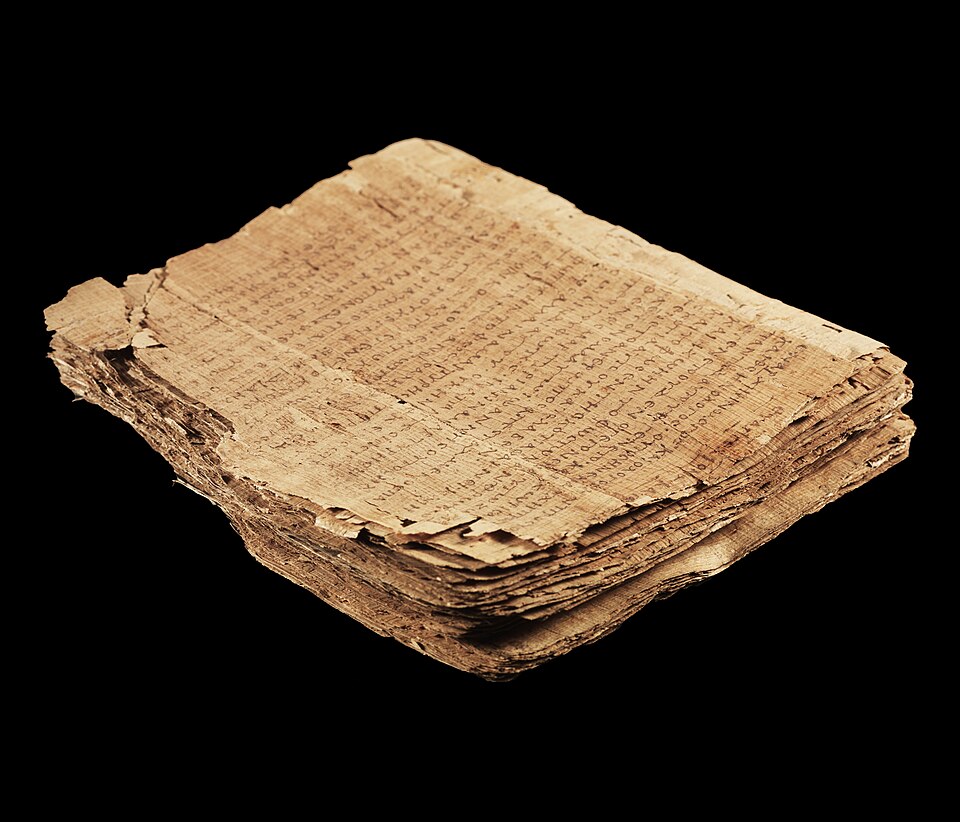
§0 sets out the earliest testimony: Papias, around 110–130, on Mark and Matthew, and Irenaeus, around 180, naming all four.[53][41] Two further pieces of evidence matter.
- The titles. As Martin Hengel and Simon Gathercole point out, the manuscripts that preserve the beginning of a Gospel give it the same kind of title, euangelion kata Matthaion, “the Gospel according to Matthew”, and none attributes a canonical Gospel to anyone else. They argue that this uniformity means the titles were attached very early: Hengel thinks before 100, as soon as more than one Gospel was read in the same churches, and Gathercole that the Gospels were never truly anonymous.[54][55] Others reply that uniform titles show only that the names were agreed before our manuscripts were copied, around 200. Contested
- “Memoirs of the apostles.” Justin Martyr, writing in Rome around 155, does not name the Gospels’ authors. He calls them “the memoirs of the apostles”, adding that they “are called Gospels”, and says they were read aloud at the Sunday gathering alongside the prophets.[56][57] By the mid-second century, then, written Gospels were already part of Christian worship, read like scripture. Consensus
The names matter less to historians than the dates: the four Gospels were written within about forty to seventy years of the crucifixion, by Christians who used written sources and oral tradition. Who exactly the authors were does not change that. Majority
Letters in the apostles’ names
Thirteen New Testament letters carry Paul’s name. Nearly all critical scholars accept seven as his (§0, §3). The other six divide them:
| Letter | Main reason for doubt | Scholarly view |
|---|---|---|
| 2 Thessalonians | Contradicts 1 Thessalonians on how near the end is; warns against letters “as though from us” (2:2)[58] | Divided |
| Colossians | Different vocabulary and style; a more developed view of Christ as head of the cosmic body | Divided; perhaps a slight majority against Paul |
| Ephesians | Close dependence on Colossians; impersonal tone, though Paul had lived in Ephesus | Majority against Paul |
| 1–2 Timothy, Titus | Vocabulary, church offices and concerns of the early second century | Large majority against Paul |
Sources: Brown, Introduction; Ehrman, Forgery and Counterforgery.[29][9] Majority
Outside Paul’s name, most critical scholars also doubt that the letters attributed to Peter, James and Jude were written by them. 2 Peter is usually reckoned the latest book of the New Testament, written between about 100 and 150; it already speaks of Paul’s letters as scripture, which “the ignorant and unstable twist… as they do the other scriptures”.[21] Majority
Forgery, or tribute?
How to describe such letters is itself debated. An older view held that writing in a revered teacher’s name was an accepted practice, an act of humility rather than deceit. Bart Ehrman’s Forgery and Counterforgery (2013) argues the opposite: that ancient writers, pagan and Christian, condemned false attribution when they detected it, and that Christian pseudepigrapha were written to be believed.[9] Ancient evidence supports at least part of his case. Tertullian, around 200, reports that the presbyter in Asia who wrote the Acts of Paul “out of love for Paul” was convicted and removed from office.[59] Defenders of the older view point out that the same writers valued schools that wrote in a founder’s name, as the followers of Pythagoras did. Contested The point of agreement is that the practice was common: early Christianity produced letters, gospels, apocalypses and acts in the names of almost every apostle. Consensus
The first church manuals: the Didache and 1 Clement
The Didache
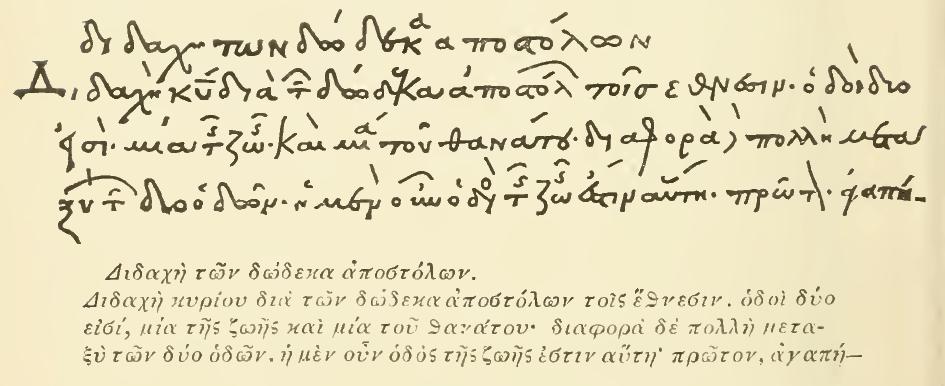
In 1873, in the library of the Jerusalem patriarchate’s monastery in Constantinople, the Orthodox metropolitan Philotheos Bryennios found a Greek manuscript copied in 1056 that contained a lost text: “The Teaching of the Twelve Apostles”, the Didache. He published it in 1883.[60] Consensus Most scholars think it was compiled from older material between about 50 and 120, probably in Syria (Niederwimmer favours 110–120).[16] Majority
It is a practical manual, and it shows a church still close to its Jewish roots:
- Baptism is “in living water” (running water), but if none is available, water may be poured on the head three times “in the name of the Father and Son and Holy Spirit” (7).[61]
- Fasting is twice a week, but not on the same days as the “hypocrites”, who fast on Monday and Thursday: Christians are to fast on Wednesday and Friday. Prayer is the Lord’s Prayer, three times a day (8).[15] The rule distinguishes Christians from other Jews by changing the days, not the practice. Majority
- The Eucharist prayers (9–10) give thanks over the cup and the broken bread, “as this broken bread was scattered over the mountains and gathered together became one”, and do not include the words “this is my body” found in Paul and the first three Gospels.[15] Consensus
- Travelling prophets are honoured but tested: an apostle may stay one day, or two if needed; “if he stays three days, he is a false prophet” (11).[62]
- Local leaders: “Appoint for yourselves bishops and deacons worthy of the Lord” (15), who are to be honoured like the prophets.[62]
1 Clement
Around 96, by the traditional date, the church of Rome wrote to the church of Corinth, where a group of younger members had deposed the presbyters. Later tradition credited the letter to Clement, listed as the third or fourth bishop of Rome, but the letter itself speaks for “the church of God which sojourns in Rome” and names no single leader.[13] Consensus Its argument is new: the apostles foresaw “strife over the office of oversight (episkopē)”, appointed their successors, and gave instruction that other approved men should succeed them in turn; the deposed presbyters should therefore be restored.[13] It is the earliest statement of an idea of succession from the apostles, and it uses “bishops” (episkopoi) and “presbyters” interchangeably. Majority It also contains the earliest reference outside the New Testament to the deaths of Peter and Paul, as examples of those who suffered “through jealousy and envy”.[3] Majority
The first bishops: Ignatius of Antioch
From many leaders to one
The New Testament knows several leadership titles but not one structure. Paul greets “the overseers and deacons” of Philippi, in the plural (Phil 1:1); Acts has Paul appoint “elders” (presbyteroi) in each church and then calls the same men “overseers” (episkopoi) (Acts 14:23; 20:17, 28); the Pastoral letters set out the qualifications of an overseer, who must be “husband of one wife”, of deacons, and of an order of widows (1 Tim 3; 5).[63][64][65][66] Consensus
The monarchical bishop, one bishop over the presbyters and deacons of a whole city, appears first in the letters of Ignatius. In Rome, Peter Lampe has argued, the church was run by a group of presbyters, each leading a house church, until about the middle of the second century; the list of Roman bishops back to Peter, first preserved by Irenaeus, projects the later system backwards.[67][68] Francis Sullivan, a Jesuit, reaches the same conclusion while defending the bishops’ succession from the apostles as a theological claim. Majority
Ignatius
Ignatius, bishop of Antioch, was arrested and taken under military guard across Asia Minor to Rome, where he expected to die in the arena. On the way he wrote seven letters: to churches along his route, to Polycarp, bishop of Smyrna, and to the church of Rome.[18][69] Eusebius dates the journey to Trajan’s reign, and most scholars put the letters around 110; a minority, including Timothy Barnes, have argued for the 140s.[70] Contested on the date.
The letters are the first sources for three things that would define later Christianity:
-
The single bishop. “Follow the bishop, as Jesus Christ followed the Father, and the presbytery as the apostles”; “let no one do anything that concerns the church without the bishop.”[18] Ignatius insists on it so often that most scholars think it was still new and contested. Majority
-
The catholic church.
hopou an phanē ho episkopos, ekei to plēthos estō, hōsper hopou an ē Christos Iēsous, ekei hē katholikē ekklēsia.
“Wherever the bishop appears, there let the congregation be, just as wherever Jesus Christ is, there is the catholic church.”[18]
Katholikē means “universal” or “whole”; it is the first known use of the phrase. Consensus
-
“Christianity” against “Judaism.” “It is absurd to speak of Jesus Christ and to Judaise (ioudaizein). For Christianity did not believe in Judaism, but Judaism in Christianity.”[19] The word Christianismos is first attested here, as the opposite of Ioudaismos. That Ignatius had to warn gentile Christians against Judaising shows that some were still attracted to Jewish practice. Majority
Ignatius also argues against Christians who held that Jesus only “seemed” to suffer (the view later called docetism),[71] and asks the Roman church not to intervene to save him: “I am God’s wheat, and I am being ground by the teeth of wild beasts, so that I may be found pure bread.”[69] Consensus on the texts.
Rome looks at the Christians
Trajan’s rule
Pliny’s letter of about 112 (§0) asked the emperor Trajan how to treat people accused of being Christians. Trajan’s reply set the empire’s policy for the next century and a half:
Conquirendi non sunt; si deferantur et arguantur, puniendi sunt, ita tamen ut, qui negaverit se Christianum esse idque re ipsa manifestum fecerit, id est supplicando dis nostris… veniam ex paenitentia impetret. Sine auctore vero propositi libelli in nullo crimine locum habere debent.
“They are not to be sought out. If they are accused and convicted, they must be punished, but anyone who denies being a Christian and proves it by worshipping our gods shall be pardoned for his repentance… Anonymous accusations must play no part in any charge.”[20]
Being a Christian was in itself punishable, in practice by death, but the state would not go looking for Christians. Persecution depended on local accusers and local governors, which is why it was sporadic until the empire-wide decrees of the 250s (§5). Consensus Tertullian later mocked the logic: if Christians are guilty, why not seek them out; if innocent, why punish them?[72]
Domitian, the Jewish tax and Revelation
Two developments under the emperor Domitian (81–96) bear on the separation of Christians from Jews.
After 70, Rome diverted the half-shekel that Jews had paid to the Temple into a tax for Jupiter Capitolinus in Rome, the fiscus Iudaicus. Suetonius says that under Domitian it was levied “with the utmost rigour” (trans. J. C. Rolfe), including on those who lived as Jews without admitting it, and he remembered seeing a ninety-year-old man examined to see if he was circumcised.[73] Domitian’s successor Nerva issued coins in 96 proclaiming fisci Iudaici calumnia sublata, “the false accusations of the Jewish tax removed”.[10] Martin Goodman has argued that Nerva’s reform defined Jews for tax purposes as those who openly practised Judaism, which in effect gave Roman law a reason to treat gentile Christians as non-Jews.[11] Contested
Revelation, the New Testament’s apocalypse, was written by a prophet named John on the island of Patmos, “because of the word of God and the testimony of Jesus” (1:9).[74] Irenaeus dates it “toward the end of Domitian’s reign”, around 95.[12] Majority It portrays Rome as “Babylon”, a whore seated on seven hills (17:9), and gives the beast’s number as 666 (13:18), which most scholars decode as “Nero Caesar” written in Hebrew letters.[75][76] Majority Christian tradition from Eusebius onwards made Domitian the second great persecutor after Nero.[77] Most modern historians find no evidence of a general persecution of Christians under Domitian; Revelation names one martyr, Antipas of Pergamum (2:13), and its fierce hostility to Rome reflects a perceived crisis as much as an organised campaign.[78][79] Majority
Women’s roles narrow
Paul’s own letters name women as patrons, deacons, co-workers and an apostle (Phoebe, Prisca, Junia; §3), and Pliny tortured two enslaved women “who were called deaconesses” (ministrae) in about 112 (§0). By the time of the Pastoral letters, the tone has changed:
didaskein de gynaiki ouk epitrepō oude authentein andros, all’ einai en hēsychia.
“I permit no woman to teach or to have authority over a man; she is to keep silent.”[17]
The letter grounds the rule in the order of creation and in Eve’s deception, and says women “will be saved through childbearing”.[17] Consensus on the text. A similar instruction in 1 Corinthians 14:34–35 (“women should be silent in the churches”) moves to a different place in some manuscripts, and some textual critics, notably Gordon Fee, think it was added by a later copyist.[80][81] Contested
The Acts of Paul and Thecla, written in Asia Minor in the second century, tells the opposite story: Thecla, a young woman of Iconium, breaks off her engagement to follow Paul, survives the pyre and the arena, baptises herself, and is sent out by Paul to “teach the word of God”.[82] Tertullian complained around 200 that some women cited Thecla’s example to claim the right to teach and baptise.[59] Dennis MacDonald argued that the Pastoral letters were written partly against the circles that told such stories, in which celibate women taught; others doubt so direct a link.[83] Contested What the sources together show is a struggle over women’s leadership in the late first and second centuries, not a single tradition. Majority
The parting of the ways, from the Christian side
The separation of Christianity from Judaism is told from the Jewish side, and with the debate over the Birkat ha-Minim, in Judaism §7. From the Christian side, the second century shows a church redefining itself as a new people, or as the true version of the old one.
-
Barnabas, c. 130. The anonymous Epistle of Barnabas argues that the covenant with Israel was lost at Sinai, when Moses broke the tablets, and that it now belongs to Christians alone. It warns readers against those who say that the covenant is shared by both peoples.[22] It reads the Jewish law allegorically and denies that it was ever meant literally. Majority
-
Justin Martyr, c. 155–160. In his Dialogue with Trypho, set in the aftermath of the Bar Kokhba war, Justin argues with a Jewish interlocutor and claims that Christians are “the true spiritual Israel”. He also complains that Jews curse believers in Christ in their synagogues.[26][84] Consensus on the texts; whether the cursing he describes is the Birkat ha-Minim is debated (Judaism §7).
-
Melito of Sardis, c. 160–170. A Passover sermon by the bishop of Sardis, a city whose Jewish community later met in one of the largest synagogues known from antiquity, contains the first explicit charge that the Jewish people killed God:
ho theos pephoneutai; ho basileus tou Israēl anēretai hypo dexias Israēlitidos.
“God has been murdered; the King of Israel has been put to death by an Israelite right hand.”[27]
Consensus on the text. The deicide charge was repeated for centuries and used to justify violence against Jews; in 1965 the Catholic Church rejected collective Jewish guilt for the crucifixion (§2, §12).[85] Political for its later use.
Bar Kokhba and the Jerusalem church
The second Jewish revolt, led by Simon bar Kosiba (Bar Kokhba) in 132–135, hardened the division. Justin says Bar Kokhba ordered “Christians alone” to be led away to terrible punishments unless they would deny Jesus the Messiah and blaspheme,[23] presumably because they would not accept him as Messiah. Majority After the revolt, Hadrian refounded Jerusalem as Aelia Capitolina and barred Jews from it.[25] Eusebius reports that the church of Jerusalem had until then been led by fifteen bishops “of the circumcision”, and that its first gentile bishop, Mark, took office after the revolt.[25] The list of fifteen is suspiciously long for the time, but the shift to gentile leadership is plausible. Majority
Jewish followers of Jesus
Jewish believers who kept the Law did not disappear. Irenaeus, around 180, describes the Ebionites (from Hebrew evyonim, “the poor”): they used only the Gospel of Matthew, rejected Paul “as an apostate from the law”, practised circumcision and regarded Jesus as a human Messiah.[86] Epiphanius, writing around 375, describes the Nazarenes, Jewish believers in Syria who kept the Law and, Epiphanius thought, largely orthodox views of Jesus.[87] Both are known only from their opponents. They were heretics to the church and outsiders to the rabbis, and they show that the line between Judaism and Christianity was drawn by both sides over time, not found ready-made.[88] Majority
Early, late, or never clean?
| View | Main argument | Main proponents |
|---|---|---|
| Early parting | Paul’s gentile mission, the fall of the Temple and the Christology of John made separation inevitable by about 100–135 | Older consensus; Dunn (with nuance)[89] |
| Gradual and regional | The parting happened at different times in different places and was completed only in the Christian empire of the fourth century | Becker and Reed; Schwartz[90][91] |
| Borders drawn by authorities | “Judaism” and “Christianity” were defined against each other by heresiologists and rabbis, who drew a border through a continuum | Boyarin[88] |
Contested. All three agree that by the mid-second century leading Christian writers treated the church and the synagogue as separate and rival bodies. Consensus
The evidence
| Question | What the evidence supports | Key evidence | Confidence |
|---|---|---|---|
| The Gospels’ dates | Mark c. 70; Matthew and Luke c. 80–90; John c. 90–110 | Mark 13; Luke’s preface; John’s synagogue passages[7][8][14] | Majority |
| Their audiences | Mark largely gentile; Matthew Jewish-Christian; Luke gentile; John a community at odds with a synagogue | Explanations of Jewish custom; Matthew 5 and 23; John 9[33][34][35][14] | Majority; Contested (single communities) |
| Pseudonymous letters | The Pastorals and 2 Peter not by their named authors; Ephesians probably not; Colossians and 2 Thessalonians divided | Style, vocabulary, church order[9][29] | Majority |
| Church order | Plural presbyter-bishops become single bishops, first in Syria and Asia Minor c. 110; Rome later | 1 Clement; Didache; Ignatius[13][62][18][67] | Majority |
| Roman policy | Christianity punishable, but Christians not to be sought out | Trajan to Pliny[20] | Consensus |
| Domitian | No proven general persecution; local hostility and a crisis of loyalty | Revelation; Eusebius; modern assessments[79][77][78] | Majority |
| Women’s leadership | Contested within the churches; restricted in the Pastorals, celebrated in Thecla | 1 Timothy 2; Acts of Paul and Thecla; Tertullian[17][82][59] | Majority |
| Parting from Judaism | Rival claims to Israel by c. 150; Jewish believers persisted for centuries | Barnabas; Justin; Melito; Irenaeus on the Ebionites[22][26][27][86] | Majority (pattern); Contested (dates) |
Primary sources
Show the 10 primary sources
1. “Let the reader understand”: Mark 13:14, c. 70 CE
Quoted above. What it proves. The earliest Gospel speaks directly to readers living through the Jewish war, warning them to flee when the Temple is profaned. It is the best internal evidence for dating Mark to around 70. Majority
2. “Not one stroke of a letter”: Matthew 5:17–19, c. 80–90 CE
Quoted above. What it proves. Matthew’s Jesus affirms the whole Law, in deliberate contrast with readings of Paul that set it aside. Matthew’s community still argued within Judaism about how to keep the Law, not whether to. Majority
3. “An orderly account”: Luke 1:1–4, c. 80–90 CE
Quoted above. What it proves. The author says others had already written accounts, and he was not an eyewitness, and he writes in the style of Greek historiography for a patron. It is the New Testament’s only explicit statement of a Gospel writer’s method. Consensus
4. “Put out of the synagogue”: John 9:22 and 8:44, c. 90–110 CE
John 9:22: “The Jews had already agreed that anyone who confessed Jesus to be the Messiah would be put out of the synagogue.”[14]
John 8:44: hymeis ek tou patros tou diabolou este, “You are from your father the devil.”[45]
What it proves. The Gospel’s readers felt themselves excluded from a synagogue, and the Gospel answers with some of the harshest language about “the Jews” in the New Testament. Whether an expulsion took place as described is debated; that the Gospel’s polemic shaped later Christian views of Jews is not. Majority
5. Paul’s letters as scripture: 2 Peter 3:15–16, c. 100–150 CE
“So also our beloved brother Paul wrote to you according to the wisdom given him, speaking of this as he does in all his letters. There are some things in them hard to understand, which the ignorant and unstable twist to their own destruction, as they do the other scriptures.”[21]
What it proves. By the time 2 Peter was written, Paul’s letters were collected, read as “scripture” alongside the Jewish scriptures, and disputed in interpretation. It is a first step toward a New Testament (§5). Majority
6. Fasting days and the Eucharist: Didache 8–9, c. 50–120 CE
hai de nēsteiai hymōn mē estōsan meta tōn hypokritōn. nēsteuousi gar deutera sabbatōn kai pemptē; hymeis de nēsteusate tetrada kai paraskeuēn.
“Do not let your fasts be with the hypocrites. They fast on the second and fifth day of the week; you are to fast on the fourth day and the day of preparation.”[15]
What it proves. A Christian group defines itself against other Jews by shifting the fasting days, from Monday and Thursday to Wednesday and Friday: a separation in practice, made with Jewish categories. Its Eucharist prayers, without the words of institution, show that worship was not yet uniform. Majority
7. Succession from the apostles: 1 Clement 44, c. 96 CE
The apostles, the letter says, “knew through our Lord Jesus Christ that there would be strife over the office of oversight”, and so appointed leaders and arranged that, when these died, “other approved men should succeed to their ministry”.[13]
What it proves. By the end of the first century the church of Rome appealed to a chain of appointment from the apostles to settle a dispute in another city. The letter’s leaders are still a plural body of presbyter-bishops. Majority
8. The catholic church: Ignatius, To the Smyrnaeans 8, c. 110 CE
Quoted above. What it proves. The first use of “catholic church”, and an insistence on one bishop over each city’s church, which implies that the arrangement was new or resisted. Majority
9. “Not to be sought out”: Trajan to Pliny, Letters 10.97, c. 112 CE
Quoted above. What it proves. Roman policy toward Christians for the next century and a half: punishable if accused, pardoned if they sacrificed, not hunted down. It explains why persecution was local and sporadic until the 250s. Consensus
10. “God has been murdered”: Melito of Sardis, On Pascha 96, c. 160–170 CE
Quoted above. What it proves. Within about 130 years of the crucifixion, a Christian bishop accused Israel of killing God. The sermon is the clearest early expression of the deicide charge, whose later history is one of the most harmful in Christian–Jewish relations. Consensus on the text; Political for its reception.
What is absent
- A New Testament. Christians quote Jesus’ sayings and the Jewish scriptures; Paul’s letters are becoming “scripture”; there is no agreed list of Christian books (§5). Consensus
- A creed beyond the basics. Baptismal formulas and short confessions exist; the creeds of Nicaea and Constantinople are two centuries away (§6). Consensus
- A pope. Rome is respected, and its church writes to Corinth; there is no single bishop of Rome with authority over other churches, and probably no single bishop in Rome at all before the mid-second century. Majority
- Church buildings. Christians meet in houses; the first known church building is at Dura-Europos, around 240 (§0). Consensus
- Christmas, Lent and Easter on a Sunday everywhere. Easter was kept on 14 Nisan by the churches of Asia, on the following Sunday elsewhere; the dispute came to a head in the 190s (§5). Majority
- Images of Jesus. None survives from this period. Consensus
- A clean break from Judaism. Jewish believers in Jesus, gentile Christians attracted to synagogues, and arguments over the shared scriptures all continue. Majority
Debates
Did the Gospels have communities?
Since the mid-twentieth century, scholars reconstructed a “Matthean community”, a “Johannine community” and others from the Gospels’ concerns. Bauckham’s The Gospels for All Christians (1998) argued that the Gospels were written for wide circulation among churches that were in close contact, and that reading a community’s history out of each text is circular.[31] Many scholars now speak of a Gospel’s “audience” or “setting” rather than a single community, while still reading each Gospel’s conflicts as evidence of its writer’s world. Contested
Was John’s community expelled from the synagogue?
| View | Position | Main proponents |
|---|---|---|
| Expulsion behind the text | The aposynagōgos passages reflect a real expulsion of Jewish believers, c. 85–90, linked to the Birkat ha-Minim | Martyn, Brown; Marcus (modified)[48][49][92] |
| A real separation, not a decree | Some painful break with a local synagogue, without a general Jewish policy | Many current scholars |
| Rhetoric | The passages construct an identity for readers; they are not evidence of an expulsion | Reinhartz[51] |
Contested
When did single bishops arise, and does it matter?
That monarchical bishops emerged in the early second century, at different times in different places, is the majority view among historians, Catholic and Protestant.[68][67] Majority Catholic and Orthodox teaching holds that the bishops are successors of the apostles in their authority, a theological claim that does not depend on an unbroken list of single bishops from the first generation; Sullivan defends both the historical finding and the theological claim.[68] Some Protestant traditions read the same evidence as showing that episcopacy was a later development without apostolic warrant. Contested on the theological meaning.
Was Domitian a persecutor?
Eusebius, following earlier Christian writers, made Domitian a persecutor. Leonard Thompson and others have argued that the evidence is thin: Roman sources accuse Domitian of executing members of the elite. Cassius Dio says Domitian executed his cousin Flavius Clemens and exiled Clemens’ wife Domitilla on a charge of “atheism”, for which many others “who drifted into Jewish ways” were also condemned. No Roman source says they targeted Christians as such.[93][78][77] Whether Clemens and Domitilla were Christians, as later tradition claimed, is unknown. Majority that there was no general persecution; Contested on the local picture.
Further reading
Show further reading (9 works)
- Raymond E. Brown, An Introduction to the New Testament (Doubleday, 1997), and The Community of the Beloved Disciple (Paulist, 1979).
- Bart D. Ehrman, Forgery and Counterforgery: The Use of Literary Deceit in Early Christian Polemics (Oxford, 2013).
- Richard Bauckham, ed., The Gospels for All Christians: Rethinking the Gospel Audiences (Eerdmans, 1998).
- J. Louis Martyn, History and Theology in the Fourth Gospel (Harper & Row, 1968; 3rd ed. 2003), with Adele Reinhartz, Cast Out of the Covenant: Jews and Anti-Judaism in the Gospel of John (Lexington, 2018).
- Anthony J. Saldarini, Matthew’s Christian-Jewish Community (Chicago, 1994).
- Kurt Niederwimmer, The Didache: A Commentary (Fortress, 1998).
- Peter Lampe, From Paul to Valentinus: Christians at Rome in the First Two Centuries (Fortress, 2003), and Francis A. Sullivan, From Apostles to Bishops (Newman, 2001).
- Michael W. Holmes, The Apostolic Fathers: Greek Texts and English Translations (Baker, 3rd ed. 2007): 1 Clement, Ignatius, the Didache and Barnabas.
- Adam H. Becker and Annette Yoshiko Reed, eds., The Ways that Never Parted (Mohr Siebeck, 2003), and Daniel Boyarin, Border Lines (Pennsylvania, 2004).
References
- ^ Josephus, Antiquities 20.200 — Jewish Antiquities. c. 93 CE. Greek. The high priest Ananus has 'the brother of Jesus who was called Christ, whose name was James' stoned in 62 CE; the passage is generally accepted as authentic. read the text
- ^ Tacitus, Annals 15.44 — Annals. c. 116 CE. Latin. Explaining the name of the Christians blamed for the fire of Rome, Tacitus says Christus was executed in the reign of Tiberius by the procurator Pontius Pilate.
- ^ a b 1 Clement 5 — First Letter of Clement (church of Rome to Corinth). c. 96 CE. Greek. Peter and Paul as examples of endurance 'through jealousy'; Paul reached 'the farthest bounds of the West' and bore witness before the rulers. read the text
- ^ a b Eusebius, Ecclesiastical History 3.5.3 — Ecclesiastical History. early 4th c. CE. Greek. Before the war the Jerusalem church, warned by an oracle, moved to Pella in Peraea. read the text
- ^ Josephus, Jewish War 6.236–266 — Jewish War. c. 75–79 CE. Greek. An eyewitness on the Roman side describes Titus's council of war and the burning of the Temple in the summer of 70 CE, claiming Titus wished to spare it. read the text
- ^ Arch of Titus, spoils relief — Arch of Titus, Roman Forum. after 81 CE. Latin. Roman soldiers carry the Temple's menorah, trumpets and table in Titus's triumph of 71 CE: Rome's own record of the spoils of Jerusalem. about
- ^ a b c Mark 13:14 — Gospel of Mark (New Testament). c. 70 CE. Greek. The 'desolating sacrilege' and the aside 'let the reader understand': Mark's readers are told to flee Judea, usually read as written during or just after the war of 66–70. read the text
- ^ a b c Luke 1:1–4 — Gospel of Luke (New Testament). c. 80–90 CE. Greek. Luke's preface: many have compiled accounts handed on by eyewitnesses; he writes an orderly account for 'most excellent Theophilus'. read the text
- ^ a b c d Bart D. Ehrman Forgery and Counterforgery: The Use of Literary Deceit in Early Christian Polemics. Oxford University Press, 2013. Argues that ancient writers condemned false attribution and that Christian pseudepigrapha were written to deceive.
- ^ a b Nerva sestertius, FISCI IVDAICI CALVMNIA SVBLATA — Roman imperial coinage. 96–97 CE. Latin. Nerva's coins proclaim the removal of false accusations in collecting the Jewish tax. about
- ^ a b Martin Goodman Nerva, the Fiscus Judaicus and Jewish Identity. Journal of Roman Studies 79: 40–44, 1989. Argues that Nerva's reform defined Jews by religious practice, separating gentile Christians in Roman eyes.
- ^ a b Irenaeus, Against Heresies 5.30.3 — Against Heresies. c. 180 CE. Greek (Latin translation). The apocalyptic vision was seen 'towards the end of Domitian's reign'. read the text
- ^ a b c d e 1 Clement 42–44 — First Letter of Clement. c. 96 CE. Greek. The apostles appointed bishops and deacons and, foreseeing strife over the episcopē, arranged for approved men to succeed them; Corinth's deposed presbyters should be restored. read the text
- ^ a b c d e John 9:22 — Gospel of John (New Testament). c. 90–110 CE. Greek. Anyone confessing Jesus as Messiah would be 'put out of the synagogue' (aposynagōgos), usually read as reflecting the late first century. read the text
- ^ a b c d Didache 8–10 — Didache (The Teaching of the Twelve Apostles). c. 50–120 CE. Greek. Fast on Wednesday and Friday, not with 'the hypocrites' on Monday and Thursday; pray the Lord's Prayer three times daily; Eucharist prayers over cup and bread without words of institution. read the text
- ^ a b Kurt Niederwimmer The Didache: A Commentary (Hermeneia). Fortress Press, 1998. The standard commentary; dates the compilation to about 110–120 from older sources.
- ^ a b c d 1 Timothy 2:11–15 — First Letter to Timothy (New Testament). c. 100–120 CE. Greek. 'I permit no woman to teach or to have authority over a man; she is to keep silent', grounded in Adam's priority and Eve's deception. read the text
- ^ a b c d e Ignatius, To the Smyrnaeans 8 — Letters of Ignatius of Antioch. c. 110 CE (date disputed). Greek. Follow the bishop as Jesus Christ the Father; 'wherever Jesus Christ is, there is the catholic church', the first known use of the phrase. read the text
- ^ a b Ignatius, To the Magnesians 10 — Letters of Ignatius of Antioch. c. 110 CE. Greek. The earliest known use of the word Christianismos, 'Christianity', set against Ioudaismos. read the text
- ^ a b c Trajan to Pliny, Letters 10.97 — Pliny the Younger, Letters. c. 112 CE. Latin. Trajan's reply: Christians are not to be sought out; if accused and convicted they are to be punished, but pardoned if they sacrifice; anonymous accusations are not to be admitted. about
- ^ a b c 2 Peter 3:15–16 — Second Letter of Peter (New Testament). c. 100–150 CE. Greek. Paul's letters contain things 'hard to understand, which the ignorant and unstable twist… as they do the other scriptures'. read the text
- ^ a b c Epistle of Barnabas 4.6–8 — Epistle of Barnabas. c. 130 CE. Greek. The covenant was lost when Moses broke the tablets at Sinai; readers are warned against those who say it belongs to both peoples. read the text
- ^ a b Justin Martyr, First Apology 31 — First Apology. c. 155 CE. Greek. In the recent Jewish war Bar Kokhba ordered Christians alone to be punished unless they denied Jesus Christ and blasphemed. read the text
- ^ Cassius Dio, Roman History 69.12–14 — Roman History. early 3rd c. CE. Greek. Blames the Bar Kokhba revolt on Hadrian's refounding of Jerusalem as a Roman colony with a temple of Jupiter, and reports 580,000 Jewish dead and 985 villages destroyed. read the text
- ^ a b c Eusebius, Ecclesiastical History 4.5–6 — Ecclesiastical History. early 4th c. CE. Greek. Fifteen bishops of Jerusalem 'of the circumcision' until the Bar Kokhba revolt; Jews barred from Aelia; Mark the first gentile bishop. read the text
- ^ a b c Justin Martyr, Dialogue with Trypho 11 — Dialogue with Trypho. c. 155–160 CE. Greek. Christians are 'the true spiritual Israel', heirs of the new covenant. read the text
- ^ a b c Melito of Sardis, On Pascha 96 — On Pascha (Peri Pascha). c. 160–170 CE. Greek. 'God has been murdered; the King of Israel has been put to death by an Israelite right hand', the first explicit deicide charge. about
- ^ Acts 21:20–26 — Acts of the Apostles (New Testament). c. 80–90 CE. Greek. James tells Paul of 'many thousands of believers among the Jews… all zealous for the law', and Paul purifies himself in the Temple. read the text
- ^ a b c d Raymond E. Brown An Introduction to the New Testament. Doubleday, 1997. The Catholic standard introduction, fair to every position.
- ^ Bart D. Ehrman The New Testament: A Historical Introduction to the Early Christian Writings. Oxford University Press, 7th ed., 2020. The standard critical introduction.
- ^ a b c Richard Bauckham, ed. The Gospels for All Christians: Rethinking the Gospel Audiences. Eerdmans, 1998. Argues that the Gospels were written for wide circulation, not single communities.
- ^ Joel Marcus Mark 1–8 (Anchor Yale Bible 27). Doubleday, 2000. Dates Mark to the Jewish revolt, c. 69–70.
- ^ a b Mark 7:3–4 — Gospel of Mark (New Testament). c. 70 CE. Greek. Mark explains to his readers that 'the Pharisees, and all the Jews' wash their hands before eating, implying a largely gentile audience. read the text
- ^ a b Matthew 5:17–20 — Gospel of Matthew (New Testament). c. 80–90 CE. Greek. Jesus has come not to abolish the law or the prophets but to fulfil them; not one letter or stroke will pass from the law. read the text
- ^ a b Matthew 23:1–36 — Gospel of Matthew (New Testament). c. 80–90 CE. Greek. The seven woes against 'scribes and Pharisees, hypocrites', Matthew's sustained polemic against the Pharisees. read the text
- ^ Matthew 4:23 — Gospel of Matthew (New Testament). c. 80–90 CE. Greek. Jesus teaches 'in their synagogues', a phrase Matthew uses repeatedly. read the text
- ^ a b Anthony J. Saldarini Matthew's Christian-Jewish Community. University of Chicago Press, 1994. Argues that Matthew's group was still a deviant Jewish sect in conflict with other Jews.
- ^ Matthew 28:16–20 — Gospel of Matthew (New Testament). c. 80–90 CE. Greek. The risen Jesus meets the eleven on a mountain in Galilee and sends them to baptise 'in the name of the Father and of the Son and of the Holy Spirit'. read the text
- ^ Acts 28:30–31 — Acts of the Apostles (New Testament). c. 80–90 CE. Greek. Acts ends with Paul two years in Rome 'at his own expense', preaching 'without hindrance'. read the text
- ^ Colossians 4:14 — Letter to the Colossians (New Testament). c. 60–90 CE. Greek. 'Luke, the beloved physician, and Demas greet you', the basis of the tradition that Luke was a physician. read the text
- ^ a b Irenaeus, Against Heresies 3.1.1 — Against Heresies. c. 180 CE. Greek (Latin translation). The earliest list naming Matthew, Mark, Luke and John as authors of the four Gospels. read the text
- ^ Acts 16:10–17 — Acts of the Apostles (New Testament). c. 80–90 CE. Greek. The first of the passages in which Acts switches to 'we'. read the text
- ^ Richard I. Pervo Dating Acts: Between the Evangelists and the Apologists. Polebridge Press, 2006. Argues for a date of Acts around 115.
- ^ John 1:1–18 — Gospel of John (New Testament). c. 90–110 CE. Greek. The prologue: 'In the beginning was the Word… and the Word was God… And the Word became flesh.' read the text
- ^ a b John 8:44 — Gospel of John (New Testament). c. 90–110 CE. Greek. Jesus tells 'the Jews who had believed in him', 'You are from your father the devil.' read the text
- ^ John 12:42 — Gospel of John (New Testament). c. 90–110 CE. Greek. Many authorities believed in Jesus but did not confess it, 'for fear that they would be put out of the synagogue'. read the text
- ^ John 16:2 — Gospel of John (New Testament). c. 90–110 CE. Greek. 'They will put you out of the synagogues', and those who kill you will think they serve God. read the text
- ^ a b J. Louis Martyn History and Theology in the Fourth Gospel. Harper & Row, 1968. Reads John's expulsion passages as the experience of a community expelled from the synagogue.
- ^ a b Raymond E. Brown The Community of the Beloved Disciple. Paulist Press, 1979. A history of the Johannine community reconstructed from the Gospel and letters of John.
- ^ Reuven Kimelman Birkat Ha-Minim and the Lack of Evidence for an Anti-Christian Jewish Prayer in Late Antiquity. in E. P. Sanders, A. I. Baumgarten and Alan Mendelson, eds., Jewish and Christian Self-Definition, vol. 2: Aspects of Judaism in the Graeco-Roman Period, Fortress Press, 226–244, 1981. Questions whether the blessing against heretics was aimed at Christians.
- ^ a b Adele Reinhartz Cast Out of the Covenant: Jews and Anti-Judaism in the Gospel of John. Lexington Books / Fortress Academic, 2018. Reads John's expulsion passages as rhetoric rather than history.
- ^ John 21:24 — Gospel of John (New Testament). c. 90–110 CE. Greek. 'This is the disciple who is testifying to these things and has written them, and we know that his testimony is true.' read the text
- ^ Eusebius, Ecclesiastical History 3.39 — Ecclesiastical History. early 4th c. CE (quoting Papias, c. 110–130). Greek. Papias' testimony that Mark wrote down Peter's recollections and Matthew collected the oracles 'in the Hebrew language'. read the text
- ^ Martin Hengel The Four Gospels and the One Gospel of Jesus Christ. SCM Press / Trinity Press International, 2000. Argues that the Gospel titles were attached early, when the Gospels circulated among churches.
- ^ Simon Gathercole The Alleged Anonymity of the Canonical Gospels. Journal of Theological Studies 69: 447–476, 2018. Argues that the Gospel titles are early and uniform and that the Gospels were never truly anonymous.
- ^ Justin Martyr, First Apology 66 — First Apology. c. 155 CE. Greek. The apostles' memoirs, 'which are called Gospels', hand down Jesus' words over the bread and cup. read the text
- ^ Justin Martyr, First Apology 67 — First Apology. c. 155 CE. Greek. On Sunday 'the memoirs of the apostles or the writings of the prophets are read, as long as time permits', followed by the Eucharist. read the text
- ^ 2 Thessalonians 2:2 — Second Letter to the Thessalonians (New Testament). c. 50–100 CE. Greek. Readers are warned not to be alarmed by a letter 'as though from us' saying the day of the Lord is already here. read the text
- ^ a b c Tertullian, On Baptism 17 — On Baptism. c. 200 CE. Latin. Women citing Thecla's example to claim the right to teach and baptise are answered: the presbyter in Asia who wrote the Acts of Paul was convicted and removed from office. read the text
- ^ Codex Hierosolymitanus (Jerusalem, Greek Patriarchal Library 54) — Greek manuscript containing the Didache, 1–2 Clement and Barnabas. 1056 CE. Greek. Found by Philotheos Bryennios in Constantinople in 1873; the only complete Greek text of the Didache, published 1883. about
- ^ Didache 7 — Didache (The Teaching of the Twelve Apostles). c. 50–120 CE. Greek. Baptism in running water in the name of the Father, Son and Holy Spirit, or by pouring water three times on the head if none is available. read the text
- ^ a b c Didache 11–15 — Didache (The Teaching of the Twelve Apostles). c. 50–120 CE. Greek. How to test apostles and prophets (one who stays three days is false), and 'appoint for yourselves bishops and deacons'. read the text
- ^ Philippians 1:1 — Paul, Letter to the Philippians. c. 50s CE. Greek. Paul greets the saints at Philippi 'with the overseers and deacons', in the plural. read the text
- ^ Acts 20:17–28 — Acts of the Apostles (New Testament). c. 80–90 CE. Greek. Paul summons the elders (presbyteroi) of Ephesus and tells them the Holy Spirit has made them overseers (episkopoi). read the text
- ^ 1 Timothy 3:1–13 — First Letter to Timothy (New Testament). c. 100–120 CE. Greek. Qualifications for an overseer (episkopos), who must be 'husband of one wife', and for deacons. read the text
- ^ 1 Timothy 5:3–16 — First Letter to Timothy (New Testament). c. 100–120 CE. Greek. Rules for an enrolled order of widows, who must be at least sixty. read the text
- ^ a b c Peter Lampe From Paul to Valentinus: Christians at Rome in the First Two Centuries. Fortress Press, 2003. Social history of Roman Christianity, including the Vatican shrine.
- ^ a b c Francis A. Sullivan From Apostles to Bishops: The Development of the Episcopacy in the Early Church. Newman Press, 2001. A Jesuit's account of the gradual emergence of single bishops, with a defence of apostolic succession.
- ^ a b Ignatius, To the Romans 4 — Letters of Ignatius of Antioch. c. 110 CE. Greek. 'I do not command you as Peter and Paul did', an early hint that both were linked with Rome. read the text
- ^ Timothy D. Barnes The Date of Ignatius. The Expository Times 120: 119–130, 2008. Argues that Ignatius' letters belong to the 140s rather than Trajan's reign.
- ^ Ignatius, To the Trallians 10 — Letters of Ignatius of Antioch. c. 110 CE (date disputed). Greek. Against those who say Christ only seemed to suffer: if so, Ignatius asks, why is he in chains? read the text
- ^ Tertullian, Apology 2 — Apology. 197 CE. Latin. Tertullian mocks Trajan's ruling: if Christians are guilty, why not seek them out; if innocent, why punish them? read the text
- ^ Suetonius, Domitian 12.2 — Lives of the Caesars. c. 121 CE. Latin. The Jewish tax was levied 'with the utmost rigour' under Domitian (trans. Rolfe), including on those who lived as Jews without professing it. about
- ^ Revelation 1:9 — Revelation (New Testament). c. 95 CE. Greek. John is on the island of Patmos 'because of the word of God and the testimony of Jesus'. read the text
- ^ Revelation 13:18 — Revelation (New Testament). c. 95 CE. Greek. The number of the beast is 666, usually decoded as 'Nero Caesar' in Hebrew letters. read the text
- ^ Revelation 17:9 — Revelation (New Testament). c. 95 CE. Greek. The seven heads are 'seven mountains on which the woman is seated', a reference to Rome. read the text
- ^ a b c Eusebius, Ecclesiastical History 3.17–20 — Ecclesiastical History. early 4th c. CE. Greek. Domitian as the second persecutor after Nero; John exiled to Patmos; Flavia Domitilla banished for her Christian testimony. read the text
- ^ a b c Leonard L. Thompson The Book of Revelation: Apocalypse and Empire. Oxford University Press, 1990. Finds no evidence of a Domitianic persecution and reads Revelation's crisis as perceived.
- ^ a b Revelation 2:13 — Revelation (New Testament). c. 95 CE. Greek. Antipas, 'my witness, my faithful one', killed at Pergamum, 'where Satan lives'. read the text
- ^ 1 Corinthians 14:34–35 — Paul, First Letter to the Corinthians. c. 54 CE. Greek. 'Women should be silent in the churches'; placed after 14:40 in some Western manuscripts. read the text
- ^ Gordon D. Fee The First Epistle to the Corinthians (NICNT). Eerdmans, 1987. Includes the argument that 1 Corinthians 14:34–35 is an interpolation.
- ^ a b Acts of Paul and Thecla — Acts of Paul. 2nd c. CE (before c. 200). Greek. Thecla of Iconium leaves her fiancé to follow Paul, survives pyre and arena, baptises herself and is sent to teach. about
- ^ Dennis Ronald MacDonald The Legend and the Apostle: The Battle for Paul in Story and Canon. Westminster Press, 1983. Argues that the Pastoral letters were written against the circles that told stories like Thecla's.
- ^ Justin Martyr, Dialogue with Trypho 16 — Dialogue with Trypho. c. 155–160 CE. Greek. Justin accuses Jews of cursing in their synagogues those who believe in Christ. read the text
- ^ Nostra Aetate 4 — Second Vatican Council, Declaration on the Relation of the Church to Non-Christian Religions. 28 October 1965. Latin. What happened in Christ's passion 'cannot be charged against all the Jews, without distinction, then alive, nor against the Jews of today'. read the text
- ^ a b Irenaeus, Against Heresies 1.26.2 — Against Heresies. c. 180 CE. Greek (Latin translation). The Ebionites use only Matthew's Gospel, reject Paul as an apostate from the law, practise circumcision and keep the law. read the text
- ^ Epiphanius, Panarion 29 — Panarion (Medicine Chest against Heresies). c. 375 CE. Greek. The Nazarenes: Jewish believers in Jesus who keep the law and use a Hebrew Gospel. about
- ^ a b Daniel Boyarin Border Lines: The Partition of Judaeo-Christianity. University of Pennsylvania Press, 2004. The boundary between Judaism and Christianity as drawn late, by heresiologists on both sides.
- ^ James D. G. Dunn The Partings of the Ways between Christianity and Judaism. SCM Press, 1991. Traces the separation through Temple, Torah, election and Christology.
- ^ Adam H. Becker and Annette Yoshiko Reed, eds. The Ways that Never Parted: Jews and Christians in Late Antiquity and the Early Middle Ages. Mohr Siebeck, 2003. Essays arguing that Judaism and Christianity separated late and unevenly.
- ^ Seth Schwartz Imperialism and Jewish Society, 200 B.C.E. to 640 C.E.. Princeton University Press, 2001. Argues Jewish society largely dissolved after 135 and was rebuilt around synagogues in the Christian empire.
- ^ Joel Marcus Birkat Ha-Minim Revisited. New Testament Studies 55, 523–551, 2009. doi The case that the blessing against heretics was aimed at Jewish Christians, answering Kimelman.
- ^ Cassius Dio, Roman History 67.14 — Roman History. early 3rd c. CE. Greek. Domitian executes his cousin Flavius Clemens and exiles Domitilla on a charge of atheism, under which many who drifted into Jewish ways were condemned. about