In 1900 most of the world’s Christians lived in Europe and the Americas, and Western churches ran missions across empires they took for granted. By 1990 the empires had gone, Christianity’s centre of gravity had begun to move to Africa, Latin America and Asia, and the fastest-growing kind of Christianity was one that had not existed in 1900: Pentecostalism, with its speaking in tongues, healing and prophecy. In between, Protestants in the United States split over the Bible and modern science; the Russian Orthodox Church was nearly destroyed by the Soviet state; the German churches mostly accommodated Hitler, with a resisting minority; the Catholic Church remade its worship and its relation to other religions at the Second Vatican Council; and many Protestant churches began to ordain women. Majority
Almost every one of these changes is still argued over by the churches that went through them. This chapter describes them and attributes the arguments; where the subject is political, as with the churches under the dictatorships and the rise of the American Christian Right, it reports the competing accounts and does not take a side. Consensus on the outline.
Timeline
| Date | Event or evidence | Confidence |
|---|---|---|
| 1 Jan 1901 | Agnes Ozman speaks in tongues at Charles Parham’s Bethel Bible School in Topeka, Kansas[1][2] | Consensus |
| 1904–1907 | Revivals in Wales, at Pandita Ramabai’s Mukti mission in India, and at Pyongyang in Korea[2] | Consensus |
| Apr 1906 | Revival begins under William J. Seymour; the Apostolic Faith Mission meets at 312 Azusa Street, Los Angeles[3][1] | Consensus |
| 1907 | Walter Rauschenbusch, Christianity and the Social Crisis[4] | Consensus |
| 1909 | The Scofield Reference Bible is published[5] | Consensus |
| Jun 1910 | World Missionary Conference, Edinburgh[6] | Consensus |
| 1910–1915 | The Fundamentals, ninety essays in twelve volumes, are distributed free[7][8] | Consensus |
| 1914 | The Assemblies of God are founded at Hot Springs, Arkansas[1] | Consensus |
| Jan 1918 | Soviet decree separating church from state and school; the Orthodox Church loses its property[9][10] | Consensus |
| 1919, 1922 | Karl Barth, The Epistle to the Romans, first and radically revised second editions[11] | Consensus |
| 1922 | Harry Emerson Fosdick preaches “Shall the Fundamentalists Win?”[12] | Consensus |
| Jul 1925 | The Scopes trial in Dayton, Tennessee[13] | Consensus |
| 1927 | Metropolitan Sergii’s declaration of loyalty to the Soviet state[14] | Consensus |
| Jul 1933 | The Reich Concordat between the Holy See and Germany is signed[15] | Consensus |
| May 1934 | The Barmen Theological Declaration founds the Confessing Church[16] | Consensus |
| 1937 | Pius XI’s encyclical Mit brennender Sorge is read in German Catholic churches[17] | Consensus |
| 1937–1938 | The Great Terror: tens of thousands, perhaps over 100,000, Orthodox clergy and laypeople are shot[10][18] | Majority (scale) |
| Sep 1943 | Stalin receives three Orthodox metropolitans; a patriarch is elected days later[18] | Consensus |
| 1944 | Florence Li Tim-Oi is ordained priest in the Anglican diocese of Hong Kong[19] | Consensus |
| Apr 1945 | Dietrich Bonhoeffer is hanged at Flossenbürg[20] | Consensus |
| Aug 1948 | The World Council of Churches is founded in Amsterdam[21] | Consensus |
| 1957 | The Southern Christian Leadership Conference is founded, with Martin Luther King Jr. as president[22] | Consensus |
| 1962–1965 | The Second Vatican Council[23] | Consensus |
| 1968 | The Latin American bishops meet at Medellín[24] | Consensus |
| 1971 | Gustavo Gutiérrez, Teología de la liberación[25] | Consensus |
| 1974 | The Lausanne Covenant; eleven women are ordained, irregularly, in the Episcopal Church in Philadelphia[26][27] | Consensus |
| 1978–1979 | Karol Wojtyła elected Pope John Paul II; his visit to Poland in June 1979[28] | Consensus |
| 1979 | The Moral Majority is founded[29] | Consensus |
| 1984, 1986 | Two Vatican instructions on liberation theology[30][31] | Consensus |
| 1988 | The millennium of the baptism of Rus’ is celebrated openly in the Soviet Union[18] | Consensus |
Where: from Los Angeles and Wittenberg to Lagos and Seoul
The century’s story starts in the old heartlands and ends somewhere else. Its early arguments took place in the United States, Britain, Germany and Russia. By mid-century the decisions that mattered most for the Catholic Church were taken in Rome by bishops from every continent; at Vatican II a large minority of the more than 2,000 voting bishops came from Latin America, Africa and Asia.[23] Majority By 1990 the places where Christianity grew fastest were sub-Saharan Africa, Brazil, Korea and, after 1979, China, where churches closed in the Cultural Revolution began to reopen.[32][33] Majority (§13 follows the shift to the present.)
Pentecostalism: a new kind of Christianity
Topeka and Azusa Street
Charles Fox Parham, a Holiness preacher in Kansas, taught that speaking in tongues, glossolalia, was the “Bible evidence” of baptism in the Holy Spirit, as at Pentecost in Acts 2. On 1 January 1901 one of his students, Agnes Ozman, began to speak in what she and Parham took to be an unlearned language.[1][2] Consensus
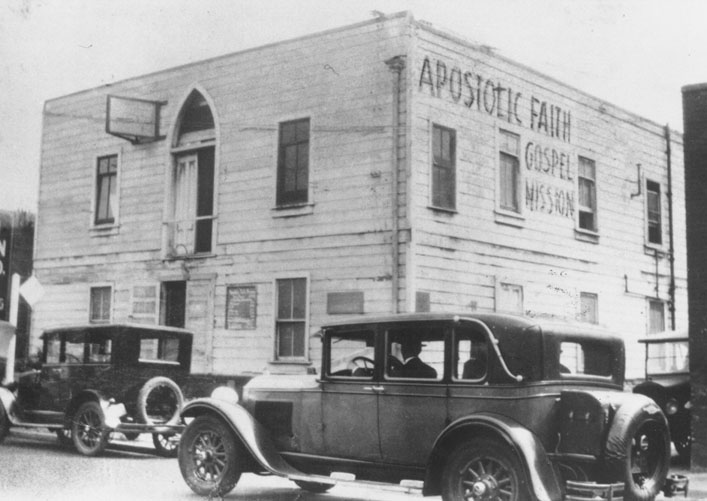
In Houston in the winter of 1905–06, William J. Seymour, the son of formerly enslaved parents, attended Parham’s classes, sitting outside the classroom door under the rules of segregation. Invited to preach in Los Angeles in 1906, he led a revival that from April met in a former church building at 312 Azusa Street. The meetings ran almost daily for three years, drew visitors from across the world, and were reported first by the hostile press and then by the mission’s own paper, The Apostolic Faith, whose first issue in September 1906 carried the headline “Pentecost Has Come”.[3][1] Consensus
What struck observers, friendly and hostile, was who worshipped together: Black and white, Latino, men and women, the poor and a few of the comfortable. Frank Bartleman, a white participant, wrote that “the color line was washed away in the blood”.[34] Parham himself visited in October 1906, condemned the racial mixing and the style of worship, and broke with Seymour. Within a decade American Pentecostalism had largely separated along racial lines: the Church of God in Christ, led by Charles H. Mason, became the main Black denomination, and the Assemblies of God, founded in 1914, a largely white one.[1][2] Majority
Many origins
The older story made Azusa Street the single source from which Pentecostalism spread. Allan Anderson and others argue that it had several origins: revivals with tongues, prophecy and healing broke out independently or nearly so in Wales (1904–1905), at Pandita Ramabai’s Mukti mission near Pune (1905–1906), in Pyongyang (1907) and in Valparaíso, Chile (1909–1910), where the Methodist missionary Willis Hoover’s congregation was expelled by its own church and founded the Methodist Pentecostal Church.[2] Majority In Brazil, two Swedish Pentecostal missionaries from the United States, Gunnar Vingren and Daniel Berg, founded what became the Assemblies of God at Belém in 1911; it is now one of the largest Protestant churches in the world.[2][35] Consensus
Pentecostalism spread through what it did more than through what it argued: it needed no seminary or bishop, met in houses and storefronts, offered healing and direct experience of the Spirit, and let the poor, and often women, preach. Later in the century a “charismatic” movement brought the same practices into the older churches, Episcopalian from 1960 and Catholic from 1967.[2] Majority
Modernists and fundamentalists
The Social Gospel and the modernists
Liberal Protestantism entered the century confident. It accepted the historical criticism of the Bible (§11), read Christianity as above all an ethical religion, and in the Social Gospel turned it on industrial poverty. Walter Rauschenbusch, a former Baptist pastor in New York’s Hell’s Kitchen, argued in Christianity and the Social Crisis (1907) that the kingdom of God Jesus preached was to be realised in a just social order.[4] Consensus
The Fundamentals
Conservatives answered with The Fundamentals: A Testimony to the Truth (1910–1915), ninety essays in twelve volumes, paid for by the oil businessmen Lyman and Milton Stewart; some three million copies were sent free to pastors, missionaries and students. The essays defended the inerrancy of scripture, the virgin birth, the substitutionary atonement, the bodily resurrection and the reality of miracles.[7][8] Consensus In 1920 the Baptist editor Curtis Lee Laws coined the word “fundamentalist” for those ready “to do battle royal for the Fundamentals”.[8] Majority
Much of the movement also held a new way of reading prophecy, dispensationalism, popularised by the Scofield Reference Bible (1909). Its notes divided history into periods and taught that the church would be taken up to meet Christ before a time of tribulation, the “Rapture” (§11).[5][8] Consensus
The fight inside the churches
The battle was fought in the northern Presbyterian and Baptist churches. In May 1922 Harry Emerson Fosdick, a Baptist preaching in a Presbyterian pulpit in New York, asked “Shall the Fundamentalists Win?” and pleaded for tolerance of those who could not accept the virgin birth or inerrancy.[12] The conservatives forced him out of that pulpit, but lost the war for the denominations: in 1929 Princeton Seminary was reorganised, and J. Gresham Machen left to found Westminster Seminary.[8] Consensus
The Scopes trial
In July 1925 John Scopes, a high-school teacher in Dayton, Tennessee, was tried for teaching human evolution, against the new Butler Act. William Jennings Bryan, three times presidential candidate, joined the prosecution; Clarence Darrow defended. Scopes was convicted and fined $100; the Tennessee Supreme Court overturned the verdict on a technicality in 1927, and the law stayed on the books until 1967.[13] Consensus
The trial’s popular image comes largely from the play and film Inherit the Wind (1955, 1960), written as a parable about McCarthyism. Edward Larson’s Pulitzer Prize–winning history shows a more complicated event: Dayton’s businessmen staged the test case partly for publicity, and Bryan’s objection to evolution was moral and social as much as biblical. Fundamentalists lost the battle for respectability, and the mainline denominations, but did not disappear; as Joel Carpenter has shown, they withdrew to build Bible institutes, radio stations, publishers and missions, the base of the evangelical revival after 1945.[13][36] Majority
Karl Barth and the crisis of liberal theology
In Europe the First World War broke the liberal confidence first. Karl Barth, a Swiss Reformed pastor, was appalled that his German teachers had signed a manifesto supporting the Kaiser’s war policy in 1914. His commentary The Epistle to the Romans (1919, and a rewritten second edition in 1922) insisted on the “infinite qualitative distinction” between God and humanity and on revelation as God’s word to the world, not an outgrowth of human culture.[11][37] Consensus The movement it began, called dialectical theology or neo-orthodoxy, dominated Protestant theology for a generation and supplied the language of the German church struggle. Majority
The churches under Stalin and Hitler Political
The Russian Orthodox Church under Soviet rule
In 1917 a church council, opened between the two revolutions, restored the patriarchate abolished by Peter the Great and, days after the Bolshevik seizure of power, elected Tikhon patriarch. In January 1918 the Bolshevik government separated church from state and school and took its property.[9][18] Consensus What followed was the most systematic attempt by a modern state to eliminate a religion. In 1922 churches’ valuables were seized for famine relief, and clergy who resisted were tried and some shot; from 1925 the League of the Godless (from 1929 “Militant Godless”) ran anti-religious propaganda; in 1927 Metropolitan Sergii, acting head of the church, declared its loyalty to the Soviet state, a step his defenders saw as the price of survival and his critics, including the Russian Orthodox Church Outside Russia, as capitulation.[14][10] Majority on the events; Contested on the judgement of Sergii.
The Great Terror of 1937–1938 was the climax. Estimates of the clergy and lay believers shot in those two years run from tens of thousands to over 100,000; the figures are disputed. Before 1917 the church had some 50,000 parishes; by 1939 only a few hundred churches remained open across the Soviet Union.[18][10] Majority on the scale; exact figures are disputed.
The war changed Stalin’s policy. On 4 September 1943 he received Sergii and two other metropolitans in the Kremlin; a council elected Sergii patriarch four days later, and thousands of churches and some seminaries were allowed to reopen under close state supervision.[18] Consensus Nikita Khrushchev’s campaign of 1959–1964 closed roughly half of them again. In 1988 the millennium of the baptism of Rus’ was celebrated openly, a sign of the thaw under Gorbachev.[18] Majority
The German churches and National Socialism
About two-thirds of Germans were Protestant and one-third Catholic in 1933. Neither church resisted Hitler as an institution; both contained enthusiasts, accommodators and a minority of resisters.[38][39] Majority
- The “German Christians” (Deutsche Christen), a Protestant movement that wanted a Nazified church without its “Jewish” Old Testament, won about two-thirds of the votes in the church elections of July 1933 and installed Ludwig Müller as Reich bishop.[40] Consensus Doris Bergen’s study shows how far they went in trying to “de-Judaise” Christianity.[40]
- The Confessing Church. Pastors who rejected state control of the church, led by Martin Niemöller’s Pastors’ Emergency League, met at Barmen in May 1934 and adopted a declaration largely drafted by Karl Barth (primary source 4). It defended the church’s independence, not the Jews: only a few members, such as Dietrich Bonhoeffer, argued that the church must also defend Jews outside it.[16][38] Majority Niemöller spent 1937–1945 in prison and concentration camps; Bonhoeffer joined the conspiracy against Hitler, was arrested in 1943 and hanged at Flossenbürg on 9 April 1945.[20] Consensus
- The Catholic Church signed a concordat with the new government in July 1933, negotiated by the papal secretary of state Eugenio Pacelli, the future Pius XII: it guaranteed Catholic worship, schools and organisations in return for clergy withdrawing from party politics.[15] Consensus When the regime broke it, Pius XI’s encyclical Mit brennender Sorge (“With burning concern”, 1937), smuggled into Germany and read from pulpits, condemned the regime’s violations and its racial idolatry.[17] Consensus In 1941 Bishop Clemens August von Galen of Münster preached publicly against the killing of disabled people, and the regime formally halted the T4 programme, though killing continued by other means.[39] Majority
Pius XII and the Holocaust
Pius XII (pope 1939–1958) never publicly condemned the murder of Europe’s Jews by name. His Christmas radio message of 1942 spoke of “hundreds of thousands of persons who, without any fault of their own, sometimes only because of their nationality or descent, are condemned to death or to progressive extinction” (primary source 5).[41] Consensus on the text.
| View | Main argument | Main proponents |
|---|---|---|
| Moral failure | His silence, his concern for the church’s diplomatic position and anti-Jewish attitudes in the church left Jews without a voice they could have had | Cornwell (who partly retreated from his thesis in 2004), Wills[42][43] |
| Constrained and partial | He feared reprisals and communism and chose quiet diplomacy; church institutions saved many Jews, but he did less than he could, and his postwar record is also open to criticism | Phayer[39] |
| Prudent rescuer | Public protest would have provoked worse persecution, as Dutch bishops’ protest in 1942 was followed by deportations of Catholic converts; the Vatican quietly sheltered Jews | Rychlak[44] |
The debate began with Rolf Hochhuth’s play The Deputy (1963). The opening of the Vatican archives for Pius XII’s pontificate in March 2020 has added evidence without ending the argument.[45] Contested The Holocaust itself, and Jewish theology after it, are told in Judaism §12.
The ecumenical movement
The World Missionary Conference at Edinburgh in June 1910, chaired by the American Methodist layman John R. Mott, brought together about 1,200 delegates from Protestant missionary societies to plan the “evangelisation of the world in this generation”. Only about twenty were Asian or African Christians, almost all from Asia, and they came as members of missionary societies’ delegations, and Latin America was left off the agenda as already Christian; the Indian clergyman V. S. Azariah told them that the younger churches needed missionaries who would be their friends.[6] Majority
Edinburgh led directly to the International Missionary Council (1921) and, through Bishop Charles Brent, to Faith and Order (Lausanne, 1927); Faith and Order and Life and Work (Stockholm, 1925), led by Archbishop Nathan Söderblom, merged in August 1948 at Amsterdam to form the World Council of Churches, with 147 member churches, Protestant, Anglican and some Orthodox.[21] Consensus The Catholic Church did not join, but from Vatican II it took part as an observer and partner (below). In 1965 Pope Paul VI and Patriarch Athenagoras of Constantinople lifted the excommunications of 1054 (§8).[23] Consensus
The Second Vatican Council, 1962–1965
The council
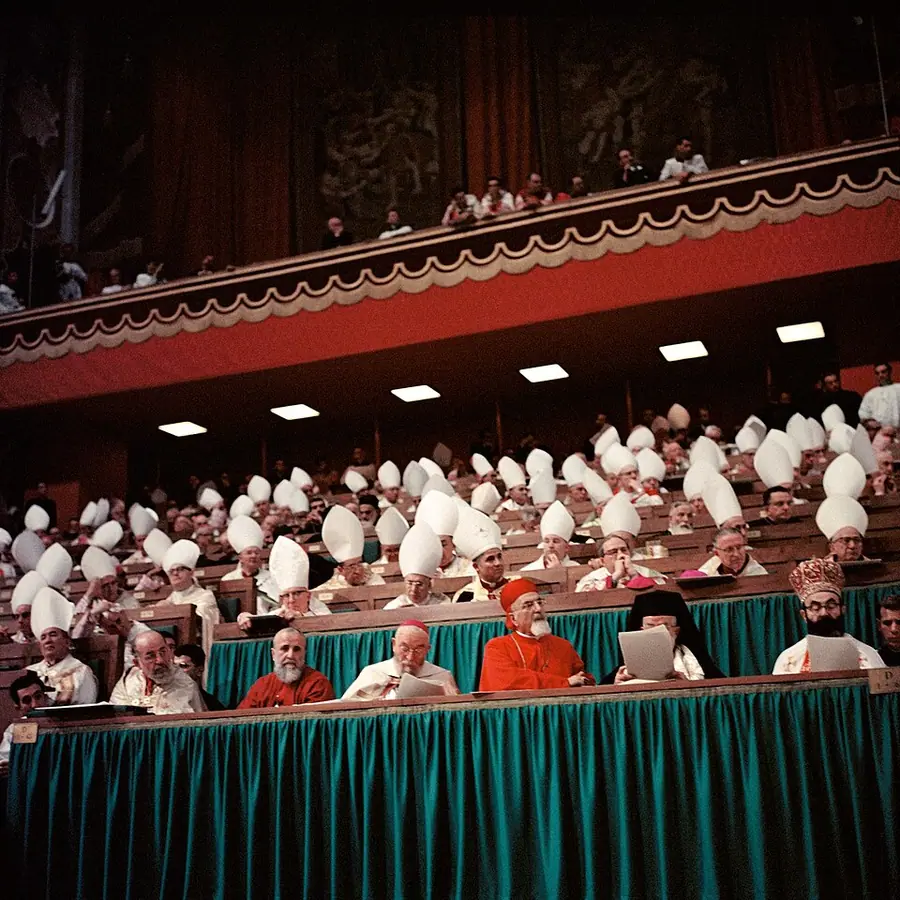
John XXIII announced a general council in January 1959, three months after his election. It opened in St Peter’s on 11 October 1962 and met in four autumn sessions until 8 December 1965, under Paul VI after John’s death in 1963. More than 2,000 bishops attended each session; Protestant and Orthodox observers watched from a tribune near the altar. It produced sixteen documents.[23] Consensus
| Document | Date | What it did |
|---|---|---|
| Sacrosanctum Concilium | 4 Dec 1963 | Reformed the liturgy; allowed the vernacular in the Mass and sacraments[46] |
| Lumen Gentium | 21 Nov 1964 | Described the church as the “people of God”; the collegiality of bishops with the pope |
| Unitatis Redintegratio | 21 Nov 1964 | Committed the church to ecumenism; spoke of other Christians as “separated brethren” |
| Nostra Aetate | 28 Oct 1965 | On other religions; rejected collective Jewish guilt for Jesus’ death[47] |
| Dei Verbum | 18 Nov 1965 | On revelation and scripture; accepted the study of literary forms |
| Dignitatis Humanae | 7 Dec 1965 | Declared a human right to religious freedom[48] |
| Gaudium et Spes | 7 Dec 1965 | On the church in the modern world |
Dates and summaries follow O’Malley’s history of the council.[23]
What changed
For most Catholics the visible change was the Mass. The council kept Latin as the language of the Latin rite but allowed the “mother tongue” to be extended (primary source 6); within a few years the reformed Mass of 1969–1970 was celebrated almost everywhere in local languages, with the priest facing the people.[46][23] Consensus
Two documents reversed long-held positions. Dignitatis Humanae declared that every person has a right to religious freedom, after a century in which popes had condemned the idea; the American Jesuit John Courtney Murray, earlier silenced by Rome, helped draft it.[48][23] Consensus Nostra Aetate stated that what happened in Jesus’ passion “cannot be charged against all the Jews, without distinction, then alive, nor against the Jews of today”. Earlier drafts had explicitly rejected the charge of deicide; the word was dropped from the final text, which was passed by 2,221 votes to 88.[47][23] Consensus (§2, §4)
Continuity or rupture?
Within the church, the meaning of the council remains disputed. One reading, associated with the Bologna school of Giuseppe Alberigo, sees it as an “event” that changed the church’s direction; another, set out by Benedict XVI in 2005, calls for a “hermeneutic of reform” in continuity with earlier teaching; traditionalists led by Archbishop Marcel Lefebvre rejected much of it, founded the Society of St Pius X in 1970, and were excommunicated after unauthorised consecrations in 1988.[23] Contested The council was followed by a sharp fall in Mass attendance and vocations in Western Europe and North America; whether the council caused it, or merely coincided with the wider secularisation of the 1960s, is argued in both directions. Contested
Women in the ministry
Many Protestant churches came to ordain women in the century, Catholic and Orthodox churches did not, and the question divided the Anglican Communion more than any other.
- The first Anglican woman priest, Florence Li Tim-Oi, was ordained by Bishop Ronald Hall of Hong Kong in January 1944, to serve Chinese Christians in Macau cut off by the Japanese occupation. After the war, under pressure, she gave up her licence, but not her orders.[19] Consensus
- Mainline Protestants. The Methodist Church in the United States gave women full clergy rights in 1956, as did the Presbyterian Church in the USA; the Church of Sweden ordained its first women priests in 1960.[49] Consensus
- The Episcopal Church. Eleven women were ordained irregularly in Philadelphia in July 1974; the General Convention approved women priests in 1976.[27] Consensus
- The Church of England voted in its General Synod in November 1992; the first 32 women were ordained priest in Bristol Cathedral in March 1994.[50] Consensus
- The Catholic Church. In 1976 the declaration Inter Insigniores held that the church had no authority to ordain women priests (§13 follows the later debate).[51] Consensus
Mark Chaves has shown that the timing of women’s ordination in American denominations followed their relation to liberal or conservative culture as much as their theology.[49] Majority
Christianity, race and liberation
The Black church and civil rights
The civil-rights movement in the American South was organised largely through Black churches. The Montgomery bus boycott of 1955–1956 made a young Baptist pastor, Martin Luther King Jr., its spokesman; in 1957 he became president of the new Southern Christian Leadership Conference, made up mostly of clergy.[22] Consensus King’s “Letter from Birmingham Jail” (April 1963), answering eight white clergymen who had called his campaign “unwise and untimely”, argued from Augustine, Aquinas and the prophets that unjust laws must be broken openly and nonviolently (primary source 8).[52] Consensus Most white churches in the South stood aside or opposed the movement; Northern clergy, Protestant, Catholic and Jewish, joined the marches.[22] Majority
Liberation theology
In Latin America, the bishops’ conference meeting at Medellín, Colombia, in 1968 applied Vatican II to a continent of poverty and dictatorship, speaking of “institutionalised violence”.[24] Consensus The Peruvian priest Gustavo Gutiérrez’s A Theology of Liberation (1971) argued that theology must begin from the experience of the poor and from commitment to their liberation, using the tools of social analysis, including Marxist ones.[25] Consensus Base communities of lay Catholics reading the Bible together spread in Brazil and Central America; the 1979 bishops’ conference at Puebla spoke of a “preferential option for the poor”.[53] Majority Archbishop Óscar Romero of San Salvador was shot while saying Mass on 24 March 1980.[53] Consensus
Rome responded twice. The Congregation for the Doctrine of the Faith, under Cardinal Joseph Ratzinger, criticised the uncritical use of Marxism in Libertatis Nuntius (1984), and gave a more positive account of Christian liberation in Libertatis Conscientia (1986); the Brazilian Franciscan Leonardo Boff was ordered to a year’s silence in 1985.[53] Consensus on the documents; Political on their reception.
Evangelicals and the Christian Right Political
From the 1940s the heirs of fundamentalism rebranded themselves “evangelicals”: the National Association of Evangelicals was founded in 1942, Billy Graham’s Los Angeles crusade of 1949 made him a national figure, and the magazine Christianity Today began in 1956.[36][54] Consensus In 1974 Graham convened the International Congress on World Evangelization at Lausanne; under pressure from Latin American theologians such as René Padilla and Samuel Escobar, its covenant affirmed that “evangelism and socio-political involvement are both part of our Christian duty” (primary source 9).[26] Consensus
In the United States, conservative Protestants entered party politics at the end of the 1970s. The Moral Majority, founded by the Baptist pastor Jerry Falwell in 1979, mobilised against abortion, which the Supreme Court had legalised in 1973, and for “traditional family values”; Pat Robertson ran for the presidency in 1988 and founded the Christian Coalition in 1989.[29] Consensus Why it happened then is argued. Randall Balmer emphasises the fight over federal challenges to the tax exemption of private Christian schools, many of them founded during desegregation; Daniel K. Williams emphasises a longer history of conservative Protestant politics and the moral issues, abortion above all.[55][29] Contested
The southern turn
In 1970 the missiologist David Barrett predicted in an article titled “AD 2000: 350 Million Christians in Africa” that Africa would have about that many Christians by the end of the century.[56] The usual estimates now put African Christians at roughly 10 million around 1910 and well over 300 million by 2000, close to his forecast.[57] Majority on the figures, which depend on how Christians are counted.
Much of the growth came through churches founded and led by Africans: the Kimbanguist church in the Congo, from Simon Kimbangu’s healing ministry of 1921; the Aladura (“praying”) churches of Nigeria from the 1920s and 1930s; the Zion Christian Church in South Africa, from 1924.[58] Consensus Lamin Sanneh argued that translating the Bible into African languages gave Africans a Christianity they could make their own, against the view that it was simply the religion of colonialism; Andrew Walls described the result as a shift of Christianity’s centre of gravity to the South.[59][60] Majority
In South Korea, Protestantism grew from a small minority in 1945 to about a fifth of the population by the 1990s; David Yonggi Cho’s Yoido Full Gospel Church in Seoul, founded in 1958, claimed the largest congregation in the world.[2] Majority In China, after the expulsion of missionaries, Protestants were organised from 1954 in the state-supervised Three-Self Patriotic Movement; all churches were closed in the Cultural Revolution (1966–1976), and when they reopened from 1979 the number of Christians proved far larger than in 1949.[33] Majority
John Paul II and the end of communism in Europe
The election of the Polish cardinal Karol Wojtyła as John Paul II in October 1978 made him the first non-Italian pope since 1523. On his first visit home, in June 1979, he told a crowd in Warsaw’s Victory Square “Let your Spirit descend… and renew the face of the earth, the face of this land” (primary source 10).[28] Consensus The Solidarity trade union grew out of the strikes of August 1980. How much the pope and the church contributed to the fall of communism in 1989, compared with economic failure, Gorbachev’s reforms and the workers’ movement itself, is debated; biographers such as George Weigel give him a decisive role, others a significant but secondary one.[61] Contested
The evidence
| Question | What the evidence supports | Key evidence | Confidence |
|---|---|---|---|
| Pentecostal origins | Several origins, with Topeka and Azusa Street the most influential in the West | Contemporary reports; The Apostolic Faith[3][2] | Majority |
| Race at Azusa Street | An interracial revival that later denominations divided by race | Bartleman; Wacker[34][1] | Majority |
| Fundamentalism | A movement of the 1910s–1920s, defending inerrancy and core doctrines, often dispensationalist | The Fundamentals; Marsden[7][8] | Consensus |
| Scopes | A public-relations defeat, not the end of the movement | Larson; Carpenter[13][36] | Majority |
| Soviet persecution | The near-destruction of the Orthodox Church by 1939 | Laws; Pospielovsky; Froese[9][18][10] | Consensus (fact); Majority (numbers) |
| German churches | Widespread accommodation; resistance in defence of church independence; few defended Jews | Barmen; Bergen; Barnett[16][40][38] | Majority |
| Pius XII | No public naming of the genocide; the reasons and judgement are disputed | Christmas 1942; Phayer; Rychlak[41][39][44] | Contested |
| Vatican II | Vernacular liturgy, religious freedom, ecumenism, rejection of collective Jewish guilt | The council documents[46][48][47] | Consensus |
| Women’s ordination | Spread through mainline Protestant churches (some from the nineteenth century) and, from 1944 to 1994, the Anglican churches | Li Tim-Oi; Chaves[19][49] | Consensus |
| Southern shift | Africa from roughly 10 million (c. 1910) to over 300 million Christians by 2000 | Barrett; Johnson and Ross[56][57] | Majority |
Primary sources
Show the 10 primary sources
1. “Pentecost Has Come”: The Apostolic Faith, September 1906
The first issue of the Azusa Street mission’s paper, published in Los Angeles, reported the revival under the headline “Pentecost Has Come” and described people receiving the Spirit and speaking in other tongues as in the Book of Acts.[3]
What it proves. Within months the participants understood the revival as a return of the apostolic age, and had their own press to say so. The paper reached tens of thousands of readers and carried the movement’s self-description across the world. Consensus
2. The Fundamentals, 1910–1915
Ninety essays by British and American conservative scholars and pastors, on the inspiration of scripture, the deity of Christ, the virgin birth, the atonement, the resurrection, and against higher criticism, evolution as a world-view, Catholicism, Mormonism and Christian Science.[7]
What it proves. “Fundamentalism” began as a scholarly defence of traditional doctrine, more moderate in tone than the movement of the 1920s, which took its name. Majority
3. “Shall the Fundamentalists Win?”, Harry Emerson Fosdick, 21 May 1922
Preached at First Presbyterian Church in New York and widely reprinted, the sermon asked for a church broad enough to hold both those who believed in the virgin birth and inerrancy and those who did not.[12]
What it proves. By 1922 the dispute had become a battle for control of the main Protestant denominations, and the liberal side was willing to say so publicly. Consensus
4. The Barmen Declaration, thesis 1, 31 May 1934
Jesus Christus, wie er uns in der Heiligen Schrift bezeugt wird, ist das eine Wort Gottes, das wir zu hören, dem wir im Leben und im Sterben zu vertrauen und zu gehorchen haben.
“Jesus Christ, as he is attested for us in Holy Scripture, is the one Word of God which we have to hear and which we have to trust and obey in life and in death.”[16]
The thesis goes on to reject as false teaching the idea that the church could recognise “other events and powers, figures and truths” as God’s revelation.
What it proves. The Confessing Church’s founding text was a theological rejection of the German Christians’ claim that God spoke through the nation and its leader. It does not mention the Jews, which later members such as Niemöller came to regret. Majority
5. Pius XII, Christmas radio message, 24 December 1942
…alle centinaia di migliaia di persone, le quali, senza veruna colpa propria, talora solo per ragione di nazionalità o di stirpe, sono destinate alla morte o ad un progressivo deperimento.
“…to the hundreds of thousands of persons who, without any fault of their own, sometimes only because of their nationality or descent, are condemned to death or to progressive extinction.”[41]
What it proves. In December 1942 the pope referred publicly to mass killing on grounds of nationality or race, in a long address, without naming Jews or Germany. Supporters read it as a clear condemnation by a pope who could say no more; critics as evidence of how little he was willing to say. Contested
6. Sacrosanctum Concilium 36, 4 December 1963
“Particular law remaining in force, the use of the Latin language is to be preserved in the Latin rites. But since the use of the mother tongue, whether in the Mass, the administration of the sacraments, or other parts of the liturgy, frequently may be of great advantage to the people, the limits of its employment may be extended.”[46]
What it proves. The council itself made only a cautious opening for the vernacular; the near-complete replacement of Latin came from the reforms that followed in the next decade. Consensus
7. Dignitatis Humanae 2, 7 December 1965
“This Vatican Council declares that the human person has a right to religious freedom. This freedom means that all men are to be immune from coercion on the part of individuals or of social groups and of any human power.”[48]
What it proves. The Catholic Church formally accepted religious freedom as a right grounded in human dignity, reversing the nineteenth-century papal condemnations of the idea (§11). Majority on the reversal; some theologians argue it was a development, not a contradiction.
8. Martin Luther King Jr., “Letter from Birmingham Jail”, 16 April 1963
“Injustice anywhere is a threat to justice everywhere.”[52]
What it proves. The movement’s leading voice made a Christian and natural-law case for civil disobedience, addressed to fellow clergy. Its mix of biblical prophecy, Augustine and American constitutional language became a model for later Christian activism. Consensus
9. The Lausanne Covenant, section 5, 1974
“…we affirm that evangelism and socio-political involvement are both part of our Christian duty.”[26]
What it proves. Global evangelicalism, partly under pressure from the Southern hemisphere, committed itself to social action as well as preaching, a balance its members have argued over since. Consensus
10. John Paul II, homily in Victory Square, Warsaw, 2 June 1979
“Let your Spirit descend. Let your Spirit descend, and renew the face of the earth, the face of this land.”[28]
What it proves. A pope publicly called for the spiritual renewal of a communist country before a vast crowd, in words heard as political by everyone present. It is often taken as one of the starting points of the Solidarity movement. Majority
What is absent
Much that defined Christianity by 1990 did not exist at the start of the century.
- Pentecostalism. There was no Pentecostal church in 1900; by 1990 Pentecostals and charismatics were counted in hundreds of millions. Majority on the count.
- Mass in the vernacular. Catholic Mass in 1900 was in Latin everywhere in the Latin rite. Consensus
- Women priests. No major church ordained women priests in 1900; by 1990 many Protestant and Anglican churches did. Consensus
- The World Council of Churches and formal Catholic ecumenism. Consensus
- Catholic acceptance of religious freedom as a human right. Consensus
- A Christian majority outside the West. In 1900 most Christians lived in Europe and North America; by the end of the century they did not. Majority
Debates
Was Pentecostalism born at Azusa Street?
| View | Main argument | Main proponents |
|---|---|---|
| Azusa as the source | The revival’s paper and visitors spread it worldwide; most early movements trace a link to Los Angeles | Older histories; many Pentecostal denominations[1] |
| Many origins | Revivals in India, Korea, Chile and Wales had their own leaders and dynamics, and were not offshoots | Anderson[2] |
Contested, with the many-origins view now widely held.
What was Pius XII’s record?
See the table above. Contested
Was Vatican II a rupture?
| View | Main argument | Main proponents |
|---|---|---|
| An event of change | The council changed the church’s self-understanding and style, not only its texts | Alberigo; O’Malley[23] |
| Reform in continuity | The council developed earlier teaching without breaking with it | Benedict XVI[23] |
| Rupture to be rejected | The council broke with tradition on liturgy and religious freedom | Lefebvre and the Society of St Pius X |
Contested
Why did the Christian Right emerge in the late 1970s?
See above. Contested
Further reading
Show further reading (11 works)
- Allan Heaton Anderson, An Introduction to Pentecostalism (Cambridge, 2nd ed. 2014).
- Grant Wacker, Heaven Below: Early Pentecostals and American Culture (Harvard, 2001).
- George M. Marsden, Fundamentalism and American Culture (Oxford, 1980; 2nd ed. 2006).
- Edward J. Larson, Summer for the Gods: The Scopes Trial and America’s Continuing Debate over Science and Religion (Basic Books, 1997).
- Dimitry Pospielovsky, The Orthodox Church in the History of Russia (St Vladimir’s Seminary Press, 1998).
- Doris L. Bergen, Twisted Cross: The German Christian Movement in the Third Reich (North Carolina, 1996), and Victoria Barnett, For the Soul of the People: Protestant Protest against Hitler (Oxford, 1992).
- Michael Phayer, The Catholic Church and the Holocaust, 1930–1965 (Indiana, 2000).
- John W. O’Malley, What Happened at Vatican II (Harvard, 2008).
- Taylor Branch, Parting the Waters: America in the King Years, 1954–63 (Simon & Schuster, 1988).
- Philip Jenkins, The Next Christendom: The Coming of Global Christianity (Oxford, 2002).
- Lamin Sanneh, Translating the Message: The Missionary Impact on Culture (Orbis, 1989).
References
- ^ a b c d e f g h Grant Wacker Heaven Below: Early Pentecostals and American Culture. Harvard University Press, 2001. Early American Pentecostals, from Topeka and Azusa Street to the 1920s.
- ^ a b c d e f g h i j Allan Heaton Anderson An Introduction to Pentecostalism: Global Charismatic Christianity. Cambridge University Press, 2nd ed., 2014. The standard global history, arguing for Pentecostalism's many origins.
- ^ a b c d The Apostolic Faith, vol. 1 no. 1 (September 1906) — The Apostolic Faith (Apostolic Faith Mission, Los Angeles). September 1906. English. The Azusa Street mission's paper reports the revival under the headline 'Pentecost Has Come'. about
- ^ a b Walter Rauschenbusch Christianity and the Social Crisis. Macmillan, 1907. The founding text of the Social Gospel.
- ^ a b Scofield Reference Bible — C. I. Scofield, ed. (Oxford University Press). 1909. English. A King James Bible with dispensationalist notes that spread the pre-tribulation Rapture among American Protestants. about
- ^ a b Brian Stanley The World Missionary Conference, Edinburgh 1910. Eerdmans, 2009. The history and significance of the conference.
- ^ a b c d The Fundamentals: A Testimony to the Truth — R. A. Torrey, A. C. Dixon et al., eds. (Testimony Publishing, Chicago). 1910–1915. English. Ninety essays in twelve volumes defending inerrancy and core doctrines, funded by Lyman and Milton Stewart and distributed free. about
- ^ a b c d e f George M. Marsden Fundamentalism and American Culture. Oxford University Press, 1980. The standard history of fundamentalism to 1925.
- ^ a b c Decree on the Separation of Church from State and School from Church — Council of People's Commissars, Soviet Russia. January 1918. Russian. Separates church from state and school, removes its legal personality and nationalises church property. about
- ^ a b c d e Paul Froese The Plot to Kill God: Findings from the Soviet Experiment in Secularization. University of California Press, 2008. The Soviet attempt to abolish religion and why it failed.
- ^ a b Karl Barth, Der Römerbrief — The Epistle to the Romans (1st ed. 1919; 2nd ed. 1922). 1919, 1922. German. The commentary that launched dialectical theology, stressing God's otherness and revelation over religion and culture. about
- ^ a b c Harry Emerson Fosdick, "Shall the Fundamentalists Win?" — Sermon at First Presbyterian Church, New York. 21 May 1922. English. Pleads for a church broad enough to hold liberals and conservatives; a turning point of the fundamentalist–modernist controversy. about
- ^ a b c d Edward J. Larson Summer for the Gods: The Scopes Trial and America's Continuing Debate over Science and Religion. Basic Books, 1997. Pulitzer Prize–winning history of the trial and its myths.
- ^ a b Declaration of Metropolitan Sergii — Acting Patriarchal Locum Tenens of the Russian Orthodox Church. 29 July 1927. Russian. Declares the church's loyalty to the Soviet state, accepted by some as the price of survival and rejected by others as capitulation. about
- ^ a b Reichskonkordat — Concordat between the Holy See and the German Reich. 20 July 1933. German and Italian. Guarantees Catholic worship, schools and associations in return for clergy withdrawing from party politics. about
- ^ a b c d Barmen Theological Declaration — Confessional Synod of the German Evangelical Church, Barmen. 31 May 1934. German. Six theses, largely drafted by Karl Barth, rejecting the German Christians' claim that God is revealed in other events and powers beside Christ. about
- ^ a b Pius XI, Mit brennender Sorge — Encyclical on the Church and the German Reich. 14 March 1937. German. Smuggled into Germany and read from pulpits on Palm Sunday, it condemns violations of the concordat and the idolatry of race and nation. read the text
- ^ a b c d e f g h Dimitry Pospielovsky The Orthodox Church in the History of Russia. St Vladimir's Seminary Press, 1998. Includes the Soviet persecution and the 1943 settlement.
- ^ a b c Ordination of Florence Li Tim-Oi — Anglican diocese of Victoria (Hong Kong). 25 January 1944. Chinese and English. Bishop Ronald Hall ordains the first woman priest in the Anglican Communion, for wartime ministry in Macau. about
- ^ a b Eberhard Bethge Dietrich Bonhoeffer: A Biography. Fortress Press, rev. ed., 2000. The standard life, by Bonhoeffer's friend and editor.
- ^ a b First Assembly of the World Council of Churches — Amsterdam. August 1948. English. The World Council of Churches is founded by 147 Protestant, Anglican and Orthodox churches. about
- ^ a b c Taylor Branch Parting the Waters: America in the King Years, 1954–63. Simon & Schuster, 1988. The civil-rights movement and its churches.
- ^ a b c d e f g h i j k John W. O'Malley What Happened at Vatican II. Harvard University Press, 2008. The council as an event, session by session.
- ^ a b Medellín conference documents — Second General Conference of the Latin American Episcopate (CELAM). August–September 1968. Spanish. The Latin American bishops apply Vatican II to poverty and dictatorship and speak of 'institutionalised violence'. about
- ^ a b Gustavo Gutiérrez Teología de la liberación: Perspectivas. CEP, Lima, 1971. The founding work of liberation theology (English 1973).
- ^ a b c The Lausanne Covenant — International Congress on World Evangelization, Lausanne. July 1974. English. Chapter 5 affirms that evangelism and socio-political involvement are both part of Christian duty. read the text
- ^ a b Ordination of women in the Episcopal Church — General Convention of the Episcopal Church (USA). 1974 (irregular); 1976 (authorised). English. Eleven women are ordained irregularly in Philadelphia in 1974; the General Convention authorises women priests in 1976. about
- ^ a b c John Paul II, homily in Victory Square, Warsaw — Homily, 2 June 1979. 2 June 1979. Polish. Ends with the prayer 'Let your Spirit descend… and renew the face of the earth, the face of this land.' read the text
- ^ a b c Daniel K. Williams God's Own Party: The Making of the Christian Right. Oxford University Press, 2010. The Christian Right's longer history before 1979.
- ^ Libertatis Nuntius — Congregation for the Doctrine of the Faith, Instruction on Certain Aspects of the Theology of Liberation. 6 August 1984. Latin. Criticises the uncritical borrowing of Marxist analysis in some liberation theology. read the text
- ^ Libertatis Conscientia — Congregation for the Doctrine of the Faith, Instruction on Christian Freedom and Liberation. 22 March 1986. Latin. A more positive account of Christian liberation and the preferential love of the poor. read the text
- ^ Philip Jenkins The Next Christendom: The Coming of Global Christianity. Oxford University Press, 2002. The southward shift and its consequences.
- ^ a b Daniel H. Bays A New History of Christianity in China. Wiley-Blackwell, 2012. From the Nestorians to the present, with the treaty-port missions and Chinese-led churches.
- ^ a b Frank Bartleman How Pentecost Came to Los Angeles. the author, Los Angeles, 1925. An eyewitness memoir of the Azusa Street revival.
- ^ Paul Freston Evangelicals and Politics in Asia, Africa and Latin America. Cambridge University Press, 2001. Includes the growth of Brazilian Pentecostalism.
- ^ a b c Joel A. Carpenter Revive Us Again: The Reawakening of American Fundamentalism. Oxford University Press, 1997. How fundamentalists built their own institutions after 1925.
- ^ Eberhard Busch Karl Barth: His Life from Letters and Autobiographical Texts. SCM Press / Fortress, 1976. The standard biography of Barth.
- ^ a b c Victoria Barnett For the Soul of the People: Protestant Protest against Hitler. Oxford University Press, 1992. The Confessing Church from its members' own accounts.
- ^ a b c d Michael Phayer The Catholic Church and the Holocaust, 1930–1965. Indiana University Press, 2000. A historian's middle position on Pius XII and the church.
- ^ a b c Doris L. Bergen Twisted Cross: The German Christian Movement in the Third Reich. University of North Carolina Press, 1996. The German Christians' attempt to 'de-Judaise' Christianity.
- ^ a b c Pius XII, Christmas radio message — Radiomessaggio natalizio (24 December 1942). 24 December 1942. Italian. Refers to hundreds of thousands condemned to death or progressive extinction, sometimes only because of their nationality or descent, without naming Jews or Germany. read the text
- ^ John Cornwell Hitler's Pope: The Secret History of Pius XII. Viking, 1999. The most influential critical account of Pius XII.
- ^ Garry Wills Papal Sin: Structures of Deceit. Doubleday, 2000. A Catholic critic on the papacy, including Pius XII and the Jews.
- ^ a b Ronald J. Rychlak Hitler, the War, and the Pope. Our Sunday Visitor, rev. ed., 2010. The leading defence of Pius XII.
- ^ David I. Kertzer The Pope at War: The Secret History of Pius XII, Mussolini, and Hitler. Random House, 2022. Uses the Vatican archives opened in 2020.
- ^ a b c d Sacrosanctum Concilium — Second Vatican Council, Constitution on the Sacred Liturgy. 4 December 1963. Latin. Keeps Latin in the Latin rites but allows the use of the mother tongue to be extended in the Mass and sacraments (art. 36). read the text
- ^ a b c Nostra Aetate 4 — Second Vatican Council, Declaration on the Relation of the Church to Non-Christian Religions. 28 October 1965. Latin. What happened in Christ's passion 'cannot be charged against all the Jews, without distinction, then alive, nor against the Jews of today'. read the text
- ^ a b c d Dignitatis Humanae — Second Vatican Council, Declaration on Religious Freedom. 7 December 1965. Latin. Declares that the human person has a right to religious freedom, grounded in human dignity. read the text
- ^ a b c Mark Chaves Ordaining Women: Culture and Conflict in Religious Organizations. Harvard University Press, 1997. Why denominations began ordaining women when they did.
- ^ First ordinations of women priests in the Church of England — Bristol Cathedral. 12 March 1994. English. Thirty-two women are ordained priest, following the General Synod vote of November 1992. about
- ^ Inter Insigniores — Congregation for the Doctrine of the Faith, Declaration on the Admission of Women to the Ministerial Priesthood. 15 October 1976. Latin. Holds that the Catholic Church does not consider itself authorised to admit women to priestly ordination. read the text
- ^ a b Martin Luther King Jr., "Letter from Birmingham Jail" — Letter answering 'A Call for Unity' by eight white clergymen. 16 April 1963. English. Defends nonviolent civil disobedience against unjust laws: 'Injustice anywhere is a threat to justice everywhere.' read the text
- ^ a b c Christian Smith The Emergence of Liberation Theology: Radical Religion and Social Movement Theory. University of Chicago Press, 1991. Medellín, base communities and the movement's spread.
- ^ Mark A. Noll American Evangelical Christianity: An Introduction. Blackwell, 2001. The evangelical movement and its institutions.
- ^ Randall Balmer Bad Faith: Race and the Rise of the Religious Right. Eerdmans, 2021. Argues that defence of segregated Christian schools, not abortion, first mobilised the Religious Right.
- ^ a b David B. Barrett AD 2000: 350 Million Christians in Africa. International Review of Mission 59: 39–54, 1970. Predicted that Africa would have about 350 million Christians by 2000.
- ^ a b Todd M. Johnson and Kenneth R. Ross, eds. Atlas of Global Christianity, 1910–2010. Edinburgh University Press, 2009. Estimates of Christian populations by region in 1910 and 2010.
- ^ Bengt Sundkler and Christopher Steed A History of the Church in Africa. Cambridge University Press, 2000. Includes the African-initiated churches.
- ^ Lamin Sanneh Translating the Message: The Missionary Impact on Culture. Orbis Books, 1989. Bible translation as vernacularisation of Christianity.
- ^ Andrew F. Walls The Missionary Movement in Christian History: Studies in the Transmission of Faith. Orbis Books, 1996. Essays on mission, translation and the shift of Christianity's centre.
- ^ George Weigel Witness to Hope: The Biography of Pope John Paul II. HarperCollins, 1999. The authorised biography, giving the pope a decisive role in 1989.