The short version: in Jewish law a person is Jewish by birth if their mother is Jewish, whatever the father, and that rule is rabbinic. The Hebrew Bible does not state it, and its stories assume the opposite: a man’s children belong to his people, whoever their mother. The rule first appears in the Mishnah, the law code compiled in Galilee around 200 CE, and the Talmud completed it over the following centuries.[1][2] Majority Why the rabbis adopted it is debated. Whether they invented it or wrote down something older is the real disagreement, and both sides have arguments worth stating.
In the Bible, children follow the father
The patriarchal and Mosaic stories never ask who an Israelite’s mother was. Joseph marries Asenath, daughter of an Egyptian priest, and their sons Ephraim and Manasseh become two of the tribes of Israel. Moses marries Zipporah, a Midianite. Judah marries a Canaanite. The book of Ruth makes a Moabite woman the great-grandmother of King David. In each case the children are Israelites because their father is.[3][4][5][2] Consensus on what the texts say.
One passage seems to look the other way. Leviticus 24 tells of “an Israelite woman’s son, whose father was an Egyptian”, who “went out among the people of Israel” and quarrelled in the camp.[6] He lives among the Israelites, but the text is a story about blasphemy, not a ruling on status, and it can be read either way. Contested
The book of Ezra, from the Persian period, is the first text to make foreign mothers a problem. Ezra has the men of Judah promise to “put away all these wives and their children”.[7] That treats the children of foreign wives as outsiders. But it is a call to dissolve marriages, not a rule about what makes a child Jewish, and it says nothing of Judean women married to foreign men (§5). Majority
The Mishnah’s rule
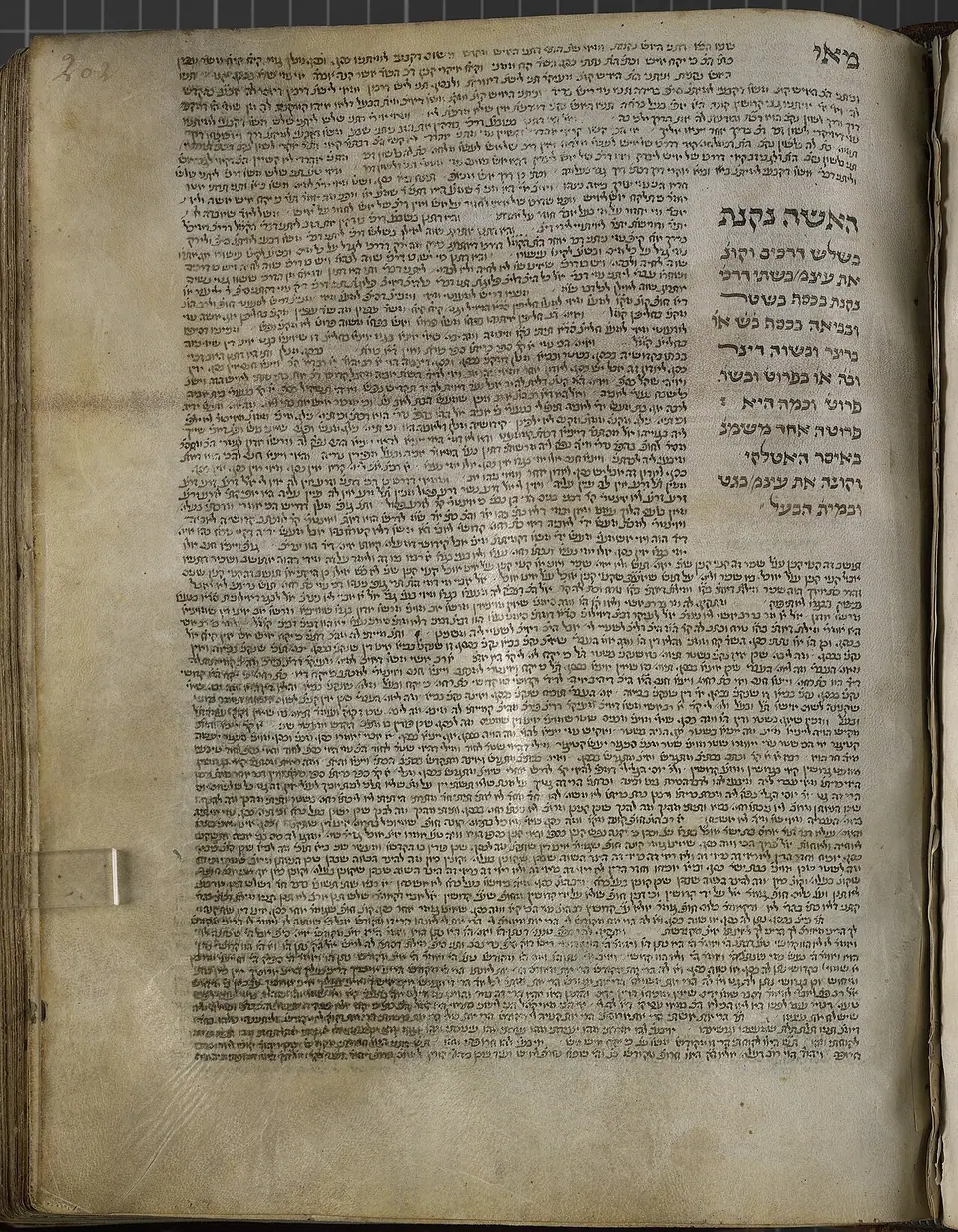
The first legal statement comes in tractate Kiddushin of the Mishnah, which sorts unions by the status of the children they produce. Where the union is valid and lawful, “the child follows the male”. At the end of the list comes the case that matters: any woman who cannot contract a valid marriage with an Israelite, “the child is like her. Which is this? This is the child of a [non-Jewish] maidservant or a non-Jewish woman.”[1] Consensus on the text.
That settles one half of the question: the child of a Jewish father and a gentile mother is a gentile. It does not say in so many words that the child of a Jewish mother and a gentile father is a Jew. That half was worked out later.
The Talmud completes it
The Babylonian Talmud reaches the other half through a verse. Deuteronomy 7:3–4 forbids marriage with the peoples of Canaan, “For he will turn away thy son from following Me”.[8] Rabbi Yoḥanan, in the name of Rabbi Shimon bar Yoḥai, reads it as a statement about descent: your son by an Israelite woman is called your son, but your son by a gentile woman is not. The later sage Ravina draws the inference: the son of your daughter by a gentile father is called your son.[9]
The status of such a child was still argued. In tractate Yevamot some rabbis held that the child of a gentile or slave father and a Jewish mother is a mamzer, a child of a forbidden union who may not marry most other Jews. The Talmud’s conclusion is that the child is fit, kasher, and that view became the law.[10] Consensus on the text. By the end of the talmudic period the rule was complete: a Jewish mother makes a Jewish child.
Where did the rule come from?
Shaye Cohen’s argument: a second-century innovation
The fullest historical study is Shaye J. D. Cohen’s The Beginnings of Jewishness (1999). He points to three things: the biblical evidence of descent through the father; the absence of the matrilineal rule from every Second Temple source, including Philo and Josephus, who discuss intermarriage without mentioning it; and its sudden appearance as settled law in the Mishnah. He concludes that the rabbis introduced it in the second century CE.[2] Majority
As for why, Cohen considers two models the rabbis had to hand. Roman law held that the child of a union in which the parents lacked the legal capacity to marry followed the mother’s status, and the wording of the Mishnah’s rule echoes that legal reasoning. And biblical law forbade mixing kinds, crossing animals or sowing two seeds together; in the Mishnah Rabbi Judah treats mules born of mares as belonging to their mother’s kind, “even though their father is a donkey”, which gave the rabbis a way of thinking about the offspring of mixed unions.[11][2][12] Cohen himself says neither model can be proved. Contested on the cause.
Two popular explanations
Two explanations are often given in popular writing. One is that motherhood is certain and fatherhood is not. The other is that the rule protected the children of Jewish women raped in wars and persecutions. Both are intuitive, and the first has a long life in later Jewish writing. But neither is the reason given in the Mishnah or the Talmud, which argue from verses and from the law of marriage, and Cohen argues that neither accounts for the rule’s origin.[11][2] Contested
The traditional view
Traditional Jewish authorities hold that the rule is as old as the Torah, and they have real evidence to point to. The Talmud reads it directly out of Deuteronomy 7:4, a verse that only makes sense if it is the grandson through the daughter whom the gentile father turns away, and so assumes that grandson is still “your son”.[9][8] Ezra’s expulsion of foreign wives together with their children assumes that the children went with their mothers.[7] And the son of an Israelite mother in Leviticus 24 lives among the people of Israel.[6] On this view the Mishnah did not invent the principle but recorded an unwritten tradition, which is what the rabbis said of much of their law. Some modern scholars accept a middle position: that a tendency to define membership through mothers was emerging in the Persian and Hellenistic periods, and that the rabbis turned it into a rule. Contested
A short timeline
| Date | What happens | Confidence |
|---|---|---|
| Iron Age traditions | Biblical stories trace descent through fathers | Consensus |
| 5th–4th c. BCE | Ezra demands the expulsion of foreign wives and their children[7] | Majority |
| c. 200 CE | Mishnah Kiddushin 3:12: the child of a gentile mother is like her[1] | Consensus |
| c. 500–700 CE | The Babylonian Talmud rules the child of a Jewish mother and gentile father Jewish and fit[9][10] | Consensus |
| 1962 | Israel’s Supreme Court rules a Jewish-born Carmelite monk is not a Jew under the Law of Return[13] | Consensus |
| 1970 | The Law of Return defines a Jew as one born of a Jewish mother or converted[14] | Consensus |
| 15 March 1983 | American Reform rabbis accept the child of either Jewish parent raised as a Jew[15] | Consensus |
The rule today
The rule now divides the Jewish movements more sharply than almost anything else (§13).
Orthodox and Conservative Judaism keep the matrilineal rule. A child of a Jewish father and a non-Jewish mother is not Jewish unless converted. Consensus
American Reform Judaism declared in 1983 that “the child of one Jewish parent is under the presumption of Jewish descent”, to be confirmed by “appropriate and timely public and formal acts of identification with the Jewish faith and people”.[15] The Reconstructionist movement had taken a similar position in 1968.[16][17] Note what the resolution does: it does not simply add fathers to mothers, but makes the status of every child of a mixed marriage, through either parent, depend on being raised as a Jew. Consensus
The State of Israel wrote the maternal definition into the Law of Return in 1970: a Jew is “a person who was born of a Jewish mother or has become converted to Judaism and who is not a member of another religion”. The last clause wrote into law the Supreme Court’s 1962 ruling in the Rufeisen case, that a Jew by birth who has adopted another religion does not count as a Jew.[13] The same amendment gave the right to immigrate to the children and grandchildren of Jews, so many people who are not Jews under the law’s own definition can become Israeli citizens under it.[14] Political
Common misconceptions
- “The rule is in the Torah.” No verse states it. Traditional authorities derive it from Deuteronomy 7:4 by interpretation; historians date its first statement to the Mishnah.[8][1]
- “Judaism has always been matrilineal.” The biblical stories are patrilineal, and the rule is absent from every Jewish source before about 200 CE.[2]
- “Being Jewish is purely a matter of birth.” Every Jewish movement accepts converts, and a convert’s status is the same as a born Jew’s in Jewish law. Consensus
- “Reform Judaism simply switched to the father.” It made either parent sufficient, but only together with a Jewish upbringing.[15]
Why it matters
The matrilineal rule is one of the clearest examples of the series’ main argument: much of what defines Judaism today was built by the rabbis after the Temple fell, not inherited unchanged from biblical Israel (§7). It is also a live question. Whether a person is Jewish can depend on which synagogue they ask, and in Israel, on which office of the state. For the rabbinic context see Chapter 7: Without a Temple: The Rabbis; for the modern movements and the Law of Return see Chapter 13: Judaism Today; for Ezra and the Persian-period debate over foreign wives see Chapter 5: Persian Yehud and the Making of the Torah.
References
- ^ a b c d m. Kiddushin 3:12 — Mishnah. c. 200 CE. Hebrew. The child of a gentile or slave woman 'is like her': the earliest statement of the matrilineal principle. read the text
- ^ a b c d e f Shaye J. D. Cohen The Beginnings of Jewishness: Boundaries, Varieties, Uncertainties. University of California Press, 1999. When Ioudaios came to mean a religious identity, and how conversion and matrilineal descent arose.
- ^ Genesis 41:50–52 — Genesis (Hebrew Bible). 1st millennium BCE. Hebrew. Joseph's sons Manasseh and Ephraim are born to Asenath, daughter of an Egyptian priest of On. read the text
- ^ Exodus 2:21–22 — Exodus (Hebrew Bible). 1st millennium BCE. Hebrew. Moses marries Zipporah, daughter of the Midianite priest, and she bears his son Gershom. read the text
- ^ Ruth 4:13–17 — Ruth (Hebrew Bible). Persian period (debated). Hebrew. Boaz marries Ruth the Moabite; their son Obed is the grandfather of David. read the text
- ^ a b Leviticus 24:10–11 — Leviticus (Hebrew Bible). Priestly material, c. 6th–5th c. BCE. Hebrew. The son of an Israelite woman and an Egyptian father goes out among the Israelites and quarrels in the camp; cited in debates over whether descent through the mother is biblical. read the text
- ^ a b c Ezra 9–10 — Ezra (Hebrew Bible). c. 4th c. BCE (composition). Hebrew. Ezra mourns that "the holy seed" has mixed with the peoples of the lands; the assembly resolves to send away foreign wives and their children. read the text
- ^ a b c Deuteronomy 7:3–4 — Deuteronomy (Hebrew Bible). 7th–6th c. BCE. Hebrew. Forbids marriage with the peoples of Canaan, 'For he will turn away thy son from following Me'; the verse from which the Talmud derives the matrilineal rule. read the text
- ^ a b c b. Kiddushin 68b — Babylonian Talmud. redacted c. 5th–7th c. CE. Hebrew and Aramaic. Rabbi Yoḥanan in the name of Rabbi Shimon bar Yoḥai reads Deuteronomy 7:4: your son by an Israelite woman is called your son, your son by a gentile woman is not; Ravina infers that a daughter's son by a gentile father is called your son. read the text
- ^ a b b. Yevamot 45a–b — Babylonian Talmud. redacted c. 5th–7th c. CE. Hebrew and Aramaic. Debates whether the child of a gentile or slave father and a Jewish mother is a mamzer; concludes that the child is fit (kasher). read the text
- ^ a b Shaye J. D. Cohen The Origins of the Matrilineal Principle in Rabbinic Law. AJS Review 10, pp. 19–53, 1985. doi The article behind Cohen's book chapter: the rule is rabbinic, and Roman law or the Mishnah's laws of mixed breeding are its likeliest models.
- ^ m. Kilayim 8:4 — Mishnah. c. 200 CE. Hebrew. Rabbi Judah: mules born of a mare, 'even though their father is a donkey', may be mated with one another, and likewise mules born of a she-donkey: the offspring's kind follows the mother. read the text
- ^ a b Rufeisen v. Minister of the Interior, HCJ 72/62 (1962) — Supreme Court of Israel. December 1962. Hebrew. By four to one, the court held that Oswald Rufeisen (Brother Daniel), born Jewish but a Carmelite monk, was not a Jew for the purposes of the Law of Return: a Jew who adopts another religion is not a Jew in ordinary Jewish understanding. about
- ^ a b Law of Return 5710–1950, §1; §4B (1970) — Law of Return (Israel). 1950; amended 1970. Hebrew. Grants every Jew the right to immigrate to Israel; the 1970 amendment defines a Jew as one born of a Jewish mother or converted and not a member of another religion, and extends the right to children, grandchildren and spouses of Jews. about
- ^ a b c CCAR resolution, 15 March 1983 — Status of Children of Mixed Marriages (Central Conference of American Rabbis). 1983. English. Declares the child of one Jewish parent, mother or father, presumptively Jewish, the status to be established by public acts of Jewish identification such as a Hebrew name, Torah study and bar/bat mitzvah. read the text
- ^ Federation of Reconstructionist Congregations and Havurot, 'Resolution Regarding Children of Mixed Marriages' (5 May 1968) — Reconstructionist movement resolution. 1968. English. The Reconstructionist movement will consider the children of a Jewish father and a non-Jewish mother Jews if they are raised and educated as Jews: patrilineal descent, fifteen years before Reform.
- ^ Jacob J. Staub A Reconstructionist View on Patrilineal Descent. Judaism 34, pp. 97–106, 1985. full text Quotes and explains the Reconstructionist resolutions of 1968 and 1979 that preceded the Reform decision of 1983.