Theravāda and Southeast Asia in one paragraph
The Buddhism of Sri Lanka, Myanmar, Thailand, Laos and Cambodia descends from one monastic fraternity, the Mahāvihāra of Anurādhapura, and from one great act of scholarship, the fifth-century commentaries of Buddhaghosa. For most of the first millennium neither was dominant. Sri Lanka itself had rival fraternities, one of them open to Mahāyāna, and Southeast Asia practised a mixture of Hindu cults, Mahāyāna and older forms of mainstream Buddhism. Between the eleventh and fifteenth centuries that changed. Kings in Sri Lanka, Pagan, Sukhothai, Ayutthaya and Angkor imported and enforced Mahāvihāra ordination lineages, and the mainland became the Pali-reading, monk-centred Buddhist world it still is. Majority
The name for this world is younger than the world itself. Pre-modern monks called themselves members of the Mahāvihāra or the “Sinhalese order,” and “Theravāda” meant a lineage of elders. “Theravāda Buddhism” as one of the three branches of a world religion is a twentieth-century usage.[1][2] Majority This chapter uses the word for convenience and tracks how the thing it names was made.
Timeline of Theravāda and Southeast Asian Buddhism
| Date | Event | Confidence |
|---|---|---|
| c. 1st c. BCE | Abhayagiri monastery founded at Anurādhapura; Sri Lanka’s monks split into rival fraternities (§5)[3] | Majority |
| c. 410–412 | Faxian in Sri Lanka counts some 5,000 monks at the Abhayagiri and 3,000 at the Mahāvihāra[4] | Consensus |
| c. 5th c. | Buddhaghosa at the Mahāvihāra: the Visuddhimagga and Pali commentaries[5][6][7] | Majority |
| c. 5th–6th c. | Pali gold leaves buried at the Pyu city of Śrī Kṣetra (§0)[8] | Consensus |
| c. 6th–9th c. | Dvāravatī culture in central Thailand: Pali “ye dhammā” verses and stone dharma-wheels[1][9] | Majority |
| c. 671–695 | Yijing studies at Śrīvijaya (Sumatra); reports Mūlasarvāstivāda monks and Mahāyāna in the “Southern Seas”[10] | Consensus |
| c. 780–830 | Borobudur built in Central Java under the Śailendras; a Mahāyāna monument[11][12] | Consensus |
| 993–1017 | Cōḷa conquest of Sri Lanka (Anurādhapura sacked 993, conquest completed 1017); the Sri Lankan nuns’ order disappears from the record[13] | Majority |
| c. 1070s | Vijayabāhu I restores Sri Lankan ordination with monks from Burma[13] | Majority |
| 1044–1077 | Anawrahta of Pagan; chronicle story of his conquest of Thaton (1057)[14][15] | Majority (reign); Contested (conquest story) |
| 1113 | Myazedi inscription at Pagan in Pali, Mon, Old Burmese and Pyu[16] | Consensus |
| c. 1165 | Parākramabāhu I unifies Sri Lanka’s orders under the Mahāvihāra[17][13] | Consensus |
| late 12th c. | Chapaṭa returns from Sri Lanka and founds a “Sīhaḷa saṅgha” at Pagan[18] | Majority |
| 1181–c. 1218 | Jayavarman VII makes Mahāyāna the Khmer state cult; the Bayon[19] | Consensus |
| 1292 (traditional) | Ram Khamhaeng inscription of Sukhothai[20][21][22] | Contested (authenticity) |
| 1296–97 | Zhou Daguan describes Buddhist monks beside Brahmanical and Śaiva specialists at Angkor[23] | Consensus |
| 1309 | First Pali inscription in Cambodia, attributed to Śrīndravarman two years after his abdication[24][15] | Majority |
| 1476–79 | Dhammazedi of Pegu reordains Lower Burma’s monks in the Sri Lankan lineage; Kalyani inscriptions[18] | Consensus |
| 1753 | Siamese monks under Upāli restore higher ordination in Kandy: the Siam Nikāya[25][26] | Consensus |
Where: from Anurādhapura to the Mekong
The Theravāda world took shape along the sea routes of the Bay of Bengal and the river valleys of the mainland: the Irrawaddy, the Chao Phraya, the Mekong and the Tonlé Sap.
Sri Lanka is the hub. Anurādhapura, the capital until the Cōḷas sacked it in 993 and completed their conquest of the island in 1017, held the three great monasteries: the Mahāvihāra, the Abhayagiri and the Jetavana.[13] Polonnaruwa, the capital of the eleventh and twelfth centuries, is where the orders were unified. Kandy, the last royal capital, is where higher ordination was restored in 1753.
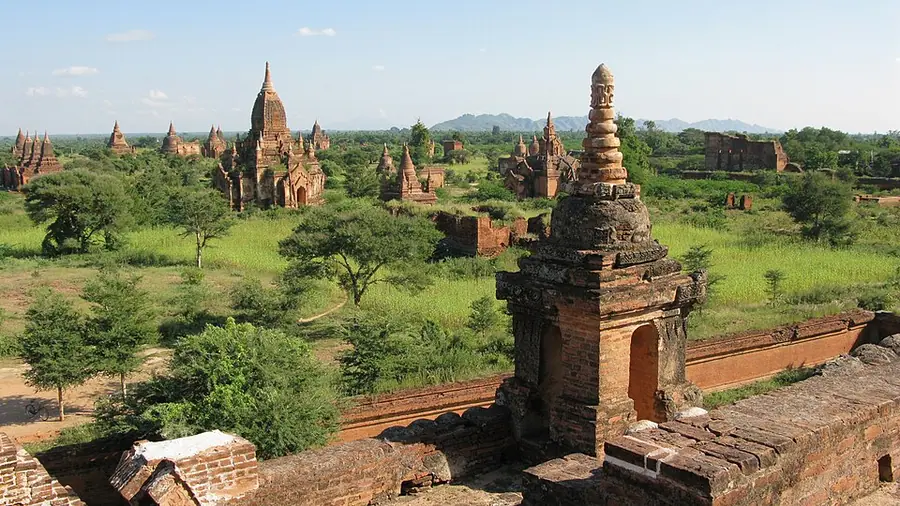
Burma had two early zones: the Pyu cities of the dry zone (Śrī Kṣetra, Halin, Beikthano) and the Mon coast of the south. From the eleventh century Pagan, on the middle Irrawaddy, became the centre, and its plain still carries more than two thousand brick monuments.[27]
Thailand and Laos passed from the Mon culture of Dvāravatī (central Thailand, sixth to ninth centuries) to the Tai kingdoms of Sukhothai, Lan Na (Chiang Mai) and Ayutthaya from the thirteenth century, and to Lan Xang on the Mekong in the fourteenth.
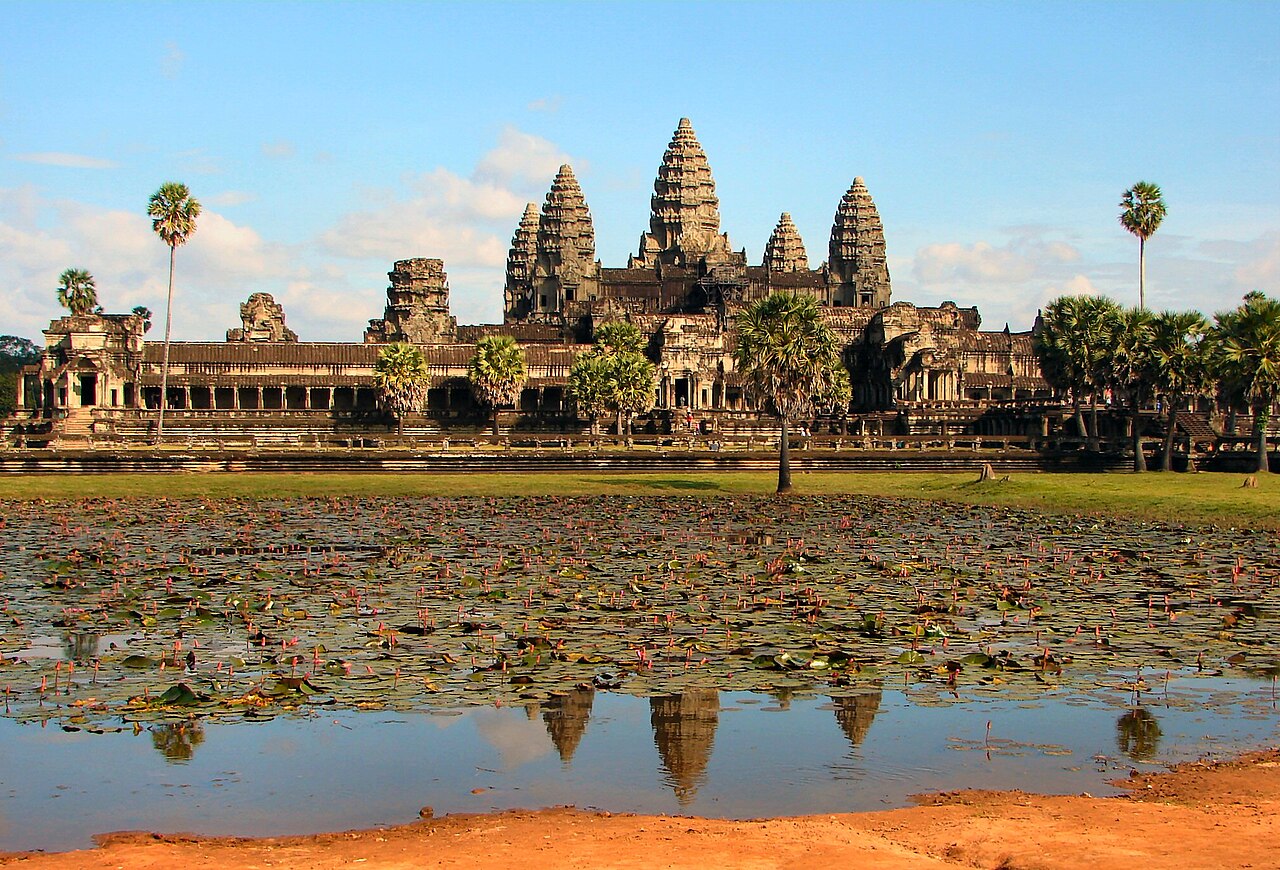
Cambodia was the Khmer empire of Angkor, which at its height in the twelfth century ruled much of the mainland and built its temples for Śiva, Viṣṇu and, under Jayavarman VII, the Buddha.
Java and Sumatra belong to the story as a contrast. The maritime power of Śrīvijaya (Sumatra) and the Śailendra kings of Java patronised Mahāyāna and later tantric Buddhism; their tradition did not become Theravāda and was largely replaced by Islam from the fifteenth century.
The evidence ledger for Theravāda Southeast Asia
| Dimension | What we can say | Evidence | Confidence |
|---|---|---|---|
| Doctrine | Defined by the Mahāvihāra commentaries more than by the canon alone | Buddhaghosa’s Visuddhimagga and commentaries; their central place in monastic learning[5][7] | Majority |
| Sri Lankan pluralism | Rival fraternities for a millennium, one open to Mahāyāna | Faxian’s monk counts; Xuanzang’s report; Abhayagiri archaeology[4][28][13] | Consensus |
| Early Southeast Asia | Mixed: Pali texts beside Sanskrit, Mahāyāna and Hindu cults | Śrī Kṣetra gold leaves; Borobudur; Angkor inscriptions; Yijing[8][11][10] | Consensus |
| Means of spread | Ordination lineages imported from Sri Lanka and backed by kings | Chapaṭa’s Sīhaḷa saṅgha; Kalyani inscriptions; Sukhothai’s forest monks[18][20] | Majority |
| Kingship | Kings as patrons and purifiers of the saṅgha | Parākramabāhu I’s code; Dhammazedi’s reordination[17][18] | Consensus |
| Language | Pali replaces Sanskrit as the sacred language; vernaculars rise beside it | Myazedi (1113); Cambodian Pali inscription of 1309[16][24] | Consensus |
| Women | The fully ordained nuns’ order disappears | Sri Lanka after 1017; Pagan inscriptions to the 13th c.[29] | Majority |
| Identity | “Theravāda” as a branch of Buddhism is a modern label | Pre-modern self-names: Mahāvihāra, Sīhaḷa saṅgha; the term spreads after 1950[1][2] | Majority |
Buddhaghosa and the commentaries: the lens on the canon
Theravāda reads the Pali canon through commentaries finalised in Pali in the fifth century, above all those attributed to Buddhaghosa. In practice the commentaries define the tradition as much as the canon does.
The Sri Lankan chronicle Cūḷavaṃsa tells Buddhaghosa’s story: a brahmin from near Bodh Gaya, converted to Buddhism, who came to Anurādhapura in the reign of King Mahānāma (early fifth century), proved his learning by writing the Visuddhimagga, and was then allowed to translate the old Sinhala commentaries into Pali.[6] The story is a later idealisation, written some eight centuries after the events, and parts of it (a miracle in which the gods hide his manuscript twice, so that he writes it three times identically) are hagiography. That an Indian scholar-monk worked at the Mahāvihāra in the fifth century and produced the Visuddhimagga is not in doubt.[7] A Mon and Burmese tradition instead has him born and dying at Thaton in Lower Burma; Coedès records it as a local legend, and historians follow the Sri Lankan evidence.[15] Majority
What he did matters more than who he was. The Mahāvihāra had kept commentaries in Sinhala since the canon was written down (§5). Buddhaghosa and his successors, Dhammapāla among them, recast them into Pali and harmonised them with Mahāvihāra orthodoxy. Not every commentary credited to Buddhaghosa is his; Oskar von Hinüber shows that the corpus is the work of several hands, under a famous name.[7] Majority The original Sinhala commentaries are lost, so the Pali versions became the only key to the canon’s difficult passages.
The Visuddhimagga itself is the most influential book in Theravāda after the canon: a single systematic map of the path, from ethics through concentration to wisdom, with forty meditation subjects and a full Abhidhamma account of mind and matter. Modern Burmese and Thai meditation teachers (§12) were trained on it.[30]
Primary sources
1. The verse that opens the Path of Purification
Buddhaghosa begins the Visuddhimagga by quoting a verse from the Saṃyutta Nikāya and announcing that his whole book is a commentary on it.
Visuddhimagga 1.1 (quoting SN 1.23), Pali:
sīle patiṭṭhāya naro sapañño, cittaṃ paññañca bhāvayaṃ; ātāpī nipako bhikkhu, so imaṃ vijaṭaye jaṭaṃ.
“A wise person grounded in ethics, / developing the mind and wisdom, / a keen and alert mendicant— / they can untangle this tangle.” (SN 1.23, trans. Bhikkhu Sujato.)[5]
What it proves. That the Theravāda path was systematised as a sequence, ethics (sīla), concentration (citta, i.e. samādhi) and wisdom (paññā), by building a whole curriculum on one canonical verse. The method is characteristic: the canon supplies the authority, and the commentary supplies the structure. Theravāda scholastic teaching has largely followed Buddhaghosa’s order ever since, though regional curricula and older meditation systems did not always do so.[31] Majority
2. Two kinds of elders: a pilgrim’s report
Xuanzang, Record of the Western Regions, book 11 (646 CE), on Sri Lanka, which he described from reports gathered in South India rather than a visit:
“The former, called the Mahāvihāravāsinas, was opposed to the Great Vehicle and adhered to the teaching of the Little Vehicle; the other was called Abhayagirivāsinas; they studied both vehicles, and widely diffused the Tripiṭakas.” (Trans. Samuel Beal, 1884, vol. 2, p. 247.)[28]
What it proves. That in the seventh century Sri Lanka’s monks were divided not into denominations but into fraternities with different attitudes to the same body of texts. Xuanzang calls both groups Sthaviras, “elders”: both are counted as one school. Two centuries earlier Faxian had described the Abhayagiri at length and counted it as the larger community.[4] The idea that Sri Lanka was always the home of a single, pure “Theravāda” comes from the Mahāvihāra’s own chronicles, written by the side that eventually won. Majority
3. A king unifies the saṅgha
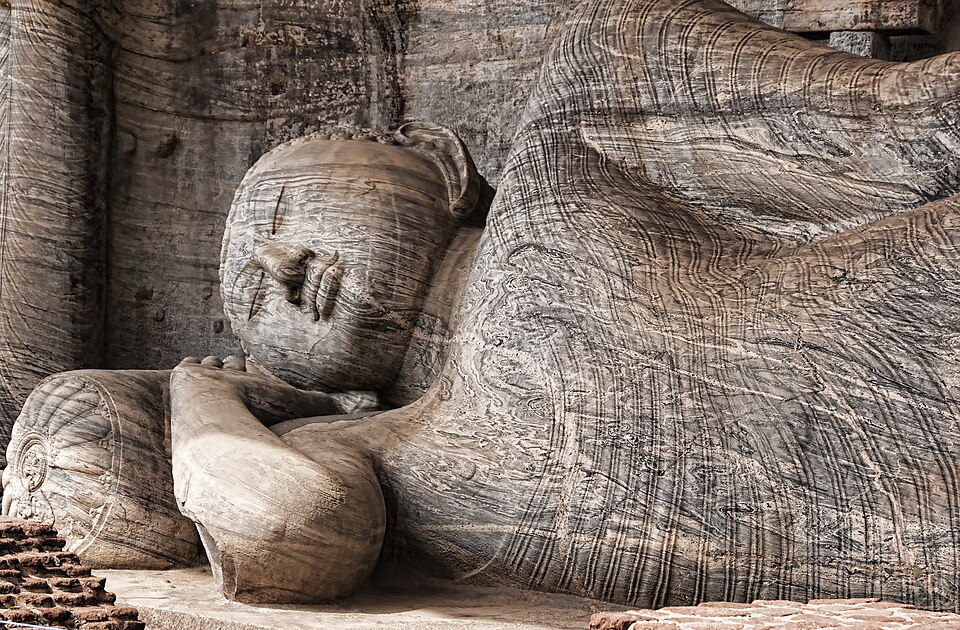
At Gal Vihāra in Polonnaruwa, beside the rock-cut Buddhas of King Parākramabāhu I (r. 1153–1186), an inscription records the king’s reform of the order. With the elder Mahākassapa of Dimbulāgala presiding, an assembly expelled monks judged corrupt, merged the three fraternities into one under the Mahāvihāra’s lineage, and issued a code of monastic conduct (katikāvata).[17]
What it proves. That the single Theravāda of Sri Lanka was created by royal action around 1165, not inherited unbroken from Mahinda. The Abhayagiri and Jetavana lineages ceased to exist as separate orders, and with them most of their literature. The model, a king calling a council to “purify the dispensation” (sāsana), became the standard way Theravāda kingdoms reformed and controlled their monks for the next seven centuries.[13] The reform also opened a burst of new Pali scholarship, which Alastair Gornall reads as the reformed order’s effort to protect the essence of the teaching against decline.[32] Consensus
4. Four languages at Pagan
The Myazedi inscription (1113 CE) records, on two pillars, the same text in four languages: Pali, Old Mon, Old Burmese and Pyu. Prince Rājakumār dedicates a golden Buddha image and a temple for the merit of his dying father, King Kyanzittha.[16]
What it proves. That Pagan in the early twelfth century was a court where Pali was the sacred language, Mon a learned language, Burmese the rising vernacular and Pyu the language of an older population still worth addressing. The inscription is also the key that allowed the Pyu script to be read. It shows the mix out of which Burmese Theravāda was made, and it shows that Mon learning was prestigious at Pagan without proving the conquest story told later (see Debates). Consensus
5. Sukhothai’s stone: fish, rice and monks
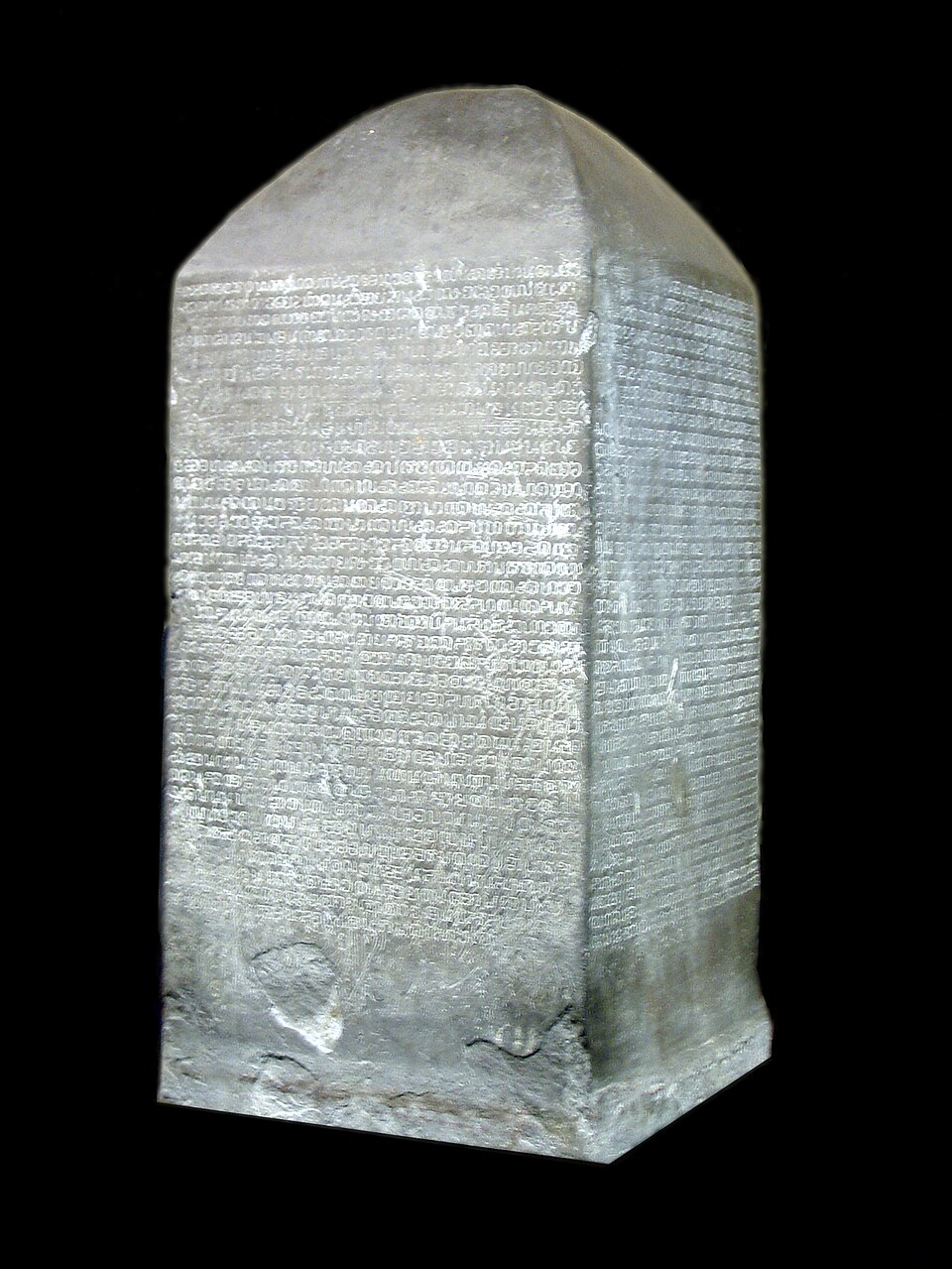
The Ram Khamhaeng inscription, a four-sided stele found in 1833 by the future King Mongkut and traditionally dated 1292, describes the Tai kingdom of Sukhothai. In A. B. Griswold and Prasert na Nagara’s translation:
“There is fish in the water and rice in the fields.”[21]
It goes on to describe a forest monastery built for the senior monk (saṅgharāja), “the sage who has studied the scriptures from beginning to end,” who has come from Nakhon Si Thammarat in the south, and a stone slab on which, on the four holy days of each month, a monk sits to preach to the laypeople who keep the precepts.[20]
What it proves. If the inscription is of its stated date, that Sukhothai’s Theravāda came through southern Thailand from Sri Lanka, in the form of learned and forest-dwelling monks with Sinhalese ordination, and that kings presented themselves as patrons of a lay Buddhism of precepts and holy days. Its authenticity has been seriously disputed (see Debates), which is why this chapter does not rest any claim on it alone. Contested
6. Reordaining a kingdom
The Kalyani inscriptions at Bago (Pegu), set up by King Dhammazedi between 1476 and 1479 in Pali and Mon, record that the king, himself a former monk, judged the ordinations of Lower Burma’s monks to be of doubtful validity because of sectarian divisions. He sent twenty-two senior monks to Sri Lanka, where they were reordained in the Mahāvihāra lineage on the Kalyāṇī river near Colombo, and on their return had the kingdom’s monks reordained through them in a newly consecrated boundary (sīmā).[18][33] The inscriptions also give a history of earlier missions, including Chapaṭa’s founding of a Sīhaḷa saṅgha at Pagan in the late twelfth century.
What it proves. That Theravāda unity was manufactured and remanufactured by ordination. Because a monk’s status depends on the validity of the chain of ordinations behind him, a king who controlled which chain counted could reshape the whole saṅgha. Sri Lanka served as the reference lineage, and the traffic in ordinations later ran the other way (see 1753, below). Consensus
7. A Chinese envoy at Angkor
Zhou Daguan, a Yuan envoy who spent eleven months at Angkor in 1296–97, wrote the only surviving eyewitness account of the Khmer capital. In his section on the “three doctrines” he describes three kinds of religious specialists: Brahmanical scholars, Śaiva ascetics and Buddhist monks. His description of the monks’ shaved heads and yellow robes, and of the images in their temples, is read by historians as the earliest outside record of Theravāda-style monks at Angkor. The surviving text is a shortened version of what he wrote, and he sometimes misunderstood what he saw, so it is used for what it shows in outline, not in detail.[23][34]
What it proves. That by the end of the thirteenth century monks who look like Theravāda monks were a familiar part of Angkorian life, beside Brahmanical priests and Śaiva ascetics, and the same king, Śrīndravarman (r. 1295–1307), left Cambodia’s oldest Pali inscription, dated 1309, two years after he abdicated and, in Coedès’s words, “retired into the forest”; it commemorates the building of a monastery (vihāra) and a Buddha image.[24][15] The conversion of Cambodia was a gradual change in practice and patronage, not a decree. Majority
Southeast Asia before Theravāda: a mixed world
Before the eleventh century there was no Theravāda Southeast Asia. There were Pali texts, Sanskrit texts, Mahāyāna monuments and Hindu temples, often in the same kingdom.
- The Pyu and Dvāravatī. The Śrī Kṣetra gold leaves (§0) and Pali inscriptions from Dvāravatī, often the “ye dhammā” verse summarising dependent origination, show that Pali-reciting Buddhism reached the mainland by the mid-first millennium. The same sites also yield Sanskrit inscriptions, bodhisattva images and Viṣṇu sculptures.[8][1] Consensus
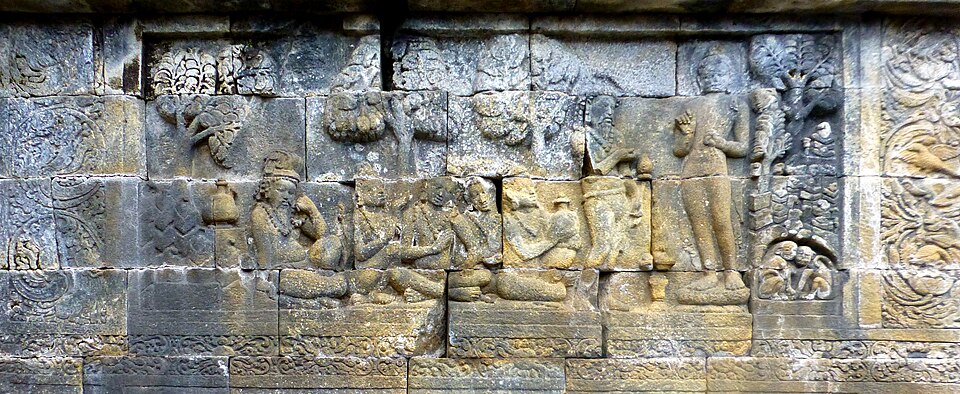
- Śrīvijaya and Java. The Chinese monk Yijing, who studied in Śrīvijaya in the 670s–690s, advised Chinese pilgrims to train there before going to India and reported that most monks of the “Southern Seas” followed the Mūlasarvāstivāda Vinaya, with Mahāyāna present among them.[10] Borobudur, built in Central Java around 780–830 (Jacques Dumarçay’s building sequence runs from about 780 to about 833; Coedès, from the script of short labels on its buried base, had put it no earlier than the mid-ninth century), is a three-dimensional Mahāyāna path: its galleries carry the Lalitavistara life of the Buddha (§2), Jātaka tales and the pilgrim Sudhana’s search in the Gaṇḍavyūha (§6), rising to rows of Buddhas in latticed stupas.[11][35][12][15] Consensus
- Angkor. The Khmer kings built for Śiva and Viṣṇu; Angkor Wat (twelfth century) is a Viṣṇu temple (Hinduism §8). Jayavarman VII (r. 1181–c. 1218) made Mahāyāna Buddhism the state cult, with the Buddha and the bodhisattva Lokeśvara at the centre of the Bayon. After him a Śaiva reaction defaced many Buddha images.[19] Consensus
The point is not that Theravāda was absent but that it was one strand among several. What changed after 1000 was the arrival of a self-conscious, exclusive Sri Lankan lineage with royal backing.
How Theravāda won the mainland
Theravāda became dominant on the mainland between the eleventh and fifteenth centuries through three mechanisms that reinforced one another: Sri Lankan ordination lineages, royal patronage and purification, and the decline of the alternatives.
Ordination lineages. The decisive export from Sri Lanka was not a text but a chain of valid ordinations. When Vijayabāhu I drove out the Cōḷas in the later eleventh century and found too few monks left to ordain new ones, he asked Pagan to send monks to restore the lineage. A century later the traffic reversed: Burmese, Mon, Thai and Khmer monks went to Sri Lanka, were reordained in the Mahāvihāra lineage, and came home to found “Sinhalese” fraternities, Chapaṭa’s at Pagan in the late twelfth century being the best documented.[18] Majority
Kingship. Theravāda gave kings a role and kings gave Theravāda a monopoly. The king as dhammarājā, righteous ruler, protected the saṅgha, supplied its needs and, when it was judged corrupt, purified it by expelling monks and reordaining the rest. In return the saṅgha legitimated the king as the greatest donor in the kingdom and the guarantor of the sāsana. The pattern runs from Parākramabāhu I through Dhammazedi to the Thai and Burmese kings of the nineteenth century.[25][31][36] Consensus
The decline of the alternatives. Mahāyāna and tantric Buddhism lost their Indian base as the great monasteries of Bihar and Bengal fell around 1200 (§8). The expensive state cults of Angkor depended on a court that was losing power. A village Buddhism of monks, merit-making and the monastery school, needing no great temples, suited the smaller Tai and Khmer kingdoms of the fourteenth century.[19] Majority
The disappearance of the nuns’ order
The fully ordained nuns’ order (bhikkhunī saṅgha), which according to the chronicles had come to Sri Lanka with Ashoka’s daughter Saṅghamittā, died out in the Theravāda world in the eleventh to thirteenth centuries and was not restored there for nearly a thousand years.
- Sri Lanka. Nuns appear in inscriptions and chronicles of the Anurādhapura period. After the Cōḷa conquest of 1017 they disappear from the record, and when Vijayabāhu I restored the monks’ lineage from Burma, no nuns’ lineage was restored with it.[37] Majority
- Burma. Than Tun’s study of Pagan inscriptions found nuns recorded as donors into the thirteenth century, against a later tradition that there had been none for many centuries.[29] Majority
The reason the loss was permanent is legal. The Vinaya requires a nun to be ordained by both a quorum of nuns and a quorum of monks. Once no Theravāda nuns remained, most authorities held that the order could not be revived without breaking the rules, and that ordination by East Asian nuns, whose lineage descends from a different Vinaya, would not count. Women continued to live as renunciants with eight or ten precepts, as mae chi in Thailand and thilashin in Burma, without full ordination. The modern revival and the argument over it belong to §13.[38][37] Consensus
1753: the lineage returns to Sri Lanka
By the eighteenth century the position of 1070 had reversed. Under Portuguese and Dutch rule of the coasts, and with the Kandyan kingdom in the interior weakened, Sri Lanka had once again lost a valid chain of higher ordination. At the urging of the novice Väliviṭa Saraṇaṃkara, King Kīrti Śrī Rājasiṃha of Kandy asked the king of Ayutthaya for help. In July 1753 a Siamese delegation led by the monk Upāli performed higher ordinations in Kandy, founding what became the Siam Nikāya, still the largest monastic fraternity on the island.[26][25] Consensus
The episode shows the system working as designed: the lineage that Sri Lanka had once exported came back to it from Thailand. It also shows its politics. Within about a decade the Siam Nikāya restricted higher ordination to men of the highest (goyigama) caste, and the fraternities founded in the nineteenth century, the Amarapura and Rāmañña Nikāyas, with ordinations from Burma, were formed partly by those it excluded (§12).[25] Majority
What is absent before 1000 CE
- A single Theravāda. Sri Lanka had three fraternities; Southeast Asia mixed Pali and Sanskrit Buddhism with Hindu cults. Consensus
- The word as a denominational label. “Theravāda” named the elders’ lineage and their interpretation, not a branch of a world religion. Majority
- Royal monopoly. Kings patronised several religions at once; the exclusive royal sponsorship of one Buddhist lineage comes later. Majority
- Pali as the only sacred language. Sanskrit dominated royal inscriptions in Cambodia until the fourteenth century (the last is dated 1327) and in Java throughout.[15] Consensus
- Mass lay meditation. Meditation was a monastic, often forest specialism; laypeople made merit through giving and precepts. The lay meditation movements are modern (§12).[30] Majority
Debates about Theravāda and Southeast Asia
Is “Theravāda” a modern invention?
Not the lineage, but the label. Peter Skilling shows that the word theravāda is rare in pre-modern sources and usually means “the doctrine of the elders” in the sense of the Mahāvihāra’s interpretation, not a branch of Buddhism; Southeast Asian monks more often called themselves members of the Sīhaḷa or Laṅkā lineage.[1] Todd Perreira traces the modern usage, “Theravāda Buddhism” as the name for the Buddhism of Sri Lanka and Southeast Asia in contrast to Mahāyāna, through European scholarship to its general adoption after the World Fellowship of Buddhists met in Ceylon in 1950, where it replaced the pejorative “Hīnayāna.”[2] The tradition is old; the category that makes it one of three “branches” is new. Against too sharp a break, others stress that a self-conscious, translocal tradition long predates the label: Steven Collins described a shared “Pali imaginaire” across Sri Lanka and mainland Southeast Asia, and Kate Crosby emphasises the continuity of lineage and practice beneath the modern name.[39][31] Majority
Did Anawrahta conquer Thaton and bring Theravāda to Pagan?
The Burmese chronicles tell how the Mon monk Shin Arahan converted Anawrahta, who then conquered the Mon kingdom of Thaton in 1057 to obtain its Pali scriptures and brought its king, monks and artisans to Pagan; George Coedès’s standard history accepted that account.[15] Michael Aung-Thwin argues that no contemporary inscription mentions Thaton or its conquest; the city first appears in the Kalyani inscriptions of 1479, and the full story only in U Kala’s chronicle of the early 1700s. He accepts that Anawrahta took Lower Burma but treats the Thaton narrative as a post-Pagan legend.[14] Critics answer that Mon cultural influence at Pagan is real, as the Mon inscriptions of Kyanzittha and the Myazedi pillars show, even if the conquest narrative is late.[16] The story is at minimum a later simplification of a slower process. Contested
Is the Ram Khamhaeng inscription a forgery?
In the late 1980s Michael Vickery argued that the stele, found by Mongkut in 1833, is not a genuine thirteenth-century source and was most probably written in the late eighteenth or early nineteenth century, pointing to anachronisms in script, vocabulary and content; Piriya Krairiksh went further and named Mongkut himself as the forger.[40] Others defended it on palaeographic and linguistic grounds, and physical analysis has been read as supporting an old date. The debate, collected in a volume of the Siam Society, has not been closed, and many scholars now treat the inscription as at least partly authentic.[22][20] Because it is the founding document of Thai national history, the argument has always had a political edge. Contested
Were the early schools rival churches?
No, and the Sri Lankan case shows why the idea arose. Faxian, Xuanzang and Yijing describe monks of different “vehicles” and schools sharing monasteries and Vinaya rules.[4][28][10] The picture of sharply bounded sects comes from the Mahāvihāra’s chronicles, which needed it: their account of the Third Council (§3), of Mahinda’s mission (§4) and of the Abhayagiri’s errors (§5) explains why one lineage was orthodox and the others were not. Modern scholars read those chronicles as partisan history, written by the Mahāvihāra long before it became the only fraternity in 1165, and later continued by its heirs.[41][13] Majority
Further reading
- Richard Gombrich, Theravāda Buddhism: A Social History (2nd ed., Routledge, 2006).
- Kate Crosby, Theravada Buddhism: Continuity, Diversity, and Identity (Wiley-Blackwell, 2014).
- Peter Skilling, “Theravāda in History,” Pacific World, 3rd series, 11 (2009).
- Peter Skilling et al., eds., How Theravāda is Theravāda? Exploring Buddhist Identities (Silkworm, 2012) — including Todd Perreira, “Whence Theravāda?”
- R. A. L. H. Gunawardana, Robe and Plough: Monasticism and Economic Interest in Early Medieval Sri Lanka (1979).
- Michael Aung-Thwin, The Mists of Rāmañña: The Legend That Was Lower Burma (2005).
- Ian Harris, Cambodian Buddhism: History and Practice (2005).
- Bhikkhu Ñāṇamoli, trans., The Path of Purification (Visuddhimagga) (1956).
References
- ^ a b c d e Peter Skilling "Theravāda in History". Pacific World, 3rd series, 11: 61–93, 2009. open access Shows how rarely and in what sense pre-modern sources use the word theravāda.
- ^ a b c Todd LeRoy Perreira "Whence Theravāda? The Modern Genealogy of an Ancient Term". In How Theravāda is Theravāda?, ed. P. Skilling et al., Silkworm Books, 2012. open library Traces 'Theravāda Buddhism' as a denominational label to the 20th century and the 1950 World Fellowship of Buddhists.
- ^ Mahāvaṃsa 33 — Mahāvaṃsa. c. 5th–6th c. CE. Pali. Vaṭṭagāmaṇi's defeat by a brahmin rebel and Tamil invaders, fourteen years of exile, his return, the founding of the Abhayagiri and the writing down of the texts. read the text
- ^ a b c d Faxian, Record of Buddhist Kingdoms — Foguo ji. c. 416 CE. Classical Chinese. The pilgrim's account of India c. 399–414, describing monasteries as Mahāyāna, non-Mahāyāna or mixed, and the two kinds of monks living side by side; he also stayed two years in Sri Lanka and counted the monks of its great monasteries. read the text
- ^ a b c Visuddhimagga 1.1 — Buddhaghosa. 5th c. CE. Pali. Buddhaghosa opens his Path of Purification by quoting SN 1.23, "a wise person grounded in ethics, developing the mind and wisdom", and builds the whole book on its three terms: ethics, concentration, wisdom. read the text
- ^ a b Cūḷavaṃsa 37 — Cūḷavaṃsa. c. 13th c. CE. Pali. The chronicle's life of Buddhaghosa: a brahmin from near Bodh Gaya who came to Anurādhapura under King Mahānāma, wrote the Visuddhimagga to prove his learning, and translated the Sinhala commentaries into Pali. read the text
- ^ a b c d Oskar von Hinüber A Handbook of Pāli Literature. De Gruyter, 1996. The standard reference on what the Pali canon is, when its parts were fixed and how the language relates to what the Buddha spoke.
- ^ a b c Śrī Kṣetra gold leaves — Khin Ba stupa, Myanmar. c. 5th–6th c. CE. Pali. Twenty gold leaves inscribed with Pali passages, buried in a reliquary at the Pyu city of Śrī Kṣetra. The oldest physical Pali texts, centuries older than any Pali manuscript. about
- ^ Robert L. Brown The Dvāravatī Wheels of the Law and the Indianization of South East Asia. E. J. Brill, Leiden, 1996. The study of Dvāravatī's stone dharma-wheels and what they show about Buddhism in first-millennium central Thailand.
- ^ a b c d Yijing, Account of Buddhism Sent from the Southern Seas — Nanhai jigui neifa zhuan. c. 691 CE. Classical Chinese. Mahāyāna and non-Mahāyāna monks keep the same Vinaya; those who worship bodhisattvas and read Mahāyāna sūtras are called Mahāyānists. The clearest contemporary statement that Mahāyāna was not a separate order. read the text
- ^ a b c Borobudur — Central Java. c. 780–830 CE. The Śailendra Mahāyāna monument: galleries carved with the Lalitavistara life of the Buddha, Jātakas and the Gaṇḍavyūha, rising to latticed stupas with seated Buddhas. about
- ^ a b Jacques Dumarçay Borobudur. Oxford University Press, Kuala Lumpur; trans. Michael Smithies, 1978. full text The architect's analysis of Borobudur's building phases, from about 780 to about 833.
- ^ a b c d e f g R. A. L. H. Gunawardana Robe and Plough: Monasticism and Economic Interest in Early Medieval Sri Lanka. University of Arizona Press, 1979. The economics behind the Mahāvihāra–Abhayagiri rivalry.
- ^ a b Michael Aung-Thwin The Mists of Rāmañña: The Legend That Was Lower Burma. University of Hawai'i Press, 2005. open access Argues the Thaton conquest and the Mon origin of Pagan's Theravāda are later legends. Open access.
- ^ a b c d e f g George Coedès The Indianized States of Southeast Asia. East-West Center Press, Honolulu; ed. Walter F. Vella, trans. Susan Brown Cowing, 1968. full text The classic narrative history: gives the chronicle account of Anawrahta and Thaton (pp. 149–50), the Thaton legend of Buddhaghosa (p. 63), Borobudur's date from its base inscriptions (p. 90), and Cambodia's first Pali (1309) and last Sanskrit (1327) inscriptions (p. 228).
- ^ a b c d Myazedi inscription — Pagan. 1113 CE. Pali, Old Mon, Old Burmese, Pyu. One text in four languages on two pillars: Prince Rājakumār dedicates a golden Buddha image for the merit of his dying father, King Kyanzittha. The key to reading Pyu. about
- ^ a b c Gal Vihāra inscription — Polonnaruwa. c. 1165 CE. Sinhala. Parākramabāhu I records his reform of the order: an assembly under the elder Mahākassapa expels corrupt monks, unites the three fraternities under the Mahāvihāra and issues a code of conduct (katikāvata). about
- ^ a b c d e f Kalyani inscriptions — Bago (Pegu). 1476–1479 CE. Pali and Mon. King Dhammazedi sends 22 senior monks to be reordained in the Mahāvihāra lineage on the Kalyāṇī river in Sri Lanka, then has Lower Burma's monks reordained through them; also records earlier missions such as Chapaṭa's. about
- ^ a b c Ian Harris Cambodian Buddhism: History and Practice. University of Hawai'i Press, 2005. The standard history, from Angkor's Hindu and Mahāyāna cults to Theravāda and beyond.
- ^ a b c d Ram Khamhaeng inscription — Sukhothai. 1292 CE (traditional; disputed). Old Thai. "There is fish in the water and rice in the fields" (Griswold and Prasert); a forest monastery for a saṅgharāja "who has studied the scriptures from beginning to end" and came from Nakhon Si Thammarat; a stone throne where monks preach on holy days. Authenticity debated since the 1980s. about
- ^ a b A. B. Griswold and Prasert na Nagara "The Inscription of King Rāma Gaṃhèn of Sukhodaya (1292 A.D.)" (Epigraphic and Historical Studies No. 9). Journal of the Siam Society 59, no. 2: 179–228, 1971. open library The standard annotated English translation of the Ram Khamhaeng inscription, made before the authenticity debate.
- ^ a b James R. Chamberlain, ed. The Ram Khamhaeng Controversy: Collected Papers. The Siam Society, 1991. Sixteen papers for and against the inscription's authenticity.
- ^ a b Zhou Daguan, The Customs of Cambodia — Zhenla fengtu ji. c. 1297–1312 CE. Classical Chinese. The only eyewitness account of Angkor (1296–97). Its section on the 'three doctrines' describes Buddhist monks beside Brahmanical scholars and Śaiva ascetics; the text survives in shortened form. about
- ^ a b c Wat Kok Svay Chek inscription (K. 754) — Angkor. 1309 CE. Pali and Khmer. The oldest Pali inscription in Cambodia, dated 1309 and attributed to King Śrīndravarman two years after his abdication in 1307; it commemorates the building of a vihāra and a Buddha image.
- ^ a b c d Richard Gombrich Theravāda Buddhism: A Social History. Routledge, 2nd ed., 2006. A social history of Theravāda from the Buddha to modern Sri Lanka: strong on the Brahmanical background, the monastic-royal compact and caste in the saṅgha.
- ^ a b Anne M. Blackburn Buddhist Learning and Textual Practice in Eighteenth-Century Lankan Monastic Culture. Princeton University Press, 2001. doi The history of Väliviṭa Saraṇaṃkara's movement and the founding of the Siyam Nikāya in 1753, including its court politics.
- ^ Bagan (Pagan) — Bagan Archaeological Zone, Myanmar. 11th–13th c. CE. The capital of the Pagan kingdom (1044–1287), where rulers and donors built thousands of temples, stupas and monasteries; the remains of over 2,000 temples and pagodas still stand on the plain. about
- ^ a b c Xuanzang, Record of the Western Regions 11 — Da Tang Xiyu ji. 646 CE. Classical Chinese. On Sri Lanka, from reports: the Mahāvihāra monks reject the Mahāyāna, while the Abhayagiri monks study both vehicles. Both groups are called Sthaviras. about
- ^ a b Than Tun The Buddhist Church in Burma during the Pagan Period, 1044–1287. PhD thesis, SOAS, University of London, 1955. Built on the Pagan inscriptions; documents nuns into the 13th century.
- ^ a b Erik Braun The Birth of Insight: Meditation, Modern Buddhism, and the Burmese Monk Ledi Sayadaw. University of Chicago Press, 2013. How lay meditation became a mass practice in colonial Burma.
- ^ a b c Kate Crosby Theravada Buddhism: Continuity, Diversity, and Identity. Wiley-Blackwell, 2014. Thematic introduction strong on lineage, kingship and the modern invention of 'Theravāda'.
- ^ Alastair Gornall Rewriting Buddhism: Pali Literature and Monastic Reform in Sri Lanka, 1157–1270. UCL Press, 2020. doi Shows how the reunified Sri Lankan order of the 12th–13th centuries produced a wave of new Pali learning meant to protect the teaching from decline. Open access.
- ^ Taw Sein Ko The Kalyani Inscriptions Erected by King Dhammaceti at Pegu in 1476 A.D.. Government Printing, Rangoon, 1892. Text and translation, made from palm-leaf copies after some stones were damaged.
- ^ Peter Harris, trans. Zhou Daguan, A Record of Cambodia: The Land and Its People. Silkworm Books, 2007. open library The first English translation from the Chinese rather than from Pelliot's French.
- ^ Lalitavistara — Lalitavistara Sūtra. c. 3rd c. CE, reworked later. Buddhist Hybrid Sanskrit. The life up to the first sermon, told as a cosmic drama. Its account of the palace youth and the four sights became the standard one across Mahāyāna Asia and the source for the Borobudur reliefs. read the text
- ^ S. J. Tambiah World Conqueror and World Renouncer: A Study of Buddhism and Polity in Thailand against a Historical Background. Cambridge University Press, 1976. Mongkut's reform, the Dhammayut and the 1902 Sangha Act.
- ^ a b Hiroko Kawanami "The Bhikkhunī Ordination Debate: Global Aspirations, Local Concerns, with Special Emphasis on the Views of the Monastic Community in Burma". Buddhist Studies Review 24, no. 2: 226–244, 2007. doi Surveys the history and the modern debate: the nuns' order lapsed in Sri Lanka in the 11th century and in Burma by about the 13th.
- ^ Bhikkhu Anālayo "The Revival of the Bhikkhunī Order and the Decline of the Sāsana". Journal of Buddhist Ethics 20, 2013. open library Examines the legal case for and against reviving Theravāda nuns' ordination, dual and single, and the fear that it would hasten the decline of the dispensation.
- ^ Steven Collins Nirvana and Other Buddhist Felicities: Utopias of the Pali Imaginaire. Cambridge University Press, 1998. Reads the Pali texts of Sri Lanka and Southeast Asia as one pre-modern imaginative world, the 'Pali imaginaire'.
- ^ Michael Vickery "Piltdown 3: Further Discussion of the Ram Khamhaeng Inscription". Journal of the Siam Society 83, nos. 1–2: 103–197, 1995. open library The sceptic's fullest statement: argues the inscription is not a genuine 13th-century source and was most probably written in the late 18th or early 19th century.
- ^ Bhikkhu Sujato Sects and Sectarianism: The Origins of Buddhist Schools. Santipada, 2006. Reads the schism stories critically and argues the early schools were divided more by geography and lineage than by doctrine.